Digital Dominates the Market & Old Methods Fall Behind1. Digital Transformation: Speed, Scalability, and Efficiency
Digital systems offer lightning-fast operations that traditional methods cannot match.
Where old systems depend on manual processes, paperwork, or physical presence, digital models operate instantly across the globe.
Speed
Transactions take seconds, from online banking to e-commerce checkout.
Supply chain decisions update in real time through sensors and AI dashboards.
Digital communication—emails, messaging, cloud collaboration—moves faster than traditional mail, memos, or in-person coordination.
Old methods, built on slower bureaucratic workflows, lose relevance when consumers and businesses expect instant outcomes.
Scalability
Digital platforms scale globally with minimal marginal cost.
A software company can serve millions without building new factories, whereas traditional businesses must invest heavily in infrastructure to grow.
This is why:
Digital streaming beats physical CDs and DVDs.
Online education reaches millions vs. classroom limits.
E-commerce expands without opening new stores.
Traditional models built around physical capacity struggle to expand at the same pace.
2. Data: The New Competitive Advantage
In the digital marketplace, data is the new oil—but more importantly, it becomes actionable instantly through analytics and AI.
How Digital Uses Data
Customer behavior tracking enhances precision marketing.
AI models predict demand, optimize pricing, and improve logistics.
Businesses personalize product recommendations—a feature impossible with old marketing tools.
Traditional methods like:
manual customer surveys,
limited market studies,
guess-based advertising,
cannot provide the accuracy or real-time insights needed for modern competition.
Because digital systems learn and adapt continuously, they grow more efficient over time, while old methods remain static.
3. Digital Consumer Behavior: Convenience Wins
Digital dominates markets because consumers have shifted online. Convenience is king.
What consumers now prefer:
Online shopping with home delivery
Digital payments over cash
OTT streaming over cable TV
Mobile banking over in-branch visits
Ride-hailing apps over traditional taxis
Food delivery apps over calling restaurants
Old methods fail because they require more effort, more time, and often more cost.
The demand for personalization
Algorithms tailor:
ads,
shopping experiences,
search results,
content recommendations.
Traditional one-size-fits-all approaches—newspapers, radio, physical catalogs—cannot match personalized digital experiences.
4. Automation and AI: Replacing Manual Workflows
Automation is a central reason digital dominates.
AI, machine learning, and robotic process automation reduce errors and costs while increasing throughput.
Digital automation examples:
Chatbots replacing customer service centers
AI underwriting replacing manual loan officers
Algorithmic trading outperforming human traders in speed
Robotic assembly lines increasing manufacturing efficiency
Smart warehouses with automated inventory systems
Old methods relying on manual labor or human-only operations lag because they are costly, slow, and prone to inconsistency.
5. Platform Economies Beat Traditional Business Models
Digital platforms like Amazon, Uber, Airbnb, and Google transformed markets by connecting millions of users through online ecosystems.
Advantages of digital platforms:
Zero inventory models (e.g., Uber owns no cars)
Low cost per additional user
Global user networks
Winner-take-all dynamics powered by data
Traditional industries with fixed assets, limited reach, and physical infrastructure cannot compete with the platform model’s efficiency.
6. Marketing: Digital Ads Crush Traditional Advertising
Advertising is one area where the shift is most obvious.
Digital marketing benefits:
performance tracking,
precise targeting,
retargeting,
demographic insights,
cost efficiency.
Platforms like Google Ads, Facebook Ads, and Instagram Reels allow businesses to reach exact audiences.
By contrast:
print ads,
billboards,
radio,
TV commercials
provide no precise data on who viewed or acted on the message.
Thus, traditional marketing budgets shrink every year as businesses migrate to digital channels.
7. Digital Finance & Payments Overtake Cash-Based Systems
FinTech has become one of the biggest disruptors.
Digital finance innovations such as:
UPI
e-wallets
algorithmic credit scoring
digital lending
automated KYC
blockchain transactions
are outcompeting traditional banking models.
Old cash-heavy methods or manual paperwork-based banking slow down transactions, increase risk, and limit accessibility.
Digital finance, being efficient, borderless, and transparent, dominates modern monetary flows.
8. E-Commerce and the Fall of Traditional Retail
E-commerce has redefined how people shop.
Digital advantages:
24/7 availability
more product variety
faster price comparison
personalized recommendations
doorstep delivery
easy returns and refunds
Traditional retail, despite offering physical experience, struggles with:
limited store hours,
higher operational costs,
smaller inventory,
regional restrictions.
Digital-first retailers with online-only models take the lead.
9. Remote Work & Cloud Systems Replace Traditional Office Models
The digital workplace has become dominant.
Digital tools:
Zoom, Google Meet
Slack, Teams
Cloud storage
Virtual project management tools
enable businesses to collaborate without needing physical offices.
Old workplaces requiring physical presence are falling behind due to:
higher real estate costs,
long commutes,
reduced flexibility.
Digital work increases productivity and widens talent pools globally.
10. Innovation Cycles: Digital Evolves Faster
Digital technology evolves at breakneck speed.
Every year brings:
faster processors,
smarter algorithms,
new apps,
improved networks,
enhanced automation.
Traditional industries, requiring physical upgrades, machinery, or labor restructuring, cannot update at the same pace.
Thus, over time, digital companies innovate exponentially while old industries evolve linearly—creating an ever-widening gap.
Conclusion: The Digital Wins Because It Is Faster, Smarter, Cheaper, Global
Digital methods dominate because they:
scale rapidly,
rely on data,
adapt through AI,
offer personalization,
reduce cost,
improve convenience,
operate globally with minimal friction.
Old methods fall behind because they:
depend on slower manual workflows,
require physical presence,
lack real-time data,
cannot personalize experiences,
involve higher costs and limited reach.
In today’s hyperconnected world, digital is not just an alternative—it is the primary driver of global markets. Old methods still exist, often for tradition or regulatory reasons, but their influence continues to shrink. The future belongs to systems that can evolve quickly, use data intelligently, and meet consumers’ expectations for instant, frictionless service. Digital does all this—and more—ensuring it remains the dominant force shaping the global economy.
Forexmarket
Global Trade and Its Impact: A Comprehensive AnalysisEconomic Impacts of Global Trade
At the core, global trade acts as a catalyst for economic growth. By allowing countries to specialize in the production of goods and services where they have a comparative advantage, trade promotes efficiency and productivity. For instance, countries with abundant natural resources can focus on extraction and export, while those with advanced manufacturing capabilities concentrate on producing high-value goods. This specialization leads to lower production costs, greater product variety, and higher overall economic output.
Trade also contributes to economic diversification. For developing countries, exporting a range of goods reduces reliance on a single sector and mitigates economic risks associated with commodity price fluctuations. For developed economies, imports provide access to raw materials, advanced technologies, and cheaper consumer goods, enhancing competitiveness. Moreover, global trade stimulates foreign direct investment (FDI), as companies establish operations abroad to access new markets, which, in turn, creates jobs and fosters economic development.
However, the economic impact of trade is not uniformly positive. While aggregate national income may rise, certain sectors and communities may face disruptions. Industries unable to compete with imported goods may decline, leading to unemployment and regional economic disparities. Additionally, excessive dependence on global markets can expose countries to external shocks, such as global recessions or supply chain disruptions, as witnessed during the COVID-19 pandemic.
Social and Labor Impacts
Global trade significantly influences labor markets and societal structures. By opening new markets and stimulating economic growth, trade creates employment opportunities across sectors. Export-oriented industries often provide higher wages and skill development opportunities. International companies operating in multiple countries also contribute to knowledge transfer, training local workforces, and raising labor standards.
On the other hand, trade can exacerbate social inequalities. Workers in industries exposed to international competition may face wage stagnation or job losses. The shift of manufacturing to countries with lower labor costs, often called “offshoring,” has led to declining industrial employment in certain developed economies, causing social and political tensions. In developing nations, while trade can lift millions out of poverty, it may also lead to exploitative labor practices if regulatory frameworks are weak.
Global trade also fosters cultural exchange. Exposure to foreign goods, services, and media enables the spread of ideas, lifestyles, and technologies, influencing societal values and consumption patterns. While this cultural interconnection promotes understanding and innovation, it may also challenge local traditions and cultural identities, leading to debates over cultural homogenization.
Technological and Innovation Impacts
One of the less immediately visible but highly transformative impacts of global trade is technological advancement. Trade encourages competition, compelling firms to innovate to maintain market share. Access to international markets allows companies to scale up production, invest in research and development, and adopt best practices from other countries. Technology transfer often accompanies trade, as multinational corporations introduce advanced processes, machinery, and management practices to host countries.
For example, the proliferation of information and communication technologies (ICT) in developing countries has been facilitated by global trade, enabling digital services, e-commerce, and global connectivity. Furthermore, trade in high-tech goods, such as semiconductors, medical equipment, and renewable energy technology, accelerates the diffusion of innovation globally, contributing to economic development and environmental sustainability.
Environmental Impacts
While global trade boosts economic growth, it also has environmental consequences. Increased production and transportation of goods contribute to carbon emissions, resource depletion, and ecological degradation. The demand for agricultural products, minerals, and manufactured goods often leads to deforestation, overfishing, and industrial pollution. Moreover, the carbon footprint associated with global supply chains has become a pressing concern, prompting discussions on “green trade” and sustainable practices.
On the positive side, trade can facilitate the dissemination of environmentally friendly technologies. Countries can import renewable energy equipment, pollution-control technologies, and sustainable agricultural practices, helping to mitigate environmental challenges. International agreements and trade policies increasingly incorporate environmental standards, promoting responsible trade practices that balance economic growth with ecological preservation.
Geopolitical and Strategic Impacts
Global trade is closely linked to geopolitics. Countries that dominate trade in critical goods, such as energy, rare minerals, and advanced technology, wield significant strategic influence. Trade relationships can foster diplomatic cooperation, strengthen alliances, and reduce the likelihood of conflict by creating mutual economic dependencies. Conversely, trade disputes, tariffs, and sanctions can become tools of geopolitical leverage, shaping international relations.
Trade also contributes to regional integration. Organizations like the European Union, ASEAN, and NAFTA (now USMCA) exemplify how trade can promote regional stability, harmonize regulations, and create large economic blocs capable of influencing global markets. However, overreliance on a few trading partners can increase vulnerability to political and economic pressures, highlighting the need for diversified trade strategies.
Globalization, Inequality, and Policy Challenges
Global trade is a driving force behind globalization, connecting economies, societies, and cultures. It has lifted millions out of poverty, expanded consumer choice, and spurred innovation. However, it has also intensified inequality, both within and between nations. Wealthier countries and multinational corporations often capture the lion’s share of trade benefits, while poorer nations may struggle to move up the value chain.
Policymakers face the challenge of maximizing trade benefits while mitigating negative impacts. Trade agreements, tariffs, and subsidies must be designed to protect vulnerable industries and labor forces. Social safety nets, skills training, and investment in infrastructure are essential to ensure that trade-driven growth is inclusive. Furthermore, international cooperation is critical to addressing environmental impacts, labor standards, and fair competition.
Conclusion
In summary, global trade is a double-edged sword with profound and multifaceted impacts. Economically, it promotes growth, efficiency, and diversification, but can disrupt local industries. Socially, it generates jobs and facilitates cultural exchange, yet can exacerbate inequality. Technologically, trade drives innovation and knowledge transfer, while environmentally, it poses both challenges and opportunities. Geopolitically, trade shapes alliances, strategic dependencies, and regional integration.
The ultimate impact of global trade depends on the policies, governance, and strategies implemented by nations. When managed effectively, trade can be a powerful engine for sustainable development, economic prosperity, and international cooperation. Conversely, neglecting its social, environmental, and political dimensions can exacerbate inequality, environmental degradation, and geopolitical tensions. As the world continues to navigate the complexities of globalization, understanding and leveraging the impact of global trade remains essential for shaping a more equitable and prosperous future.
EUR/NZD Builds Bullish Structure – Will Buyers Dominate?💶💚 EUR/NZD “EURO VS KIWI DOLLAR” — Profit Pathway Setup (Day Trade)
🎯 Market Bias:
Bullish momentum confirmed ✅ following a 786 LSMA breakout, showing potential continuation strength on intraday structure.
🧩 Entry Plan (Layering Strategy Style)
This setup uses a layered entry method (multi-limit strategy) to build position strength on pullbacks.
🟢 Buy Limits: 2.01000 / 2.01200 / 2.01400
(You can increase or fine-tune limit layers based on your risk management plan.)
💡 This approach helps catch liquidity dips before the main impulse move.
🛡️ Stop Loss:
📍 “Thief SL” positioned at 2.00800 — designed for tight risk control within short-term volatility.
⚠️ Note: Fellow traders (Thief OG’s 👀), this is not financial advice — you may adjust SL as per your personal plan. Trade smart, take money, move clean.
🎯 Target Zone (Police Barricade Ahead!)
🚧 2.03000 is marked as our resistance checkpoint — an area of previous overbought pressure and liquidity traps.
Plan to secure profits once price approaches this zone.
⚠️ Again — you’re the boss of your take-profit. My setup, your decision!
🧠 Technical Context & Market Insight
LSMA breakout above 786 retracement confirms bullish bias.
RSI mid-zone recovery supports upward momentum.
MACD histogram crossover indicates renewed buying pressure.
Watch for volatility spikes during London & NY overlap session.
🔗 Correlated Pairs to Watch
💷 $GBP/NZD → Similar Kiwi reaction strength; strong upward momentum often mirrors EUR/NZD.
💶 $EUR/AUD → Positive correlation; Euro performance gauge.
💵 $USD/NZD → Inverse bias; weakness in Kiwi could strengthen this play.
💸 $AUD/NZD → Regional flow confirmation; helps validate Kiwi strength/weakness patterns.
Monitoring these can provide inter-market confirmation before scaling in or adding layers.
✨ “If you find value in my analysis, a 👍 and 🚀 boost is much appreciated — it helps me share more setups with the community!”
🔖 #EURNZD #Forex #DayTrading #PriceAction #EUR #NZD #TradingView #TechnicalAnalysis #ThiefStrategy #BullishSetup #MarketInsights #LSMABreakout #SwingTrading #TradePlan #LiquidityZones #ForexTrader #RiskManagement
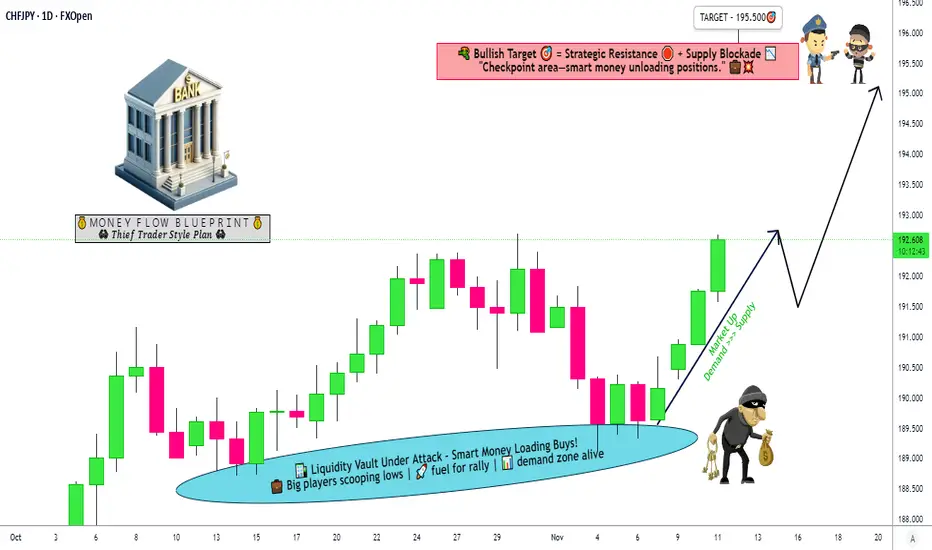
CHF/JPY Trade Guide – Targeting the Next Resistance ZoneCHF/JPY "SWISS VS YEN"
Forex Swing Trade Opportunity Guide | Bullish Scenario
📊 TRADE SETUP AT A GLANCE
Asset: CHF/JPY | Timeframe: Swing Trade | Bias: BULLISH ↗️
Risk/Reward: Premium Setup | Strategy: Layered Entry Method
📍 ENTRY STRATEGY: "THIEF LAYERING METHOD"
Multiple Limit Order Entries (Smart Accumulation)
Deploy your capital across 5 strategic price layers for optimal risk management:
🎯 Layer 1: Entry @ 190.000 (20% allocation)
🎯 Layer 2: Entry @ 190.500 (20% allocation)
🎯 Layer 3: Entry @ 191.000 (20% allocation)
🎯 Layer 4: Entry @ 191.500 (20% allocation)
🎯 Layer 5: Entry @ 192.000 (20% allocation)
💡 Pro Tip: Adjust layers based on your account size & risk tolerance. This method averages your entry and reduces emotional trading.
🛑 STOP LOSS: "PROTECTION PROTOCOL"
SL Level: 189.000
⚠️ IMPORTANT: This is a suggested level ONLY.
👑 Thief OG's Rule: Adjust your SL based on YOUR strategy, account size, and personal risk management. This is YOUR decision.
🎯 TARGET: "POLICE BARRICADE BREAKOUT"
TP Level: 195.500
Why This Target? 🔍
Strong Resistance Zone identified at 195.500
Overbought Conditions present in upper range
Profit Trap Warning: Market shows reversal signals at this level
Smart Exit: Lock in gains before the police barricade stops the rally
🚨 CRITICAL NOTE: This TP is suggested guidance ONLY.
👑 Thief OG's Rule: Your profit target is YOUR choice. Take profits at levels comfortable with YOUR risk tolerance. Remember: Secured profits > Unrealized gains.
📈 RISK MANAGEMENT CHECKLIST
✅ Start with 1-2 layers to test the setup
✅ Scale into remaining layers as price confirms direction
✅ Move SL to breakeven after 2-3% profit
✅ Take partial profits at 50% of target
✅ Trail your remaining position for maximum gains
🔗 RELATED PAIRS TO WATCH (CORRELATION ANALYSIS)
FX:USDJPY (Strong Positive Correlation with CHF/JPY)
Why It Matters: Both are JPY pairs. If USD/JPY rallies, CHF/JPY typically follows
Key Point: USD strength = CHF strength against JPY
Watch For: When USD/JPY breaks resistance, CHF/JPY momentum accelerates
Current Setup: Bullish USD/JPY aligns with your CHF/JPY long bias
OANDA:EURJPY (Moderate Positive Correlation)
Why It Matters: EUR and CHF move together; both USD proxies
Key Point: EUR strength supports CHF strength
Watch For: If EUR/JPY stalls, CHF/JPY may face headwinds
Risk Alert: EUR weakness = potential CHF/JPY reversal signal
USD/CHF (Inverse Correlation)
Why It Matters: Inverse pair to your setup
Key Point: If USD/CHF drops, CHF/JPY rises (inverse logic)
Watch For: USD/CHF support breaks = CHF strength confirmation
Confirmation Tool: Use for entry validation
FX_IDC:CHFUSD (Direct Correlation)
Why It Matters: Shows pure CHF strength vs USD
Key Point: CHF/USD rally = CHF/JPY bullish confirmation
Watch For: Break above key resistance = continuation signal
Quick Check: Fast confirmation of CHF bullish bias
JPY Index (Inverse Correlation)
Why It Matters: Measures JPY weakness across all pairs
Key Point: When JPY weakens, CHF/JPY rallies
Watch For: JPY index breakdown = CHF/JPY tailwind
Macro Signal: Broader JPY weakness supports your trade
⚡ EXECUTION SUMMARY
Step 1: Place 5 buy limit orders at layered prices (190.000 → 192.000)
Step 2: Set SL at 189.000 (adjust to your preference)
Step 3: Target TP at 195.500 (adjust to your preference)
Step 4: Monitor correlated pairs (USD/JPY, EUR/JPY, CHF/USD)
Step 5: Manage risk aggressively — your account, your rules
👑 Thief OG's Philosophy: Make money on YOUR terms. Take profits at YOUR pace.
Last Updated: Real-Time Market Conditions
Follow for more strategic swing trade setups! 📈
CAD/JPY at Key Weighted Support – Is the Next Wave Up?💹 CAD/JPY – Bullish Layer Trap Setup | Weighted Power Play! 💥
Asset: CAD/JPY (Canadian Dollar vs Japanese Yen)
Market Type: Forex Market Profit Pathway Setup (Swing / Day Trade)
🎯 Plan: The Bullish Thief’s Weighted Move
The bullish plan is confirmed after a Weighted Moving Average (WMA) pullback — a classic thief-style momentum catch! 😎
We’re stalking the zone where price respects the WMA curve and bounces higher, hinting a continuation to the upside.
💡 Why Weighted MA?
Because it gives sharper precision and reacts faster to price volatility, giving us the edge in timing our entries before the crowd jumps in.
💰 Entry Zone (Layer Strategy Style)
The Thief Strategy uses a layered limit order entry method — stacking multiple buys to average a prime position during pullbacks:
Buy Limit Layers: 108.000 | 108.200 | 108.400 | 108.600
(You can adjust or add more layers based on your risk appetite)
🛡️ Stop-Loss: @ 107.700 (Thief SL Zone)
📈 Target Zone: @ 110.200 – 110.500
🧠 Trade Logic & Insight
🔹 Why Bullish?
The recent momentum shows buyers defending key structural lows near 108.000.
Weighted MA crossover supports bullish momentum continuation, backed by strong CAD fundamentals and stable oil prices (CAD often correlates positively with crude).
🌐 Correlated Pairs to Watch
💵 USD/JPY: Similar JPY-side weakness can confirm CAD/JPY upside.
💰 CAD/CHF: Often mirrors CAD strength in risk-on sentiment.
🛢️ XTI/USD (WTI Crude Oil): Rising oil prices can fuel CAD gains, providing extra confirmation for bullish CAD/JPY bias.
⚠️ Notes from the Thief OG’s Desk
Dear Ladies & Gentlemen (Thief OGs) — this setup is my personal style of entry planning.
Not a recommendation. You’re the driver — your profit, your risk, your rulebook! 📜
Police barricade near 110.500 is a trap zone — act smart, escape with profits before the correction hits.
Always manage risk wisely and use your judgment — that’s the real thief’s code! 🕶️
✨ If you find value in my analysis, a 👍 and 🚀 boost is much appreciated — it helps me share more setups with the community!
⚖️ Disclaimer
This is a Thief-style trading strategy shared just for fun and educational purposes.
Not financial advice — trade responsibly and always do your own analysis.
🔖 #CADJPY #Forex #SwingTrade #DayTrade #ThiefStrategy #TechnicalAnalysis #FX #WMA #WeightedMovingAverage #CAD #JPY #ForexSetup #RiskManagement #TradingCommunity #TrendTrader
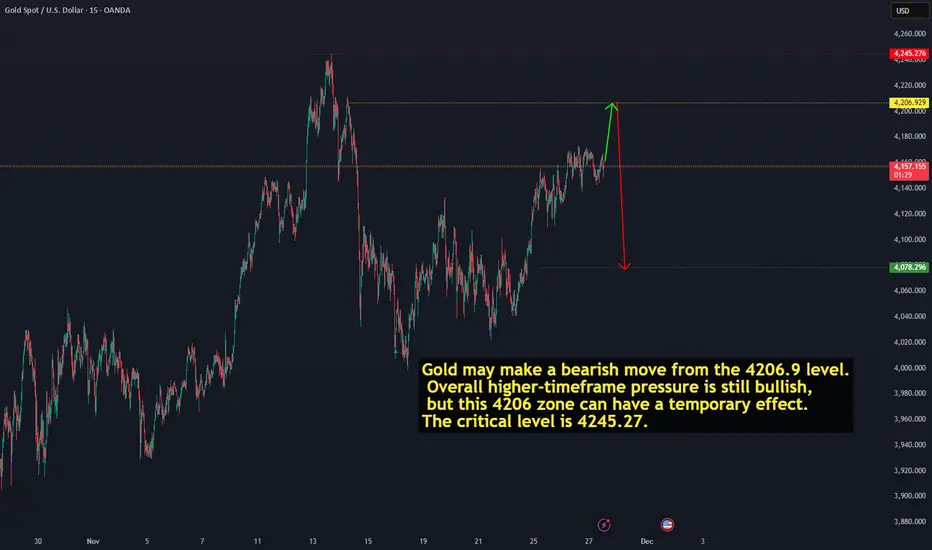
XAUUSD – Weekly Analysis & Trade ScenarioPrice is currently trading above a weekly Fair Value Gap (FVG) that aligns with the previous weekly low, forming a strong demand zone.
As long as price stays above this zone, the market structure remains bullish.
Best Scenario:
I’m looking for a retest of the weekly FVG to confirm demand. If price taps back into this imbalance and shows rejection, that would be the ideal long entry.
Trade Idea:
Entry: Inside the weekly FVG
Bias: Buy from demand
Target: Sweep the Weekly High above (major liquidity pool)
Invalidation: A clean break below the weekly FVG
This setup anticipates a retracement ↓ into demand, followed by a continuation ↑ to take liquidity.
The Impact of Corporations on Global Trade1. Corporations as Engines of Trade Expansion
Corporations, especially MNCs, are central to the expansion of global trade. These organizations operate in multiple countries, producing and selling goods and services on a scale that often surpasses the capacity of national economies. By establishing subsidiaries and joint ventures in foreign markets, corporations increase trade flows both in imports and exports. For instance, a technology company headquartered in the United States may source components from Japan, manufacture products in China, and sell them across Europe, effectively linking multiple economies through a single corporate network. This activity not only boosts trade volumes but also diversifies market opportunities for smaller businesses that supply inputs to these corporations.
2. Supply Chain Integration and Global Value Chains
A critical way in which corporations impact global trade is through the development of global supply chains and value chains. Modern production processes are fragmented across nations, allowing corporations to optimize costs, access specialized skills, and leverage comparative advantages. For example, automotive companies often design vehicles in Europe, manufacture engines in Germany, assemble components in Mexico, and distribute finished products worldwide. These intricate supply chains have led to the emergence of Global Value Chains (GVCs), where value is added in different stages across multiple countries. This fragmentation increases cross-border trade in intermediate goods and services, significantly expanding global trade volumes.
3. Technology Transfer and Knowledge Dissemination
Corporations are key conduits of technology and knowledge transfer across borders. When a corporation invests in a foreign country, it often brings advanced production techniques, management practices, and innovation capabilities. This transfer of technology boosts the productivity and competitiveness of the host country, indirectly influencing trade by enhancing export potential. For example, foreign direct investment (FDI) by high-tech corporations in developing economies can enable local firms to adopt modern technologies, facilitating the production of export-quality goods and services. Consequently, corporations not only trade goods but also foster skill development and technological upgrading globally.
4. Market Creation and Consumer Demand Expansion
Corporations also shape global trade by creating new markets and stimulating consumer demand. Through strategic marketing, product localization, and brand recognition, corporations expand the reach of their products to international markets. This expansion often encourages other domestic and international suppliers to enter these markets, increasing trade activity. For instance, the entry of multinational consumer goods companies into emerging economies often introduces a range of new products and stimulates imports of raw materials, packaging, and equipment. This effect extends beyond mere consumption—it establishes long-term trade relationships between suppliers and corporate buyers worldwide.
5. Influence on Trade Policy and International Regulations
Large corporations often influence global trade policies and regulations. Through lobbying, strategic partnerships, and participation in international organizations, corporations can affect trade agreements, tariffs, and standards. For example, tech giants may lobby for reduced tariffs on electronic goods or for harmonized digital standards, thereby facilitating smoother cross-border trade. Their influence can also shape regulatory frameworks regarding intellectual property, environmental standards, and labor practices, which in turn affect how trade flows are structured globally. While this can accelerate trade liberalization, it may also create challenges for smaller firms that cannot navigate complex regulatory environments.
6. Economic Impact and Market Competition
Corporations’ impact on global trade extends to economic growth and market competition. By expanding into new markets, corporations generate employment, contribute to tax revenues, and foster industrial development. Increased competition from multinational entrants can encourage local firms to innovate and improve efficiency, raising the overall competitiveness of industries in different countries. However, this dominance can also concentrate market power, leading to monopolistic practices that may distort trade and limit benefits for smaller players. The balance between stimulating trade and maintaining fair competition is a critical aspect of corporate influence on the global economy.
7. Challenges and Criticisms
Despite their positive contributions, corporations’ role in global trade is not without criticism. Critics argue that MNCs can exacerbate economic inequality by extracting resources from developing nations without sufficient local reinvestment. They may exploit labor and environmental regulations to minimize costs, leading to social and ecological consequences. Additionally, the dominance of a few large corporations in key sectors, such as technology or pharmaceuticals, can limit market access for smaller firms and distort trade dynamics. Trade imbalances may also arise if corporations disproportionately favor production in low-cost countries while concentrating profits in high-income regions. Addressing these challenges requires international cooperation, responsible corporate governance, and equitable trade policies.
8. Future Trends and Evolving Corporate Roles
The role of corporations in global trade is evolving in response to technological innovation, geopolitical shifts, and sustainability concerns. The rise of digital platforms and e-commerce enables even small and medium-sized enterprises (SMEs) to engage in cross-border trade, challenging the traditional dominance of large corporations. Sustainability initiatives are pushing corporations to consider environmental and social factors in supply chains, potentially reshaping trade patterns toward greener practices. Moreover, geopolitical tensions, trade wars, and regional trade agreements are influencing corporate decisions on production locations and supply chain management, reflecting a more complex and strategic approach to global trade.
Conclusion
Corporations, particularly multinational ones, are fundamental drivers of global trade. They expand markets, integrate supply chains, transfer technology, and shape consumer demand, all of which amplify international trade flows. At the same time, they wield significant influence over trade policies and economic structures, generating both opportunities and challenges for global markets. While their operations contribute to economic growth and innovation, they also raise concerns regarding inequality, environmental impact, and market concentration. Understanding the multifaceted impact of corporations on global trade is essential for policymakers, businesses, and international organizations seeking to foster equitable, sustainable, and efficient trade systems. As global commerce continues to evolve, the role of corporations will remain central, shaping not only the movement of goods and services but also the broader economic landscape of the 21st century.
The Impact of Multinational Corporations (MNCs) on Trading1. Driving International Trade Growth
MNCs are major engines of global trade. By establishing operations in multiple countries, they create a demand for goods, services, and capital across borders. Their activities often lead to the creation of intricate global supply chains where raw materials, intermediate goods, and finished products move seamlessly between countries. For example, an automobile company headquartered in Germany may source parts from Japan, assemble vehicles in Mexico, and sell them in the United States. This not only increases the volume of trade but also diversifies trade patterns, creating new economic linkages between nations.
MNCs often promote exports from developing countries by investing in local manufacturing plants. This stimulates local economies, generates employment, and enables these countries to integrate into global markets. Countries like China, Vietnam, and India have benefited significantly from MNC-led trade, seeing their export sectors expand dramatically due to foreign direct investment (FDI) from multinationals.
2. Influence on Market Structure and Competition
MNCs can reshape trading markets by altering competitive dynamics. Their size, access to advanced technology, and global networks give them a competitive advantage over domestic firms. This can create efficiencies in production, logistics, and distribution, often resulting in lower costs for consumers. For instance, multinational retail corporations like Walmart or Amazon leverage economies of scale to offer goods at prices that domestic competitors may struggle to match.
However, MNC dominance can also lead to market concentration, where a few large players control significant shares of certain markets. This has implications for trade policies, as governments may feel pressured to create favorable conditions for MNCs to attract investment, sometimes at the expense of local businesses. Thus, while MNCs enhance efficiency and expand trade, they can also introduce competitive challenges for smaller domestic firms.
3. Shaping Global Supply Chains
The operations of MNCs often dictate global supply chain structures, which have a direct impact on trading patterns. Companies like Apple, Samsung, and Toyota rely on a network of suppliers and manufacturers spread across continents. These supply chains facilitate the cross-border movement of intermediate goods, raw materials, and components, which in turn drives international trade.
Moreover, MNCs play a critical role in setting global standards for quality, production, and logistics. By enforcing uniform standards across their global operations, they encourage trading partners to adopt similar practices, thereby enhancing trade efficiency and reliability. However, dependence on MNC-driven supply chains can also create vulnerabilities. For example, disruptions in one region—like a natural disaster or geopolitical tension—can impact global trade flows significantly, as seen during the COVID-19 pandemic when supply chains were severely affected.
4. Technological Transfer and Innovation in Trade
MNCs are often at the forefront of technological innovation. Through their international operations, they transfer knowledge, skills, and technologies to host countries, impacting trading patterns. For instance, a multinational in the electronics sector may establish a research and development (R&D) center in a developing country, equipping local talent with advanced technological know-how. This technology transfer often enhances local production capabilities, enabling these countries to produce goods for export that meet international standards.
Additionally, MNCs introduce advanced management practices, logistics solutions, and production techniques, which improve efficiency and productivity in trade operations. Over time, these innovations contribute to the growth of trade volumes and the development of competitive export sectors in host countries.
5. Impact on Foreign Exchange and Financial Markets
MNCs’ global operations have a significant influence on currency markets and international finance. Their cross-border transactions in goods, services, and capital flows impact foreign exchange demand and supply. For instance, a U.S.-based multinational importing raw materials from India would need to convert dollars into Indian rupees, thereby affecting currency exchange rates. Large-scale operations of MNCs can thus introduce volatility into foreign exchange markets, influencing trade competitiveness and pricing.
Furthermore, MNCs often participate in international capital markets through foreign direct investment (FDI), portfolio investment, or borrowing in foreign currencies. These activities facilitate global financial integration and enhance liquidity in international trade financing. Their investments can also affect trade balances by increasing exports from host countries or boosting imports to supply their global production networks.
6. Influence on Trade Policies and Agreements
Governments often design trade policies to attract or regulate MNC activity. Many countries offer tax incentives, reduced tariffs, and favorable regulatory environments to encourage MNC investments. Consequently, MNCs influence trade policies and international trade agreements. For example, the presence of MNCs in a country may motivate it to negotiate bilateral or multilateral trade agreements that facilitate smoother export and import flows.
Additionally, MNC lobbying can impact international trade rules, including labor standards, environmental regulations, and intellectual property protections. By shaping the regulatory environment, MNCs indirectly affect the flow of goods and services across borders, promoting trade liberalization in some cases while creating barriers in others.
7. Risks and Challenges Introduced by MNCs
While MNCs boost global trade, they also introduce challenges. Overreliance on multinational corporations can make countries vulnerable to global economic shocks, such as sudden shifts in investment flows or supply chain disruptions. The dominance of MNCs in certain sectors can stifle domestic entrepreneurship, reducing the diversity of trade sources. Additionally, ethical concerns related to labor practices, environmental sustainability, and profit repatriation can complicate trade relations.
Global trade is also affected by political tensions involving MNCs. For instance, disputes between home and host countries over taxation, tariffs, or sanctions can disrupt trade flows, highlighting the complex interplay between multinational operations and international commerce.
8. MNCs and the Future of Global Trade
Looking ahead, MNCs will continue to be central to trading patterns. Emerging technologies like artificial intelligence, blockchain, and automation will enable more efficient global logistics and trade tracking. MNCs will likely invest in sustainable and green supply chains, aligning with international environmental standards, which will influence the type of goods traded and the countries involved.
Moreover, geopolitical shifts, trade wars, and regional economic blocs will affect how MNCs structure their operations, creating new trade corridors while potentially reducing reliance on certain markets. Their strategic decisions will continue to have far-reaching implications for global trade, economic growth, and international financial stability.
Conclusion
Multinational corporations have fundamentally transformed international trade. By driving global supply chains, influencing market structures, transferring technology, and shaping trade policies, MNCs create opportunities and challenges for countries around the world. Their operations stimulate economic growth, expand trade volumes, and integrate emerging markets into global commerce. At the same time, their dominance introduces risks such as market concentration, supply chain vulnerabilities, and ethical concerns. Understanding the nuanced impact of MNCs is critical for policymakers, investors, and businesses seeking to navigate the complexities of global trade.
In essence, MNCs act as both facilitators and influencers of trade. Their strategies and decisions resonate across borders, shaping not only the flow of goods and services but also the broader economic and political environment in which international commerce occurs. As globalization evolves, the role of MNCs in trading will remain a defining factor in the architecture of the global economy.
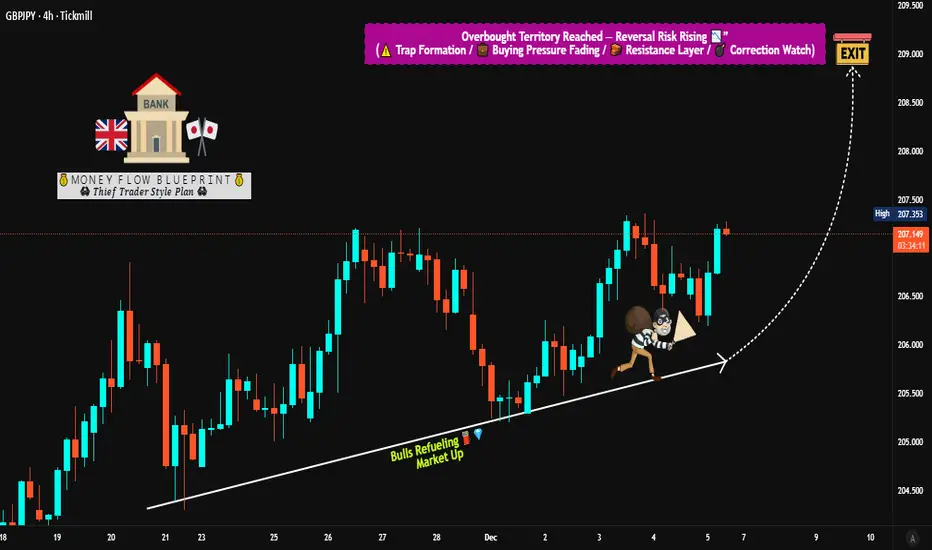
Is GBP/JPY Setting Up a High-Probability Bullish Move?🔥 GBP/JPY “The Beast” – Layered Bullish Playbook for Smart Swing/Day Traders 🔥
📌 Asset: GBP/JPY — “The Beast”
📌 Trade Opportunity Guide: Swing / Day Trading Blueprint
📌 Bias: Bullish Momentum Outlook 🚀
📈 Trade Plan (Thief Layering Strategy)
The pair continues to display strong bullish structure with aggressive momentum flows. This setup uses the Thief Layer Method, stacking multiple Buy Limits to secure better blended entries as liquidity sweeps occur.
🟢 Buy Limit Layers (Thief’s Signature Stacking Entries)
206.000
206.500
207.000
(You may extend layers further depending on liquidity pockets & your own strategy.)
This layered approach captures pullbacks, traps, and micro-corrections while maintaining directional conviction.
🛡️ Stop-Loss Placement (Flexible & Risk-Adaptive)
⛔ Thief’s Default SL: 205.000
Ladies & Gentlemen (Thief OG’s) — adjust SL based on your risk appetite, volatility tolerance, and account size.
This is not a fixed recommendation, only a structural guide.
🎯 Target Zone (Bullish Exhaustion Area)
The market is heading into a heavy resistance cluster, with overbought + trap-formation signals expected.
🎯 Take-Profit Zone: 209.000
Again, Thief OG’s — this TP is not mandatory. Lock in profit at your preferred levels depending on your strategy & risk rules.
💡 Market Outlook Summary
Strong bullish structure
Clean higher-high continuation
JPY weakness supports upside
Momentum + liquidity build toward 209.000
Ideal for layer-based accumulation entries
🌐 Correlated Pairs to Watch (Dollar + Yen + GBP Network Insight)
Monitoring these pairs helps confirm flows, risk sentiment, and cross-currency strength.
1️⃣ FX:USDJPY (UJ)
Strong correlation with GBP/JPY because both share JPY as quote currency.
When UJ pumps, JPY weakens → supports GBP/JPY bullish continuation.
Watch for USD strength + global risk-on behavior.
2️⃣ FX:GBPUSD (Cable)
Measures GBP strength directly against USD.
If GU is bullish, it confirms broader GBP strength → boosts GBP/JPY upside momentum.
Also shows whether GBP inflows are fundamental or risk-driven.
3️⃣ OANDA:EURJPY (EJ)
Tracks Yen strength/weakness across Eurozone risk sentiment.
Strong EJ = weak JPY, supporting bullish GBP/JPY moves.
Great for measuring JPY-wide liquidity flow.
4️⃣ TVC:DXY (US Dollar Index)
Helps understand global risk sentiment.
Strong DXY → often risk-off → can increase JPY strength.
Weak DXY → risk-on → boosts JPY pairs upward (bullish GJ).
5️⃣ OANDA:GBPCHF
Stability gauge for GBP risk appetite.
Rising GBP/CHF supports GBP strength narrative across the board.
#GBPJPY #TheBeast #ForexTrading #SwingTradeSetup #DayTradingPlan #JPYPairs #SmartMoneyConcepts #LayeringStrategy #BuyLimits #FXMarket #ThiefStrategy #BullishSetup #TradingViewAnalysis #PriceAction #ForexCommunity
Global Recession Impact on the Stock Market1. Decline in Corporate Earnings and Profit Margins
A recession directly reduces business activity. Companies face:
Lower consumer spending
Weak industrial output
Supply-chain disruptions
Reduced global trade
All these factors hurt corporate profits. Since stock prices are fundamentally based on future earnings, declining earnings expectations lead to falling stock valuations. Sectors dependent on discretionary spending—such as automobiles, luxury goods, travel, entertainment, and retail—tend to see the largest drops.
Industries like utilities, consumer staples, and healthcare experience comparatively less damage because demand remains steady even in downturns.
2. Sharp Stock Market Sell-Offs and Panic Reactions
Recessions amplify fear and uncertainty, triggering:
Panic selling
Liquidity crunches
Forced margin call selling
Flight to safety (bonds, gold, cash)
Investors prefer safe assets over risky equities. This results in broad market declines, often leading to bear markets—defined as a 20% or more drop in stock indices.
Historical patterns show:
2008 Global Financial Crisis: Markets fell 50–60%
2000 Dot-com Crash: Tech-heavy indices declined massively
2020 COVID Crash: Markets dropped 30% in weeks due to recession fears
Psychology plays a huge role. When investors anticipate economic pain, they exit the market rapidly, causing steep downward moves.
3. Rising Volatility and Unpredictable Market Behaviour
During a recession, stock markets experience extreme volatility. Indices can swing 3–8% in a single day as investors react to:
Policy announcements
Interest rate changes
Earnings warnings
Employment reports
Global news and geopolitical events
The VIX index, known as the “fear index”, typically shoots upward in recession periods, reflecting a sharp rise in market uncertainty.
4. Credit Tightening and High Borrowing Costs
Recessions often lead banks and financial institutions to become risk-averse. This causes:
Reduced lending activity
Higher interest rates for risky borrowers
Difficulty for companies to raise capital
Delayed expansion or investment projects
As finance becomes difficult to access, companies struggle to maintain operations, leading to declining stock prices. Financial sector stocks are heavily affected because loan defaults and credit stress increase during recessions.
5. Job Losses and Lower Consumer Spending Hit Market Sentiment
When unemployment rises, consumers reduce spending. This creates a chain reaction:
Lower sales → lower profits → lower stock prices
Businesses cut costs → more layoffs → weaker economy
Investor sentiment drops further
The stock market is extremely sensitive to consumer confidence. When the global population reduces spending, markets price in weaker future demand, causing indices to fall.
6. Currency Fluctuations and Emerging Market Instability
During global recessions:
Investors move money to safe-haven currencies like USD or CHF
Emerging market currencies weaken
Foreign investors withdraw capital
This capital outflow leads to:
Stock market declines in developing countries
Higher import costs
Interest rate hikes to stabilize currency
These factors further intensify stock market stress in regions dependent on foreign investment.
7. Commodity Price Crashes Hit Commodity-Based Markets
Demand for commodities—oil, metals, energy—drops sharply during recessions. This leads to:
Falling commodity prices
Significant declines in commodity-driven equity markets
Lower revenues for countries and companies dependent on raw materials
Energy and mining stocks especially suffer during global downturns.
8. The Role of Central Banks and Government Interventions
While recessions hurt markets, governments and central banks attempt to stabilize conditions using:
Interest rate cuts
Quantitative easing
Fiscal stimulus packages
Bank bailouts or liquidity injections
Such actions can provide temporary relief and may cause short-term market rallies, even during recessions. However, long-term recovery depends on the real economy improving.
Markets often respond positively to stimulus, but if the recession is deep, the rallies may be short-lived.
9. Shift from Growth Stocks to Value and Defensive Stocks
During recessions, investor preferences shift:
Growth Stocks (Tech, Startups, High-Risk Sectors)
Decline more sharply due to high valuations
Struggle with funding shortages
Reduced investor appetite for risk
Value and Defensive Stocks (FMCG, Utilities, Healthcare)
Hold value better
Provide dividends
Offer stability
Portfolio rotation becomes a major trend during recessions, influencing market behavior across sectors.
10. Long-Term Opportunities for Investors
While recessions cause fear and losses, they also create the best long-term investment opportunities. Historically:
Markets recover and hit new all-time highs after recessions
Quality stocks become undervalued
Long-term investors gain the most during recovery phases
Key benefits for disciplined investors include:
Lower entry prices
Higher future returns
Stronger long-term compounding
However, identifying fundamentally sound companies is crucial.
11. Slow and Uneven Recovery Across Sectors
Even after recession ends:
Some sectors recover quickly (technology, IT services, pharma)
Others take years (travel, real estate, heavy industries)
The recovery of stock markets does not always align with economic recovery. Markets often recover before the economy because they are forward-looking.
Conclusion
A global recession deeply affects stock markets through falling corporate earnings, reduced spending, rising job losses, tightening credit, and panic selling. Market volatility increases dramatically, and global liquidity dries up. Sectors linked to discretionary spending and commodities face the sharpest declines, while defensive sectors remain comparatively stable.
Although recessions cause fear and uncertainty, they also offer long-term buying opportunities. Markets eventually recover and grow beyond previous highs, rewarding patient, disciplined investors with strong returns.
Understanding these dynamics helps traders and investors navigate turbulent times with clarity, strategy, and confidence.
Role of International Trade1. Driving Economic Growth and Development
One of the primary roles of international trade is to accelerate economic growth. When countries engage in cross-border trade:
GDP increases due to higher production and export activities.
Foreign exchange earnings expand, allowing countries to import advanced goods and technologies.
Investment flows rise, as global investors look for new markets and opportunities.
Developing nations particularly benefit from increased exports of agricultural products, textiles, minerals, or manufactured goods. When these countries participate in global markets, they experience:
Higher income levels
Improved infrastructure
Better economic stability
Integration with global supply chains
Historically, trade-led growth has transformed economies like China, South Korea, and Singapore, demonstrating that global integration is a powerful engine for development.
2. Promoting Specialization and Comparative Advantage
International trade allows countries to specialize, producing goods and services they can create most efficiently. This concept is rooted in the theory of comparative advantage, proposed by economist David Ricardo.
For example:
India specializes in IT services, pharmaceuticals, and textiles.
Germany excels in automobile manufacturing and engineering.
Japan specializes in electronics and robotics.
Brazil is strong in agriculture and raw materials.
Specialization increases:
Productivity
Efficiency
Quality of goods
Global competitiveness
By focusing on strengths, nations produce more with fewer resources and trade for goods they cannot efficiently manufacture.
3. Expanding Markets for Businesses
Without international trade, companies are constrained by the size of their domestic markets. Trade opens access to billions of consumers worldwide, allowing firms to scale production, reduce costs, and increase profits.
Key benefits include:
Access to larger customer bases
Opportunity to diversify products
Increased brand recognition
Ability to compete globally
Export-oriented industries often grow faster than domestic-focused ones because they face greater demand and tougher competition, which boosts innovation and efficiency.
4. Generating Employment Opportunities
International trade creates millions of direct and indirect jobs across sectors such as:
Manufacturing
Agriculture
IT and services
Logistics and shipping
Banking and finance
Export industries usually require skilled and unskilled labor, increasing employment opportunities. Additionally, growth in trade-related sectors—port operations, customs, warehousing, and transportation—creates supply chain jobs.
In many developing countries, trade-driven manufacturing has pulled millions out of poverty by providing stable income and opportunities for skill development.
5. Encouraging Innovation and Technology Transfer
A key role of international trade is accelerating global technological advancement. When countries import technology-rich products such as machinery, robotics, medical devices, and software, they indirectly gain access to new knowledge and innovation.
Trade fosters:
Technology transfer, from advanced economies to developing nations
Improved industrial processes through imported machinery
Research and Development (R&D) investments driven by global competition
Multinational companies bring modern production systems, managerial skills, and digital tools to the countries where they operate. This accelerates industrialization and enhances productivity.
6. Enhancing Consumer Choice and Quality of Life
International trade dramatically increases the variety of products available to consumers. Without global trade:
Fruits like apples, kiwis, and oranges would be unavailable in many regions.
Electronics, automobiles, and smartphones would be far costlier.
Medicines and medical equipment would be limited.
Trade ensures:
Lower prices
Better product quality
Wider product variety
Continuous innovation
Competition from foreign producers forces domestic companies to improve their products and cut costs, benefiting consumers directly.
7. Strengthening Geopolitical and Diplomatic Relations
Trade is not just an economic tool but also a strategic instrument in international diplomacy. When countries engage in trade partnerships, they build political trust and cooperation.
Benefits include:
Stronger international alliances
Reduced chances of conflict due to mutual economic dependence
Increased cultural exchange
Collaborative agreements in defense, research, and environment
Institutions like the World Trade Organization (WTO), regional trade blocs (EU, ASEAN, NAFTA/USMCA), and bilateral agreements help maintain global economic stability.
8. Supporting Industrial and Infrastructural Development
International trade encourages governments to invest in:
Ports
Highways
Railways
Digital networks
Special Economic Zones (SEZs)
Warehousing and logistics facilities
These improvements not only boost export capacity but also strengthen domestic economic development. In many developing countries, international trade has driven major upgrades in transportation and communication infrastructure.
9. Reducing Production Costs through Global Supply Chains
Trade enables companies to source raw materials, components, and labor from countries where they are most cost-effective.
Examples:
Electronics manufacturers source chips from Taiwan, assembly from China, and components from Malaysia.
Automobile companies import spare parts from multiple countries.
Fashion brands source textiles from India and Bangladesh.
This interconnected global supply chain reduces production costs and enhances efficiency. It also allows companies to diversify supply sources, reducing dependence on any single country.
10. Promoting Economic Resilience and Diversification
Countries that rely heavily on a single industry or resource are vulnerable to economic shocks. International trade helps diversify economic activities.
For example:
Gulf countries are investing in tourism and manufacturing to reduce oil dependency.
African countries are moving from raw material exports to processed goods.
Asian economies balance IT services, manufacturing, and agriculture.
Diversification through trade strengthens economic resilience and reduces vulnerability to global price fluctuations.
Conclusion
International trade plays a foundational role in shaping the modern global economy. It drives economic growth, promotes specialization, increases innovation, and expands opportunities for businesses and workers alike. It enriches consumer choice, strengthens diplomatic ties, and promotes global economic stability.
For developing nations, international trade is a powerful engine for lifting populations out of poverty, modernizing industries, and integrating into global value chains. For advanced economies, it supports innovation, competitiveness, and continued prosperity.
In a rapidly globalizing world, the role of international trade is more significant than ever—linking nations, building economies, and shaping a more interconnected and prosperous global future.
EUR/USD Buy Levels Mapped Out | Bullish Pullback PlayEUR/USD "The Fibre" 🎯 Bullish MA Pullback | Layered "Thief" Entry Strategy (Swing/Day Trade) 💰⚡
👑 EUR/USD BULLISH OPPORTUNITY - PROFESSIONAL PLAN 👑
Hey Traders! 👋 The "Fibre" is setting up a classic and high-probability bullish continuation pattern. Here’s a detailed guide to navigate this Swing to Day Trade opportunity.
📈 Core Thesis:
Asset: EUR/USD ("The Fibre")
Bias: BULLISH ✅
Strategy: Moving Average Dynamic Support Pullback, confirmed by higher timeframe structure.
Entry Method: "The Thief" Layered Limit Order Strategy – Stealing pips on the way down.
⚙️ Trade Plan & "Thief" Execution:
CONFIRMATION: Wait for price to pull back into the key support zone (e.g., Dynamic Moving Averages like EMA 50/200) and show signs of rejection (bullish pin bar, engulfing candle, RSI support).
ENTRY (LAYERED LIMITS): Instead of one risky entry, use multiple buy limit orders to scale in. This "Thief" method improves your average entry price.
Suggested Layers: 1.16400 | 1.16200 | 1.16000 | 1.15800
⚠️ You can adjust the number of layers and levels based on your capital & risk tolerance.
STOP LOSS (MANDATORY):
Ideal Thief SL: Below the swing low at 1.15000.
🔒 RISK DISCLAIMER: THIS IS MY PLAN. You MUST adjust your SL based on YOUR OWN risk management and strategy. Protect your capital!
TAKE PROFIT TARGETS:
Primary Target (TP1): 1.17800 – A strong resistance & overbought zone. "Escape with profits before the trap!"
Scalping Option: Consider partial profits at interim resistance levels.
🎯 KEY NOTE: TP is your choice! Manage your trade actively. "Make money, then take money" at your own discretion.
🌍 RELATED PAIRS TO WATCH & KEY CORRELATIONS:
Monitoring these pairs helps confirm the Euro/Dollar story:
PEPPERSTONE:USDX (DXY): 🔥 INVERSE CORRELATION. A weaker DXY directly supports a stronger EUR/USD. Watch for DXY rejection from resistance.
GBP/USD ("Cable"): ✅ POSITIVE CORRELATION. Often moves in tandem with EUR/USD. Strength here can confirm broad USD weakness.
EUR/GBP: 🔄 INTERNAL EURO STRENGTH GAUGE. If EUR/USD rises and EUR/GBP is stable/rising, it signals genuine Euro demand, not just USD selling.
USD/CHF: ✅ INVERSE CORRELATION. Another USD pair that often mirrors EUR/USD inversely (though watch for CHF safe-haven flows).
AUD/USD & NZD/USD: 🟡 RISK CORRELATION. If these are also strong, it indicates a broader "risk-on" USD sell-off, reinforcing the bullish EUR/USD setup.
✅ Summary:
Strategy: Bullish Pullback + Layered "Thief" Entries.
Risk: Defined & Managed with layered SL.
Target: Clear Resistance Zone.
Context: Supported by multi-pair analysis.
💬 Let's Discuss!
What do you think of this setup? Are you watching the same levels? Drop your analysis below! 👇
🚨 REMINDER: This is my personal analysis, not financial advice. Always do your own research and manage risk. Trade responsibly!
👍 LIKE & FOLLOW if you find this detailed guide helpful! It helps the algorithm and keeps more professional ideas coming your way! ✅
#TradingView #Forex #EURUSD #Fibonacci #SwingTrading #DayTrading #ForexAnalysis #TradingStrategy #ThiefStrategy #RiskManagement #DXY #FX
Investing in the World Trade Market1. Understanding the World Trade Market
The world trade market is not a single unified marketplace. Instead, it consists of several interconnected segments:
Goods and Services
Countries trade products such as automobiles, electronics, oil, agricultural goods, and software services. Investors can participate through stocks, ETFs, or multinational companies involved in global trade.
Foreign Exchange (Forex)
Global currency trading supports international business. Investors participate to profit from exchange rate fluctuations driven by economic data, interest rates, and geopolitical events.
Commodities
Oil, natural gas, gold, silver, wheat, and other commodities are exchanged globally. Commodity markets are crucial because they influence trade balances, inflation, and corporate profitability.
Global Financial Markets
International stock markets, bonds, derivatives, and cross-border investment instruments allow investors to trade foreign assets.
Together, these components form the backbone of global commerce, offering multiple investment avenues.
2. Why Invest in the World Trade Market?
a. Diversification Beyond Domestic Borders
Investing globally spreads risk across countries and industries. When one nation faces recession, another may experience growth. Diversification helps protect capital from country-specific political or economic downturns.
b. Access to High-Growth Economies
Many emerging markets—India, China, Vietnam, Brazil, and African economies—offer rapid growth rates higher than developed countries. Investing early in these regions can yield substantial long-term returns.
c. Exposure to Global Brands
Companies like Apple, Toyota, Samsung, Nestlé, and LVMH operate across continents. Investors benefit from their global revenues and stability.
d. Currency Appreciation
Global investing exposes investors to foreign currencies. Gaining from strong currencies can multiply returns when converted back into the home currency.
e. Hedge Against Domestic Market Instability
If the domestic market faces inflation, political instability, or economic slowdown, global assets may provide stability.
3. Ways to Invest in the World Trade Market
Investors can participate globally in several ways depending on risk tolerance, knowledge, and financial goals.
a. International Stocks
Investors can buy shares of foreign companies through:
Direct foreign exchanges
Indian brokers offering global investment accounts
American Depositary Receipts (ADRs)
Global Depositary Receipts (GDRs)
This provides direct exposure to overseas corporations.
b. Exchange-Traded Funds (ETFs)
Global ETFs track:
Foreign stock indices (e.g., S&P 500, Nikkei, FTSE)
Global bonds
Emerging markets
Commodities
Multi-asset portfolios
They offer simplicity, diversification, and lower cost.
c. Forex Trading
Investors trade currency pairs like:
USD/INR
EUR/USD
GBP/JPY
Forex gives quick profit potential but carries high volatility and requires knowledge.
d. Commodity Investments
Investors can trade:
Gold and silver
Oil and natural gas
Agriculture (wheat, cotton, coffee)
Commodities are influenced by supply–demand dynamics, weather, geopolitical tensions, and global economic cycles.
e. Global Mutual Funds
Mutual fund companies offer international and global schemes, allowing investors exposure without direct trading in foreign markets.
f. Investing in Multinational Corporations (MNCs)
Buying shares of companies heavily engaged in global trade gives indirect access to world markets. These companies spread risk across continents and benefit from diverse revenue streams.
g. Digital Assets (Crypto)
Crypto markets operate globally and provide decentralized trading opportunities. However, they carry higher risk and require regulatory awareness.
4. Factors Driving Success in World Trade Investments
To succeed in the world trade market, investors must understand key global drivers.
a. Geopolitical Stability
Conflicts, trade wars, sanctions, or diplomatic tensions affect global markets. For example:
War can raise oil and gold prices.
Trade sanctions can reduce corporate profits.
Political instability disrupts supply chains.
b. Economic Indicators
Investors track:
GDP growth
Inflation
Interest rates
Employment data
Consumer spending
Countries with strong indicators attract foreign capital and generate higher returns.
c. Global Supply Chain Trends
Events like pandemics, port shutdowns, or semiconductor shortages create volatility. Understanding these trends helps investors position themselves better.
d. Currency Strength
A strong foreign currency boosts returns when converted back into the home currency. Conversely, currency depreciation can reduce profits.
e. Technological Advancements
Technology facilitates global trade through:
E-commerce
Digital payments
Blockchain logistics
AI-driven global analytics
Industries adopting modern innovations often grow faster.
5. Risks of Investing in the World Trade Market
While opportunities are high, global investing carries distinct risks.
a. Currency Risk
A profitable foreign investment could still result in loss if the target country’s currency weakens relative to the investor’s home currency.
b. Geopolitical Risk
Wars, coups, border disputes, and political changes can disrupt markets.
c. Regulatory Differences
Each country has unique taxation rules, trading restrictions, and compliance standards.
d. Economic Instability
Recessions, inflation, or corporate bankruptcy in foreign nations can negatively affect investments.
e. Liquidity Risk
Some international markets lack trading volume, making it hard to buy or sell assets quickly.
f. Information Gap
Investors may not fully understand foreign markets due to language, cultural, or informational barriers.
Understanding and mitigating these risks is crucial for long-term success.
6. Strategies for Smart Global Investing
a. Research Countries Before Investing
Consider:
Economic strength
Growth potential
Political stability
Currency trends
Market regulations
b. Diversify Across Regions
Spread investments across:
Developed markets (USA, Europe, Japan)
Emerging markets (India, Brazil, Indonesia)
Frontier markets (Africa, Vietnam)
c. Use Global ETFs for Beginners
They provide:
Automated diversification
Low cost
Easy access
Reduced risk
d. Hedge Currency Exposure
Some global funds offer currency-hedged versions to minimize exchange-rate risk.
e. Keep a Long-Term Perspective
Global markets move slower than domestic ones but yield stable, compounding returns over time.
f. Stay Updated with Global News
Monitor:
Trade agreements
Economic releases
Interest-rate decisions
Commodity price movements
Being informed helps anticipate trends earlier.
7. The Future of the World Trade Market
The next decade will transform global investing due to:
Rise of digital currencies
Expansion of India and Southeast Asia
Major shifts in manufacturing hubs
AI-driven global forecasting
Green energy and carbon-credit trading
Growth of cross-border fintech platforms
Global trade is becoming faster, more digital, and more interconnected, opening significantly larger opportunities for investors worldwide.
Conclusion
Investing in the world trade market allows investors to participate in the global economy, benefit from international growth, and diversify their portfolios beyond domestic boundaries. Although it comes with risks such as currency fluctuations, political uncertainty, and regulatory complexities, strategic planning, informed research, and diversification can help investors achieve strong long-term returns. As the world continues to integrate economically, global markets will increasingly influence investment outcomes, making world trade investing not only an opportunity but a necessity for modern investors.
Global Market Risks1. Macroeconomic Risks
a. Inflation and Interest Rate Volatility
Inflation is one of the most significant global risks. When inflation rises, central banks respond by increasing interest rates, which affects borrowing costs, consumer spending, corporate profitability, and international capital flows.
High inflation erodes purchasing power, disrupts business planning, and raises input costs. Meanwhile, sudden interest rate hikes can trigger equity market corrections, real estate slowdowns, and capital outflows from emerging markets. Even a minor shift in policy by the U.S. Federal Reserve or European Central Bank can ripple through global markets.
b. Economic Slowdowns and Recessions
Recessions in major economies like the U.S., China, and the EU create worldwide ripples. Sluggish demand reduces exports, commodity consumption, foreign investments, and corporate earnings. For emerging economies dependent on global trade, a slowdown in developed markets can lead to unemployment, fiscal pressure, and currency instability.
2. Geopolitical Risks
a. Wars, Conflicts, and Political Tensions
Geopolitical tensions—whether in Eastern Europe, the Middle East, or the Indo-Pacific—lead to supply chain disruptions, commodity price volatility, and investor uncertainty. Wars or sanctions can affect energy markets, shipping routes, and cross-border financing. Any conflict involving major nations increases volatility across equities, bonds, and commodity markets.
b. Trade Wars and Tariffs
Rising protectionism can severely impact global trade flows. Trade wars between economic giants like the U.S. and China create uncertainty for global manufacturers, exporters, and consumers. Tariffs raise the cost of goods, reduce competitiveness, and distort global supply chains.
c. Political Instability
Governments facing elections, regime changes, policy uncertainty, or civil unrest create unpredictable market conditions. Investors tend to withdraw capital from politically unstable regions, weakening currencies and stock markets.
3. Currency and Exchange Rate Risks
In global markets, currency movements are one of the most immediate risk factors. Exchange rate fluctuations can affect:
Export competitiveness
Import costs
Foreign debt repayments
Profit margins for multinational companies
Emerging markets are especially vulnerable. A strong U.S. dollar often leads to capital outflows, weakening local currencies and making dollar-denominated debt more expensive. Sudden devaluations can trigger financial crises, as seen in past Asian, Latin American, and Turkish market events.
4. Financial Market Risks
a. Stock Market Volatility
Global equity markets are influenced by economic data, corporate earnings, geopolitical news, and investor sentiment. High-frequency trading, derivatives, and speculation can amplify volatility. Market bubbles—often driven by excessive liquidity—can burst suddenly, leading to massive wealth destruction.
b. Bond Market Risk
Government and corporate bond markets face interest rate, credit, and liquidity risks. Rising rates reduce bond prices, while weaker economies increase default risk. Sovereign debt crises (like those seen in Greece or Argentina) can threaten the entire global financial system.
c. Banking System Risk
Banking failures or liquidity shortages can spread quickly across borders. The global financial system is interconnected, and stress in one region can impact banks worldwide through money markets, cross-border loans, and derivatives exposure.
5. Commodity Market Risks
a. Energy Prices
Oil and natural gas prices are influenced by geopolitics, OPEC decisions, supply disruptions, and global demand. Sharp swings impact inflation, transportation, manufacturing costs, and country finances—especially for oil-dependent economies.
b. Agricultural Commodities
Climate change, extreme weather, export restrictions, and global supply chain issues affect food prices. Food inflation can trigger political instability and global humanitarian risks.
c. Metals and Minerals
Industrial and precious metals are affected by mining output, geopolitical tensions, green-energy demand, and currency strength. For nations dependent on metal exports, price declines pose fiscal and economic threats.
6. Supply Chain and Logistics Risks
Global supply chains became highly vulnerable after the pandemic. Key risks include:
Shipping delays
Port congestion
Container shortages
Dependence on single-country manufacturing
Labour strikes
Trade restrictions
Disruptions lead to higher production costs, longer delivery times, inventory shortages, and reduced global trade efficiency. Critical industries—such as semiconductors, pharmaceuticals, and electronics—are especially exposed.
7. Technological and Cybersecurity Risks
In a world dependent on digital infrastructure, cyber risks are among the most dangerous. Cyberattacks can disrupt:
Banks and payment systems
Stock exchanges
Government operations
Energy grids
Corporate networks
Data theft, ransomware, and hacking incidents create financial losses, reputational damage, and operational outages. As AI and automation expand, cyber vulnerabilities become even more critical.
8. ESG and Climate Change Risks
a. Extreme Weather and Climate Events
Floods, droughts, hurricanes, and wildfires disrupt agriculture, infrastructure, and global supply chains. They raise insurance costs and reduce productivity. Climate risks also shift commodity markets, increase inflation, and strain government budgets.
b. Energy Transition Risks
As countries transition to renewable energy, fossil fuel industries face structural decline. Companies that fail to adapt can suffer large losses or collapse. Investors are also exposed to sudden regulatory changes like carbon taxes or bans on polluting technologies.
c. ESG-Driven Regulatory Risks
Businesses must comply with stricter environmental, social, and governance (ESG) rules. Non-compliance may lead to fines, supply chain disruption, or loss of investor support.
9. Global Debt Risks
Rising global debt—household, corporate, and government—creates major vulnerabilities. High debt levels reduce resilience during shocks. When rates rise, debt servicing becomes costlier, increasing the risk of defaults. Some countries face unsustainable debt burdens, threatening global financial stability.
10. Black Swan and Systemic Risks
Black swan events—rare and unpredictable shocks—can completely reshape markets. Examples include:
Pandemics
Natural disasters
Financial collapses
Major technological failures
Sudden geopolitical crises
Systemic risks occur when failures in one sector spread widely, as seen in the 2008 crisis. Today’s interconnected digital-financial world makes systemic risk more threatening than ever.
Conclusion
Global markets face a wide spectrum of risks—economic, geopolitical, financial, technological, environmental, and systemic. Because global economies are closely linked, shocks in one region often spread rapidly across continents. Managing these risks requires diversification, strong policy frameworks, technological resilience, and timely strategic decisions. Understanding these risks is the first step for investors, businesses, and governments to stay prepared in an increasingly uncertain world.
AUD/JPY Market Outlook: Bullish Structure Still Intact AUD/JPY 🦘🇦🇺 vs 🇯🇵💴 | Bullish Kijun Pullback + LAYERED ENTRY Strategy (Swing/Day Trade)
🚀 TRADE OPPORTUNITY: BULLISH CONFIRMED
AUD/JPY is showing a strong bullish structure, with the price respecting the HULL moving average as dynamic support. We are looking for a pullback to layered demand zones for high-probability entries.
📈 TRADE PLAN: "THIEF" LAYERED LIMIT ORDER STRATEGY
This plan uses a multi-limit order ("layer") approach to average into the trend.
Entry Zones (Buy Limit Orders):
Layer 1: 101.500
Layer 2: 101.800
Layer 3: 102.000
Layer 4: 102.300 (You can add more layers based on your capital & risk)
👉 Entry Logic: Any price action confirmation (bullish engulfing, pin bar) at these levels adds confluence.
⛔ RISK MANAGEMENT (KEY TO SURVIVAL)
Stop Loss (Consolidated): Below swing low @ 101.000.
⚠️ IMPORTANT NOTE: This is MY strategic SL. YOU MUST adjust your stop loss based on your personal risk tolerance, account size, and strategy. Protect your capital first!
🎯 PROFIT TARGETS
Primary Target: 103.800 (Major resistance zone, prior structure, and potential overbought trap area).
💡 Smart Tip: Consider scaling out profits on the way up (e.g., at 102.800, 103.300) to secure risk-free trades.
⚠️ REMINDER: Take profits based on YOUR plan. Price may reverse early or extend further. Manage your trade actively.
🔍 RELATED PAIRS & MARKET CORRELATION (CRUCIAL FOR CONTEXT)
Watching these pairs helps confirm the broader trend and risk sentiment:
OANDA:AUDUSD & OANDA:NZDUSD (Risk Gauges):
Key Point: Strong AUD/USD supports a bullish AUD/JPY view. Weakness here may limit AUD/JPY upside.
FX:USDJPY & NASDAQ:JPY Index (JPY Strength):
Key Point: JPY is the funding currency. Broad JPY weakness (USDJPY ↑) is BULLISH for AUD/JPY. Watch for BoJ intervention rumors.
FOREXCOM:SPX500 or FX:US30 (Global Risk Sentiment):
Key Point: AUD/JPY is a RISK-ON pair. Rising stock markets typically fuel AUD/JPY rallies. A market sell-off could trigger safe-haven JPY buying, hurting this trade.
NASDAQ:IRON & CAPITALCOM:COPPER (AUD Commodity Driver):
Key Point: Strong commodity prices (Iron Ore/Copper) are fundamentally bullish for the Australian Dollar (AUD).
📊 TECHNICAL CONFLUENCE (Why This Works):
Trend: Higher Highs & Higher Lows on Daily/4H.
Support: HULL MA + Previous Swing Lows.
Strategy: Layered entries improve average price and reduce emotional trading.
👍 LIKE & FOLLOW if you find this detailed guide helpful!
🔔 Turn on notifications for my next "Thief Layer Strategy" update.
💬 Comment below with your entry level or questions!
#AUDJPY #Forex #TradingView #TradingIdea #SwingTrading #DayTrading #Ichomoku #Kijun #RiskManagement #LayerStrategy #ThiefStrategy #FX #AUD #JPY #TechnicalAnalysis
BTC Next moveBTC gave a choch and bos / Trend line break conformation
market came without taking a supply from trend change area and there we can see FVG
so trend have to collect that FVG for continue sell trend
or break there structure for uptrend
📌 Please support me with your likes 🤞🏻 and comments 💬 to motivate me to share more analysis with you and share your any opinion about the possible trend of this chart with me !
Best Regards , Davis 🥰
Hit the like 🤞🏻 button to !! Motive some energy !!🥇
📌 Note :
⨻ Check the live market updates and analysis yourself before buy 📈🔺 or sell 📉🔻
⨺ Am not giving any advisory or signals its just my idea for upgrade my knowledge 📚 in trading
⨹ This is my pre and post market analysis to improve my trading journey 🚀
⨂ Am Not suggesting anyone to buy or sell ❌ am just giving my views 👀
⫸ You are responsible for your trading ✅ not me ❌ ⫷
HAPPY TRADING 🥰
Nov 21, 2025
Trade closed: target reached
bitcoin reach as expected on supply area around5000$ upside and down side gave target
HAPPY TRADING 🥰
USDCAD: Mild Bullish ForecastUSDCAD is currently in a mild uptrend, driven by the strengthening of the USD and the weakening of the CAD. The pair continues to hold above a strong support trendline and is testing the resistance area at 1.40600. News about Canada’s inflation in October showed a slight decrease, weakening the CAD and providing an opportunity for the USD to continue its strength.
On the 4H chart, we can see USDCAD trading within an accumulation zone between 1.40000 and 1.40600. Although some small pullbacks may occur, the overall trend remains mildly bullish. If the price maintains above the support at 1.40000, it is likely to continue its uptrend toward 1.40600.
Forecast:
With the supporting technical factors and fundamental news, USDCAD may continue to rise in the short term, with the next target being 1.40600. Traders may look for buy signals when the price pulls back to 1.40000 to enter the trend.
USDHKD Forex Pair is exploding as expectedMost traders keep chasing candles on the 5-minute chart, hoping to find magic. But magic doesn’t happen there — it happens when you learn to wait.
The USD/HKD Forex pair is the perfect example. We called the monthly demand level at 7.77 weeks ago, and look at it now — it’s reacting beautifully.
The big boys are buying while everyone else is still guessing. Let’s dive into the chart and see why this pair is offering both swing and intraday opportunities right now!
USDHKD Forex Analysis and Forecast
The USD/HKD Forex pair is doing exactly what supply and demand imbalances told us it would do.
The monthly demand level at 7.77 — the one we discussed in our last analysis — is playing out beautifully. Price reached this imbalance, and once again, demand took full control.
This isn’t the first time the US dollar has bounced hard from around the 7.75–7.78 range. Historically, whenever the dollar dips near that area, strong buyers step in, triggering a powerful bullish reaction.
Now, as the pair rallies from this strong monthly demand, we can already see strong impulses on the daily, 4H, and 1H timeframes. These are early signs of new buyers entering the market — perfect for Forex swing traders and intraday traders alike.