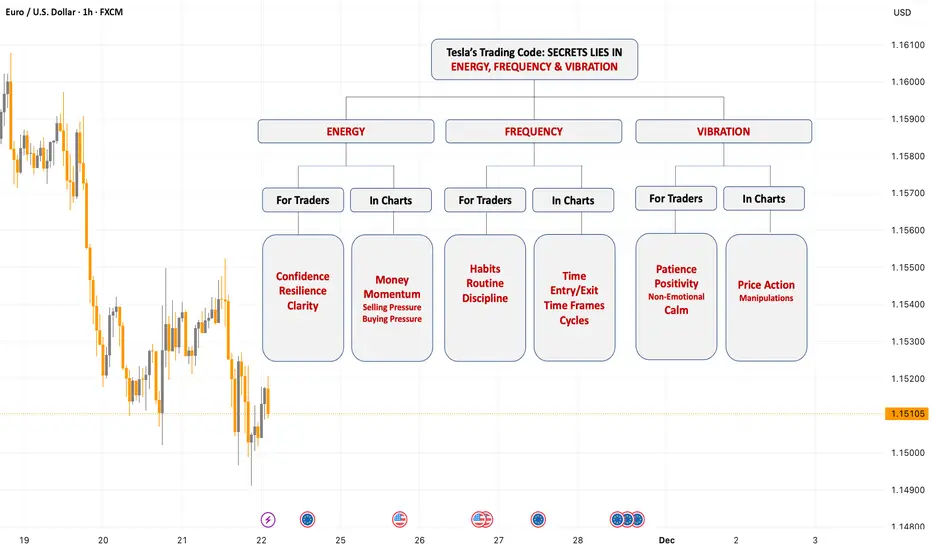
Decoding Trading Charts and Psychology in NIKOLA TESLA'S way! Hey, how are you all! Let's dive deep into a powerful concept inspired by Nikola Tesla’s famous quote: “If you wish to find the secrets of the universe, think in terms of ENERGY, FREQUENCY, and VIBRATION.” This idea, though from the realm of physics, it beautifully translates into the world of trading—both in developing the individual’s right trading mindset and understanding price charts.
Disclaimer:
This post is dedicated solely to educational content and community-driven insights. All information shared here—including strategies, trade setups, and opinions—are for informational purposes only and should not be considered as financial, investment, or trading advice.
Viewers are solely responsible for their own investment decisions.
Trading and investing in financial markets involve risk, and the channel will not be held responsible for any losses or damages incurred as a result of actions taken based on the content presented.
Please consult with a qualified financial advisor before making any investment decisions.
Let’s break down each component and see how you can apply it practically to your trading journey.
At first, let’s talk about the Energy: The Driving Force in Mindset of an individual and Money in Markets.
Energy —Tesla described it as the fundamental driving force behind everything. In trading mindset, energy is your mental and emotional vitality. It’s the passion that fuels your motivation to study markets daily, the focus that keeps you glued to charts during sessions, and the resilience that helps you bounce back from losses without losing confidence.
Imagine two traders: One wakes up excited, ready to analyse and follow their strategy, maintaining positivity even after a tough day. The other wakes up tired and doubtful, easily frustrated by every small loss. The difference? Their energy levels. High, consistent energy levels mean a trader can handle stress better, maintain discipline, and stick to a well-thought plan rather than acting impulsively.
On the market side, think of it as the driving force in the universe of trading. In trading, energy directly corresponds to Money. Money represents the real driving power or driving force behind price movement. It is the buying or selling pressure that injects momentum into the market.
When big chunks of money flow into a stock, like institutional buying, it fuels powerful upward moves. Conversely, large sell-offs drain energy, pushing prices down. Understanding where money is concentrated and how much “Energy” in the form of “Money” is behind the moves lets you anticipate strong trends or reversals.
Secondly, It’s time to discuss about Frequency: The Discipline of an individual and the Time factor in Trading.
Frequency, which for Tesla referred to the rate at which something vibrates or repeats. In trading mindset, frequency is the rhythm of your actions—your habits, your routine, and your discipline. Are you consistently reviewing charts at time intervals? Do you stick to your risk management and trading plan day after day? That regularity creates a frequency that stabilise your results.
Consider a trader who trades instantly, jumping into random setups at different hours without a plan. Their frequency is erratic, and their results are often inconsistent. Contrast that with a trader who enters the market with a fixed routine, analysing and executing trades in well-defined sessions. This disciplined frequency builds confidence and clarity, reducing emotional reactions like fear and greed.
For market charts, the context is in which price move happen in market hours, trading sessions, days, weeks, or months. Frequency is about the rhythm or cycle of these movements. The time of entry and exit of a trade needs understanding of the time factor to achieve better results. For example, price Accumulation and Distribution within an area represent the range of price movements in the near future.
It relates to the timing of price moves. This includes how often prices spend in a particular area without sweeping their highs and lows. The more time spent on it can potentially be how directional the price can behave.
At last, it is Vibration we must look into: It is the Emotional State of an individual and Price Action in charts.
Vibration: On a psychological level, vibration reflects your emotional states—the subtle feelings influencing how you react to market moves. Positive vibrations like calmness, confidence, and patience help you stay grounded, while negative ones like fear, frustration, and impatience can cause poor decisions.
For example, a trader who can stay calm during a price pullback might hold their position with confidence, trusting their analysis. Another who feels anxious might exit too early or overtrade to compensate, resulting in losses.
On the chart side, vibration is best understood as the actual Price Action on the charts—the patterns, candlesticks, and trends that represent how the market feels and behaves at any moment.
Just as vibration represents waves or oscillations in physics, price action is the ever-changing market vibration, reflecting trader sentiment, supply and demand shifts, and market psychology.
For example, a strong bullish trend or bearish trend are vibrations signalling increasing pressure. Sideways or choppy price action indicates indecision and low vibration energy. Learning to read these vibrations means interpreting the real-time mood and momentum of the market.
vibration is the actual price action—the patterns, trends, and candlestick formations that “vibrate” with market sentiment. Sharp price spikes, steady trends, or choppy sideways movement all represent different vibrations of the market. Learning to “read” these vibrations lets you align your trades with what the market is truly expressing.
Bringing It All Together>>>>>>>>>>>
So, how do we use these three—energy, frequency, and vibration—in practical trading mastery?
- First, cultivate your energy by maintaining a positive mindset, managing stress, and staying passionate about learning how, where and when the money is being exchanged.
- Next, build your frequency by developing and sticking to disciplined routines and timing your trades in harmony with market rhythms.
- Lastly, heighten your awareness of vibration by controlling your emotions and learning to interpret price action signals accurately.
Mastering these interconnected elements doesn’t just help you with strategy—it transforms your entire trading psychology, turning you into a more consistent and confident trader.
If this perspective adds value and if you have any inputs to this understanding about trading, Share your experiences or questions in the comments below—I love hearing the application of this thought into charts. Until next time, focus on your energy, maintain your frequency, and tune into the vibrations. Trade smart, and stay disciplined!
Growth
Why Retailers lose 90%? Smart Money doesn't allow to follow!Hello. If you’re curious about trading or you’ve tried to beat the markets ? Think what smart money has been doing again and again.
Disclaimer:
This post is dedicated solely to educational content and community-driven insights. All information shared here—including strategies, trade setups, and opinions—are for informational purposes only and should not be considered as financial, investment, or trading advice.
Viewers are solely responsible for their own investment decisions.
Trading and investing in financial markets involve risk, and the channel will not be held responsible for any losses or damages incurred as a result of actions taken based on the content presented.
Please consult with a qualified financial advisor before making any investment decisions.
In this post you will learn:
1. How to read price action, not just indicators.
2. How to follow the smart money, not the crowd.
3. Real statistics, live examples, and honest warnings. The discipline needed to turn a trading account into long-lasting wealth.
4. If you’re ready to stop searching for shortcuts and finally learn what works from first principles, understand this post.
Let’s begin at the root: What is trading?
It is the act of buying and selling financial instruments, like stocks, currencies, commodities, or derivatives, with the sole aim of making a profit which has the ability to impact the economy of a country is now accessible to anyone with a mobile phone.
You might wonder, how does trading influence an entire economy?
Trading adds massive liquidity to financial markets, allows companies to raise capital for expansion, and lets investors participate in a country’s growth story. However, wild or speculative trading can sometimes trigger volatility, even a crisis, impacting jobs and industries across the economy.
So when it is available to everyone, why do Most Fail? Why It’s Not for Everyone?
Here’s the catch — trading isn’t everyone’s cup of tea. Statistics are brutal: Nearly 90% of retail traders lose money over time. Only about 10% manage to survive, and an even smaller fraction thrives long-term. So, if you’re looking for an easy way out or quick money, trading might not be for you.
Honestly, if you want guaranteed results and dislike uncertainty, it’s better to focus your energy elsewhere — that’s the hard truth.
At the same time, Who Thrives in Trading?
It is one of the toughest jobs in the world — tougher than rocket science or open-heart surgery, because here, the enemy is your own psychology. Those who succeed have discipline, patience, and adaptability. If that excites you, then let’s continue.
Moving forward, Why Most Retail Traders Lose?
Let’s talk about indicators and patterns. Have you ever wondered why there’s a flood of free tools online, each claiming to unlock profits? If these tools worked, wouldn’t everyone be rich? The harsh reality is Big institutions and banks have the resource to track all algorithms and setups of every petty retailer. Indicators are often designed to manipulate the masses, helping big players—smart money—feed off smaller, retail traders. Most of these strategies look good on paper, but fail miserably upto 50% in real trades.
Let me explain further with A Live Example: How Smart Money Profits from Retailers:
Whenever retail traders enter a popular selling zone, their collective stop losses are clustered just above that zone. The smart money—hedge funds and institutional players—can see these clusters. Smart money already has the expertise and resources to track down the cluster of stop losses. They push the price up briefly, either by buying pressure or hedging, triggering retail stop losses and buying those positions at a discount. The losing retail traders exit in panic, while the smart money enjoys the rebound.
So, the common man’s entry price often becomes the rich man’s exit, and the provider of liquidity is the one who loses.
Thus, The Statistics emphasise on Rich Get Richer, Poor Get Poorer.
Statistics don’t lie. The top 1% of traders control over 80% of the wealth because they understand market psychology, price action, and institutional flow. Most retail traders keep chasing easy profits, only to end up as “fuel” for the professionals. The famous saying, “In trading, money flows from the impatient to the patient,” is very real.
In all these circumstances, Can Retail Traders Ever Win?
Is there any hope for retailers to win consistently? Yes, but only with the right approach!
Forget about magic indicators, secret patterns, or the latest news flash—institutions can manipulate all that. But there’s one thing nobody can manipulate: price itself.
Stop chasing the crowd, imagine them as a school of fish. Instead, hug the belly of the big sharks—blend in with institutional flow and study pure price action.
Why Price Action is King?
Why trust price action? Because price is the total of every force—news, sentiment, manipulation, and truly valuable information. If you can read the footprints left by smart money, you’ll stop getting tricked by the bread crumbs distributed to unsuspecting retailers.
Stop losses of retailers are literally profits for institutions. A retailer’s entry, without proper analysis, often becomes a signal for big players to do the opposite. Follow price—not noise.
Drop a comment sharing your own trading journey, mistakes, or burning questions.
Bellring Brands | BRBR | Long at $22.77Bellring Brands NYSE:BRBR , a consumer staples company focused on ready-to-drink protein shakes, powders, and bars. Its key brands are Premier Protein, Dymatize, and PowerBar.
Technical Analysis
Post-earnings, NYSE:BRBR fell through my "crash" simple moving average zone (green lines). This price area is often a location of algorithmic share accumulation. The final major stop is sometimes the my "major crash" zone (now between $15 and $20). However, the earnings results weren't terrible for $NYSE:BRBR. I think an overall market turn, recession announcement, or company debacle would be the only driving factors causing the price to hit near $15. Thus, in the near-term, there may be some temporary weakness, but the bounce today shows strength.
Growth
While slower than anticipated into 2026 (which many companies are reporting...), continued earnings and revenue growth into 2028 is anticipated: www.tradingview.com
Health
Cash king
No long-term debt
Very low bankruptcy risk (Altman's Z Score = 7+)
Trading at a good 15x P/E
Action
NYSE:BRBR is still a high-growth company. I think the price movement recently has simply been a reset due to previous overvaluation. While the economy shows signs of weakness, the niche this Bellring Brands operates in is growing and shows strength. However, caution if there is a market downturn or recession announcement - $15 or lower isn't out of the question. Outside of that, though, continued growth may prop this company further beyond late 2025 / early 2026. Thus, at $22.77, NYSE:BRBR is in a personal buy zone.
Targets into 2028
$30.00 (+31.8%)
$39.00 (+71.3%)
COPPER / GOLD & ISM PMI = Critical For AltseasonBeen seeing a lot of commentary on COPPER / GOLD.
This is a strong indication of industrial growth in the economy, as the demand for copper rises with build-outs.
The ISM PMI has a very strong correlation with C/G, also showing strength in the economy, as consumers buy more which gives businesses the ability to expand operations.
In a nutshell, these charts portray “Retail” ie “Main Street”.
There’s a very real possibility that we do not get our typical Alt Season at all this cycle if C/G & ISM PMI do not have a violent move up in the next few months. (more on this later)
The last time we saw such a divergence between these two was in January 2016 where it took C/G ~230 days to turn-up.
This would put Alt-Season Q4 ’26 - Q1 ’27, which makes sense theoretically based on Trump’s suspected stimulus plans which would come right before mid-terms.
This would give us our typical year-long bear market which has snuck up on us all because we lacked the retail euphoria phase due to very weak retail participation.
HOPIUM:
In 2016 When the ISM climbed above 50, COPPER soon found a bottom and Alts ripped.
Notice the bullish divergence on the RSI during that time, same as we are seeing now.
It looking like C/G may have found a bottom on this multi-decade parallel channel.
*Our livelihood depends on the ISM showing immense strength in the coming months so that C/G can follow.
Breakout in progress
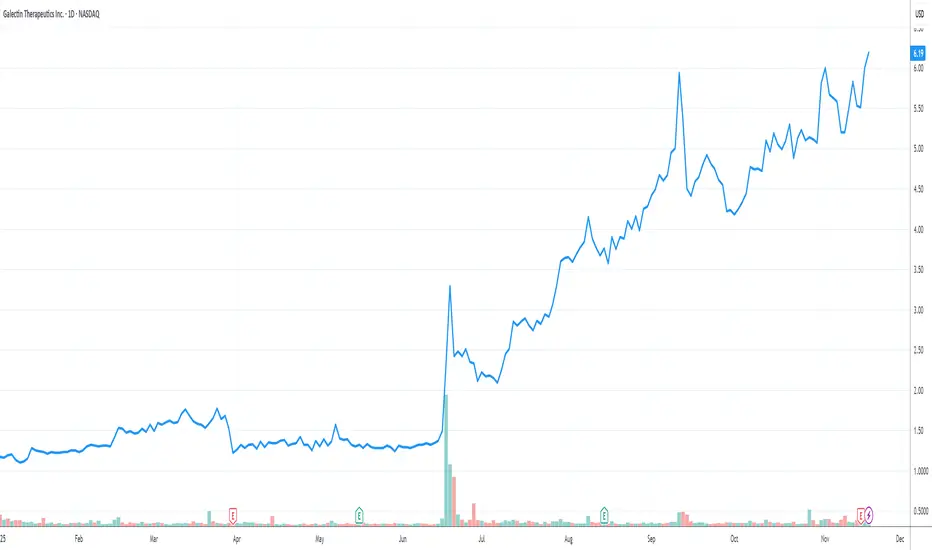
GALT is starting a breakout after reporting good news at the AASLD liver conference for the #1 untapped market for big pharma, liver cirrhosis.
There is prior industry precedent that a buyout could send the stock price into the triple digits.
Why GALT’s Fibrosis Data Are Better Than Any Other MASH Company
1. They are showing fibrosis improvement in true compensated cirrhosis (F4) — the population where EVERY OTHER DRUG HAS FAILED.
Almost all other “great” fibrosis results in MASH come from F2–F3 populations (Akero, 89bio, Madrigal).
Fibrosis moves easily there. But in biopsy-confirmed F4 cirrhosis with portal hypertension, fibrosis essentially does not reverse in modern trials.
This is why Gilead, Intercept, NGM, Novartis, Genfit, and Madrigal all failed in this population.
GALT is the first to repeatedly show biomarker improvement AND fewer clinical events in compensated cirrhosis.
No other company has done that.
2. The magnitude of fibrosis-biomarker improvement is unusually large and consistent across ALL major antifibrotic markers.
At 18 months (NAVIGATE):
• Pro-C3 reduction: >50% vs baseline
This is the main “fibrogenesis” marker.
Competitors usually get ~20–30% reduction in easier F2–F3 patients.
• ELF score: clinically meaningful drop
Again, competitors rarely get ELF improvement in cirrhosis.
• FibroScan liver stiffness: improved
Liver stiffness almost always worsens in F4 patients.
Belapectin produced improvement.
• YKL-40 / other collagen markers: improved
Indicates reduced macrophage-driven scarring.
What’s unique:
Other companies may improve one marker (e.g., ALT, MRI-PDFF, or PRO-C3),
but GALT shows simultaneous improvement across the entire fibrosis parameter set in cirrhosis.
That has not been replicated by any other company.
3. Only GALT has shown a link between fibrosis biomarkers → portal pressure improvement → fewer cirrhosis complications.
This is the reason the field is paying attention.
HVPG (portal pressure) improvement
Belapectin produced meaningful drops in HVPG — the FDA’s gold-standard surrogate for preventing variceal bleeding, ascites, transplant, and death.
No other MASH drug has ever shown a consistent HVPG improvement in cirrhosis.
Reduced clinical progression
Belapectin-treated patients developed fewer new esophageal varices, which is the #1 warning sign of impending decompensation.
This matches the HVPG signal.
It matches the biomarkers.
This “full chain” alignment is unmatched:
Fibrosis biomarkers improve
Portal pressure decreases
Varices occur less often
Disease stays compensated
Other companies haven’t shown this chain — not even close.
4. The 36-month follow-up CONFIRMED the benefit keeps going — something almost no MASH drug has ever shown.
At 36 months:
• New varices incidence: 12.4% at 2 mg/kg vs 23.4% placebo
The advantage persisted for 3 years.
This is extremely rare in cirrhosis.
• Biomarker improvements remained stable
PRO-C3, ELF, liver stiffness all stayed improved.
Durability is critical:
Many drugs show an early signal that disappears later.
Belapectin’s signal strengthens with time.
No other MASH drug has shown a 36-month antifibrotic durability signal with matching clinical outcomes.
5. Mechanistically, belapectin is the only drug directly targeting activated macrophage–galectin-3 fibrosis architecture.
Other drugs target:
Fat reduction (Madrigal)
Metabolic pathways (89bio, Akero)
FGF signaling
Lipid metabolism
Inflammation
Those help in F2/F3 — but not in F4.
Belapectin targets the scaffolding of fibrotic architecture itself by inhibiting galectin-3 on activated macrophages.
This mechanism explains why:
• GALT works in cirrhosis but others fail.
• Biomarker improvements line up across every fibrosis marker.
• HVPG drops.
• 36-month clinical progression slows down.
It’s the right mechanism for the right stage of disease.
6. The field desperately needs a drug for compensated cirrhosis — and GALT is alone.
Every other company is fighting over:
F2/F3
Early fibrosis
Resmetirom-like mechanisms
MRI-PDFF reductions
Triglycerides
ALT normalization
Body-weight changes
But none of that matters in F4.
Regulators, hepatologists, and payers want something that:
Slows portal pressure rise
Prevents varices
Delays decompensation
Reduces need for transplant
Only belapectin has shown all of that together.
THE SIMPLE ANSWER
GALT’s fibrosis data are better than any other MASH company because they succeed exactly where every other program has failed: reversing fibrosis biology, lowering portal pressure, and slowing clinical progression in real compensated cirrhosis — with signals that persist out to 36 months and are consistent across all major biomarker categories.
No other company in MASH has shown:
deep PRO-C3 reduction
ELF improvement
liver stiffness improvement
HVPG reduction
fewer varices
36-month durability
in true F4 cirrhosis
with a fibrosis-architecture mechanism
GALT is alone in that category.
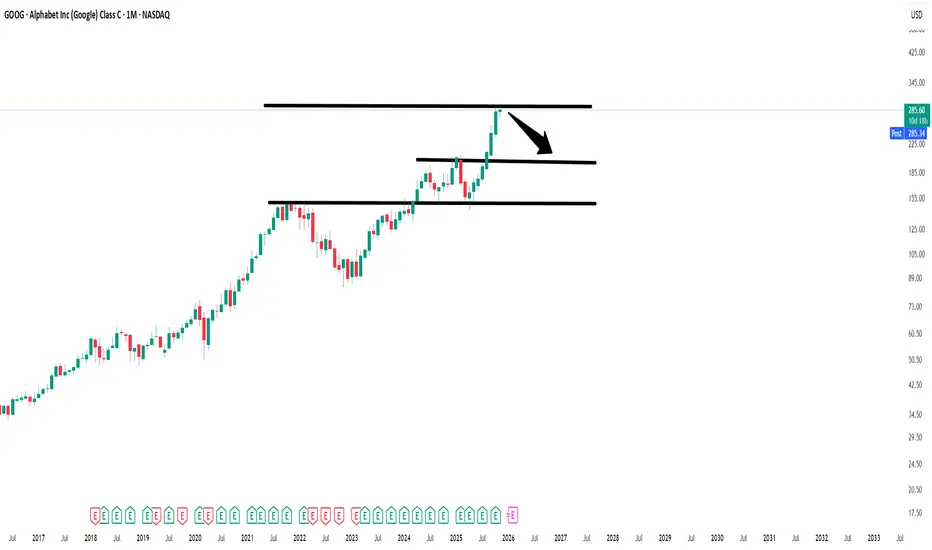
Even The Most Accomplished Make Mistakes $Goog [Berkshire]Berkshire Hathaway made an entrance into the Mag 7 (Excluding Apple) with its purchase of Alphabet / Google I believe that this was a mistake solely based on the fact that the majority of the tech industry is extremely overvalued. While Googles Valuation at least in my opinion is justified considering how strong Its business model is with its High Margin Reoccurring Subscription models (Google Cloud),(YouTube Premium),(Google Workshop),(Google Play) to name a few and how Dominate it is in Ads with YouTube / Chrome. It also Dominates Web Search let alone the majority of people saying they will "Google something" it sounds stupid but its a good mental metric on how people think of search. Google has built Search / web ecosystem to complement each other and force you to use there services in one way or another you are using there web ecosystem everyday from Google maps, to Google Docs or Gmail, they made you dependent on there services, Especially the younger generation (GenZ) is growing very dependent on Google Maps which may be free but shows you the grip they have on peoples web use. The Primary issue I have with Berkshire Hathaway entering at these prices is generally the markets are indiscriminate if the mag 7 or tech industry has a red day no matter how strong Google may be that will bring them down too.
-----------------------
My Personal Thesis on Google:
I am very bullish on several areas of Alphabet Including but not limited to Google Cloud, YouTube, Its subscription Services, Its high Margin software business model. Most Importantly to me is There Robotics Section Deepmind and Gemini Robotics. Robotics is underappreciated and my personal belief is that it is the Next AI like boom but we are very early to this. Robotics has use cases in every industry from Solving lack of labor issues and an aging workforce / population especially in western countries Robots can easily pick up this slack and they will greatly benefit from Artificial intelligence Google / Alphabet has the money and cashflow to heavily invest in this area maybe not creating the physical humanoid robots but they can definitely excel in the software section of it. Segments like Waymo are also interesting and bullish. Google is also massively profitable has very little debt, and an extremely solid balance sheet.
-----------------------
Risks:
I Believe the biggest Risk for Alphabet once again is that The American Tech Sector is extremely Overvalued, I Also See moderate amount of risk being that Google is such a monopoly that leaves it open for Antitrust Suits.
-----------------------
Business Model:
Google Is Vertically Integrated its Business was closely tied to the AI Boom being one of the Big 3 with its AI spending. People Disregard its extremely impressive moat it possesses having one of the strongest moats in tech let alone in the history of business.
-----------------------
Fundamentals:
Cash: US$98.50b
Debt: US$26.60b
Equity: US$386.87b
Total Liabilities: US$149.60b
Total assets: US$536.47b
Net Margins: 32.23%
-----------------------
Metrics:
Return On Equity: 32.1%
Return On Assets: 22.5%
Return On Capital Employed: 28.8%
-----------------------
Valuation:
Price to Sales: 8.9x
Price To Earnings: 27.7x
Price To Book: 8.9x
-----------------------
Disclaimer: I am not Initiating buy, Sell or Hold Opinions. I Only make these posts for Conversation. I am not a financial Expert or an Analyst.
$M2 money printer is about to go brrrM2 money supply could see an increase in the near future due to several key factors. Central banks may adjust monetary policies to inject more liquidity into the economy, while new fiscal stimulus measures could further boost M2. Additionally, rising consumer and business spending might drive up the demand for money. Inflation concerns could also lead central banks to expand M2 to stabilize prices. Keep an eye on these developments as they unfold.
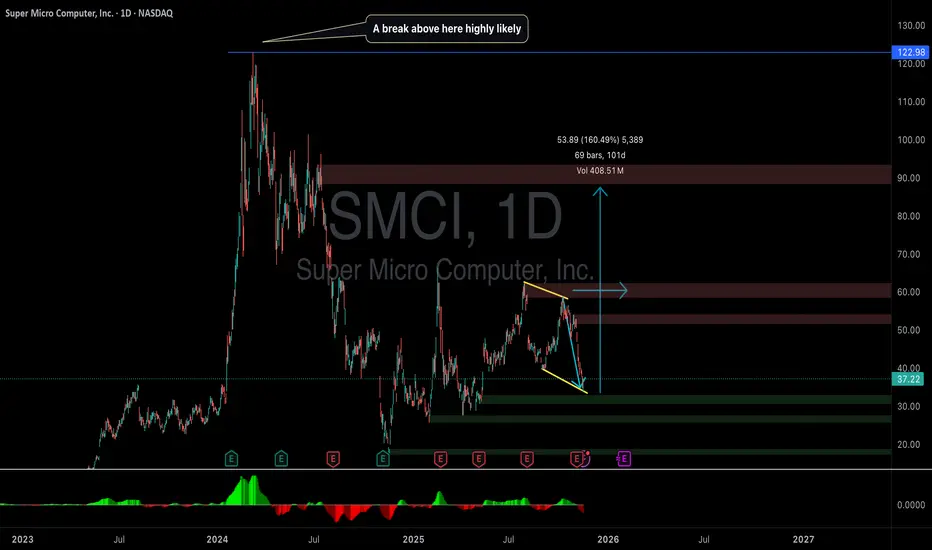
Bullish Case for SMCI: Why the Next Big Move Could Be ExplosiveSuper Micro Computer (SMCI) remains one of the most powerful AI-infrastructure plays in the market, and the bullish setup going into the next quarter looks exceptional.
1. Next Quarter Revenue Forecast: $10B — Up 100% QoQ
Analysts expect SMCI to report $10 billion in revenue next quarter — a 100% jump from the previous quarter.
This kind of acceleration is extremely rare for a company of SMCI’s size.
A triple-digit quarter-over-quarter growth rate signals:
Surging demand for AI servers
Rapid expansion of hyperscaler orders
Strong execution in supply chain and delivery
SMCI taking meaningful market share from Dell, HP, and legacy OEMs
Wall Street absolutely rewards revenue hyper-growth like this.
2. AI Infrastructure Demand Is Exploding
AI training and inference workloads are scaling at a pace never seen before. Every major AI company is racing to expand server capacity, and SMCI has positioned itself as:
Faster than competitors
Cheaper to deploy
Highly customizable
NVIDIA’s preferred partner for next-gen GPU systems
As long as AI accelerators remain the hottest commodity in tech, SMCI remains at the center of that demand.
3. Margins Are Expanding With High-End Configurations
High-performance racks built around H100, H200, B100, and next-gen NVIDIA/AMD GPUs carry much higher margins.
More customers are upgrading to fully-integrated racks rather than low-tier components.
This means earnings could beat expectations, not just revenue.
4. SMCI Is Becoming a Core AI Index Play
Funds that want exposure to AI infrastructure don’t have many pure plays available. SMCI is now viewed as:
A backbone of AI datacenters
A beneficiary of every new GPU cycle
A growth stock with real earnings, not hype
This attracts institutional inflows during AI-sector rotations.
5. Technical Setup Supports a Bullish Breakout
Although volatile, SMCI consistently builds higher lows over time.
With a $10B revenue forecast ahead, sentiment could flip extremely fast.
A strong earnings beat + raised guidance can trigger:
A major gap-up
Short covering
Renewed momentum buying
Bottom Line
SMCI is entering one of the strongest growth phases in its history. With revenue expected to double next quarter, rapidly expanding AI demand, and improving margins, the setup is highly bullish.
If the company delivers anything close to the $10B forecast —
the stock could reprice sharply to the upside.
Insight Enterprises | NSIT | Long at $92.10Insight Enterprises NASDAQ:NSIT
Technical Analysis
Price entered my "crash" simple moving average zone. Often, but not always, this is an area of algorithmic share accumulation and price reversal. A red flag, however, is that there are still open price gaps on the daily chart down to $50. A green flag is that there are open price gaps up to $215. While the price gaps below will likely get filled in the future, I am betting on a short-term reversal (if not longer-term one) given the prospective growth and its current P/E of 20x (electronic industry currently near 30x).
Insight AI
Stock enters the "crash" zone, and suddenly there is an generative AI announcement to drive revenue and EPS growth: www.businesswire.com . Intentional drive down of stock price for entry? Time will tell.
Revenue and Earnings-per-Share Growth into 2028
Revenue: $8.32 billion in 2025 to $9.88 billion in 2028 (+10.8%)
EPS: $9.64 in 2025 to $12.38 in 2028 (+28.4%)
Health
Debt-to-Equity: 0.9x (pretty good)
Quick Ratio / ability to pay current bills: 1.3 (1.5-3.0 is ideal, but still pretty good)
Alman's Z Score / risk of bankruptcy: 1.8 (3+ is ideal, so moderate risk)
EBIDTA: 5% to 7% range, which is generally considered healthy
Action
Given the "value", AI integration, technical analysis assessment, and growth, NASDAQ:NSIT is in a personal buy zone at $92.10. Caution if the stock dead-cat bounces and aims to drop further into the $50s, but I suspect fundamentals will have to dramatically change in the near-term for that to happen (or the economy crashes)...
Conservative Targets into 2028
$105.00 (+14.0%)
$117.00 (+27.0%)
High Growth Super APP at under 6 PEKaspi is a super app with ecommerce, fintech, mobile payments and more all in one.
High Profit margin, High growth potential and trading at a very low PE.
Not without risk, the stock is in Kazakhstan, right below Russia.
"Kaspi is like the Amazon + PayPal of Kazakhstan – one app for shopping, paying bills, and loans. Everyone uses it, so it keeps growing fast.
It makes a ton of money on every dollar it earns – 35 cents profit per $1 in sales, way better than most companies.
The stock is on sale – costs $71 but could be worth $489 next year if people see how fast it grows.
Grows earnings 18% every year – like your allowance doubling every 4 years, forever.
Almost no debt – only owes 27 cents for every $1 it owns, super safe.
Holds $2 billion cash – enough to buy back shares or expand without worry.
Bosses own 44% of the company – they win only if you win.
Expanding to Turkey – like opening new stores in a bigger mall.
Makes $6.74 free cash per share – could pay big dividends later or grow faster.
If growth stays, $71 today → $2,164 in 10 years – "
DUOLINGO AI MAXThe recent sentiment for Duolingo has been shaky. Leveraging AI to maximize content output has not exactly translated well for Duolingo. AI content is controversial, and tests lost some accuracy. They also wish extend their reach by offering different subjects now that they believe the content is ready to produce. Is it really necessary or could this be similar to what Meta tried to do when they pushed their Metaverse ambitions? Will mistakes need to be made first before finding something that makes sense? Despite the controversy and upset loyal users, growth companies will behave like visionaries until they are slapped back into reality.
According to documents from 2023 to 2025, Duolingo financials show consistent high growth numbers, stable but slightly compressing margins, and rapidly improving profitability.
On revenues, the company reports remarkable momentum driven primarily by subscription growth. ~+40% YoY, $754.7 this year so far.
User Metrics:
MAU = 135.3M, +20% YoY
DAU = 50.5M, +36% YoY
Paid Users = 11.5M, +34% YoY
Margins remain exceptionally high for a software subscription business, showing strong operating leverage, with mild compression due to AI-Driven product investment.
Gross Margins:
2025 YTD: 72%
2024: 73%
2023: 73%
Duolingo has entered a highly profitable scaling phase. The business is transitioning from growth-mode to cash-generative compounding mode. R&D and G&A is growing slower than revenue.
Given rising net income and expanding equity base, ROE is improving materially as operating leverage continues. ROC is surging upwards as the company shifts from R&D heavy to monetization heavy. In other words, low capital requirements and rapidly expanding operating income.
An intrinsic value of $260 - $345 aligns with its hard to replicate network effect, high FCF conversion, and growing margins.
Thinkific Labs (TSX: THNC) - Swing Trade💰 THNC — Swing Trade Breakdown (TSX)
🏢 Company Snapshot
Thinkific Labs (TSX: THNC) is a Vancouver-based SaaS company that enables creators and enterprises to build, market, and sell online courses. It’s been drawing attention recently after stabilizing near multi-month lows, with earnings on deck and improving cash flow signaling a possible turnaround setup.
📊 Fundamentals
THNC trades at roughly 180× earnings (TTM) — stretched versus typical software peers around 20–40×, though its profitability base is small.
P/B is ~2.4×, which is reasonable given its strong cash position (~C$71M) and minimal debt (D/E ≈ 0.04).
ROE sits around 1.6%, showing that profitability is still in the early stages of improvement.
It doesn’t pay a dividend, staying fully growth-focused.
Free cash flow sits near C$12M, giving it enough flexibility to reinvest while maintaining a solid liquidity cushion.
Summary: Fundamentally sound balance sheet and cash reserves, but expensive valuation and low profitability — typical for an early-stage SaaS recovery story.
📈 Trends & Catalysts
Revenue growth is soft but positive (+1.6% QoQ).
EPS has turned slightly positive — small profits are emerging, marking a potential inflection point.
Cash flow and liquidity continue improving, with consistent positive free cash flow.
Upcoming Q3 2025 earnings (Nov 12) could serve as a catalyst, especially if margins expand.
Risks include rich valuation, competitive pressure in the e-learning space, and lingering weakness in software sentiment.
🪙 Industry Overview
The software and e-learning sector has been mixed. Over the past month, THNC is down roughly 11%, lagging peers. Over 12 months, it’s down about 27%, underperforming the sector amid a shift toward profitability and AI-driven platforms. Short-term sentiment is neutral to slightly bearish, but any strong beat in earnings could quickly flip that tone.
📐 Technicals
THNC closed around C$2.11, sitting slightly above its 50-day SMA (~C$2.05) — an area of near-term support.
The 200-day SMA (~C$2.41) looms overhead as a key resistance marker.
Momentum has cooled, but the stock is consolidating tightly between C$2.00 and C$2.15, showing signs of base-building.
Support sits at C$2.00–2.10, resistance around C$2.40–2.70.
Volume remains light (~50–80k shares/day), so watch for a breakout day with strong volume to confirm demand.
Pattern: Tight consolidation near support after a steep decline — potential for a reversal or relief rally if volume spikes.
RSI(2): Neutral — no oversold or overbought signal currently.
🎯 Trade Plan
Entry Zone: C$2.05–2.15 — ideal for accumulation near support or a 50-SMA retest.
Stop Loss: C$1.95 — below key support; invalidates base.
Target: C$2.70 — aligns with resistance and 200-SMA retest.
Risk/Reward: Approx. 2.7× (solid swing setup).
Alternate Setup: Breakout above C$2.50 on strong volume could trigger a momentum continuation toward the high C$2s.
🧠 My Take
THNC offers a low-risk swing setup with improving fundamentals and technical stabilization. It’s cash-rich, debt-light, and forming a potential base around C$2.00. While long-term momentum remains bearish (still below 200-SMA), short-term traders can target a bounce back to C$2.70 if earnings or sentiment improve.
My bias: Cautiously bullish — watching for entry near C$2.05 with tight risk below support and a 2:1+ R/R toward the C$2.70 zone.
ASTS 4H: space internet or orbital dream?AST SpaceMobile (ASTS) is consolidating above the $61–69 zone, right near the 0.618 Fibonacci level of its last major rally. On the 4H chart, momentum shows early reversal signs: falling volume on pullbacks, stochastic turning up, and buyers defending local lows. The bullish setup holds as long as price stays above $61, with upside targets at $100 and $135 where the extension projection aligns.
Fundamentally , as of November 2025, ASTS stands out as one of the most promising yet capital-intensive players in the satellite telecom industry. The company completed deployment of its BlueWalker test constellation and is preparing for commercial rollout of direct-to-cell satellite connectivity. Successful phone-to-satellite calls using standard smartphones - validated with AT&T and Vodafone - mark a true technological milestone, positioning ASTS as a potential first-mover in global space-based mobile internet.
Revenue for the first nine months of 2025 reached roughly $55M, almost double last year’s level, but operating losses still exceed $300M due to high manufacturing and launch costs. The company holds about $180M in cash versus ~$260M in debt, continuing to rely on strategic partnerships and funding programs to maintain liquidity. The key upcoming catalyst is the commercial network activation in 2026 in cooperation with AT&T, Vodafone, and Rakuten, which could dramatically change valuation if successful.
With investor attention shifting back to space communications, competition with Starlink and Lynk Global is heating up, but ASTS’s advantage lies in using standard smartphones without extra hardware. Risks remain - high capital needs, launch delays, and dependency on partner timelines - yet the reward potential is extraordinary if execution holds.
Tactically, staying above $61 keeps the bullish structure alive with $100 and $135 as primary targets. A breakdown below $60 would negate the setup.
They’ve already connected phones to space - now let’s see if they can connect revenue to profit.
NOVAGRATZLOADED shares at $29.45 Friday. This is MSTR on steroids with actual revenue + AI data centers.
Just printed their best quarter ever ($505M net income, ~$29B rev) thanks to a $9B BTC whale trade 80k+ BTC sold OTC with minimal slippage + exploding trading volumes. But the real rocket fuel is HELIOS AI/HPC pivot: 800MW live, 2.7GW pipeline, NASDAQ:CRWV locked in for $435M+ annual EBITDA potential. Morgan Stanley calls it $30B terminal value. $1.15B convertible notes at 0.50%? Dirt-cheap capital to fund growth — not dilution yet. Catalysts: BTC >$120K (Galaxy amplifies 2-3x)
Helios revenue ramp H1 2026 On track for initial energization/power-up in December 2025
Technicals: Broke out of multi-month base
RSI cooling after dip (oversold bounce incoming)
Volume shelf at $29 = strong support $25 floor
Golden cross forming on weekly
This dip was the last shakeout post-notes FUD.
Add on dips around $30
Trail stops or take partials above $45
Full send to $60+ this year if BTC rips
Helios power-up = moonshot. Estimates backward-looking; if Helios hits + crypto cooperates, Q4 crushes again (revenue normalizes but margins fatten). $60+ YE
A SetupWhat qualifies as an A+ setup (Big Three)
Compression: A valid Big Three squeeze on your chosen timeframe.
Signal: Big Three Buy Signal present.
Trend filter: Price above the moving averages.
Multi-timeframe game plan
Anchor (bigger picture): Daily / 3-day squeezes to define backdrop & runway.
Trigger (trade timeframe): 2-Hour (or 30-min/15-min/5-min) A+ squeezes for entries.
Bias maintenance: Hold only while the price stays above the trailing stop and the structure stays bullish.
Pre-flight checklist (grade it fast)
Squeeze present on your entry timeframe (2h / 30m / 15m / 5m).
EMA stacked in order (no exceptions for A+).
Trend/structure: Uptrend or at least neutral turning up.
Bigger picture alignment: Daily / 3-day not fighting you; momentum not deeply negative.
Nearby “fuel” (levels): Key MAs (e.g., daily 50), pre-break accumulation, gamma call walls, and recent highs.
Entry & management (simple and consistent)
Entry trigger options
First break out of the squeeze range with structure and signal intact.
Or pullback-to-hold above trailing stop/MA inside the squeeze; buy the next higher low → higher high sequence.
Initial risk
Stop: just below the trailing stop or last pivot low inside the squeeze.
Positioning: size so a stop hit ≈ 0.5R of daily risk (or less).
Profit taking
Tier 1: prior swing high / measured move from squeeze range.
Tier 2: roadmap targets (recent highs, round numbers, and gamma walls).
Trail partial with trailing stop; roll or trim if momentum cools.
What cancels A+ mid-trade
Lose the buy signal and close below the trailing stop, 8 EMA.
Momentum rollover on your entry TF while higher TFs aren’t supportive.
Repeated failed reclaims of the squeeze top.
Plan
A+ vs “Almost A+” (how to decide)
A+ now = All four: Squeeze + Buy Signal + Above trailing stop.
Almost A+. Missing momentum.
Action: Stalk on lower TFs (5m/15m) for earlier entries, but only size up when the main TF prints full A+.
Execution guardrails (to keep your edge)
Don’t force entries before the squeeze/score/signal align—let it become A+.
If you take a starter on a lower TF, earn the add-on higher-TF confirmation.
Respect gaps: lock tiers into gap pushes from active squeezes.
Keep a daily max loss; after 2R down or 2 invalid setups, flatten and reset.
Screener:
www.tradingview.com
CANSLIM Overview📘 CANSLIM Overview — The 7 Traits of Big Stock Winners
CANSLIM is an acronym developed by William J. O’Neil, founder of Investor’s Business Daily (IBD) and author of How to Make Money in Stocks.
It describes the seven common characteristics shared by the biggest winning stocks before their major price moves.
The system blends fundamental growth, institutional behavior, and market timing—and is grounded in historical quantitative studies dating back to the 1800s.
🧩 The Acronym:
Letter Stands For Core Concept
C Current Quarterly Earnings Explosive short-term earnings growth
A Annual Earnings Growth Multi-year compounding of profits
N New Product, Service, or Management Innovation driving market leadership
S Supply and Demand Stock’s float size and institutional accumulation
L Leader vs. Laggard Relative strength and group leadership
I Institutional Sponsorship Quality fund ownership and buying pressure
M Market Direction Aligning with the general market trend
1️⃣ C — Current Quarterly Earnings: Big Growth, Not Modest Growth
“The biggest winners showed three consecutive quarters of 25%+ growth, but the best averaged 70%+ before their runs.”
Measure this quarter vs. the same quarter last year, not sequentially. This avoids seasonal distortions.
Ideal Growth Rate:
Minimum: +25% YoY EPS growth for 3+ quarters
Stronger filter: +70–100% or even triple-digit earnings growth
Combine with revenue growth of 30–50% or more.
Stocks with massive EPS and sales growth attract institutional attention early.
Modern Adjustment:
Today’s growth leaders (e.g., NVDA, TSLA, PANW) still show these patterns, though some use non-GAAP EPS or adjusted metrics. The concept—explosive profitability inflection—remains identical.
2️⃣ A — Annual Earnings Growth: Sustained Profitability
“Look for at least three years of annual earnings increases.”
Consistency is key. Accelerating growth adds conviction.
Avoid one-time spikes or negative earnings trends.
Favor firms with 3+ years of 20%+ annual EPS growth and positive forward analyst estimates for continuation.
Analyst Upward Revisions are particularly powerful—funds often buy on these changes.
Interpretation:
Multi-year profit acceleration shows management execution, competitive edge, and strong demand.
Example: O’Neil’s model studies (1952–2001) showed 73% of winners had +70% EPS growth the quarter before their breakout and 3+ years of rising annual profits.
3️⃣ N — New Product, Service, Management, or Market Catalyst
“You want the next Apple, not the next RCA.”
Innovation is the engine of multiple expansion. The “new” can take many forms:
Breakthrough product or service
Transformative business model
New leadership or management
Market share disruption
Examples (then and now):
Apple (iPhone), Tesla (EVs), Nvidia (AI GPUs), Uber (gig economy)
Earlier eras: IBM, Home Depot, Microsoft
Psychological angle: Human nature craves novelty. The market rewards perceived future dominance, not current stability.
4️⃣ S — Supply and Demand: The Float Matters (Less Now)
Originally, O’Neil favored smaller floats (≤50–70M shares) since limited supply + strong demand = sharp price moves.
“It’s less critical today—large caps can still double or triple. Focus on quality, earnings, and leadership over share count.”
The principle still holds but is muted due to:
ETFs, passive flows, and massive institutional liquidity
Widespread retail access and option leverage
The core idea remains: price rises when demand exceeds supply, visible via volume surges.
Modern adaptation:
Monitor volume spikes, accumulation/distribution, and relative volume ratios over absolute float size.
5️⃣ L — Leader vs. Laggard: The Power of Relative Strength (RS)
“Buy the strongest stocks in the strongest groups during a confirmed uptrend.”
O’Neil found each bull cycle is led by 2–3 dominant industry groups (e.g., semiconductors, software, solar).
Within those, only the top few names outperform meaningfully.
Key Filters:
Relative Strength (RS) Rating: 85–99 (top 15% of market)
Leading groups by RS, EPS growth, and fund buying
Avoid laggards even within strong sectors.
Modern context:
Institutional algorithms still chase relative momentum. RS-based filters would be Ideal.
“When you have the strongest stocks, in the strongest sectors, in an uptrend—and you use disciplined stop-losses—it’s very hard not to make money.”
6️⃣ I — Institutional Sponsorship: The Smart Money Footprint
“70% of market volume comes from institutions—follow their footprints.”
Institutions (mutual funds, hedge funds, pension plans) create sustained demand that drives major trends.
Key things to watch:
Rising number of institutional holders quarter-over-quarter
Presence of high-quality funds (e.g., Fidelity Contra, Vanguard Growth)
Volume patterns on charts confirming accumulation
Quantitative Significance:
Example: Zoom (ZM)—278 funds → 1,413 funds within 7 quarters (5× increase)
Enphase (ENPH)—160 → 1,008 funds in 8 quarters
Such surges often precede parabolic price advances.
7️⃣ M — Market Direction: The Most Critical Factor
“If you don’t get the M right, nothing else matters.”
O’Neil’s data showed:
3 out of 4 stocks follow the general market trend.
Even perfect fundamentals fail in bear markets.
Core Rule: Only buy aggressively during a confirmed market uptrend.
The signal is the Follow-Through Day (FTD)—a +1.5% or greater gain on strong volume, typically 4–10 days after a market low.
When the Market Is Choppy or Bearish:
Reduce exposure or move to cash (cash is a position).
Focus on capital preservation over prediction.
⚠️ Risk Management — The “Eighth Principle”
“You can be right 1 out of 3 times and still make a fortune—if you cut losses fast.”
O’Neil borrowed from Jesse Livermore and Bernard Baruch’s philosophy:
Max loss per trade: 7–8% (ideally 5%)
Never average down; if it fails the breakout, sell immediately.
Emotional capital matters as much as financial capital.
Risk Math:
Loss Required Gain to Break Even
7% +7.5%
20% +25%
50% +100%
→ The deeper the drawdown, the harder recovery becomes — and the worse your discipline gets.
Cutting losses early keeps both capital and confidence intact.
Advanced Discipline:
Always use stop-losses near pivot points
Size positions so that total portfolio risk ≤1–2% per trade, and the Reward is 3x your risk.
Expect that most trades won’t work; winners will more than offset losers
🔢 Practical CANSLIM Checklist
Step Criterion Target Metric
C Current quarterly EPS growth ≥25%, ideally 70%+
A Annual EPS growth 3 consecutive years ≥20%
N Innovation or catalyst New product/service/management
S Supply-demand imbalance Volume > average, low float optional
L Leadership RS ≥85; top 3 names in top sector
I Institutional ownership Increasing QoQ, ≥2 top-tier funds
M Market trend Confirmed uptrend via FTD
Risk Stop loss 5–8% below entry, always enforced
🧠 Psychological Cornerstones
Human nature never changes. Fear and greed drive every cycle—from 1800s railroads to 2020s AI stocks.
Discipline beats prediction. Entry precision is less important than loss limitation.
Conviction comes from quality. Big winners are clear leaders with strong fundamentals.
Cash is a position. Avoid trading in “cold decks” (sideways or down markets).
Emotion control = longevity. Protect your confidence as much as your capital.
🧩 Modern CANSLIM Adaptations
While CANSLIM’s DNA remains timeless, modern quantitative investors integrate:
Relative Volume & RS Ranking (machine-scored)
EPS revision momentum (analyst upgrades)
Institutional rotation data (13F filings, ETF flows)
Macro context: liquidity cycles, Fed policy, credit spreads
Technical refinements: base patterns, volume dry-ups, and volatility contraction setups (VCP).
💬 Summary Insight
“Nothing has changed since the 1800s—only the tools.
Human nature and crowd behavior are constants.”
CANSLIM is a structured behavioral framework for spotting institutional accumulation of fundamentally superior companies at the right time in the market cycle.
Its greatest edge lies not in stock-picking, but in discipline—knowing what not to touch, when to cut, and when to press.
Here is the Screener I use.
www.tradingview.com
Rolls-Royce is Going to the Moon (Literally)Its Friday night and here I am with nothing better to do than write an article on what I think is one of the most interesting companies on the market. I am absolutely enamored by Rolls-Royce for reasons I am going to explain in depth. I don't want my idea to be long and boring so I'm going to get straight to the point and explain as best as I can in a few paragraphs. There's a lot of information I want to share with you about this company so I will break the idea up into sections for an easier and more enjoyable reading experience.
Normally I would start my idea writing about the intrinsic value, I'm going to skip that because this company is incredibly overvalued as per the numbers I ran. By the end of this idea hopefully you might learn something new or find value in my writing, I am writing this idea for educational and entertainment purposes. In no way does this idea constitute financial advice but rather provide you with the all the information required to make intelligent and rational financial decisions based on facts, I am not one to be speculating about the market, I prefer to have good reasons to make investments.
As a capitalist, one of the most important things I think about before making a financial decision, is how does the company I am interested in make financial decisions. In this section I will write about how Rolls-Royce uses capital primarily to fund long-term strategic investments in R&D, advanced manufacturing, and new technologies (e.g., SMRs, electric systems), and for efficient working capital management to support day-to-day operations and a strong balance sheet.
A significant portion of capital is invested in R&D to maintain a competitive advantage and innovate. This includes developing new engine technologies (like the UltraFan and the Pearl engine family), improving engine efficiency and durability ("time on wing"), and exploring lower-carbon solutions such as sustainable aviation fuels (SAF), hybrid-electric propulsion, and small modular nuclear reactors (SMRs).
Rolls-Royce invests in property, plant, and equipment. Recent examples include investments in its manufacturing facilities (such as the £300 million investment at the Goodwood facility) to enhance capabilities for bespoke projects and improve operational efficiency.
The company focuses on the efficient management of short-term assets and liabilities to ensure robust liquidity and the ability to meet day-to-day expenses. Key aspects include:
- Inventory management: Balancing stock levels to support production and MRO (Maintenance, Repair, and Overhaul) services while avoiding excess inventory.
- Receivables collection and payables management: Optimizing cash flow by managing customer relations and supplier payments strategically. The business model for civil aerospace, where revenue comes from engine servicing based on flying hours (Long-Term Service Agreements), heavily influences its working capital dynamics and provides a stable cash flow stream.
Rolls-Royce makes strategic portfolio choices, using capital for acquisitions in key growth areas (e.g., a yacht automation business) and using proceeds from divestitures of non-core activities to reallocate resources to higher-return segments.
A primary goal is maintaining a strong balance sheet with an investment-grade profile. Once this strength is assured, capital is used for shareholder distributions, including reinstating and growing dividends and engaging in share buybacks (e.g., a £1 billion share buyback announced for 2025).
Rolls-Royce is currently executing a share buyback program to return up to £1 billion to shareholders. The program was announced on February 27, 2025, and is expected to be completed no later than December 31, 2025.
The buyback aims to repurchase up to £1 billion worth of shares by the end of 2025. As of July 31, 2025, £0.4 billion (£400 million) had been completed. The purpose is to reduce share capital and fulfill obligations from employee share plans, which should increase earnings per share. UBS AG London Branch is managing the purchases on the London Stock Exchange and other exchanges, operating under the authority granted at the 2024 Annual General Meeting. This share buyback is part of a larger capital return strategy, including a reinstated dividend, reflecting the company's financial turnaround.
Now I will write about what I find interesting to me about Rolls-Royce;
Rolls-Royce has a partnership with NASA and the UK Space Agency to develop micro-nuclear reactors for lunar habitation and exploration. While a full reactor is not yet built, the collaboration is focused on design, development, and testing phases to have a functional system ready for the Moon by the early 2030s.
Key details about the partnership include;
To provide a reliable, continuous, and powerful energy source for a future human lunar base, especially in permanently shadowed regions of the lunar South Pole where sunlight is scarce or non-existent. Rolls-Royce is developing a small, lightweight nuclear fission micro-reactor that measures about 1 meter wide and 3 meters long. This system would produce around 40 kilowatts (kW) of power, enough for a lunar outpost's life support, communications, and scientific experiments.
Roles in the lunar program;
Rolls-Royce: Responsible for the design and development of the reactor concept itself, leveraging its expertise from decades of building nuclear power plants for the UK's submarine fleet.
NASA: Leads the overall Fission Surface Power project and has awarded separate contracts to multiple industry partners (including Rolls-Royce North American Technologies, General Electric, and Brayton Energy) to develop specific components, such as power converters that turn the reactor's heat into electricity.
UK Space Agency: Provides significant funding to Rolls-Royce for research and development, aiming to get a demonstration model on the Moon by 2029 or the early 2030s.
A conceptual model of the micro-reactor has been unveiled. The focus is currently on detailed design stages and developing power conversion technology, with an open solicitation planned for Phase 2 of the project in 2025. The technology is seen as a crucial stepping stone not only for the Moon but also for powering human missions to Mars and for potential commercial and defense applications on Earth, such as providing clean energy to remote locations.
Under CEO Tufan Erginbilgiç, the company has undergone a "miraculous" transformation from a "burning platform" to a robust, cash-generating business. This has resulted in soaring profits, strong free cash flow, and a significantly strengthened balance sheet.
Rolls-Royce operates in industries with high barriers to entry due to the specialized technology, safety regulations, and huge capital requirements involved. Its large, established base of engines ensures a stable stream of aftermarket revenue.
Management has a history of setting conservative forecasts and then outperforming them, which suggests potential for future positive surprises for investors.
In summary, Rolls-Royce offers a compelling investment case for growth oriented investors willing to pay a premium for a high-quality company with a strong competitive position and clear catalysts for future growth.
ESPR 1W: cholesterol therapy for patients and investors alikeEsperion Therapeutics (ESPR) has broken its long descending trendline and retested the $2.4–$2.6 support area, forming a solid triple bottom with rising volume. The stock is now holding above key moving averages, signaling accumulation. While above $2.5, the technical setup points to a move toward $6.4, aligning with major resistance and the 200-week MA.
Fundamentally, the company enters one of its strongest phases in years. Following earlier liquidity struggles, Esperion has stabilized its operations and regained investor confidence. The core growth driver is Nexletol (bempedoic acid), a non-statin cholesterol-lowering therapy for patients intolerant to statins. In 2025, combined Nexletol and Nexlizet sales jumped over 45% year-on-year, surpassing $170 million for the first nine months. Recent safety data were positive, leading to new approvals across Europe and Japan - expanding partnerships and licensing revenues. Cash position strengthened via milestone payments from Daiichi Sankyo and Viatris, reducing debt and supporting R&D without new dilution. Challenges remain: profitability is still out of reach, as marketing and development expenses stay high, though liquidity provides breathing room. The broader biotech sector’s rebound amid rate-cut expectations adds tailwind to revenue-backed small caps like Esperion.
Tactically, holding above $2.5 keeps the bullish trajectory intact toward $6.4. A weekly close below $2.3 would negate the setup and re-test lower support, though current accumulation favors the upside.
Esperion helps reduce cholesterol - ironic that its chart still raises investors’ heart rate.
I Think GE Aerospace is BrilliantThis is one of my favorite companies on the market. I really have a deep fascination for aviation and all things, planes. Naturally it makes sense for me to have exposure to the sector. I do not have many companies in my portfolio but I'm going to share my reasons for why I have been buying GE stock over the last few months.
The value of the shares are, in my opinion overvalued right now at this price. I am going to explain why I still think this is a good investment despite the numbers coming back negative. The intrinsic value of the stock as per my model is $250. Indicating a significant overvaluation, I think my reasons for not selling and possibly buying more are sufficient fundamentally to still hold the stock in my portfolio.
The primary reasons I like this company above all the others is because of how they are using capital in their business;
GE Aerospace invests heavily in developing future technology, including advancements in Open Fan engines, hybrid electric propulsion, and hyper sonics. The company is investing in its supply chain, facilities, and suppliers to meet rising demand and improve production and service capacity. Capital is used to help customers update and expand their fleets, supporting the demand for GE Aerospace's products and services.
The company plans to return approximately 70–75% of available funds to shareholders through dividends and share buybacks, a significant increase from previous levels. This capital return strategy is intended to generate incremental value for shareholders, in addition to the company's expected growth.
A significant portion of capital is dedicated to increasing its global capacity for servicing engines to meet growing demand and support its engine platforms for decades. After the spin-off of GE Vernova, GE Aerospace retained a strong cash position that was used to fund the new company. As part of its launch as a standalone public company, GE Aerospace awarded one-time equity awards to employees to make them owners of the business.
That is all the reasons why I think this company is a good investment, fundamentally.