BTC/USDT | Bitcoin Drops Hard – Key Demand Zones Now in Play!By analyzing the #Bitcoin chart on the daily timeframe, we can see that BTC failed to hold above $104,700, and as expected, this led to a heavy sell-off. First, the price dropped to $94,000, and then a second strong wave pushed it down to $89,000. Bitcoin is now trading around $91,000.
Key supply zones and demand zones are marked on the chart. Important demand levels sit at $88,000, $84,000, and the larger zone at $74,000–$78,000. Watch how the price reacts to these areas.
If Bitcoin wants to recover, it must first hold above these key zones. But if BTC breaks below $74,000, it could open the door for a deeper drop toward $50,000. For now, focus on price reactions at the marked demand levels.
Please support me with your likes and comments to motivate me to share more analysis with you and share your opinion about the possible trend of this chart with me !
Best Regards , Arman Shaban
Trade ideas
DeGRAM | BTCUSD is testing the $90k level📊 Technical Analysis
● BTC/USD is testing a major support cluster near 88–90K, where price aligns with the long-term dynamic support line formed from previous triangle and flag breakdowns.
● The new rejection wick at support and the descending channel structure suggest a potential medium-term rebound toward 95–97K if buyers defend this level.
💡 Fundamental Analysis
● Bitcoin sentiment stabilizes as ETF inflows resume and risk assets recover after easing US inflation expectations.
✨ Summary
Support: 88–90K. Rebound potential: 95–97K. Medium-term bullish scenario valid while holding the dynamic support.
-------------------
Share your opinion in the comments and support the idea with a like. Thanks for your support!
Mastering RSI: A Complete Guide to Momentum🔵 Mastering RSI: A Complete Guide to Momentum, Regimes, Reversals & Professional Signals
Difficulty: 🐳🐳🐳🐳🐋 (Advanced)
This article goes far beyond the basic idea of “RSI = overbought/oversold.” If you want to truly master RSI as a momentum gauge, trend filter, reversal tool, and structure confirmation model, this guide is for you.
🔵 WHY MOST TRADERS MISUSE RSI
Most traders use RSI in the simplest way:
RSI above 70 = sell
RSI below 30 = buy
This leads to shorting strong trends and catching falling knives.
RSI is not a reversal button. RSI is a momentum translator.
To master RSI, you must understand:
Trend regimes
Momentum pressure
Acceleration and deceleration
Failure swings
Divergences
Trend vs range behavior
Multi-timeframe alignment
Structure confirmation
RSI shows the strength behind price, not just extremes.
🔵 1. RSI TREND REGIMES (CORE FOUNDATION)
RSI moves in predictable zones depending on the type of market environment.
Bullish RSI Regime
RSI holds between 40 and 80
Pullbacks bottom around 40–50
Breaks above 60 show trend acceleration
Bearish RSI Regime
RSI holds between 20 and 60
Pullback tops form around 50–60
Breaks below 40 confirm bearish dominance
These regimes tell you who controls the market before you even look at candles.
🔵 2. MOMENTUM PRESSURE (RSI AS A SPEEDOMETER)
RSI measures the speed and pressure of price movement.
Rising RSI with rising price = trend acceleration
Falling RSI with rising price = momentum weakening
Rising RSI with falling price = early strength
Falling RSI with falling price = continuation pressure
This is not divergence. It is momentum pressure, the earliest sign of trend shift.
🔵 3. FAILURE SWINGS (THE MOST RELIABLE RSI REVERSAL SIGNAL)
Failure swings are powerful because they show internal momentum breaking before price reacts.
Bullish Failure Swing
RSI makes a low
RSI rallies
RSI dips again but stays above previous low
RSI breaks the previous high
Bearish Failure Swing
RSI makes a high
RSI pulls back
RSI rallies but fails to break the previous high
RSI breaks the previous low
Failure swings often appear at trend tops and bottoms before candles reveal anything.
🔵 4. DIVERGENCES (REGULAR AND HIDDEN)
Regular Divergence: Reversal Clue
Bullish: price lower low, RSI higher low
Bearish: price higher high, RSI lower high
Hidden Divergence: Trend Continuation
Bullish hidden: price higher low, RSI lower low
Bearish hidden: price lower high, RSI higher high
Hidden divergence is more powerful than regular because it confirms trend continuation.
🔵 5. RANGE RSI VS TREND RSI
RSI behaves very differently in ranges versus trends.
Range Environment
RSI oscillates between 30 and 70
Reversals at extremes have high accuracy
RSI 50 is the equilibrium
Trend Environment
RSI stays above 50 in bullish trends
RSI stays below 50 in bearish trends
30 and 70 extremes lose meaning
Always identify environment first. RSI signals change depending on regime.
🔵 6. RSI AS A STRUCTURE FILTER
RSI combined with structure improves trade selection dramatically.
Price makes higher highs + RSI rising = healthy trend
Price makes higher highs + RSI flat = weak breakout
Price makes higher highs + RSI dropping = exhaustion
Support retest + RSI 40–50 = strong continuation potential
Most false breakouts are avoided simply by checking RSI pressure.
🔵 7. MULTI-TIMEFRAME RSI ALIGNMENT
Use higher timeframe RSI to validate lower timeframe setups.
HTF RSI bullish + LTF RSI pullback = high-quality entry
HTF RSI bearish + LTF RSI bounce = premium short area
HTF RSI crossing 50 = long-term regime shift
This is one of the most powerful RSI confluences.
🔵 EXAMPLE TRADING FRAMEWORK
Bullish Setup Checklist
RSI in bullish regime (above 50)
Pullback into 40–50 zone
Hidden bullish divergence or failure swing
Structure forms a higher low
Bearish Setup Checklist
RSI in bearish regime
Rejection from 50–60 zone
Hidden bearish divergence or failure swing
Structure forms a lower high
🔵 COMMON RSI MISTAKES
Trading RSI extremes without trend context
Ignoring RSI regimes
Entering on regular divergences in strong trends
Not using RSI midline (50) as a regime filter
Relying only on overbought/oversold signals
🔵 CONCLUSION
RSI is one of the most powerful indicators when used correctly. It provides a complete framework for:
Reading trend strength
Tracking momentum pressure
Identifying early reversals
Trading continuation setups
Filtering breakout strength
Aligning multi-timeframe bias
Master RSI, and you gain a clearer view of momentum than most traders ever experience.
How do you use RSI? Do you prefer divergences, trend zones, or failure swings? Share your approach below!
You’re Not Supposed to See This Analysis…Ladies and gentlemen, previously on Skeptic Lab—if you're following the page, you're probably short from the 101k level —we talked about upcoming support levels for Bitcoin. We pointed to the first support at 98k, then in order 95k and 91k. But one by one, all the supports got blown through, and now it's consolidating below the key 91k support. So, it's best we do an update on the overall structure that's formed, the next supports, scenarios, and triggers we could have.
Let's start from the weekly timeframe:
It makes sense that this week's candle has a smaller size—we've reached a daily support level, which is exactly 91,213.99 . If we lose that, the next support levels are at 87,566.47 .
In the daily timeframe
I see a high probability of ranging here. First off, the amount of liquidations has been decreasing each time: initially 300 million $ liquidated on the 101k break, then 250 million on the 95k break, but yesterday only about 195 million dollars in long positions got liquidated (if you notice, volume has also been getting lower and lower on the drops somewhat). This means the big traders aren't really present down here in a serious way, which could lead to a multi-week range. That's assuming the support zone from 90k to 91,213.99 holds— if it doesn't , we could see more downside to the weekly level I mentioned.
In the 4H timeframe
if you're with me on a position from 101k, I think it's a good spot to fully take profit. I see potential for ranging here or a reversal from this level, since it's a very key support. My long trigger here is specified as breaking the resistance at 96,066.89 in the 4H timeframe—that'd be our first long trigger. Why this level? Because after reacting to it, we dumped 7% :) So it's a super important level. For shorts, I'm waiting for a range box to form here—otherwise, I'm not opening any positions right now. Generally, opening positions right on strong support/resistance zones leads to your win rate dropping. Why? High volatility / high chance of fakes / lots of shadows... all of that tanks the win rate.
Finally, BTC.D also dropped super sharply with Bitcoin's dump.
This means going forward, if Bitcoin ranges or does a bearish range + BTC.D goes a bit uptrend, altcoins will give really good short triggers. That's it. Now get outta here.
Bitcoin’s Five-Wave Peak and What Comes NextIt seems that Bitcoin’s price action over the past two years has more or less completed a full five-wave advance. At the same time, even though each push upward made new highs, the RSI didn’t confirm those highs. This kind of divergence is often seen as a classic sign of fading momentum — the market looks strong on the surface, but the underlying buying pressure is no longer keeping up.
Based on common market structures, once a five-wave cycle finishes, the market often shifts into a three-part corrective pattern, known as an ABC correction.
Overall, Bitcoin may still see some short-term bounces, but the broader rhythm feels more like the start of a digestion or consolidation phase rather than the immediate beginning of a new bull cycle.
As for how things will ultimately unfold, we’ll have to let the market reveal the answer in its own time.
Bitcoin $BTC price analysis we need your vote !💥 Final “dip” of November?
💰 Will CRYPTOCAP:BTC drop to $91,600
to close that old GAP on the chart? 🤔
🟢 Bullish case: $100K holds → next rally begins.
🔴 Bearish case: gap fills near $91,600 → possible reversal after.
What do you think — final washout or just a pause before the next move?, vote at comments
______________
◆ Follow us ❤️ for daily crypto insights & updates!
🚀 Don’t miss out on important market moves
🧠 DYOR | This is not financial advice, just thinking out loud.
#BTC – Isn’t it time to buy?#BTC – Isn’t it time to buy? 🚀
By analyzing market structure and outside news, BTC is approaching the zone where I’d seriously consider entering .
📍 88k–76k is the key range I’m watching for potential buys, aiming for 15–40%+ profit with a 15% stop los s.
⚡️ Important: Wait for LTF entry sign – don’t jump in blindly . Always do your own research before making a move.
#CryptoTrading #Bitcoin #BTC #ScalpTrading #CryptoAnalysis #BTCScalp #CryptoStrategy #TradeSmart #HODL #BitcoinAnalysis
Understanding Risk Management in TradingWelcome everyone back to Trading view article by King_BennyBag.
In today’s post we will discuss how one can understand risk management in trading, and action it.
We will start off by defining what risk management is.
Risk management definition:
Risk management is the process of identifying your current capital and assessing what you can afford to invest and lose. Never to see again.
It involves identifying risks, assuming risks and ensuring you have a planned response for before, during and after a trade.
CAPITAL IN RISK MANAGEMENT:
In the past, I have stated that the goal of trading is to “PROTECT” your capital first. Once you know how to protect it, you can then multiply it and risk bit by bit.
To take on proper risk management, you must decide what amount you will allocate to your investments or trades. For example – you risk only 1% of your capital on every trade.
INVEST WHAT YOU CAN AFFORD TO LOSE:
You should only do trading with the funds that you can AFFORD to lose, even then you must be cautious and apply the process above to the same capital. Doing this eliminates the emotional pressure factor and avoids decisions that are driven by Fear of Missing Out. (FOMO)
Before Trading, set a clear number on what you can lose (NEVER to see again) without it affecting your life.
IDENTIFYING RISKS:
Relating to my previous posts, you must have a defined trading plan/edge. This plan must allow you to identify market volatility, news events, psychological mistakes, or technical invalidation points. These are risks that must be identified BEFORE trading.
Knowing these will allow you to apply the right position size correctly.
ASSUMING RISKS:
When it comes to assuming risks, (most people don’t factor this in) it means to accept the potential scenario of you losing, before the trade is actioned.
Your stop loss (always use a stoploss!) must be defined in a way that will not get yourself liquidated. You must calculate the right position size and learn to accept the outcome of the trade, and the mental effects it has on you.
Doing this, the trades & the process becomes mechanical. No longer would it be emotional.
If the loss is too big and you take it anyway. You should not be taking that trade as it will encourage revenge trading.
PLANNING RESPONSES BEFORE, DURING and AFTER RISKS:
With trading & risk management, you must have a pre-defined response for before, during and after trades. Your risks must be set.
Before the trade, you should have an entry, SL & TP set. Along with an invalidation level (if price hits a specific point, you DON’T take the trade) and a maximum risk, eg “I’ll risk max $5,000 on this trade”
During the trade, you must stick to the plan, don’t adjust your SL, or TP if it’s not part of your strategy.
After the trade, if you win, or lose, find out why. Was it a valid trade, did it follow your edge? Or did you take a blind gamble. If you lose, figure out why, if you won, figure out how you could have scaled it upwards.
Applying these 3 factors allows the cycle of discipline to develop and grow. It then removes randomized decision making.
Risk management is a crucial Key in trading. Without it – you have already lost.
I have attached the 3 KEYS to trading success below. Here I go in depth on what an individual must master to be successful in trading.
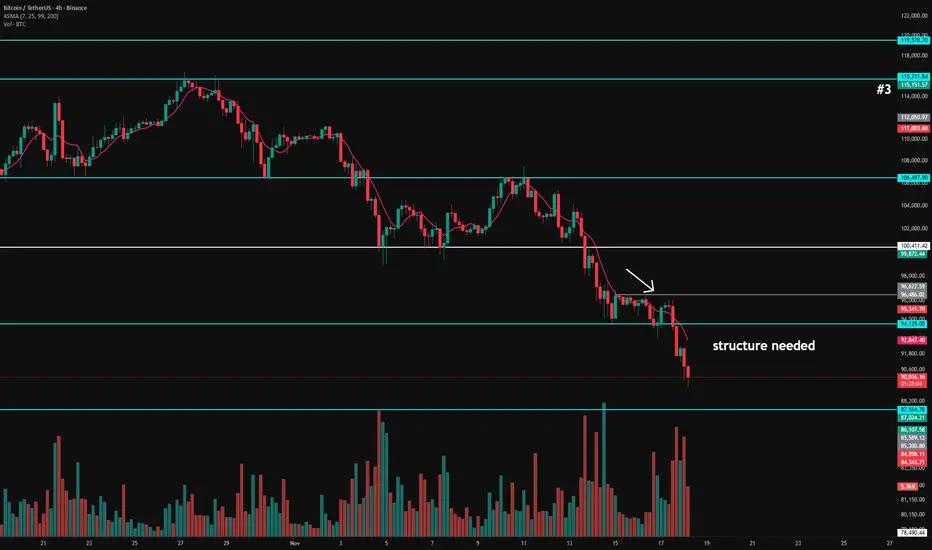
Bitcoin Analysis – November 18 | A Day for Patience & Observati
Hello to all my fellow traders! Hope you're having an amazing day! 🌟
Today is 18 Nov, and here’s the updated Bitcoin analysis.
I honestly expected the $93K level to break, as I mentioned before — I also said buyers needed to prove their strength one more time before any long position… but they couldn’t.
The market moved downward instead. 📉
My short position should have been opened below $94,000 yesterday, but unfortunately I wasn’t at the charts at that time and was outside.
🔍 So what are today’s scenarios?
Today, I’m simply going to be a viewer.
My main analysis timeframe is the 4-hour, and entries are on the 1-hour.
Right now, Bitcoin hasn’t built any clear bullish or bearish structure for me to take a long or short position.
❗Does this mean if BTC dumps to $87K or pumps back to $96.5K I still won’t take a trade?
Yes.
If my strategy doesn’t give me a setup, I won’t force a position. I’m not going to stress myself just to “be in a trade.”
So today's plan on Bitcoin:
➡️ Wait. Watch. Stay patient.
20 minutes before each 4H candle closes, I’ll check the chart again to see if a proper structure is forming.
📌 But today has a more important task: The Watchlist!
I expected BTC to lose the $93K level with rising dominance,
but the opposite happened — dominance fell, yet BTC still broke the level! 🤯
This means one thing:
I need to look at other crypto pairs against BTC — especially those with strong volume.
Examples:
ETH/BTC
SOL/BTC
If these pairs show a strong trend, then I will follow that trend in their USDT pairs.
In simple terms:
➡️ I want to find which coins dumped harder against BTC
➡️ or which ones did NOT dump at all
Those will be my priority today — that’s where I prefer to take risk.
🧠 Today’s Plan Summary
✔️ Wait for BTC to build a clear structure
✔️ Focus more on altcoins vs BTC pairs
✔️ Set alerts on important BTC levels: $87K and $96.5K
✔️ Build & update the watchlist
🔔 Final Note
Thank you for reading my analysis! 🙏
Wishing you profit, clarity, and blessings in every trade! 💛✨
The most important thing I can tell you is this:
⚠️ In unclear market conditions, it makes NO sense to take unnecessary risks or trade emotionally.
When we reach strong, meaningful levels in the future, I’ll say the opposite — but today is a day for patience.
Have a great day, traders! 🚀📊
Bitcoin (BTCUSDT) – Short-Term Bearish StructureHi!
The chart shows BTC moving inside a descending channel, with consistent lower highs and lower lows confirming a controlled downtrend. Recent price action attempted to push back into the QML (Quasimodo Level) area, but the reaction there shows clear rejection, suggesting supply remains in control.
Price is now falling toward the lower boundary of the channel, where a short-term bounce is possible. However, unless BTC breaks above the QML zone and the descending trendline, the broader expectation remains bearish.
The projected path suggests:
A drop into the channel low,
A corrective pullback,
And then a continuation lower toward the next major support zone around 89,700 – 89,800.
Overall, momentum and structure both support a bearish continuation unless buyers manage to reclaim the supply zone above.
Bitcoin Can reach 93000 Bitcoin could reach the price level of $93,000 in the coming weeks.
There is a possibility that after breaking the midline of its long-term weekly channel, it may move up to the indicated FVG level to fill the remaining unfilled orders.
After that, it could start a new bullish rally aiming for the upper boundary of the channel.
This is purely an analysis and should not be considered as financial advice.
Buying or selling is at the trader’s own risk.
$BTC - Market UpdateBINANCE:BTCUSDT | 1D
In our November 12 outlook, we noted that if price formed another lower high and failed again below the 107k resistance, momentum could fade quickly. That scenario played out: Bitcoin broke below the 102k support and slid into the 89k zone.
From here, if the current low holds, the next area that must be reclaimed is 92–93k. Buyers need to step in, a move back below this level increases the risk of a breakdown toward the 84k–82k region.
If price can stabilize and build a base here, upside hurdles to watch are 96–97k, followed by 100k and 107k (swing point)
Crude Oil Market (WTI, Brent) & OPEC+ Decisions1. Understanding WTI and Brent Crude
WTI Crude Oil
West Texas Intermediate (WTI) is a high-quality, light, and sweet crude oil primarily sourced from fields in the United States, especially Texas. Its low sulfur content makes it easier to refine into gasoline and diesel, which are in high demand in the North American market. WTI is traded on the New York Mercantile Exchange (NYMEX) and considered a benchmark for U.S. crude prices.
Brent Crude Oil
Brent is sourced from oil fields in the North Sea, spanning the UK and Norway. It is slightly heavier than WTI but still considered a light, sweet crude. Brent is traded on the Intercontinental Exchange (ICE) and acts as the global benchmark for two-thirds of internationally traded crude oil.
Why Two Benchmarks?
The existence of both benchmarks reflects regional differences in production, shipping costs, refining requirements, and market access. Generally:
WTI represents U.S. supply-demand dynamics.
Brent reflects international conditions across Europe, Asia, and Africa.
The price spread between the two (WTI–Brent spread) often indicates logistical constraints, geopolitical tensions, or shifts in global demand.
2. Factors Influencing Crude Oil Prices
Crude oil markets are volatile due to the interplay of multiple economic, geopolitical, and market-driven factors.
a. Global Supply & Demand
Oil demand is affected by:
Economic growth rates
Industrial output
Transportation needs
Seasonal factors (winter heating demand, summer driving season)
Supply depends on:
Production levels in OPEC and non-OPEC countries
U.S. shale output
Production outages or upgrades
Infrastructure constraints
b. Geopolitical Events
Conflicts in the Middle East, sanctions on major producers like Iran, instability in Venezuela, and maritime disruptions (e.g., Strait of Hormuz tensions) significantly move oil prices.
c. Currency Movements
Oil is priced in U.S. dollars.
When the USD strengthens, oil becomes expensive for foreign buyers → demand decreases → prices fall.
When the USD weakens, oil prices tend to rise.
d. Inventories & Storage
Weekly U.S. crude inventory data, especially from the EIA (Energy Information Administration), provides insights into near-term supply-demand balances.
e. Energy Transition Policies
Shift toward renewable energy, environmental policies, and long-term decarbonization targets influence investment, production, and expectations of future oil use.
3. Role of OPEC and OPEC+
What is OPEC?
The Organization of the Petroleum Exporting Countries (OPEC) was founded in 1960 to coordinate and unify petroleum policies of major producing countries. Key members include Saudi Arabia, Iraq, Iran, Kuwait, and UAE.
OPEC+ Formation
In 2016, OPEC expanded to include major non-OPEC producers such as Russia, Mexico, Kazakhstan, and others, forming OPEC+.
This group controls around 40% of global oil production and 80% of known reserves, making their decisions highly influential.
4. OPEC+ Production Decisions
a. Production Cuts
When demand falls (e.g., during pandemics or recessions), OPEC+ often cuts production to support prices.
Cuts reduce global supply → tighter market → higher prices.
b. Production Increases
During times of strong demand, OPEC+ increases output to maintain market stability.
Higher supply → pressure on prices → prevents overheating of global inflation.
c. Voluntary vs. Mandated Cuts
Sometimes individual countries choose voluntary cuts to stabilize the market.
Saudi Arabia often leads with additional voluntary cuts beyond the group agreement.
5. How OPEC+ Decisions Influence WTI and Brent
Market Expectations
Before meetings, traders speculate on whether OPEC+ will:
Cut supply
Maintain quotas
Increase production
Even rumors can create dramatic price swings.
Outcomes of Meetings
A formal announcement of cuts usually triggers:
Brent prices increasing more sharply, as it is more globally sensitive
WTI moving upward, though influenced by U.S. shale reactions
On the contrary, increases in output often lead to a pullback in both benchmarks.
Long-term Impact
Persistent cuts support a long-term bullish trend.
Persistent increases (or cheating on quotas by some members) lead to bearishness.
6. U.S. Shale Oil and the WTI–Brent Spread
One of the biggest changes in oil markets over the past decade is the rise of U.S. shale production.
Shale oil is flexible and responds quickly to price changes:
When prices rise → shale producers increase drilling
When prices fall → production slows
Because shale is mostly priced off WTI, higher U.S. output often widens the WTI–Brent spread.
Logistics Constraints
Pipeline bottlenecks in the U.S. midcontinent region can cause WTI prices to fall below Brent due to oversupply.
7. The Financialization of Oil Markets
Crude oil is not just a physical commodity—it's also a major financial asset.
Investors trade oil futures, options, ETFs, and swaps, influencing price movements.
Key players include:
Hedge funds
Banks
Producers hedging future output
Airlines hedging jet fuel costs
This financial activity creates liquidity but also increases volatility.
8. OPEC+, Price Stability, and Global Economics
Inflation Management
Crude oil is a major driver of fuel prices, transportation costs, and overall inflation.
Sharp increases in oil prices often:
Push inflation higher
Increase the chances of central bank rate hikes
Slow down economic growth
OPEC+ often aims to maintain price ranges that balance producer revenues with global economic stability.
Revenue Dependence
Many OPEC+ members rely heavily on oil revenue to fund government budgets.
Low prices strain fiscal systems; high prices improve surpluses.
9. Future of Crude Oil Markets
Short to Medium Term
Demand is expected to remain strong in developing economies.
Geopolitical risks will continue to play a major role in volatility.
Long Term
Energy transition policies and global decarbonization will gradually reshape demand patterns.
However, oil will likely remain a major energy source for decades due to:
Transportation needs
Industrial petrochemicals
Aviation fuel
Limited large-scale alternatives in some sectors
OPEC+ is expected to maintain a central role in managing supply and stabilizing prices during this transition.
Conclusion
The crude oil market, anchored by the benchmarks WTI and Brent, plays a central role in global economic activity. Price movements are influenced by production levels, geopolitical events, inventory data, currency dynamics, and financial market behavior. Among all players, OPEC+ remains the most influential force in shaping supply trends and managing market stability. Their production decisions can trigger global inflation shifts, currency volatility, and economic fluctuations. As the world gradually moves toward cleaner energy sources, the balance between demand, supply, and policy-driven cuts will define the future of oil markets for years to come.
BTC ON THE WAY 40KWake me up when BTC reaches that level — yes, the 40,000 zone.
Bitcoin is rising on its own.
Even at its ATH, it's still in a BEARSIH zone.
Besides that, alts are dying.
The comparison between their declines and their rises is insignificant.
For now, the alt season is just a small taste and sensation... and that's after a deep drop.
That's one thing I'm paying attention to.
I'm too lazy to comment any further.
The point is, BTC will reach 40,000. Wake me up when it gets there.
Update BTC Bearish BiasBitcoin is dropping again and has now entered its first Fair Value Gap (FVG). Will the price stop and bounce from this level? It seems unlikely. This is because there are still significant liquidity pools and the Monthly Sell-Side Liquidity (SSL) resting below it. Moreover, even if the price does bounce, we require confirmation on a Lower Time Frame (LTF) via a Market Structure Shift (MSS) or displacement. Remember the principle of liquidity: price moves from External Range Liquidity (ERL) to Internal Range Liquidity (IRL) or vice versa.
BTC the way on 89000🔍 What the chart is showing right now
1. Trend Bias:
Bearish Price is below EMA50 and EMA200 → structure still bearish.
Multiple lower highs and strong rejection from descending trendline.
Market is holding below major supply zones (100k–102k, 105k–107k, 109k–111k).
2. Current Area:
Demand reaction zone Price bounced from a blue demand block ~93.0k–94.5k.
Weak bounce so far — no strong volume or bullish displacement.
A lower-timeframe liquidity sweep happened at the bottom → short-term bullish correction possible.
3. Nearest resistance
First big sell zone: 97.8k–99.5k
If price reaches it, sellers will likely hit aggressively.
BTCUSDT Short – Absorption + Delta Shift Confirmation 11/18Reasoning / Analysis
Price is in a clear downtrend on higher timeframes – lower highs and lower lows confirming bearish structure.
On the 1-minute chart, price pulled back into previous supply and failed to break higher.
Inside the footprint chart, we saw positive Delta buying into resistance, but price failed to move higher → bulls got absorbed.
This is a classic Bullish Absorption → Bearish Reversal setup.
Key Signals:
🔹 Up-move into resistance with positive Delta, but no continuation → trapped buyers
🔹 Volume spike without follow-through = exhaustion
🔹 Trend remains bearish, so I trade in the direction of the higher-timeframe move
🔹 Clean entry after confirmation candle
Trade Plan
Entry: After confirmation candle failed to push higher
Stop Loss: Just above absorption wick (invalidates setup if broken)
Target: 1:1 RR at previous support
Session: Intraday scalp based on order flow / delta logic
Invalidation
❌ If price breaks the absorption candle body, signal is invalid
❌ If Delta continues rising while price pushes higher → buyers in control
$BTC Next Movement The chart shows Bitcoin breaking below a long-term ascending trendline that has held since early 2023. Price is currently around 90,000 USDT and has closed decisively under the trendline, suggesting a loss of bullish momentum and the possibility of a deeper corrective phase. The break indicates that buyers failed to defend the structural support, shifting short-term market sentiment toward caution. If the price does not quickly reclaim the trendline, the market may look for lower support levels formed during previous consolidation zones, while any recovery back above the trendline would signal an attempt to restore the broader uptrend.
BTC Approaches 89,256Hello, traders and investors!
This analysis is based on the Initiative Analysis (IA) method.
Bitcoin’s price is getting closer to the 89,256 level.
Yesterday, November 17, the daily candle closed as a seller candle.
The volume was accumulated in the upper part of the candle, and the candle itself showed increased volume.
In this configuration, a continuation of the seller’s move is quite likely.
Wishing you profitable trades!
Final 2025 Forecast for BTCUSDT 18th November 2025 (Updated)Short term pump to ~$94k (this week), dump in or around New Moon (20th November) down to ~$84k for a bottom in or around Black Friday (28th November) for one of two scenarios to play out;
1. Dead Cat Bounce Pump (Red Line)
Pump to ~$108k only for it to dump to confirm bear market
2. Final Pump to ATH (Green Line)
Target #1 $140k-$145k,
Target #2 $170k-$175k
Target #3 $200k-$205k