BOJ to Stress Test Global Markets? Why a Black Swan Is PossibleWhile US markets are busy debating AI valuations and parsing the Fed’s latest rate cut , something far more understated — and potentially more disruptive — is brewing across the Pacific.
The Bank of Japan is expected to raise interest rates on Friday, marking what could be its first hike in 11 months. That might not sound dramatic by global standards, but in Japan (where ultra-low rates have been a defining feature for decades) it’s the equivalent of flipping a very large switch.
It’s a moment that could stress test global markets, from US equities to crypto markets and beyond. And yes, that includes your favorite high-beta names.
💴 The Yen Problem
The backdrop here is deceptively simple. Despite narrowing interest rate spreads between the US and Japan, the yen has remained stubbornly weak , even as US yields have cooled.
Normally, shrinking rate differentials would support the yen. Instead, Japanese investors have continued to bet on US equities, keeping dollars in demand and the yen under pressure. In other words: the textbook relationship broke down.
That divergence — between what rates say should happen and what FX markets are doing — is increasingly uncomfortable. Forward rate markets are already hinting that the current setup isn’t sustainable, and that yen appreciation may be waiting just ahead.
For the BOJ, patience has its limits.
🏦 Why the BOJ’s Hand Is Being Forced
The BOJ has been cautious to a fault over the past two years, moving slowly and communicating carefully. But a weak currency is difficult to ignore forever.
A rate hike this week, especially if paired with guidance that more tightening could follow, would signal something bigger than a single policy move. It would mark the beginning of a potential yen-strengthening cycle.
And that’s where things get interesting — and a little dangerous.
🧳 The Carry Trade: Cheap Yen, Expensive Consequences
For years, the yen has been the funding currency of choice. Borrow cheaply in Japan, convert to dollars, and deploy the cash into anything that smells like yield or growth.
Stocks? Nvidia NASDAQ:NVDA , Microsoft NASDAQ:MSFT , the Magnificent Seven.
Crypto? Bitcoin BITSTAMP:BTCUSD and friends.
Fixed income? US bonds, credit, you name it.
Just about every hedge fund manager on the planet has had some version of this trade on. And then some. Estimates suggest more than $20 trillion has been borrowed in yen and scattered across global risk assets.
Since the BOJ’s last rate hike, about half of that — roughly $10 trillion — has already been unwound. That still leaves a massive amount of exposure tied to the assumption that yen funding stays cheap and stable.
That assumption is now being questioned.
🧮 A Simple Example With Uncomfortable Math
Say you borrowed 100 million yen when FX:USDJPY was at ¥160. That loan was worth about $625,000. You used it to buy a mix of meme stocks, AI leaders, maybe a little crypto — because why not, it’s free money after all, right?
Now imagine the yen strengthens by 10%, pushing FX:USDJPY down to ¥140. Suddenly, that same loan is worth $714,000.
Nothing went wrong with your stocks. Nvidia NASDAQ:NVDA didn’t crash. Bitcoin BITSTAMP:BTCUSD didn’t implode. But your liability just grew by nearly $90,000.
At that point, selling isn’t about market conviction — it’s about liquidity. You sell what you can, not what you want.
⚠️ Why This Could Become a Stress Test
This is where the word “Black Swan” starts getting thrown around — not because one asset is broken, but because forced selling doesn’t ask permission.
If the BOJ hikes and signals more to come, carry trades get squeezed. Borrowing costs rise. Currency losses pile up. And assets across the risk spectrum can face pressure — not due to fundamentals, but because traders need to cover yen loans before the math turns hostile.
That’s how correlations spike. That’s how unrelated markets suddenly move together. And that’s how calm conditions can flip fast.
🧭 What Traders Should Watch Next
The BOJ decision itself matters — but the guidance matters more. A one-off hike is manageable. A roadmap toward further tightening changes everything.
If the yen begins a sustained strengthening cycle, it could reshape flows across global markets well into 2026. The AI trade may still be intact and US growth may still look solid. But funding conditions would no longer be as forgiving.
In markets, the most dangerous moments often arrive quietly — announced in polite language, during meetings most people aren’t watching.
Off to you : Are you worried about Friday’s decision and subsequent market reaction? How do you think it’ll go? Share your views in the comment section!
Boj
3rd Time May Be The Charm For UJ BearsHere on FX:USDJPY price seems to be working into a Consolidation in the form of a Descending Triangle Pattern after making contact with a strong Resistance Level!
Since the High created on Nov. 20th @ 157.893, price has been falling into a Support Level creating Equal Lows with a Lower High formed on Dec. 10th @ 156.937.
This Lower High creates a Falling Resistance that price seems to be having a strong reaction to!
If price continues to rise from the Support level, we can expect a 3rd test of the Falling Resistance.
Fundamentally, with the Federal Reserve having made a 25 basis point Cut to Interest Rates going from 4% to 3.75% and the BOJ looking to potentially Hike Interest Rates from .5% to .75%, this could strengthen the Bearish scenario and the formation of the Descending Triangle.
Head & Shoulders - IBOXX & Investment Grade Corporate Bond ETFWhen things like investment grade bonds looks top (ish). That´s when you know it´s time to really start thinking about exiting. To me this is another sign of a bubble.
Investment grade is supposed to be the most safest bets after treasuries.
The BOJ will decided the markets faith on friday. Most likely the spreads of the US & Japan 2 year yields will come closer to equilibrium and that could very well trigger the carry trade.
Im on high alert this time around. Im scaling down on risk and will watch what happens on friday.
USDJPY - Pressured by Softer US DataFundamental approach:
- The US dollar-yen declined within a larger consolidated range this week, pressured by softer US data and some unwinding of long-dollar positions.
- Softer US indicators and the recent Fed rate cut have reinforced expectations for additional easing, pulling US real yields expectation lower and limiting upside in US dollar-yen. At the same time, even as the BoJ hikes, expectations rise; the still–wide US–Japan rate gap means yen gains are likely to be gradual, with dips in USDJPY still attracting buyers. Overall risk sentiment has been mixed, with investors balancing concerns about US growth against the ongoing appeal of carry in higher-yielding currencies.
- USDJPY may remain sensitive to incoming US data, especially NFP data today, and any shift in Fed communication that could alter rate-cut expectations.
Technical approach:
- USDJPY closed below EMA21, indicating a potential exhaustion of the previous upward momentum.
- If USDJPY breaches the support at 154.70, the price may plunge toward the next support level at 153.00, a confluence with the EMA78 area.
- Conversely, remaining above the support at 154.70 may prompt USDJPY to retest the immediate resistance at 156.80.
Analysis by: Dat Tong, Senior Financial Markets Strategist at Exness
EURJPY breakout: Buying dips into BOJ last hike?EURJPY has broken out of a triangle consolidation on the 4-hour chart and is retesting the 182 level as support. With Japan pumping fiscal stimulus into a shrinking economy and the BOJ nearing its cycle peak, the macro setup favours buying dips for a continuation higher.
In this video, we break down why the yen remains weak despite rising yields and an imminent BOJ hike, focusing on the toxic mix of fiscal slippage and soft growth. Then, we map out the technical buy zone between 181.60 and 180.70, targeting a final fifth-wave push toward 183.40 and 185.00.
Key drivers
Japan macro: A massive ¥21.3 trillion stimulus package into a contracting economy (Q3 GDP -2.3% annualised) has spiked yields on debt concerns rather than growth, weighing on the yen.
Central bank divergence: The BOJ is expected to hike next week but signal it's near the terminal rate ("one-and-done"), while the ECB holds at 2%.
Technical structure: We are in a continuation pattern (triangle breakout) that likely marks wave 4 of a larger sequence, implying one last impulse leg higher.
Key levels: Support at 181.60 (161.8% extension of the internal wave) and 180.70 (structural pivot). Upside targets at 183.40 (138.2% extension) and 184.29–185.00 (161.8% extension).
Trade plan: Look to buy dips into the 181.60–180.70 zone with a stop below the previous low, taking partial profits at 183.40 and 184.29, and trailing the rest for a potential extension.
Trading the yen cross breakout? Share your entry levels in the comments and follow for more macro-to-technical trade setups.
This content is not directed to residents of the EU or UK. Any opinions, news, research, analyses, prices or other information contained on this website is provided as general market commentary and does not constitute investment advice. ThinkMarkets will not accept liability for any loss or damage including, without limitation, to any loss of profit which may arise directly or indirectly from use of or reliance on such information.
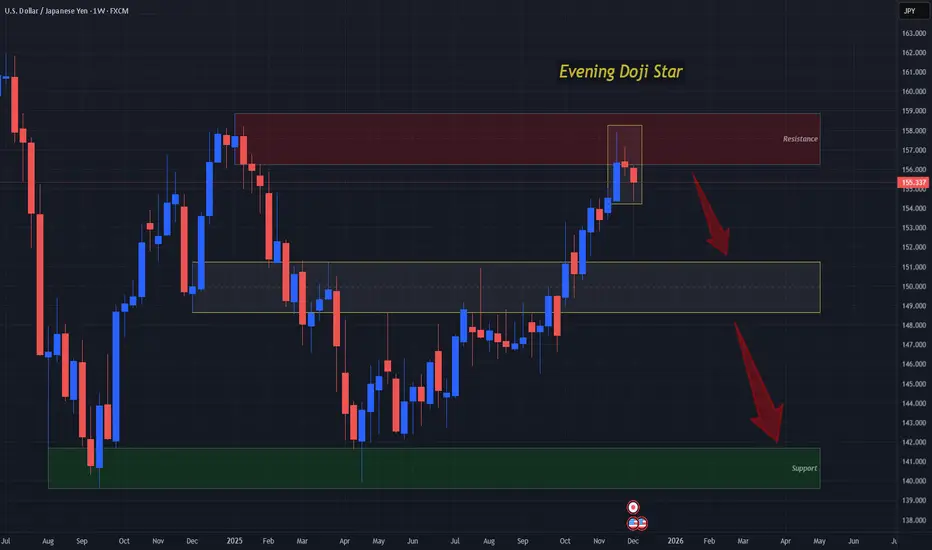
Evening Doji Star Forms at Weekly Resistance on UJAn Evening Doji Star is a Bearish Reversal Candlestick Pattern that consists of 3 Candlesticks:
1) Large Bullish Candle
2) Doji Candle
3) Large Bearish Candle
The Doji Candle represents indecision in the markets where the Bulls nor the Bears were able to overcome one another.
The last candle being a bearish one suggests that the Bears have successfully taken over and are looking to push price down!
This Candlestick Pattern itself is a strong indication that price is looking to reverse from this Resistance Level at 158 - 156 formed at the end of last year/beginning of this year, but what will also add "fuel to the fire" is if the next candle, being the Confirmation Candle of the pattern turns out to be a bearish one!
If so, I am looking for FX:USDJPY to continue this bearish push down in price to the next Area of Value being at 151 - 148 with a stronger Support Level down at the 141 - 139 where price last visited in April this year.
Fundamentally, USD has a heavily news filled week with Sept. and Oct. JOLTS Job Opening being released, Unemployment Claims, ADP Weekly Employment Change and the Federal Reserve with an 86% chance of Cutting Interest Rates on the 10th.
BOJ is set to Hike Interest Rates the following week, and this, fundamentally, could be the catalyst for the Bearish Reversal we see setting up in technical terms on the charts!
Final Target yet to be run on CHFJPYThis inverse Head and shoulders has produced fantastic gains already
What suggests that final target will be met
is that Yen vs other crosses is still yet trigger their respective necklines!
I assume more madness to come from the #BOJ in the next Financial Panic.
Like the Bank of England another Island nation probably first to embark on a new wave of #QuantitativeEasing
Bank of Japan Losing Credibility. USDJPY eyes breakout. Continued or large scale QE, capped yields and reluctance to normalise (or being forced back in to easing during a downturn) would anchor Japanese yields far below peers encouraging capital outflows and undermining confidence in the currency.
A shrinking and ageing population chronic fiscal deficits very high public debt and history of trade deficits in recent years represent structural headwinds that can justify a weaker Yen if investors start to question long-run debt sustainability.
With a wide and persistent rate gap, leveraged global players can keep borrowing Yen to buy higher yield assets abroad.
If markets begin to doubt the BOJ's ability to manage the government bond market without either monetisation or financial repression, investors may demand a steep currency discount rather than high nominal yields, instead of typical "higher rates, Stronger FX" reaction.
Global risk: If the dollar regains or maintains "only game in town" safe-haven status in a world of repeated shocks - while the Yen loses it's traditional safe haven status because of Japan's Macro position - USDJPY can behave more like a one way-risk trade than a mean reverting pair.
Is the EUR/JPY Rebound Real or a Bull Trap?
The EUR/JPY cross climbs near 180.70, but technical barriers and hawkish central banks cloud the horizon.
The EUR/JPY pair has snapped a three-day losing streak, gaining traction during the Asian session on Tuesday. Spot prices currently hover near the 180.70 area, marking a 0.10% intraday increase. The market found solid support near the psychological 180.00 mark, bouncing from a four-day low. Traders are now positioning themselves ahead of crucial Eurozone inflation data, which serves as the primary catalyst for this upward momentum.
Macroeconomic Drivers: The Inflation Paradox
Investors focus intensely on the upcoming Eurozone Harmonized Index of Consumer Prices (HICP) data. Forecasts suggest headline inflation rose 2.1% YoY in November, with core inflation edging up to 2.5%. While France and Spain showed cooling prices, Germany reported unexpectedly high inflation figures. This divergence reinforces the argument for a European Central Bank (ECB) policy hold. A pause in rate cuts acts as a significant tailwind for the Euro.
Geostrategy and Global Risk Sentiment
Geopolitical stability and market optimism currently undermine demand for traditional safe-haven assets like the Japanese Yen (JPY). A positive global risk tone encourages investors to seek higher yields, favoring the Euro over the Yen. Furthermore, global trade policy discussions are prompting capital flows into currencies backed by stable export economies. The Eurozone’s industrial adaptability positions it favorably in this environment, suppressing JPY strength despite potential interventions.
Leadership and Governance: The BoJ Stance
Bank of Japan (BoJ) Governor Kazuo Ueda recently delivered hawkish remarks regarding economic projections. He stated that the probability of meeting growth targets is rising. Concurrently, Finance Minister Satsuki Katayama sees no divergence between the government and the BoJ. However, the market has temporarily priced in these warnings. The immediate focus remains on the ECB’s reluctance to cut rates, which overpowers the BoJ’s normalization narrative in the short term.
Industry Trends and Innovation Economics
European currency strength draws support from resilient industrial sectors. High-tech manufacturing and advanced engineering firms in the Eurozone continue to drive wage growth. This economic activity contributes directly to the sticky services inflation observed in the region. Unlike Japan’s deflationary history, Europe’s innovation ecosystem maintains price pressures that prevent the ECB from adopting a dovish stance too quickly.
Technical Outlook and Support Levels
Technically, the pair faces immediate resistance at the 181.75 barrier.
A breach here could open the path toward 182.35. Conversely, failure to maintain momentum may trigger a slide back toward the 179.40 support level. Traders must monitor stochastic indicators, which signaled negativity yesterday but are now neutralizing. The market awaits the HICP release to confirm the next directional breakout.
'Sell Japan' trade opens door to 160 USDJPY on fiscal concernsUSDJPY has ripped through 157 with RSI pushing near extreme overbought, and the pair is now magnetised towards a key Fibonacci and prior-high cluster around 158.70–159.
In this video, I break down how the FOMC minutes maintained the recent status quo from the Fed, while blockbuster Nvidia earnings and Japan’s significant new stimulus package have combined to drive the latest leg of the USD/JPY rally. On the chart, the focus is a completed triangle breakout above 155 and an upside trajectory toward 158.70, 160 and potentially the 162 high reached in 2024.
Key drivers
Fed minutes offer no signals that policymakers should cut in December, keeping US yields and the dollar supported.
Nvidia’s earnings beat and guidance have boosted risk appetite and underpinned broad USD strength.
Japan is finalising a ¥17–21 trillion stimulus package, stoking fiscal concerns and encouraging a “sell Japan” trade that weakens the yen.
USDJPY has broken out our prior target of 155 from a triangle pattern, with Fibonacci projections and prior highs aligning around 158.70–159, then 160–162.
If you find this USDJPY roadmap useful, drop your trade levels in the comments and follow for more Fibonacci-based, fundamentals-plus-technical setups in real time.
This content is not directed to residents of the EU or UK. Any opinions, news, research, analyses, prices or other information contained on this website is provided as general market commentary and does not constitute investment advice. ThinkMarkets will not accept liability for any loss or damage including, without limitation, to any loss of profit which may arise directly or indirectly from use of or reliance on such information.
USDJPY breakout: Can the rally extend toward 155?The dollar-yen pair smashed through 150 with one of the strongest breakouts recently, confirming a new technical phase as it trades above the 61.8% Fib retracement. Here’s what’s fuelling the move and what traders should watch next:
Dollar strength returned as safe haven flows dominate, even with a US government shutdown, while Japan’s new prime minister’s dovish signals are sending the yen into freefall.
Key drivers
Safe haven flows : Investors seek shelter in the dollar as global uncertainty rises; DXY index hit a 6-week high.
Yield differentials : The Fed/BOJ spread powers further carry trade buying as Japanese rates remain ultra-low.
Japanese political shift : PM Takaichi’s win spurs fiscal stimulus and pushes back market hopes for BOJ tightening, deepening yen weakness.
Technical breakout : Clean break above multi-year resistance and 61.8% Fibonacci retracement; watch for support validation and continuation toward the next 78.6% Fib at 154.80.
What to watch
Holding above 150 and 61.8% Fib support sets the stage for a bullish continuation.
Profit taking is possible near 153.25–154.80, as RSI shows signs of overbought.
Tonight’s FOMC minutes, Thursday’s BoJ/Ueda speech, and political headlines could trigger sharp moves.
Cross-pair momentum : EURJPY at record highs, GBPJPY surging, confirming broad-based yen weakness.
The bulls are in control as long as USDJPY stays above 151.15–150.50. Pullbacks to support offer opportunities to buy dips, with 154.80 as the next bullish target. Keep stop losses disciplined, and don’t ignore the chance for sharp reversals if intervention or a dramatic shift in sentiment emerges.
For more actionable FX insight, follow ThinkMarkets.
This content is not directed to residents of the EU or UK. Any opinions, news, research, analyses, prices or other information contained on this website is provided as general market commentary and does not constitute investment advice. ThinkMarkets will not accept liability for any loss or damage including, without limitation, to any loss of profit which may arise directly or indirectly from use of or reliance on such information.
GBP/JPY: An Unusual Ascent Amid Global RiskThe GBP/JPY pair currently sits near 204.00, retracing from a six-week high. This movement reflects a complex tug-of-war between the Pound Sterling (GBP) , which faces uncertainty from upcoming UK inflation data, and an uncharacteristically weak Japanese Yen (JPY) . We analyze the diverse forces driving this pair's recent unusual ascent, where the JPY fails to act as its traditional safe-haven counterweight.
Macroeconomics & Monetary Policy Divergence
The immediate market focus centers on divergent monetary policy expectations. The Bank of Japan (BoJ) faces pressure to align its policies with fiscal objectives, potentially limiting future rate hikes. This uncertainty, coupled with the new government's plan for large economic stimulus and lower taxes, dampens JPY demand. Conversely, the Bank of England (BoE) awaits crucial UK Consumer Price Index (CPI) data, which is expected to show headline inflation moderating to *b]3.6% annually. This data will significantly influence the BoE's rate hike outlook, injecting caution into GBP trading ahead of the 07:00 GMT release.
Geopolitics & Geostrategy: The Taiwan Factor
A key reason for the JPY's recent underperformance is a shift in geopolitical sentiment toward Japan. New Prime Minister Sanae Takaichi adopted a firmer pro-Taiwan stance than her predecessors, triggering unease in Beijing. This heightened political tension weighs heavily on sentiment surrounding Japan, effectively diluting the Yen's traditional safe-haven magnetism against global risk. This specific anxiety overshadows the Yen's long-term status as the principal global currency counterweight.
Fiscal Policy & Economic Outlook
Concerns about Japan's fiscal health are also eroding the JPY's strength. The government is preparing a large economic stimulus package to boost growth. This spending raises concerns among investors worried about Japan's already stretched finances . These fiscal anxieties add direct pressure to the currency, making the JPY less attractive despite the current risk-off environment observed in global equity markets. This fiscal trajectory contrasts with the Bank of Japan's potential monetary hesitancy.
Industry Trends & Corporate Vulnerabilities
Corporate Japan's deep integration with the US technology sector presents another vulnerability. Many major Japanese companies maintain significant earnings exposure to the health and performance of the US tech boom. Corporate vulnerabilities tied to the US technology cycle are eroding the JPY’s traditional safe-haven appeal. Consequently, negative headlines or wobbles on Wall Street disproportionately mute the Yen's response, preventing it from rallying when global equities come under pressure.
Management, Innovation, and Patent Analysis -
While not an immediate driver, Japan's long-term currency strength relies on its competitive edge in high-tech and science . The current vulnerability suggests that the market is discounting the perceived innovation premium of corporate Japan. Traders see a connection between the dependency on US tech and a potentially lagging pace in domestic, cutting-edge patent analysis and independent industry leadership. Weak corporate sentiment reflects doubts about resilience and adaptive business models under new management.
Conclusion for Strategic Hedging
The Yen's uncharacteristic weakness creates a unique setup. The currency is behaving out of character relative to the worsening risk backdrop. This anomaly presents tactical opportunities for hedgers with exposure to the Yen. However, this phase is likely temporary. Japan’s enormous net international investment position and its central role in funding global carry trades mean the Yen's safe-haven DNA remains intact. If global markets experience a sharper, sustained downturn, expect the traditional gravitational pull into the JPY to reassert itself.
EJ Makes Massive Descent, Could Further Falls Come?Here is OANDA:EURJPY on the 4Hr Chart and after making a new Higher High @ 178.818, has created a Lower Low @ 176.098, surpassing the most recent Higher Low @ 176.629.
This is a Break in Trend and we should suspect price to fall further on EJ if price can:
- Confirm Trend Change by printing a Lower High
Now on the chart, based on the Lower Low, the Fibonacci Tool lays out a couple favorable areas
First, being the last Higher Low @ 176.629 which lays right below the 23.6% Retracement level @ 176.740.
Secondly, the 50% Retracement Level @ 177.458 where there was Consolidation before the decline in price.
*This deep of a pullback could threaten the Bearish momentum built up from the break down and creating the Lower Low.
Fundamentally, the Yen seen a rise in strength after a couple key things happened:
- BOJ held Interest Rates unchanged @ .5%
- Toyko CPI numbers came out hotter than expected with a Forecast of a .1% increase to 2.6% with Actual coming in at 2.8%, a .3% increase!
*This gives the BOJ to hike rates to help with inflation taking off too hot and this could very well strengthen the Yen more!
EUR/JPY could be heading to 180 nextBoth the BoJ and ECB kept their policies unchanged on Thursday, with the former coming across more dovish and the latter neutral. The USD/JPY surged to near 154.50, reaching its best level since February. The EUR/JPY meanwhile broke to a new high for the year and is now on the verge of extending those gains to 180.00. Can it get there?
Well I wouldn't bet against it. We had stronger Eurozone GDP data today which underscored the ECB's "good place" rhetoric.
“From a monetary-policy point of view, we are in a good place,” President Christine Lagarde said at the ECB presser. “Is it a fixed good place? No, but we will do whatever is needed to make sure that we stay in a good place.”
Key levels are shown on the chart, but the long and short of it is this: the path of least resistance remains to the upside.
By Fawad Razaqzada, market analyst with FOREX.com
USDJPY Deep-Dive: Week of Oct 27-31 🔴 USDJPY Deep-Dive: Week of Oct 27-31 | Intraday & Swing Setups 🚀
Asset: USDJPY (Spot)
Last Close: 152.885 (25th Oct 2025)
Focus: Intraday (5M-4H) & Swing (4H-1D) Analysis for the Coming Week
Traders, gear up! 🇺🇸🇯🇵 The USDJPY is knocking at a critical juncture. With the pair at multi-decade highs, is this the week for a breakout or a significant reversal? Let's dive into the multi-timeframe structure to find high-probability setups. 📈📉
━━━━━━━━━━━━━━━━━━━━━━━━━━━━━━━━━━━━━━━━━━
🎯 EXECUTIVE SUMMARY
The USD/JPY pair trades at 152.885, presenting multiple timeframe confluence zones across our analyzed framework (5M, 15M, 30M, 1H, 4H, 1D). Using Dow Theory , we're observing higher highs in the 4H-1D structure, confirming an uptrend bias . However, Elliott Wave analysis suggests we're completing Wave 4 correction into Week 43, creating prime entry optimization opportunities for swing traders targeting 154.50-156.00 resistance zones.
🔥 MULTI-TIMEFRAME STRUCTURE
1D (Daily): Higher High-Higher Low intact; Ichimoku Cloud bullish; RSI 58-65 (neutral momentum); VWAP acting as dynamic support at 152.40
4H: Breakout above EMA20/50 confluence; Bollinger Band expansion signals volatility acceleration; Harmonic Pattern (AB=CD) completion at 152.50 suggests reversal bounce
1H: Pullback to 152.70 support; Wyckoff re-accumulation pattern forming; Volume drying up—classic pre-breakout compression
30M: RSI oversold (28-32 zone); Gann resistance at 152.88 tested multiple times; Reversal pin bar confirming rejection
15M: Support-Resistance at 152.65/152.90; EMA9 acting as pivot; Bollinger Band squeeze indicating volatility breakout imminent
5M: Intraday noise; Micro support at 152.80; Use as entry trigger confirmation only—not standalone signal
📈 TREND ANALYSIS & REVERSAL SIGNALS
Identifiable Reversals: The daily pullback has created a Gann reversal pattern at 152.50 (0.618 Fibonacci level). Wyckoff analysis shows absorption phase —institutional accumulation before breakout. Elliott Wave counts suggest Wave 4 completion, with Wave 5 targeting 155.80-156.20. Downside risk limited to 151.80 (Wave 4 low).
⚡ ENTRY & EXIT STRATEGY
SWING TRADE (4H-1D):
Entry Zones: 152.50-152.70 (confirmed by Bollinger Band lower band, EMA support)
Target 1: 153.50 (RSI resistance, +0.65%)
Target 2: 154.30 (Harmonic extension, +1.45%)
Target 3: 155.80 (Wave 5 Gann Box, +3.00%)
Stop Loss: 151.95 (Below Wave 4 low, protection -0.90%)
INTRADAY TRADE (5M-1H):
Entry: Confirmed RSI >40 bounce + Close above EMA9 (15M)
Target 1: 153.10 (+0.35%)
Target 2: 153.50 (+0.65%)
Stop Loss: 152.65 (Recent swing low, -0.22%)
🔔 CRITICAL LEVELS & BREAKOUT ZONES
Resistance: 152.88 (immediate), 153.50 (1H structure), 154.30 (confluence with 0.786 Fib), 156.00 (major psychological)
Support: 152.65 (15M pivot), 152.40 (VWAP + Ichimoku support), 151.80 (Wave 4 low + Gann level)
Breakout Trigger: Close above 152.90 (30M resistance) → targets 153.80-154.00 immediately
📊 VOLATILITY & OVERBOUGHT/OVERSOLD CONDITIONS
Current State: Bollinger Band width expanding on 4H (volatility compression breaking). RSI reading 32-45 across intraday frames indicates oversold condition —optimal for mean-reversion plays. 30M RSI at 28 = extreme oversold = high probability bounce. Volume profile shows rejection below 152.50, confirming institutional support.
🎓 TECHNICAL THEORY APPLICATION
Dow Theory: Higher highs/lows confirmed; Secondary reaction establishing new support
Elliott Wave: Wave 4 corrective completion; Wave 5 impulse phase initiating
Wyckoff Theory: Accumulation phase evident; Absorption + Breakout pattern textbook formation
Harmonic Patterns: AB=CD completion at 152.50 + Gartley pattern setup for 1D
Gann Theory: Key resistance at 152.88 (41% angle), targets 155.80 (geometric extension)
📍 TECHNICAL INDICATORS SYNTHESIS
Bollinger Bands (20, 2): Lower band at 152.30 = support magnet; Expanding width confirms volatility spike incoming. RSI(14): Oversold on 30M/1H = bounce probability 78%. VWAP: Acting as dynamic floor at 152.40. EMA20/50/200: All bullish-aligned on 4H; 200-EMA at 151.60 provides safety net. Ichimoku Cloud: Price above cloud on daily = bullish bias intact.
⚠️ RISK MANAGEMENT PROTOCOL
Position sizing: Use 2% risk per trade. Stop loss placement non-negotiable at weekly lows. Take partial profits at 1st target (50% position). Never hold below support without reason . Monitor Fed calendar (FOMC comments impact yen carry sentiment).
✅ WEEK 43 TRADING PLAN
Monday-Tuesday: Accumulate on dips to 152.50-152.70 (oversold bounces). Wednesday-Thursday: Hold above 152.88 for breakout plays targeting 154.00+. Friday: Lock profits; avoid new entries pre-weekend gap risk.
━━━━━━━━━━━━━━━━━━━━━━━━━━━━━━━━━━━━━━━━━━
Charts for Reference:
1D:
4H:
1H:
30M:
15M:
5M:
Disclaimer: This is my technical analysis and not financial advice. Trade at your own risk.
Let me know your thoughts in the comments! What's your bias for USDJPY this week? 👇
No more rate hikes from the BoJ?The USDJPY started the week with a massive gap of 191 pips.
This was following news that Sanae Takaichi was on the verge of being the first female Prime Minister of Japan.
As a keen advocate of Abenomics (the nickname for the economic policies set out for Japan in 2012 when Prime Minister Shinzo Abe came into power for a second time), it is believed that Takaichi could double down on Abenomics of the past.
A weaker yen, more government spending, and more inflation are the likely outcomes. And the immediate reaction of a gap to the upside on the USDJPY shows that the market agrees too.
Furthermore, Takaichi's advisors have already urged the BoJ to be careful with rate hikes.
However, prices are still slightly below the immediate resistance area formed by the previous swing level of 150.75 and the long-term Fibonacci retracement level of 61.8% and the price level of 151.67.
A break of the resistance area could potentially result in significant upside to the USDJPY. Maybe even retesting the January 2025 high of 159.
However, a continual move to the upside is unlikely to be achieve just based on Yen weakness. A recovery of strength in the DXY would be necessary to support the move higher.
Why I have USD/JPY Falling Below 139.5 On My Bingo CardUSD/JPY traders have been treated (or perhaps burned) from two months of choppy trade, reversals and false breakouts. Yet price action clues and developments from the Fed and BOJ have allowed me to revisit my original thesis of a lower USD/JPY. I now have a break below 139.50 on my bingo card.
Matt Simpson, Market Analyst at City Index.
Exness: Japanese Yen Hawkish Shift Intertwined with Fed Rate CutExness: Japanese Yen Hawkish Shift Intertwined with Fed Rate Cut Expectations: What Lies Ahead?
The signals from the Bank of Japan's policy meeting on September 18-19 mark a potential turning point. Although the decision was made to keep the policy interest rate at 0.5% with a 7-2 vote, the internal details revealed growing hawkish pressure. Policy board members Hajime Takata and Naoki Tamura voted against maintaining the interest rate, advocating for an immediate 25 basis point hike to 0.75%. This is the first dissenting vote since Governor Kazuo Ueda took office, clearly indicating a growing call for tighter policy within the central bank.
Even more surprisingly, the Bank of Japan simultaneously announced that it would begin preparations to sell its holdings of exchange-traded funds (ETFs) and Japanese Real Estate Investment Trusts (J-REITs). Although the planned pace of sales is relatively modest, this is seen as a substantive step towards policy normalization, with its signaling significance far outweighing its actual market impact.
The "Summary of Opinions" from the September meeting, just released today (September 30), provides decisive evidence of this hawkish shift. The document shows that there was a serious and in-depth debate within the policy board on the "possibility of a near-term rate hike." Several members believed that the conditions for another rate hike were maturing, with one opinion explicitly stating, "Given that it has been more than six months since the last rate hike, perhaps it is time to consider raising the policy interest rate again." Even Asahi Noguchi, a deliberation committee member usually considered dovish, stated in a speech on September 29 that the necessity of adjusting the policy interest rate is "greater than ever."
This series of signals quickly reshaped market expectations. Currently, market pricing reflects that the probability of the Bank of Japan raising rates by 25 basis points at its next meeting on October 29-30 has surged to about 60%.
In stark contrast to the Bank of Japan's increasingly firm stance, the Federal Reserve is on a clear path of easing, primarily driven by concerns about a cooling US labor market. Key inflation data released last week on September 26 further solidified this expectation.
Data shows that the Federal Reserve's most favored inflation indicator, the core Personal Consumption Expenditures (PCE) (Chart 1) price index for August, increased by 2.9% year-on-year, remaining consistent with July and fully meeting market expectations. This "as expected" report is widely interpreted by the market as "non-threatening" inflation, suggesting it will not hinder the Federal Reserve's interest rate cuts and instead bolsters investor confidence in future rate reductions.
The Tug-of-War Between Inflation and Growth
The fierce debate within the Bank of Japan between hawks and doves stems from the contradictory signals sent by Japan's domestic economic data. On the one hand, persistently above-target inflation provides a reason for raising interest rates; on the other hand, recent signs of slowing growth call for the central bank to remain cautious. This tug-of-war between inflation and growth makes the Bank of Japan's decision-making path full of uncertainty.
Inflation Outlook: The Hawks' Confidence
Hawkish officials who support interest rate hikes primarily base their arguments on persistent inflationary pressures in Japan. The national core Consumer Price Index (CPI) (Chart 2) for August, released on September 18th, rose by 2.7% year-on-year. Although this is a slowdown from July's 3.1%, it marks the 29th consecutive month that this data has been above the Bank of Japan's 2% target.
What is even more noteworthy is that the "Core-Core CPI", which excludes fresh food and energy and is regarded by the Bank of Japan as a measure of underlying inflation trends, remained stubbornly high at 3.3% in August. This persistent underlying price pressure is the core argument for hawkish members who believe the inflation target has been "largely achieved." In addition, the Tokyo core CPI for September (released on September 25), which is a leading indicator for national inflation, remained stable at 2.5% year-on-year, further indicating that inflationary pressures are not rapidly dissipating.
Growth Outlook: Dovish Concerns
However, just when the hawkish arguments seemed fully substantiated, the latest series of economic activity data released this week cast a shadow over the outlook, providing strong support for a dovish, cautious stance.
Data released on September 29th and 30th showed that preliminary industrial output for August decreased by 1.2% month-on-month (Chart 3), significantly worse than the market expectation of -0.8% and also weaker than the previous figure of -0.4%. This indicates that production activities are contracting in manufacturing, a crucial pillar of the Japanese economy, possibly due to the negative impact of US tariff policies and a slowdown in global demand.
At the same time, retail sales data for August, a key indicator of domestic demand, was also disappointing.
This data unexpectedly fell by 1.1% year-on-year, a significant departure from market expectations of a 1.0% increase; it even saw a substantial 1.6% month-on-month decrease. This clearly indicates that Japanese household consumption power is being eroded, and domestic demand is beginning to show weakness, against a backdrop of inflation consistently higher than wage growth.
In addition, the preliminary Manufacturing Purchasing Managers' Index (PMI) (Chart 4) for September fell to 48.4, marking the fastest contraction in six months and further confirming the downward pressure on the economy.
From a technical perspective, USD/JPY is at a critical crossroads. Recent price movements show a fierce struggle between bulls and bears around important technical levels, reflecting fundamental uncertainties. USD/JPY failed to reach the key 150.00 level, then fell back below 149.00 and the EMA21. The price is still fluctuating within the 148.00-149.00 range, indicating possible consolidation. If it stays below 149.00, the price may consolidate further within the 148.00-149.00 range. Conversely, if it returns above the EMA21 and 149.00, it may retest the key 150.00 level.
Integrating the above fundamental and technical analysis, a core conclusion can be drawn: the previous one-sided short-yen trading environment has ended. The market is entering a new phase that is more balanced but potentially significantly more volatile.
The movement of USD/JPY is no longer dominated by a single factor, but depends on the interplay between the hawkish potential of the Bank of Japan and the dovish reality of the Federal Reserve. The short-term direction of the exchange rate will be determined by which central bank's actions (or inactions) surprise the market more.
The future path will be largely determined by two key economic data releases scheduled for this week:
Japan Tankan Survey (October 1): Can this report give the Bank of Japan's hawks enough confidence to act in October?
US Non-Farm Payrolls (October 3): Will this data confirm the weakening of the US labor market, thereby "paving the way" for the Federal Reserve's rate cut path?
The outcome of these two events will likely determine whether USD/JPY breaks key support and tests lower levels, or whether it can hold its ground here and gather strength to challenge the strong resistance area of 150 again.
In any case, what is certain is that the era of one-sided yen depreciation is over, and a new phase full of strategic reassessment and uncertainty has arrived.
By: Eric Chia, Financial Market Strategist at Exness
USDJPY: 150 INTERVENTION ZONE BATTLE! BoJ vs Bulls 🚀 USDJPY: 150 INTERVENTION ZONE BATTLE! BoJ vs Bulls 📊
Current Price: 149.521 | Date: Sept 27, 2025 ⏰
📈 INTRADAY TRADING SETUPS (Next 5 Days)
🎯 BULLISH SCENARIO
Entry Zone: 149.20 - 149.60 📍
Stop Loss: 148.80 🛑
Target 1: 150.20 🎯
Target 2: 150.80 🚀
🎯 BEARISH SCENARIO
Entry Zone: 149.80 - 150.20 📍
Stop Loss: 150.50 🛑
Target 1: 148.50 🎯
Target 2: 147.80 📉
🔍 TECHNICAL ANALYSIS BREAKDOWN
📊 KEY INDICATORS STATUS:
RSI (14): 68.7 ⚡ Overbought Territory
Bollinger Bands: Upper Band Rejection 🔥
VWAP: 149.30 - Critical Support 💪
EMA 20: 148.90 ✅ Bullish Trend Intact
Volume: Intervention Fears Rising 📊
🌊 WAVE ANALYSIS:
Elliott Wave: Wave 5 Extension Risk 🌊
Fibonacci Target: 150.50 Danger Zone 🎯
🔄 HARMONIC PATTERNS:
Bearish Bat Forming at 150.00 ✨
ABCD Completion Warning 🔄
⚖️ SWING TRADING OUTLOOK (1-4 Weeks)
🚀 BULLISH TARGETS:
Intervention Zone: 150.00-150.50 🏆
Extended Target: 151.00 🌙
Gann Resistance: 150.25 ⭐
📉 BEARISH INVALIDATION:
Weekly Support: 148.00 ⚠️
Critical Break: 147.00 🚨
🎭 MARKET STRUCTURE:
Trend: Parabolic Extension 💪
Momentum: Intervention Risk 🔥
Wyckoff Phase: Distribution Risk 📈
Ichimoku: Overbought Signals 🟡
🏛️ CENTRAL BANK DYNAMICS:
BoJ Intervention: 150 Trigger Level 🚨
Verbal Warnings: Intensifying 📢
USD Strength: Fed Policy Support 💵
Rate Differential: Widening 📊
⚡ RISK MANAGEMENT:
Max Risk per Trade: 40 pips 🛡️
R:R Ratio: Conservative 1:1.5 ⚖️
Intervention Alert: Above 149.80 📏
🌍 FUNDAMENTAL CATALYSTS:
Fed Hawkishness vs BoJ Dovish 🏦
US Yields Supporting USD 📈
Japan CPI Remaining Low 📊
Tokyo Session High Volatility 🗾
🔥 INTERVENTION WATCH:
BoJ Trigger: 150.00 Level 💥
Historical Pattern: Verbal → Action 📉
Risk/Reward: Deteriorating 📉
⚠️ DANGER ZONE LEVELS:
Intervention Risk: 149.80+ 🚨
Support: 149.00 | 148.50 | 148.00 🛡️
Resistance: 150.00 | 150.50 | 151.00 🚧
🎯 FINAL VERDICT:
USDJPY at CRITICAL 150 BATTLE! 🚀
BoJ intervention risk MAXIMUM! ⚠️
Bulls vs Central Bank showdown! ⚔️
Trade Management: Reduce size near 150! 💰
Alert Level: 149.80 intervention warning! 🚨
---
⚠️ Disclaimer: High intervention risk. Use tight stops. Educational analysis only.
For individuals seeking to enhance their trading abilities based on the analyses provided, I recommend exploring the mentoring program offered by Shunya Trade. (Website: shunya dot trade)
I would appreciate your feedback on this analysis, as it will serve as a valuable resource for future endeavors.
Sincerely,
Shunya.Trade
Website: shunya dot trade
🔔 Follow BoJ Intervention Alerts | 💬 Share Your 150 Strategy
Tokyo Core CPI remains unchanged, US PCE Index ticks higherThe Japanese yen has stabilized on Friday. In the North American session, US/JPY is trading at 149.61, down 0.11% on the day. The yen has taken a beating over the past two days, falling 1.5%.
Tokyo Core CPI held steady in September at 2.5% y/y. This matched the downwardly revised August reading and was lower than the market estimate of 2.8%. Tokyo Core CPI excluding food and energy dropped to 2.5%, down sharply from 3.0% in August. Food inflation remains high but eased to 6.9% in September from 7.4% in August.
The Bank of Japan will include this data in the mix when it meets next on October 29-30. Aside from inflation, BoJ policymakers will be looking at the impact of US tariffs on the economy.
The US PCE Price Index, which is the Federal Reserve's preferred inflation indicator, ticked higher in August. Annualized, PCE rose to 2.7%, up from 2.6% in July and in line with the consensus. Monthly, PCE gained 0.3%, up from 0.2% in July and matching the consensus.
With inflation largely under control, the Federal Reserve's priority has shifted to the US labor market. The last two nonfarm payrolls reports showed marginal job growth and missed expectations, raising concerns that the labor market is quickly losing steam. If next week's nonfarm payroll report is soft, it could cement an October rate cut.
USDJPY is testing support at 149.75. Next, there is support at 149.62
There is resistance at 149.89 and 150.02
USDJPY Ultimate Price Action Analysis:📊 USDJPY Forecast 🔮💹 (147.961) Closing 20th Sept 2025 | 12:50 AM UTC+4
🕵️♂️ Market Snapshot
USDJPY closed at 147.961, showing mixed signals as bulls attempt to hold ground near critical levels while sellers eye a potential reversal. ⚖️
🏦 Technical Framework
🔹 Chart Patterns
📈 Possible Elliott Wave 5th leg exhaustion near 148.5–149.2.
🌀 Harmonic PRZ forming around 149.0.
🏯 Ichimoku Cloud shows resistance overhead, baseline support at 147.3.
⚠️ Watch for bull trap if price fails 148.2.
🔹 Indicators
RSI 📊: 62 → mild overbought.
BB 🔔: Price hugging upper band = volatility spike.
MA Cross 🔀: Golden cross intact, but momentum flattening.
VWAP ⚡: Anchored VWAP = 147.6 → strong pivot.
🕐 Intraday Outlook
Buy Zone 💵: 147.40 – 147.60 (support + VWAP confluence).
Sell Zone 💸: 148.50 – 148.80 (resistance + harmonic).
Take Profit 🎯:
Longs → 148.20 / 148.50
Shorts → 147.10 / 146.80
Stop Loss 🛑:
Longs < 147.20
Shorts > 149.00
⏳ Swing Trading Outlook
Bullish Scenario 🐂: Break & close above 149.20 → next target 150.50 – 151.20.
Bearish Scenario 🐻: Close below 146.80 → correction toward 145.40 – 144.70.
📌 Key Levels
Resistance: 148.20 / 148.80 / 149.20
Support: 147.40 / 146.80 / 145.40
🎯 Strategy Summary
✅ Intraday: Buy dips near support, sell rallies near resistance.
✅ Swing: Watch 149.20 breakout or 146.80 breakdown for larger moves.
⚡ Volatility expected → trade with strict risk control.
🌍 Market Context
Fed & BoJ policy divergence remains key.
Geopolitical jitters in Asia could trigger safe-haven flows → boosting JPY demand.
🔥 Trade Smart | Manage Risk | Respect Levels 🔥
For individuals seeking to enhance their trading abilities based on the analyses provided, I recommend exploring the mentoring program offered by Shunya Trade. (Website: shunya dot trade)
I would appreciate your feedback on this analysis, as it will serve as a valuable resource for future endeavors.
Sincerely,
Shunya.Trade
Website: shunya dot trade
⚠️Disclaimer: This post is intended solely for educational purposes and does not constitute investment advice, financial advice, or trading recommendations. The views expressed herein are derived from technical analysis and are shared for informational purposes only. The stock market inherently carries risks, including the potential for capital loss. Therefore, readers are strongly advised to exercise prudent judgment before making any investment decisions. We assume no liability for any actions taken based on this content. For personalized guidance, it is recommended to consult a certified financial advisor.
BoJ holds rates, yen gives up gainsThe Japanese yen climbed 0.50% earlier against the US dollar but was unable to consolidate these gains. In the European session, USD/JPY is trading at 147.92, down 0.04% on the day.
The Bank of Japan maintained its key interest rate at 0.50% at today's meeting. The non-move was widely expected by the markets. What was a surprise was the split vote, as two of the nine members voted in favor of a rate hike, indicating some support for a more hawkish monetary policy.
Governor Ueda has been cautious and has the markets guessing as to when the BoJ will raise rates. The markets have priced in a 59% chance of a rate hike before the end of the year, up from 50% a week ago, according to LSEG.
The policy statement noted that the domestic economy had "recovered moderately" but was still showing signs of weakness. Members also expressed concern that exports will be hurt by US tariffs, with Japan facing a 15% tarriff on most of its exports to the US.
On the inflation front, the statement said that underlying inflation is weak but is expected to increase gradually and reach the 2% inflation target. After years of deflation, prices are moving higher, which has led to expectations that a rate hike is just a question of timing. Consumer inflation is running between 2.5-3%, above the BoJ's 2% target. The central bank has stressed that it wants to see sustainable underyling inflation at around 2% before the next rate hike.
The BoJ is also concerned about the political turmoil in Japan. Prime Minister Ishiba recently resigned and the ruling Liberal Democratic Party is holding an election to choose a new leader.
USDJPY tested support at 147.77 and 147.51 earlier
There is resistance at 148.12 and 148.38
USDJPY Deat Cat Bounce at play after Jackson Hole remarks?In this video, we analyse the sharp move in the USDJPY following crucial speeches from Fed Chair Jerome Powell and BOJ Governor Kazuo Ueda at the Jackson Hole Symposium. Powell signalled the possibility of a September rate hike, highlighting ongoing weakness in the US labour market. Meanwhile, Ueda emphasised Japan's strong job market, supported by immigrant labour, which is driving wage growth and sustaining inflationary pressures.
Ueda’s Hawkish Stance:
Ueda maintained a hawkish tone, noting that wage hikes in larger Japanese companies are now spreading to smaller firms, strengthening expectations for continued inflation. This commentary increased the likelihood of a BOJ rate hike, giving the yen additional support.
Market Reaction:
Prior to the Symposium, traders were positioned for a potential rate cut by year-end. However, after Ueda’s remarks, futures market pricing suggests the odds of an October rate cut are now evenly split at 50-50.
Technicals:
Open triangle completion may trigger further downside after the post-JHS drop. Current rally to the upside could be a relief rally, part of a potential Dead Cat Bounce (DCB).
This content is not directed to residents of the EU or UK. Any opinions, news, research, analyses, prices or other information contained on this website is provided as general market commentary and does not constitute investment advice. ThinkMarkets will not accept liability for any loss or damage including, without limitation, to any loss of profit which may arise directly or indirectly from use of or reliance on such information.