Gold’s $200 Surge Defies the DollarOver the past week, gold prices exploded by more than $200 per ounce, shattering the $3,500/oz threshold to new all-time highs . Silver joined the surge, breaching $40/oz for the first time since 2011 . This explosive precious metals rally is striking not only for its magnitude, but because it occurred in tandem with a strengthening U.S. dollar – a sharp break from the usual inverse correlation between gold and the greenback. Typically, “gold’s appeal reflects an inverse relationship with the dollar’s value”, as one analyst noted , and gold soars when the dollar slumps. Yet this time, the U.S. Dollar Index held firm (even rising against some currencies), so gold’s ascent “alongside the value of the US dollar” appears anomalous .
This disconnect has confounded the simplistic media narrative that tried to pin gold’s move on U.S. political drama – namely turmoil surrounding Donald Trump pressuring the Federal Reserve. Indeed, mainstream headlines have leaned on that explanation: “Gold surges after Trump’s Fed pressure,” blared the Financial Times, after President Trump’s attempted (and unprecedented) firing of Fed Governor Lisa Cook raised alarms about Fed independence . Bloomberg News similarly attributed gold’s spike to “rate-cut bets” spurred by Trump’s actions . There is some truth here – investors clearly sought safety amid U.S. political uncertainty, with the largest gold ETF (SPDR Gold Shares, ticker GLD) hauling in over $2.3 billion of inflows last week to top all ETFs, “as gold prices flirted with record highs near $3,500” following Trump’s attempt to oust a Fed official . Concerns over Fed independence and Washington turmoil did fuel safe-haven demand . But a closer investigation of market data and cross-asset flows reveals a more complex story than “Trump made gold jump.” In particular, the simultaneous rise of gold and the dollar hints at other forces at play – potentially global capital rotations and eurozone undercurrents – that the simplistic narrative overlooks.
Order Flow: U.S. Buying vs. Asian Selling
One immediate clue lies in where the strongest gold buying originated. Market internals and order flow patterns suggest that North American investors led this rally, while Asian and European participants were net sellers or laggards. Gold’s intraday price action repeatedly showed dips during Asia and London trading hours, followed by robust gains during U.S. market hours – indicating steady accumulation out of New York overcoming profit-taking elsewhere. This aligns with recent flow trends: “Gold ETF buying has flipped from Asia to Western investment markets”, notes BullionVault, as China and India saw outflows while U.S. and European gold funds began expanding together . In the past fortnight, Asian-listed gold ETFs shrank by over 5 tonnes – the heaviest 2-week outflow since the Ukraine invasion – even as Western funds saw their strongest stretch of inflows in over two years .
Physical gold selling in Asia corroborated this trend. As prices hit fresh highs above $3,000 and $3,500, Asian jewelry holders rushed to “cash in”. In India’s bazaars and Middle Eastern souks, retailers report a surge of people selling old jewelry and coins to lock in gains . “Customers raced to cash in their old gold,” Reuters noted, with scrap sales booming across India and the Middle East . This flood of recycled gold effectively made Asia a net supplier to the market during the rally, potentially “tempering gold’s rally” in those regions if it continues . In contrast, U.S. investors were voracious buyers: not only did American ETFs see big inflows, but U.S. futures markets showed relentless bids during New York trading sessions, driving price strength into each day’s close.
In sum, Western demand carried gold higher even as Eastern markets took profits. This East-to-West flow reversal suggests the price surge was not simply a global panic “bid” for gold, but rather a targeted rotation of capital – with U.S. and European buyers eagerly absorbing the supply coming out of Asia. Such a dynamic is important because it hints that new money (likely institutional and speculative) in the West was a key driver, rather than traditional physical demand from Asia (which actually softened amid the high prices).
Gold in USD vs. Gold in EUR: A Currency Disconnect
Another intriguing aspect of this rally is how differently it played out in U.S. dollars versus other currencies – particularly the euro. Gold’s price in USD hit record highs, but gold priced in euros (XAU/EUR) did not. In fact, at gold’s peak this week the euro-priced ounce “held beneath spring highs” even as the USD-priced ounce broke out . Gold in British pounds and Japanese yen did notch new records alongside USD gold , but the euro-denominated price lagged.
This discrepancy between XAU/USD and XAU/EUR is telling. Had the rally been driven purely by U.S.-centric fears (Trump/Fed turmoil) causing a weak dollar, we would expect the opposite – gold might jump in USD but soar even more in euros as the dollar falls. Instead, the dollar strengthened against the euro, and gold’s rise in USD terms outpaced its rise in EUR terms. One interpretation is that some of the buying came from investors shifting capital out of euro assets and into dollar-based gold, effectively boosting both gold and the dollar simultaneously. In other words, capital flight from euro-based holdings could be an underlying factor. If European investors (or global investors with euro exposure) moved funds into U.S. dollars or dollar-priced gold, that would drive the dollar higher at the same time as gold – precisely what we saw.
It’s notable that earlier in the year, gold in euros had spiked to record levels (during a bout of euro weakness and regional banking worries), whereas U.S. gold lagged at that time. Now the roles reversed: “the dollar price topped its previous high, but the euro price of gold stayed below its spring peak” . This reversal suggests the latest rally was U.S.-led, not euro-led. Rather than a panic specifically within Europe, this feels like a more subtle rotation away from the euro toward “safe” currencies and assets. The euro’s exchange rate was relatively firm during this gold spike (indeed, gold’s jump was despite a firm dollar, not because of a weak one), implying the move wasn’t about a collapsing euro – it was about proactive reallocation. In essence, global investors may be quietly diversifying out of euros into gold (and dollars) as insurance against potential eurozone troubles down the line.
Speculators Pile In: CFTC Data Shows Growing Longs
Fueling gold’s ascent has been a wave of speculative positioning in the futures market. The Commodity Futures Trading Commission (CFTC) Commitments of Traders (COT) report reveals that hedge funds and money managers have been steadily adding to bullish gold bets. In fact, bullish bets are at their highest levels in years. As one market analysis noted, “the net long position of Managed Money traders rising… back to 4-year high… reaching 155% of long-term average” . This means speculators hold vastly more long contracts than usual, a clear sign of momentum-chasing and confidence in further upside.
Recent data confirms the build-up: speculators’ net-long gold positions jumped to around 237,000 contracts in mid-August (versus ~178,000 in early 2024) and remain elevated . For context, that mid-August figure was the largest net long in at least four years. Even trend-following funds that had been absent are now “firing on all cylinders,” adding to length as gold broke out. Importantly, while these speculative inflows are large, some analysts point out they are “relatively modest… given the move in gold prices – suggesting there is further upside to come” if more investors pile in . In other words, positioning is bullish but not yet at extreme record levels in proportion to gold’s price move, leaving room for additional buyers.
This surge in paper gold interest highlights that the rally has a strong “hot money” component. It’s not just passive safe-haven holding; fast-moving traders are actively driving the market higher. The rising COT longs also underscore why gold’s jump defied the dollar: in a typical risk-off scenario, one might see short covering or flight from other assets incidentally lift gold, but here we have an affirmative speculative buildup anticipating higher gold ahead.
Massive ETF Inflows: GLD and Silver ETFs See Big Demand
Alongside futures activity, investment flows into gold and silver exchange-traded funds (ETFs) have been massive, indicating broad-based demand from institutions and retail investors alike. The flagship gold ETF, GLD, saw particularly eye-popping inflows. In the week of the surge, GLD attracted roughly $2.3 billion of new money, making it “the No.1 asset gatherer among U.S.-listed ETFs” . To put that in perspective, GLD outdrew even the largest stock index funds for the week – a remarkable rotation of capital into precious metals.
These inflows pushed GLD’s total assets to new heights, as investors sought the convenience of paper gold exposure during the rally. Other precious metals funds saw similar interest: iShares’ silver trust (SLV) reportedly logged sizable inflows as silver prices jumped in unison with gold. Silver’s rally – over 10% in a week to above $40/oz – was the strongest in years, and analysts noted that “momentum traders obviously also became involved” once silver broke technical levels . The U.S. government’s proposal last week to classify silver as a critical mineral (which could spur domestic stockpiling) “helped to fuel the surge through $40” , giving fundamental justification to silver’s move and further enticing ETF investors.
Taken together, the ETF data paints a picture of widespread investment allocation into precious metals. Gold-backed ETFs globally had already been seeing positive inflows in recent months – the World Gold Council reported that the first half of 2025 saw the largest H1 gold ETF inflows since 2020 – and this past week accelerated that trend. The demand was not confined to the U.S. either; European-listed gold funds also saw creations (with particularly strong buying in the UK, Switzerland, and Germany in recent months) . But the U.S. flows were dominant. North American funds accounted for the bulk of new gold ETF buying this quarter , reflecting that U.S. investors are driving this shift to hard assets.
Such massive ETF inflows, alongside record futures longs, indicate a broad conviction trade into gold and silver. Whether as an inflation hedge, a geopolitical hedge, or a play on future Fed easing, capital is pouring into these assets via easily accessible vehicles. GLD’s $2+ billion weekly haul underscores that this was not a niche move – it was front and center in capital markets.
Not a Typical “Risk-Off” – Stocks, Crypto and Bonds Stayed Resilient
Crucially, unlike many past gold spikes, this one did not coincide with a major selloff in other asset classes. In classic market panics, gold’s rise is often mirrored by tumbling equities, collapsing bond yields (as investors buy Treasuries), or even a rush out of speculative assets like cryptocurrencies. That didn’t really happen here – indicating this gold rally was driven by rotation of capital from cash or low-yield reserves, rather than forced liquidations elsewhere.
Consider the stock market: global equities barely blinked. The MSCI World Stock Index had just hit an all-time high in late August; it fell only about 1.5% from that peak during gold’s run-up . A 1.5% dip is trivial – essentially normal daily volatility – and U.S. indices similarly remained near record levels. There was no sense of an equity crash or widespread fear in stocks; in fact, some risk assets like small-cap stocks rose on hopes of Fed rate cuts. Crypto markets were also relatively stable. Bitcoin and other major cryptocurrencies held in their recent trading ranges with no signs of a flight-to-safety out of crypto. Unlike early 2020 (when Bitcoin plunged during a dash for cash), this time crypto was “largely unfazed”. If anything, crypto investors likely interpreted Fed dovishness as positive, which could have buoyed coins – but there was no mass exodus from crypto into gold.
Bonds told a more nuanced story. U.S. Treasuries did not rally alongside gold – in fact, long-term bond prices fell last week, sending yields higher . Typically, if there were a major fear-driven episode, one would expect Treasury yields to plunge (as bond prices rise on safe-haven buying). Instead, the 10-year and 30-year yields ticked up. Notably, gold and bonds moved in opposite directions: “the split between government debt and gold prices has been underway, with gold rising… while the value of longer-term Treasury bonds has halved over five years” . Part of last week’s bond weakness was due to fresh concerns about fiscal deficits and inflation – which ironically can boost gold. A fund manager at Newton noted that the bond market isn’t yet signaling long-term inflation, but “there is falling confidence that can continue indefinitely”, characterizing the situation as a “fiscal crisis, rather than an economic crisis” driving gold’s rise . In short, gold’s jump wasn’t the result of a panic-driven bond rally – if anything, it coincided with a bond selloff. That implies the money fueling gold had to come from elsewhere (cash, forex reserves, or rotation out of other holdings) rather than from investors dumping stocks and bonds in fear.
This cross-market resilience supports the idea that the gold/silver inflows were more of a strategic reallocation or hedge, not a reaction to an acute crash in other assets. As one analyst put it, “If you were a Martian observing this, gold and long-term bonds sending opposite signals is telling you there are concerns” below the surface – but it’s an unusual mix of signals. Investors didn’t run for the exits in equities or corporate bonds; instead, they appear to have drawn on sidelined cash or reallocated currency reserves to fund their gold purchases. This makes the episode more interesting: it hints at a rotation happening quietly, rather than an obvious crisis visible in all markets.
Beyond the Trades: Is Capital Fleeing the Eurozone?
These patterns – U.S.-led gold buying, euro underperformance, no broad risk asset selloff – point to a deeper macro narrative: a potential rotation of capital out of Europe’s financial system and into hard assets. Several data points and developments reinforce this interpretation:
Reserve Currency Shifts: In a striking milestone, gold has now surpassed the euro as the world’s second-largest reserve asset (behind only the U.S. dollar). An ECB report highlighted that for the first time ever, gold represents a larger share of global foreign exchange reserves (20%) than the euro (16%) . In other words, central banks collectively hold more value in gold than in euro-denominated assets. This reflects concerted gold accumulation (over 1,000 tonnes per year since 2022, more than double the prior decade’s average ) at the expense of fiat holdings. It’s effectively a rotation out of traditional currencies – notably the euro – and into bullion. Such a shift “is remarkable”, as one market veteran noted, and coincides with 95% of central banks stating they plan to increase gold reserves in the next year – the highest on record . This trend screams a subtle mistrust in the long-term stability of the euro and other fiat assets, and a desire for the safety of hard currency.
Eurozone Stress Signals: While the eurozone isn’t in open crisis, there are hints of structural stress that may be nudging smart money to preemptively seek safety. Political instability is one concern – for example, in France (the Eurozone’s second-largest economy), the government is teetering on the edge of collapse amid budget battles. Even ECB President Christine Lagarde cautioned that “any risk of a government falling in the euro zone a concern”, after French markets wobbled on snap election fears . Such political tremors feed into a narrative of euro-area fragility. Meanwhile, European banks and governments are grappling with high debt loads and thin margins. As interest rates rose this year, sovereign and corporate borrowing costs in Europe jumped, exposing vulnerabilities in heavily indebted nations. Observers have warned of “debt saturation” and precarious leverage in Europe’s financial system (some even pointing to bloated gold derivatives positions at European banks as a risk) . If investors – or other central banks – perceive even a small chance of a Eurozone financial accident (be it a debt crisis, a bank failure, or political rupture), they may quietly trim exposure now.
Geopolitical Fragmentation and Inflation Hedging: Beyond Europe-specific issues, the broader macro backdrop is one of fracturing globalization and lingering inflation – conditions under which hard assets historically thrive. Under President Trump, the U.S. has upended elements of the post-WWII order, from trade alliances to security commitments . Trade wars and tariffs are forcing reallocations of supply chains and reserves. According to Reuters, Trump’s aggressive policies and sanctions have “upended Western security policy” and contributed to an environment where diversifying away from reliance on any single currency (especially the U.S. dollar) becomes prudent . Many developing countries have responded by boosting gold holdings as a hedge against geopolitical risks and potential sanctions (a lesson learned after Russia’s USD reserves were frozen in 2022) . This “de-dollarization” impulse, interestingly, often doesn’t benefit the euro – it benefits gold. Nations looking to reduce dollar dependence aren’t rushing into euros; they’re buying bullion (and to some extent, yuan) . This adds to global gold demand independent of day-to-day traders.
At the same time, inflation remains a concern. Though off its peak, inflation in both the U.S. and Europe has been stubbornly above central bank targets, eroding trust in fiat purchasing power. Gold is the classic inflation hedge, and its appeal grows when investors worry that “there are concerns… the right tail of inflation risk” in the future . Notably, this gold rally occurred even as inflation expectations in bond markets remained relatively contained – suggesting some investors aren’t waiting for official signals; they are positioning early against the possibility of inflation or currency debasement down the road. The fact that inflation-linked bonds have not rallied (underperforming regular bonds) implies the bond market isn’t convinced inflation will run away . But gold’s surge could be seen as a belts-and-suspenders approach – insurance in case the bond market is wrong or central banks falter.
Hard Asset Accumulation by Private Wealth: It’s not just central banks. Wealthy individuals and institutions are also shifting into tangible assets. Anecdotally, vault operators report high demand for physical gold storage. Real assets from commodities to real estate are getting increased allocation in portfolios as a hedge against both inflation and geopolitical strife. Silver’s inclusion on a U.S. critical minerals list last week (to secure supply chains) is emblematic of the new era of resource nationalism and strategic stockpiling . Gold and silver stand to benefit as strategic assets in a fragmenting world. The rally in both metals might be an early sign of investors preferring the certainty of hard assets in hand over promises on paper.
All these factors converge to a clear insight: the gold and silver surge may be an early warning signal of capital seeking safety from systemic risks – particularly those emanating from currency systems and financial institutions. Unlike a sudden crisis that causes a panicked stampede, this feels more like a strategic redeployment of capital: a rotation before the full storm hits.
Conclusion: A Canary in the Coal Mine?
Gold’s extraordinary run this past week – soaring in concert with a firm dollar, absent a stock market crash – is not just a one-off curiosity. It appears to be a manifestation of deeper shifts in investor behavior and economic regime. The simple story of “Fed drama and political turmoil” belies the larger context: we are likely witnessing a rotation toward safety and solidity in anticipation of future turbulence. Whether that turbulence comes from Europe’s financial system, unsustainable government debts, or a fracturing global order, investors are hedging their bets.
Precious metals are, in effect, serving as a barometer of macro stress and a receptacle for capital seeking refuge. As the European Central Bank’s own analysis noted, “gold generally offers a safe haven in times of stress… in extreme cases, gold prices tend to rise alongside the US dollar, while stock and bond prices decline” . That’s essentially what we’ve just observed – minus the sharp stock decline (at least so far). It puts policymakers on notice: something is bubbling beneath the surface. The last time we saw gold and the dollar rising together was during episodes like the onset of COVID-19 and the 9/11 attacks – clear crises. This time, the “crisis” is more subtle: a slow burn of fiscal strains, geopolitical realignments, and creeping distrust in institutions.
For investors and professionals, the takeaways are clear. Diversification into hard assets is gaining momentum, and not without reason. Gold’s role as a portfolio stabilizer is reasserting itself; even at record nominal prices, it’s attracting huge inflows as a form of insurance. The traditional inverse relationship with the dollar is not sacrosanct – when confidence in both major fiat blocs (dollars and euros) is tested, gold can rise against all currencies at once. Silver’s concurrent jump and its industrial strategic importance highlight that this is a broader precious metals renaissance.
Finally, it’s worth pondering the source of the $200 gold move. The evidence suggests it came not from panic, but from prudence – a reallocation from the quiet corners of cash and currency reserves into the safety of bullion. If that is the case, this gold surge could very well be the early tremor before larger quakes. Investors are effectively voting with their wallets, and their message is a cautious one: prepare for potential storms by holding real assets. Gold’s unusual rally, defying the dollar gravity, might be the canary in the coal mine for broader shifts to come – from an era of easy money and faith in central banks to one where tangible value and trust (or the lack thereof) drive decisions. As always, gold is both a barometer and a beneficiary of such paradigm shifts.
Sources:
Reuters – “Gold hits a record $3,532…main drivers fueled by U.S. President Trump’s upending of policy and Fed independence concerns.”
ETF.com – “GLD led all ETFs last week, hauling in $2.3B as gold flirted with $3,500.”
Reuters – “Gold tops $3,500… FT: ‘Gold surges after Trump’s Fed pressure’… Bloomberg: ‘Record high as rate-cut bets fuel demand.’”
BullionVault – Order flow: “Asian gold ETFs shrank…while European and North American products have now expanded together in 7 of the past 8 weeks, the strongest stretch in 27 months.”
Reuters – Physical market: “As gold prices jump… customers race to cash in old jewellery… If the rush to sell continues, could temper gold’s rally.”
BullionVault – “Dollar gold hit new highs…but Euro and Yuan price of gold held beneath spring highs”
BullionVault – COT data: “Net long position of Managed Money traders 4-year high…155% of long-term average.”
Reuters – “Silver breached $40, highest since 2011… momentum traders involved after US proposal to label silver a critical mineral helped fuel the surge.”
BullionVault – “Western stock markets dropped only 1.5% from last week’s record… long-term gov’t debt fell, driving yields higher, even as gold rose.”
ECB Financial Stability Review (via Frank Holmes) – “Gold now represents 20% of global FX reserves vs 16% for the euro – first time gold’s share exceeds euro’s.”
Reuters – Christine Lagarde: “France is solid but any risk of a government falling in the euro zone is a concern.”
Reuters – “Annual central bank gold purchases have exceeded 1,000 tons since 2022, double the 2010s average”
World Gold Council – “Gold ETFs saw 397t inflows Jan-June 2025, the largest first-half inflow since 2020.”
ECB Research – “In extreme cases (9/11, pandemic onset), gold prices tend to rise alongside the US dollar while stock and bond prices decline markedly – confirming gold’s safe-haven role in times of stress.”
- Gold trades near record highs on US rate cut bets; silver at 14-year high | Reuters
- Gold Surpasses Euro as the Second-Largest Reserve Currency in the World
- What does the record price of gold tell us about risk perceptions in financial markets?
- Gold Tops $3500 Record Price | Gold News
- Gold ETF Inflows Lead $34.3B Surge Into U.S.-Listed ETFs
- Gold ETF Investing Flips from East to West | Gold News
- After the gold rush: Asian, Mid-East sellers flood jewellery market | Reuters
- Central bank demand propels safe-haven gold to record peak | Reuters
- Explainer: Gold's record-breaking rally: who's keeping it going? | Reuters
- Global flows stay hot | World Gold Council
- France's far-right RN says it is getting ready for potential snap elections | Reuters
- Eurozone Financial Crisis: Debt and Derivative Dangers
EUR
EURUSD H4 | Bearish reversal setup formingThe Fiber (EUR/USD) is rising toward he sell entry, which is an overlap resistance and could reverse from this level to the downside.
Sell entry is at 1.1648, which is an overlap resistance that is slightly below the 38.2% Fibonacci retracement.
Stop loss is at 1.1691, which is a pullback resistance that aligns with the 61.8% Fibonacci retracement.
Take profit is at 1.1582, which acts as a multi swing low support.
High Risk Investment Warning
Trading Forex/CFDs on margin carries a high level of risk and may not be suitable for all investors. Leverage can work against you.
Stratos Markets Limited (tradu.com ):
CFDs are complex instruments and come with a high risk of losing money rapidly due to leverage. 65% of retail investor accounts lose money when trading CFDs with this provider. You should consider whether you understand how CFDs work and whether you can afford to take the high risk of losing your money.
Stratos Europe Ltd (tradu.com ):
CFDs are complex instruments and come with a high risk of losing money rapidly due to leverage. 66% of retail investor accounts lose money when trading CFDs with this provider. You should consider whether you understand how CFDs work and whether you can afford to take the high risk of losing your money.
Stratos Global LLC (tradu.com ):
Losses can exceed deposits.
Please be advised that the information presented on TradingView is provided to Tradu (‘Company’, ‘we’) by a third-party provider (‘TFA Global Pte Ltd’). Please be reminded that you are solely responsible for the trading decisions on your account. There is a very high degree of risk involved in trading. Any information and/or content is intended entirely for research, educational and informational purposes only and does not constitute investment or consultation advice or investment strategy. The information is not tailored to the investment needs of any specific person and therefore does not involve a consideration of any of the investment objectives, financial situation or needs of any viewer that may receive it. Kindly also note that past performance is not a reliable indicator of future results. Actual results may differ materially from those anticipated in forward-looking or past performance statements. We assume no liability as to the accuracy or completeness of any of the information and/or content provided herein and the Company cannot be held responsible for any omission, mistake nor for any loss or damage including without limitation to any loss of profit which may arise from reliance on any information supplied by TFA Global Pte Ltd.
The speaker(s) is neither an employee, agent nor representative of Tradu and is therefore acting independently. The opinions given are their own, constitute general market commentary, and do not constitute the opinion or advice of Tradu or any form of personal or investment advice. Tradu neither endorses nor guarantees offerings of third-party speakers, nor is Tradu responsible for the content, veracity or opinions of third-party speakers, presenters or participants.
Falling towards pullback support?EUR/GBP is falling towards the pivot which has been identified as a pullback support and could bounce to the 1st resistance which acts as a swing high resistance.
Pivot: 0.8667
1st Support: 0.86204
1st Resistance: 0.8738
Risk Warning:
Trading Forex and CFDs carries a high level of risk to your capital and you should only trade with money you can afford to lose. Trading Forex and CFDs may not be suitable for all investors, so please ensure that you fully understand the risks involved and seek independent advice if necessary.
Disclaimer:
The above opinions given constitute general market commentary, and do not constitute the opinion or advice of IC Markets or any form of personal or investment advice.
Any opinions, news, research, analyses, prices, other information, or links to third-party sites contained on this website are provided on an "as-is" basis, are intended only to be informative, is not an advice nor a recommendation, nor research, or a record of our trading prices, or an offer of, or solicitation for a transaction in any financial instrument and thus should not be treated as such. The information provided does not involve any specific investment objectives, financial situation and needs of any specific person who may receive it. Please be aware, that past performance is not a reliable indicator of future performance and/or results. Past Performance or Forward-looking scenarios based upon the reasonable beliefs of the third-party provider are not a guarantee of future performance. Actual results may differ materially from those anticipated in forward-looking or past performance statements. IC Markets makes no representation or warranty and assumes no liability as to the accuracy or completeness of the information provided, nor any loss arising from any investment based on a recommendation, forecast or any information supplied by any third-party.
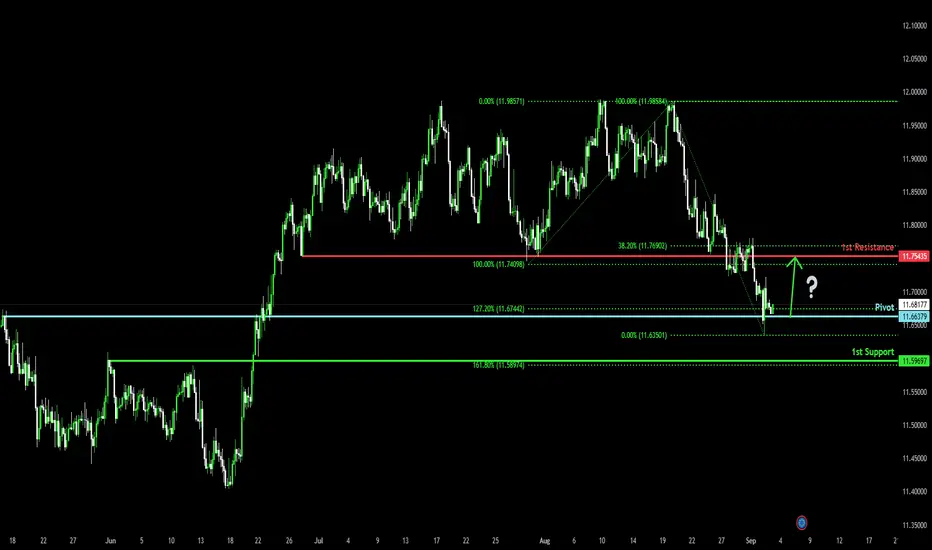
Bullish reversal off pullback support?EUR/NOK is reacting off the pivot which acts as a pullback support that lines up with the 127.2% Fibonacci extension and could reverse to the 1st resistance which is a pullback resistance.
Pivot: 11.66379
1st Resistance: 11.75435
1st Support: 11.59697
Risk Warning:
Trading Forex and CFDs carries a high level of risk to your capital and you should only trade with money you can afford to lose. Trading Forex and CFDs may not be suitable for all investors, so please ensure that you fully understand the risks involved and seek independent advice if necessary.
Disclaimer:
The above opinions given constitute general market commentary, and do not constitute the opinion or advice of IC Markets or any form of personal or investment advice.
Any opinions, news, research, analyses, prices, other information, or links to third-party sites contained on this website are provided on an "as-is" basis, are intended only to be informative, is not an advice nor a recommendation, nor research, or a record of our trading prices, or an offer of, or solicitation for a transaction in any financial instrument and thus should not be treated as such. The information provided does not involve any specific investment objectives, financial situation and needs of any specific person who may receive it. Please be aware, that past performance is not a reliable indicator of future performance and/or results. Past Performance or Forward-looking scenarios based upon the reasonable beliefs of the third-party provider are not a guarantee of future performance. Actual results may differ materially from those anticipated in forward-looking or past performance statements. IC Markets makes no representation or warranty and assumes no liability as to the accuracy or completeness of the information provided, nor any loss arising from any investment based on a recommendation, forecast or any information supplied by any third-party.
Potential bearish drop?EUR/USD has rejected off the resistance level which is an overlap resistance that aligns with the 38.2% Fibonacci retracement and could drop from this level to our take profit.
Entry: 1.1657
Why we like it:
There is an overlap resistance that aligns with the 38.2% Fibonacci retracement.
Stop loss: 1.1736
Why we like it:
There is a multi swing high resistance.
Take profit: 1.1579
Why we like it:
There is a swin low aupport.
Enjoying your TradingView experience? Review us!
Please be advised that the information presented on TradingView is provided to Vantage (‘Vantage Global Limited’, ‘we’) by a third-party provider (‘Everest Fortune Group’). Please be reminded that you are solely responsible for the trading decisions on your account. There is a very high degree of risk involved in trading. Any information and/or content is intended entirely for research, educational and informational purposes only and does not constitute investment or consultation advice or investment strategy. The information is not tailored to the investment needs of any specific person and therefore does not involve a consideration of any of the investment objectives, financial situation or needs of any viewer that may receive it. Kindly also note that past performance is not a reliable indicator of future results. Actual results may differ materially from those anticipated in forward-looking or past performance statements. We assume no liability as to the accuracy or completeness of any of the information and/or content provided herein and the Company cannot be held responsible for any omission, mistake nor for any loss or damage including without limitation to any loss of profit which may arise from reliance on any information supplied by Everest Fortune Group.
EURGBP at Supply – Short Setup Ahead?EURGBP is testing a key supply zone while also entering the overbought region.
Sellers could step in here, making it an interesting area to look for shorts.
However, if buyers manage to break above, further bullish continuation may follow.
⚡ What do you think?
👉 Will the bears take control, or will the bulls push through?
📚 Always follow your trading plan regarding entry, risk management, and trade management.
Good luck!
All Strategies Are Good; If Managed Properly!
~Richard Nasr
Bearish reversal in play: Key resistance holding strongThe Fiber (EUR/USD) has rejected off the pivot and could drop to the 1st support that aligns with the 50% Fibonacci retracement.
Pivot: 1.1724
1st Resistance: 1.1783
1st Support: 1.1648
Risk Warning:
Trading Forex and CFDs carries a high level of risk to your capital and you should only trade with money you can afford to lose. Trading Forex and CFDs may not be suitable for all investors, so please ensure that you fully understand the risks involved and seek independent advice if necessary.
Disclaimer:
The above opinions given constitute general market commentary, and do not constitute the opinion or advice of IC Markets or any form of personal or investment advice.
Any opinions, news, research, analyses, prices, other information, or links to third-party sites contained on this website are provided on an "as-is" basis, are intended only to be informative, is not an advice nor a recommendation, nor research, or a record of our trading prices, or an offer of, or solicitation for a transaction in any financial instrument and thus should not be treated as such. The information provided does not involve any specific investment objectives, financial situation and needs of any specific person who may receive it. Please be aware, that past performance is not a reliable indicator of future performance and/or results. Past Performance or Forward-looking scenarios based upon the reasonable beliefs of the third-party provider are not a guarantee of future performance. Actual results may differ materially from those anticipated in forward-looking or past performance statements. IC Markets makes no representation or warranty and assumes no liability as to the accuracy or completeness of the information provided, nor any loss arising from any investment based on a recommendation, forecast or any information supplied by any third-party.
EURUSD Watching 1.16600 Support as Dollar Weakness PersistsHey Traders, in the coming week we are monitoring EURUSD for a buying opportunity around the 1.16600 zone. EURUSD remains in an uptrend and is currently undergoing a correction phase, approaching a key support/resistance level at 1.16600.
Meanwhile, the US Dollar Index (DXY) continues to trade in a downtrend and is nearing resistance around the 98.000 zone. The dovish stance from the Federal Reserve, coupled with growing expectations for potential rate cuts in September, is adding consistent selling pressure on the dollar — increasing the probability for further EURUSD upside.
Trade safe,
Joe.
EURUSD Channel Up aiming at 1.20500The EURUSD pair has been trading within a Channel Up since the April 21 High and is on its new Bullish Leg since the Higher Low bottom on the 1D MA100 (green trend-line).
Having flipped the 1D MA50 (blue trend-line) into Support, the 1D RSI shows that we are on a symmetrical level similar to June 10 2025. We expect the Bullish Leg to reach the 1.5 Fibonacci extension (at least) just like the previous one did. Our Target is 1.20500.
-------------------------------------------------------------------------------
** Please LIKE 👍, FOLLOW ✅, SHARE 🙌 and COMMENT ✍ if you enjoy this idea! Also share your ideas and charts in the comments section below! This is best way to keep it relevant, support us, keep the content here free and allow the idea to reach as many people as possible. **
-------------------------------------------------------------------------------
💸💸💸💸💸💸
👇 👇 👇 👇 👇 👇
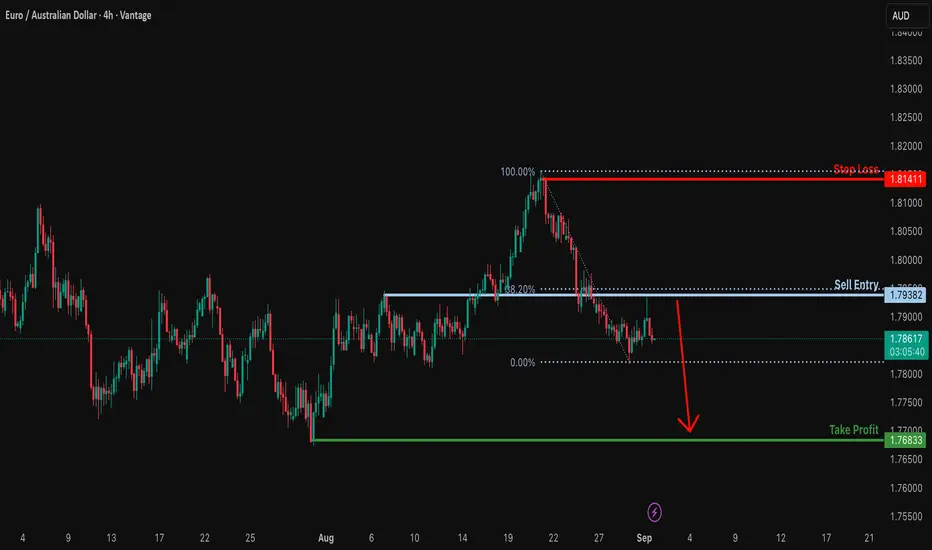
Potential bearish drop off?EUR/AUD has rejected off the resistance level, which is an overlap resistance that aligns with the 38.2% Fibonacci retracement, and could drop from this level to our take profit.
Entry: 1.7938
Why we like it:
There is an overlap resistance that aligns with the 38.2% Fibonacci retracement.
Stop loss: 1.8141
Why we like it:
There is a swing high resistance level.
Take profit: 1.7683
Why we like it:
There is a swing low support.
Enjoying your TradingView experience? Review us!
Please be advised that the information presented on TradingView is provided to Vantage (‘Vantage Global Limited’, ‘we’) by a third-party provider (‘Everest Fortune Group’). Please be reminded that you are solely responsible for the trading decisions on your account. There is a very high degree of risk involved in trading. Any information and/or content is intended entirely for research, educational and informational purposes only and does not constitute investment or consultation advice or investment strategy. The information is not tailored to the investment needs of any specific person and therefore does not involve a consideration of any of the investment objectives, financial situation or needs of any viewer that may receive it. Kindly also note that past performance is not a reliable indicator of future results. Actual results may differ materially from those anticipated in forward-looking or past performance statements. We assume no liability as to the accuracy or completeness of any of the information and/or content provided herein and the Company cannot be held responsible for any omission, mistake nor for any loss or damage including without limitation to any loss of profit which may arise from reliance on any information supplied by Everest Fortune Group.
EURUSD H4 | Price approaching swing high resistanceBased on the H4 chart analysis, we could see the price rise to the sell entry, which acts as a swing high resistance and could reverse from this level to the take profit.
Sell entry is at 1.1774, which is a swing high resistance.
Stop loss is at 1.1828, which is also a swing high resistance.
Take profit is at 1.1651, which is a pullback support.
High Risk Investment Warning
Trading Forex/CFDs on margin carries a high level of risk and may not be suitable for all investors. Leverage can work against you.
Stratos Markets Limited (tradu.com ):
CFDs are complex instruments and come with a high risk of losing money rapidly due to leverage. 65% of retail investor accounts lose money when trading CFDs with this provider. You should consider whether you understand how CFDs work and whether you can afford to take the high risk of losing your money.
Stratos Europe Ltd (tradu.com ):
CFDs are complex instruments and come with a high risk of losing money rapidly due to leverage. 66% of retail investor accounts lose money when trading CFDs with this provider. You should consider whether you understand how CFDs work and whether you can afford to take the high risk of losing your money.
Stratos Global LLC (tradu.com ):
Losses can exceed deposits.
Please be advised that the information presented on TradingView is provided to Tradu (‘Company’, ‘we’) by a third-party provider (‘TFA Global Pte Ltd’). Please be reminded that you are solely responsible for the trading decisions on your account. There is a very high degree of risk involved in trading. Any information and/or content is intended entirely for research, educational and informational purposes only and does not constitute investment or consultation advice or investment strategy. The information is not tailored to the investment needs of any specific person and therefore does not involve a consideration of any of the investment objectives, financial situation or needs of any viewer that may receive it. Kindly also note that past performance is not a reliable indicator of future results. Actual results may differ materially from those anticipated in forward-looking or past performance statements. We assume no liability as to the accuracy or completeness of any of the information and/or content provided herein and the Company cannot be held responsible for any omission, mistake nor for any loss or damage including without limitation to any loss of profit which may arise from reliance on any information supplied by TFA Global Pte Ltd.
The speaker(s) is neither an employee, agent nor representative of Tradu and is therefore acting independently. The opinions given are their own, constitute general market commentary, and do not constitute the opinion or advice of Tradu or any form of personal or investment advice. Tradu neither endorses nor guarantees offerings of third-party speakers, nor is Tradu responsible for the content, veracity or opinions of third-party speakers, presenters or participants.
Bullish Rise on EUR/USD – Key Support Holding?EUR/USD has bounced off the support level which is a pullback support, and could potentially rise from this level to our take profit.
Entry: 1.1653
Why we like it:
There is a pullback support.
Stop loss: 1.1581
Why we like it:
There is a multi-swing low support.
Take profit: 1.1774
Why we like it:
There is a swing high resistance.
Enjoying your TradingView experience? Review us!
Please be advised that the information presented on TradingView is provided to Vantage (‘Vantage Global Limited’, ‘we’) by a third-party provider (‘Everest Fortune Group’). Please be reminded that you are solely responsible for the trading decisions on your account. There is a very high degree of risk involved in trading. Any information and/or content is intended entirely for research, educational and informational purposes only and does not constitute investment or consultation advice or investment strategy. The information is not tailored to the investment needs of any specific person and therefore does not involve a consideration of any of the investment objectives, financial situation or needs of any viewer that may receive it. Kindly also note that past performance is not a reliable indicator of future results. Actual results may differ materially from those anticipated in forward-looking or past performance statements. We assume no liability as to the accuracy or completeness of any of the information and/or content provided herein and the Company cannot be held responsible for any omission, mistake nor for any loss or damage including without limitation to any loss of profit which may arise from reliance on any information supplied by Everest Fortune Group.
EUR/USD range and USD/CHF breakdown risk into payrollsIn a shortened US week, August jobs data will be the key event.
Nonfarm payrolls, the unemployment rate, wage growth, the ADP report, the JOLTS, and Challenger job cuts will all reveal whether the labour market continues the sharp slowdown seen in prior releases.
For Europe, attention will be on inflation prints from both the Eurozone and Switzerland, providing fresh direction for EUR- and CHF-linked pairs.
On the 4H chart, EUR/USD is trading around 1.1680, caught in a choppy sideways range. Price has repeatedly tested both support near 1.1640 and resistance. Strong jobs data could weigh on the pair and push it back below 1.1640, while weaker labour data may allow a breakout toward 1.1740–1.1780.
USD/CHF shows a rounding top pattern on the 4H timeframe, with price pressing the neckline near 0.8000. Sellers have steadily pushed lower highs since mid-August, and this pattern could hint at further downside momentum.
EUR/USD Technical Analysis & Trading Strategy Forecast# EUR/USD Technical Analysis & Trading Strategy Forecast - Comprehensive Multi-Timeframe Analysis
Asset Class: EUR/USD (Euro vs US Dollar)
Current Price: 1.16869 (as of August 30, 2025, 1:00 AM UTC+4)
Analysis Date: August 31, 2025
Market Context: Post-Jackson Hole consolidation phase with emerging bullish momentum
Executive Summary
The EUR/USD pair is currently trading at 1.16869, showing signs of consolidation following recent bullish momentum sparked by Fed Chair Powell's dovish tone at Jackson Hole. Our comprehensive multi-dimensional technical analysis reveals a critical juncture where multiple analytical frameworks converge, presenting compelling opportunities for both intraday scalping and swing trading strategies. The analysis incorporates advanced pattern recognition, wave theory, harmonic patterns, and momentum indicators to provide actionable trading insights for the world's most traded currency pair.
Current Market Landscape & Fundamental Context
Jay Powell's speech at Jackson Hole helped EURUSD bulls turn what was until then a weak performance into another weekly gain, marking a significant shift in market sentiment. The pair has demonstrated resilience despite ongoing economic uncertainties, with traders positioning for potential Federal Reserve policy adjustments.
Recent Elliott Wave analysis indicates an ongoing five-wave impulse structure from the August 1, 2025 low, with wave 1 peaking at 1.173, followed by a wave 2 pullback that concluded at 1.157. This structure suggests the pair is currently developing within a larger bullish framework, though short-term consolidation remains likely.
Market forecasters note that the 1.1650 level aligns with the 50 percent Fibonacci retracement drawn from the April high of 1.1900 to the July low near 1.1500, creating a significant resistance zone that will be crucial for determining the pair's next major directional move.
Multi-Timeframe Elliott Wave Analysis
Primary Wave Count Structure
Long-term Perspective (Monthly/Weekly):
Grand Supercycle: Currently in corrective Wave (B) from 2008 lows
Cycle Wave: Developing five-wave impulse from 2022 parity lows
Primary Wave: Wave III of larger degree cycle in progress
Intermediate Count: Currently in Wave (3) of III with subdivisions
Medium-term Count (Daily/4H):
From the August 1, 2025 low at 1.157, the pair has been developing a five-wave impulse structure:
Wave 1: Completed at 1.173 (160 pips)
Wave 2: Expanded Flat correction to 1.157 (38.2% retracement)
Wave 3: Currently in progress, targeting 1.180-1.185 zone
Wave 4: Expected pullback to 1.170-1.165 range
Wave 5: Ultimate target 1.190-1.200 region
Short-term Analysis (1H/15M):
EURUSD is currently developing an intraday three-wave pullback from recent highs, with ideal support area at 1.16146-1.15521 using Equal Legs technique.
Elliott Wave Targets & Projections
Immediate Targets:
Wave 3 Extension: 1.180-1.185 (1.618 x Wave 1)
Secondary Target: 1.188-1.192 (2.618 x Wave 1)
Major Resistance: 1.200-1.205 (Wave equality zone)
Support Levels (Wave 4 Correction):
Primary Support: 1.168-1.170 (23.6% retracement)
Secondary Support: 1.164-1.166 (38.2% retracement)
Critical Support: 1.160-1.162 (50% retracement)
Harmonic Pattern Analysis & Fibonacci Framework
Active Harmonic Formations
1. Bullish Gartley Pattern (4H-Daily Timeframe)
X to A Leg: 1.1900 to 1.1500 (400 pips decline)
A to B Retracement: 61.8% at 1.1747
B to C Projection: 78.6% of AB at 1.1553
Completion Zone (D): 1.1589-1.1620 (78.6% XA retracement)
Status: Pattern completed, currently in markup phase
2. Potential Bullish Bat Pattern (Daily-Weekly)
Formation Stage: B to C leg development
Critical Level: 1.1650 (B point validation)
Target Completion: 1.1520-1.1480 zone (88.6% XA)
Risk Assessment: Moderate probability (60%)
3. Crab Pattern Alert (Higher Timeframes)
Monitoring Level: Break below 1.1480 could trigger deeper Crab formation
Completion Zone: 1.1380-1.1320 (161.8% XA extension)
Strategic Implication: Major accumulation zone if activated
Fibonacci Confluence Analysis
Key Fibonacci Levels:
38.2% Retracement: 1.1652 (April-July range) - Current resistance
50% Retracement: 1.1700 (Major resistance confluence)
61.8% Golden Ratio: 1.1748 (Strong resistance barrier)
78.6% Level: 1.1796 (Ultimate bull target)
Extension Targets:
127.2% Extension: 1.1820 (From August correction)
161.8% Extension: 1.1895 (Major projection target)
200% Extension: 1.1965 (Extreme bull scenario)
Wyckoff Theory Market Structure Analysis
Current Market Phase Assessment
Phase Identification: Early Markup Phase (Spring Test Completed)
Wyckoff Characteristics Observed:
1. Accumulation Completed: May-July 2025 range (1.1500-1.1650)
2. Spring Test: August 1st low at 1.1570 (successful test)
3. Sign of Strength (SOS): August 5-8 rally to 1.1730
4. Last Point of Support (LPS): August 15-20 pullback to 1.1580
5. Current Phase: Early markup with backing and filling
Volume Analysis:
Accumulation Phase: Declining volume on pullbacks, expanding on rallies
Markup Confirmation: Volume expansion above 1.1650 resistance required
Distribution Warning: Watch for climactic volume at 1.1800+ levels
Wyckoff Price Targets:
Initial Objective: 1.1800-1.1850 (measured move from accumulation range)
Secondary Target: 1.1950-1.2000 (full range projection)
Long-term Goal: 1.2200-1.2300 (major Wyckoff projection)
W.D. Gann Theory & Sacred Geometry Analysis
Gann Square of 9 Analysis
Current Position: 1.16869 sits near critical Gann level
Key Gann Levels:
Natural Support: 1.1600 (perfect square root level)
Resistance: 1.1700 (next major Gann square)
Critical Resistance: 1.1881 (major Gann confluence)
Ultimate Target: 1.2100 (next significant square level)
Gann Time Theory & Cycles
Active Time Cycles:
90-Day Cycle: Due September 15, 2025 (±3 days)
Seasonal Tendency: September typically bearish for EUR/USD
Major Time Square: October 12, 2025 (144-day cycle)
Gann Angles Analysis:
1x1 Support Angle: Rising at 1.1620 (from August lows)
2x1 Resistance: 1.1720 (dynamic resistance line)
1x2 Support: 1.1580 (major support angle)
4x1 Resistance: 1.1840 (long-term target angle)
Price-Time Balance
Current Assessment: Price slightly ahead of time (bullish imbalance)
Equilibrium Zone: 1.1650-1.1680 (time-price balance)
Acceleration Level: Break above 1.1720 suggests time-price momentum shift
Ichimoku Kinko Hyo Cloud Analysis
Current Ichimoku Structure
Tenkan-sen (9): 1.1675 (immediate dynamic support)
Kijun-sen (26): 1.1635 (medium-term trend indicator)
Senkou Span A: 1.1655 (near-term cloud boundary)
Senkou Span B: 1.1590 (strong cloud support)
Chikou Span: Trading above price 26 periods ago (bullish signal)
Ichimoku Signals & Interpretation
Current Status: Price above cloud (bullish environment)
Key Signals:
1. TK Cross: Tenkan above Kijun (bullish short-term momentum)
2. Cloud Color: Green cloud ahead (bullish bias continues)
3. Price vs Cloud: Above cloud (trend confirmation)
4. Chikou Span: Clear of historical prices (momentum confirmation)
Ichimoku Targets:
Immediate Resistance: Tenkan-sen at 1.1675
Cloud Resistance: 1.1700-1.1720 (future cloud thickness)
Major Target: 1.1800+ (cloud projection upward)
Support Levels:
Immediate: Kijun-sen at 1.1635
Strong Support: Cloud base at 1.1590-1.1600
Critical Level: 1.1570 (cloud break would turn bearish)
Technical Indicators Deep Dive
Relative Strength Index (RSI) Analysis
Multi-Timeframe RSI Status:
Daily RSI: 58.5 (Neutral-bullish zone)
4H RSI: 62.3 (Approaching overbought but sustainable)
1H RSI: 45.2 (Oversold on recent pullback - buying opportunity)
RSI Signals & Divergences:
Bullish Divergence: Spotted on 4H chart (price lows vs RSI lows)
Support Level: RSI 50 holding as dynamic support
Resistance Zone: 70 level will indicate overbought condition
RSI Trading Levels:
Buy Signal: RSI below 40 on hourly charts
Sell Signal: RSI above 75 on daily timeframe
Trend Confirmation: RSI above 60 confirms bullish trend
Bollinger Bands (BB) Volatility Analysis
Current Band Position:
Upper Band: 1.1720 (immediate resistance)
Middle Band (SMA 20): 1.1655 (dynamic support)
Lower Band: 1.1590 (strong support)
Band Analysis:
Current Position: Upper third of bands (bullish bias)
Bandwidth: Expanding after recent contraction (volatility increase)
Band Walk: Potential for upper band walk if 1.1680 breaks
Bollinger Band Strategies:
Squeeze Play: Completed - expecting volatility expansion
Band Bounce: Look for bounces off middle band (1.1655)
Breakout Setup: Upper band break targets 1.1750+
Volume Weighted Average Price (VWAP) Analysis
Multi-Session VWAP Levels:
Daily VWAP: 1.1668 (immediate pivot)
Weekly VWAP: 1.1642 (medium-term anchor)
Monthly VWAP: 1.1595 (major support)
VWAP Trading Signals:
Above VWAP: Bullish institutional sentiment
VWAP Reclaim: 1.1668 break confirms bullish continuation
Volume Profile: Heavy volume at 1.1640-1.1660 (support zone)
Moving Average Convergence Analysis
Simple Moving Averages:
SMA 20: 1.1655 (immediate support)
SMA 50: 1.1618 (medium-term support)
SMA 100: 1.1585 (long-term support trend)
SMA 200: 1.1542 (major trend indicator)
Exponential Moving Averages:
EMA 12: 1.1672 (short-term trend)
EMA 26: 1.1651 (MACD baseline)
EMA 50: 1.1628 (medium-term trend)
Moving Average Signals:
Golden Cross Watch: EMA 12 crossing above EMA 26 (bullish)
Support Confluence: Multiple MAs clustering at 1.1620-1.1650
Resistance Zone: 1.1680-1.1700 (MA resistance cluster)
Advanced Candlestick Pattern Recognition
Recent Candlestick Formations
Weekly Chart Patterns:
1. Hammer Formation (Week of August 26) - Bullish reversal signal
2. Doji Sequence (Previous weeks) - Indecision resolved to upside
3. Bullish Engulfing potential for current week
Daily Chart Patterns:
1. Three White Soldiers (August 5-7) - Strong bullish momentum
2. Flag Pattern (August 15-20) - Consolidation before continuation
3. Morning Star formation developing (August 28-30)
4-Hour Chart Signals:
1. Bull Flag Breakout - Target 1.1750
2. Ascending Triangle - Apex at 1.1680
3. Cup and Handle pattern completing
Candlestick Strategy Integration
Reversal Patterns to Watch:
Evening Star at 1.1720+ (bearish reversal warning)
Shooting Star above 1.1700 (short-term top signal)
Hanging Man at current levels (continuation vs reversal)
Continuation Patterns:
Bullish Flag break above 1.1680 (measured move to 1.1750)
Pennant formation resolution (typically bullish in uptrend)
Rising Three Methods (bullish continuation pattern)
Market Structure & Key Levels
Critical Support & Resistance Framework
Major Resistance Levels:
1. 1.1680-1.1690: Immediate resistance (Bollinger upper band + previous highs)
2. 1.1720-1.1730: Intermediate resistance (August highs + Gann angle)
3. 1.1750-1.1760: Major resistance (Multiple harmonic confluences)
4. 1.1800-1.1820: Significant resistance (Fibonacci extensions + Wyckoff target)
5. 1.1880-1.1900: Ultimate resistance (April highs + major Gann level)
Critical Support Levels:
1. 1.1650-1.1660: Immediate support (VWAP + Fibonacci 38.2%)
2. 1.1620-1.1635: Intermediate support (Kijun-sen + SMA cluster)
3. 1.1590-1.1600: Major support (Cloud base + Gann square)
4. 1.1570-1.1580: Critical support (Elliott Wave invalidation)
5. 1.1520-1.1540: Ultimate support (Harmonic completion + major lows)
Market Structure Analysis
Current Structure: Higher highs and higher lows since August 1
Trend Definition: Bullish on all timeframes above 1.1580
Structure Break: Below 1.1570 would signal trend reversal
Impulse vs Corrective: Currently in impulsive bullish phase
Comprehensive Trading Strategies
Intraday Trading Strategy (5M - 4H Charts)
# Strategy 1: Bollinger Band Bounce (Success Rate: 65%)
Setup Requirements:
- Price approaching middle Bollinger Band (1.1655)
- RSI < 45 on 1H chart
- Volume above average on approach
Entry Criteria:
Long Entry: 1.1650-1.1658 (scale in approach)
Stop Loss: 1.1635 (below key support)
Target 1: 1.1680 (Upper Bollinger Band)
Target 2: 1.1720 (Previous resistance)
Risk-Reward: 1:2.5
# Strategy 2: Breakout Trading (Success Rate: 70%)
Bullish Breakout:
Entry: Break above 1.1680 with volume confirmation
Stop Loss: 1.1665 (back below breakout level)
Target 1: 1.1720 (measured move)
Target 2: 1.1750 (harmonic target)
Target 3: 1.1800 (major resistance)
Bearish Breakout:
Entry: Break below 1.1635 with volume
Stop Loss: 1.1655 (failed breakdown)
Target 1: 1.1600 (immediate support)
Target 2: 1.1570 (major support)
# Strategy 3: RSI Divergence Play (Success Rate: 75%)
Setup: RSI divergence on 1H-4H timeframes
Entry: Confirmation candle after divergence spotted
Management: Trail stops below key swing lows/highs
Targets: Previous swing extremes
Swing Trading Strategy (4H - Monthly Charts)
# Primary Swing Setup: Elliott Wave Continuation
Market Context: Currently in Wave 3 of larger degree impulse
Long Position Framework:
Accumulation Zone: 1.1620-1.1660 (on any pullbacks)
Entry Trigger: Hold above 1.1635 with bullish momentum
Stop Loss: 1.1570 (Elliott Wave invalidation)
Target 1: 1.1750-1.1800 (Wave 3 extension)
Target 2: 1.1850-1.1900 (Wave 3 completion)
Ultimate Target: 1.1950-1.2000 (Wave 5 projection)
Position Size: 2% account risk
Time Horizon: 4-8 weeks
Risk Management:
Initial Risk: 30-50 pips (tight stops on entries)
Position Scaling: Add on pullbacks to 1.1640-1.1650
Profit Taking: 25% at Target 1, 50% at Target 2, 25% runner
Trailing Stops: Implement after 1:1 risk-reward achieved
# Alternative Swing Setup: Range Trading
If Elliott Wave Fails:
Range: 1.1570-1.1720 (broad consolidation range)
Buy Zone: 1.1570-1.1600 (range lows with confirmation)
Sell Zone: 1.1680-1.1720 (range highs with reversal signals)
Stop Loss: Outside range boundaries
Strategy: Fade extremes, take profits at opposite boundaries
Weekly Trading Plan (September 2-6, 2025)
Monday September 2: Labor Day Impact
Expected Scenario: Thin liquidity due to US holiday
Strategy: Avoid major positions, focus on range trading
Key Levels: 1.1650-1.1680 range likely
Risk: Potential for fake breakouts due to low volume
Tuesday September 3: ISM Manufacturing PMI
Market Focus: US economic data release (10:00 AM ET)
Strategy: Position ahead of data if clear setup exists
Bullish Scenario: Weak PMI data (EUR/USD rally potential)
Bearish Scenario: Strong PMI data (USD strength)
Key Level: 1.1670 break determines direction
Wednesday September 4: ECB Rate Decision Watch
Major Event: ECB policy meeting preparation
Strategy: Volatility expansion expected
Pre-Event: Look for coiling patterns, reduced ranges
Post-Event: Breakout trading strategies
Risk Management: Reduce position sizes before announcement
Thursday September 5: US Initial Claims + Services PMI
Technical Focus: Mid-week momentum continuation
Morning Strategy: European session range trading
Afternoon Strategy: US data reaction plays
Key Confluence: 1.1680 resistance test likely
Friday September 6: Non-Farm Payrolls Preparation
Week-End Positioning: Major data preparation
Strategy: Reduce risk ahead of weekend
Technical Focus: Weekly close positioning
Target: Weekly close above 1.1660 (bullish) or below 1.1640 (bearish)
Advanced Pattern Recognition Alerts
Bull Trap Scenarios
Setup 1: False Breakout Above 1.1720
Warning Signs: Low volume breakout, immediate reversal
Response: Short on break back below 1.1700
Target: 1.1650-1.1620 (measured move down)
Stop Loss: Above 1.1730 (failed trap)
Setup 2: Failed Elliott Wave Extension
Scenario: Wave 3 fails to extend beyond 1.1750
Implication: Possible complex Wave 2 still developing
Strategy: Wait for deeper pullback to 1.1600 area
Bear Trap Alerts
Setup 1: False Break Below 1.1635
Characteristics: High volume break, quick recovery
Response: Long on reclaim of 1.1640-1.1645
Target: 1.1680-1.1700 (trapped bears covering)
Confirmation: RSI bullish divergence required
Setup 2: Harmonic Pattern Failure
Scenario: Break below harmonic support at 1.1590
Response: Wait for retest and rejection
Strategy: Strong long opportunity if support holds on retest
Risk Management & Position Sizing Framework
Account Risk Allocation
Single Trade Risk: Maximum 1% for intraday, 2% for swing trades
Currency Exposure: Total EUR/USD exposure not exceeding 5% of account
Correlation Risk: Monitor EUR/GBP, GBP/USD correlations
News Risk: Reduce positions by 50% ahead of major events
Stop Loss Methodology
Technical Stops:
Support/Resistance: 10-15 pips beyond key levels
Moving Average: Below/above significant MA levels
Volatility-Based: 1.5x Average True Range (ATR)
Time-Based Stops:
Intraday: Exit if no progress within 4-6 hours
Swing: Exit if no progress within 5 trading days
Event Risk: Flat before major announcements unless specifically trading the event
Profit Taking Protocols
Scaled Exit Strategy:
1. 25% at 1:1 Risk-Reward (secure break-even)
2. 50% at 1:2 Risk-Reward (lock in profits)
3. 25% runner with trailing stop (capture trends)
Trailing Stop Guidelines:
Activate: After reaching 1:1 risk-reward
Method: Trail below/above previous swing lows/highs
Minimum Trail: 15 pips for intraday, 30 pips for swing
Market Psychology & Sentiment Analysis
Current Sentiment Indicators
Positioning Data:
COT Report: Large speculators slightly long EUR
Retail Sentiment: 60% long EUR/USD (contrarian bearish)
Institutional Flow: Mixed signals, slight USD weakness
Fear & Greed Indicators:
VIX Level: Moderate (supportive of risk-on)
Currency Vol: EUR/USD implied volatility declining
Safe Haven Demand: USD demand moderating
Psychological Price Levels
Major Round Numbers:
1.1600: Psychological support (previous resistance)
1.1700: Major psychological resistance
1.1800: Significant psychological barrier
1.2000: Major psychological milestone (parity with 2020 levels)
External Factors & Macroeconomic Context
Central Bank Policy Divergence
Federal Reserve:
- Current stance: Data-dependent, potential pause in tightening
- Market expectations: 25bps cut possibility in Q4 2025
- Key speakers: Watch for Powell, Williams, and other Fed officials
European Central Bank:
- Current stance: Gradual normalization continues
- Inflation target: Progress toward 2% target ongoing
- Policy differential: EUR benefits from relative hawkishness
Geopolitical Risk Factors
European Union:
- Energy security concerns monitoring required
- Political stability in major EU economies
- Brexit-related trade impacts on EUR sentiment
Global Factors:
- China economic data impacts on risk sentiment
- Commodity price fluctuations affecting EUR
- Global supply chain normalization supporting EUR
Economic Calendar Priority Events
High Impact EUR Events:
- ECB Rate Decisions and Press Conferences
- Eurozone CPI and Core CPI readings
- German IFO Business Climate and ZEW indices
- European PMI manufacturing and services data
High Impact USD Events:
- Federal Reserve policy meetings and minutes
- US Non-Farm Payrolls and unemployment rate
- US CPI and Core CPI inflation readings
- US GDP and consumer confidence indicators
Technology Integration & Automation
Automated Alert Systems
Price Alerts:
Breakout Levels: 1.1680, 1.1720, 1.1635, 1.1600
Support/Resistance: All major levels identified
Pattern Completion: Harmonic pattern targets
Elliott Wave: Wave completion and invalidation levels
Indicator Alerts:
RSI: Oversold (<30) and Overbought (>70) conditions
Bollinger Bands: Band squeeze and expansion signals
MACD: Signal line crosses and divergences
Volume: Unusual volume spikes (2x average)
Trading Platform Integration
TradingView Setup:
Multi-timeframe dashboard: 15M, 1H, 4H, Daily, Weekly
Custom indicators: Harmonic scanner, Elliott Wave tools
Alert integration: Mobile and email notifications
Backtesting: Strategy performance validation
MetaTrader Integration:
Expert Advisor: Automated entry/exit based on confluences
Risk Management: Position sizing and stop-loss automation
News Integration: Economic calendar with impact levels
Statistics Tracking: Trade performance analytics
Advanced Strategy Combinations
Multi-Confluence Entry System
Tier 1 Signals (Highest Probability):
- Elliott Wave + Harmonic Pattern + RSI Divergence
- Wyckoff accumulation + Gann support + Volume confirmation
- Ichimoku bullish signals + Candlestick reversal patterns
Tier 2 Signals (Moderate Probability):
- Fibonacci confluence + Moving average support
- Bollinger Band bounce + VWAP reclaim
- Chart pattern breakout + momentum confirmation
Tier 3 Signals (Lower Probability):
- Single indicator signals without confluence
- Counter-trend trades without strong reversal signals
- News-based trades without technical confirmation
Scenario Planning & Contingency Strategies
Scenario 1: Strong Bull Market (40% Probability)
Trigger: Break above 1.1720 with strong volume
Targets: 1.1800, 1.1880, 1.1950
Strategy: Trend following, add on pullbacks
Risk: Overbought conditions, potential corrections
Scenario 2: Range-Bound Market (35% Probability)
Parameters: 1.1570-1.1720 trading range
Strategy: Fade extremes, take profits at boundaries
Duration: 4-6 weeks potential
Risk: False breakouts, whipsaw price action
Scenario 3: Bear Market Resumption (25% Probability)
Trigger: Break below 1.1570 with conviction
Targets: 1.1520, 1.1480, 1.1400
Strategy: Short rallies, trend following down
Risk: Central bank intervention, policy shifts
Performance Metrics & Success Indicators
Strategy Validation Metrics
Win Rate Targets:
- Intraday strategies: 60-65% win rate minimum
- Swing strategies: 55-60% win rate acceptable
- Overall portfolio: 58% win rate target
Risk-Reward Ratios:
- Minimum acceptable: 1:1.5 risk-reward
- Target average: 1:2.5 risk-reward
- Exceptional setups: 1:4+ risk-reward potential
Maximum Drawdown Limits:
- Daily drawdown: 2% maximum
- Weekly drawdown: 5% maximum
- Monthly drawdown: 8% maximum
Performance Tracking KPIs
Trading Efficiency:
- Average holding period for winning trades
- Average holding period for losing trades
- Profit factor (gross profit/gross loss)
- Sharpe ratio for trading performance
Market Timing Accuracy:
- Entry timing effectiveness
- Exit timing optimization
- Pattern recognition accuracy
- Economic event impact prediction
Conclusion & Strategic Outlook
The EUR/USD pair presents a compelling technical landscape with multiple analytical frameworks converging to suggest potential bullish continuation from current levels. MACD remains above the zero line, though momentum is fading, signaling a potential sideways phase. RSI holds near 60, reflecting the dominance of bullish sentiment, supporting our cautiously optimistic bias.
The confluence of Elliott Wave impulse structure, completed harmonic patterns, Wyckoff markup phase characteristics, and supportive Ichimoku cloud positioning creates a favorable risk-reward environment for both intraday and swing trading opportunities.
Key Strategic Themes:
1. Primary Bias: Bullish above 1.1570 invalidation level
2. Target Hierarchy: 1.1720 → 1.1800 → 1.1880 → 1.1950
3. Risk Management: Critical support at 1.1635-1.1650 cluster
4. Time Horizon: 4-8 week bullish campaign potential
Success Probability Assessment:
Bullish Continuation: 65% probability
Sideways Consolidation: 25% probability
Bearish Reversal: 10% probability
Critical Decision Points:
1. 1.1680 Resistance: Break confirms bullish acceleration
2. 1.1635 Support: Hold required for bullish structure integrity
3. 1.1720 Zone: Major resistance test will determine intermediate-term direction
The integration of advanced technical methodologies with comprehensive risk management protocols positions traders to capitalize on the EUR/USD pair's evolving price action while maintaining appropriate downside protection. Continuous monitoring of central bank policies, economic data releases, and global risk sentiment remains essential for strategy adaptation and optimal trade execution.
Trading Recommendation: Maintain bullish bias with defensive positioning, scale into strength above key resistance levels, and prepare for potential volatility expansion around major economic events and central bank communications.
EURUSD H4 | 61.8% Fibonacci Retracement Signals Bearish ReversalThe Fiber (EUR/USD) is reacting off the sell entry which is a pullback resistance that aligns with the 61.8% Fibonacci retracement and could drop from this level to the downside.
Sell entry is at 1.16743, whihc is a pullback resistance that lines up with the 61.8% Fibonacci retracement.
Stop loss is at 1.1724, whihc is a pullback resistance.
Takeprofit is at 1.1588, which is an overlap support.
High Risk Investment Warning
Trading Forex/CFDs on margin carries a high level of risk and may not be suitable for all investors. Leverage can work against you.
Stratos Markets Limited (tradu.com ):
CFDs are complex instruments and come with a high risk of losing money rapidly due to leverage. 65% of retail investor accounts lose money when trading CFDs with this provider. You should consider whether you understand how CFDs work and whether you can afford to take the high risk of losing your money.
Stratos Europe Ltd (tradu.com ):
CFDs are complex instruments and come with a high risk of losing money rapidly due to leverage. 66% of retail investor accounts lose money when trading CFDs with this provider. You should consider whether you understand how CFDs work and whether you can afford to take the high risk of losing your money.
Stratos Global LLC (tradu.com ):
Losses can exceed deposits.
Please be advised that the information presented on TradingView is provided to Tradu (‘Company’, ‘we’) by a third-party provider (‘TFA Global Pte Ltd’). Please be reminded that you are solely responsible for the trading decisions on your account. There is a very high degree of risk involved in trading. Any information and/or content is intended entirely for research, educational and informational purposes only and does not constitute investment or consultation advice or investment strategy. The information is not tailored to the investment needs of any specific person and therefore does not involve a consideration of any of the investment objectives, financial situation or needs of any viewer that may receive it. Kindly also note that past performance is not a reliable indicator of future results. Actual results may differ materially from those anticipated in forward-looking or past performance statements. We assume no liability as to the accuracy or completeness of any of the information and/or content provided herein and the Company cannot be held responsible for any omission, mistake nor for any loss or damage including without limitation to any loss of profit which may arise from reliance on any information supplied by TFA Global Pte Ltd.
The speaker(s) is neither an employee, agent nor representative of Tradu and is therefore acting independently. The opinions given are their own, constitute general market commentary, and do not constitute the opinion or advice of Tradu or any form of personal or investment advice. Tradu neither endorses nor guarantees offerings of third-party speakers, nor is Tradu responsible for the content, veracity or opinions of third-party speakers, presenters or participants.
Bearish reversal?EUR/USD is reacting off the resistance level, which is a pullback resistance that aligns with the 61.8% Fibonacci retracement and could reverse from this level to our take profit.
Entry: 1.1678
Why we like it:
There is a pullback resistance level that lines up with the 61.8% Fibonacci retracement.
Stop loss: 1.1776
Why we like it:
There is a swing high resistance level,
Take profit: 1.1584
Why we like it:
There is an overlap support.
Enjoying your TradingView experience? Review us!
Please be advised that the information presented on TradingView is provided to Vantage (‘Vantage Global Limited’, ‘we’) by a third-party provider (‘Everest Fortune Group’). Please be reminded that you are solely responsible for the trading decisions on your account. There is a very high degree of risk involved in trading. Any information and/or content is intended entirely for research, educational and informational purposes only and does not constitute investment or consultation advice or investment strategy. The information is not tailored to the investment needs of any specific person and therefore does not involve a consideration of any of the investment objectives, financial situation or needs of any viewer that may receive it. Kindly also note that past performance is not a reliable indicator of future results. Actual results may differ materially from those anticipated in forward-looking or past performance statements. We assume no liability as to the accuracy or completeness of any of the information and/or content provided herein and the Company cannot be held responsible for any omission, mistake nor for any loss or damage including without limitation to any loss of profit which may arise from reliance on any information supplied by Everest Fortune Group.
Bearish drop off pullback resistance?EUR/JPY has rejected off the pivot which has been identified as a pullback resistance and could drop to the major support.
Pivot: 171.99
1st Support: 169.91
1st Resistance: 172.85
Risk Warning:
Trading Forex and CFDs carries a high level of risk to your capital and you should only trade with money you can afford to lose. Trading Forex and CFDs may not be suitable for all investors, so please ensure that you fully understand the risks involved and seek independent advice if necessary.
Disclaimer:
The above opinions given constitute general market commentary, and do not constitute the opinion or advice of IC Markets or any form of personal or investment advice.
Any opinions, news, research, analyses, prices, other information, or links to third-party sites contained on this website are provided on an "as-is" basis, are intended only to be informative, is not an advice nor a recommendation, nor research, or a record of our trading prices, or an offer of, or solicitation for a transaction in any financial instrument and thus should not be treated as such. The information provided does not involve any specific investment objectives, financial situation and needs of any specific person who may receive it. Please be aware, that past performance is not a reliable indicator of future performance and/or results. Past Performance or Forward-looking scenarios based upon the reasonable beliefs of the third-party provider are not a guarantee of future performance. Actual results may differ materially from those anticipated in forward-looking or past performance statements. IC Markets makes no representation or warranty and assumes no liability as to the accuracy or completeness of the information provided, nor any loss arising from any investment based on a recommendation, forecast or any information supplied by any third-party.
Bearish drop off?EUR/CAD has rejected off the pivot which acts as a pullback resistance and could drop to the 1st support.
Pivot: 1.60852
1st Support: 1.59637
1st Resistance: 1.61356
Risk Warning:
Trading Forex and CFDs carries a high level of risk to your capital and you should only trade with money you can afford to lose. Trading Forex and CFDs may not be suitable for all investors, so please ensure that you fully understand the risks involved and seek independent advice if necessary.
Disclaimer:
The above opinions given constitute general market commentary, and do not constitute the opinion or advice of IC Markets or any form of personal or investment advice.
Any opinions, news, research, analyses, prices, other information, or links to third-party sites contained on this website are provided on an "as-is" basis, are intended only to be informative, is not an advice nor a recommendation, nor research, or a record of our trading prices, or an offer of, or solicitation for a transaction in any financial instrument and thus should not be treated as such. The information provided does not involve any specific investment objectives, financial situation and needs of any specific person who may receive it. Please be aware, that past performance is not a reliable indicator of future performance and/or results. Past Performance or Forward-looking scenarios based upon the reasonable beliefs of the third-party provider are not a guarantee of future performance. Actual results may differ materially from those anticipated in forward-looking or past performance statements. IC Markets makes no representation or warranty and assumes no liability as to the accuracy or completeness of the information provided, nor any loss arising from any investment based on a recommendation, forecast or any information supplied by any third-party.
Bearish continuation?EUR/NOK is reacting off the pivot which acts as a pullback resistance and could drop to the pullback support that lines up with the 78.6% Fibonacci projection.
Pivot: 11.76373
1st Support: 11.66458
1st Resistance: 11.85074
Risk Warning:
Trading Forex and CFDs carries a high level of risk to your capital and you should only trade with money you can afford to lose. Trading Forex and CFDs may not be suitable for all investors, so please ensure that you fully understand the risks involved and seek independent advice if necessary.
Disclaimer:
The above opinions given constitute general market commentary, and do not constitute the opinion or advice of IC Markets or any form of personal or investment advice.
Any opinions, news, research, analyses, prices, other information, or links to third-party sites contained on this website are provided on an "as-is" basis, are intended only to be informative, is not an advice nor a recommendation, nor research, or a record of our trading prices, or an offer of, or solicitation for a transaction in any financial instrument and thus should not be treated as such. The information provided does not involve any specific investment objectives, financial situation and needs of any specific person who may receive it. Please be aware, that past performance is not a reliable indicator of future performance and/or results. Past Performance or Forward-looking scenarios based upon the reasonable beliefs of the third-party provider are not a guarantee of future performance. Actual results may differ materially from those anticipated in forward-looking or past performance statements. IC Markets makes no representation or warranty and assumes no liability as to the accuracy or completeness of the information provided, nor any loss arising from any investment based on a recommendation, forecast or any information supplied by any third-party.
EURBGP Sell this Leg and buy at the bottom.Last time we took a look a the EURGBP pair (July 11, see chart below), we gave a buy signal inside the Channel Up, which quickly hit our 0.87400 Target:
This time the price has found itself on a decline, the latest Bearish Leg of the Channel Up. The previous two declined by -2.75% before bottoming and reversing. The 1D RSI Higher Lows can be an additional indicator as to where the Low can be priced.
We expect the pair to reach at least 0.85500 before starting the new Bullish Leg, which we believe will extend all the way near the top (1.0 Fibonacci) of the Channel Up. Our Target will be 0.8900.
-------------------------------------------------------------------------------
** Please LIKE 👍, FOLLOW ✅, SHARE 🙌 and COMMENT ✍ if you enjoy this idea! Also share your ideas and charts in the comments section below! This is best way to keep it relevant, support us, keep the content here free and allow the idea to reach as many people as possible. **
-------------------------------------------------------------------------------
Disclosure: I am part of Trade Nation's Influencer program and receive a monthly fee for using their TradingView charts in my analysis.
💸💸💸💸💸💸
👇 👇 👇 👇 👇 👇
Bearish Reversal Ahead?The Fiber (EUR/USD) is rising towards the pivot, which aligns with the 61.8% Fibonacci retracement and could reverse to the 1st support which is a pullback support.
Pivot: 1.1678
1st Support: 1.1532
1st Resistance: 1.1772
Risk Warning:
Trading Forex and CFDs carries a high level of risk to your capital and you should only trade with money you can afford to lose. Trading Forex and CFDs may not be suitable for all investors, so please ensure that you fully understand the risks involved and seek independent advice if necessary.
Disclaimer:
The above opinions given constitute general market commentary, and do not constitute the opinion or advice of IC Markets or any form of personal or investment advice.
Any opinions, news, research, analyses, prices, other information, or links to third-party sites contained on this website are provided on an "as-is" basis, are intended only to be informative, is not an advice nor a recommendation, nor research, or a record of our trading prices, or an offer of, or solicitation for a transaction in any financial instrument and thus should not be treated as such. The information provided does not involve any specific investment objectives, financial situation and needs of any specific person who may receive it. Please be aware, that past performance is not a reliable indicator of future performance and/or results. Past Performance or Forward-looking scenarios based upon the reasonable beliefs of the third-party provider are not a guarantee of future performance. Actual results may differ materially from those anticipated in forward-looking or past performance statements. IC Markets makes no representation or warranty and assumes no liability as to the accuracy or completeness of the information provided, nor any loss arising from any investment based on a recommendation, forecast or any information supplied by any third-party.