JPY/USD – Bearish Channel Continuation SetupThe chart shows a descending channel (highlighted in pink), indicating a continuing downtrend.
Price is currently near the lower boundary of the channel, suggesting possible short-term support before another potential move downward.
📉 Trade Setup Breakdown
Entry Point: 0.006820
Stop Loss: 0.006913
Target Point: 0.006465
This represents a sell (short) setup after a potential pullback.
⚙️ Scenario Explanation
Pullback Phase:
Price is expected to rebound upward from the lower boundary of the descending channel toward the support-turned-resistance zone (blue box).
Rejection Zone:
The blue highlighted zone around 0.006820 – 0.006913 is marked as a resistance/supply zone, where sellers are expected to regain control.
Target Zone:
The target near 0.006465 aligns with the lower boundary of the channel, confirming continuation of the bearish trend.
📊 Risk–Reward Ratio
Approx. R:R = 1:3, which is a strong setup (risk ≈ 0.000093, reward ≈ 0.000355).
🔍 Technical Summary
Trend: Bearish
Structure: Descending channel
Bias: Sell on retracement
Confirmation Needed: Bearish candle formation or rejection near 0.006820 zone.
JPYUSD
USD/JPY Intraday Analysis – October 2, 2025The USD/JPY pair is currently trading at 0.0067970 on the 1-hour chart, showing signs of a bullish continuation within the upward channel. After a strong recovery from the 0.0066800 support area, price is approaching the upper trendline, suggesting the market may be preparing for a corrective wave before resuming its uptrend.
Technical Overview:
Trend: Short-term bullish, confirmed by a clear ascending channel.
Support Levels:
0.0067800 – immediate support at the lower trendline of the channel.
0.0067600 – mid-term support near recent consolidation.
0.0067400 – deeper support if price breaks below the channel.
Resistance Levels:
0.0068200 – near-term resistance at the previous swing high (Point A).
0.0068400 – upper channel trendline resistance.
0.0068600 – potential target for wave C if bullish momentum continues.
Chart Pattern & Wave Analysis:
Based on the current movement, the price appears to be forming an ABC corrective structure:
Wave A: recent upward move to 0.0068200.
Wave B: expected short-term pullback toward the lower channel boundary near 0.0067800.
Wave C: projected continuation of the uptrend toward 0.0068600 if channel support holds.
Trading Strategy:
Long Opportunity: Consider entering near 0.0067800–0.0067850 after confirming support and bullish price action. Target 0.0068400–0.0068600 with a stop loss below 0.0067700.
Short Opportunity: Only consider if price breaks below the channel convincingly, targeting 0.0067600–0.0067400, but this remains secondary as the overall trend is bullish.
Indicators:
EMA: Price above the short-term EMA confirms bullish momentum.
RSI: Approaching 60–70, watch for overbought conditions near the upper trendline.
- Summary: USD/JPY is trending upward in a defined channel. Traders should watch for a small pullback (Wave B) as an optimal entry for continuation toward Wave C. Always respect risk management and confirm support before entering long positions.
Remember: Save this analysis if you find it helpful and follow for more intraday strategies and ABC wave projections on USD/JPY and other major pairs.
JPY Futures - Can We Take Out The 3rd ExoFade PeakTo clear any confusing for those that dont know, 6J Futures aka JPY/USD, is the inverse of your regular USD/JPY. Got it?
It's currently in a strong uptrend, since the dollar is in a free fall.
We've been taking out the ExoFade peaks and the trend looks juicy. Taking the 3rd pullback bounce of a uptrend is not my favorite thing to do cos each time you get a bounce, the probably of the next of failing goes up significantly cos sellers need to feed their families too lol.
The first bounce in a new uptrend has a higher success rate and with much lower risk required.
The ExoFade peaks are great for setting price targets and prediction, and we can see the last 2 peaks we're successfully taken out. If the trends momentum stays intact, i expect us to take out the 3rd one as predicted.
London session is in a couple of hours, which will inject more volatility and we have unemployment news in the morning, which can disrupt the trend.
We'll see how it goes.
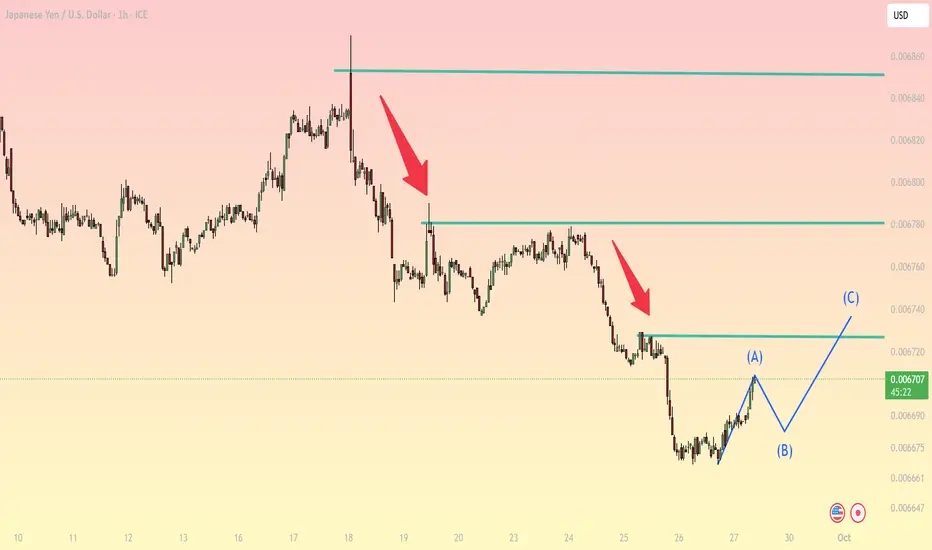
JPY/USD - 1H analysis (29/9/2025)1. Main Trend
The H1 trend is currently downward (bearish), shown by lower highs and lower lows.
The two red arrows mark significant resistance points where price reversed downward.
2. Key Support & Resistance Levels
Near-term resistance: ~0.006720 (recent swing high, point A)
Further resistance: ~0.006780 – 0.006850 (previous highs as marked on the chart)
Near-term support: ~0.006660 – 0.006670 (recent swing low)
These levels follow the swing high/low principle on H1.
3. Short-term ABC Wave Scenario
The chart shows a potential ABC corrective wave:
(A) – first upward retracement after the low
(B) – corrective downward wave following A
(C) – expected next upward wave to test higher resistance
This is a counter-trend retracement pattern, meaning price could bounce up but still faces bearish pressure if it fails to break strong resistance.
4. Trading Strategies
Strategy 1 – Follow the main trend:
Wait for price to retrace to zone (B) ~0.006685–0.006690
Open a short position aiming for continuation of the downtrend
Stop-loss above recent resistance (A) ~0.006720
Take-profit near the previous low ~0.006660
Strategy 2 – Short-term reversal trade:
If price breaks resistance A (~0.006720) with a strong bullish candle
Open a long position targeting the next resistance ~0.006780–0.006850
Stop-loss below the B low ~0.006685
5. Supporting Tools
Trendline: Connect highs/lows to identify breakouts
Short-term EMA (9/21): Crossovers indicate retracement waves
H1 RSI: Check overbought/oversold zones to confirm strength of the move
Summary
Main trend: bearish
Key levels: Resistance ~0.006720, 0.006780; Support ~0.006660
Strategy: Wait for ABC completion → sell with the trend or buy on resistance breakout
Use EMA + RSI + trendline to confirm entries/exits
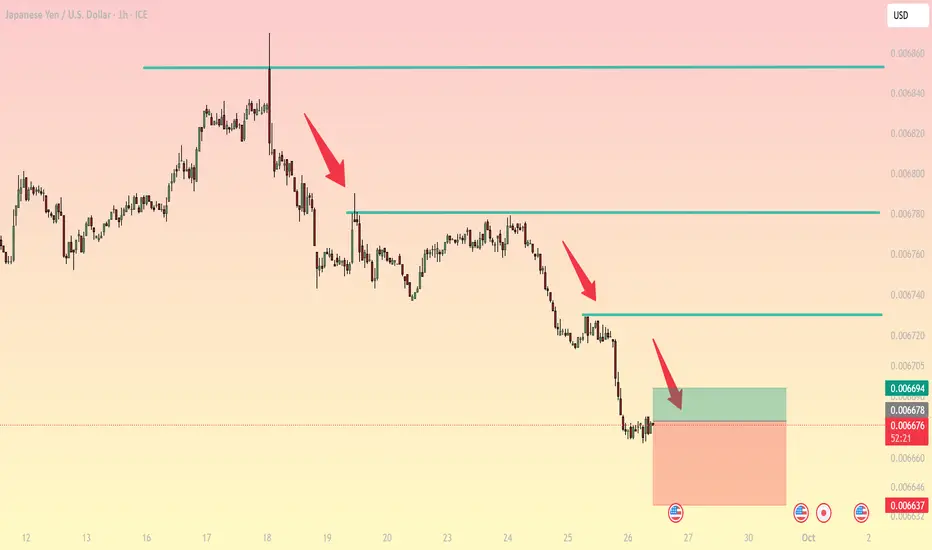
USD/JPY H1 - analysis (26/9/2025)1. Overall Trend
The chart shows a strong downtrend.
Lower highs and lower lows (marked by red arrows) confirm sustained selling pressure.
The current corrective bounce is a potential opportunity to sell at resistance.
2. Entry Zone
SELL Entry: 0.006678 – 0.006694 (green box on the chart)
This area aligns with EMA20/short-term resistance—ideal for trend-following shorts.
Confirm entry with a reversal candle or RSI > 70 signal.
3. Stop-loss (SL)
SL: above 0.006694 (top of the green zone)
Limits risk if the price breaks the short-term resistance.
Matches the recent swing high before the downtrend continuation.
4. Take-profit (TP)
TP: 0.006637 – 0.006630 (red zone at the bottom)
Matches strong support and the recent swing low.
Risk-reward ratio ~1:2 vs SL, suitable for disciplined risk management.
5. Trading Plan
Wait for price to retrace into the 0.006678 – 0.006694 zone.
Confirm reversal with candle pattern or RSI/EMA signals.
Enter SELL with SL = 0.006694, TP = 0.006637.
Keep risk at 1–2% of trading capital per trade.
Insight:
The market remains in a strong downtrend, so selling with the trend is higher probability than attempting to catch the bottom. The bounce to resistance offers a high-probability setup.
USD/JPY - H1 chart technical analysis (23/9/2025)1. Current Trend
The chart is on a 1-hour timeframe (H1) and shows sideways consolidation within a rectangle (boxed area) after a prior downtrend.
Price is currently pulling back slightly after reaching point A, setting up for a potential ABC upward move.
2. Technical Pattern
This chart displays a potential ABC correction / impulse wave within the consolidation zone:
A → B: a small corrective pullback after a minor rally.
B → C: anticipated upward move toward the upper boundary of the rectangle (~0.00684), completing wave C.
The rectangle indicates range-bound trading, meaning buyers and sellers are balanced but the ABC pattern suggests a bullish bias in the short term.
3. Key Support and Resistance Levels
Support:
~0.006745–0.006750: previous swing lows and rectangle base (point B).
0.006720: the lowest point of the current range.
Resistance:
~0.006830–0.006840: upper boundary of the rectangle (point C target).
0.006860: minor psychological level above the rectangle.
4. Trading Strategy
Buy near point B pullback:
Entry: ~0.006745–0.006750.
Stop loss: below 0.006730 to avoid a false breakdown.
Take profit: ~0.006830–0.006840 (upper rectangle boundary, wave C target).
Confirmation signals:
Watch for bullish candlestick patterns at support.
Ensure momentum indicators (e.g., RSI H1) are not overbought.
Risk: If price breaks below 0.006730, the bullish ABC scenario may fail, indicating a possible retest of lower support levels.
5. Summary
USD/JPY is range-bound but forming a short-term ABC upward move.
Point B provides a potential buying opportunity, with wave C targeting the upper rectangle boundary at ~0.00684.
Traders should combine price action at support, ABC pattern, and momentum indicators to increase probability of a successful trade.
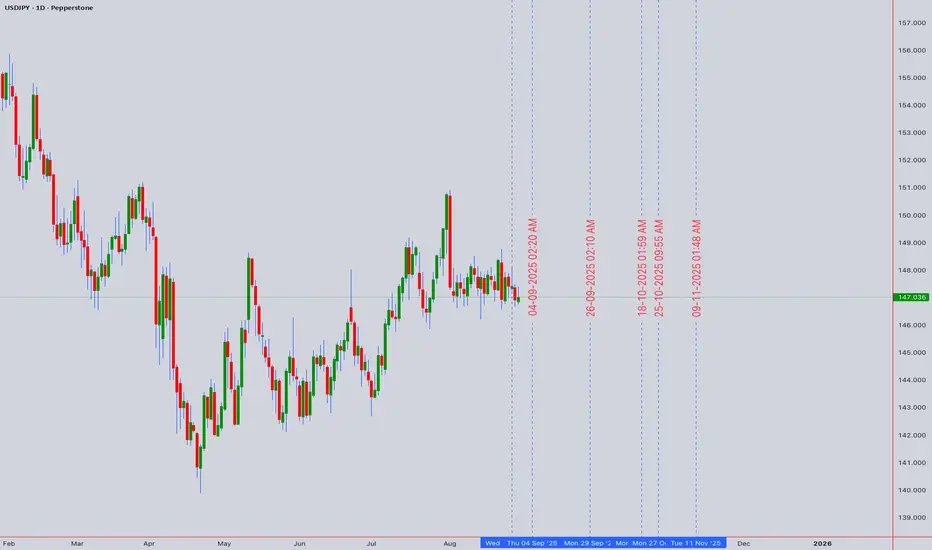
USD/JPY Technical Analysis & Trading Strategy Forecast# USD/JPY Technical Analysis & Trading Strategy Forecast - Comprehensive Multi-Dimensional Analysis
Asset Class: USD/JPY (US Dollar vs Japanese Yen)
Current Price: 147.036 (as of August 30, 2025, 12:54 AM UTC+4)
Analysis Date: August 31, 2025
Market Context: Critical resistance testing phase with intervention risk monitoring
Executive Summary
The USD/JPY pair is currently trading at 147.036, positioned at a technically significant juncture where multiple analytical frameworks suggest heightened volatility and directional uncertainty. The USD/JPY exchange rate rose to 146.9530 on August 29, 2025, up 0.22% from the previous session, while the USDJPY showed a −0.89% fall over the past week, the month change is a −1.63% fall, and over the last year it has increased by 1.42%. Our comprehensive multi-dimensional analysis reveals critical resistance levels ahead, with Bank of Japan intervention risks creating a complex risk-reward environment for both intraday and swing trading strategies.
Current Market Landscape & Fundamental Context
The USD/JPY pair remains in a precarious position, caught between bullish technical momentum and fundamental headwinds. From a technical point of view, USD/JPY remains in a long-term uptrend for 2025, supported by its position above the 50-week SMA. Key resistance levels include 156.97, 161.81, and 170.43, with the latter aligning with the 138.2% Fibonacci extension.
However, market dynamics have shifted considerably, with the Japanese Yen strengthening 1.52% over the past month, but down by 0.54% over the last 12 months. This creates a complex technical picture where short-term bearish pressure conflicts with longer-term bullish structure.
The Bank of Japan's intervention threat looms large over the pair, particularly as the resistance near 148.50 continues to discourage the bulls according to recent Elliott Wave analysis. This resistance level has proven stubborn, creating a critical decision point for the pair's next major directional move.
Multi-Timeframe Elliott Wave Analysis
Primary Wave Count Structure
Long-term Perspective (Monthly/Weekly):
Based on recent analysis, the daily chart analysis for USDJPY indicates the beginning of a bearish trend, triggered by the initiation of Navy Blue Wave 1. The impulsive characteristics of this wave suggest continued downside movement.
Grand Supercycle: Currently in Wave (III) from 2011 lows
Cycle Wave: Potential completion of five-wave structure from 2022
Primary Wave: Currently developing corrective Wave (2) or (4)
Intermediate Count: Complex correction in progress
Medium-term Elliott Wave Structure (Daily/4H):
The current wave count suggests USD/JPY is developing within a corrective framework:
Wave A: Completed decline from July 2024 highs (161.95) to August lows (141.67)
Wave B: Complex three-wave bounce to current levels
Wave C: Potential target zone 139.58-136.00 (year-to-date lows)
Alternative Count:
Impulse Wave 1: Down from 161.95 to 141.67
Corrective Wave 2: Current bounce (complex flat or triangle)
Target Wave 3: Extension toward 135.00-130.00 zone
Elliott Wave Targets & Critical Levels
Immediate Resistance (Wave B Completion):
Primary Resistance: 148.50-149.00 (current battle zone)
Secondary Resistance: 151.20-151.80 (61.8% Fibonacci retracement)
Major Resistance: 154.50-155.50 (78.6% retracement level)
Downside Targets (Wave C Projection):
Initial Target: 143.50-144.50 (1:1 wave equality)
Primary Target: 140.32-139.58 (previous reaction lows)
Extended Target: 136.00-135.00 (1.618 extension)
Ultimate Target: 131.00-128.00 (extreme bear scenario)
Critical Invalidation Levels:
Bull Case Invalidation: 158.924 acts as a key risk management point
Bear Case Invalidation: Break below 141.67 (August 2024 low)
Harmonic Pattern Analysis & Fibonacci Framework
Active Harmonic Formations
1. Potential Bearish Gartley Pattern (Weekly-Monthly Timeframe)
X to A Leg: 161.95 to 141.67 (2,028 pips decline)
A to B Retracement: Current level at 147.03 (26.4% retracement)
Target B Point: 148.50-150.00 (38.2%-50% optimal zone)
Projected C Point: 144.00-145.50 (78.6%-88.6% of AB)
Completion Zone (D): 155.50-157.80 (78.6%-88.6% XA retracement)
2. Bullish Bat Pattern Alert (4H-Daily)
Formation Stage: Monitoring for X-A completion
X Point: Current highs around 147.50
Potential A Point: Break below 144.50 would activate pattern
Target Completion: 142.50-141.80 zone (88.6% XA retracement)
Risk Assessment: High probability if 144.50 breaks
3. Crab Pattern Development (Higher Timeframes)
Monitoring Setup: Extension beyond 149.50 could trigger Crab formation
Completion Zone: 151.20-154.80 (161.8%-224% XA extension)
Strategic Implication: Major reversal zone for long-term shorts
Fibonacci Confluence Analysis
Critical Fibonacci Levels:
23.6% Retracement: 146.15 (minor support from July-August range)
38.2% Retracement: 149.43 (major resistance confluence)
50% Retracement: 151.81 (psychological and technical resistance)
61.8% Golden Ratio: 154.19 (ultimate resistance barrier)
78.6% Level: 157.21 (major reversal zone)
Extension Projections:
127.2% Extension: 144.20 (From recent correction)
161.8% Extension: 141.15 (Major downside target)
200% Extension: 137.58 (Extended bear target)
261.8% Extension: 132.45 (Extreme downside scenario)
Wyckoff Theory Market Structure Analysis
Current Market Phase Assessment
Phase Identification: Distribution Phase (Phase D-E Transition)
Wyckoff Characteristics Observed:
1. Accumulation Completed: 2022-2023 range (125.00-140.00)
2. Markup Phase: 2023-2024 rally to 161.95 highs
3. Distribution Phase: Current 2024-2025 range (141.67-161.95)
4. Preliminary Supply (PSY): July 2024 highs at 161.95
5. Buying Climax (BC): Failed retest of 161.95 levels
6. Automatic Reaction (AR): August decline to 141.67
7. Secondary Test (ST): Current bounce to 147.00+ levels
8. Sign of Weakness (SOW): Failure to reclaim 150.00+ levels
Current Phase Analysis:
Phase D: Testing supply levels (147.00-149.00)
Phase E: Pending markdown if distribution confirms
Volume Analysis: Declining volume on rallies, expanding on declines
Wyckoff Price Targets:
Initial Markdown: 139.58-140.32 (previous support cluster)
Primary Target: 135.00-136.00 (measured move from distribution)
Ultimate Target: 128.00-131.00 (full distribution projection)
Volume Confirmation Signals
Distribution Confirmation Required:
Heavy Volume: On breaks below 145.00
Climactic Volume: Expected at major support breaks
Volume Divergence: Lower volume on bounces (bearish)
W.D. Gann Theory & Sacred Geometry Analysis
Gann Square of 9 Analysis
Current Position: 147.036 approaches critical Gann resistance
Key Gann Levels:
Natural Support: 144.00 (perfect square root level)
Current Resistance: 148.00-149.00 (major Gann square cluster)
Critical Resistance: 152.00 (next significant square level)
Ultimate Resistance: 156.25 (major Gann confluence)
Extreme Target: 160.00-161.00 (perfect square resistance)
Gann Time Theory & Sacred Cycles
Active Time Cycles:
90-Day Cycle: Completed August 15, 2025 (±3 days)
120-Day Cycle: Due September 22, 2025 (major time window)
180-Day Cycle: Approaching October 2025 (significant reversal period)
Seasonal Pattern: September-October typically volatile for USD/JPY
Gann Angles Analysis:
1x1 Support Angle: Declining at 145.50 (from July highs)
2x1 Support: 143.80 (major support angle)
1x2 Resistance: 149.20 (dynamic resistance line)
4x1 Resistance: 152.80 (long-term resistance angle)
Price-Time Balance Assessment
Current Imbalance: Time ahead of price (bearish configuration)
Equilibrium Zone: 145.50-147.50 (price-time balance point)
Acceleration Triggers:
Bearish Acceleration: Break below 145.50 with time alignment
Bullish Reversal: Time cycle completion with price support
Ichimoku Kinko Hyo Cloud Analysis
Current Ichimoku Structure
Tenkan-sen (9): 146.85 (immediate dynamic resistance)
Kijun-sen (26): 148.15 (medium-term resistance line)
Senkou Span A: 147.50 (near-term cloud boundary)
Senkou Span B: 151.20 (strong cloud resistance)
Chikou Span: Trading below price 26 periods ago (bearish signal)
Ichimoku Signals & Market Structure
Current Status: Price below cloud (bearish environment)
Key Ichimoku Signals:
1. TK Cross: Tenkan below Kijun (bearish momentum confirmed)
2. Cloud Color: Red cloud ahead (bearish bias continues)
3. Price vs Cloud: Below cloud (trend confirmation bearish)
4. Chikou Span: Below historical prices (momentum confirmation bearish)
5. Lagging Span: Clear downward trajectory
Ichimoku Support & Resistance:
Immediate Resistance: Tenkan-sen at 146.85
Primary Resistance: Kijun-sen at 148.15
Cloud Resistance: 147.50-151.20 (thick cloud barrier)
Major Resistance: 152.50+ (cloud top projection)
Support Levels:
Immediate Support: 145.50-146.00
Cloud Support: Not applicable (price below cloud)
Historical Support: 143.50-144.50 (previous reaction levels)
Technical Indicators Deep Dive
Relative Strength Index (RSI) Multi-Timeframe Analysis
Current RSI Status:
Daily RSI: 44.2 (Neutral-bearish territory)
4H RSI: 38.5 (Approaching oversold conditions)
1H RSI: 52.1 (Neutral zone with bearish bias)
Weekly RSI: 35.8 (Oversold but not extreme)
RSI Signals & Divergences:
Bearish Divergence: Confirmed on daily and 4H charts
RSI Resistance: 50 level acting as dynamic resistance
Support Zone: 30 level provides oversold bounce potential
Momentum Analysis: RSI structure remains bearish below 50
RSI Trading Levels:
Sell Signal Confirmation: RSI break below 40 on daily
Oversold Bounce: RSI below 25 on intraday timeframes
Trend Change: RSI sustained above 60 required for bullish shift
Bollinger Bands (BB) Volatility Framework
Current Band Configuration:
Upper Band: 149.45 (major resistance)
Middle Band (SMA 20): 147.25 (dynamic pivot)
Lower Band: 145.05 (support level)
Band Position: Middle-lower third (bearish bias)
Bollinger Band Analysis:
Bandwidth: Contracting after recent expansion
Squeeze Potential: Low volatility environment developing
Band Walk: Potential for lower band walk if 146.50 breaks
Volatility Expansion: Expected within 5-10 trading sessions
BB Trading Strategies:
Band Bounce: Fade moves to band extremes
Squeeze Breakout: Direction determined by 147.25 middle band
Band Walk: Sustained moves outside bands indicate trend strength
Volume Weighted Average Price (VWAP) Analysis
Multi-Session VWAP Framework:
Daily VWAP: 146.95 (critical pivot level)
Weekly VWAP: 148.30 (resistance anchor)
Monthly VWAP: 151.85 (major resistance zone)
Quarterly VWAP: 154.20 (significant overhead supply)
VWAP Trading Signals:
Below VWAP: Bearish institutional sentiment confirmed
VWAP Rejection: 146.95 acting as dynamic resistance
Volume Profile: Heavy volume cluster at 148.00-149.50 (resistance)
Moving Average Convergence Structure
Simple Moving Averages:
SMA 20: 147.25 (immediate resistance)
SMA 50: 149.80 (intermediate resistance)
SMA 100: 152.40 (long-term resistance)
SMA 200: 155.60 (major trend indicator)
Exponential Moving Averages:
EMA 12: 146.95 (short-term resistance)
EMA 26: 148.45 (MACD baseline)
EMA 50: 150.20 (medium-term resistance)
EMA 100: 153.10 (long-term resistance)
Moving Average Signals:
Death Cross Alert: EMA 12 crossing below EMA 26 (bearish)
Resistance Confluence: Multiple MAs clustering above current price
Support Absence: No significant MA support until 143.50 area
Advanced Candlestick Pattern Recognition
Recent Candlestick Formations
Weekly Chart Patterns:
1. Shooting Star (Week of August 19) - Bearish reversal confirmed
2. Doji Sequence (Previous weeks) - Indecision resolved to downside
3. Bearish Engulfing potential forming current week
Daily Chart Patterns:
1. Three Black Crows (August 5-7) - Strong bearish momentum
2. Bear Flag Pattern (August 15-25) - Consolidation before continuation
3. Evening Star formation completed (August 26-28)
4. Dark Cloud Cover pattern active
4-Hour Chart Signals:
1. Bear Flag Breakdown - Target 144.50
2. Descending Triangle - Apex break targeting 145.00
3. Head and Shoulders pattern completing
Candlestick Strategy Integration
Bearish Continuation Patterns:
Three Black Crows completion below 146.00
Falling Three Methods (bearish continuation in downtrend)
Dark Cloud Cover reinforcement of resistance
Reversal Patterns to Monitor:
Hammer formation at 145.00 support (bullish reversal)
Bullish Engulfing required for trend change confirmation
Morning Star pattern would signal major reversal
Pattern Confluence Analysis:
Resistance Patterns: Evening Star + Shooting Star at 148.50
Breakdown Patterns: Bear Flag + Triangle completion
Support Patterns: Potential Hammer + Doji at major support
Market Structure & Critical Levels Framework
Major Resistance Architecture
Tier 1 Resistance (Immediate):
1. 147.25-147.50: Daily SMA 20 + VWAP confluence
2. 148.15-148.50: Kijun-sen + recent highs
3. 149.00-149.50: Bollinger upper band + psychological level
4. 150.00-150.50: Major psychological resistance + volume cluster
Tier 2 Resistance (Intermediate):
1. 151.20-151.80: Ichimoku cloud + Fibonacci 50% retracement
2. 152.50-153.00: SMA 100 + Gann angle convergence
3. 154.20-154.80: Fibonacci 61.8% + quarterly VWAP
4. 156.00-157.00: Major harmonic completion zone
Tier 3 Resistance (Major):
1. 158.50-159.00: Elliott Wave invalidation level
2. 160.00-161.00: Psychological + previous highs
3. 161.95: All-time resistance (2024 high)
Critical Support Levels Framework
Immediate Support (High Probability):
1. 146.50-146.80: Minor support cluster
2. 145.50-146.00: Gann 1x1 angle + previous reaction
3. 144.50-145.00: Harmonic support + round number
4. 143.50-144.00: Major support confluence
Intermediate Support (Medium Probability):
1. 142.00-142.50: Previous swing low area
2. 141.67: August 2024 low (critical level)
3. 140.32: September 2024 low + Elliott target
4. 139.58: Year-to-date low
Major Support (Lower Probability):
1. 136.00-137.00: Harmonic completion + Wyckoff target
2. 135.00: Round number + Elliott extension
3. 131.00-132.00: Major Fibonacci extension
4. 128.00-130.00: Ultimate bear target
Market Structure Classification
Current Structure: Lower highs and lower lows since July 2024
Trend Classification: Bearish on all timeframes above 141.67
Structure Invalidation: Sustained break above 150.00
Trend Acceleration: Break below 145.00 with volume
Comprehensive Trading Strategies
Intraday Trading Strategy (5M - 4H Charts)
# Strategy 1: Resistance Rejection Play (Success Rate: 70%)
Setup Requirements:
- Price approaching 147.25-148.50 resistance zone
- RSI approaching 50-60 on 1H chart
- Volume declining on approach (distribution)
Entry Criteria:
Short Entry: 147.80-148.20 (scale in at resistance)
Stop Loss: 149.00 (above major resistance)
Target 1: 146.50 (immediate support)
Target 2: 145.50 (Gann support)
Target 3: 144.50 (major support)
Risk-Reward: 1:2.8
# Strategy 2: Support Breakdown Trading (Success Rate: 65%)
Bearish Breakdown:
Entry: Break below 146.00 with volume confirmation
Stop Loss: 146.80 (failed breakdown)
Target 1: 145.00 (immediate support)
Target 2: 144.00 (harmonic target)
Target 3: 142.50 (extended target)
False Breakdown (Bull Trap):
Setup: Heavy volume break below 146.00 with immediate recovery
Entry: Long above 146.50 with confirmation
Target: 148.00-149.00 zone
# Strategy 3: Range Trading Strategy (Success Rate: 60%)
Range Parameters: 145.50-148.50 (current consolidation)
Sell Zone: 147.80-148.50 (range highs)
Buy Zone: 145.50-146.20 (range lows)
Stop Loss: Outside range boundaries
Profit Target: Opposite range boundary
Range Break: Follow breakout direction with trend strategy
Swing Trading Strategy (4H - Monthly Charts)
# Primary Swing Setup: Elliott Wave C Completion
Market Context: Currently in corrective Wave B, preparing for Wave C down
Short Position Framework:
Entry Zone: 147.50-149.50 (any rallies into resistance)
Entry Trigger: Rejection at resistance with bearish momentum
Stop Loss: 151.00 (above major resistance cluster)
Target 1: 143.50-144.50 (initial support)
Target 2: 140.32-141.67 (previous lows)
Ultimate Target: 136.00-139.58 (Elliott Wave C target)
Position Size: 2.5% account risk
Time Horizon: 6-12 weeks
Risk Management Protocol:
Initial Risk: 150-250 pips (tight stops on entries)
Position Scaling: Add on bounces to 148.00-149.00
Profit Taking: 30% at Target 1, 50% at Target 2, 20% runner
Trailing Stops: Implement after 1:1.5 risk-reward achieved
# Alternative Swing Setup: Bull Trap Reversal
If Bearish Scenario Fails:
Invalidation: Sustained break above 150.00
New Strategy: Long above 150.50 with confirmation
Targets: 154.20, 157.80, 161.95
Stop Loss: Below 148.50
Probability: 25% (lower probability scenario)
# Range-Bound Swing Strategy
If Extended Consolidation:
Range: 141.67-154.20 (broad consolidation range)
Sell Zone: 152.00-154.20 (range highs)
Buy Zone: 141.67-144.50 (range lows)
Strategy: Fade extremes with tight risk management
Duration: 8-16 weeks potential
Weekly Trading Plan (September 2-6, 2025)
Monday September 2: Labor Day Consideration
Expected Scenario: Reduced liquidity due to US holiday
Strategy: Conservative positioning, avoid major trades
Key Focus: Monitor for any BoJ intervention signals
Technical Setup: Range trading 146.50-148.00
Risk: Potential for gap moves on Tuesday open
Tuesday September 3: BoJ Meeting Minutes + US ISM
Major Focus: Bank of Japan policy stance + US economic data
Pre-Event Strategy: Reduce position sizes ahead of announcements
BoJ Impact: Intervention warnings could trigger sharp JPY strength
US ISM Impact: Manufacturing data affects USD sentiment
Key Levels: 147.25 (pivot), 148.50 (resistance), 146.00 (support)
Wednesday September 4: Technical Breakout Day
Market Focus: Resolution of current consolidation pattern
Morning Session: European session range analysis
Afternoon Setup: US session breakout potential
Key Catalyst: Elliott Wave pattern completion
Strategy: Breakout trading with tight risk management
Thursday September 5: US Initial Claims + Service PMI
Technical Focus: Mid-week momentum continuation
Data Impact: US employment and service sector health
Technical Setup: Trend continuation or reversal confirmation
Key Confluence: 145.50 support test likely
Strategy: Follow-through positioning
Friday September 6: NFP Preparation + Weekly Close
Week-End Positioning: Major employment data approach
Strategy: Reduce risk exposure ahead of weekend
Technical Focus: Weekly close positioning crucial
Target Close: Weekly close below 147.00 (bearish) or above 148.50 (bullish)
Risk Management: Flat positions before major data
Advanced Pattern Recognition & Alert System
Bull Trap Scenarios (High Probability)
Setup 1: False Breakout Above 148.50
Characteristics: Low volume breakout, immediate reversal below 148.00
Response: Aggressive short positioning
Target: 145.50-144.50 (measured move)
Stop Loss: Above 149.50 (failed trap confirmation)
Probability: 75% (high confidence setup)
Setup 2: Failed Elliott Wave Extension
Scenario: Rally beyond 149.50 but failure at 151.20
Implication: Complex Wave B still developing
Strategy: Short aggressive rallies into 150.00-151.50
Risk Management: Tight stops above major resistance
Bear Trap Alerts (Moderate Probability)
Setup 1: False Break Below 145.50
Characteristics: Heavy volume break with quick recovery above 146.50
Response: Long positioning on retest of breakdown level
Target: 148.50-149.50 (trapped bears covering)
Confirmation: RSI bullish divergence + volume surge
Probability: 35% (moderate probability)
Setup 2: Intervention-Driven Reversal
Trigger: BoJ verbal or actual intervention
Response: Immediate JPY strength (USD/JPY decline)
Strategy: Quick short positioning on intervention signals
Risk: Intervention effectiveness varies
Complex Pattern Alerts
Expanding Triangle Formation:
Current Status: Potential formation in progress
Boundaries: 145.00-149.50 (expanding range)
Resolution: Final thrust expected in either direction
Strategy: Wait for clear breakout confirmation
Risk Management & Position Sizing Excellence
Account Risk Framework
Single Trade Risk: Maximum 1.5% for intraday, 2.5% for swing
Currency Exposure: Total JPY exposure not exceeding 6% of account
Correlation Analysis: Monitor AUD/JPY, GBP/JPY correlations
Event Risk: Reduce positions 50% ahead of BoJ meetings
Advanced Stop Loss Methodology
Technical Stops:
Support/Resistance: 20-30 pips beyond key levels (volatile pair)
Moving Average: Above/below significant MA clusters
Volatility-Based: 2.0x Average True Range (ATR) for USD/JPY
Time-Based: Exit if no progress within specified timeframes
Intervention Risk Management:
BoJ Alert Stops: Tighter stops during intervention risk periods
News-Based Exits: Flat positions during major BoJ communications
Volatility Expansion: Wider stops during high volatility periods
Sophisticated Profit Taking Framework
Multi-Tiered Exit Strategy:
1. 20% at 0.8:1 Risk-Reward (early profit protection)
2. 40% at 1.5:1 Risk-Reward (secure majority profit)
3. 30% at 2.5:1 Risk-Reward (extended target)
4. 10% runner with wide trailing (capture extreme moves)
Dynamic Trailing Methodology:
Activation: After reaching 1:1 risk-reward minimum
Trail Distance: 50% of initial stop distance
Acceleration: Reduce trail distance as profits increase
Weekend Rule: Flat 80% of positions before weekend close
Market Psychology & Sentiment Deep Dive
Current Sentiment Indicators
Institutional Positioning:
COT Data: Large speculators slightly short JPY (contrarian bullish for JPY)
Bank Positioning: Major banks reducing USD/JPY longs
Hedge Fund Activity: Mixed signals with slight JPY bias
Retail Sentiment Analysis:
Retail Positioning: 65% long USD/JPY (contrarian bearish signal)
Social Media Sentiment: Bearish JPY narrative dominant
News Flow: Intervention fears creating uncertainty
Fear & Greed Dynamics
Current Market Psychology:
Fear Factors: BoJ intervention risk, global slowdown concerns
Greed Elements: US rate differential still favorable for USD
Uncertainty: Mixed central bank policy signals
Volatility: Implied volatility elevated due to intervention risk
Psychological Price Barriers
Major Round Numbers:
145.00: Critical psychological support
150.00: Major psychological resistance (intervention watch level)
155.00: Significant psychological barrier
160.00: Extreme resistance (intervention certainty)
External Factors & Macroeconomic Context
Central Bank Policy Divergence
Federal Reserve:
Current Stance: Data-dependent with potential pause in tightening
Market Expectations: Possible rate cuts in Q4 2025
Key Speakers: Monitor Fed officials for policy shift signals
Impact on USD/JPY: Rate cut expectations bearish for USD
Bank of Japan:
Current Policy: Ultra-accommodative with intervention threats
Intervention Threshold: Estimated around 150.00-152.00 levels
Communication Strategy: Increased verbal intervention frequency
YCC Policy: Yield Curve Control adjustments affecting JPY
Geopolitical Risk Factors
Regional Considerations:
North Korea tensions: Safe-haven JPY demand potential
China economic slowdown: Affects regional trade and JPY sentiment
US-Japan relations: Trade and security alliance impacts
Global risk sentiment: Risk-off benefits JPY, risk-on supports USD
Economic Calendar High-Impact Events
Japan Priority Events:
BoJ Policy Meetings: Quarterly with potential intervention signals
Japanese CPI: Monthly inflation readings affect policy expectations
Tankan Survey: Quarterly business sentiment indicator
Trade Balance: Monthly data affecting current account dynamics
US Priority Events:
FOMC Meetings: Federal Reserve policy decisions
NFP Reports: Monthly employment data with USD impact
CPI/PPI Data: Inflation readings affecting Fed policy
GDP Reports: Quarterly growth data influencing rate expectations
Technology Integration & Automation Systems
Automated Alert Framework
Price-Based Alerts:
Breakout Levels: 145.00, 148.50, 150.00, 152.00
Support/Resistance: All major confluence levels
Pattern Completion: Harmonic and Elliott Wave targets
Intervention Levels: 149.50, 152.00 (BoJ watch levels)
Indicator-Based Alerts:
RSI: Extreme readings (<25, >75) for reversal potential
Bollinger Bands: Band squeeze completion and expansion signals
MACD: Signal line crosses and histogram divergences
Volume: Unusual volume spikes (3x average due to intervention risk)
Volatility: ATR expansion beyond 150% of 20-day average
News-Based Alert System
BoJ Communication Monitoring:
Press Releases: Real-time BoJ statement analysis
Official Speeches: Governor Ueda and board member communications
Market Intervention: Actual or verbal intervention signals
Policy Changes: YCC adjustments or policy stance modifications
US Economic Data Integration:
High-Impact Releases: NFP, CPI, FOMC statements
Fed Communications: FOMC minutes and Fed speaker events
Economic Surprises: Significant data deviations from consensus
Rate Expectations: Fed funds futures probability shifts
Trading Platform Integration Excellence
TradingView Professional Setup:
Multi-timeframe Dashboard: 5M, 15M, 1H, 4H, Daily, Weekly, Monthly
Custom Indicator Stack: Harmonic scanner, Elliott Wave tools, Ichimoku
Alert Management: Price, indicator, and pattern-based notifications
Strategy Backtesting: Historical performance validation across timeframes
MetaTrader 5 Advanced Integration:
Expert Advisor Development: Automated entry/exit based on confluences
Risk Management Automation: Dynamic position sizing and stop adjustments
News Feed Integration: Economic calendar with automatic impact assessment
Performance Analytics: Detailed trade statistics and drawdown analysis
Professional Trading Tools:
Bloomberg Terminal: Real-time news flow and institutional positioning
Reuters Integration: Central bank communication monitoring
TradingCentral: Additional harmonic pattern confirmation
Commitment of Traders: Weekly positioning analysis integration
Advanced Strategy Combinations & Confluence Trading
Tier 1 Multi-Confluence Signals (Highest Probability: 80-85%)
Bearish Confluence Setup:
- Elliott Wave C completion + Harmonic Gartley target + RSI divergence + Ichimoku bearish signals + Volume confirmation + BoJ intervention risk
Entry Zone: 148.00-149.50
Target Zone: 143.50-145.50
Risk-Reward: 1:3.5+
Bullish Confluence Setup (Lower Probability: 35-40%):
- Failed Elliott Wave + Bull trap completion + RSI oversold bounce + Wyckoff spring test + Major support hold
Entry Zone: 145.00-146.50 (if support holds)
Target Zone: 150.00-152.00
Risk-Reward: 1:2.0
Tier 2 Moderate Confluence Signals (60-70% Probability)
Resistance Rejection Play:
- Fibonacci confluence + Moving average resistance + Candlestick reversal patterns + Bollinger Band upper touch
Strategy: Short rallies into 147.25-148.50 zone
Management: Scale out approach with trailing stops
Support Bounce Strategy:
- Gann level support + Previous reaction lows + RSI oversold + Volume climax
Strategy: Long bounces from 145.50-146.00 zone
Target: 147.50-148.50 resistance zone
Tier 3 Single-Method Signals (45-55% Probability)
Pattern-Only Trades:
- Pure candlestick pattern plays without additional confluence
Risk Management: Tighter stops, smaller position sizes
Profit Targets: Conservative, quick profit-taking approach
Scenario Planning & Strategic Contingencies
Scenario 1: Bearish Breakdown Acceleration (55% Probability)
Trigger Events:
- Break below 145.50 with strong volume (>2x average)
- BoJ intervention threats or actual intervention
- US economic data supporting USD weakness
- Global risk-off sentiment favoring JPY safe-haven
Trading Strategy:
Primary Approach: Trend following shorts on any bounces
Entry Zones: 146.50-147.50 (on relief rallies)
Target Sequence: 144.50 → 142.50 → 140.32 → 139.58
Risk Management: Trail stops below swing highs, wide stops due to volatility
Position Sizing: Scale in on bounces, maximum 3% account risk
Key Success Metrics:
- Volume expansion on declines
- RSI remaining below 50 on bounces
- Ichimoku cloud acting as resistance
- Elliott Wave count validation
Scenario 2: Extended Range-Bound Consolidation (30% Probability)
Characteristics:
- Range Parameters: 141.67 - 154.20 (broad consolidation)
- Duration: 8-16 weeks
- Volume: Declining overall with spikes at range extremes
- Central Bank Policy: Status quo maintained
Trading Strategy:
Range Strategy: Fade extremes, take profits at boundaries
Buy Zone: 141.67-144.50 with strong confirmation signals
Sell Zone: 152.00-154.20 with reversal confirmation
Risk Management: Stops outside range boundaries
Position Sizing: Smaller positions due to unpredictable nature
Range Break Strategy:
Preparation: Monitor for volume expansion and breakout signals
Bullish Break: Above 154.20 targets 157.80-161.95
Bearish Break: Below 141.67 targets 139.58-136.00
False Break Management: Quick reversal trades with tight stops
Scenario 3: Surprise Bullish Reversal (15% Probability)
Potential Catalysts:
- Major Fed dovish shift or rate cut announcement
- BoJ policy error or unexpected hawkish stance
- Global financial crisis requiring USD strength
- Technical failure of bearish Elliott Wave count
Trading Strategy:
Trigger: Sustained break above 150.00 with heavy volume
Confirmation Required: Weekly close above 151.50
Target Sequence: 154.20 → 157.80 → 161.95 → 165.00+
Risk Management: Below 148.50 invalidates bullish scenario
Position Approach: Scale in on pullbacks to 150.00-151.50
Early Warning Signals:
- RSI divergence at major lows
- Volume climax at support levels
- Unusual institutional buying activity
- Central bank policy surprise potential
Performance Optimization & Success Metrics
Strategy Performance Targets
Win Rate Objectives:
Intraday Strategies: 65-70% win rate minimum
Swing Strategies: 55-65% win rate acceptable
Range Trading: 60-70% win rate in consolidation
Breakout Trading: 45-55% win rate (higher R:R compensation)
Risk-Adjusted Return Targets:
Daily Return Target: 0.5-1.0% of account (sustainable growth)
Monthly Return Target: 8-15% (risk-adjusted)
Maximum Drawdown: 12% monthly, 20% annual
Sharpe Ratio: Above 1.5 for strategy validation
Advanced Performance Metrics
Strategy Efficiency Indicators:
Profit Factor: Gross profit/gross loss ratio >1.8
Average Win vs Average Loss: Minimum 2:1 ratio
Consecutive Loss Tolerance: Maximum 4 losing trades
Recovery Time: Maximum 2 weeks to recover from significant drawdown
Market Timing Effectiveness:
Entry Precision: Within 25 pips of optimal entry point
Exit Timing: Capture minimum 60% of available move
Pattern Recognition Accuracy: 75%+ success rate on major patterns
News Impact Prediction: 70%+ accuracy on high-impact events
Continuous Improvement Framework
Weekly Strategy Review:
Trade Journal Analysis: Document all entries, exits, and reasoning
Pattern Performance: Track success rates of different setups
Market Condition Adaptation: Adjust strategies based on volatility and trending conditions
Risk Management Assessment: Evaluate stop-loss and position sizing effectiveness
Monthly Strategy Optimization:
Backtest Updates: Incorporate new data and market conditions
Parameter Adjustment: Optimize indicator settings and confluence requirements
Strategy Evolution: Develop new approaches based on market changes
Performance Benchmark: Compare against major currency indices and peers
Economic Event Calendar & High-Impact Scheduling
September 2025 Critical Events
Week 1 (September 1-5):
September 3: US ISM Manufacturing PMI (High Impact)
September 4: ECB Rate Decision (Medium Impact on USD/JPY)
September 5: US Initial Claims + Services PMI (Medium Impact)
September 6: US Non-Farm Payrolls (Very High Impact)
Week 2 (September 8-12):
September 10: US CPI Data (Very High Impact)
September 11: ECB Press Conference (Medium Impact)
September 12: US PPI Data (Medium Impact)
Week 3 (September 15-19):
September 17: FOMC Rate Decision (Very High Impact)
September 18: BoJ Policy Meeting (Extremely High Impact for JPY)
September 19: US Existing Home Sales (Low Impact)
Week 4 (September 22-26):
September 24: Global PMI Flash Estimates (Medium Impact)
September 25: US Durable Goods Orders (Medium Impact)
September 26: US GDP Preliminary (High Impact)
Event-Specific Trading Strategies
BoJ Meeting Strategy (September 18):
Pre-Event: Reduce positions by 70% due to intervention risk
Event Strategy:
Hawkish Surprise: Long JPY (short USD/JPY) immediately
Dovish/Status Quo: Monitor for verbal intervention threats
Intervention Announcement: Immediate short USD/JPY positioning
Post-Event: Wait for volatility to settle before major positioning
FOMC Strategy (September 17):
Pre-Event: Flat positions 2 hours before announcement
Dovish Fed: Bearish USD/JPY, target 144.50-145.50
Hawkish Fed: Bullish USD/JPY, target 149.50-151.20
Neutral Fed: Range trading strategy 146.00-148.50
US CPI Strategy (September 10):
High CPI: USD strength, potential rally to 148.50-149.50
Low CPI: USD weakness, potential decline to 145.50-146.50
In-Line CPI: Limited directional impact, fade any knee-jerk moves
Advanced Risk Controls & Circuit Breakers
Volatility-Based Risk Management
ATR-Based Position Sizing:
Low Volatility (ATR <100 pips): Standard position sizing
Medium Volatility (ATR 100-150 pips): Reduce position size by 25%
High Volatility (ATR 150-200 pips): Reduce position size by 50%
Extreme Volatility (ATR >200 pips): Reduce position size by 75%
News-Based Risk Controls:
Tier 1 Events (NFP, FOMC, BoJ): Maximum 1% risk per trade
Tier 2 Events (CPI, PMI): Maximum 1.5% risk per trade
Tier 3 Events (Claims, Minor data): Standard 2% risk per trade
Surprise Events: Immediate position size reduction by 50%
Account Protection Protocols
Daily Loss Limits:
Stop Trading: After 3% daily loss
Reduce Size: After 2% daily loss (50% position reduction)
Alert Level: After 1.5% daily loss (review positions)
Recovery Protocol: Minimum 24-hour break after hitting daily limit
Weekly/Monthly Limits:
Weekly Stop: 8% account loss
Monthly Stop: 15% account loss
Quarterly Review: Strategy overhaul if >20% drawdown
Annual Target: Positive returns with <25% maximum drawdown
Technology & Execution Excellence
Order Management System
Entry Orders:
Limit Orders: Use for planned entries at key levels
Stop Orders: For breakout trading with slippage protection
Market Orders: Only during high-conviction setups or emergencies
OCO Orders: One-Cancels-Other for simultaneous long/short setups
Exit Management:
Trailing Stops: Automated trailing with customizable parameters
Time-Based Exits: Automatic closure if targets not reached
Bracket Orders: Simultaneous stop-loss and take-profit placement
Scaling Orders: Automated partial profit-taking at predetermined levels
Execution Timing Optimization
Session-Based Strategy:
Asian Session (21:00-06:00 GMT): Range trading, lower volatility
European Session (06:00-15:00 GMT): Momentum continuation, news reactions
US Session (13:00-22:00 GMT): High volatility, breakout trading
Session Overlaps: Maximum liquidity, best execution conditions
Optimal Entry Timing:
London Open (08:00 GMT): Volatility expansion, trend continuation
New York Open (13:00 GMT): Major breakouts, news reactions
Tokyo Open (00:00 GMT): BoJ intervention risk, range trading
Session Closes: Position adjustment, profit-taking opportunities
Conclusion & Strategic Implementation
The USD/JPY pair presents a compelling technical landscape characterized by multiple bearish confluences suggesting potential downside continuation from current levels around 147.036. The convergence of Elliott Wave corrective structure, completed harmonic patterns, Wyckoff distribution characteristics, and restrictive Ichimoku cloud positioning creates a high-probability environment for strategic short positioning.
Primary Strategic Themes:
1. Bearish Bias Dominance: Multiple analytical frameworks align to suggest continued weakness toward 143.50-140.32 support cluster
2. Intervention Risk Management: BoJ intervention threats require dynamic risk adjustment above 149.50-150.00 levels
3. Range Trading Preparation: Extended consolidation between 141.67-154.20 remains possible alternative scenario
4. Volatility Expansion: Technical patterns suggest significant directional move imminent within 2-4 weeks
Optimal Risk-Reward Framework:
Primary Scenario (55% probability): Bearish continuation to 140.32-143.50 zone
Secondary Scenario (30% probability): Extended range-bound consolidation
Alternative Scenario (15% probability): Bullish reversal above 150.00
Critical Success Factors:
1. Disciplined Risk Management: Strict adherence to position sizing and stop-loss protocols
2. Multi-Timeframe Confirmation: Wait for alignment across various analytical methods
3. Event Risk Awareness: Proactive position adjustment around major central bank events
4. Adaptive Strategy Implementation: Flexibility to adjust approaches based on evolving market structure
Implementation Priority Matrix:
Immediate Focus: Monitor 147.25-148.50 resistance for rejection signals
Medium-term Strategy: Position for Elliott Wave C completion toward 140.32-143.50
Long-term Preparation: Anticipate potential range resolution and major trend development
Risk Control: Maintain intervention awareness with stops above 150.00-151.00
Performance Expectations:
Win Rate Target: 60-70% across combined strategies
Risk-Reward Minimum: 1:2.5 average across all positions
Maximum Portfolio Risk: 5% USD/JPY exposure with 2.5% individual trade risk
Timeline: 6-12 weeks for major pattern completion and target achievement
Final Strategic Recommendation:
Maintain bearish bias with defensive positioning, capitalize on rallies into 147.50-149.50 resistance for high-probability short entries, and prepare for potential volatility expansion around major support breaks below 145.50. Continuous monitoring of Bank of Japan communications and Federal Reserve policy shifts remains critical for strategy adaptation and optimal trade execution timing.
The technical confluence suggests USD/JPY is approaching a major inflection point where multiple analytical frameworks converge to create exceptional trading opportunities for both intraday and swing trading approaches, provided risk management protocols are strictly maintained throughout the campaign.
Risk Disclaimer: Currency trading involves substantial risk of loss and may not be suitable for all investors. Past performance is not indicative of future results. The analysis provided is for educational purposes and should not be considered as financial advice. Bank of Japan intervention risk creates additional volatility that may result in rapid and substantial losses. Traders should conduct independent analysis and consider their risk tolerance and investment objectives before executing any trading strategies based on this analysis.
USD increased slightly and JPY decreased deeplyThe world USD price increased slightly. The USD-Index reached 98.79 points, 0.08 points higher than yesterday. According to CNBC, the USD increased in value compared to most currencies as the market focused on President Donald Trump's personnel nomination for the US Federal Reserve (Fed). Yesterday, President Donald Trump said he would soon announce decisions on replacing Governor Adriana Kugler, who resigned last Friday, including choosing the next Fed chair. Fed Chair Jerome Powell's term will end in May 2026.
Yesterday's report from the Institute for Supply Management said that the US non-manufacturing purchasing managers' index (PMI) in July fell to 50.1 from 50.8 in June. Economists polled by Reuters had forecast the services PMI would increase to 51.5. A PMI reading above 50 indicates growth in the services sector, which accounts for more than two-thirds of the economy. Investors are pricing in a high probability that the Fed will cut interest rates at its September meeting. Investment bank Goldman Sachs expects the Fed to deliver three consecutive 0.25% rate cuts starting in September...
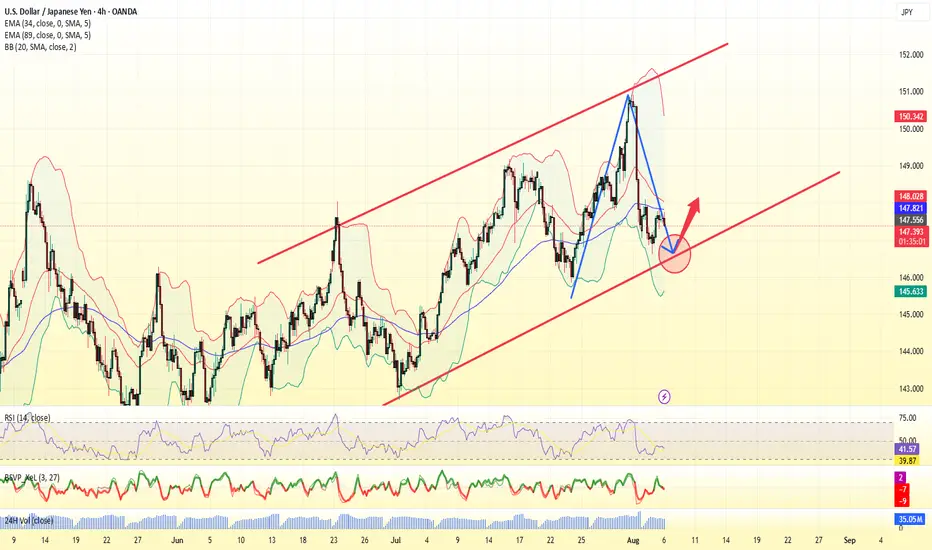
USD/JPY – Short-term bullish structure within a larger downtrendThe USD/JPY pair has been in a well-established downtrend on the daily timeframe, showing consistent weakness over recent weeks.
Daily timeframe
The pair recently bounced from a significant and well-respected support zone around the $140.00 level. This area has historically provided a strong base for price, and once again, it appears to be holding as reliable support. Although the overall daily trend remains bearish, this bounce introduces the potential for a short-term retracement or consolidation phase.
Clear Rising Trendline on the 4H Chart
Zooming into the 4-hour timeframe, the price action shows a notable shift in momentum. A clear rising trendline has formed, acting as a dynamic support level and guiding the pair higher in the short term. As long as this trendline remains intact and unbroken, the bullish bias on the 4H remains valid. This upward move suggests a corrective phase within the broader daily downtrend, supported by increasing demand at higher lows.
Approaching Key Resistance — FVG and 0.786 Fibonacci Level
The pair is currently approaching a key resistance area near the $145.50 level. This zone aligns with the 4-hour Fair Value Gap (FVG) left by the previous strong downward move and coincides with the 0.786 Fibonacci retracement level, measured from the most recent swing high to swing low. A few days ago, price action briefly tested the lower boundary of this FVG but failed to fully fill the imbalance. Given the current momentum, another attempt to fill the entire FVG and test the 0.786 Fibonacci level is likely. This confluence of technical factors creates a strong resistance zone that could trigger significant price reactions, potentially resuming the broader downtrend.
Target Levels — Where to Look for Reversal or Profit-Taking
A sensible short-term target would be the previous lower high around the $144.00 level. This zone may serve as an initial resistance or take-profit area before price challenges the $145.50 resistance region. Additionally, if the pair breaks below the rising trendline on the 4H, this $144.00 zone could become a support level from which the pair might attempt another move higher.
Conclusion
To summarize, the USD/JPY pair remains in a broader daily downtrend but has shown signs of short-term strength after bouncing from the $140.00 support zone. On the 4-hour timeframe, bullish momentum is evident, supported by a rising trendline and upward movement toward a significant resistance area. Traders should closely watch the $145.50 zone, as it represents a confluence of the FVG and 0.786 Fibonacci retracement — both of which could act as a strong ceiling for price. Until the rising trendline breaks, the short-term outlook remains cautiously bullish, but the medium-term bias leans bearish if resistance holds and selling pressure resumes.
Disclosure: I am part of Trade Nation's Influencer program and receive a monthly fee for using their TradingView charts in my analysis.
Thanks for your support.
- Make sure to follow me so you don't miss out on the next analysis!
- Drop a like and leave a comment!
JPYUSD Smart Money VIP Analysis – Eyeing High-Probability Target📈 Market Context:
The JPYUSD (Japanese Yen vs. US Dollar) is currently navigating through a critical structure phase where price is reacting to previously established institutional zones. Recent price movements reveal a clean and structured setup — one that aligns perfectly with Smart Money Concepts (SMC) and CHoCH (Change of Character) theory.
This 2H chart provides a roadmap for anticipating the next high-probability reversal, giving traders an edge in both short-term scalps and mid-term swing trades.
🔍 In-Depth Chart Analysis:
🧱 Resistance Zone (0.007020–0.007040):
This area has been tested multiple times in the past and acted as a strong supply zone. Institutional orders have previously caused significant bearish pressure from this level. Unless a strong bullish breakout occurs with volume, this zone is likely to hold again.
🔁 Next Reversal Zone (0.006975–0.006985):
Price is currently climbing from the SR Interchange Zone, heading toward this marked reversal area. Here's why this zone matters:
Confluence of past resistance and imbalance
Potential liquidity sweep above minor highs
Perfect setup for a bearish reaction to form a lower high
Traders should watch for signs of weak bullish candles, wicks, or a bearish engulfing here.
🔄 SR Interchange (Support-Resistance Flip):
This level held firm, showing buyer interest after a previous structure break. It signals a healthy correction phase — a typical SMC signature before larger moves occur. The market is offering a retracement opportunity.
🟡 CHoCH Zones:
Minor CHoCH (0.006900): A break and close below this level would invalidate bullish correction and confirm the shift in momentum.
Major CHoCH (0.006840): The final confirmation of bearish dominance. A breach here opens the door for new lows, targeting long-term support areas.
⚔️ Smart Money Playbook:
Current Move: Price is in bullish retracement from previous demand zone
Watch Zone: 0.006975–0.006985 (Potential Smart Money sell zone)
Reaction Setup:
Bearish structure forms (e.g., M pattern, liquidity sweep, bearish engulfing)
Price breaks minor CHoCH
Sell Entry: After confirmation, with stops above reversal zone
TP1: SR Interchange level
TP2: Major CHoCH zone
📅 Fundamental Triggers Ahead:
Watch for upcoming USD economic data (CPI, PPI, interest rate decisions) between June 11–14, which could act as catalysts for volatility and confirm technical setups.
🧠 Educational Note:
This setup is a classic example of market structure shift, liquidity engineering, and order block theory — concepts used by banks and smart money traders. Retail traders often get trapped on the wrong side of these zones. Your edge lies in anticipating the trap, not reacting to it.
🎯 Conclusion:
JPYUSD is offering a textbook Smart Money setup. The current retracement gives an opportunity to position early into a likely bearish continuation, provided structure confirms at the next reversal zone. Patience, discipline, and precise timing will be key to capitalizing on this move.
Japanese Yen to Da Moon!I compared the yen to every single currency pair and USDJPY is the most volatile. BOJ will raise interest rates to 0.75%-1% by late 2025/early 2026. And IF the FED chooses to lower rates that will further exacerbate Yen strength.
103.156 TP, but TBH I see price breaking well past that point and yen will make new all time highs. The dollar will get desecrated across all currencies, the yen will destroy it the hardest. Most likely BTC will also peak around this same time period and youll see and end to the bull cycle and we will enter BTC bear cycle but that is beside the point.
Potential Black Swan Event: the US enters into a recessionary environment, while I dont think this is likely bc everyone is saying that, it will be possible if we see a further escalation in the Ukraine conflict or if the US chooses to enter war with Iran. War is the only situation I see potential US recession.
I predicted then yen would get dusted during COVID, now I predict yen will make never seen before gains for the next 5 years minimum. Let's see how this plays out.
JPYUSD Technical Breakdown | Inverse Head & Shoulders + Target🔍 Pattern Breakdown: Inverse Head & Shoulders (H&S)
We’ve identified a textbook Inverse Head & Shoulders pattern, a classic bullish reversal formation that often appears at the end of a downtrend. Here's how the structure played out:
Left Shoulder:
The initial drop formed a local low, followed by a short recovery, creating the first "shoulder" on the left.
Head:
A deeper push down formed the lowest point of the pattern, indicating a possible trap for sellers or exhaustion in bearish momentum. This is the "head" and the key anchor of the pattern.
Right Shoulder:
A higher low forms, showing buyers stepping in earlier and with more strength. This symmetry confirms the structure and signals a potential reversal in trend.
Neckline:
Drawn across the highs between the shoulders, this key resistance line was broken decisively, confirming the bullish pattern and triggering an upward breakout.
📌 Trendline + Retest Zone = Confluence Support
After the breakout above the neckline:
Price surged strongly, showing confidence in the reversal.
It pulled back gently to retest the neckline, which now acts as support.
This retest also aligns with the upward trendline, adding confluence — a strong signal in technical trading that increases the probability of a successful continuation move.
This zone is labeled on the chart as:
🟦 “Like a Retesting Zone After Boom” — a perfect description of what’s occurring.
🎯 Target and Resistance Zones
The price is now moving toward a major resistance zone marked between 0.007020 – 0.007060, with a target zone slightly above at 0.007080.
These zones represent historical selling pressure or supply areas. A breakout above this region would open doors to even higher levels, signaling strong bullish continuation.
📈 Why This Setup Matters (MMC Strategy Applied)
Using the Market Mapping Concept (MMC) approach, this trade idea combines:
Market structure (Inverse H&S pattern)
Momentum confirmation (strong bullish move after breakout)
Zone mapping (support/resistance confluence)
Trendline validation (clean structure with pullback respect)
This creates a well-defined trade setup with clear entry and exit logic, excellent risk-to-reward potential, and technical confirmation.
✅ Summary: Bullish Outlook With Managed Risk
Bias: Bullish continuation as long as price holds above the neckline/trendline zone.
Confirmation: Inverse H&S pattern + successful retest.
Target: 0.007060–0.007080 resistance zone.
Invalidation: Break below 0.006980 and close under trendline support.
💬 Minds Post Caption (Extended)
🔥 JPYUSD Ready to Fly? Inverse Head & Shoulders Breakout Spotted!
Clean reversal pattern (H&S) just completed with a strong neckline breakout and a perfect retest at trendline confluence. MMC analysis suggests bullish continuation toward the 0.007060+ resistance zone. Classic "retest after boom" move. Watching price action closely! 🚀📊
JPYUSD Weekly Analysis (MMC) – Smart Structure & Target Zones🧠 Market Sentiment & Technical Landscape
The JPYUSD currency pair has entered a decisive phase in its multi-week bullish run, driven by structural integrity, smart money behavior, and market psychology. This chart captures a strategic trade progression using the Mind Market Concept (MMC) approach — a hybrid strategy blending curve dynamics, volume imprints, and structural flow to track institutional intent.
We're seeing a powerful alignment of structure, momentum, and volume signals, all pointing to a potential high-probability completion near the upper target/reversal zone.
🔍 In-Depth Technical Breakdown
🔹 1. Curve Support Foundation – The Psychological Bedrock
At the heart of this bullish move lies the Black Mind Curve Support — a dynamic, rounded trendline support based on momentum cycles and structural lows. This curve is not arbitrary; it’s a reflection of where smart money has repeatedly absorbed sell-side liquidity before marking up the price.
Multiple rejections from this zone around 0.00640 – 0.00650 provided confirmation of intent.
The rounded nature of this curve support mimics market accumulation patterns — think of it as a “loading zone” before explosive movement.
🔹 2. Structural Breakout – A Clean Bullish Sequence
Price respected a multi-month resistance line and finally broke out in April–May 2025. The breakout wasn't just technical — it occurred after:
A liquidity sweep below the February-March higher low
A retest of the curve
A sharp bullish engulfing formation on the weekly chart
This combination confirms a high-confidence shift in market structure — transitioning from ranging accumulation to directional markup.
🔹 3. Volume Imprints – Institutional Footprints
The chart highlights a Needed Volume area — this is where previous institutional order blocks likely existed. The strong bullish move into that zone confirms:
Buyers were active and aggressive
The area served as both resistance and a breakout retest
This volume footprint now acts as a supportive launchpad, reaffirming trend continuation logic.
🔹 4. Target + Next Reversal Zone
As price continues climbing, it’s now approaching a critical confluence zone around 0.00720 – 0.00725. This zone is projected using:
Fibonacci extension of the last impulse
Measured move symmetry
Historical supply and resistance (Q3 2024 highs)
This is not just a target — it’s a high-probability reversal area. Expect:
Potential exhaustion candles
Momentum divergence
Institutional profit-taking
📊 MMC Strategy Approach – Trade Blueprint
Parameter Detail
Bias Bullish (until reversal confirmation)
Current Price ~0.00694
Buy Zone 0.00685–0.00690 (pullback entry)
Target Zone 0.00720–0.00725
Curve Support 0.00650–0.00660
Invalidation Clean break below curve or engulfing bear momentum
This MMC-based setup emphasizes patience, psychological precision, and proper confirmation for both entry and exit. The idea is to buy smart (on structure), and exit smarter (at institutional interest zones).
⚠️ Key Trader Insights
Don’t chase — wait for clean entry signals near structure (curve or trendline retest).
Use volume confirmation — don’t trade against low-volume rejections at resistance.
Watch emotional extremes — FOMO at targets often precedes reversal.
Plan for both scenarios:
Continuation → scale partial profits at target
Reversal → shift bias if bearish confirmation aligns with momentum loss
🔖 Summary Outlook
✅ Trend: Bullish continuation, respecting structure
🎯 Immediate Focus: Reaching the 0.0072 Target + Next Reversal Zone
🔄 Actionable Tip: Monitor for rejection/absorption candles in the upper blue zone
💼 Risk Management: Use curve break or engulfing reversal as an exit trigger
This setup reflects high technical confluence and fits into a longer-term institutional roadmap. Whether you're swing trading or intraday scaling within this wave — the logic remains powerful.
JPYUSD Technical Analysis | (MMC) in Play + Target🟦 1. Structure & Price Action Overview
The chart is of JPY/USD on the 2-hour timeframe, showing a clear picture of price movement over several weeks.
We see three major market phases:
Range/Resistance Phase (Left side of chart)
Uptrend Phase (Middle – rising channel)
Reversal Setup (Right side – potential bearish move forming)
📈 2. Uptrend Channel (Accumulation to Expansion Phase)
From around May 13th, price started forming higher highs and higher lows, respecting a bullish channel (light blue shaded area).
This is a classic ascending channel, often seen during a controlled uptrend where buyers are still in control but momentum is slowing.
The channel took price directly into the resistance zone (marked in purple at the top).
🚫 3. Resistance Zone Rejection (Key Supply Zone)
Once price hit the resistance zone (~0.00705), it failed to break higher.
This level had previously caused sharp drops, so it's a well-established supply zone.
Price was rejected and dropped sharply, breaking out of the ascending channel – a strong bearish signal.
🔄 4. Mirror Market Concept (MMC) – Curve Bending Pattern
After the initial drop, price attempted a bounce, but couldn't even reach previous highs.
The curved arrow labeled "Curve Bending" shows how the market is “bending” its momentum – not pushing upward anymore but turning into a reversal.
This forms the mirror of the previous rise – indicating the market is ready to “mirror” that previous bullish leg, but to the downside.
🔄 5. SR Interchange (Support Flipped Resistance)
The previous demand zone (around 0.006950–0.007000), where buyers pushed price higher during the uptrend, is now acting as resistance.
This is called an SR Flip (Support becomes Resistance) – a very reliable technical sign of trend reversal.
🎯 6. Bearish Target Projection
Based on MMC and symmetry of past movements, the chart is projecting a strong drop toward the 0.006800 support zone.
This zone is also historically significant and acted as a demand area earlier.
The black arrow and target box show this expected move, which aligns with the mirror structure.
🧩 Conclusion & Trade Plan
Bias: Strong Bearish
Confirmation : Channel break + rejection at resistance + curve bending
Trigger: Price fails to reclaim 0.00700 and breaks below 0.006930
Target: 0.006800
Invalidation : Clean break & hold above 0.007050
🛡️ Pro Tips:
Don’t just jump in — wait for bearish confirmation (like a bearish engulfing candle, or a failed retest).
Always set your SL (Stop Loss) above the resistance zone (~0.007050).
Let the setup come to you — don’t force trades.
JPY/USD Deep Analysis Using MMC – Curve Zone + Volume Burst Zone📌 Overview:
Today’s chart setup on JPY/USD demonstrates a classic Mirror Market Concept scenario, where price mimics past structure and behavior to create high-probability trade setups. We are looking at a textbook reversal with a rounded bottom forming right above a key Support Zone—signaling a strong potential move upward.
This is not just a basic support bounce. It’s a multi-layered confluence where structure, volume, and price action come together to build a strong bullish narrative.
🌀 Phase 1: The Curve Zone Support (Accumulation)
The Curve Zone Support (marked clearly on the chart) sits right above 0.006890–0.006910.
Price touched this zone multiple times without breaking it, forming higher lows—a typical sign of accumulation.
This pattern resembles a “rounded bottom” or cup shape, indicating that sellers are getting exhausted and buyers are slowly stepping in.
💡 Market Psychology: This is where smart money begins to accumulate positions, absorbing panic sellers while price coils up.
🧱 Phase 2: SR Interchange + Central Zone Reaction
Notice the SR Interchange Zone around 0.006950. Previously it acted as a resistance, but price broke above and now respects it as support.
This is a textbook SR flip, confirming that this level holds weight.
The Central Zone, formed earlier, is where a battle between bulls and bears took place. Now price is creeping back toward it.
🧠 Mirror Market Concept Insight: Market tends to repeat structure. The earlier bullish rally from the same base level is a mirrored version of what’s forming now. That’s why this concept gives us confidence in projecting future price moves.
🔊 Phase 3: Volume Burst Area – The Target Zone
We’ve marked a Volume Burst Area around 0.007040. This is where heavy buying occurred before a sharp decline.
According to MMC, these areas often act like magnets—price gravitates back toward them once demand builds up below.
If price clears the midpoint (50% retracement) around 0.006960, it opens the door for a bullish breakout toward the volume cluster.
🎯 Trade Plan Based on This Setup:
Component Details
Entry Zone 0.006920 – 0.006930 (buy zone)
Stop Loss Below 0.006890
First Target 0.006980 (mid-level reaction)
Final Target 0.007000 – 0.007040 (Volume Zone)
🧬 MMC Confluences That Make This Setup Powerful:
✅ Curve Zone Support – Foundational base for entry.
✅ SR Flip (Interchange) – Old resistance turned support.
✅ Volume Burst Area – Target based on prior aggressive moves.
✅ Structure Break – Bullish structure shift as price forms higher lows.
✅ Psychology – Accumulation turning into expansion.
🏁 Final Thoughts:
This chart is a great example of how Mirror Market Concepts can unlock the hidden patterns of the market. It’s not just technicals, it’s also about understanding how traders think and how price reflects those emotions.
When you combine curve structures, SR interchanges, and volume dynamics, you’re not guessing—you’re anticipating. If price respects this structure, this could be a clean move toward 0.007000+, offering a great risk-to-reward ratio.
USDJPY PLAN – Will FOMC Be the Next Big Catalyst?USDJPY PLAN – Will FOMC Be the Next Big Catalyst?
💬 After several sessions of sideways movement, USDJPY is showing signs of a potential breakout, supported by both technical signals and macro fundamentals. As the FOMC meeting approaches, the market is poised for a major shift — making this the perfect time to prepare actionable trade plans.
🔍 TECHNICAL ANALYSIS
Primary Trend: Short-term bullish retracement within a broader downtrend – currently testing the 200 EMA on H2.
EMAs in use: EMA13 (black), EMA34 (orange), EMA89 (red) – effective dynamic support/resistance indicators.
Key Resistance Levels:
145.35: Major confluence zone with 0.618 Fibonacci and trendline resistance.
146.11 – 147.20: Previous highs and Fibonacci extension targets.
Key Support Zones:
144.61: EMA200 acting as immediate pressure point.
143.43 – 143.02: Crucial demand zone with strong reaction expected on pullback.
🌍 MACRO & FUNDAMENTAL FACTORS
FOMC Outlook: With recent CPI data softening and labor numbers moderating, markets anticipate a hold on rates. However, any hawkish tone from Chair Powell could trigger a sharp bullish move on USDJPY.
BOJ’s Dovish Stance: The Bank of Japan remains accommodative, showing no clear intent to hike rates. This weakens the Yen and supports mid-term upward momentum for USDJPY.
Interest Rate Differentials & Carry Trade Flows continue to drive volatility and directional bias in this pair.
🎯 TRADE SETUP SUGGESTION
If price breaks and sustains above 144.61 (EMA200): look to BUY on pullback toward 144.15–144.20, targeting 145.35 and 146.11.
If price gets rejected at 145.35: consider a short-term SELL toward 144.00 – 143.43 for a corrective leg.
⚠️ STRATEGY NOTE:
Avoid entering right at the time of the FOMC release. Wait for post-event confirmation. Prioritize strong breakouts or rejections, and manage risk carefully under volatile conditions.
JPY/USD – Clean Rejection from Mini Resistance | Bearish Move🔻 1. Major & Mini Resistance Zones
Mini Resistance Zone: This is a key supply area that aligns with previous highs and recent structure points. As the price approaches this level, it tends to react due to unfilled sell orders and trapped buyers.
The chart shows a rejection from this mini resistance zone — visible through strong bearish candles. This suggests institutional selling pressure has entered the market.
Major Resistance is still untouched above, which becomes a clear invalidation level for any short bias. If price breaks and sustains above it, the bearish idea would be invalidated.
🔄 2. MMC (Mirror Market Concepts) at Work
The MMC idea is clearly illustrated. The price movement after the last major drop is mirrored on the right side:
Strong rally > Formation of lower highs > Resistance retest > Sharp decline
These mirrored behaviors often hint at psychological repetition in the market, driven by trader memory and order placement.
The bearish movement after retesting the mini resistance looks nearly identical to the previous leg on the left — reinforcing the idea that we may see a similar downside structure repeat.
🌀 3. Central Zone Area – Liquidity Trap and Reaction Point
The Central Zone Area is labeled where a previous sharp bounce occurred. This zone is critical for several reasons:
It acted as support multiple times.
It’s also where a liquidity grab occurred — shown with a long wick — before a reversal rally.
In current price action, this zone may again act as a magnet for price, as institutions seek liquidity to fuel further moves. Once price reaches it, expect a temporary bounce or reaction.
📐 4. 50% Fibonacci Retracement Confluence
The projected target sits right on the 50% retracement level of the previous bullish leg.
Institutions frequently target the 50%–61.8% Fibonacci zones to rebalance orders and create continuation moves.
This target zone is marked in purple and is aligned with historical support, adding confluence.
📉 5. Sharp Bearish Reversal from Structure
You can observe a very clear shift in momentum:
The uptrend was broken with a strong bearish engulfing candle.
That move wiped out several minor bullish structures — a sign of structure collapse.
This breakdown, combined with the resistance rejection and MMC mirroring, strongly supports a bearish continuation bias.
📊 6. Previous Targets and Structure Memory
The previous targets and historical swing points are not just annotations — they represent real zones of order flow memory.
When price revisits these levels, you often see reactions (reversals, consolidations, or continuation).
🎯 Trade Plan (Based on Chart):
Bias: Bearish
Entry Zone: After rejection confirmation at mini resistance
Target Zone: 0.00675 area (50% retracement)
Invalidation: Close above 0.00715 (Major Resistance)
✅ Conclusion:
This JPY/USD 4H chart beautifully showcases the power of technical structure, Mirror Market Concepts, and liquidity-focused trading. With a clean rejection from mini resistance, a history of mirrored bearish setups, and a confluence target at the 50% zone, this chart suggests a high-probability short opportunity for disciplined traders.
USDJPY – Diverging Policies Drive Yen into Pressure Zone near 14USDJPY – Diverging Policies Drive Yen into Pressure Zone near 144
🌍 Macro Landscape: JPY Stuck Between Two Diverging Forces
In recent weeks, the US dollar has regained strength as the Federal Reserve remains committed to its "higher-for-longer" interest rate stance. On the flip side, the Bank of Japan (BoJ) is maintaining an ultra-loose monetary policy, widening the yield spread between the USD and JPY, and putting pressure on the yen.
The surge in US 10-year yields toward 4.5% is further dampening demand for JPY as a safe haven, prompting institutional capital outflows from the yen and inflows into USD-based assets.
🏦 Central Bank Policy Divergence: Fed Remains Firm, BoJ Stays Dovish
Federal Reserve: FOMC members continue to signal patience on rate cuts. Recent inflation data (PCE, CPI) shows sticky price pressure, especially in services.
Bank of Japan: BoJ remains hesitant to normalize policy despite inflation consistently above the 2% target.
This policy divergence is reminiscent of the conditions that pushed USDJPY above 151 last year — and current dynamics hint that history may repeat.
🌐 Capital Flows: JPY Loses Safe-Haven Appeal
Global capital flow models indicate a major shift. While gold and the US dollar are once again sought-after hedges amid US-China tensions and EU fiscal risk, the Japanese yen is being overlooked.
Japan’s debt-to-GDP ratio — the highest in the G7 — forces BoJ to maintain low rates to keep the fiscal structure sustainable. As a result, JPY is no longer viewed as a reliable store of safety.
📊 Technical Structure: Momentum Building Toward 144.1
On the H1 chart:
Price bounced sharply from the 142.33 demand zone, forming a higher low.
EMA 13 – 34 – 89 show a bullish alignment ("fan-out formation") confirming short-term bullish momentum.
Resistance near 144.13–144.20 is key: a clean breakout could trigger an extended rally to 145.00+
However, this zone may also trigger profit-taking, especially if traders react to upcoming macro data.
🎯 Trade Strategy Recommendations
Scenario 1 – Buy the Pullback (Preferred):
Entry: 142.70 – 142.90
Stop-Loss: 142.30
Take-Profit: 143.80 → 144.13 → 144.60
Scenario 2 – Breakout Momentum Buy:
Entry: 144.15
Stop-Loss: 143.70
Take-Profit: 145.00 → 145.50
⚠️ Key Events to Watch:
US PCE Price Index (April): If hotter-than-expected, this would reinforce the Fed’s hawkish tone and lift USD.
BoJ Governor Speech (end of week): Any unexpected hawkish shift could trigger a short-term rebound in JPY.
JPY/USD Rising Wedge Breakdown – Bearish Reversal in Play🔎 Technical Breakdown:
1. Rising Wedge Formation:
The pair has been trading within a Rising Wedge, a bearish reversal pattern that forms when price makes higher highs and higher lows but with diminishing momentum. The wedge is visible from the swing low on May 13, where price began to climb aggressively but within increasingly narrow price action. This narrowing range signals weakening bullish strength.
2. Key Resistance Zone:
The wedge forms right below a Major Resistance Zone marked earlier in the chart (around 0.007050), where price had previously faced heavy selling pressure. This adds confluence to the bearish bias, as the zone historically acted as a turning point.
3. SR Interchange Zone:
Below the wedge lies a Support-turned-Resistance (SR) Interchange level, a critical price area where past support may now act as resistance if the price attempts to retrace. This is a commonly watched level by institutional and technical traders.
4. Breakdown Confirmation:
The price has broken below the wedge's lower trendline, which is often considered the breakdown signal. A valid breakdown typically includes a close outside the wedge body followed by a retest or continuation.
5. Bearish Target:
The projected move is toward 0.006796, derived by measuring the wedge height and applying it from the breakdown point. This level aligns with a historical support zone, adding more confluence to the target.
🧠 Psychological & Structural View:
Bullish exhaustion: Buyers pushed price higher into resistance, but momentum slowed, signaling exhaustion.
Trapped longs: Traders who entered late in the wedge may now be trapped, potentially accelerating a sell-off as they exit.
Smart money behavior: Rising wedges near resistance often signal distribution by smart money before a drop.
🛠️ Trading Plan Suggestion (Not Financial Advice):
Entry: After a clear wedge breakdown, consider short entries on a retest of the broken trendline or a bearish candle confirmation.
SL: Above the wedge high or major resistance zone.
TP: Staggered exits below 0.006850 and final target around 0.006796.
🔁 What to Watch For:
Retest of the wedge breakdown (potential short entry zone)
Momentum confirmation via volume or bearish candles
Price reaction at SR Interchange and final support target
🧠 Minds Section – Condensed Summary
JPY/USD formed a Rising Wedge below major resistance, signaling bullish exhaustion. Price has broken down from the wedge, confirming bearish momentum. A clean breakdown targets 0.006796, with SR interchange acting as a minor support. A retest of the wedge breakdown could offer a good short opportunity.
JPY/USD Weekly Chart – Bullish Triangle Breakout Pattern Forming🔍 Chart Pattern Breakdown:
The chart is showing a symmetrical triangle pattern forming on the weekly timeframe of JPY/USD (Japanese Yen vs. US Dollar). This triangle is developing after a massive multi-year downtrend, which started all the way back in 2021. Such a triangle at the bottom of a trend often signals a potential reversal or a strong trend shift.
Here's what's happening technically:
🔺 Triangle Formation (Consolidation Phase):
Lower highs and higher lows indicate a clear symmetrical triangle.
The price has been bouncing between these converging trendlines for months.
This compression is like a spring — it’s storing energy and getting ready to break out.
The triangle pattern is nearing its apex, which means a breakout is likely soon.
📉 Previous Trend Context:
Before the triangle, the market had a strong bearish move — a downtrend that brought the pair into a major weekly support zone.
This support zone (marked in light blue) around 0.0062–0.0063 has been tested and respected multiple times.
📊 Key Technical Zones:
Support Zone: 0.0062 – 0.0063 — this is where price bounced and formed the base of the triangle.
Resistance Zone / Triangle Top: Around 0.0071 – this is the upper boundary of the triangle. A breakout above this will confirm the bullish scenario.
Target Area: 0.00829 – derived from measuring the height of the triangle and projecting it from the breakout point.
Major BOS (Break of Structure): Once price breaks above the triangle and the BOS line, it confirms a shift from bearish to bullish structure.
SL Zone: Stop loss area is just below the support zone at 0.00629 to protect against false breakouts.
🔁 Retest Setup:
After the breakout, it's common to see a pullback to retest the previous resistance (now turned support). That retest often provides a high-probability entry for swing and position traders. If it happens — that’s your golden moment!
🎯 Trade Plan (Example for Education):
Entry Criteria Value/Zone
Breakout Entry Above 0.0071 (confirmed candle close)
Retest Entry 0.0069 – 0.0070 (support flip)
Stop-Loss (SL) Below 0.00629
Target (TP) 0.00829
✅ Why This Setup Matters:
Clear structure on the weekly chart.
Multi-touch points on both trendlines = strong pattern.
Support zone backing the triangle base gives extra conviction.
A breakout from such consolidation patterns often results in sharp movements.
Risk/reward ratio is highly favorable.
⚠️ Risk Management Reminder:
Always trade with a plan, use a stop-loss, and don’t jump into the breakout blindly. Volume confirmation or retest confirmation will help increase the success rate. These kinds of setups are powerful, but only when approached with discipline.
🧠 Final Thoughts:
This JPY/USD triangle on the weekly chart is a textbook example of potential bullish reversal from a major downtrend. It’s showing signs of a structural shift, supported by strong support, tightening price action, and the chance for a breakout to deliver a major upside move toward 0.00829.
If you’re a swing or position trader, keep this on your radar. Momentum is building — don’t miss the move when the breakout hits. 📈🔥
JPYUSD | Head & Shoulders Breakdown Setup | Bearish move Build🔍 Technical Overview
A clear Head & Shoulders pattern has formed on the JPY/USD 8H chart — a well-known bearish reversal setup often signaling a shift from bullish momentum to bearish control. The pattern is confirmed with a left shoulder, higher head, and lower right shoulder, all aligned along a defined neckline acting as key horizontal support.
Currently, the price is retesting both the neckline and a descending trendline, which adds confluence to the bearish bias. If price fails to break back above this resistance zone, we can anticipate a further drop toward the projected target zone.
📌 Key Technical Levels
Head: ~0.007180
Neckline Support: ~0.006660
Retest Area (Confluence Zone): ~0.006940–0.006960
Bearish Target: ~0.006470 (measured from the head to the neckline and projected downward)
Trendline Resistance: Acting as dynamic resistance since the recent high
⚙️ Price Action Insights
Pattern Clarity: The structure of the H&S is clean and symmetrical — a classic sign of distribution and topping out after a bullish rally.
Retest in Play: Price is currently retesting the trendline resistance. Rejection from this area strengthens bearish continuation potential.
Momentum Shift: Bullish pressure is weakening. Lower highs on the right shoulder show buyer exhaustion.
🧠 Mindset & Strategy
This setup demonstrates how patience, pattern recognition, and confluence can align to offer a high-probability trading idea.
✅ Wait for Confirmation: A strong bearish candle off the retest zone or neckline breakdown gives a cleaner short entry.
✅ Risk Management First: Place stops just above the right shoulder or trendline (~0.007000 zone).
✅ Target Logically: The target is not random — it’s derived using the classic measured move technique, matching the head-to-neckline distance.
📋 Trade Idea (Not Financial Advice)
📍 Entry: On rejection at retest zone or confirmed neckline breakdown
🎯 Target: 0.006470
🛑 Stop Loss: Above 0.007000 (trendline/right shoulder area)
⚖️ Risk/Reward Ratio: Minimum 2:1 if entered post-retest confirmation
🧠 Trader’s Note (Minds Insight)
This is where discipline comes into play. Don’t chase the move. Let the pattern complete and confirm. Head and Shoulders formations are among the most reliable reversal patterns — but only after neckline breaks or strong rejections.
This setup teaches traders to trust the process, combine horizontal and diagonal resistance, and let the price action do the talking.
JPY/USD Rising Wedge Pattern Formed | Retest & Move To Target🧠 Overview:
The JPY/USD pair has recently exhibited a Rising Wedge Pattern, a classic technical formation known for its bearish implications. This pattern has developed over several days of bullish price action, showing diminishing bullish momentum as price action narrows.
The wedge is forming right beneath a minor resistance zone, increasing the likelihood of a potential rejection and breakdown. This setup is particularly noteworthy due to the multiple layers of confluence supporting the bearish bias.
🔍 Technical Breakdown:
📌 1. Rising Wedge Formation
A rising wedge is often considered a bearish reversal pattern, especially after a strong uptrend.
As seen on the chart, price is respecting both the upper and lower bounds of the wedge, but with a loss of bullish momentum, indicated by shallower highs.
This tightening price action hints at indecision and likely exhaustion from buyers.
📌 2. Minor Resistance Zone
Price has approached a previous structure high where strong selling interest was seen before.
This zone has already rejected price once, acting as a supply area.
The repeated failure to break above reinforces the strength of this resistance.
📌 3. SR Interchange (Support Turned Resistance)
Below the current price action, there's a well-defined Support-Resistance Flip Zone (SR Interchange).
Previously a strong demand area, this zone may now act as a new resistance if price breaks below and retests it.
This is a key area where sellers are likely to step in again.
📌 4. Break & Retest Structure
As price begins to break the lower wedge boundary, the next move we anticipate is a retest of the broken wedge trendline.
This retest, if confirmed by rejection candles (such as bearish engulfing or pin bars), would present an ideal entry opportunity for short positions.
🎯 Trade Plan & Price Levels:
💼 Bearish Scenario
Entry Point: Wait for a successful retest of the broken wedge line (confirmation via price action: bearish engulfing or pin bar).
Stop Loss: Above the recent swing high or above the wedge resistance (~0.006920).
Take Profit 1 (TP1): 0.006845 – First key support zone.
Take Profit 2 (TP2): 0.006807 – Next major support / liquidity zone.
🧩 Why This Setup Makes Sense:
✅ Multiple Confluences:
Bearish wedge structure = reversal pattern.
Resistance zone = psychological and technical rejection.
SR Interchange = confirms institutional selling interest.
Retest confirmation = high-probability entry.
Target zones = based on recent support levels and market structure.
🛑 Risk Management:
Risk-to-reward ratio favors short positions if executed after retest.
Avoid jumping in early — wait for confirmation.
Proper stop loss is key to avoiding false breakouts or premature entries.
📊 Summary:
This is a textbook bearish setup with strong technical backing. The rising wedge pattern, when combined with resistance and retest zones, offers a great shorting opportunity — assuming price respects the pattern. Patience will be crucial here; wait for the break, the retest, and the confirmation before entering.
🔔 What to Watch:
Price behavior near the lower wedge boundary.
Reaction on retest — do bulls defend or do bears take over?
Confirmation from volume or price action (engulfing candles, rejection wicks).
Any fundamental catalysts or USD-related news.
✍️ Final Thoughts:
This is a well-structured short setup on the JPY/USD 1H chart. Wedges often deceive with temporary breakouts before reversing hard — so discipline, timing, and confirmation will be key. If the market respects this technical structure, we could see a clean drop toward our projected targets.