Crude oil: test the upside potentialAfter completing the consolidation and foundation-building phase yesterday, crude oil has maintained a fluctuating upward trend today.
We will continue to monitor the strength and effectiveness of the rebound. Based on the momentum of the consolidation, crude oil should be able to extend its gains today. If the momentum is strong, it could reach around 61. Therefore, from a short-term perspective, we can still take long positions to test the upside potential.
Buy 58.8 - 59.3
SL 58.3
TP 59.8 - 60.3 - 61
Sell 61 - 60.5
SL 61.5
TP 59.5 - 59 - 58.5
Usoilanalysis
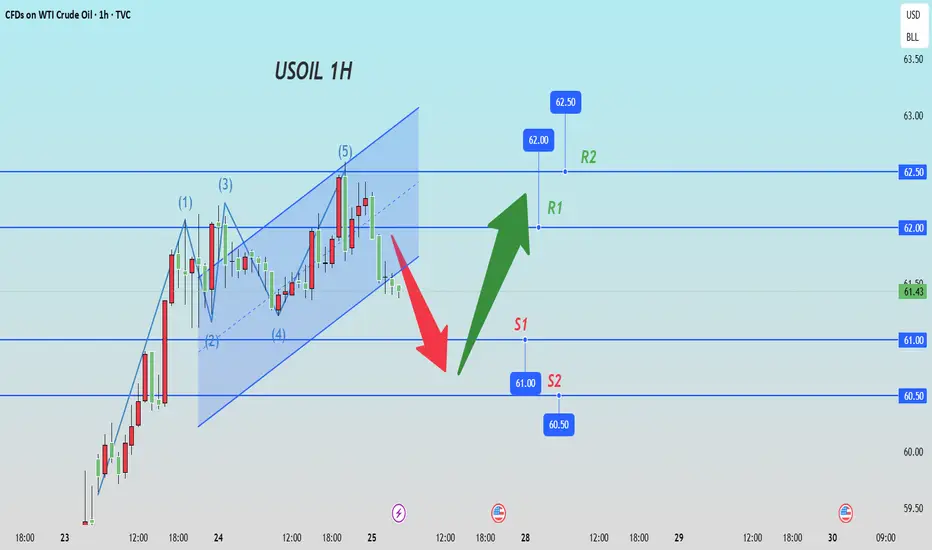
Crude oil's downward space is expandingDue to a significant increase in U.S. crude oil inventories, WTI prices have extended their decline.
In the short term, crude oil’s trend saw a seesaw battle between bulls and bears near the lower edge of the range, with frequent shifts in momentum. Eventually, the bears prevailed, sending prices lower. The moving averages are in a bearish alignment, indicating an objectively downward short-term trend.
Oil prices have broken below the 60 support level. It is expected that crude oil’s intraday trend will continue to expand downward. And the short-term support is 58.5,If it breaks below 58.5, focus on the support level at 57.5, while resistance above is at 60.8.
Buy 58.5 - 58.8
SL 58
TP 59.3 - 59.8 - 60.3
Sell 60.5 - 60
SL 61
TP 59 - 58.5 - 58
Analysis of crude oil trends. Hope it is helpful to you. "Demand and Sentiment" With crude oil prices currently stabilizing at $61.50, instead of obsessing over "whether supply is excessive," it’s better to focus on three more direct signals supporting a long position. These signals lie in changes in demand and market sentiment, and they are actually more closely aligned with short-term price movements:
1. "Unexpected Recovery" on the Demand Side
Previously, there were widespread concerns that "oil consumption would not pick up," but recent data has sent a reversal signal: Last week, the U.S. refinery utilization rate rose from 85% to 88% (the higher a refinery's operating rate, the more oil it consumes). Moreover, China has just rolled out a "stable growth plan for the petrochemical industry," which requires guaranteed supply of refined oil products in the fourth quarter—this directly drives up demand for crude oil purchases. More crucially, U.S. crude oil inventories unexpectedly decreased by 2.8 million barrels (compared to the original expectation of a 500,000-barrel increase). This is equivalent to "more oil being consumed than produced," and such a demand recovery will directly prop up oil prices.
2. Market Sentiment Shifting from "Bearish" to "Neutral, Then Bullish"
Previously, when oil prices were below $60, 80% of traders were taking short positions (expecting prices to fall). But the situation has changed now: Over the past three days, the volume of funds flowing into long positions has increased by 30%, and even small and medium-sized traders have started following the trend to enter the market. A more obvious sign is that in the past, oil prices would be pushed down by a flood of sell orders once they rose to $59.8, but now there are plenty of buy orders to absorb pressure at $60.50. This shows that the market's view on oil prices has changed—it’s no longer the case that "traders sell as soon as prices rise."
3. Short-Term Funds "Piling In" to Support Prices
The world’s largest crude oil ETF (equivalent to a fund where investors pool money to invest in crude oil) has seen a net inflow of $1.2 billion over the past three days—the largest single-week inflow since the start of this year. Additionally, some short-term funds on Wall Street are also quietly increasing their crude oil holdings. These funds are not entering the market for long-term investments; they are simply betting on a short-term rise in oil prices. Their buying activity will directly push oil prices upward, and at the very least, prevent a sharp short-term drop.
Crude Oil Trading Strategy for Today
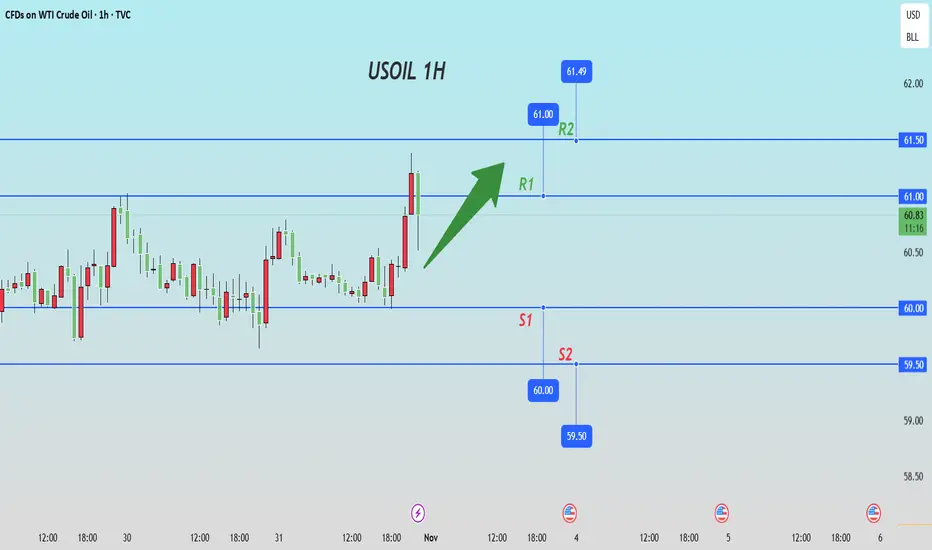
usoil @buy61.00-61.50
tp:62-62.5
sl:59.5
Crude Oil Trading Strategy for TodayThe cooling of inflation data strengthens the logic of a rate cut.
The core PCE price index in the United States rose by 2.8% year-on-year in October (lower than the expected 3.0%), reaching a new low since March 2023 and remaining below 3% for three consecutive months, confirming that inflation is approaching the Fed's 2% target. The probability of a 25BP rate cut in December has risen from 65% to 82%, and the cumulative rate cut expectation for 2026 has reached 125BP. In a liquidity-lean environment, the valuation attractiveness of crude oil as a risky asset has significantly increased - historical data shows that the average increase in WTI oil prices during the rate-cut cycle is 12%-15%, and the current price of $61.21 is still in the early stage of valuation recovery.
The US dollar index is under pressure, and the expectation of non-US demand release is expected.
The US dollar index has fallen by 3.2% from its October high and is currently stabilizing below the 92.5 mark. The purchasing power of non-US currencies has rebounded. The purchasing costs of oil-importing countries such as India and China have decreased. In November, India's oil imports are expected to increase by 6% month-on-month (to 5.2 million barrels per day), and China's refineries have received new quotas in November (an additional 12 million tons), and the policy-driven replenishment demand will directly support oil purchases, forming a positive cycle of "weak US dollar - increased purchases - oil price rise".
Crude Oil Trading Strategy for Today
buy:60.5-61
tp:61.5-62
sl:60
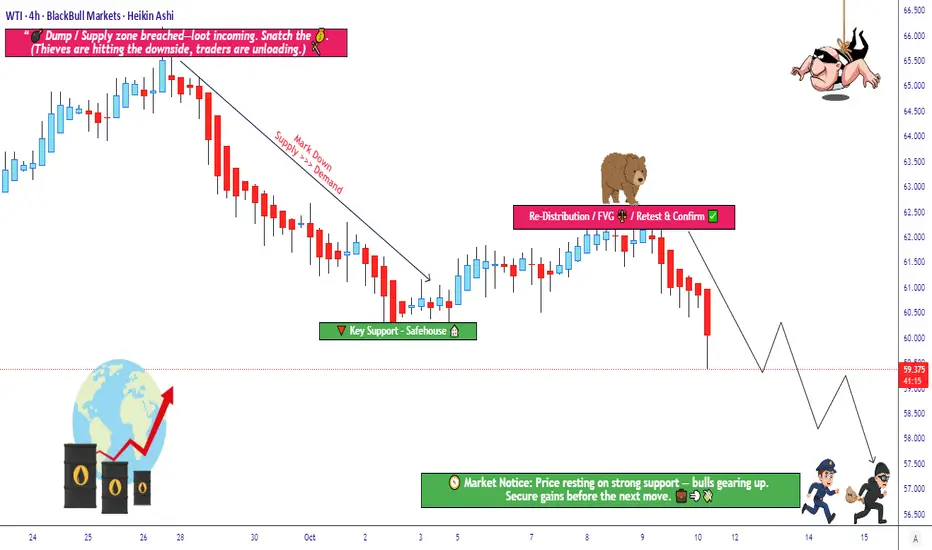
Is Crude Oil Setting Up for a Major Bearish Reversal?🛢️ XTI/USD “WTI” – Bearish Redistribution Zone Incoming (Thief Strategy Inside)
📉 Setup Overview
Market: XTI/USD (WTI crude oil)
Bias: Bearish confirmed — we’re looking for re-distribution / supply pressure to take control
Trade Type: Swing / Day Trade hybrid
🎯 Entry Plan (Thief-Layer Strategy)
I use a layering / multiple limit order approach (aka “Thief Strategy”). You may use any price level as entry, but here’s my preferred ladder:
Sell Limit @ 61.500
Sell Limit @ 61.000
Sell Limit @ 60.500
Sell Limit @ 60.000
Sell Limit @ 59.500
(You may extend more layers if you like)
You don’t need to hit all layers — just get partial fills, ride the move downward.
🚫 Stop Loss
Thief’s SL: 62.500
⚠️ Note to Thief OG’s: I’m not forcing you to follow my SL. You choose what works. Make money, take money — at your own risk.
🎯 Target
We see police barricade as a strong support zone + oversold trap possibility.
So primary target: 57.000
⚠️ Note to Thief OG’s: Don’t blindly hold to my TP. If price gives you your gains early, escape with your money — don’t wait for perfection.
🔍 Related Pairs & Correlations
AMEX:USO or USOIL (oil ETFs / indices) – real-world crude correlation
$BRENT/USD – watch for strength or weakness divergence
AMEX:XOP / AMEX:OIH (oil & gas sector indices) – sentiment in energy names
Key point: if Brent weakens while WTI breaks down, it reinforces the bias.
📌 Key Technical Notes
We’re waiting for ** redistribution / supply zone** to hold — a retest or failure bounce is ideal setup.
Oversold conditions + a “trap” candle (fake breakout) strengthen the move.
Use layering to average in, not “all-in” at once.
Be ready for whipsaws around support zones; partial exits can help.
✨ “If you find value in my analysis, a 👍 and 🚀 boost is much appreciated — it helps me share more setups with the community!”
Disclaimer: This is Thief-style trading strategy just for fun. I am not giving financial advice. Trade at your own decision and risk.
#WTI #CrudeOil #XTIUSD #EnergyTrading #OilStrategy #Layering #SwingTrade #DayTrade #BearishBias #ThiefStrategy
Next week's crude oil trading strategyGeopolitical Dimension: Rising Military Risks from the US to Venezuela, Becoming the Largest Uncertain Variable
Expected escalation of military operations, supply disruption risk premium
On October 31, Western media disclosed that the Trump administration is considering upgrading the military operation against Venezuela from maritime drug interdiction to ground-based air strikes, involving facilities such as naval bases and airport runways. The target list has been evaluated. Venezuela's current daily crude oil production is 940,000 barrels. If the military strike is implemented, its core oil fields and port facilities may be paralyzed, and short-term exports may drop to zero, creating a sudden supply gap. Although Trump did not explicitly deny it and the probability of actual actions before the election is affected by political games, the market has already begun to incorporate geopolitical risk premiums. The CFTC crude oil volatility index has risen from 18 to 25.
The Interaction between Russia and Venezuela Adds Uncertainty
The Maduro regime has urgently sought military support from Russia, including the supply of anti-missile missile systems and the upgrade of weapons maintenance. The Venezuelan transportation minister has secretly visited Moscow to hand over a personal letter. If Russia intervenes, it may intensify the geopolitical game in Latin America and further disrupt the crude oil supply chain; however, Russia has already invested a large amount of resources in the Ukraine issue, and the possibility of direct military intervention is low. It is more likely to respond in a "low-intensity" manner.
Next week's crude oil trading strategy
buy:60-60.5
tp:61.5-62
sl:59
Crude Oil Trading Strategy for TodayThe conflict between Russia and Ukraine continues, and the reconstruction of supply chains takes a long time.
The short-term conflict between Russia and Ukraine is unlikely to be resolved. Russian oil needs to rely on shadow fleets for transportation, but currently the discount is only 1-2 US dollars (far lower than the historical level of 10-20 US dollars), and there is insufficient willingness from third parties to take over. The reconstruction of supply chains is expected to take more than 3 months, and during this period, a supply gap of 100-150 thousand barrels per day will continue to support oil prices.
The expectation of the Fed's interest rate cut has risen, and loose liquidity is beneficial.
The market expects a higher probability of the Fed cutting interest rates in November and December. The loose liquidity environment will be beneficial for crude oil and other risky assets, while lowering the US dollar index and reducing the purchase cost of non-US currencies, stimulating the demand for replenishment in emerging markets.
Crude Oil Trading Strategy for Today
buy:59.5-60
tp:61-61.560
sl:58.5
Crude Oil Trading Strategy for TodayExcess inventory reduction exceeded expectations, and the resilience of demand was continuously verified
The latest EIA data shows (as of the week ending October 31), U.S. crude oil inventories decreased by 4.5 million barrels on a month-on-month basis (expected - 1.8 million barrels), and inventories have exceeded expectations for two consecutive weeks of reduction; gasoline inventories decreased by 3.2 million barrels (the largest decline in the same period since November, nearly 5-year low), refined oil inventories decreased by 2.8 million barrels, and inventories of the three major oil products were all below the 5-year average by 10%-15%. The inventory in the Cushing region increased by 800,000 barrels, but the overall reduction trend did not change, and the marginal tight balance feature of supply and demand was prominent.
Increased risk of Red Sea transportation, intensified supply chain disruptions
The Houthi armed group has recently intensified attacks on Red Sea merchant ships. Since November, 5 oil tanker ships have been attacked, and some oil tankers were forced to take a detour around the Cape of Good Hope (the voyage increased by 30%, transportation cost increased by 200,000 US dollars per ship). Currently, Red Sea crude oil transportation accounts for 12% of the global total. If the situation worsens, it may add 50-80 thousand barrels per day of supply disruptions.
The expectation for Fed rate cuts has risen again, and the US dollar is under pressure, which benefits oil prices
The U.S. 10-month CPI increased by 3.2% (lower than the expected 3.3%), and the core CPI increased by 2.9% (the lowest since January 2023), and the probability of the Fed cutting interest rates by 25 basis points in December from 55% rose to 78%. The US dollar index fell below the 93 threshold, the cost of purchasing non-US currencies decreased, and China and India's crude oil imports are expected to increase by 5%-8% month-on-month in November.
Crude Oil Trading Strategy for Today
buy:59.5-60
tp:61-61.560
sl:58.5
USOIL H4 | Bearish Reversal from Pullback ResistanceUSOIL has rejected the sell entry, which is a pullback resistance that aligns with the 38.2% Fibonacci retracemnt and could drop from this level to the downside.
Sell entry is at 60.77, whichis a pullback resistance that aligns with the 38.2% Fibonacci retracement.
Stop loss is at 62.09, which is a swing high resistance.
Take profit is at 58.74, which is a pullback support that lines up witht he 61.8% FIbonacci retracement.
Stratos Markets Limited (tradu.com ):
CFDs are complex instruments and come with a high risk of losing money rapidly due to leverage. 68% of retail investor accounts lose money when trading CFDs with this provider. You should consider whether you understand how CFDs work and whether you can afford to take the high risk of losing your money.
Stratos Europe Ltd (tradu.com ):
CFDs are complex instruments and come with a high risk of losing money rapidly due to leverage. 70% of retail investor accounts lose money when trading CFDs with this provider. You should consider whether you understand how CFDs work and whether you can afford to take the high risk of losing your money.
Crude Oil Trading Strategy for TodayFunds continue to accumulate: Although the non-commercial net short position of the CFTC remains negative, it has decreased by 80,000 lots in the past two days. Hedge funds have increased their long positions by 120,000 lots in the range of $59 - $60. The trend of fund rebalancing continues, and there is no withdrawal signal.
Refinery replenishment to stabilize: The 3-2-1 cracking spread in the United States remains at $23 per barrel. The processing profit of refineries has not significantly declined, and the operating rate has stabilized at 88%. Corresponding to the daily purchase volume of crude oil, it has increased by 300,000 barrels compared to the beginning of October, and the demand for active replenishment of inventories supports the price.
Crude Oil Trading Strategy for Today
buy:59.5-60
tp:61-61.5
sl:58.5
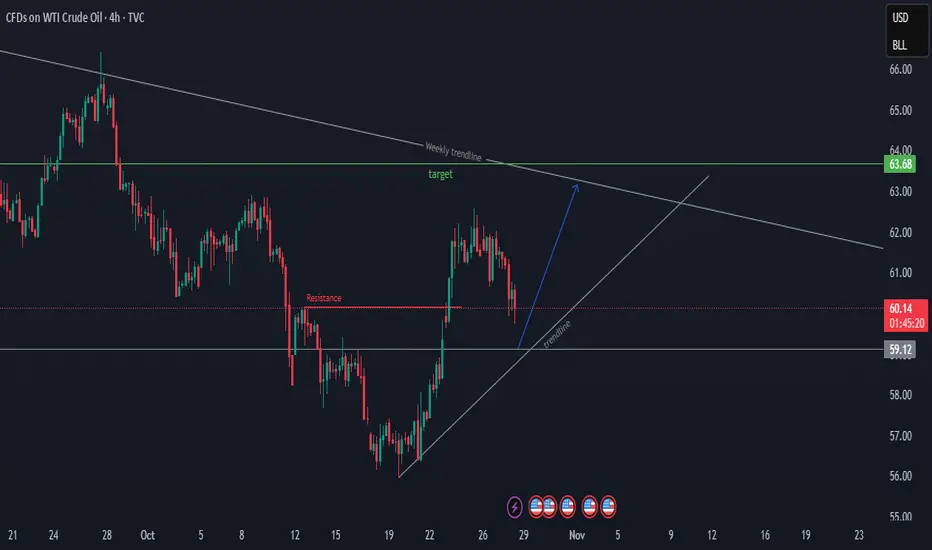
USOIL TRADE IDEAhi all
USOIL has broken through the resistance level at 60.17 on the H4 timeframe. The current decline is likely a pullback. In my view, the 59.3–59.1 range presents a good opportunity to go long on USOIL
good luck all
**My trading strategy is not intended to be a signal. It's a process of learning about market structure and sharpening my trading my skills also for my trade journal**
Thanks a lot for your support
Crude Oil Trading Strategy for TodayThe current WTI oil price of $61.2 is not merely a fluctuation center, but rather a "multiplier window" formed by the resonance of three core variables - "cost floor, geopolitical breakthrough, and sentiment correction" - indicating a "structural contradiction-driven short-term trend". It is clear that this is a "wave-like market phenomenon" rather than a trend reversal. However, the short-term upward momentum is highly certain:
The cost floor is clearly defined, with $60 being the "iron bottom".
The new well production break-even cost of US shale oil has reached $63 per barrel. The current price of $61.2 is already below the marginal production cost line. From the data, the number of active oil drilling rigs in the US has dropped to 424 (a decrease of 60 compared to the previous year), and if the oil price remains below $60, the shale oil production may be reduced by 1-1.5 million barrels per day next year. The supply contraction expectation has been priced in in advance. At the same time, non-OECD countries are accelerating their replenishment of stocks at low prices, forming "non-tradable inventories" to absorb excess supply, further strengthening the support at $60. The geopolitical sanctions are intensifying, leading to a structural rift in the supply side.
After the US imposed secondary sanctions on Russian oil, India's 1.7 million barrels per day Russian oil long-term contract faces the risk of termination. This part of the demand is now shifting to the spot market in the Middle East, directly pushing the Dubai crude oil premium to $2.1 per barrel (a 3-month high). More importantly, the actual spare capacity of OPEC+ has been seriously overestimated - Saudi Arabia's actual spare capacity is only 60-100 thousand barrels per day, far below the claimed 2.43 million barrels per day, and the OPEC+ has only increased production by 61% for five consecutive months, highlighting the capacity bottleneck and inability to fill potential supply gaps.
The market sentiment is overly pessimistic, with a significant recovery space.
As of October 23rd, the speculative net long position has dropped to a historical low. When Brent oil price fell below $60, 80% of traders held a bearish stance, forming a typical "extreme emotional state". However, the month spread structure still remains positive (Backwardation), not entering the Contango structure, indicating that the spot market does not have a real surplus. The previous decline was more dominated by sentiment, and the demand for recovery is strong.
Crude Oil Trading Strategy for Today
buy:61-61.3
tp:61.6-61.9
SL:60
USOIL – Daily Rejection & 4H Bearish Engulfing: Short Setup from 💬 Trade Description:
Price on **USOIL** recently pushed into a **daily supply zone** around the **62.00 area**, which had previously acted as a strong rejection point.
On the **daily timeframe**, a **clear pin-bar rejection** formed, showing that buyers lost control and sellers are stepping back into the market.
Dropping down to the **4-hour timeframe**, price created a **bearish engulfing candle** directly inside that same daily supply zone — confirming a strong **shift in momentum** and offering a precise entry opportunity.
This setup aligns perfectly with the **higher-timeframe bearish structure**, where the market continues to print **lower highs and lower lows**.
The reaction from the 62.00 zone suggests a potential continuation to the downside as price seeks liquidity near the **next major demand zone around 57.00**.
⚙️ Trade Breakdown:
* **Weekly Bias:** Bearish — market creating lower highs.
* **Daily Confirmation:** Pin bar rejection from daily supply.
* **4H Entry Trigger:** Bearish engulfing after retest.
* **Entry:** After 4H candle close.
* **Stop Loss:** Above the 4H engulfing high.
* **Take Profit:** Targeting 57.00 (next demand zone).
---
## 🧩 Technical Insights:
* The **daily pin bar** served as higher-timeframe confirmation that sellers were defending a premium level.
* The **4H engulfing** offered an early confirmation of short-term structure shift.
* The **trade idea** follows a simple, high-probability model:
**“Daily confirmation → 4H execution → Patience for follow-through.”**
---
## 💭 Trader’s Note:
Patience was key on this one. I waited for the daily signal first before dropping to the 4H to catch the clean bearish momentum. This is how I’m structuring all my trades now — only executing when the higher-timeframe aligns with the lower-timeframe trigger.
Discipline > Frequency.
Quality > Quantity.
Crude Oil Trading Strategy for Today"Smart money" quietly entered the market, and the buying power accumulated rapidly.
In the last three trading days, the speculative funds (hedge funds, investment banks, etc.) in the crude oil futures market suddenly increased their bullish positions by 150,000 lots, marking the largest weekly increase in 3 months. These funds began to build positions in batches when the oil price dropped below $60, just like when the oil price fell to $58 last year, it was also these funds that entered the market, and the oil price soon rebounded by $5. At the same time, the inflow of funds into crude oil ETFs also increased fourfold. Ordinary investors began to follow suit and enter the market, and the buying pressure changed from "scattered" to "concentrated", providing sufficient short-term upward momentum.
Crude Oil Trading Strategy for Today
usoil @ buy 61-61.5
tp:62-62.5
SL:60
Crude Oil Trading Strategy for TodayInventory data validates the short-term demand resilience: The U.S. EIA data shows that the crude oil inventory decreased by 960,000 barrels on a week-on-week basis as of October 17th, with the decline exceeding market expectations. At the same time, the gasoline inventory also decreased simultaneously, alleviating concerns about weak demand. The unexpected decline in inventories coincided with geopolitical benefits, driving speculative funds to quickly enter the market to repair the previously oversold situation.
Price patterns exhibit rebound momentum: Since October 17th, WTI crude oil has risen by more than 8% in the past three trading days, closing at $61.68 on October 24th, forming a "bottom-up volume-driven rebound" pattern; the main contract of Shanghai crude oil also rose significantly, with the closing price on October 24th rising by 6.7% compared to the low point on October 20th, and the trading volume has continuously expanded for three consecutive days, indicating a rapid accumulation of buying power.
Crude Oil Trading Strategy for Today
usoil @ buy 61-61.5
tp:62-62.5
SL:60
Crude Oil Trading Strategy for TodayGeopolitical sanctions trigger expectations of supply contraction: In late October, both the United States and Europe simultaneously escalated their energy sanctions against Russia. The United States imposed sanctions on Rosneft (the Russian oil company) and Lukoil (another Russian oil company), with the combined total of these two companies accounting for nearly 50% of Russia's total crude oil exports; the 19th round of sanctions by the European Union for the first time blocked the "third-country bypass" export channels. India, as the largest buyer of Russian maritime crude oil (accounting for over 36%), has begun to seek sources in the Middle East, directly pushing up the spot market premium and providing immediate support for oil prices.
Crude Oil Trading Strategy for Today
usoil @buy 61-61.5
tp:62-62.5
SL:60
Crude Oil Trading Strategy for Next Week"Buy low" strategy + "bottom has stabilized" in terms of technical analysis - there is a chance for a short-term rebound.
Financing side: "Bottoming" funds "quietly enter the market" and change the supply-demand expectations
In the past three days, the "non-commercial net long positions" (that is, the bullish positions of speculative funds) in the crude oil futures market suddenly increased by 120,000 lots, marking the largest weekly increase in 3 months. Among them, hedge funds and large investment banks were the main buyers. They began to build positions in batches starting from below 60 US dollars, just like when the oil price dropped to 58 US dollars, these funds entered the market and the oil price quickly rebounded by 4 US dollars. At the same time, the inflow of funds into crude oil ETFs also tripled, and ordinary investors began to follow the trend, and the buying power was accumulating rapidly.
Technical aspect: The price "successfully bottomed out" and the breakthrough signal has appeared
WTI crude oil has been oscillating in the range of 59.8 - 60.5 US dollars for a week, forming a "double bottom" pattern (two times falling to 59.8 without breaking through), and broke through the upper edge of the oscillation range (61.2 US dollars) on Thursday. After that, it has been running above this position. From the short-term trend, every time it drops to 61 US dollars, there are buyers to take over, indicating that the bottom support is very stable. In addition, the trading volume has also increased along with the breakthrough (the trading volume at the breakthrough was 40% higher than usual), it is not "false increase", and the rebound signal is very clear.
usoil @ buy 60.5-61.0
tp:62-62.5
SL:59.5
Review of USOIL's Performance This Week📝This week, the USOil market exhibited a highly volatile pattern of "first bottoming out and stabilizing, then rebounding driven by geopolitical factors". The competition between supply-demand fundamentals and sudden geopolitical events dominated the market trend throughout the week. Details are as follows:
💡Price Movement: From Approaching Annual Lows to Intraday Surges, Volatility Within Ranges Intensifies
1. Bottoming Out Early in the Week
On Monday, USOil continued its weak oscillation. It opened at $57.32 per barrel, dipped to a low of around $56 per barrel (approaching the 2025 annual low of $55.12), and finally closed at $56.93 per barrel, down $0.61 from the previous trading day.
From Tuesday to Wednesday, as panic eased, prices gradually stabilized and rebounded. It closed at $57.58 per barrel on Tuesday; on Wednesday, boosted by geopolitical expectations, it surged by $3.25 in a single day to close at $61.75 per barrel, with trading volume rising to 711,600 lots.
2. Rebounding and Then Retreating in the Latter Half of the Week
On Thursday, the official release of detailed EU and U.S. sanctions on Russian energy triggered a strong market reaction. USOil opened at $59.94 per barrel and then jumped, peaking at $62.59 per barrel with an intraday gain of nearly 5%, before closing at $61.44 per barrel.
On Friday, after the earlier rebound, prices entered a consolidation phase, fluctuating narrowly around $62. For the whole week, it rebounded by over 10% from the previous week’s low.
💡Core Influencing Factors:
1. Bearish Drivers: Sustained Supply-Demand Easing Suppresses Oil Prices
✔Worsening Supply Glut
✔Weak Demand Weighs on Prices
2. Bullish Disturbances: Geopolitical Sanctions Trigger a Phased Rebo
💡Technicals and Market Sentiment: Recovery After Oversold Conditions, Persistent Long-Short Divisions
1. Divergent Signals from Technical Indicators
2. Intense Battles Around Key Levels
The support at the annual low of $55.12 proved effective, serving as the starting point for the week’s bottoming and rebound. The resistance levels at $58 and $62 were breached one after another, but the resistance from the $63 level and the 70-dollar trend line still posed long-term pressure. A breakthrough would require sustained improvement in fundamental
💡Outlook: Short-Term Oscillations Unlikely to Reverse Long-Term Weak Trend
💎Short-Term Perspective: Geopolitical risk premiums and technical recovery after oversold conditions may support oil prices to fluctuate within the $58-$63 range. If the supply gap caused by sanctions continues to widen, it may test the resistance level of $66.
💎Long-Term Perspective: The IEA predicts that Brent crude oil prices will range between $52-$60 in 2026. Core contradictions such as loose supply-demand, accelerated energy transition, and approaching demand peaks remain unresolved. If the support at $55 is broken, it may fall to the deep correction range of $49 or even $37.
The market should focus on whether OPEC+ will adjust its production increase plan at the November 2 meeting and the impact of global manufacturing PMI data on demand expectations.
Analysis of crude oil trend next week.Short-term positive factors: "Effective Cycle" and "Support Strength"
The actual impact of Russian sanctions: Supply gap could reach 1.5 million barrels per day
The new sanctions imposed by the US and Europe on October 22 directly cover the overseas settlement accounts of Russian oil companies (Rosneft) and Lukoil. These two companies collectively control 50% of Russia's crude oil exports (approximately 3 million barrels per day). Currently, major buyers such as India and Turkey have suspended the purchase of crude oil from these two companies and turned to the Middle East market, resulting in the spot premium in the Middle East rising from $1.2 per barrel to $2.5 per barrel. However, it should be noted: Russia can transfer part of its exports to China and Iran through "non-dollar settlement", and the actual supply gap may shrink to 100-120 million barrels per day. The positive support is likely to last for 1-2 weeks, after which the market will gradually adapt to the new supply pattern.
"Realistic Support" of Inventory and Refinery Data
According to the US EIA data, as of October 18 of the current week, crude oil inventories decreased by 960,000 barrels (expected to decrease by 500,000 barrels), and the refinery utilization rate rose from 86.8% to 88.6%, reaching a 3-month high. This is due to the end of the seasonal maintenance of US refineries (the maintenance rate in September was 15%, and it dropped to 8% in October), combined with the start of heating oil demand in the Northern Hemisphere (heating oil inventories in October decreased by 8% year-on-year), short-term crude oil purchase demand will remain at a high level, and it can support prices at least until mid-November.
Crude Oil Trading Strategy for Next Week
usoil @buy 60.5-61.0
tp:62-62.5
SL:59.5
USOIL: Go long on pullbacksGeopolitical risks have dominated short-term market sentiment for crude oil. Investors' concerns about the supply side have overshadowed negative factors on the demand side, driving oil prices to rise consecutively. However, the weak global economy has dimmed the long-term demand outlook, limiting the extent of oil price increases, resulting in relatively complicated overall market sentiment.
From a technical indicator perspective, momentum indicators are showing positive signals, and the MACD is trending upward. This indicates that the bullish bias is strengthening, but a fully established uptrend has not yet formed.
Overall, technical indicators point to a certain bullish tendency, though it is also necessary to monitor the price performance at key resistance levels.
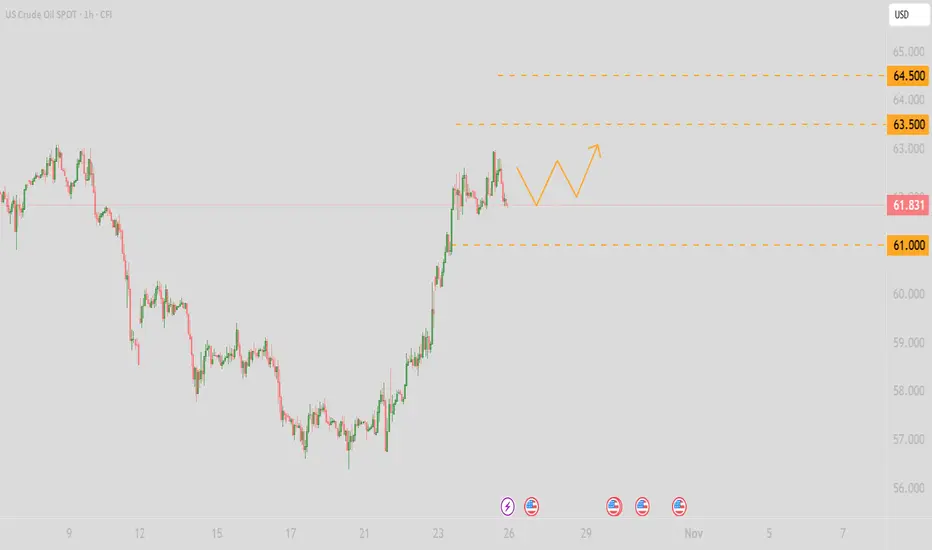
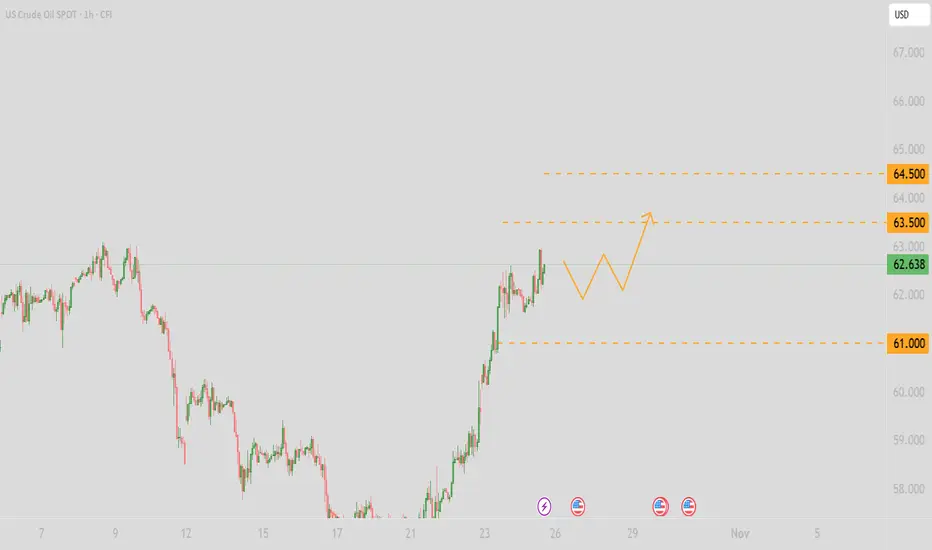
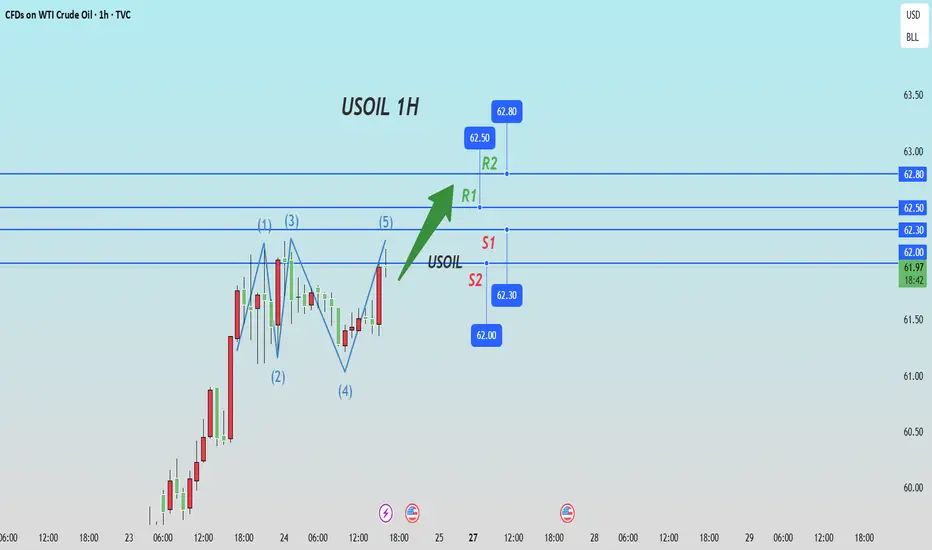
In the short term, focus on the resistance range of 63.5–64.5 on the upside and the support range of 60–61 on the downside. For intraday operations, the main strategy is to go long on pullbacks, with short positions on rebounds as a supplementary approach.
💎Trading Strategy:
Buy 61.8 SL 62.4 TP 61.1
Daily-updated accurate signals are at your disposal. If you run into any problems while trading, these signals serve as a reliable reference—don’t hesitate to use them! I truly hope they bring you significant assistance
Where Does the Short-Term Confidence for Going Long Come From?Geopolitical Conflicts "Continue to Drive Momentum" – Supply Worries Persist
The U.S. has just imposed sanctions on two major Russian oil giants, which account for 50% of Russia’s crude oil exports. This could mean a daily reduction of 1.5 million barrels in global supply, and the market is worried about "insufficient oil". A prime example: when Ukrainian forces attacked Russian refineries earlier, daily exports dropped by 1 million barrels, and oil prices rose 2% the same day. Now, such sanctions are still escalating, which will firmly support oil prices in the short term and prevent a sharp decline.
Demand Data Offers "Genuine" Positives – Strong Floor Support
U.S. crude oil inventories have decreased by 960,000 barrels, and refinery utilization rate has risen to 88.6% – this clearly shows "more oil is being consumed than produced", so the current price increase is not unfounded. Meanwhile, China’s refinery utilization rate has also climbed from 86% to 88%, and there is a requirement to ensure refined oil supply in the fourth quarter. This means demand for crude oil will only increase, not decrease, adding a "safety cushion" for long positions. Even if there is a short-term pullback, the decline will be very limited.
Crude Oil Trading Strategy for Today
usoil @buy 62.0-62.3
tp:62.5-62.8
sl:61.8
Crude oil shows an optimistic upward trend📈The situation of crude oil is relatively optimistic, showing an upward trend, mainly affected by geopolitics and supply-demand relationships.
💡Geopolitical factors:
The United States has imposed sanctions on Russian oil companies, and the European Union's sanctions against Russia are also continuing. At the same time, the news that the United States intends to take military action against Venezuela has fermented, triggering market concerns about disruptions in crude oil supply and boosting oil prices.
💡Supply-demand factors:
On the one hand, OPEC announced at a new round of meetings that it would continue to increase production by 137,000 barrels, but the scale of production increase is relatively small, and the production increase capacity of some oil-producing countries is limited, which alleviates the pressure of oversupply. On the other hand, as of October 17th, the EIA crude oil inventory data decreased by 960,000 barrels, the gasoline inventory decreased by 21.05 million barrels per day, and the distillate oil inventory decreased by 1.48 million barrels per day. The decrease in inventory has provided some support for oil prices. However, the weakness of the global economy has made the long-term demand outlook bleak, which has suppressed the increase in oil prices to a certain extent.
💡Technical analysis:
From the daily line level, the daily K-line shows a trend of breaking below the previous low point and then recovering, and the weekly K-line forms a rising sun pattern, indicating that there is a possibility of continued rebound in prices in the short term. At the same time, the medium-term indicator MACD supports an upward trend, also indicating that the short-term trend is upward.
💎Trading Strategy:
Buy 60 SL 61.5 TP 59
Daily-updated accurate signals are at your disposal. If you run into any problems while trading, these signals serve as a reliable reference—don’t hesitate to use them! I truly hope they bring you significant assistance
USOIL : Full analysisHello friends
Well, considering the sharp decline we had, the price has entered a descending channel and is slowly going down in this channel.
Now the price has reached a critical point, namely the bottom of the channel.
We need to see if buyers will support the price at the bottom of the channel like the previous two times or not?
If we do not see support from buyers and the channel is broken, we can expect lower prices.
56.30 and 53 dollars respectively.
But we will most likely see buyers' support in this area and the price could even reach the channel ceiling.
*Trade safely with us*