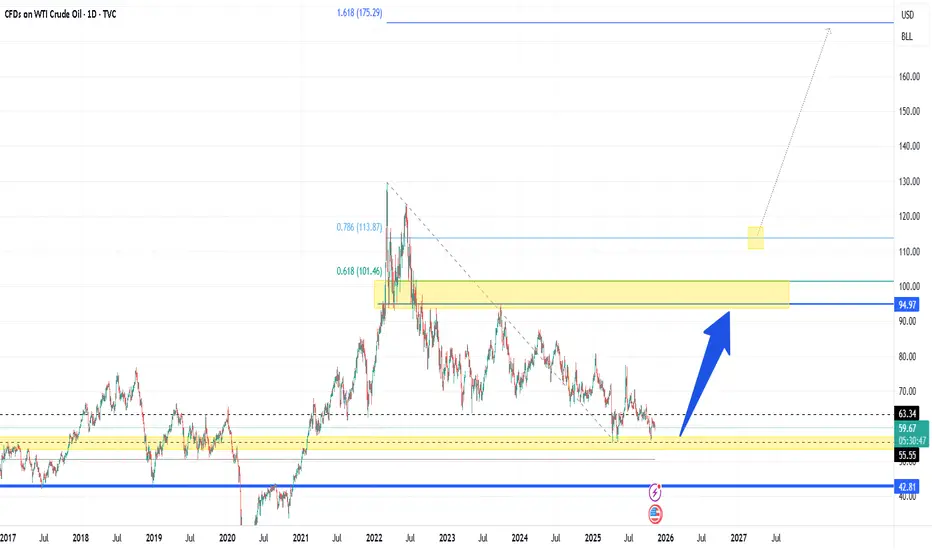
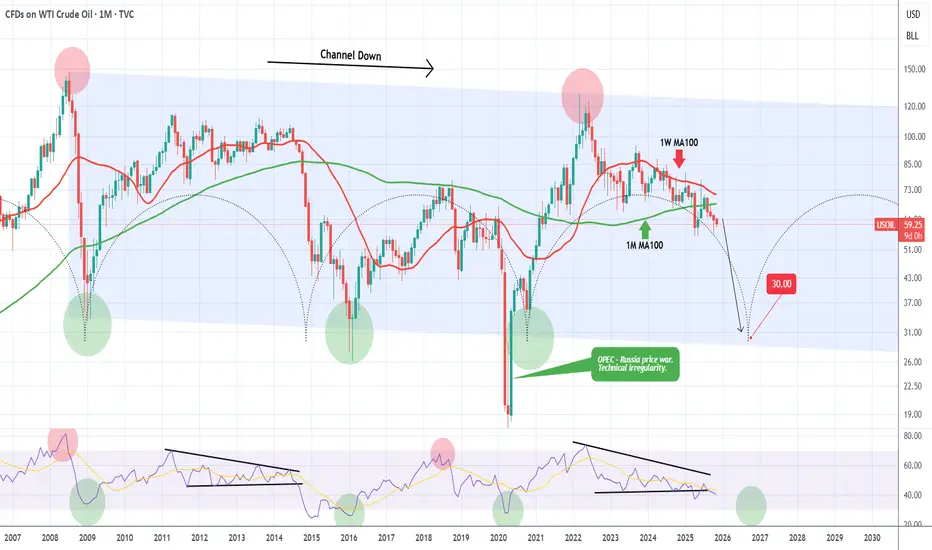
WTI OIL Is it possible to crash at $30.00?WTI Oil (USOIL) has been declining for 3 straight months (current red 1M candle is the 4th one) since the June 2025 rejection on the 1W MA100 (red trend-line). That has been the last rejection of a series of Lower Highs rejections on the 1W MA100 in the past 2 years.
On the much longer-term scale, this is the aftermath of the March 2022 market Top, made as a direct result of the Ukraine - Russia war. On a 17-year horizon, that was the 2nd Lower High of the multi-year Channel Down that WTI has been trading in since the July 2008 Top of the Housing Crisis.
As you can see, there is a high degree of symmetry on this pattern with Lower Lows in particular (market bottoms) getting formed around every 5-6 years. The use of the Time Cycles can fairly accurately project this. The next one is estimated to be towards the end of 2026, which matches perfectly the projected Bear Cycle bottom on the stock markets.
Based on this model, we may very well see WTI drop to as low as $30.00. A fairly solid bottom buy indicator would be when (if) the 1M RSI breaks below its 30.00 (oversold) barrier.
---
** Please LIKE 👍, FOLLOW ✅, SHARE 🙌 and COMMENT ✍ if you enjoy this idea! Also share your ideas and charts in the comments section below! This is best way to keep it relevant, support us, keep the content here free and allow the idea to reach as many people as possible. **
---
💸💸💸💸💸💸
👇 👇 👇 👇 👇 👇
WTI
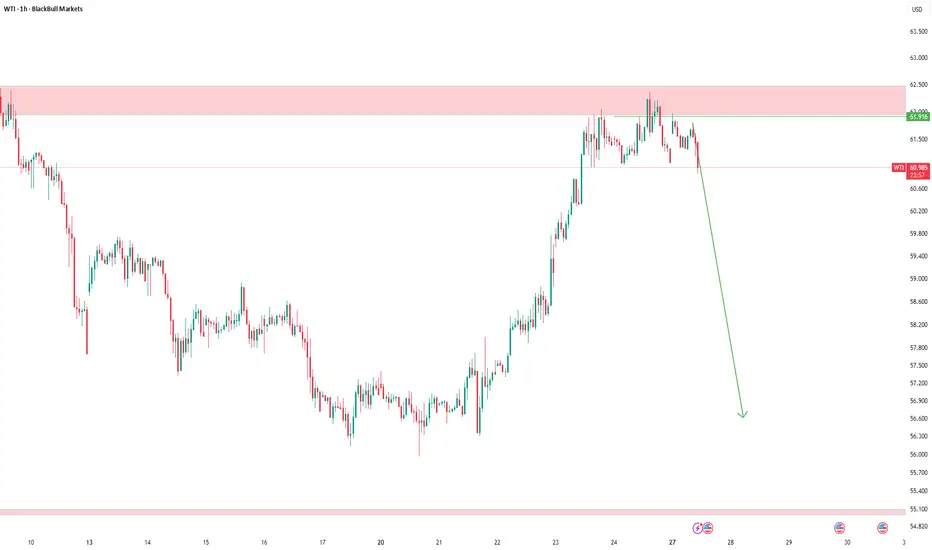
WTI resumes slideExcess supply concerns continue to hold back oil each time it tries to stage a recovery, and today it looks like the market has decided that it wants to trade below $60 per barrel. WTI has been testing this barrier from underneath for a few days but today it looks like the advance has been rejected once again. Prices have broken below the lows of the past two days, thus triggering some stops. From here $58.00 could be the next stop, below which there is nothing significant in terms of support until $55.00.
By Fawad Razaqzada, market analyst with FOREX.com
USDCAD: Patient Fed & oil drop support iH&S projection to 1.4370USDCAD is building an interesting medium-term setup as crude oil weakness combines with Fed patience and supports dollar strength against the loonie, with an inverse head-and-shoulders pattern pointing to a measured-move target near 1.4370.
Crude oil recently broke below $60, directly pressuring the Canadian dollar since Canada is a major commodity exporter. Meanwhile, the Fed's cautious stance on rate cuts, despite labour market softness ahead of a potential partial NFP on Friday, keeps the buck bid as investors hold dollars for yield.
The technical structure confirms what the macro backdrop suggests: USDCAD has room to run higher from current levels.
Key drivers
Oil breakdown hurts CAD: crude slipped below $60 recently, and every time oil weakens, the commodity-linked loonie follows. This correlation has been tracking cleanly since July, when USDCAD turned higher alongside the energy sell-off.
Fed patience supports USD: Despite labour-market weakness signals from existing data releases, the Fed isn't rushing to cut in December, and a patient central bank typically supports the dollar because investors can hold dollars and earn decent carry while awaiting clarity on policy.
Inverse H&S pattern: The technical setup shows a head near 1.3537, a neckline breakout near 1.3900, and a clean retest at 1.3985 (former 2022 resistance turned support). The measured move from head to neckline brings 1.4370 into play, with intermediate targets at swing levels.
RSI reset above 50: After showing flat divergence at the recent highs, the RSI has reset by bouncing cleanly off the 50 line on the daily chart, suggesting momentum has room for another leg higher before any overbought concern.
Use 1.3985 as your line in the sand, consider longs above this level with the first target at the peak of 1.4145 (validation of the breakout), the second at 1.4250, and trail stops toward 1.4370 if momentum holds. Watch for oil to remain below $60 and Fed messaging to stay cautious, as a daily close below 1.3985 would shift the bias to consolidation, while full pattern invalidation sits at 1.3720.
This content is not directed to residents of the EU or UK. Any opinions, news, research, analyses, prices or other information contained on this website is provided as general market commentary and does not constitute investment advice. ThinkMarkets will not accept liability for any loss or damage including, without limitation, to any loss of profit which may arise directly or indirectly from use of or reliance on such information.
BRIEFING Week #46 : Make or BreakHere's your weekly update ! Brought to you each weekend with years of track-record history..
Don't forget to hit the like/follow button if you feel like this post deserves it ;)
That's the best way to support me and help pushing this content to other users.
Kindly,
Phil
The Contango Conundrum: Why Crude’s Price Power WanesThe global crude oil market is signaling sustained weakness. A clear sign is the Contango in the West Texas Intermediate (WTI) futures curve for most of 2026. This structure prices future oil deliveries higher than immediate ones, strongly indicating a global supply glut. Major forecasting bodies like the International Energy Agency (IEA) and the Organization of the Petroleum Exporting Countries (OPEC) now confirm a record surplus looms in 2026, reversing previous tight market expectations. Understanding this decline requires a multidisciplinary lens, examining supply resilience against sluggish demand across several domains.
Geostrategy and Geopolitics: Production Over Protocol
Geopolitical decisions, paradoxically, contribute to oversupply. OPEC+ members are gradually unwinding previous voluntary production cuts, adding millions of barrels back to the market. This production boost, formalized in their latest agreements, increases supply visibility and dampens price spikes. Simultaneously, sustained geopolitical tensions between major powers often lead key consumers like China to ramp up Strategic Petroleum Reserves (SPR) , effectively soaking up immediate surplus but reducing future demand visibility. This policy-driven stockpiling mitigates immediate price falls, but structural oversupply persists.
Macroeconomics and Economics: Slowdown Meets Resilience
A deceleration in global oil demand growth meets unexpectedly resilient supply . Macroeconomic headwinds, including trade tensions and a sluggish global economic outlook, suppress consumption growth below historical trends. This tepid demand environment is exacerbated by expanding production from non-OPEC+ nations. Crucially, the United States, Brazil, Canada, and Guyana lead this non-OPEC+ supply expansion, challenging the cartel’s market dominance. The resulting imbalance, production exceeding demand, creates the chronic oversupply driving WTI into contango.
Technology and High-Tech: Efficiency Enhances Supply
Advancements in extraction technology dramatically boosted supply, particularly within the US shale sector. Continuous innovations in horizontal drilling and hydraulic fracturing sustain high US output, even as prices soften. Furthermore, the rapid expansion of Electric Vehicle (EV) sales and increasing vehicle fuel efficiencies represent a major technological headwind for transportation fuel demand. This shift, supported by global patent activity in battery and wave energy technology, structurally limits long-term oil consumption growth.
Patent and Science Analysis: The Energy Transition
Patent activity confirms the directional shift away from fossil fuels. While patents related to downhole completion systems and drilling fluid prediction remain, increased patenting in Carbon Capture and Sequestration (CCS) [/b and Green Hydrogen signals the industry's necessary pivot. The science of energy transition, focusing on low-carbon solutions, suggests a future where oil remains a critical input but faces mounting competition from technological substitutes. This long-term displacement risk pressures oil prices, even if demand remains firm in the short run.
Cyber and Strategic Risk: Supply Chain Security
The increasing reliance on complex digital infrastructure across the oil value chain introduces cyber risk . Successful attacks on pipeline operators or refineries can cause temporary supply disruptions and price spikes. However, the market currently views such disruptions as temporary events rather than long-term structural issues affecting the overall supply-demand balance. The oversupply acts as a buffer, with floating storage and ample inventory mitigating the impact of short-term, localized outages.
Investment Outlook: Watching Spreads
The market signals clearly indicate supply strength and demand vulnerability. The widening WTI contango structure provides a clear arbitrage opportunity for traders willing to finance storage. Investors should closely monitor the Brent-Dubai Exchange of Futures for Swaps (EFS), which is turning negative, underscoring specific weakening in the Atlantic Basin. Barring a sharp, coordinated OPEC+ cut or an unexpected large-scale geopolitical conflict, pricing pressure should persist into 2026. Traders must prioritize futures spread analysis over simple outright price forecasting.
WTI Crude Oil – Update
I’ve entered a short position around this zone.
I don’t predict the market — I just follow opportunities.
It doesn’t matter what happens after entry; I simply follow my plan.
Those who’ve been following me know my system:
At a 1:1 reward, I close half of my position — that means zero risk.
If the market reverses and hits my stop, I lose nothing.
If it keeps moving, I use a trailing stop to catch as much of the move as possible.
That’s what real position management looks like.
And if my level breaks, I don’t just sit and watch — I’ll go long with the market.
I don’t predict or guess the future;
I trade with discipline, patience, and respect for the market.
I’m a trader, not a fortune teller.
WTI OIL Successive 1D MA50 rejections. Sell Signal.WTI Oil (USOIL) has been trading within a 3-month Channel Down with the price experiencing successive rejection on the 1D MA50 (blue trend-line) since the October 24 Lower High.
Given that the 0.5 Fibonacci retracement level was also filled (as on the previous Lower High), we expect this inability to break above, to kickstart the new Bearish Leg.
As previously, the Target is the Support at $56.00.
---
** Please LIKE 👍, FOLLOW ✅, SHARE 🙌 and COMMENT ✍ if you enjoy this idea! Also share your ideas and charts in the comments section below! This is best way to keep it relevant, support us, keep the content here free and allow the idea to reach as many people as possible. **
---
💸💸💸💸💸💸
👇 👇 👇 👇 👇 👇
USOIL: Q4/2025 Q1 2026 Action PlansSentiment:
- The broader market is cautious in a risk-off environment, which typically translates to concerns about demand and the strength of the US dollar. However, the market is not in a state of panic as the Fear Index is at around 30, opening room for either direction.
- Social Media (X/Twitter): The current tone is positive, as participants expect USOil to rise within the range of 57.50-65.00 in the near term, anticipating an upcoming upward breakout.
- The COT report shows extremely bearish sentiment regarding the latest data from 26/9 (following the US government shutdown), so we can only have a snapshot of more than a month ago. Although the current sentiment may or may not be as extreme (we need to wait for the latest data), it still reflects the state of market positioning.
- I think that Retail is unaware of positioning extremes and is more focused on technical breakout. It may lead to a sentiment shift as a result of a technical breakout and changes in the fundamental narrative.
Fundamental:
A. OPEC+ Production Shift:
- Narrative: OPEC+ has pivoted to MORE cautious supply management. After nine consecutive monthly increases, the group is now implementing only a modest 137k bpd increase for Dec 2025, followed by a production pause for the entire first quarter of 2026.
- Rationale: Healthy market fundamentals, low inventory levels, seasonal demand
- It means more supportive than what we observed earlier in 2025. Q1 2026 pause suggests OPEC+ acknowledges oversupply risks and is being disciplined. One more thing to note is that the current price is also not entirely factored into this narrative.
B. Geopolitical Risk Premium Returning:
- Narrative: Recent US/EU sanctions on Russian energy companies and escalating tension in oil-producing regions are providing price support.
- Market impact: This narrative provides a fundamental floor for price at least till the end of this year.
C. Bearish Fundamentals - Oversupply into 2026:
- Narrative: Despite the OPEC+ pause, global oil inventories are expected to rise through 2026 on weak demand growth and non-OPEC supply increases (such as the US production)
- Factors: global inventories forecast to rise through 2026, weak demand from China, tariff uncertainties and US production at record levels.
- Market impact: Bearish medium-term outlook for Q1-Q2 2026.
Technical:
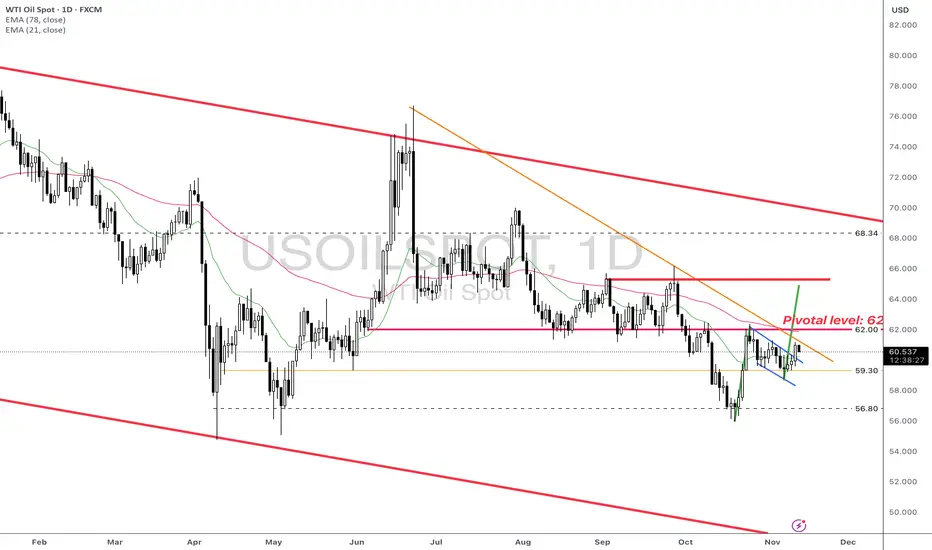
- USOIL broke the small blue channel and is expected to reach the measured level at around 65, confluence with the Sep resistances.
- If USOIL can hold above 60 (retest the broken channel), it may resume its momentum to retest the key resistance at 62 first, then 65, as measured by the move upon breaking.
- Conversely, closing below the support at 59.30 may invalidate the short-term upward view and open the door for further decline, potentially retesting the swing low at 56.80.
Conclusion:
- Despite a short-term upward momentum until year-end, the prospect for USOIL in 2026 is not as promising.
- Therefore, a range of 65-70 is possible for the short term upward plan; however, any surge bejond that may open another opportunity for counter-trade setups in Q1-Q2 2026.
Analysis by: Dat Tong, Senior Financial Markets Strategist at Exness
How to Trade Crude Oil with Smart Money Concepts SMC Explained
Smart Money Concepts is one of the most reliable techniques for trading WTI Crude Oil.
In this article, I will teach you a profitable SMC strategy for analysing and trading USOIL futures and CFD.
This simple strategy is based on an important event every SMC trader should know - a break of structure BoS.
In a bullish trend, the best break of structure will be based on a violation and a candle close above a current higher high.
It will signify a highly probable bullish continuation and provides a great opportunity to buy
Though you can spot a bullish break of structure on any time frame, the most reliable one is a daily.
After a formation of a new high, I suggest waiting for a short term intraday correctional movement.
With a high probability, the market will retest a recently broken structure and smart money will manipulate the market, pushing the price below that, making buyers close their positions.
Once the market starts retracing, analyze an hourly time frame. The price will need to establish an i ntraday minor bearish trend.
In this bearish trend, 2 trend lines should connect lower highs and lower lows composing an expanding, parallel or contracting channel - a bullish flag pattern.
Your best signal will be a breakout of a resistance line of the flag and a violation of the level of the last lower high - a bullish change of character of a liquidity grab.
It will confirm a completion of a correction.
Buy the market on a retest of the level of the last higher low, it will be your best entry.
Set your stop loss at least below a trend line and aim at the next strong daily resistance.
That will be a perfect model for trading break of structure on WTI Crude Oil.
We spotted such a setup in my trading academy on one of the live streams with my students.
WTI Crude Oil was trading in an uptrend on a daily time frame.
A bullish violation of the last Higher High and a candle close above that confirmed a Break of Structure BoS.
The price started a correctional movement then, and we spotted a bullish flag pattern on an hourly time frame.
The market completed a correction after grabbing a liquidity below a broken structure.
A bullish movement started then, and the price violated a resistance line of the flag and the level of the last lower high.
These 2 breakouts confirmed a completion of a correction and a resumption of a bullish trend.
We opened a buy position immediately on a retest of a broken level of the last lower high.
Stop loss was below a trend line, take profit was based on the closest key daily resistance.
And the price went straight to the target.
Break of Structure BoS will be useful for analysis, forecasting and trading WTI Crude Oil.
Combining that with top-down analysis and lower time frames confirmations will provide accurate signals and profitable trading setups.
Integrate a price model that I shared in your strategy, and good luck to you trading USOIL!
❤️Please, support my work with like, thank you!❤️
I am part of Trade Nation's Influencer program and receive a monthly fee for using their TradingView charts in my analysis.
Is XTI/USD Setting Up for a Sharp Bearish Correction?🚨 WTI/USD CRUDE OIL: THE BEARISH HEIST AWAITS 🎯
═══════════════════════════════════════════════════════════
THE SETUP: Breaking Down The Crime Scene 🕵️♂️
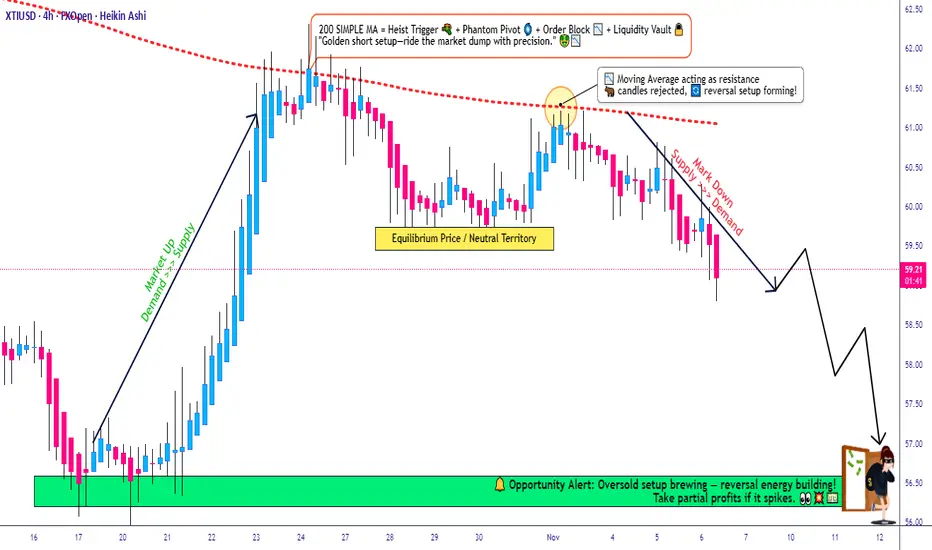
We're executing a bearish pullback strategy on WTI/USD spot crude oil, leveraging the 200-period Simple Moving Average (SMA) as our primary technical confirmation. The energy sector is flashing opportunity signals, and it's time to work the levels like a seasoned professional.
📊 STRATEGY FRAMEWORK
Market Direction: Bearish Pullback from 200 SMA Resistance
Timeframe: Suitable for Swing & Day Trading Operations
Asset Class: Energies | WTI Crude Oil Spot
💰 THE LAYERED ENTRY STRATEGY (Multi-Level Approach)
This is where the Thief Method shines—stacking limit orders at key price levels to accumulate positions as the market comes to you:
Suggested Entry Layer Points:
Layer 1: 60.50 💧
Layer 2: 60.00 💧
Layer 3: 59.50 💧
Layer 4: 59.00 💧
⚠️ Pro Tip: Feel free to add or adjust layers based on your risk tolerance and position size. The beauty of this method is scalability—customize to YOUR account size and risk parameters.
🛑 STOP LOSS PLACEMENT
Primary SL Level: 61.00
Positioned at the nearest swing high/candle wick resistance above our entry cluster. This respects natural market structure and gives us a defined, measurable risk point.
⚡ DISCLAIMER ON RISK MANAGEMENT:
This is NOT financial advice. Risk management is YOUR responsibility. The suggested SL is based on technical structure, but YOU control your account. Set stops that align with YOUR risk tolerance. Trade only what you can afford to lose.
🎯 PROFIT TARGET STRUCTURE
Primary Target: 56.50
Secondary Support Level: 56.00 — A police barricade of strength where multiple factors converge:
Strong historical support confluence 📍
Oversold zone recognition ⚖️
Potential reversal trap (exit strategy alert) ⚠️
Exit Strategy: Consider banking profits at 56.50 before support intensifies at 56.00. Lock in gains as the technical structure suggests potential friction.
⚡ DISCLAIMER ON PROFIT TARGETS:
Again, these are TECHNICAL levels only. YOU decide your exit strategy. Whether you take full profits at 56.50, trail stops, or use partial exits—this is YOUR trading plan. No setup is guaranteed.
🔗 RELATED PAIRS TO WATCH (Correlation Check)
Understanding energy market interrelations helps you spot confirmation signals:
US Dollar Index ( TVC:DXY ) → Inverse correlation to crude oil. Strengthen USD = Bearish pressure on oil. Watch DXY for confirmation of our bearish bias.
CSEMA:S&P 500 ( AMEX:SPY / CME_MINI:ES1! ) → Risk sentiment indicator. If equities weaken, crude often follows bearish patterns. Check equity trends for macro confirmation.
Energy Select Sector ETF ( AMEX:XLE ) → Direct correlation. Tracks large-cap energy stocks. Oil weakness often precedes XLE drops.
FX:EURUSD → Global risk sentiment. Weak euro = risk-off environment = potential crude weakness. Monitor for macro context.
AMEX:USO (Crude Oil ETF) → Direct oil tracking instrument. Moves in lockstep with WTI. Use for backup confirmation.
📋 THE THIEF STRATEGY CHECKLIST
✅ Confirm 200 SMA as resistance/bearish context
✅ Stack limit orders—don't chase price
✅ Define your personal stop loss (around 61.00 structure)
✅ Target scale-outs near 56.50-56.00
✅ Use correlation pairs for macro confirmation
✅ Manage position size ruthlessly
✅ Accept losses—they're tuition in the market
💬 ENGAGEMENT BOOST
✨ If you find value in my analysis, a 👍 and 🚀 boost is much appreciated — it helps me share more setups with the community!
#WTI #CrudeOil #EnergyTrading #TechnicalAnalysis #ThiefStrategy #SwingTrading #DayTrading #Trading101 #ForexEnergy #MultiLayerEntry #RiskManagement #TradingSetup #FinancialMarkets #Energies #TradingCommunity
Learn How to Trade WTI in 1 MinuteWTI in the 4H timeframe has formed a solid range for us that could lead to a strong trend after breaking out of it.
Setup and Entry: A: Our long trigger is breaking the ceiling, meaning 60.329 , and B: Our short trigger is breaking the floor at 59.375 .
Exit Plan: For scenario A, we can take profits at levels 61.203 and 61.891 —also, if you spot any kind of reject candle or reversal pattern on these levels, you can close the position.
For scenario B, 57.360 could serve as a sort of final target; depending on the risk-to-reward you get, you can close or hold out for 56.321 . Short targets are more extensive because HWC and MWC also carry bearish momentum, which aids further drops—so the bearish bias here is stronger.
Goal: For A, simply capturing the daily corrective wave; for B, continuing the MWC with partial profits to aim for higher R/R ratios.
Thanks for your attention.
CRUDE OIL (WTI): Strong Selling Imbalance
Look at a large selling imbalance candle that was formed
on an hourly time frame after a test of falling trend line on a daily.
I think that there is a high chance that WTI Crude Oil will
continue falling now.
Goal - 59.6
❤️Please, support my work with like, thank you!❤️
I am part of Trade Nation's Influencer program and receive a monthly fee for using their TradingView charts in my analysis.
BRIEFING Week #45 : Growth made the TopHere's your weekly update ! Brought to you each weekend with years of track-record history..
Don't forget to hit the like/follow button if you feel like this post deserves it ;)
That's the best way to support me and help pushing this content to other users.
Kindly,
Phil
WTI USOIL CRITICAL CONFLUENCE ZONES# 🛢️ SPOTCRUDE (WTI CRUDE OIL) COMPREHENSIVE TECHNICAL ANALYSIS 🎯
## Week of November 10-14, 2025 | Intraday & Swing Trade Mastery
Close Price: 59.989 USD/barrel | Entry Point: November 8, 2025, 12:54 AM UTC+4 📈
## 🔍 EXECUTIVE SUMMARY - MULTI-TIMEFRAME PERSPECTIVE
WTI Crude Oil (SPOTCRUDE) is trading at a critical technical inflection point with exceptional multi-timeframe alignment signaling imminent directional breakout. Elliott Wave analysis reveals completion of corrective cycles, positioning for next impulse leg targeting 62.50-65.00 extension zone with powerful momentum. Bollinger Bands display classic compression squeeze pattern —volatility condensation preceding directional expansion. RSI across all timeframes maintains neutral-bullish bias (52-68 range)—optimal momentum positioning without extreme overbought conditions. Volume clustering at 59.50-60.50 represents significant institutional accumulation foundation. Wyckoff spring tests near 58.50-59.00 provide aggressive entry triggers. Harmonic pattern convergence at 61.00-62.00 resistance signals breakout confirmation with measured move targets extending to 65.00+. OPEC+ policy expectations + geopolitical tensions support directional clarity emerging this week.
## 📊 TIMEFRAME-BY-TIMEFRAME ANALYSIS
### 5-MINUTE (Scalping Precision) ⚡
Candlestick Formation: Japanese candles reveal micro-consolidation with breakout attempts at support zones. Evening Star rejection formations detected at 61.50-62.00 intraday resistance creating reversal opportunities.
Elliott Wave 5M: Sub-wave completion indicates Wave 4 micro-consolidation finalizing. Wave 5 breakout anticipated above 60.20-60.50 with targets 61.50-62.00 (measured move).
Bollinger Bands: Upper compression mode—middle band at 59.95 acts as pivot point. Lower band rejection (59.20-59.50) creates scalp-long setups with excellent risk/reward.
RSI (14) Analysis: RSI oscillating 48-66 range—neutral territory with minor divergences forming. Bullish divergence at 59.30 support signals buyer engagement; caution on 72+ resistance.
Micro Support/Resistance: 59.20 (micro-support) | 59.70 (POC cluster) | 60.20 (pivot) | 61.20 (intraday resistance) | 61.80 (scalp target)
Volume Signature: Volume concentrated 59.70-60.30 zone—institutional marker. Breakout volume >50% above average required above 61.20 for sustained move above 62.00.
VWAP Alignment: Price oscillating around session VWAP at 59.80—each touch generates scalp opportunity. Upper VWAP band at 61.50; lower support at 59.20.
### 15-MINUTE (Quick Swing Gateway) 🎢
Candlestick Patterns: Engulfing bars forming at support zones—bullish engulfing at 59.50 zone confirms reversal attempts. Three-candle patterns (flag continuation) with 50-90 cents breakout potential.
Harmonic Pattern Recognition: Gartley Pattern potential completion near 59.40-59.80 PRZ (Potential Reversal Zone). Exceptional risk-reward at 1:3.6 for harmonic traders. Butterfly variant also forming.
Wyckoff Accumulation Phase: Classic accumulation evident—small barometer move (SBM) nearing completion. Spring test anticipated 58.50-58.90 zone; markup phase targets 62.00-63.50.
Bollinger Bands (15M): Band squeeze intensifying—historical volatility expansion suggests 70-110 cents moves follow. Upper band resistance at 62.00; lower band support at 58.90.
Volume Profile (15M): Point of Control (POC) at 59.85—prime concentration zone. Volume surge >55% required confirming breakout above 61.50. Imbalances favor upside significantly.
Ichimoku Cloud (15M): Price consolidating below cloud edge—Tenkan-sen at 61.50 = resistance pivot. Kijun-sen (61.00) = critical secondary support. Cloud support 59.50-60.20.
EMA Structure: EMA 9 (60.20) above EMA 21 (59.80)—bullish alignment confirmed. Price above both = intraday strength maintained.
### 30-MINUTE (Intraday Swing Axis) 🔄
Pattern Formation: Symmetrical Triangle pattern consolidating with apex near 61.50. Ascending triangle variant shows bullish bias—breakout above 61.20 targets 62.50-63.50 extension.
Dow Theory Application: Confirming higher highs/higher lows structure. Secondary trend bullish; pullbacks to EMA 20 (60.10) = optimal swing entry zones.
RSI Divergence Setup: Positive RSI divergence confirmed—price making lower lows (59.00) while RSI forms higher lows (38 level). Classic reversal setup targeting 61.50 minimum.
Exponential Moving Average: EMA 9 (60.30) = core support pivot. EMA 21 (59.80) = secondary support. EMA 50 (58.50) = structural hold level. Bullish ribbon alignment intact.
Support Architecture: 58.50 (EMA 50/structural) | 59.20 (demand zone) | 59.80 (volume cluster) | 60.20 (EMA 9 dynamic)
Resistance Architecture: 61.20 (triangle formation) | 61.80 (measured move target) | 62.50 (weekly resistance) | 63.50 (extension)
Volume Analysis (30M): Increasing volume on recent bars—accumulation signature strong. Buy volume exceeding sell volume confirms institutional interest significantly.
### 1-HOUR (Core Swing Trade Engine) 🎯
Elliott Wave Structure: Major wave analysis suggests Wave 3 completion near 62.50. Current Wave 4 correction targets 60.50-61.00 support zone. Wave 5 impulse anticipated—target: 63.50-65.00.
Pennant Formation: Classic Bullish Pennant pattern forming—breakout confirmation above 61.50 validates pattern. Pole height measured move = 63.50+ realistic target.
Bollinger Bands (1H): Upper band at 62.50 = squeeze breakout target. Middle band (61.50) = bullish support zone. Lower band rejection (58.50) creates swing longs with excellent R/R.
VWAP Daily: Oil trading above daily VWAP at 59.50—bullish gradient confirmed. Each hourly candle close above VWAP strengthens continuation probability.
Volume Profile Hotspot: Heavily traded at 59.70-60.30 (accumulation zone) and 61.50-62.00 (resistance cluster). Imbalances above 62.50 suggest vacuum-fill potential.
Ichimoku Cloud Alignment: Price above Senkou Span A (61.50) & Span B (61.00)—cloud thickness indicates strong support. Chikou Span above candles = bullish confirmation. Cloud color: BULLISH GREEN.
Gann Theory Application: 45-degree angle from swing low (57.50) establishes rally trajectory. Resistance at 38.2% Fibonacci extension (61.80) precedes aggressive breakout phase.
Support Tiers 1H: 58.50 (structural hold) | 59.20 (EMA support) | 59.80 (Kijun-sen) | 60.30 (accumulation zone)
Resistance Tiers 1H: 61.50 (breakout trigger) | 62.00 (extension) | 62.50 (major level) | 63.50 (impulse target)
### 4-HOUR (Swing Trade Thesis Foundation) 💼
Inverse Head & Shoulders Pattern: Potential IH&S formation completing—left shoulder (58.20), head (57.80), right shoulder completing (58.50-59.00). Neckline breakout at 61.50 targets 63.00-64.00 extension.
Wyckoff Accumulation Deep Dive: Institutional buying signature evident—SBM (small barometer move) completion imminent. Spring test to 58.20-58.60 anticipated; subsequent markup phase targets 63.50-64.50.
RSI 4H Analysis: RSI at 56-70 range—bullish bias maintained. Room for upside extension without extreme overbought. RSI above 74 targets 63.50+; below 34 = defensive posture required.
Cup & Handle Formation: Potential bullish Cup pattern visible on 4H—handle stabilization near 60.20-61.00. Breakout above handle (61.80) targets cup depth extension = 63.50-64.00.
EMA Ribbon Structure: EMA 8 (60.80), EMA 13 (60.50), EMA 21 (59.80), EMA 50 (58.50), EMA 200 (56.00)—BULLISH ALIGNMENT PERFECT. Compression/expansion cycles identify momentum phases.
Support Tiers 4H: 58.20 (structural support) | 58.50 (accumulation) | 59.50 (pivot) | 60.30 (demand cluster)
Resistance Tiers 4H: 61.50 (key breakout) | 62.00 (extension) | 62.50 (major target) | 63.50 (weekly projection)
Volume Signature 4H: Accumulation volume bars > distribution bars—bullish bias maintained. Volume nodes clustering at 59.70-60.30 indicate strong institutional support zone.
### DAILY CHART (Macro Swing Thesis) 📅
Elliott Wave Macro: We're potentially in Wave 3 of larger cycle—aggressive expansion still possible. Wave structure supports break of 62.50 targeting 64.50-66.00 daily close objectives.
Double Bottom Recognition: Historical Double Bottom pattern near 57.00-58.00 support—confirmed breakthrough above 61.50 neckline triggered. Second target near 63.00-64.00.
Bollinger Bands Daily: Upper band at 63.50 = realistic daily target zone. Mean (61.50) = healthy pullback support. Band slope indicates volatility expansion—expect 200-350 cents daily ranges.
Volume Profile Daily: Strong buying volume bar at 58.50-60.00 zone—institutional accumulation marker established. Selling volume decreasing—demand controls trend absolutely.
Ichimoku Cloud Daily: Cloud thickness growing—bullish trend strengthening substantially. Cloud support around 60.00-61.50 zone. Kumo breakout anticipated—targets cloud top at 62.50-63.50.
Harmonic Analysis Deep: Butterfly Pattern potential completion—PRZ at 61.50-62.00 suggests reversal zone OR breakout confirmation. Confluence amplifies probability of extension.
Gann Angles & Fibonacci: 50% retracement (59.50) + 61.8% extension (62.50) = key reversal zones. Gann fan angles suggest 62.00-63.00 as structural resistance before continuation.
Key Daily Support: 57.80 (psychological/structural) | 58.50 (accumulation zone) | 59.50 (demand level) | 60.20 (midpoint)
Key Daily Resistance: 61.50 (breakout trigger) | 62.00 (extension) | 62.50 (measured move) | 64.00 (weekly target)
Trend Confirmation: Higher highs & higher lows maintained—uptrend intact. Daily close above 62.50 = strong continuation signal targeting 65.00+ next level.
## 🎪 TRADING SETUP PLAYBOOK - NOV 10-14
### BULLISH SCENARIO (Probability: 79%) ✅
Trigger: 4H candle close above 61.80 + volume surge (>50% above average) + RSI above 64
Entry Zone: 61.00-61.50 (with breakout confirmation signal)
Target 1: 62.00 (TP1) | Target 2: 62.50 (TP2) | Target 3: 63.50 (TP3) | Target 4: 64.50 (TP4)
Stop Loss: 59.70 (below EMA/structural support)
Risk/Reward: 1:3.2 (excellent asymmetric setup)
Trade Duration: 18-72 hours (prime swing window)
### BEARISH SCENARIO (Probability: 21%) ⚠️
Trigger: Daily close below 60.20 + volume increase + RSI divergence failure
Entry Zone: 61.80-62.50 (short setup)
Target 1: 61.50 (TP1) | Target 2: 61.00 (TP2) | Target 3: 60.20 (TP3)
Stop Loss: 63.50 (above resistance)
Risk/Reward: 1:1.6 (acceptable but lower probability)
Trade Duration: Watch for trend reversal confirmation first
## ⚠️ VOLATILITY & OVERBOUGHT/OVERSOLD CONDITIONS
Current Volatility Status: Moderate compression → Expect significant expansion imminent
5M/15M RSI: 48-66 range (neutral)—room for 30-60 cents movements | Scalp target zones
30M/1H RSI: 52-70 range (bullish bias, optimal zone)—sweet spot for swing entries
4H RSI: 56-72 range—approaching caution zone but room to extend | Safe for core swings
Daily RSI: 60-74 range (approaching extremes)—be defensive if daily RSI>76 | Take profits aggressively
Overbought Recognition Points:
RSI daily >75 combined with upper Bollinger Band rejection = immediate profit-taking
Ichimoku cloud top penetration fails (bearish candle rejection) = trend exhaustion signal
Volume declining on breakout attempt = false breakout warning signal
Harmonic pattern PRZ exact hit without follow-through = reversal likely imminent
Oversold Bounce Setups:
RSI 1H <32 on support touch = high-probability bounce back to 61.50-62.00
Price below EMA 50 (58.50) + RSI <30 = aggressive accumulation zone
Spring test below 58.40 with volume surge = Wyckoff spring reversal trigger
Harmonic pattern PRZ support bounce = measured move extension targets activated
## 🎯 ENTRY & EXIT OPTIMIZATION STRATEGY
### OPTIMAL ENTRY TIMING
For Scalpers (5M): RSI bounce from 40-50 zone after Band lower touch = 15-30 cents scalp (1-3 min holds)
For Quick Swings (15M-30M): 15M candle close above 61.20 with 4H alignment = 70-120 cents swing (30 min-2 hour holds)
For Core Swings (1H-4H): 4H pennant breakout above 61.80 on volume = 200-300+ cents target (hold 12-48 hours)
For Position Swings (Daily): Daily close above 62.50 = continuation play targeting 64.00-65.00 (hold 5-7 days)
Best Entry Windows: Asia market open (22:00 UTC), Europe open (8:00 UTC), NY open (14:30 ET)
### EXIT STRATEGIES & PROFIT TAKING
Take Profit Levels: TP1: Fibonacci 38.2% (61.80) | TP2: Harmonic PRZ (62.30) | TP3: Daily Band upper (63.50) | TP4: Weekly target (64.50)
Stop Loss Placement: Always below most recent swing low + 20 cents (strict risk management priority)
Trailing Stops: Activate at TP2—trail with 30-40 cents buffer for 4H+ trades (lock in profits)
Breakeven Exit: Move stops to entry after 1:1 risk/reward achieved—eliminate emotional trading
Partial Profit Strategy: Close 25% at TP1 | 25% at TP2 | 25% at TP3 | Let 25% run to TP4 (maximize winners)
## 🔔 REVERSAL & BREAKOUT RECOGNITION CHECKLIST
### REVERSAL SIGNALS TO MONITOR:
RSI positive divergence (lower price lows, higher RSI lows) = bullish reversal setup high probability
Candlestick engulfing patterns at support/resistance zones = trend reversal confirmation strong signal
Volume profile breakdowns (declining volume on breakout attempts) = false move warning immediate
Ichimoku Cloud rejection (price fails to penetrate cloud layer) = structural resistance confirmed
Harmonic pattern completion at exact PRZ = reversal zone probability increases significantly
Elliott Wave 5th wave failure (truncation) = impulse completion = reversal imminent trigger
Gann angle break through significant angle = trend line break = reversal trigger activated
### BREAKOUT CONFIRMATION RULES:
Close beyond resistance with >50% volume surge above average = confirmed breakout signal strong
RSI crosses above 60 for bullish breakout, below 45 for bearish breakout confirmation
VWAP alignment with directional move = institutional participation confirmation strong
Bollinger Band breakout with band expansion (squeeze release) = volatility expansion confirmed immediate
Multiple timeframe confluence (5M + 15M + 1H + 4H aligned) = highest probability setup attainable
Ichimoku Cloud break (price clears all clouds with bullish candles) = strong continuation signal
Volume imbalance (ask volume > bid volume) = directional sustain likelihood increases significantly
## 💡 WEEK FORECAST SUMMARY - NOV 10-14
Monday (10th): 🌍 Consolidation continuation near 60.00-61.00 zone. Range-bound trading anticipated. Early breakout direction watch crucial. Entry setups favor reversal plays at support zones.
Tuesday-Wednesday (11-12th): 📈 Prime breakout window opens —61.50 represents key decision point. Expect 150-250 cents daily volatility. Breakout confirmation targets 62.50-63.00 extension. This is the optimal swing trade window all week. OPEC+ headlines watch critical.
Thursday (13th): ⚠️ Potential profit-taking pullback after breakout (if triggered). Support retest of 62.00-61.50. Buying opportunity if pullback holds above 60.50.
Friday (14th): 📊 Weekly close pattern formation critical. Extension run anticipated if above 62.50. If above 63.00 = week target 64.00-65.00 achieved. End-of-week positioning for next week.
## 📍 CRITICAL CONFLUENCE ZONES - KEY TARGETS
58.20-58.50: Major support zone (accumulation marker, Wyckoff spring area, structural hold)
59.20-60.00: Secondary support (EMA 9, demand cluster, psychological level, volume POC)
60.20-61.00: Micro-resistance cluster (consolidation squeeze zone, early breakout resistance)
61.50-62.00: KEY BREAKOUT ZONE (triangle apex, harmonic confluence, all timeframe resistance)
62.00-63.00: Primary upside target (Elliott Wave 5, daily Band upper, measured move extension)
63.00-64.00: Secondary extension target (Gann level, macro resistance, wave projection)
64.00-65.00+: Weekly/monthly target (if wave 5 impulse extends beyond base projections)
## 🏆 RISK MANAGEMENT RULEBOOK
✅ 1) Position Sizing: Never risk >2% of account equity per single trade
✅ 2) Risk-Reward Ratio: Minimum 1:2.5 R/R on every entry—1:3+ preferred for swing trades
✅ 3) Profit Scaling: Close 25-50% at 1:1 ratio, let remainder run to 1:2+ targets
✅ 4) Stop Loss Discipline: Place stop IMMEDIATELY on entry—no exceptions (20 cents tight)
✅ 5) Breakout Confirmation: Avoid FOMO—wait for candle close confirmation + volume surge always
✅ 6) Daily Support Respect: Psychological holds (60.00 | 62.00 | 65.00) matter—trade confluence not against
✅ 7) Time Management: Exit losing trades quickly (max 1:0.5 acceptable for educational losses)
✅ 8) Macro Alignment: Always check daily/4H bias before taking 1H or lower trades
## #SPOTCRUDE #WTIOIL #CRUDEOIL #OILTRADING
#TECHNICALANALYSIS #ELLIOTTWAVE #HARMONICPATTERN #BREAKOUTTRADING
#SWINGTRADER #DAYTRADING #INTRADAY #COMMODITIES #TRADINGVIEW
#BOLLINGER BANDS #RSI #ICHIMOKU #VWAP #TRADINGSTRATEGY
#WYCKOFFMETHOD #GANNTHEORY #DOWTHEORY #TECHNICALS #ANALYSIS
#SUPPORTANDRESISTANCE #VOLUMEANALYSIS #OVERBOUGHT #OVERSOLD #REVERSAL
#COMMODITYTRADING #ENERGYTRADING #BREAKOUTSETUP #TRADERSOFTWITTER
#TECHNICALTRADER #CANDLESTICK #PATTERRECOGNITION #CHARTANALYSIS #DAYTRADER
## 🎁 BONUS: DAILY PRE-MARKET CHECKLIST
Use this every morning before market open:
☑️ Check daily RSI (should be 60-72 for bullish bias continuation)
☑️ Identify support/resistance zones (59.70 | 60.50 | 61.50 | 63.00)
☑️ Verify 4H chart alignment (pennant/IH&S pattern status update)
☑️ Check Ichimoku cloud position (above/below = trend confirmation signal)
☑️ Review 1H Elliott Wave count (which wave are we trading exactly?)
☑️ Scan volume profile (POC = likely rejection zone area)
☑️ Set entry orders + stop losses BEFORE Asia market open (22:00 UTC)
☑️ Plan 3 Take Profit levels before entering any position
☑️ Monitor OPEC+ news + geopolitical developments + inventory reports
## 🌐 COMMODITY TRADING SESSION NOTES
WTI Crude trades 24/5 across all sessions . Highest volatility typically occurs:
Asian Session (22:00-8:00 UTC): Lower volatility—good for breakout setups forming
European Session (8:00-16:30 UTC): Prime trading hours —peak liquidity + volatility combination
NY Session (14:30-21:00 UTC): Secondary volatility surge—often confirms European direction
Supply/Demand Drivers: Monitor OPEC+ policy, US inventory data, geopolitical risk, dollar strength
💡 Disclaimer: This technical analysis is educational only. Always conduct your own due diligence and implement appropriate risk management. Past performance does not guarantee future results. Trade responsibly within your risk tolerance. Use stop losses on every position. Not financial advice.
Analysis Created: November 8, 2025 | Valid Through: November 14, 2025 | Updated Daily
The Imminent U.S.–Iran Crisis: A Real-Time Analytical AssessmentDate of Analysis: Friday, November 7, 2025
Overview
The following is a condensed version of a dynamic strategic discussion between an intelligent user and an AI assistant. The analysis aimed to decode the hidden layers of a potentially imminent military crisis in the Middle East through real-time observation of geopolitical developments.
Introduction: Initial Hypothesis and the Major Shift
The analysis initially rested on the assumption that following the “12-Day War” (June 2025), the region was in a fragile ceasefire. The central question was when the “second round” of conflict might begin. It was correctly identified that Israel’s main constraint was a shortage of defensive missiles.
Turning Point:
Assuming four months had passed since the first war, it was concluded that the logistical bottleneck (missile defense shortage) had likely been resolved. This invalidated earlier timelines predicting renewed conflict by December and instead shifted the danger window to November—the current month.
Part I: The Strategic Deception (Iraq and Venezuela as Cover)
Attention then turned to a wave of simultaneous “crisis signals”: rising talk of “a U.S. conflict with Venezuela” and “U.S. warnings to Iraq.”
Assessment:
These were identified as elements of a classic deception operation, intended to divert the attention of the media, diplomats, and, most importantly, Iran’s intelligence and defense systems away from the real target. This served as a perfect cover for preparing a strike on Iran.
Part II: Breakdown of the Deception and Loss of Surprise
Key Insight (User’s Observation):
The user correctly noted that this deception had failed. With “war with Iran” trending again in global media and official warnings escalating, Iran was no longer complacent—it had entered maximum alert.
This fundamentally changed the dynamics. The element of surprise, the attacker’s greatest asset, was now entirely lost.
Part III: The “Forced Hand” Scenario
When surprise evaporates, what can the attacker (the U.S. and Israel) do next?
Analysis:
The attacker is now trapped in a strategic stalemate:
Cost of Attrition: Maintaining full-scale military readiness for both sides is expensive, stressful, and unsustainable.
Risk of Delay: Every passing hour allows Iran to disperse and conceal its strategic assets (missiles, drones), making target acquisition harder.
Point of No Return: The use of Venezuela and Iraq as covers was the equivalent of cocking a rifle—any retreat now would amount to a catastrophic strategic humiliation for the U.S.
Time-Based Conclusion:
Since the deception failed and surprise is gone, the attacker is effectively compelled to act. They must launch the attack before their forces degrade further and before Iran becomes even more fortified.
New Urgent Window: Within 24 to 72 hours (this very weekend).
Part IV: The Hidden Economics of War — Why “Crisis” Becomes a “Solution”
In the final stage, the focus shifted from “when” to “why”, exploring the economic motives driving the potential escalation. The analysis suggested that this war could serve as a planned economic reset to address U.S. domestic challenges.
Global Economic Shock:
The immediate aftermath of an attack would be a spike in oil prices (estimated to surpass $150 per barrel within 24 hours) due to disruptions in the Strait of Hormuz and Iranian retaliation—triggering global stagflation.
Dollar Strength (Flight to Safety):
During such turmoil, global investors would flee risky assets (like crypto, which had already pre-priced a downturn) and rush into U.S. dollars, causing the DXY index to surge.
Domestic Political and Economic Diversion (Wag the Dog Effect):
This crisis would allow the U.S. government to:
Deflect attention from domestic debt and weak economic indicators (e.g., PMI and recession risks).
Reignite the military-industrial complex, boosting GDP through massive arms sales to regional allies and internal consumption.
Justify inflation by attributing it to “geopolitical instability and rising oil prices” rather than past monetary policies.
Hellena | Oil (4H): LONG to resistance area 64.8.Colleagues, in fact, I have not changed the wave markup, but I have a slightly different view on the near-term price movement plan.
In the last forecast I emphasized that the target is the area of 58.9, but now it looks more likely that the completion of wave “C” in a complex correction (resistance area 64.8). Then I will consider the long-awaited downward movement again.
Manage your capital correctly and competently! Only enter trades based on reliable patterns!
WTI(20251106)Today's AnalysisMarket News:
US ADP employment rose by 42,000 in October, the largest increase since July 2025, exceeding market expectations of 28,000. The US ISM non-manufacturing PMI for October came in at 52.4, a new high since February 2025.
Technical Analysis:
Today's Buy/Sell Threshold:
60.27
Support and Resistance Levels:
61.30
60.91
60.66
59.87
59.62
59.23
Trading Strategy:
Consider buying if the price breaks above 60.27, with a first target price of 60.66.
Consider selling if the price breaks below 59.87, with a first target price of 59.62.
WTI OIL 4H Channel Down aiming for a Lower Low.WTI Oil (USOIL) is extending the 1D MA50 (red trend-line) rejection of October 24 and has formed a short-term Channel Down. We are currently on its second Bearish Leg following a new rejection this time on the 4H MA200 (orange trend-line).
With the first Bearish Leg declining by -4.72%, we expect the current one to replicate this drop and target $58.60.
-------------------------------------------------------------------------------
** Please LIKE 👍, FOLLOW ✅, SHARE 🙌 and COMMENT ✍ if you enjoy this idea! Also share your ideas and charts in the comments section below! This is best way to keep it relevant, support us, keep the content here free and allow the idea to reach as many people as possible. **
-------------------------------------------------------------------------------
💸💸💸💸💸💸
👇 👇 👇 👇 👇 👇
Hellena | Oil (4H): SHORT to support area of 59.00.Colleagues, the situation is complicated, but I still expect the price to renew the local low of 56.40.
It looks like the price is forming a complex compound correction (WXY) and I think that for now it is worth looking at the 59.00 area as the nearest most likely level.
Ideally, I would like to see the completion of wave “C” in the area of 64.80.
Fundamental context
According to the latest IEA report, the global oil market remains under pressure as supply continues to outpace demand. For 2025, production is expected to rise by around 3 million barrels per day, while demand growth is forecast at only 0.7 million barrels. This imbalance increases the risk of oversupply and inventory buildup across key regions.
Manage your capital correctly and competently! Only enter trades based on reliable patterns!
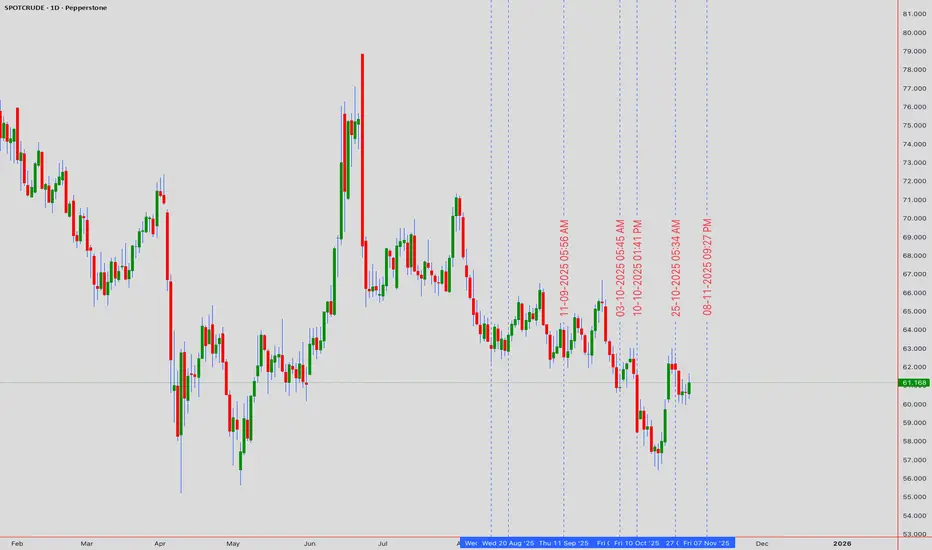
Crude Oil's Critical Breakdown: Is a Plunge to $58 Imminent?Hello, TradingView community! 👋 SpotCrude (WTI) has taken a significant turn, closing the week at a precarious 61.168 . After failing to sustain its recent rally, oil is now teetering on the edge of a major support level. Is this the beginning of a new downtrend, or will buyers step in to defend the line? The upcoming week, November 3rd to 7th, will be decisive.
Let's drill down into the multi-timeframe data, blending classic technical theories with key indicators to forge a robust trading strategy for the days ahead. 💡
🌍 The Macro Outlook: Weekly & Daily Charts - The Bears Are Back in Town
The market is a battlefield, and the trend is your strongest ally.
The higher timeframes are flashing significant warning signals, suggesting the recent strength was merely a correction in a larger downtrend.
Weekly Chart (1W) : The long-term picture remains bearish. As per Dow Theory , the primary trend is down, with the recent push higher failing at a key resistance zone. The price is firmly below the Ichimoku Cloud, and the formation of a Bearish Engulfing candle last week is a powerful rejection signal.
Daily Chart (1D) : On the daily chart, the story of failure becomes clearer. We have a potential Double Top formation right at a major resistance level. The RSI is exhibiting a clear bearish divergence where price made a higher high, but the RSI failed to confirm, indicating weakening momentum. The price has been decisively rejected and is now threatening to break down from this topping pattern.
⚔️ The Swing Trader's Battleground: 4-Hour & 1-Hour Analysis
For swing traders, a classic and powerful reversal pattern has taken center stage.
4-Hour Chart (4H) : This timeframe is the most critical. A clear Head and Shoulders pattern has formed, and crucially, the price has already broken below the neckline . This is a textbook bearish reversal signal. The Bollinger Bands are expanding, pointing to an injection of downside volatility . From a Wyckoff Theory standpoint, this breakdown represents a "Sign of Weakness" (SOW) following a distribution phase at the highs.
1-Hour Chart (1H) : The hourly chart confirms the breakdown with conviction. Price is trading well below the VWAP and the Ichimoku Cloud, both of which are now acting as overhead resistance. Any attempt to rally back to the broken neckline (around the 62.00-62.20 area) is likely to be met with significant selling pressure.
🔬 The Intraday Scalpel: 30M, 15M, & 5M Insights
For intraday traders, the path of least resistance is clearly down.
30M/15M Charts : These timeframes are displaying a strong, impulsive downtrend. Following the initial breakdown, we are seeing the formation of a Bearish Pennant or flag. This typically represents a brief pause as sellers reload for the next push lower. The RSI is hovering near oversold levels, so a minor bounce is possible, but this is likely a selling opportunity, not a reversal.
5M Chart : On the 5-minute chart, the VWAP is the key level to watch. As long as the price remains below it, bears are in full control. Scalpers should be wary of any sudden spikes upward, as they could be a bear trap designed to lure in buyers before the next decline. Watch for volume to increase on down moves as confirmation of the bearish intent.
⏳ Gann Theory & Price/Time Analysis
Applying the principles of W.D. Gann, the rejection occurred at a key Gann resistance angle. The price has now broken below a key support angle, suggesting an acceleration of the downtrend. Gann's range analysis points to the $58.00 - $58.50 area as the next major price magnet to the downside.
🎯 Actionable Trade Plan for the Week Ahead
Based on this comprehensive analysis, the bearish case is overwhelmingly strong.
The Primary Bearish Scenario 🐻
Entry: The ideal entry is to short a pullback to the broken Head and Shoulders neckline, targeting the 62.00 - 62.20 resistance zone. An alternative entry is to short the breakdown of the current bearish pennant, below 61.00 .
Targets: The first target is the psychological 60.00 level. The main target, derived from the Head and Shoulders pattern measurement, is the major support zone at 58.50 .
Invalidation: A strong and sustained 4H candle close back above the right shoulder of the pattern, specifically above 63.00 , would negate the immediate bearish thesis.
The Low-Probability Bullish Scenario 🐂
Entry: This is a counter-trend trade and is not recommended. It would require an exceptionally strong reclaim of the 62.50 level, effectively invalidating the entire Head and Shoulders pattern.
Targets: Resistance at 63.50 and 64.50 .
Invalidation: Any drop back below 62.00 .
Conclusion: The Evidence Points Down
The technical picture for Crude Oil is decidedly bearish. With a confirmed Head and Shoulders breakdown on the 4H chart, supported by weakness on both higher and lower timeframes, the path of least resistance is to the downside.
This week, the strategy is to sell the rallies . Be patient and wait for a high-probability entry near established resistance.
What are your thoughts on oil? Are you positioning for a further drop, or do you see a reversal in the cards? Share your analysis in the comments below! 👇
Disclaimer: This is not financial advice. This analysis is for educational purposes only. Always conduct your own research and manage your risk appropriately.
WTI OIL 1D MA50 rejection. Sell Signal.Last time (October 14, see chart below) we took a look on WTI Oil (USOIL), we gave a Buy Signal right at the bottom of its 3-month Channel Down, which eventually hit our 62.00 Target:
This time we have a Sell Signal as the price and the Channel's Bullish Leg got rejected on its 1D MA50 (blue trend-line). When that happened in September, the market started to decline and reached its lower Support.
As a result, we expect Oil to turn bearish here, targeting $56.00.
-------------------------------------------------------------------------------
** Please LIKE 👍, FOLLOW ✅, SHARE 🙌 and COMMENT ✍ if you enjoy this idea! Also share your ideas and charts in the comments section below! This is best way to keep it relevant, support us, keep the content here free and allow the idea to reach as many people as possible. **
-------------------------------------------------------------------------------
💸💸💸💸💸💸
👇 👇 👇 👇 👇 👇