Falling towards pullback support?DAX40 (DE40) is pulling back toward the pivot, which is acting as a key support. This level aligns with the 38.2% Fibonacci retracement, and price could potentially bounce toward the first resistance.
Pivot: 23,877.01
1st Support: 23,646.41
1st Resistance: 24,219.38
Disclaimer:
The opinions given above constitute general market commentary and do not constitute the opinion or advice of IC Markets or any form of personal or investment advice.
Any opinions, news, research, analyses, prices, other information, or links to third-party sites contained on this website are provided on an "as-is" basis, are intended to be informative only, and are not advice, a recommendation, research, a record of our trading prices, an offer of, or solicitation for, a transaction in any financial instrument and thus should not be treated as such. The information provided does not involve any specific investment objectives, financial situation, or needs of any specific person who may receive it. Please be aware that past performance is not a reliable indicator of future performance and/or results. Past performance or forward-looking scenarios based upon the reasonable beliefs of the third-party provider are not a guarantee of future performance. Actual results may differ materially from those anticipated in forward-looking or past performance statements. IC Markets makes no representation or warranty and assumes no liability as to the accuracy or completeness of the information provided, nor any loss arising from any investment based on a recommendation, forecast, or any information supplied by any third party
Market indices
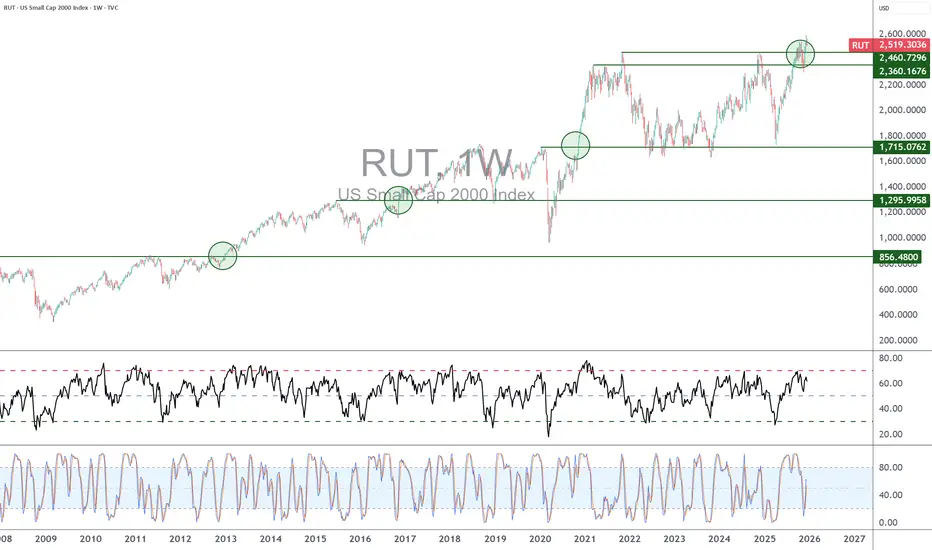
Monetary Liquidity: the Russell 2000 on the Front LineThe Russell 2000 is a U.S. stock market index that includes approximately 2,000 small-cap companies listed in the United States. Unlike the S&P 500 or the Nasdaq, which are largely dominated by large multinational corporations with significant international exposure, the Russell 2000 primarily reflects the domestic U.S. economic dynamics of small and mid-sized companies. The firms that make up the index are generally younger, more leveraged, and more dependent on financing conditions than large-cap companies. They derive most of their revenues from the domestic market and are therefore particularly sensitive to changes in U.S. growth, consumer demand, and the cost of credit. For this reason, the Russell 2000 is often regarded as a leading barometer of the U.S. economic cycle and of risk appetite in financial markets.
This index is also one of the most sensitive to monetary liquidity conditions, both current and anticipated. Periods of declining policy rates and accommodative monetary policies—particularly quantitative easing (QE) programs—have historically been favorable for it. When the Federal Reserve eases policy, the cost of capital declines, refinancing conditions improve, and access to credit becomes more fluid for small and mid-sized businesses. In this context, the Fed’s recent decision to lower the federal funds rate to 3.75%, combined with the announcement of a so-called “technical” QE, represents a strong signal for assets that are most dependent on liquidity. By its very structure, the Russell 2000 acts as an amplifier of these monetary regime shifts: when liquidity returns or when markets begin to anticipate it, the index tends to outperform large-cap benchmarks.
From a technical perspective, a bullish continuation signal has just been triggered on the weekly time frame. The index has broken above its former all-time high, set at the end of 2021, a level that had acted as a major resistance for more than four years. This breakout fits within a clearly identifiable long-term uptrend structure, characterized by a succession of higher lows and higher highs. Clearing this key zone confirms an upside exit from a broad consolidation phase and turns the former high into a potential new support level. From a chartist standpoint, such a breakout above a historical high is a classic trend-continuation signal, made even more relevant by a monetary environment that has become more accommodative again. As long as the index holds above this threshold, the underlying trend remains bullish, with further upside potential supported by both technical factors and global liquidity. Caution is still warranted, however, as corrective phases can always occur in the short term.
DISCLAIMER:
This content is intended for individuals who are familiar with financial markets and instruments and is for information purposes only. The presented idea (including market commentary, market data and observations) is not a work product of any research department of Swissquote or its affiliates. This material is intended to highlight market action and does not constitute investment, legal or tax advice. If you are a retail investor or lack experience in trading complex financial products, it is advisable to seek professional advice from licensed advisor before making any financial decisions.
This content is not intended to manipulate the market or encourage any specific financial behavior.
Swissquote makes no representation or warranty as to the quality, completeness, accuracy, comprehensiveness or non-infringement of such content. The views expressed are those of the consultant and are provided for educational purposes only. Any information provided relating to a product or market should not be construed as recommending an investment strategy or transaction. Past performance is not a guarantee of future results.
Swissquote and its employees and representatives shall in no event be held liable for any damages or losses arising directly or indirectly from decisions made on the basis of this content.
The use of any third-party brands or trademarks is for information only and does not imply endorsement by Swissquote, or that the trademark owner has authorised Swissquote to promote its products or services.
Swissquote is the marketing brand for the activities of Swissquote Bank Ltd (Switzerland) regulated by FINMA, Swissquote Capital Markets Limited regulated by CySEC (Cyprus), Swissquote Bank Europe SA (Luxembourg) regulated by the CSSF, Swissquote Ltd (UK) regulated by the FCA, Swissquote Financial Services (Malta) Ltd regulated by the Malta Financial Services Authority, Swissquote MEA Ltd. (UAE) regulated by the Dubai Financial Services Authority, Swissquote Pte Ltd (Singapore) regulated by the Monetary Authority of Singapore, Swissquote Asia Limited (Hong Kong) licensed by the Hong Kong Securities and Futures Commission (SFC) and Swissquote South Africa (Pty) Ltd supervised by the FSCA.
Products and services of Swissquote are only intended for those permitted to receive them under local law.
All investments carry a degree of risk. The risk of loss in trading or holding financial instruments can be substantial. The value of financial instruments, including but not limited to stocks, bonds, cryptocurrencies, and other assets, can fluctuate both upwards and downwards. There is a significant risk of financial loss when buying, selling, holding, staking, or investing in these instruments. SQBE makes no recommendations regarding any specific investment, transaction, or the use of any particular investment strategy.
CFDs are complex instruments and come with a high risk of losing money rapidly due to leverage. The vast majority of retail client accounts suffer capital losses when trading in CFDs. You should consider whether you understand how CFDs work and whether you can afford to take the high risk of losing your money.
Digital Assets are unregulated in most countries and consumer protection rules may not apply. As highly volatile speculative investments, Digital Assets are not suitable for investors without a high-risk tolerance. Make sure you understand each Digital Asset before you trade.
Cryptocurrencies are not considered legal tender in some jurisdictions and are subject to regulatory uncertainties.
The use of Internet-based systems can involve high risks, including, but not limited to, fraud, cyber-attacks, network and communication failures, as well as identity theft and phishing attacks related to crypto-assets.
NIFTY Technical Analysis (Educational Purpose Only)📌Not a SEBI Registered Research Analyst – For educational/chart discussion only
Nifty Rounding Top chart pattern in hourly timeframe
NIFTY is facing strong resistance near ~26,200, where price has struggled to stay above. Recent price action shows a rounding top-like pattern forming at this key resistance zone.
Support Levels:
• Immediate support is at 25,750 – 25,700 where price has bounced multiple times.
• This zone is important: a clean break below it signals increased downside pressure.
Momentum (RSI & Candles):
• RSI shows weak momentum near highs and is not making strong new highs even as price hits resistance – indicating loss of upside strength.
• Near resistance, bearish/weak candles with upper wicks suggest supply outweighs demand.
Pattern Interpretation:
• A rounding top suggests a slow shift from buyers to sellers near the 26,200 zone.
• If price breaks below 25,750–25,700, this pattern becomes more valid and may lead to further downside.
• Using the pattern measurement rule, the target on breakdown could be around 25,000 area. (Educational projection)
Key Levels:
📍 **Resistance: ~26,200
📍 Support: 25,750–25,700
📍 Pattern Target (if support breaks): ~25,000
What to Watch Next:
✔ Break & close below 25,750–25,700 — increases probability of lower continuation.
✔ Strong hold above 25,700 — keeps the structure undecided and may lead to range or reversal if momentum improves.
📌 Summary (Simple):
NIFTY is forming a rounding top around **26,200 resistance**. Support at **25,750–25,700** is crucial. Due to weak momentum and supply near resistance, breaking below this support may push price toward **~25,000**. This is an **educational technical analysis**, not a buy/sell recommendation.
How To Judge First Candle Of Nifty 50This video explains how to judge the first candle of the Nifty 50 index by observing price behavior at the market open. The discussion focuses on how the opening candle reflects early participation, directional intent, and momentum, and how its bullish or bearish nature can be interpreted using basic price action logic.
The objective of this video is to help build understanding around opening-session behavior and candle structure from an educational perspective, without offering any trading or investment recommendations.
Dollar I Weekly CLS I Model 1 - Pullback to 98.500Hi friends, new range created. As always we are looking for the manipulation in to the key level around the range. Don't forget confirmation switch from manipulation phase to the distribution phase to make the setup valid. Stay patient and enter only after change in order flow. If price reaches 50% of the range take partial or full close.
👊 Your ultimate goal as a trader is not to be a generalist who knows 10 000 patterns. But rather create one system with narrowed criteria of each element of the trade to remove subjective and emotional decisions as much as possible and stick to this system no matter what. Practice it 10 000 times become a MASTER.
I promised myself I’d become the person I once needed the most as a beginner. Below are links to a powerful lessons I shared on Tradingview. Hope it can help you avoid years of trial and error I went thru.
📊 Sharpen your trading Strategy
⚙️ 100% Mechanical System - Complete Strategy
🔁 Daily Bias – Continuation
🔄 Daily Bias – Reversal
🧱 Key Level – Order Block
📉 How to Buy Lows and Sell Highs
🎯 Dealing Range – Enter on pullbacks
💧 Liquidity – Basics to understand
🕒 Timeframe Alignments
🚫 Market Narratives – Avoid traps
🐢 Turtle Soup Master – High reward method
🧘 How to stop overcomplicating trading
🕰️ Day Trading Cheat Code – Sessions
🇬🇧 London Session Trading
🔍 SMT Divergence – Secret Smart Money signal
📐 Standard Deviations – Predict future targets
🎣 Stop Hunt Trading
🧠 Level Up your Mindset
🛕 Monk Mode – Transition from 9–5 to full-time trading
⚠️ Trading Enemies – Habits that destroy success
🔄 Trader’s Routine – Build discipline daily
💪 Get Funded - $20 000 Monthly Plan
🛡️ Risk Management
🏦 Risk Management for Prop Trading
📏 Risk in % or Fixed Position Size
🔐 Risk Per Trade – Keep consistency
Never stop learning
David Perk
NIFTY S/R for 17/12/25santhosh
Support and Resistance Levels:
Support Levels: These are price points (green line/shade) where a downward trend may be halted due to a concentration of buying interest. Imagine them as a safety net where buyers step in, preventing further decline.
Resistance Levels: Conversely, resistance levels (red line/shade) are where upward trends might stall due to increased selling interest. They act like a ceiling where sellers come in to push prices down.
Breakouts:
Bullish Breakout: When the price moves above resistance, it often indicates strong buying interest and the potential for a continued uptrend. Traders may view this as a signal to buy or hold.
Bearish Breakout: When the price falls below support, it can signal strong selling interest and the potential for a continued downtrend. Traders might see this as a cue to sell or avoid buying.
MA Ribbon (EMA 20, EMA 50, EMA 100, EMA 200) :
Above EMA: If the stock price is above the EMA, it suggests a potential uptrend or bullish momentum.
Below EMA: If the stock price is below the EMA, it indicates a potential downtrend or bearish momentum.
Trendline: A trendline is a straight line drawn on a chart to represent the general direction of a data point set.
Uptrend Line: Drawn by connecting the lows in an upward trend. Indicates that the price is moving higher over time. Acts as a support level, where prices tend to bounce upward.
Downtrend Line: Drawn by connecting the highs in a downward trend. Indicates that the price is moving lower over time. It acts as a resistance level, where prices tend to drop.
Disclaimer:
I am not SEBI registered. The information provided here is for learning purposes only and should not be interpreted as financial advice. Consider the broader market context and consult with a qualified financial advisor before making investment decisions.
#Banknifty directions and levels for December 17th:What to expect today?
Current view:
> If the market opens with a decline and holds it, we can expect further continuation with some consolidation. Both price structure and OI data support this sentiment.
Alternate view:
> If the market opens with a gap-up or takes a solid pullback at either of the immediate support levels, it could experience a minimum 38% pullback. However, until it breaks above the 38% level, the market bias remains bearish. If it does break, we can expect a move to the top of the range in the upcoming session.
#Nifty directions and levels for December 17th:Good morning, friends! 🌞
Market directions and levels for December 17th:
> No major changes occurred in global or Indian markets overnight. The Dow Jones shows bullish sentiment, while the Indian market indicates a moderately bullish outlook.
> Today, the GIFT Nifty is expected to open with a neutral start.
What to expect today?
Current view:
> If the market opens with a decline and holds it, we can expect further continuation with some consolidation. Both price structure and OI data support this sentiment.
Alternate view:
> If the market opens with a gap-up or takes a solid pullback at either of the immediate support levels, it could experience a minimum 38% pullback. However, until it breaks above the 38% level, the market bias remains bearish. If it does break, we can expect a move to the top of the range in the upcoming session.
DAX30/GER30 - SETTING UP A TRADETeam, we been very successful trading DAX in the past and many successful trade
the current price at 24130, we are not going to suicide at this entry level
We wait for a set up entry at 24000-23960 rangs,
STOP LOSS at 23860
Target 1 at 24085-96
Target 2 at 24115-24150
Target 3 at 24180-24280
Lets be patience to see if our entry price hit, do NOT rush into a trade.
keep an eye on it today once the DAX market open, half an hour after real market open!
LETS GO
US100 Free Signal! Sell!
Hello,Traders!
US100 taps into a well-defined horizontal supply zone after a strong bearish displacement, confirming smart money distribution. Price failed to reclaim the supply cluster and is now respecting bearish order flow, with downside liquidity resting below recent lows.
--------------------
Stop Loss: 25,283
Take Profit: 24,891
Entry: 25,123
Time Frame: 4H
--------------------
Sell!
Comment and subscribe to help us grow!
Check out other forecasts below too!
Disclosure: I am part of Trade Nation's Influencer program and receive a monthly fee for using their TradingView charts in my analysis.
Battle of the trendsThis short term action today, appears to me to be the battle over whether to break the orange trend line, or brake out up to the blue (At least).
Im generally long term short, as per my previously published idea. I think this thing is going to 16-12k maybe in the next year. But keeping an eye on short term rallies to look where to increase or decrease position size.
USNAS100 Price Update Clean Clear ExplanationUS100 on the 1-hour timeframe, highlighting a shift in market structure from bullish to bearish Price was previously moving within an ascending channel, respecting higher highs and higher low a strong bearish breakdown occurred, with price decisively breaking below the rising trendline, indicating a loss of bullish momentum the sharp sell-off suggests institutional distribution and a potential trend reversal.
Resistance Zone (≈ 25,400 – 25,580)
Immediate Support (≈ 25,150 – 25,200)
These are marked demand/support areas and are likely downside targets if bearish momentum continues we could see support 24,900 to 24,700
The projected arrows indicate a possible retracement toward resistance, followed by continuation to the downside as long as price remains below the broken trendline and resistance zone, the bearish bias remains valid buyers appear weak, while sellers maintain control.
If you find it helpful please like and comments for this post and share thanks.
SPX500 RaceSupport levels from pivot points and multiple moving averages create a technical base that reduces downside risk in the short term.
Volume remains steady, which confirms the reliability of the ongoing trend.
These combined technical factors typically precede price appreciation in the Nasdaq 100 , suggesting the index will likely continue to Declines hortly based on trend-following and momentum-based trading strategies with limited immediate overbought risk.
NAS100 ChoppySupport levels from pivot points and multiple moving averages create a technical base that reduces downside risk in the short term.
Volume remains steady, which confirms the reliability of the ongoing trend.
These combined technical factors typically precede price appreciation in the Nasdaq 100 , suggesting the index will likely continue to Declines hortly based on trend-following and momentum-based trading strategies with limited immediate overbought risk.