• Products
  • Community
  • Markets
  • More
Get started
  • Markets
  • /Mainland China
  • /Stocks
  • /Ideas
Shanghai Bailian (Group) Co., Ltd. Shanghai Bailian (Group) Co., Ltd. (SBG) is China’s largest state-owned commercial retail and distribution conglomerate. Its business model is a diversified conglomerate that spans multiple retail formats and complementary businesses. These include department stores (e.g., Shanghai First Yaohan, Wing On Department Store), shopping malls, outlet centers, modern logistics, asset management, real estate, supermarkets (Lianhua Supermarket, Century Lianhua), and e-commerce platforms. To maintain its dominance, especially in the highly competitive hypermarket and supermarket sector, Bailian has used acquisitions as a key growth lever. Major acquisitions over the past decade include the purchase of Jiajiayue in 2015 and Yonghui Superstores, moves that significantly strengthened its market presence. These consolidation efforts enabled Bailian to account for approximately 10% of China’s total retail supermarket market by the end of 2022. The company formally launched its digital transformation initiative in 2020 to enhance its e-commerce capabilities. The most significant milestone in this journey was the strategic alliance announced with Alibaba Group in February 2017. This partnership aimed to advance the “New Retail” concept by integrating Bailian’s vast physical store network (4,700 stores across 200 cities) with Alibaba’s digital ecosystem for the first time. Bailian is currently making capital-intensive investments in the luxury and experiential segments. In 2024, it announced plans to open Asia’s largest outlet mall in Shanghai. This investment seeks to capitalize on China’s outlet market, which generated annual sales of approximately 239 billion yuan in 2024, with year-on-year growth of 4%. By focusing on large-format, high-margin physical assets, Bailian aims to capture greater value from premium and experiential consumption. The opening of Asia’s largest outlet (over 200,000 m² of built area, connecting Phase 1 — which has been open since 2006 — via pedestrian and vehicular bridges) is scheduled for 2026.
SSE:600827Long
by OldWave96
Bright Dairy & Food (Group) Co. LtdThe price is showing accumulation on strong support with the presence of high volume, which indicates the involvement of large institutional investors. This Chinese company produces and distributes dairy products and processed foods, and it is perfectly aligned with the context of a likely rally in the Yili-Mengniu dairy duopoly, which is a very positive signal. It’s as if the big players are gearing up for an upward move.
SSE:600597Long
by OldWave96
YiliThe scale of Yili and Mengniu gives them superior access to capital markets with significantly lower financing costs. In addition, their purchasing volume enables them to negotiate preferential prices for key inputs such as livestock feed. This lower cost structure means that the duopoly’s breakeven point is far below that of their competitors, ensuring that—even in an environment of historically low prices—they can withstand the pressure and continue operating profitably while small and medium-sized enterprises (SMEs) become insolvent. Following the 2008 melamine-tainted milk scandal, the Chinese state imposed regulations that dramatically raised operating costs for small and medium-sized companies. Consequently, the current collapse of SMEs due to low prices is the economic manifestation of a long-standing political objective: the elimination of marginal players and the concentration of the market in the hands of large companies capable of guaranteeing quality, control, and supply at scale.
SSE:600887Long
by OldWave96
deflationDeflation is a massive transfer of wealth from debtors to creditors.
SSE:601398
by NASA_gov
How MNCs Influence Global Trade Patterns1. Understanding Multinational Corporations (MNCs) A multinational corporation is a company that owns or controls production, distribution, or service facilities in more than one country. Examples include Apple, Toyota, Unilever, and Tata Group. These corporations operate with a global strategy — sourcing materials where they are cheapest, producing goods where labor is most efficient, and selling in markets that offer the best demand. Unlike domestic firms that focus solely on their home markets, MNCs operate with a worldwide perspective, blending international business practices with local adaptation. This gives them a competitive edge and allows them to significantly impact global trade dynamics. 2. MNCs as Drivers of International Trade MNCs are the backbone of global trade. They account for a large portion of world exports and imports. According to global trade estimates, nearly two-thirds of international trade occurs within multinational networks — either between parent companies and their subsidiaries or among affiliates of the same corporate group. By setting up production units across borders, MNCs effectively convert domestic production processes into international trade. For example, when Apple designs iPhones in the U.S., manufactures components in South Korea and China, and sells them worldwide, it creates multiple layers of trade transactions across countries. This production and supply chain integration magnifies global trade volumes and diversifies trade routes. 3. The Role of Foreign Direct Investment (FDI) Foreign Direct Investment (FDI) is one of the primary ways MNCs influence trade patterns. Through FDI, MNCs invest in foreign markets to establish subsidiaries, acquire local firms, or build production facilities. These investments promote trade in two ways: Export-Oriented Investment: MNCs set up production bases in developing countries to manufacture goods for export, thus increasing the host country’s export capacity. Import-Substituting Investment: They also establish local operations to produce goods that were previously imported, reducing a country’s dependency on foreign goods. For instance, automobile giants like Hyundai or Suzuki have established plants in India, not only to serve domestic markets but also to export vehicles to other regions. This has reshaped India’s position in the global automotive trade network. 4. Integration of Global Value Chains (GVCs) One of the most significant contributions of MNCs to global trade is the creation of Global Value Chains (GVCs) — systems where production is fragmented across multiple countries. Each country participates in a specific stage of production based on its comparative advantage. For example: Raw materials are sourced from Africa. Components are manufactured in China. Assembly happens in Vietnam. Products are marketed and sold in Europe and North America. This interconnected production model has increased trade in intermediate goods (parts and components) and services (like logistics and IT support). The rise of GVCs means that the trade between countries today is not just about finished goods but also about value-added processes at each stage of production. 5. Technology Transfer and Innovation Diffusion MNCs play a vital role in transferring technology and innovation across borders. When a multinational sets up a subsidiary in a developing country, it often brings with it advanced technologies, managerial expertise, and global best practices. This leads to productivity improvements in the host economy and helps integrate it into the global trade system. For example, when semiconductor companies like Intel or TSMC establish units in emerging markets, they introduce sophisticated manufacturing methods. Over time, local firms adopt these innovations, raising the overall technological capacity and enhancing the country’s trade competitiveness. 6. Shaping Trade Policies and Economic Diplomacy Due to their economic power, MNCs often influence trade and investment policies in both home and host countries. They lobby for favorable regulations, tariff reductions, and improved trade infrastructure. Their global reach gives them leverage in shaping bilateral and multilateral trade agreements. For example, major technology firms like Google, Microsoft, and Amazon often advocate for data transfer and digital trade rules that benefit cross-border e-commerce and cloud services. Similarly, manufacturing giants push for lower tariffs and better intellectual property protections to facilitate smooth global operations. 7. Labor and Resource Allocation Across Borders MNCs influence global labor and resource allocation by situating different functions in regions that offer maximum efficiency. They often: Establish manufacturing in low-cost labor regions (like Southeast Asia). Maintain R&D and management centers in high-skill economies (like the U.S. or Germany). Source raw materials from resource-rich regions (like Africa or Latin America). This distribution of work leads to economic specialization, where countries develop industries aligned with their strengths. While it fosters global interdependence, it can also create vulnerabilities — for example, over-reliance on certain regions for critical components (as seen during the COVID-19 supply chain crisis). 8. Impact on Emerging and Developing Economies For developing nations, MNCs can be both a blessing and a challenge. Positive impacts include: Job creation and skill development. Improved infrastructure and export potential. Access to global markets and technologies. However, challenges arise when MNCs dominate local markets, repatriate profits instead of reinvesting locally, or exploit labor and natural resources. Policymakers in developing countries must therefore balance attracting foreign investment with protecting domestic economic interests. 9. MNCs and Trade in Services Traditionally, international trade was dominated by goods. Today, MNCs have expanded trade in services, including finance, telecommunications, logistics, and IT. For example, companies like Accenture, Infosys, and Amazon Web Services operate globally, exporting knowledge-based and digital services that are less constrained by geography. This shift from goods to services trade has diversified global commerce and allowed developing economies with strong human capital to integrate into the global economy more effectively. 10. Environmental and Ethical Dimensions Global trade expansion through MNCs has also raised environmental and ethical concerns. Large-scale production across multiple countries often leads to resource depletion, pollution, and carbon emissions. Additionally, differences in labor laws between nations can lead to exploitation. In response, many MNCs have adopted sustainability frameworks and ESG (Environmental, Social, and Governance) principles. For example, companies like Unilever and Tesla have integrated eco-friendly practices into their global supply chains. Consumers and investors now reward corporations that demonstrate responsible global trade behavior. 11. The Future of MNCs in Global Trade The next phase of MNC-driven trade will be shaped by digital transformation, geopolitical shifts, and supply chain resilience. Digitalization will enable even small businesses to join global markets through e-commerce and AI-driven logistics. Geopolitical tensions (like U.S.-China decoupling) may lead MNCs to diversify their supply chains to new regions such as India, Vietnam, or Mexico. Sustainability pressures will push MNCs to adopt greener trade practices. MNCs that adapt to these trends will continue to dominate international trade, while countries that align their policies with these shifts will benefit the most. Conclusion Multinational corporations are not just participants in global trade — they are architects of it. Their global operations integrate economies, influence policy, and determine the direction of international commerce. From creating global value chains to driving technological progress, MNCs have fundamentally reshaped how the world trades. However, their influence also comes with responsibilities — to ensure fair competition, ethical labor practices, and sustainable development. As globalization evolves, MNCs will remain central to the world economy, continuously redefining global trade patterns in an increasingly interconnected world.
SZSE:002594Education
by GlobalWolfStreet
Types of Trading in the World Market1. Equity Trading (Stock Market Trading) Overview Equity trading refers to buying and selling shares of publicly listed companies. It’s one of the oldest and most popular forms of trading, conducted through stock exchanges like the New York Stock Exchange (NYSE), NASDAQ, London Stock Exchange (LSE), Tokyo Stock Exchange (TSE), and National Stock Exchange (NSE) in India. Types of Equity Trading Intraday Trading: Traders buy and sell shares within the same trading day, aiming to profit from short-term price movements. Positions are squared off before market close. Swing Trading: Traders hold stocks for a few days or weeks, capitalizing on short- to medium-term price swings based on technical indicators and market structure. Positional Trading: This involves holding positions for several months based on long-term trends, earnings growth, or macroeconomic shifts. Algorithmic & Quantitative Trading: Computer-driven strategies execute trades based on mathematical models, speed, and efficiency, minimizing human error. Why It Matters Equity trading reflects the health of corporate and economic growth. It helps companies raise capital, offers liquidity to investors, and provides traders with opportunities for profit through price fluctuations. 2. Derivatives Trading Overview Derivatives are financial contracts whose value is derived from an underlying asset, such as stocks, commodities, interest rates, currencies, or indices. Common derivative instruments include futures, options, swaps, and forwards. Main Types of Derivative Trading Futures Trading: Futures are standardized contracts to buy or sell an asset at a predetermined price on a future date. They are widely used for speculation and hedging — e.g., crude oil futures or Nifty futures. Options Trading: Options give traders the right but not the obligation to buy (call) or sell (put) an asset. This flexibility attracts both hedgers and speculators who seek leveraged exposure with limited risk. Swaps and Forwards: Forwards are over-the-counter (OTC) contracts with customizable terms. Swaps involve exchanging cash flows, such as interest rate swaps or currency swaps. Why It Matters Derivatives are vital for risk management and price discovery. For instance, airlines hedge against rising fuel costs using crude oil futures, while exporters hedge currency risks via forex options. 3. Commodity Trading Overview Commodities are tangible goods like gold, silver, crude oil, natural gas, wheat, or coffee. Commodity trading dates back centuries and today takes place on organized exchanges like the Chicago Mercantile Exchange (CME), London Metal Exchange (LME), and Multi Commodity Exchange (MCX) in India. Types of Commodity Trading Hard Commodities: These include natural resources extracted from the earth — metals (gold, silver, copper) and energy (crude oil, gas, coal). Soft Commodities: Agricultural products such as wheat, coffee, sugar, cotton, and soybeans fall under this category. Spot vs. Futures Market In the spot market, commodities are traded for immediate delivery. In the futures market, contracts are traded for future delivery at a pre-agreed price. Why It Matters Commodity markets serve as a barometer for global economic health. Prices of oil, gold, and agricultural goods affect inflation, currency values, and even geopolitical stability. 4. Foreign Exchange (Forex) Trading Overview The foreign exchange market (Forex or FX) is the world’s largest and most liquid financial market, with daily trading volumes exceeding $7 trillion. It involves trading currency pairs such as EUR/USD, USD/JPY, GBP/INR, and USD/INR. Types of Forex Trading Spot Forex: Currencies are exchanged instantly at the current market rate. Forward Forex: Agreements to buy/sell a currency at a future date at a fixed rate. Currency Futures and Options: Exchange-traded derivatives based on currency pairs. Carry Trade: Traders borrow in low-interest-rate currencies (e.g., JPY) and invest in higher-yielding currencies (e.g., AUD), profiting from the interest rate differential. Why It Matters Forex trading impacts global trade, tourism, and investment flows. Central banks, corporations, and investors use it to hedge currency exposure and speculate on macroeconomic trends. 5. Fixed Income (Bond) Trading Overview Bond trading involves buying and selling debt securities issued by governments, corporations, or financial institutions. Bonds provide fixed interest income and are considered relatively stable compared to equities. Types of Bonds Traded Government Bonds (Sovereign Debt): Issued by national governments (e.g., U.S. Treasuries, Indian G-Secs). Corporate Bonds: Issued by companies to raise capital. Municipal Bonds: Issued by local bodies for infrastructure projects. Bond Market Trading Styles Primary Market: New bonds are issued and sold directly to investors. Secondary Market: Existing bonds are traded among investors. Why It Matters Bond trading plays a crucial role in interest rate transmission, fiscal policy management, and capital market stability. Institutional investors often rely on bonds for predictable income and risk diversification. 6. Cryptocurrency Trading Overview A modern addition to global markets, cryptocurrency trading involves digital assets like Bitcoin (BTC), Ethereum (ETH), and Solana (SOL). These assets trade on decentralized exchanges (DEXs) and centralized platforms (like Binance, Coinbase, or WazirX). Forms of Crypto Trading Spot Trading: Direct buying/selling of cryptocurrencies for immediate settlement. Margin Trading: Borrowed funds are used to trade larger positions, amplifying potential gains (and losses). Futures & Options on Crypto: Derivative products for hedging or speculation based on future prices of digital assets. DeFi & Staking: Traders earn yields by locking assets in decentralized finance protocols. Why It Matters Crypto trading represents a new frontier of global finance — decentralized, transparent, and accessible 24/7. Despite volatility, it’s reshaping how traders and institutions view digital value and monetary systems. 7. Exchange-Traded Fund (ETF) Trading Overview ETFs are investment funds that track indices, commodities, or sectors and are traded like stocks. Examples include S&P 500 ETFs, Gold ETFs, and sectoral ETFs (like technology or healthcare). Types of ETF Trading Index ETFs: Track market indices such as NASDAQ-100 or Nifty 50. Commodity ETFs: Represent commodities like gold or oil. Bond ETFs: Mirror fixed income portfolios. Thematic/Leveraged ETFs: Focus on emerging themes like AI, clean energy, or innovation. Why It Matters ETFs combine diversification and liquidity, enabling traders to gain exposure to broad markets or specific themes with minimal effort and cost. 8. Index Trading Overview Instead of trading individual stocks, traders can trade indices that represent a group of stocks, such as S&P 500, Dow Jones, FTSE 100, Nikkei 225, or Nifty 50. Forms of Index Trading Index Futures: Contracts based on the future value of an index. Index Options: Options to speculate or hedge based on index movements. CFDs (Contracts for Difference): Instruments to speculate on index price changes without owning underlying stocks. Why It Matters Index trading reflects the broader market trend and is a key tool for institutional investors managing portfolios or hedging systemic risk. 9. Real Estate Investment Trust (REIT) Trading Overview REITs are companies that own and operate income-generating real estate — such as office buildings, malls, or warehouses. They are listed and traded like stocks. Types of REITs Equity REITs: Own properties and generate rental income. Mortgage REITs: Invest in real estate debt and earn interest income. Hybrid REITs: Combine both models. Why It Matters REIT trading provides investors access to the real estate market with liquidity and lower capital requirements compared to buying property directly. 10. Environmental and Carbon Credit Trading Overview A relatively new type of market, carbon trading involves the buying and selling of carbon credits, which represent the right to emit a certain amount of carbon dioxide. How It Works Companies with excess carbon allowances sell them to those exceeding emission limits. Platforms like the EU Emissions Trading System (EU ETS) facilitate this trade. Why It Matters Carbon trading incentivizes sustainability and helps nations meet global climate goals, linking environmental policy with financial markets. 11. Proprietary and Institutional Trading Overview Beyond retail participation, large financial institutions and hedge funds engage in proprietary trading (prop trading) — using their own capital to generate profits — and institutional trading, which involves massive volumes handled by fund managers. Key Strategies Arbitrage: Exploiting price differences across markets. High-Frequency Trading (HFT): Leveraging algorithms for microsecond trade execution. Market Making: Providing liquidity by quoting buy/sell prices. Why It Matters Institutional trading ensures liquidity and efficiency, while prop trading adds depth and innovation to global markets. 12. Over-the-Counter (OTC) Trading Overview OTC trading occurs directly between two parties, outside of formal exchanges. It’s common in currencies, bonds, derivatives, and unlisted equities. Why It Matters OTC markets offer flexibility and customization but carry higher counterparty risk due to the lack of centralized regulation. Conclusion: The Interconnected Trading Ecosystem The global trading landscape is a dynamic network where every segment — from equities to crypto — contributes to market efficiency and liquidity. Equity and ETF trading attract retail and institutional investors. Derivatives and Forex markets manage global risks and currency exposures. Commodity and carbon trading influence inflation and sustainability. Crypto and DeFi trading symbolize the digital transformation of finance. Ultimately, the types of trading in the world market form an integrated system that channels capital, manages risk, and reflects economic sentiment worldwide. The future of trading lies in data-driven strategies, AI automation, cross-border integration, and sustainable finance, all of which will redefine how participants interact in this ever-evolving global marketplace.
SZSE:002594Education
by GlobalWolfStreet
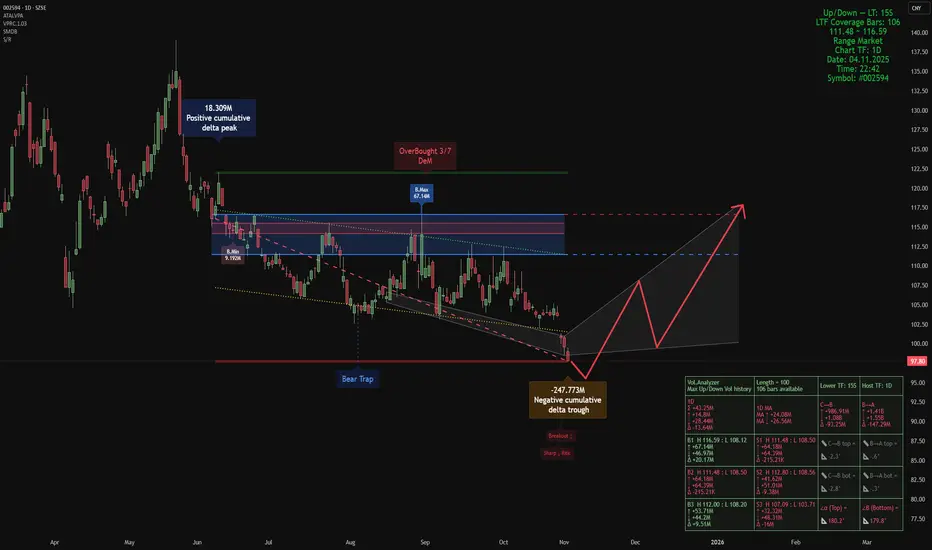
Smart Money Composite View — BYD Company Limited Class ASmart Money Composite View — #002594 (1D), BYD Company Limited Class A Indicators used: • Smart Money Support/Resistance • Smart Money Dynamics Blocks (Pearson Matrix) • ATAI •Volume Pressure Analyzer v1.2 — Pure Up/Down (Editorial Pick) We fuse these three into a single composite read. With offset = 48, the setup highlights where price sits relative to smart-money demand/supply, how liquidity is being absorbed, and where momentum can re-emerge. Market read (composite) • Price is trading below the 112–118 supply block, which currently acts as the dominant resistance. The failed attempts into this band and the overhead “OverBought” tag mark it as the active sell wall. • The current swing printed a large negative cumulative delta trough (~-247.8M) right at the lower reaction zone (bear-trap baseline + descending structure). That’s classic absorption of aggressive selling rather than fresh distribution. • Wing geometry is near-flat (α≈180° / β≈179.8°), signalling compression: momentum has bled off while liquidity rotates. This is typically the pause before a directional decision. • The grey path on the chart sketches the logical reaction sequence: a relief leg first into the mid-band (~108), where supply should be re-tested, and—only if absorption continues—an extension toward 112–118. Until price reclaims and holds above ~108, the structure remains a redistribution risk under that supply. Invalidation: A decisive close below the recent trough low (the bear-trap baseline on the chart) would negate the recovery sequence and opens lower prices. This analysis is a personal market view and is not investment advice.
SZSE:002594Long
by ata_sabanci
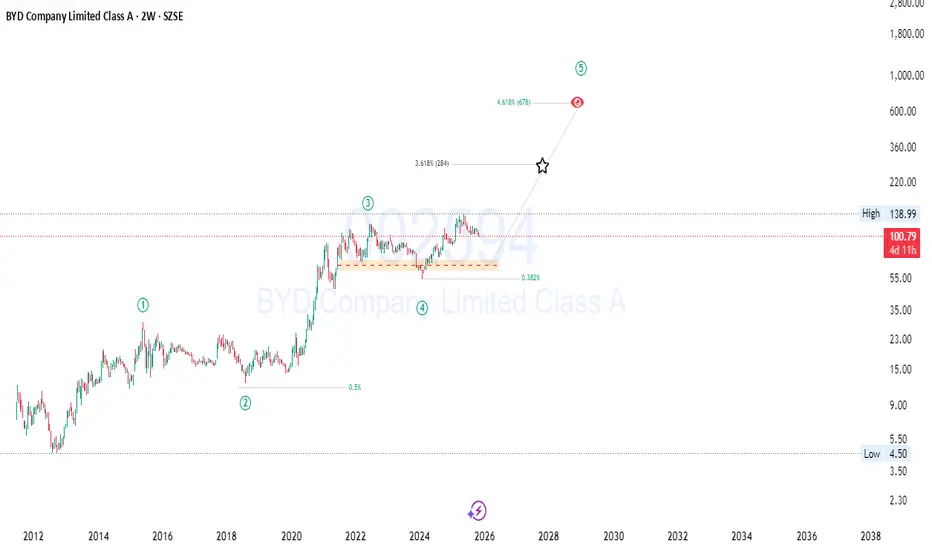
BYD : Smart Money Loading Before a Massive Wave 5 Breakout🚀 BYD Company Limited Class A (SZSE: 002594) — Wave 5 Expansion Setup Big structure, clean levels, and solid fundamentals… Wave 5 might surprise a lot of people 👇 BYD has been quietly building strength, and the chart now suggests that the next major bullish wave could be setting up. After a long consolidation phase (Wave 4), smart money appears to be accumulating again — a classic sign of preparation for the next impulsive move. A clean breakout above 138.99 would confirm Wave 5 , potentially targeting the 284–676 CNY zone based on Fibonacci extensions . With solid fundamentals, supportive market structure, and a strong Elliott Wave setup, BYD could be entering a new long-term expansion phase. ⚡ Follow for updates on Wave 5 development and smart money reactions in the breakout zone! 📊 #BYD #002594 #ElliottWave #SmartMoneyConcepts #Fibonacci #WaveAnalysis #MarketStructure #PriceAction #EVstocks #GrowthStocks #ChinaMarket #LongTermInvesting #SwingTrade #TechnicalAnalysis #StockMarket
SZSE:002594
by fibcos
3333
876.SZ | Long Setup | Oversold Agricultural Producer | Oct, 2025📌 000876.SZ | Long Setup | Oversold Agricultural Producer Near Structural Support | Oct 27, 2025 🔹 Thesis Summary New Hope Liuhe (000876.SZ) is showing signs of structural stabilization after a prolonged downtrend within a multi-year accumulation zone. With value metrics at historically low levels and upcoming Q3 earnings as a near-term volatility catalyst, the setup favors a mean-reversion play into 2026. 🔹 Trade Setup Bias: Long Entry Zone: ¥8.55 – ¥9.80 (Value Area Low + limit order block) Stop Loss: Below ¥6.80 (invalidates structural support) Take-Profits: TP1: ¥11.60 (first channel retest) TP2: ¥14.70 (volume node resistance) TP3: ¥18.10 (mid-cycle target) Max Target: ¥28.50 (golden-fib projection, 2029–2030 horizon) 🔹 Narrative & Context The chart structure reveals a long-term rising channel since 2011, punctuated by a 650% rally (2018–2020) followed by a 70% correction and multi-year base formation. Current price sits at the lower channel boundary, overlapping with the 2018 liquidation low, a zone historically associated with institutional accumulation. Volume profile shows a dense node near ¥9, confirming ongoing absorption. The “Value Area Low” around ¥8.5 – ¥9 is where limit orders cluster, indicating professional interest at discounted valuations. The upcoming Q3 2025 earnings (in 4 days) will be pivotal: EPS est. = ¥0.04, Revenue est. = ¥27.1 B. Even a mild beat could re-anchor sentiment given low expectations and sector normalization. 🔹 Valuation & Context P/E = 17.8x vs sector ≈ 15x → modest premium justified by strong cash flow recovery. P/CF = 4.15x → efficient cash generation, implying the market undervalues operational liquidity. P/S = 0.42x → deep discount to revenue, often seen near cyclical troughs. Tangible Book Value / Share = ¥5.16 → price trades near 1.9× book, historically a reversal zone. - Quality metrics remain supportive: - ROE ≈ 6–7% on depressed earnings, expected to improve with feed and livestock margin normalization. - Debt/Equity < 1, maintaining balance-sheet flexibility for reinvestment or buybacks. Plainly put, the stock is cheap on sales, fair on earnings, and rich in optionality if macro tailwinds lift agri-commodity margins into 2026. 🔹 Contrarian Angle (Your Edge) While consensus models price limited upside (~¥13–¥15), the combination of structural base, sector rotation back to staples, and valuation compression supports a path to ¥18–¥28 by 2030. Market fatigue and workforce reductions (-18% YoY) hint at late-cycle capitulation rather than secular decline. 🔹 Risks - Margin pressure from global feed-cost volatility - Policy shifts in China’s pork-supply stabilization - Execution risk amid cost-reduction cycle and labor downsizing 🔹 Macro Considerations Agri-commodities are stabilizing post-volatility, while CNY and DXY correlations suggest risk assets in China could rebound with easing conditions. Beta (1Y) = 0.98 implies moderate sensitivity to broader market flows. 🔹 Bottom Line New Hope Liuhe offers an asymmetric long setup near structural support with improving fundamentals and defined risk. Despite modest yield (0.25%) and subdued EPS growth, balance-sheet resilience and potential volume recovery justify accumulation within ¥8.5–¥9.8. For 2026 and beyond, sustained margin recovery could re-rate this name toward historical mid-channel valuations. Like & Follow for structured ideas, not signals. I post high-conviction setups here before broader narratives play out. Q & A Does the fundamental tell us that the stock is dying? The data suggest New Hope Liuhe is not dying , it’s resetting. The company is compressing through a profitability trough typical of agricultural commodity cycles, while maintaining cash flow, solvency, and large-scale operations. The market has priced it like a stagnant player, but its balance sheet and valuation ratios imply survivability with optional upside if feed prices normalize and consumer demand recovers into 2026. Do you think fundamentally it will make it? Short answer: Yes, fundamentally it can make it, provided margins normalize and execution stays disciplined. Nothing in the data screams “terminal decline. Would you invest in it right now? Short answer: yes, but only as a sized starter with defined risk given earnings in 4 days. ⚠️ Disclaimer: This is not financial advice. Always conduct your own research. Charts and visuals may include AI enhancements. 🔹 Footnote Forward P/E: Price ÷ expected earnings over next 12 months. Lower = cheaper relative to profits. P/FCF (Price-to-Free-Cash-Flow): Price vs. cash left after investments. Measures efficiency. FCF Yield: Free cash flow per share ÷ price per share. Higher = more cash for each dollar invested. ROE (Return on Equity): Net income ÷ shareholder equity. Shows management efficiency. ROIC (Return on Invested Capital): Net income ÷ (all invested capital). A purer profitability gauge. Debt/Equity: Debt ÷ equity. <1 = conservative balance sheet. R:R (Risk-to-Reward): Expected upside vs. downside. 3:1 = risk ¥1 to make ¥3.
SZSE:000876Long
by Risk_Adj_Return
300037.SZ: Unveiling Over 30% Undervaluation 300037.SZ: Unveiling Over 30% Undervaluation – SWOT and Intrinsic Value Deep Dive Introduction 📊 As of October 24, 2025, Shenzhen Capchem Technology Co., Ltd. (300037.SZ), a key player in electronic chemicals and battery materials, is positioned within a rebounding chemicals sector amid emerging market volatility and global energy shifts. Macroeconomic factors, such as China's economic stimulus boosting EV adoption and commodity stabilization, are driving renewed interest in battery supply chains. Sector dynamics include rising demand for lithium-ion electrolytes, with public data from recent filings showing quarterly revenue growth of 8.60% year-over-year, indicating resilience in a dip-driven market. This overview draws from verifiable metrics without endorsing any trading action. SWOT Analysis Strengths 💹 Shenzhen Capchem exhibits solid financial fundamentals, with EBITDA at 1.6B CNY and a profit margin of 11.87%, reflecting efficient operations in high-demand segments like battery electrolytes. The company's low debt-to-equity ratio of 26.22% supports stability, while revenue per share of 11.39 CNY underscores diversified product lines in functional materials. Quarterly earnings growth of 1.30% highlights consistent performance amid sector challenges. Weaknesses ⚠️ Elevated valuation metrics, such as a trailing P/E ratio of 39.84, may indicate sensitivity to market fluctuations and potential margin compression in competitive chemical markets. Return on assets at 4.13% suggests room for improved asset utilization, while levered free cash flow of 152.19M CNY reflects moderate liquidity in expansion phases. Opportunities 🚀 Undervalued indicators, including a forward P/E of 19.61 and price-to-book of 4.01, position the company for investor interest in EV growth. Analyst forecasts project 25.59% revenue growth to 9.85B CNY in 2025, driven by expanding battery and semiconductor markets, with EPS growth at 20.79%. Further upside from 43.67% EPS growth in 2026 amid global green energy transitions. Threats 🛑 Regulatory pressures in China's chemical industry, including environmental standards and trade tensions, could impact operations. Competition from global battery material suppliers and commodity price volatility pose risks to margins, while geopolitical factors may affect supply chains. Intrinsic Value Calculation 💰 Value investing involves estimating intrinsic value to identify assets trading below their fundamental worth, with a margin of safety for uncertainties. We apply: Intrinsic Value = (Book Value per Share × Weight) + (EPS × Growth Multiplier), using a book weight (e.g., 0.5) for asset emphasis and a higher multiplier (e.g., 40) to account for strong growth projections in the sector. Using recent data: Book Value per Share = 13.33 CNY, Forward EPS = 1.53 CNY. Assume a 25% growth rate from revenue forecasts, justifying the elevated multiplier for sustainability. Calculation: - Book component: 13.33 × 0.5 = 6.665 - Earnings component: 1.53 × 40 = 61.2 - Intrinsic Value ≈ 6.665 + 61.2 = 67.865 CNY Compared to the current price of 46.80 CNY, 300037.SZ appears undervalued by over 30%, providing a solid margin of safety (e.g., 30-50% discount for risks like low debt but market volatility). 📉 Debt flags are minimal at 26% D/E, with robust growth (43.67% EPS in 2026) supporting long-term sustainability if expansion continues. Annotate intrinsic value lines in green on the chart, with current price in red for visual comparison. Entry Strategy Insights 🔍 Institutional strategies often target bottom-extreme zones, such as oversold levels from historical supports, for unleveraged long-term positions. A dollar-cost averaging approach allows scaling in during dips. For 300037.SZ, observe zones near 52-week lows amid sector rebounds, focusing on fundamentals like revenue momentum over transient volatility. Risk Management ⚠️ Position sizing should be limited to 1-5% of portfolio to contain risks. Diversify across tech and materials sectors to offset China-specific exposures, with long-term holds tied to growth in EV materials. Track debt and cash flow in quarterly reports, establishing exit points for adverse regulatory or macro changes. Conclusion This analysis spotlights Shenzhen Capchem's operational strengths and growth opportunities, tempered by valuation and external risks, with intrinsic calculations indicating meaningful upside for value-oriented approaches. Always verify independently via latest filings and professional guidance.
SZSE:300037
by DCAChampion
Woof and Meow , a buying opportunity awaits the patient onesI expect the price to continue falling to the 72.95 price level - here I would be keen to take a LONG position in this market leader of Pet food in China. Unless over the next few weeks, I see a bullish sign at the 84.94 price level , I might nibble some to initiate a position. Please DYODD
SZSE:301498Long
by dchua1969
Wish you were a doggie or cat in your next life ? Read this article here , here and here The things that human can do for their pet dogs and cats are limited to one's imagination. With a higher and higher pet adoption rates, it is a matter of time that pet products and services will go more upscale, luxurious and niche as evidenced in these articles. I have shared before that this is a global trend of aging society, people are feeling way too stressed to commit to a relationship and if they do, they choose not to have kids. Substitute ? A lovely , adorable pet dog, cat, bunny, etc. The chart shows a strong support at 52.97 price level and the 2nd bullish bar breaking out of the bearish trend line is definitely more convincing than the first. To me, it is a no brainer type of stock to pick and this trend is going to last for many years to come. Long/accumulate
SZSE:002891Long
by dchua1969
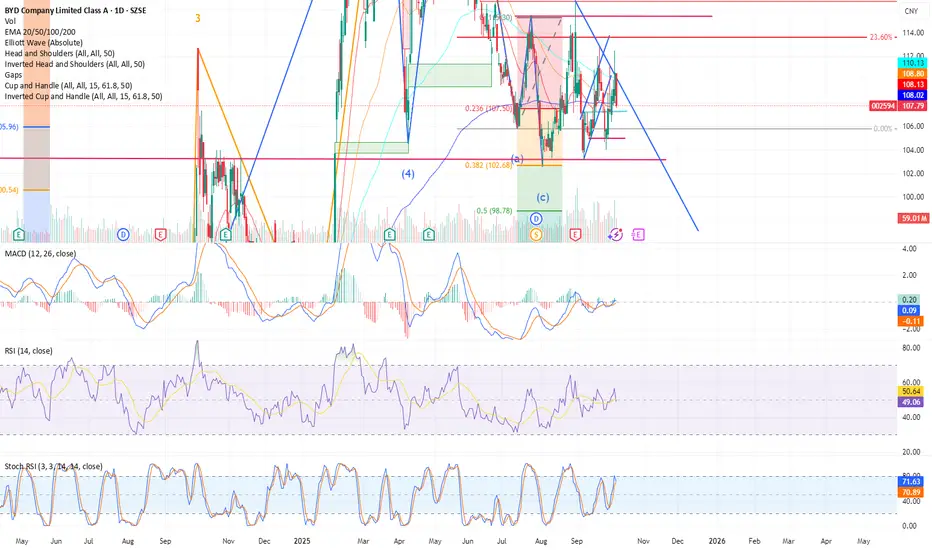
BYD Breakdown: Short-Term Pain, Long-Term Gain in ChinaSZSE:002594 (BYD) is currently in a corrective pattern, forming a small bearish triangle within a larger bearish triangle structure while completing Elliott Wave C. The stock has been supported by smaller support zones at 105 CNY, and once this level is broken, I expect a retest of support at 100-103 CNY. This level represents not only psychological support but also a support/resistance zone that has been tested multiple times historically. Once the 100-103 CNY level breaks, I expect BYD to drop to approximately 85 CNY. This decline could be sparked by several catalysts, such as the potential elimination of EV tax credits in the USA or a broader Chinese economic slowdown. However, I believe that in the long run, this stock represents a great value play. The Chinese government has clearly demonstrated its commitment to aggressively pushing the electric vehicle market. Combined with the apparent end of the brutal EV price wars in China—as I believe we have already seen the worst of them—this industry has significant upside potential for patient investors.
SZSE:002594Long
by Vasileios_Kairaktidis
Updated
CATL’s HK Debut IGNITES EV Revolution Tesla’s Secret Weapon?🔥 CATL’s HK Debut IGNITES EV Revolution Tesla’s Secret Weapon? BOOM! Chinese battery king CATL ($CATL.HK) just skyrocketed in its Hong Kong debut, defying Pentagon blacklists. Powering Tesla, VW, and Mercedes, it’s the EV supply chain’s 800-lb gorilla. Funds are pouring in for global domination miss this, and you’re sidelined! ⚡️ Pro Tip: EV stocks are heating up, but US-China tensions could crash the party. Watch NYSE:NIO , NASDAQ:LI too! 🚀 Share this if you’re bullish on EVs! What’s your top EV pick?
SZSE:300750Long
by DCAChampion
Updated
Let see if this play out as expected in this market cycle.This is the main PCB supplier for NV AI server board and the high end graphic cards. They started to make money and all of their capacity is indeed fully loaded with NV orders. Then the stock start respond to the EPS growth. They rapid capacity expansion in China, Thailand and Vietnam at the same time. China site build 6 stories building in record 3 months and machines being installed and already started running. Another building broke ground and expect to finish by Nov. 2018 when there's supply shock in passive components, the market went crazy and the stocks follow this pattern. Back then all the suppliers also expand capacity rapidly, and then it's followed by over supply. DRAM also has pretty much the same pattern. So let see if this is another typical case.
SZSE:300476
by warau
Do you have a pet at home ?For as long as I remembered, when I was a kid, we were always catching little chicks from the village and keep as pets. Later, I had tortoise, a white parrot, a myna , some other birds kept by my late dad, angel fish etc. All these cramped in a tiny 1 room flat ! Fast forward 5 decades later, we are seeing a resurgence of furry pets entering into modern human lives more and more. From Korea to China to Jarkarta, we see a growing trend of young couples getting married but not wanting to have kids. Instead, they opt for pets and this can range from furry ones like bunnies, hamsters, guinea pigs, cats and dogs to exotic ones like reptiles and some even keep ants. Times have changed....... These furry kids are now replacing human kids and I am of the opinion it will proliferate more and more as we witness the emergence of pet friendly cafes, parks for dogs, accessories sold online and in pet shops. The downside we are also seeing is abandonment by some of these paw parents who could not handle the stress of upkeeping these pets . Before, it was all canned food but now they are going for fresh foods even curated by some chefs. Wouldn't you want to be reincarnated as a cute doggie in your next life ? I first spotted this company i n late 2024 and nibbled some shares. Fast forward 6-7 months later, I am so lucky to be blessed with more than 200% returns on my investment. Mind you , this is not even a tech companies with AI patents ......... Read this latest article here and you would be convinced how deep the penetration these pets have on human. Of course, the more they spend , the higher prices these companies will be. What's next ?
SZSE:002891Long
by dchua1969
22
Muyan Foods price action reaching end of wedge.....Market is always full of surprises, just when you think it will nicely falls to the support level, the price action decides to take a different path. From the weekly chart, we can see it has move higher (18 Sep 24) and (17 Feb 25). Now, we are coming to the end of the wedge pattern. Well, it could breaks out nicely and continue to rally as I wished , haha OR it could disappoint your a little more by heading south to revisit the support line at 30.95 before moving sideways and eventually breaks out. I will be accumulating slowly on this counter (vested interest). Please DYODD
SZSE:002714Long
by dchua1969
CATL Perfect Triangle SetupCATL is looking more an more interesting right now. It's forming a perfect symmetrical triangle as we're speaking. We shall see more before entrying, but it's looking promising.
SZSE:300750Long
by MrSparkles69
China Vanke: Assessing the Investment Potential Company Overview China Vanke Co., Ltd. ( HKEX: 2202 ) is one of China's largest real estate developers, known for its diversified portfolio spanning residential, commercial, and mixed-use properties. Established in 1984, the company has expanded its presence beyond mainland China, with projects in Hong Kong, Southeast Asia, and even the U.S. Vanke has built a reputation for sustainable urban development, integrating green building practices and smart city technologies into its projects. Despite macroeconomic headwinds, the company remains a key player in China's housing market. Financial Performance and Market Position China Vanke's financial stability has been tested by the broader real estate crisis in China, exacerbated by regulatory constraints and declining consumer confidence. The company's revenue in 2023 stood at approximately CNY 450 billion ($63 billion), marking a slight decline from previous years as property sales slowed. However, its debt-to-equity ratio remains one of the lowest among major developers, making it relatively resilient in a highly leveraged sector. Key financial highlights: • Total Assets: CNY 1.75 trillion (~$245 billion) • Net Profit (2023): CNY 17 billion (~$2.4 billion) • Debt-to-Equity Ratio: 1.1 (compared to industry average of 2.5) • Liquidity: Strong cash reserves (~CNY 150 billion) While many competitors, including Evergrande ( HK:3333 ), have struggled with debt repayment, China Vanke has maintained a more conservative approach to leverage, avoiding the severe liquidity crises that have plagued other developers. China’s Real Estate Market: Risks and Opportunities The Chinese government’s efforts to stabilize the real estate sector have had mixed results. While stimulus measures, such as reduced mortgage rates and relaxed home-buying restrictions, have provided some relief, consumer sentiment remains weak. Additionally, population decline and urbanization trends are shifting, altering demand dynamics for new developments. However, China Vanke's diverse portfolio and focus on high-demand metropolitan areas may help mitigate risks. The company's expansion into rental housing, commercial properties, and urban redevelopment projects also provides alternative revenue streams beyond traditional home sales. Stock Performance and Valuation China Vanke's Hong Kong-listed shares have declined by approximately 40% over the past two years, reflecting broader concerns about the real estate market. However, its current price-to-earnings (P/E) ratio of 6.8 suggests the stock may be undervalued compared to global peers. Valuation metrics: • Current Share Price: HKD 9.50 ($1.21) • P/E Ratio: 6.8 (historical average: 10-12) • Dividend Yield: 4.2% Given its strong balance sheet and diversified business model, some investors may see China Vanke as a long-term recovery play rather than a short-term speculative investment. Conclusion: Investment Outlook China Vanke stands out as a relatively stable player in an otherwise volatile real estate sector. While risks remain due to the broader economic slowdown and policy uncertainties, the company’s strong liquidity, diversified revenue streams, and strategic focus on urban redevelopment position it better than many of its peers. Investors considering China Vanke should weigh the potential for a long-term market recovery against the ongoing risks in China's housing sector. The company's ability to navigate regulatory changes and sustain profitability will be crucial for its future performance.
SZSE:000002
by juliakhandoshko
China’s Financial Power Play: CICC and Galaxy Sec. Set to MergeChina’s Financial Power Play: CICC and Galaxy Securities Set to Merge into a $193B Giant ✨💼 By: @DCAChampion | Date: February 26, 2025 Introduction China’s financial sector is buzzing with blockbuster news: state-owned China International Capital Corp (CICC) and China Galaxy Securities are poised to merge, creating the nation’s third-largest brokerage with a staggering $193 billion (1.4 trillion yuan) in assets. Announced on February 26, 2025, this deal signals Beijing’s bold strategy to forge domestic financial titans ready to compete with global heavyweights like Goldman Sachs and Morgan Stanley. Is this the start of a new era for China’s securities industry? Let’s break it down. 🕵️‍♂️💰 Trending Sector Performance 🔍 Merger Highlights Massive Scale: The CICC-Galaxy merger will form a financial powerhouse with $193 billion in assets, vaulting it past Huatai Securities to claim the No. 3 spot behind CITIC Securities and the recently merged Guotai Junan-Haitong Securities. Market Reaction: Investors are all in—CICC’s Hong Kong shares soared over 8%, while Galaxy Securities jumped more than 10% following the news, reflecting sky-high expectations for this union. Beijing’s Backing: Five sources confirm Chinese authorities greenlit the merger in recent weeks, with an official announcement potentially just days away. This follows a wave of consolidation, marking the second mega-merger in China’s $1.6 trillion securities industry in months. This isn’t just a merger—it’s a seismic shift in a crowded market of over 140 brokerages. Sector Valuation 📊 The combined entity promises to reshape the competitive landscape: CICC (601995.SS): Known for its investment banking prowess, CICC brings expertise in IPOs and high-stakes deals to the table. Galaxy Securities (601881.SS): A leader in retail brokerage, Galaxy adds a robust client base and operational scale. Together, they’ll command $193 billion in assets, positioning them as a formidable player. While specific P/E ratios aren’t detailed in recent reports, the market’s enthusiastic response suggests investors see undervalued potential in this blockbuster pairing. Risk Assessment ⚠️ Every big move comes with risks: Regulatory Hurdles: The deal awaits approval from regulators and shareholders, a process that could hit snags despite government support. Market Volatility: A consolidating sector faces fierce competition from global firms like Goldman Sachs, which are expanding their China footprint. Integration Challenges: Merging CICC’s investment banking focus with Galaxy’s retail strengths could spark operational growing pains. Strategic Sector Analysis 🛠️ SWOT Analysis Strengths: ✅ Complementary strengths: CICC’s deal-making savvy + Galaxy’s retail dominance. ✅ Beijing’s push for world-class financial firms gives this merger strategic clout. Weaknesses: ❌ Integration risks could slow momentum. Opportunities: 💡 A stronger foothold in wealth management and capital markets. 💡 A chance to rival global giants on the international stage. Threats: 🚨 Regulatory delays or shareholder pushback. 🚨 Intensifying competition from Wall Street’s China expansions. Key Trends Shaping the Sector: Consolidation Wave: Beijing’s directive to merge and restructure brokerages is gaining steam, aiming for 2-3 global banks by 2035. Global Competition: As foreign firms deepen their roots in China, domestic players are bulking up to stay ahead. Accuracy and Data Validity ✅ All insights here are drawn from the latest reports on February 26, 2025, including Reuters and X posts, ensuring this reflects the freshest developments as of 11:58 AM CET. Conclusion 🏁 The CICC-Galaxy merger is a game-changer for China’s financial sector. With $193 billion in assets and Beijing’s blessing, this new giant could redefine the industry’s future—domestically and globally. But success hinges on navigating regulatory waters and blending two distinct powerhouses. Is this the golden ticket for China’s financial ambitions? Time will tell. Poll Time! 📊 What’s your take on this merger? 🔺 Bullish: It’s a masterstroke for China’s markets! ➡️ Neutral: Let’s see how it plays out. 🔻 Bearish: Too many risks to shine. Vote and share your thoughts below!
SSE:601995Long
by DCAChampion
CICC ($601995.SS) Q4—CHINA’S IB STAR KEEPS SHININGCICC ($601995.SS) Q4—CHINA’S IB STAR KEEPS SHINING (1/9) Good morning, Tradingview! CICC ($601995.SS) is humming—$ 33.108B ‘23 revenue, steady into ‘24 📈🔥. Q4 hints at grit—let’s unpack this finance champ! 🚀 (2/9) – REVENUE HUM • ‘23 Total: $ 33.108B—up 0.5% YoY 💥 • ‘24 Wealth: $ 6.657B—subset shines 📊 • Trend: X says stable—no big dips CICC’s ticking—China’s steady glow! (3/9) – EARNINGS SNAP • ‘23 Profit: $ 6.107B—down 11.5% 🌍 • Q4 ‘24: X buzzes mixed—details soon 🚗 • Lead: Tops IB, wealth—no sweat 🌟 CICC’s grit holds—market maestro! (4/9) – BIG MOVES • Forum: China-Japan ‘24—global zip 📈 • Lead: Equity financing king—steady run 🌍 • No Merge: Solo path shines on 🚗 CICC’s flexing—China’s finance ace! (5/9) – RISKS IN SIGHT • China Slow: Demand wobbles—yikes ⚠️ • Regs: Rules tighten—costs nip 🏛️ • Comp: Fintech bites—heat’s on 📉 Solid run—can it dodge the storm? (6/9) – SWOT: STRENGTHS • IB Lead: Equity king—top dog 🌟 • Wealth: $ 6.657B—steady juice 🔍 • Global: HK, NY, London—big reach 🚦 CICC’s a steady beast—rock solid! (7/9) – SWOT: WEAKNESSES & OPPORTUNITIES • Weaknesses: 11.5% dip—slow zing 💸 • Opportunities: Policy lift, global buzz 🌍 Can CICC zap past the bumps? (8/9) – CICC’s Q4 grit—what’s your vibe? 1️⃣ Bullish—Value shines bright. 2️⃣ Neutral—Solid, risks hover. 3️⃣ Bearish—China stalls it out. Vote below! 🗳️👇 (9/9) – FINAL TAKEAWAY CICC’s $ 33.108B ‘23 and Q4 buzz spark zing—$ 6.657B wealth hums 🌍🪙. China’s ace, but risks lurk—gem or pause?
SSE:601995Long
by DCAChampion
CHINA GALAXY ($601881.SS) Q4—STEADY IN CHINA’S STORMCHINA GALAXY ($601881.SS) Q4—STEADY IN CHINA’S STORM (1/9) Good morning, TradingView! China Galaxy (601881.SS) is buzzing—$ 35.37B ‘24 revenue, up 2.23% 📈🔥. Q4 hints at grit—let’s unpack this securities star! 🚀 (2/9) – REVENUE HUM • ‘24 Haul: $ 35.37B—2.23% up from $ 34.6B 💥 • Steady: X says no big dips—brokerage shines 📊 • Edge: Tough market, still ticking Galaxy’s humming—China’s steady hand! (3/9) – EARNINGS ZAP • ‘24 Profit: $ 10.13B—up 45.6% YoY 🌍 • EPS: $ 0.63—beats ‘23 slump 🚗 • Q4 ‘24: X buzzes resilience—details soon 🌟 Galaxy’s profit surges—market maestro! (4/9) – BIG MOVES • Lead: Tops brokerage, futures—$ 36.26B 🌍 • No Merge: CICC rumor nixed—solo run 📈 • Cash: $ 115.03B net—loaded vault 🚗 Galaxy’s flexing—steady as she goes! (5/9) – RISKS IN SIGHT • China Slow: Demand wobbles—yikes ⚠️ • Regs: Rules tighten—costs nip 🏛️ • Volatility: Trading dips could sting 📉 Hot run—can it dodge the heat? (6/9) – SWOT: STRENGTHS • Broker King: $ 36.26B—top dog 🌟 • Profit: $ 10.13B—45.6% zing 🔍 • Cash: $ 115.03B—rock solid 🚦 Galaxy’s a steady beast—built tough! (7/9) – SWOT: WEAKNESSES & OPPORTUNITIES • Weaknesses: Slow 2.23%, China lean 💸 • Opportunities: Digital boom, stimulus lift 🌍 Can Galaxy zap past the bumps? (8/9) – Galaxy’s Q4 buzz—what’s your vibe? 1️⃣ Bullish—Profit shines bright. 2️⃣ Neutral—Solid, risks hover. 3️⃣ Bearish—China stalls it out. Vote below! 🗳️👇 (9/9) – FINAL TAKEAWAY Galaxy’s $ 35.37B ‘24 and $ 10.13B profit spark zing—steady champ 🌍🪙. Low P/E, but risks lurk—gem or pause?
SSE:601881Long
by DCAChampion
CITIC SECURITIES CHINA’S FINANCE CHAMP STAYS STEADYCITIC SECURITIES—CHINA’S FINANCE CHAMP STAYS STEADY (1/9) Good morning, Tradingview! CITIC Securities is humming—$ 37.7B ‘23 revenue, holding firm in ‘24 📈🔥. Q4 whispers hint resilience—let’s unpack this China giant! 🚀 (2/9) – REVENUE HUM • ‘23 Segment: $ 37.7B—up 0.5% YoY 💥 • ‘24 Trend: Steady, no big drops—X buzz 📊 • Driver: Banking, investments chug on CITIC’s ticking—China’s steady hand! (3/9) – EARNINGS GLOW • ‘23 Profit: $ 7.1B—up 5.1% YoY 🌍 • Q4 ‘24: X says solid—details soon 🚗 • Lead: Tops China’s IB—no sweat 🌟 CITIC’s grit shines—market maestro! (4/9) – BIG PLAYS • Asset Shift: Mgmt. to new arm—efficiency zip 📈 • Market Share: 24.5% A-share lead 🌍 • Global Push: Overseas ops perk up 🚗 CITIC’s flexing—China’s finance king! (5/9) – RISKS IN VIEW • China Slow: Demand wobbles—yikes ⚠️ • Regs: Rules tighten—costs nip 🏛️ • Tensions: U.S.-China friction bites 📉 Hot run—can it dodge the heat? (6/9) – SWOT: STRENGTHS • IB Lead: 24.5% China share—top dog 🌟 • Profit: $ 7.1B—5.1% growth 🔍 • Focus: New energy bets—future zip 🚦 CITIC’s a steady beast—rock solid! (7/9) – SWOT: WEAKNESSES & OPPORTUNITIES • Weaknesses: Profit dip, China lean 💸 • Opportunities: Global cash, stimulus lift 🌍 Can CITIC zap past the bumps? (8/9) – CITIC’s Q4 grit—what’s your vibe? 1️⃣ Bullish—Value shines bright. 2️⃣ Neutral—Solid, risks hover. 3️⃣ Bearish—China stalls it out. Vote below! 🗳️👇 (9/9) – FINAL TAKEAWAY CITIC’s $ 37.7B ‘23 and Q4 buzz spark zing—$ 7.1B profit hums 🌍. China’s champ, but risks lurk—gem or pause?
SSE:600030Long
by DCAChampion
1122334455667788991010111112121313141415151616171718181919202021212222232324242525
…999999

Select market data provided by ICE Data Services. Select reference data provided by FactSet. Copyright © 2025 FactSet Research Systems Inc.Copyright © 2025, American Bankers Association. CUSIP Database provided by FactSet Research Systems Inc. All rights reserved. SEC fillings and other documents provided by Quartr.© 2025 TradingView, Inc.

More than a product
  • Supercharts
Screeners
  • Stocks
  • ETFs
  • Bonds
  • Crypto coins
  • CEX pairs
  • DEX pairs
  • Pine
Heatmaps
  • Stocks
  • ETFs
  • Crypto
Calendars
  • Economic
  • Earnings
  • Dividends
More products
  • Yield Curves
  • Options
  • News Flow
  • Pine Script®
Apps
  • Mobile
  • Desktop
Community
  • Social network
  • Wall of Love
  • Refer a friend
  • House Rules
  • Moderators
Ideas
  • Trading
  • Education
  • Editors' picks
Pine Script
  • Indicators & strategies
  • Wizards
  • Freelancers
Tools & subscriptions
  • Features
  • Pricing
  • Market data
  • Gift plans
Trading
  • Overview
  • Brokers
Special offers
  • CME Group futures
  • Eurex futures
  • US stocks bundle
About company
  • Who we are
  • Space mission
  • Blog
  • Careers
  • Media kit
Merch
  • TradingView store
  • Tarot cards for traders
  • The C63 TradeTime
Policies & security
  • Terms of Use
  • Disclaimer
  • Privacy Policy
  • Cookies Policy
  • Accessibility Statement
  • Security tips
  • Bug Bounty program
  • Status page
Business solutions
  • Widgets
  • Charting libraries
  • Lightweight Charts™
  • Advanced Charts
  • Trading Platform
Growth opportunities
  • Advertising
  • Brokerage integration
  • Partner program
  • Education program
Community
  • Social network
  • Wall of Love
  • Refer a friend
  • House Rules
  • Moderators
Ideas
  • Trading
  • Education
  • Editors' picks
Pine Script
  • Indicators & strategies
  • Wizards
  • Freelancers
Business solutions
  • Widgets
  • Charting libraries
  • Lightweight Charts™
  • Advanced Charts
  • Trading Platform
Growth opportunities
  • Advertising
  • Brokerage integration
  • Partner program
  • Education program
Look FirstLook First