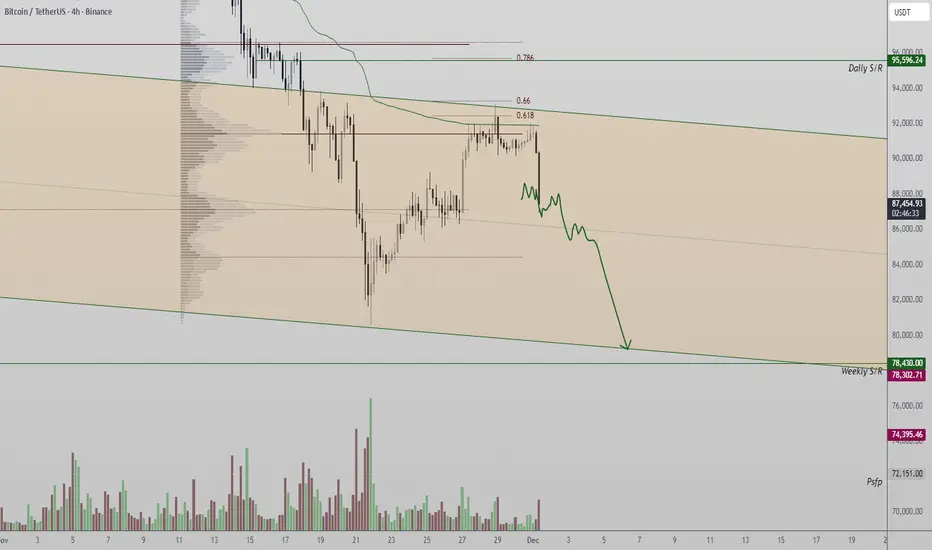
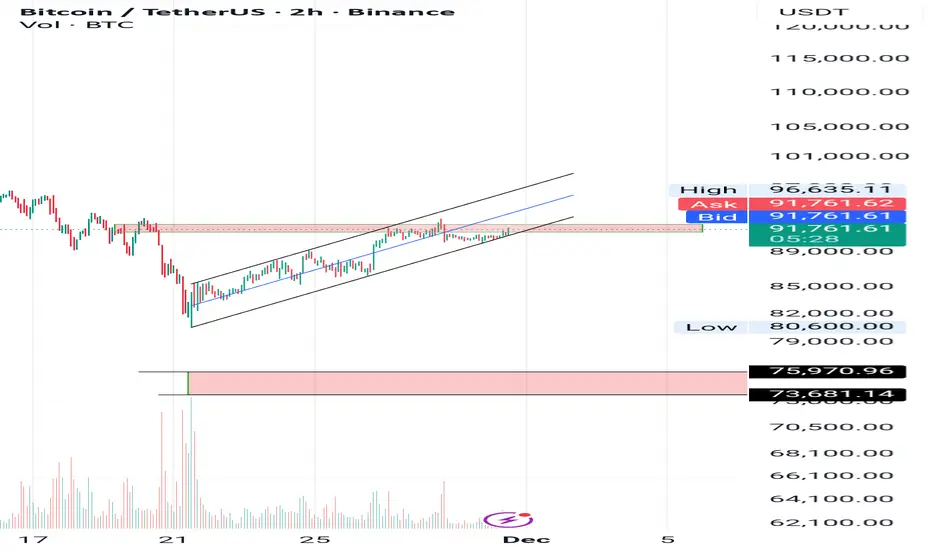
Falling Wedge on the 2H Timeframe: Is a Bullish Breakout BrewingHey TradingView community,
I’ve been closely monitoring Bitcoin’s price action amid this volatile November, and the 2H chart is painting an intriguing picture. After a sharp correction from October’s all-time highs above $126,000, BTC has been grinding lower, but it’s now forming a classic falling wedge pattern – a setup that’s often a precursor to bullish reversals in downtrends.    Check out my screenshot below for the details.
Key Observations from the Chart:
• The Pattern: We’ve got a descending resistance line connecting the lower highs since mid-November, paired with an ascending support line from the recent lows around $88,000-$90,000. This compression is typical of a falling wedge, where selling pressure diminishes, setting the stage for an upside breakout. If it holds, we could see a snap higher, similar to how these patterns resolved in past cycles.  
• Support and Resistance Levels:
• Strong support cluster at $92,000-$92,500 (current price action bouncing here) and lower at $89,000-$90,000, which has acted as a demand zone multiple times this month. 
• Overhead resistance at $96,000-$97,000 (prior highs), with a breakout potentially targeting $100,000-$104,000 based on the wedge’s measured move. On the flip side, a breakdown below $89,000 could open the door to $80,000 or even lower, as some analysts warn of deeper corrections.   
• Momentum Indicators: Volume appears to be drying up in the wedge, which is bullish, and RSI is hovering near oversold levels (around 30-40 on higher TFs), hinting at a potential rebound. No major divergences yet, but watch for one on the next leg down.
Market Context:
November 2025 has been a bloodbath for Bitcoin, with a 33% drop from peaks amid overleveraged longs getting flushed and broader macro pressures.  However, on-chain data shows accumulation by whales, and BlackRock’s ETF flows are turning positive again, suggesting the selling might be exhausting.  Sentiment is numb – perfect for a contrarian setup. Interestingly, ETH/BTC is also breaking out of its own multi-month wedge, which could signal altcoin strength if BTC stabilizes.  
Trading Idea:
• Bullish Scenario: Long on a confirmed breakout above the upper trendline (~$94,000) with stops below $92,000. Targets: $97,000 (short-term), $105,000+ (extended). 
• Bearish Scenario: If support cracks, short toward $85,000-$88,000, but I’d wait for confirmation to avoid whipsaws.
• Risk Management: Always use 1-2% risk per trade. Volatility is high, so position size accordingly. This isn’t financial advice – DYOR!
What do you think, bulls or bears in control? Drop your thoughts below. Let’s discuss!
#BTC #Bitcoin #Crypto #TechnicalAnalysis #FallingWedge #Trading
Trade ideas
The Bill Williams Strategy ExplainedWe all know the market doesn’t always play nice, but the Bill Williams Fractal Indicator can help you read between the lines. If you're focused on fine-tuning your entries and exits, let’s break down how fractals can be a useful tool in your strategy.
What is the Bill Williams Fractal Indicator?
At its core, the Bill Williams Fractal Indicator is a technical analysis tool that identifies potential reversal points in the market. This indicator is based on the fractal definition by Bill Williams, who described fractals as price patterns that can be used to predict potential shifts in price direction.
In simple terms, a fractal pattern consists of five consecutive bars or candlesticks on a chart. The middle bar of this pattern represents a local peak or trough, while the two bars on either side of it are smaller. A bullish fractal occurs when the middle bar is a higher high than the surrounding bars, and a bearish fractal appears when the middle bar is a lower low.
Bill Williams Fractal Definition
The Bill Williams Fractal is defined by a sequence of five consecutive bars. The middle bar represents the peak (for bearish fractals) or trough (for bullish fractals), surrounded by smaller bars on both sides. When price breaks the high (for bearish fractals) or low (for bullish fractals) of this central bar, it signals a potential breakout.
How Does the Bill Williams Fractal Trading Strategy Work?
The Bill Williams Fractal Strategy is a proven approach in crypto trading. Whether you're a beginner or an experienced trader, using the fractal strategy can provide valuable insights into potential market reversals and breakouts. By combining the Bill Williams Fractal Indicator with effective risk management, you can improve your trading edge.
A common method is to use the 200 EMA to gauge the overall trend. If the price is below the 200 EMA, traders tend to focus on lower fractals and look for short opportunities, while if the price is above the 200 EMA, they focus on upper fractals and consider long trades. However, always remember to confirm the breakout of local levels for greater reliability in your trades.
Master the Bill Williams Fractal Strategy
The Bill Williams Fractal Strategy is a well-established method in crypto trading. Whether you're just starting out or you're an experienced trader, incorporating the fractal strategy can provide useful insights into potential market reversals and breakouts. By combining the Bill Williams Fractal Indicator with a solid risk management plan, you can enhance your trading approach.
That said, remember that no strategy guarantees success. Fractal trading isn't about predicting the market with absolute certainty — it's about managing your entries and exits with precision and maintaining discipline. Always make sure to think critically and adapt to market conditions. So, when you spot a Bill Williams Fractal on your chart, use it as a guide, but always trust your analysis and approach. Happy trading!
How to use statistics and Pine Script to find a real edge.Are patterns really profitable, or are we just connecting random candles with a story?
Most of us started trading by seeing patterns on the chart: double bottoms, pin bars, three green candles, “smart money” footprints… but do we have any evidence they actually works ?
In this idea, I want to talk about the statistical significance of chart patterns, and how you can use simple statistics + Pine Script to move from “I think this works” to “I measured this edge.”
◼ Patterns are opinions until you define them
“Strong bullish candle”, “nice rejection”, “liquidity grab” – these are subjective words.
Statistics don’t work with feelings, they work with clear rules. Before testing anything, a pattern must be converted into something like:
Candle 1: bullish, body size > X% of price
Candle 2: low does not break previous low
Close of Candle 3 > high of Candle 1
Once you can write your pattern as strict conditions (true/false), you can: Count how many times it appeared, measure what happens after it appears, and decide if it’s worth trading or not. That’s where Pine Script becomes a powerful research tool.
◼ What does “statistical edge” actually mean?
A pattern is interesting if, when you look at many occurrences, you see a consistent tendency. For example, choose a simple question like: “When this pattern appears, where is the price on average after 10 bars?”
If you track that over hundreds or thousands of samples, you’ll get:
How often price is higher vs lower (win rate).
The average move (for example, +0.8% after 10 bars).
How volatile or noisy the results are.
This doesn’t magically make a holy grail, but it tells you: Is this pattern better than random? Is it worth building a full strategy around it? Without this step, you’re basically trading based on screenshots and memories.
◼ Using Pine Script as your statistics magic tool.
Even without going deep into code, the logic in Pine Script is simple, here is a simple example that you can do.
A. Detect the pattern Whenever your conditions are true on a bar, mark that bar as a “pattern bar”.
B. Look forward in time For each pattern bar, check the price after N bars (for example 5, 10, or 20 bars later). Calculate the % change between the pattern close and the future close.
C. Aggregate the results Keep a running count: How many patterns triggered (sample size), How many ended positive (wins), The average % move after N bars.
D. Interpret the numbers If you find that your pattern appeared 800 times, and after 10 bars: 62% of the time price was higher, Average move was +0.6%... then you have something much more concrete than “this looks good on the chart.” You don’t need to turn this into a full strategy immediately. Even a simple statistical study like this already filters out a lot of illusions.
◼ Common mistakes when testing patterns
When you start doing this, it’s easy to fool yourself. A few traps to avoid:
Tiny sample size : If your pattern only occurred 15 times and 11 of them were winners, that 73% win rate is probably not reliable. Statistics start to mean something with large samples (hundreds or thousands of events).
Obsession with win rate : A 70% win rate means nothing if your winners are tiny and your losers are huge. You must look at: Average move, Distribution of outcomes (are there huge negative outliers?), How a realistic stop-loss / take-profit would behave. Sometimes a pattern with 52–55% win rate can be excellent if the average reward is larger than the average risk.
Overfitting the past : If you keep changing rules until the backtest looks perfect, you are no longer discovering a pattern – you’re forcing the past to agree with you. A healthier flow is: Start with a simple, logical idea. Define it clearly in rules. Test it on one market / timeframe. Check it on other symbols and timeframes without changing the rules.
If the edge survives in different environments, that’s much more interesting.
Using this approach will save you a lot of time and money in losses, do your research before taking a trade, make sure you have the statistical evidence if you want to trade a pattern.
i will be sharing more ideas on the use of Pinescript to improve your trading in the next days. make sure you follow me.
LONG TRADE (BTCUSDT)ENTRY: 92,300
STOP LOSS: 91,800
TP1: 93,100
TP2: 93,700
RRR: ~2.0:1
1m:
Clear micro breakout above 92,200, followed by tight consolidation and bullish wick reclaim
Structure formed a strong higher low → clean sniper entry near 92,300
Momentum candle confirms bullish intent
5m:
Strong bullish engulfing breakout from prior chop zone
Price reclaimed the 91,800–92,000 zone with follow-through
Volume increase supports breakout structure
15m:
Confirmed higher low → impulsive continuation
Holding above recent key consolidation resistance (~91,800)
Next clean target zone at prior rejection highs near 93,000–93,700
TradeCityPro | Bitcoin Daily Analysis #234👋 Welcome to TradeCityPro!
Let’s move on to the Bitcoin analysis. The market is continuing the upward movement it started earlier.
⏳ 1-Hour Timeframe
Yesterday, after breaking the resistance zone, Bitcoin entered a small ranging box, and now the price has managed to stabilize above this box.
🔔 This range allowed the price to rest, and with new momentum entering the market, Bitcoin is now ready to move toward the 93,555 level.
💥 The RSI oscillator has formed a new momentum low around the 50 level.
✔️ This shows increased bullish momentum compared to the previous leg, because in the previous leg, RSI’s support was at 21.
✨ If this new RSI low holds, the market’s momentum will remain bullish, allowing the price to continue its upward movement.
📊 The triggers we previously had 87,942, 89,000, and 91,813 all activated and are currently in profit.
The next trigger for Bitcoin is at 93,555.
⭐ When the price reaches 93,555, there is a high probability that the market will begin ranging again or enter a correction.
⚡️ So if I see signs of exhaustion or reversal at that level, I will manage risk and take profits on my positions.
❌ Disclaimer ❌
Trading futures is highly risky and dangerous. If you're not an expert, these triggers may not be suitable for you. You should first learn risk and capital management. You can also use the educational content from this channel.
Finally, these triggers reflect my personal opinions on price action, and the market may move completely against this analysis. So, do your own research before opening any position.
BTC/USDT Analysis. Local Structure Favors Buyers
Hello everyone! CryptoRobotics trader-analyst here with the daily market breakdown.
Yesterday, Bitcoin continued rotating inside the resistance zone at $90,000–$92,300.
Locally, there is a strong probability of a breakout above this range, followed by a move toward the next resistance at $94,000–$97,500 (volume zone). This is supported by the absence of aggressive selling pressure and the way volume is distributed inside the consolidation.
The $90,000 level remains a key pivot point. We still allow for a retest of this level before buyers attempt another upward move.
On a larger scale, once price reaches the next sell zone, we expect a deeper correction to form.
Buy Zones
$90,000 (cluster anomalies)
$88,000–$86,000 (local volume zone)
$84,000–$82,000 (volume anomalies)
Sell Zones
$94,000–$97,500 (volume zone)
$101,000–$104,000 (accumulated volumes)
$105,800–$106,600 (local resistance)
This publication is not financial advice.
BTCUSDT.PA safe and sound plan has been marked on the chart on 1 day TF.
It might take long time but as soon it will drop to our zone and we see some bullish momentum we are in definitely.
Trading is only patience we cannot just move with moving line.
We need the price to act as we need and once the price starts acting as we decided than it will go where we want to see.
Have a good trading.
Trade once or twice a month is better than trading whole day 24/7.
Make it a peace of mind not stress.
Follow for more.
Trend Exhaustion: How to Spot a Reversal Before It HappensReversals rarely start with dramatic candles. They begin quietly, through subtle shifts in momentum and structure that most traders overlook.
A strong trend doesn’t collapse all at once. It loses strength in stages, and those stages are visible long before price turns in the opposite direction.
The first sign of exhaustion is weakening impulse strength. In a healthy trend, impulsive moves are clean and decisive, and retracements are controlled. When each new push produces smaller higher highs or lower lows, it signals reduced participation.
Buyers or sellers are still present, but the force driving the trend is fading.
The second clue lies in how price interacts with liquidity. Strong trends break key levels with conviction. Exhausted trends start reaching above highs or below lows only to reject immediately.
These sweeps show that the market is clearing liquidity without gaining follow-through, often trapping late entries and signaling that larger players are offloading positions.
A third indication appears when structure begins to fracture. An uptrend losing its higher-low sequence or a downtrend failing to maintain lower highs is a shift in narrative. A single break is not confirmation, but when it aligns with slowing impulses and liquidity failures, momentum is clearly changing.
Volatility then begins to compress. Candle ranges shrink, movement becomes less directional, and price enters a tightening pattern.
This compression often precedes expansion in the opposite direction. When a decisive candle breaks out of this cluster, the reversal typically accelerates.
Trend exhaustion is about recognizing when the conditions that supported continuation no longer exist.
By reading momentum, liquidity, and structure together, you can anticipate shifts earlier, manage risk more effectively, and position yourself on the right side of the next move.
Bitcoin recovers rise again moveBitcoin is showing signs of bullish consolidation after a prolonged decline into key support. Based on the current range structure, the market may be preparing for an upward move.
The recovery aligns with broader market sentiment, as U.S. stock indices recorded their fourth consecutive session of gains, driven by expectations of potential Federal Reserve interest-rate cuts.
From a technical perspective, if Bitcoin can hold bullish momentum and secure a 4H candle close above the 90,000 level, it would strengthen the case for continuation to the upside. After the recent long fall, price may look to retest overhead resistance in the 98,000 – 105,000 zone.
You may find more details in the chart.
Trade wisely best of Luck buddies.
Ps; support with like and comments for better analysis thanks for supporting.
btcusdtBitcoin (BTC) Daily Technical Analysis
Current Market Context:
Price action suggests a bearish intraday bias within the broader context. The setup indicates a potential for a short-term decline towards lower support levels.
Trade Setup Overview:
Direction: Short (Bearish)
Strategy: Fade on strength towards resistance / anticipate breakdown.
Execution Parameters:
Entry Point: $91,630
Rationale: This level is anticipated to act as a point of rejection following a retest of a breakdown level or a minor resistance zone.
Stop-Loss: $92,065
Rationale: Placed just above the recent swing high or a key resistance level. A break above this invalidates the bearish premise and suggests a potential move higher.
Take-Profit Target: $90,365
Rationale: This target aligns with a significant support level where profit-taking or a bullish reversal might occur.
Risk Management:
Risk/Reward Ratio: ~1:4.9
This is an excellent risk-to-reward ratio, where the potential profit significantly outweighs the potential loss.
Position Sizing: Ensure the position size is calibrated so that a loss from this trade remains within your predefined risk tolerance (e.g., 1-2% of total capital).
Technical Justification & Chart Analysis:
This setup implies that Bitcoin is facing selling pressure near the $91,630 - $92,065 zone. A rejection from this area, confirmed by bearish price action (e.g., a bearish engulfing pattern, pin bar, or loss of momentum), could trigger a sell-off towards the $90,365 support level.
The trade's validity relies on the market structure remaining bearish on the lower timeframes (e.g., 4-hour or 1-hour charts). The tight stop-loss requires precise execution.
Conclusion:
This is a high-probability, high-R/R short-term bearish setup. The key to success lies in waiting for confirmation at the entry zone rather than entering blindly. Monitor lower timeframes for bearish confirmation signals before executing the trade.
Disclaimer: This analysis is for educational purposes only and does not constitute financial advice. Trading cryptocurrencies carries significant risk.
Bitcoin Tests $90K Range High: Binance Netflows Signal PotentialTechnical & On-Chain Outlook:
After losing the $90K support level, Bitcoin has settled into a clear Range Zone between $70,000 and $90,000.
As seen on the technical chart, price action found support near the Point of Control (POC) and is now rallying to test the Range High at $90K.
Binance Netflows: Bearish Divergence Appears
Binance’s 7-day cumulative netflow data highlights a potentially bearish setup:
1. Heavy Asset Inflows (Bearish Signal)
Large amounts of crypto assets have been deposited into Binance:
$2 Billion in BTC
$500M in XRP
$315M in ETH
Such large inflows typically indicate an intention to sell.
2. Weak Stablecoin Buying Power
Stablecoin movements show limited demand:
$1.4B USDT flowed into the exchange
$665M USDC flowed out
➡️ Net stablecoin inflow: ~$735 Million
This represents the actual available buying power on Binance.
Conclusion
A clear supply-demand imbalance is forming:
Potential selling pressure: ~$2.8B (Crypto assets)
Available buying power: ~$0.735B (Stablecoins)
This strongly suggests that short-term investors are preparing to sell at the range ceiling.
Without a renewed wave of stablecoin liquidity, a clean breakout above $90K is unlikely.
A rejection from the range high and continuation within the $70K–$90K range appears to be the more probable scenario.
Bitcoin Analysis – November 28|The Most Important Day of Month!Bitcoin Analysis – November 28
Hello dear traders! Hope you’re all doing well.
Today is November 28, the last active market day of the week — and honestly one of the most important days of the month. Even if bitcoin doesn’t make a big move today, I strongly recommend staying at the charts, because these days often bring unexpected volatility.
The Fear & Greed Index is sitting at 20, which means we’ve moved from Extreme Fear into normal Fear. As you know, the past weeks were dominated by extreme fear.
🟦 Why Today Matters
We’ve seen heavy selling throughout November, but today and the next two days will determine how the monthly candle closes.
Since the major markets will be closed tomorrow and the day after, crypto will likely have lower overall liquidity, meaning today has the highest probability of making the move.
🟧 Market Structure
Daily timeframe: still bearish
1H timeframe: bullish
If today continues upward → 4H may turn bullish as well
Yesterday I explained why this shift can happen — buyers have stepped in with better momentum.
Also note:
After the recent short rally, the market had a time-based correction with very low volume.
A fresh surge in volume today can be a strong signal for continuation.
🟩 Scenario A – Bullish
If 91,636 breaks to the upside:
✅ You can take a long position
• Preferably after a 1-hour candle close above the level
• A 15-minute breakout is acceptable if you see strong volume
• Bitcoin itself is a good option because Bitcoin Dominance is currently supporting the move
-Don’t forget to check the order book on your exchange.”
🟥 Scenario B – Bearish
If 90,786 breaks down:
⚠️ Expect a clean drop
In this case:
→ I recommend shorting BTC pairs that already have a bearish structure
Example: APT, which is currently trending down.
🔑 Final Notes
Always use proper risk management
Avoid unnecessary risky trades
My goal is to keep the analysis as simple and clean as possible
The market rewards traders who show up every day
And to stay in the game every day, you must protect your capital
Have a great day and trade safely! 💙📉📈
Understanding Global Market Meltdowns and CrisesIntroduction
Global markets are the backbone of the world economy, connecting nations, investors, and industries. They are often perceived as resilient and self-correcting, yet history shows they are prone to sudden and severe collapses known as market meltdowns. These meltdowns are characterized by sharp declines in stock prices, bond markets, and commodities, often accompanied by panic selling, liquidity crises, and systemic financial disruptions. Understanding the causes, mechanisms, and impacts of these crises is essential for policymakers, investors, and businesses alike.
Defining Market Meltdowns
A market meltdown, sometimes referred to as a financial crisis, occurs when the prices of assets drop precipitously within a short period. Unlike normal market corrections, which reflect adjustments based on valuations or economic cycles, meltdowns are marked by panic-driven behavior, loss of confidence, and widespread liquidity constraints. They are rarely confined to a single sector, often triggering a chain reaction across global financial systems.
Historically, major meltdowns include the 1929 Great Depression, the 2008 Global Financial Crisis, and the 2020 COVID-19 market crash. Each had unique triggers but shared common dynamics of excessive speculation, over-leverage, and systemic vulnerabilities.
Causes of Global Market Crises
Excessive Leverage and Debt
Financial institutions, corporations, and households often borrow excessively during economic booms. High leverage amplifies gains during expansions but drastically magnifies losses during downturns. For example, the 2008 crisis was primarily driven by over-leveraged banks investing in subprime mortgages. When defaults rose, the interconnectedness of institutions led to a global liquidity crisis.
Speculative Bubbles
A speculative bubble forms when asset prices soar far above their intrinsic value, fueled by irrational investor optimism. Bubbles are often visible in real estate, equities, and commodities. When investor sentiment reverses, the bubble bursts, triggering rapid sell-offs. The 2000 dot-com crash exemplified this phenomenon, where internet-based companies were massively overvalued before the market collapsed.
Banking System Failures
Banks are the lifeblood of modern economies. A failure in the banking sector can quickly escalate into a financial crisis. Bank runs, where depositors rush to withdraw funds, can destabilize the entire financial system. The 1930s Great Depression was exacerbated by widespread bank failures, causing massive unemployment and contraction in economic output.
Macroeconomic Imbalances
Excessive fiscal deficits, high inflation, or persistent trade imbalances can undermine confidence in financial markets. Investors may withdraw capital from affected regions, causing currency depreciation, stock market losses, and economic stagnation. The Asian Financial Crisis of 1997 was partly triggered by high external debt and currency overvaluation in countries like Thailand and Indonesia.
Geopolitical and Global Shocks
Wars, political instability, pandemics, and natural disasters can act as sudden shocks, triggering market panics. For instance, the COVID-19 pandemic in 2020 caused unprecedented global market volatility as governments imposed lockdowns, disrupting supply chains and consumer demand.
Regulatory Failures and Lack of Oversight
Weak regulatory frameworks, insufficient supervision, or financial innovation without proper oversight can allow systemic risks to build unnoticed. The 2008 crisis highlighted the dangers of unregulated derivatives, which magnified losses and spread risks across global financial institutions.
Mechanisms of Market Meltdowns
Liquidity Crunch
During a meltdown, liquidity—the ease with which assets can be bought or sold—evaporates. Investors rush to convert assets into cash, driving prices further down. Banks may restrict lending to preserve liquidity, exacerbating economic contraction.
Contagion Effect
Financial markets are globally interconnected. A crisis in one region can quickly spread internationally through trade, investment flows, and banking linkages. The 2008 crisis, which started with U.S. mortgage-backed securities, rapidly affected Europe, Asia, and emerging markets due to these linkages.
Panic Selling and Herd Behavior
Human psychology plays a significant role. Fear often triggers irrational selling, creating a self-reinforcing downward spiral. Investors abandon long-term strategies, leading to sharp price declines that are disproportionate to actual economic fundamentals.
Credit Freeze
Banks and investors may hoard cash and reduce lending, causing a credit crunch. Businesses struggle to finance operations, leading to layoffs, bankruptcies, and reduced consumer spending, which further depresses economic activity.
Impacts of Market Crises
Economic Recession
Market meltdowns often coincide with broader economic downturns. Declining asset prices reduce wealth, curtail consumption, and disrupt investment, leading to slower economic growth or outright recession.
Unemployment and Social Consequences
Business failures and reduced investment lead to layoffs, increasing unemployment rates. Social unrest and political instability may follow, as seen during the Great Depression and subsequent economic crises.
Loss of Investor Confidence
Crises shake investor confidence, making markets more volatile and risk-averse. Recovery often takes years, as rebuilding trust is slower than stabilizing balance sheets.
Policy Interventions
Governments and central banks typically intervene through fiscal stimulus, interest rate cuts, or quantitative easing. While necessary to restore stability, these measures may increase long-term debt burdens or inflate asset prices, potentially sowing the seeds of future crises.
Global Ripple Effects
In a globalized economy, meltdowns in major financial centers impact trade, investment, and currency markets worldwide. Emerging economies often bear the brunt of capital outflows, currency depreciation, and reduced access to credit.
Lessons and Mitigation Strategies
Diversification and Risk Management
Investors can protect themselves by diversifying portfolios across asset classes, sectors, and geographies. Proper risk management helps absorb shocks during periods of extreme volatility.
Regulatory Oversight and Transparency
Strong regulation, stress testing of financial institutions, and transparency in financial products reduce the likelihood of systemic risks accumulating unnoticed.
Monetary and Fiscal Preparedness
Central banks and governments must maintain tools to stabilize markets, such as liquidity facilities, interest rate adjustments, and targeted fiscal stimulus to cushion economic shocks.
Behavioral Awareness
Understanding the psychological dimensions of markets—herd behavior, panic selling, and over-optimism—can help investors make rational decisions even in turbulent times.
Global Coordination
Given the interconnectedness of modern markets, international cooperation is crucial to prevent contagion and stabilize financial systems. Institutions like the IMF and World Bank play pivotal roles in crisis mitigation.
Conclusion
Global market meltdowns are complex phenomena with roots in economic imbalances, speculative excesses, regulatory lapses, and human psychology. While each crisis has unique characteristics, their recurring nature underscores the need for vigilance, risk management, and systemic safeguards. Understanding the mechanisms, causes, and impacts of these meltdowns is essential for investors, policymakers, and societies to navigate the volatile terrain of global finance.
By learning from history and implementing robust preventive measures, the world can reduce the frequency and severity of market crises, ensuring more stable and resilient financial systems in the future.
Final 2025 Forecast for BTCUSDT 28th November 2025 (Updated)Same idea as previous post, just zoomed in to see the potential gyrations towards to move towards ~$128k and hopefully beyond ✌️
1. Friday session dip to around ~$81k
2. Pump to around ~$87k over the weekend
3. Dump down to ~$80k for Monday Trap
4. Black Friday Pump to ~$89k
5. Max Pain Dump to ~$75k-$79k
6. Final pump to ~$128k to end the cycle
If we are lucky and price pullbacks from ~$128k and then exceeds it. Here are the targets I would be looking at;
Target #1 $140k-$145k,
Target #2 $170k-$175k
Target #3 $200k-$205k
This of course could be 100% wrong so remember (as always) to ruthlessly ✂️ cut your losers when wrong, and hold ✊ onto your winners when right.
--
I might also add, come early December 1st - 5th the following celestial events will take place which support the run up to $128k (and possibly beyond);
1. Super Full Moon (“Cold Moon”) 🌖
• On December 4, 2025, there’s a nearly full moon (~98% illuminated). 
• This will be a supermoon, meaning the Moon appears slightly larger and brighter than average. 
• The Moon is in Taurus, and near the Pleiades (M45) — Taurus is represented no other than the Bull.
Supermoons correlate with:
• spikes in emotion
• increased speculative behavior
• temporary liquidity expansions
• bigger candles (up OR down)
A near-super full moon tends to:
• mark volatility apexes
• precede relief rallies
• create short-term “energy reversals”
2. Moon–Jupiter conjunction (Dec 7) — traditionally expansive 🌖
Jupiter is symbolically linked with:
• expansion
• optimism
• big moves
• risk-on thinking
• growth
• speculation
When the Moon (sentiment) aligns with Jupiter (expansion), it often coincides with:
• higher risk appetite
• FOMO
• bullish short-term flows
In Summary;
1. Moon–Jupiter conjunction (Dec 7) → Expansive, optimistic, risk-on symbolism
2. Super Full Moon (Dec 4) → Volatility peak → Reversal → Upward burst
4 days ago
Bitcoin Update — Big Correction, Clear Levels, and What’s NextBitcoin has been in a strong corrective phase ever since the October ATH. After breaking down from the rising structure, price has been grinding lower and finally tapped into the broader demand zone we’ve been watching for weeks.
The recent bounce shows that buyers are still active, but the larger trend remains in “recovery mode,” not full reversal mode yet.
🔍 Current Structure
BTC has been trending inside a descending channel since the ATH
Lower highs continue to form under the yellow resistance line
Price found support inside the orange mid-range demand box
RSI and MACD on 8H/12H are recovering, hinting at short-term strength
Volume on the selloff has calmed, suggesting the worst of the panic may be over
Overall, this is a classic cool-down phase after a major breakout — nothing structurally unusual.
📈 Key Levels to Watch
Support:
$87k–$90k — current holding zone
$78k–$80k — major range low if things dip lower
Resistance:
$98k — mid-range ceiling
$102k–$105k — the first meaningful resistance cluster
$113k — upper diagonal rejection area
As long as BTC stays above the mid-range support, the structure remains healthy. Reclaiming the yellow diagonal would open the door toward $102k+ again.
⚡ What’s Next?
Bitcoin is stabilizing after a multi-week correction, but it hasn’t yet broken back into bullish momentum. The next major move will likely depend on whether BTC:
breaks above the descending resistance, or
retests deeper support before reversing higher.
Either way, the macro trend remains intact — this is still a structured pullback within a larger bull cycle.
Not financial advice — just chart analysis.
BTC — Trendline Rejection or Breakout? BTC is approaching a key structural decision point, and the next move will determine whether we see continuation upward or a corrective sweep to lower liquidity levels. This idea outlines both scenarios with clear targets and educational structure analysis.
Key Structural Areas
1️⃣ Rising Trendline Support
BTC continues to respect a clean ascending trendline. This line has been a major pivot for the past several days.
Price is currently hovering just above it, and the yellow circle marks the confluence of:
Rising trendline support
A local demand block
Prior liquidity sweep zone
This is the most important area to watch for reaction.
2️⃣ Short-Term Rejection Scenario (White Path)
Before breaking upward, BTC may show short-term downside rejection, targeting:
➡️ Short-Term Target:
$88,180
This level aligns with:
Demand block retest
Trendline kiss
Local inefficiencies needing fill
A rejection into 88,180 would be normal and healthy before a potential bullish continuation.
3️⃣ Bullish Reclaim Scenario
If price taps the rejection zone and reclaims the trendline, upside targets remain:
$95,800 – $96,500 → Half-filled FVG + structural supply
$99,500 – $100,200 → Major FVG + macro resistance zone
These zones are where we expect strong reaction and profit-taking.
4️⃣ Breakdown Scenario
If BTC fails the trendline with a full candle close below, expect:
Breakdown of structure
Full sweep of demand
Deeper correction into mid-range levels
Not my primary bias, but it's critical to acknowledge the possibility.
Summary
BTC is sitting on an important trendline.
A quick rejection into 88,180 could be the liquidity grab needed before upside continuation.
Reclaiming the trendline = bullish continuation toward FVGs.
Breaking below = deeper corrective move.
📘 Disclaimer
This analysis is for educational purposes only. It represents personal opinion and not financial advice. Always do your own research and manage your own risk.
Bitcoin prediction Nov 2025Bitcoin prediction Nov 2025, Bitcoin is expected to push to the upside after it broke previous high and came to test previous low and bullish order block and start to move toward previous high (Bullish Extension). This move may break previous all-time high and break record of 2025 All-time high.