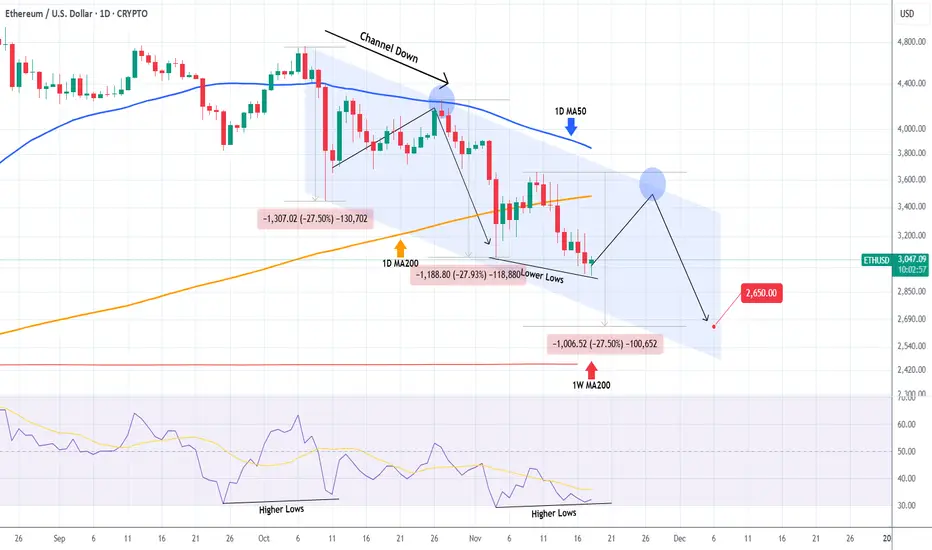
Trade ideas
#ETHUSDT 2025–2028 OutlookFIB/GANN/classic Method Analysis
🔹 Gann Key Timing
According to Gann cycles,
25 November marks the start point of a new bullish attempt for ETH.
The $2,500 level is the critical line
if ETH closes a monthly candle below $2,500, it signals a significant change in the long-term roadmap.
Trend Setup
As long as ETH holds $2,500 and stays above the Blue Trend Line (A),
The bullish roadmap remains valid.
🎯 Roadmap Targets
Breakout Key:
$5,100 → Main breakout confirmation
Target 1:
$5,900 – $6,700 → First bullish leg (until Feb 2026)
Target 2:
$8,200 – $8,900 → Full bullish year if 2026 confirms
Target 3:
$10,150 → Extended top projection (2027–2028)
📌 All levels remain valid as long as ETH holds $2,500 on the monthly close.
💰 Trade Plan
We have active entries: from $3, XXX, with remaining buy levels between $1,500–$1,850–$2,150.
Set up invalidation: Monthly close below $2,500.
Max investment: 15 % of wallet.
Risk-Reward (R: R): ≈ 1: 2 or higher.
Example: If you hold 10 ETH, you risk about $10K vs. the potential upside of $35–70K.
⚖️ Summary
Support to hold: $2,500
Breakout confirmation: $5,100
Main targets: $5,900 → $6,700 → $8,900 → $10,150
Cycle: 2025 → 2028
Exposure: 15 % max
Always trade with a clear plan and controlled risk.
⚓ Renzo Tip
“The chart tells its truth to the patient — not the loudest trader, but the calm observer of time.”
🤲 Prayer
May Allah guide us to trade with clarity, protect our effort from greed and confusion,
and reward our discipline with lasting growth and wisdom.
Ethereum Wave Analysis – 14 November 2025- Ethereum reversed from support zone
- Likely to rise to resistance level 3600.00
Ethereum cryptocurrency recently reversed from the support area between the support level 3090.00 (which stopped the previous impulse wave (C) at the start of November), 50% Fibonacci correction of the upward impulse from April and the lower daily Bollinger Band.
The upward reversal from this support zone stopped the previous medium-term ABC correction (2).
Given the strength of the support level 3090.00, Ethereum cryptocurrency can be expected to rise to the next resistance level 3600.00.
An inverse cup and handle or a double bottom?The chart is in a downtrend sitting on big support, and we have sketched the two obvious branching paths.
Where we are now
Price ~3.2k, below the 9/21/50/100/150/200-day MAs but sitting on the 300–400-day cluster around 3.05–3.10k.
That zone also matches the previous summer range = strong structural support.
Trend is still clearly down until at least the 200-day (~3.45k) is reclaimed.
⸻
Bull case – double bottom
The green double bottom is basically
Lows: ~3.05k–3.10k (twice).
Neckline: the swing high between them, roughly ~3.5–3.6k.
For this to be “real” we want:
decisive daily close above ~3.5–3.6k with volume.
Ideally 200-day MA reclaimed and flattening.
If that happens, measured move targets land somewhere in the mid-4ks, which lines up with your big green arrow.
Subjective odds right now: lower, maybe ~40% until that neckline breaks. We're trying to fight the prevailing downtrend; the pattern is only a potential bottom.
⸻
Bear case – inverse cup / rounded top
The red “inverse cup and handle” is basically a big rounded top since August
Series of lower highs, price rejected by falling MAs.
Current bounce is so far just a retest of that declining structure / MA cluster from below.
Bearish resolution would be
Failure somewhere under ~3.5k.
Breakdown below 3.0–3.05k (loss of 300–400-day MAs and range support).
That opens a move to the mid-2ks or worse, which is your red arrow scenario.
Given the existing downtrend and overhead MA gravity, continuation has the edge for now—call it ~60% vs the bullish reversal, unless the neckline is reclaimed.
⸻
Net take
Above ~3.6k with volume → double bottom validated, trend potentially flips up.
Below ~3.0k with conviction → rounded-top breakdown, expect acceleration down.
In between 3.0–3.6k you’re in Schrödinger’s pattern: chop, fakeouts, and pain.
So the market is basically asking: “Do we defend the 3k fortress, or do the MAs slowly grind everyone down?” The chart slightly favors the bears until price proves otherwise.
This Crypto Dump Was Planned — Don’t Get TrappedThe Crypto Market Is Tanking… But This Is Exactly What I Expected.
In today’s video, I break down the sharp move to the downside across BTC, ETH, and Total Market Cap — a move I warned about in my previous videos. Despite bullish news about the US government reopening, the market dropped aggressively… and that’s not an accident.
This is a psychology game.
They want you scared.
They want you to believe it’s over.
But I’m still bullish, and in this video I explain:
-Why this dump is part of the plan
-How much lower price can still go
-The key levels I am looking at
-The bigger picture for BTC, ETH, and Total
-Why strong hands win in times like this
Stay focused. The real move hasn’t even started yet.
“ETH – Bullish OB broken, downtrend resumes.”ETH Analysis – Nov 14 (VNShark)
Bullish OB: Fully broken — confirming that the previous bullish structure is no longer valid.
Retest: Price pulled back to the trendline and the broken OB zone, showing a clear bearish rejection — a logical sell signal.
Volume: Selling pressure continues to increase with each downside leg.
At this stage, VNShark prioritizes waiting for a pullback and observing the price reaction at the offer zone before considering a short entry aligned with the new downtrend.
This analysis is for educational purposes only and not financial advice.
#Tags
#ETHUSD #Ethereum #OrderBlock #SmartMoneyConcept #SMC #PriceAction #Volume #VNShark #CryptoAnalysis #MarketStructure #BreakOfStructure #Downtrend
NEXT 3 MONTHS are historically BULLSIH FOR CRYPTOEthereum is positioned as a top buy for the coming six months, with technical patterns, historical seasonality, and evolving fundamentals suggesting a realistic pathway toward the $10,000 mark. A clear Double bottom on the technicals is indicating reversal for COINBASE:ETHUSD
### Why Ethereum Is a Great Buy Now
- **Technical Setup**: ETH recently formed a double-bottom pattern at crucial support, signaling strong demand. The recent bounce from the $3,000 range aligns with bullish reversals in volume, moving averages, and on-chain metrics.
- **Network Growth**: Massive increases in layer-2 adoption, thriving DeFi ecosystems, and the emergence of a spot ETH ETF are expanding use cases and institutional interest, setting the stage for explosive price moves.
- **Macro Tailwinds**: The prospect of lower interest rates and renewed risk-on appetite among global investors are catalysts for crypto’s next surge. Hedge funds and corporates are increasingly adding Ethereum to their treasuries, aligning with historic accumulation phases.
- **Price Targets**: Top analysts forecast rapid gains, with DigitalCoinPrice and Changelly projecting $6,900–$11,000 for ETH within the next year, and Gov Capital suggesting $5,400 by late 2025. Bullish scenarios outline $10,000 as achievable if momentum and adoption trends accelerate.
### Seasonally Strong Months for ETH
Historical performance shows that certain months have offered outsized returns for Ethereum . Notably:
- January, February, and July are statistically the strongest rally months
- December and March often show above-average gains.
- May, June, and September tend to be bearish or mean-reverting.
#### ETH Month-by-Month Rally Table
| Month | Average Return | Rally Potential |
|-----------|:--------------:|:--------------:|
| January | +15% | Strong |
| February | +12% | Strong |
| March | +8% | Moderate |
| April | +5% | Positive |
| May | -3% | Weak |
| June | -4% | Weak |
| July | +17% | Very Strong |
| August | +9% | Moderate |
| September | -6% | Weak |
| October | +7% | Positive |
| November | +6% | Positive |
| December | +9% | Strong |
Conclusion
With history on its side and market fundamentals evolving rapidly, Ethereum is set for a major upside move in the next six months. Investors should target accumulation during seasonal lows in late winter and early spring, aiming for parabolic runs in summer and year-end. Technical and on-chain signals, combined with dominant seasonality, paint a bullish picture—making $10,000 a plausible target for proactive ETH buyersbuyers.
eth dip incomingwith simple analysis you can see eth started a bullish channel back in 2022 every time we touch the top of the red trend line we see a reversal. so i will expect to see eth retrace to the green support line and bottom of channel where we could expect 1800.00 to 1500.00 then continue up after a test of support. if we start to see a reversal we well likely create a inverted head and shoulders and will invalidate the trend only time will show us hints of direction .until i see a clear trend change i will remain bear.
Global Soft Commodity Trading1. What Are Soft Commodities?
Soft commodities are agricultural goods used for food, textiles, beverages, and biofuels. They are classified into several broad segments:
a) Grains and Cereals
Wheat
Corn (maize)
Rice
Barley
These form the backbone of global food security and are traded extensively via futures contracts.
b) Oilseeds and Edible Oils
Soybeans
Palm oil
Sunflower oil
Rapeseed
These commodities are vital for cooking oil, animal feed, and industrial applications.
c) Tropical Products
Coffee
Cocoa
Sugar
Spices
Produced mostly in tropical regions, they are influenced by regional climate and weather events like El Niño and La Niña.
d) Fiber Commodities
Cotton
Rubber
Jute
Used primarily in textiles, manufacturing, and industrial processes.
e) Livestock and Dairy
Cattle
Hogs
Milk derivatives
These are essential for the food processing and meat industries.
2. Structure of Global Soft Commodity Trading
Soft commodity trading operates through two primary channels:
a) Physical (Spot) Trading
Involves buying and selling the actual agricultural product.
Participants include:
Farmers and cooperatives
Exporters and importers
Commodity merchants (e.g., Cargill, ADM, Bunge)
Food processing companies
Textile manufacturers
Physical trading focuses on logistics, shipping, storage, warehousing, and quality inspection.
b) Derivatives Trading
Soft commodities are widely traded on futures exchanges such as:
Chicago Board of Trade (CBOT)
Intercontinental Exchange (ICE)
NYMEX
Dalian Commodity Exchange (DCE)
Multi Commodity Exchange (MCX India)
Derivatives allow traders, corporations, and governments to hedge price risks or speculate on future price movements.
3. Key Players in the Soft Commodity Market
a) Producers
Countries in Latin America, Africa, India, China, and Southeast Asia dominate production. For example:
Brazil: coffee, soybeans, sugar
Ivory Coast & Ghana: cocoa
India: cotton, sugar, spices, wheat
China: soybeans, rice
b) Traders and Merchants
Large multinational firms manage procurement, logistics, and distribution networks.
c) Commodity Exchanges
Provide transparent pricing and risk-management tools for global participants.
d) Financial Institutions
Banks, hedge funds, and investment firms trade soft commodities for portfolio diversification and speculation.
e) End-Users
Food manufacturers, textile mills, beverage companies, and energy producers rely on stable supply.
4. Factors Influencing Soft Commodity Prices
Soft commodities are highly volatile because they depend on natural events and global economic fluctuations. Major price-moving factors include:
a) Weather and Climate
Extreme weather—droughts, floods, cyclones—can sharply reduce production.
Events like El Niño often disrupt supply chains worldwide.
b) Seasonal Cycles
Planting and harvesting seasons create predictable demand and supply patterns.
c) Geopolitics
Trade restrictions, sanctions, export bans, and conflict zones (like in the Black Sea region) significantly influence grain and oilseed prices.
d) Currency Movements
Most commodities are priced in USD, so a stronger dollar makes them more expensive for importing nations.
e) Supply Chain Disruptions
Port delays, shipping shortages, or logistical failures create shortages.
f) Global Demand Trends
Rising middle-class consumption boosts demand for:
Protein (livestock feed demand increases soy and corn usage)
Coffee and cocoa
Biofuels (palm oil, corn ethanol, sugar ethanol)
g) Government Policies
Minimum support prices, export taxes, and subsidies influence domestic and global markets.
5. Trading Strategies in Soft Commodities
Soft commodity traders use multiple strategies in derivatives and physical markets:
a) Hedging
Producers lock in prices to protect against volatility.
Example: a coffee farmer hedges future production by selling coffee futures.
b) Arbitrage
Traders exploit price differences:
Between markets (inter-market arbitrage)
Between expiration months (calendar spreads)
Between commodity grades (quality spreads)
c) Speculation
Traders take directional bets on future price movements based on:
Weather forecasts
Supply-demand data
Economic indicators
d) Spread Trading
Buying and selling correlated commodities:
Corn vs. wheat
Soybeans vs. soybean oil
e) Algorithmic and High-Frequency Trading
Increasingly used for short-term price anomalies.
6. Importance of Soft Commodity Trading in the Global Economy
a) Food Security and Stability
Soft commodities ensure availability of food grains and edible oils.
Their pricing impacts inflation, especially in developing countries.
b) Industrial and Manufacturing Input
Cotton, rubber, and other fibers support the textile and automotive sectors.
c) Employment Generation
Millions of farmers, traders, and logistics workers depend on agriculture.
d) Global Trade Balances
Major exporters—Brazil, Argentina, India, US—earn significant foreign exchange through soft commodity exports.
e) Price Discovery
Futures markets provide transparent global benchmarks that help governments and industries plan production and inventory.
7. Emerging Trends in Soft Commodity Trading
a) Sustainable and Ethical Sourcing
Consumers demand ethically sourced coffee, cocoa, and palm oil.
Traceability and ESG compliance are becoming mandatory.
b) Digital Farming and Smart Agriculture
Technologies like:
AI-based weather prediction
Drones and satellite imaging
Precision farming
These improve crop quality and supply forecasting.
c) Climate-Resilient Commodities
Investment is rising in drought-resistant seeds, alternative proteins, and regenerative agriculture.
d) Rise of Biofuels
Biofuel policies increase demand for:
Corn (ethanol)
Sugarcane (ethanol)
Soy/palm oil (biodiesel)
e) E-Trading Platforms
Digital trade platforms reduce intermediaries and streamline global trade.
8. Challenges in Soft Commodity Trading
a) High Volatility
Weather and geopolitics create unpredictable price swings.
b) Supply Chain Complexities
Quality inconsistencies, delays, and transportation losses can impact pricing.
c) Regulatory Changes
Sudden export bans (as seen with wheat, sugar, or rice) disrupt global markets.
d) Climate Change
Rising temperatures threaten yields and increase production risks.
e) Financial Constraints for Farmers
Small farmers in developing nations lack access to credit and hedging tools.
Conclusion
Global soft commodity trading plays a vital role in ensuring global food availability, supporting manufacturing industries, and stabilizing economic systems. It connects farmers to international markets, provides effective price discovery mechanisms, and helps manage risk through futures trading. However, the market is highly sensitive to weather, geopolitics, and global economic shifts.
With rising concerns around sustainability, digital transformation, and climate impacts, soft commodity trading is evolving rapidly. Countries and corporations that adapt to these changes—through better risk management, technology adoption, and sustainable practices—will shape the future of global agricultural trade.
RSI Never Lies🧠 RSI Never Lies
I believe the RSI indicator, especially on the daily timeframe, is the most powerful signal in the market.
Since the moment I noticed the bearish divergence on Ethereum, the price has dropped over 15%, even touching $3500.
I didn’t do anything special — I’m no fortune teller.
I just listened to my dear friend, RSI.
Now RSI is around 40 on the daily chart, which clearly suggests that the downtrend may continue.
#ETH #Ethereum #RSI #TechnicalAnalysis #TradingView #RMBS
ETHUSD long trade activated In my opinion EThUSD has a great potential to benefit from the seasonal trend in November and December, when compared to Bitcoin on ETHBTC chart it also show momentum.
The daily and weekly trends are also strong so a reverseal is the most probable move here.
The stoploss and targets are showed in the chart.
BTC ETH It's Decision Time!BTC ETH should be deciding which direction to move to by next week.
We need DAILY CLOSINGS above green resistance and Downtrend Line OR below red support to confirm in which direction it will move to next.
The odds are that it's a BREAKOUT back to ATH with ETH, perhaps, maybe, blasting higher into January.
BTC might not blast too much higher just yet.
If the price does not breakout of the Downtrend Line rather quick, things could turn really ugly again next week.
ETHUSD: Caught in a Downtrend Triangle Below Key Targets📉 ETHUSD: Caught in a Downtrend Triangle Below Key Targets – What's Next for Ethereum?
Timeframe: 4-Hour Chart
Ethereum (ETHUSD) is currently trading around $3,440. The price is showing clear signs of bearish pressure, trapped within a developing pattern after failing to sustain higher levels.
Current Price Action & Trend Analysis:
Ethereum has been in a sustained downtrend since hitting peaks in late October, marked by a series of lower highs. The most recent attempt at a recovery was firmly rejected at the 3700 'Upside 1st Target' zone around November 10th-11th. Since this rejection, ETHUSD has been consolidating, largely operating below a prominent red descending trendline that acts as dynamic resistance.
The price is currently hovering around the 3350 'Deciding Area', which appears to be acting as immediate support. However, repeated rejections from the descending trendline (forming a potential descending triangle or wedge pattern) highlight the persistent selling pressure. While the price has found temporary bounces from this 'Deciding Area', the inability to break the overhead trendline suggests continued weakness.
Key Resistance Levels:
Descending Red Trendline: This dynamic trendline, currently just above the 3500 mark, is the most immediate obstacle for any bullish recovery. A breakout above this would be the first hint of shifting momentum.
3700 Upside 1st Target: This was the recent high point before the current leg down and represents a significant resistance level that bulls need to overcome to regain conviction.
3850 to 3950 1st Key Resistance & 4085: These higher resistance zones are currently out of immediate reach but remain significant hurdles for a broader trend reversal.
4200 to 4300 Strong Resistance: This major overhead resistance marks the area of the previous peak and would require a substantial bullish impulse to challenge.
Key Support Levels:
3350 Deciding Area: This grey zone is acting as immediate support. Sustained trading below this area would be a clear bearish signal.
3200 Downside 1st Target: Should the 'Deciding Area' fail to hold, the chart identifies 3200 as the 'Downside 1st Target'. This level could attract buyers but also represents a critical breakdown point.
3000 Key Support Level: This strong psychological and technical support level would come into play if 3200 is breached. It represents a last line of defense for the broader mid-term bullish structure.
Bullish Scenario:
For Ethereum to turn bullish in the short term, it needs to decisively break above the descending red trendline and then firmly reclaim the 3700 'Upside 1st Target' with strong volume. This would invalidate the current bearish pattern and suggest a potential move towards higher resistance levels.
Bearish Scenario:
The prevailing bearish sentiment suggests a higher probability of continued downward movement. Failure to break the descending trendline and a decisive break below the 3350 'Deciding Area' would likely open the path to test the 3200 'Downside 1st Target'. A breach of 3200 could lead to a rapid descent towards the 3000 'Key Support Level'.
Conclusion:
Ethereum is currently at a critical juncture, struggling under a bearish trendline and clinging to the 3350 'Deciding Area' support. The immediate future for ETHUSD hinges on whether it can break out of this descending formation to the upside, or if continued selling pressure will push it towards the 3200 and 3000 support levels. Traders should watch for a clear break from the current consolidation pattern to confirm the next directional move.
Disclaimer:
The information provided in this chart is for educational and informational purposes only and should not be considered as investment advice. Trading and investing involve substantial risk and are not suitable for every investor. You should carefully consider your financial situation and consult with a financial advisor before making any investment decisions. The creator of this chart does not guarantee any specific outcome or profit and is not responsible for any losses incurred as a result of using this information. Past performance is not indicative of future results. Use this information at your own risk. This chart has been created for my own improvement in Trading and Investment Analysis. Please do your own analysis before any investments.
ETH PERPETUAL TRADE SELL SETUP Short from $3505ETH PERPETUAL TRADE
SELL SETUP
Short from $3505
Currently $3505
Targeting $3452 or Down
(Trading plan IF ETH
go up to $3570 will add more shorts)
Follow the notes for updates
In the event of an early exit,
this analysis will be updated.
Its not a Financial advice
Potential bullish rise?Ethereum (ETH/USD) has bounced off the pivot, which is an overlap support, and could rise toward the first resistance, a pullback resistance level that aligns with the 61.8% Fibonacci retracement.
Pivot: 3,439.63
1st Support: 3,194.116
1st Resistance: 3,756.58
Disclaimer:
The opinions given above constitute general market commentary and do not constitute the opinion or advice of IC Markets or any form of personal or investment advice.
Any opinions, news, research, analyses, prices, other information, or links to third-party sites contained on this website are provided on an "as-is" basis, are intended to be informative only, and are not advice, a recommendation, research, a record of our trading prices, an offer of, or solicitation for, a transaction in any financial instrument and thus should not be treated as such. The information provided does not involve any specific investment objectives, financial situation, or needs of any specific person who may receive it. Please be aware that past performance is not a reliable indicator of future performance and/or results. Past performance or forward-looking scenarios based upon the reasonable beliefs of the third-party provider are not a guarantee of future performance. Actual results may differ materially from those anticipated in forward-looking or past performance statements. IC Markets makes no representation or warranty and assumes no liability as to the accuracy or completeness of the information provided, nor any loss arising from any investment based on a recommendation, forecast, or any information supplied by any third party.