ETH - levels of interestprice bounces between timeframes yearly levels are black monthly levels are pink Weekly are grey day = red 4hr = orange maybe we'll see how the timeframes test and target one another. by StudyGuideTAUpdated 5
Ethereum to 5kCurrent range discount area, we have 4h confirmation to going higher, we have liquidity to the buyside, we have weekly and monthly imbalances we we are finding support to push higher, looking for longsLongby Trading_Labb6
ETH- Quick LongETH $4400-4500 support zone, bullish momentum. I am long for a quick intra-week trade. Be cautious, stop loss tight. ETH could progress lower. Longby BradikaziUpdated 3
Disbelief Rally Time?A lot of extreme bearish exuberance, but fundamentals continue to go up on the Ethereum network: lower gas fees, record transactions, record stable coin and real-world asset volume (digital treasuries, digital gold, etc). Recipe for a disbelief rally given extreme low sentiment. Bullish catalysts: - Fusaka upgrade go-live - Tariff SCOTUS reversal odds - Government reopening - Clarity act progress - New record network stats - New dovish economic reportsLongby Audacity618Updated 2226
brrrr - ETH weekly update Nov 10 - 16thThe Deutsche Bank expects the Fed to start printing money in the beginning of December. In addition to that, we already saw a liquidity shortage in the past weeks, with the Fed reacting with a $21B liquidity injection into the system to keep the system running and prevent a bank run. After all that, there is also the massive debt of the US, which can't be paid off properly anymore and needs to be monetized by inflation. These factors lead to this point, where liquidity needs to be injected. Funding Rates show local highs, suggesting the local top is in. The liquidity heatmap shows liquidity above us, which leads to the thesis that after this move most traders are entering leveraged short positions now. The bottom could be in when Funding Rates flip negative. The current count as seen on the chart shows that the corrective movement isn't over and this has to reasons: Firstly, the indicators of the superior timeframe and cycle do not show signs of the end of this corrective movement and secondly, the current structure doesn't show the impulsiveness I'd like to see of a first wave. The alternative scenario is invalidated as we break the red market low, but the chances for the alternative scenario already lowered massively because of the big candle facing downwards. My favored position here is definitely a short but the chances getting liquidated or stopped out are very high. Stop loss would be at one peercent above the high of the X and take profit at the low of the Z.Shortby Phillipklh2
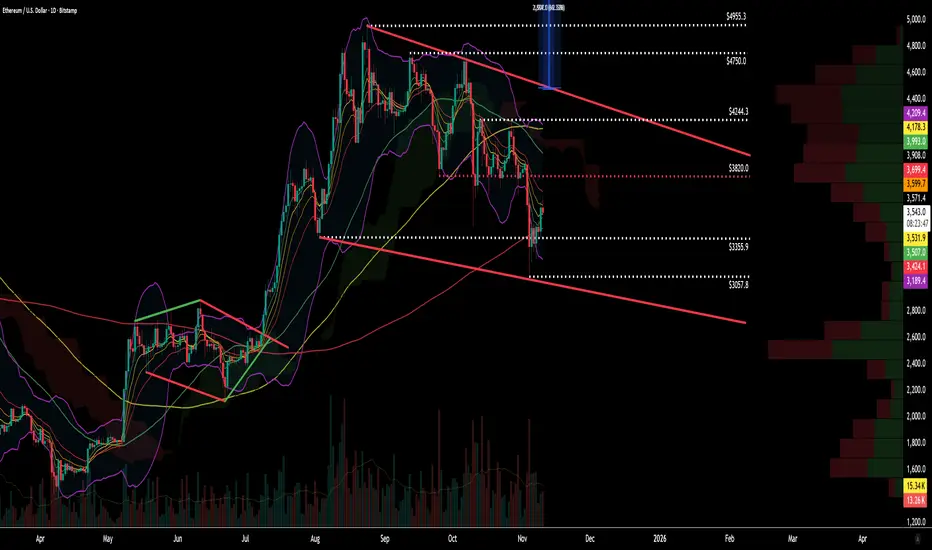
$ETH – Bull Flag Formation & Major Structural SetupSince the Liberation Day Tariffs on April 7th, Ethereum ( CRYPTOCAP:ETH ) has rallied over +257%, peaking in late August before entering a consolidation phase. The structure of this chart has shifted multiple times throughout the year, each time forming new continuation and reversal patterns that have defined the broader trend. Pattern Evolution 1️⃣ Diamond Continuation (May – July) Between May and July, CRYPTOCAP:ETH printed a Diamond formation, which often behaves similarly to a symmetrical triangle. The breakout from this pattern came with high volume participation, fueling a sharp rally into late August. 2️⃣ Descending Triangle Breakdown (August – October) From August through late October, the trend shifted. A Descending Triangle formed, breaking below key support around $3,820. However, the breakdown failed to achieve its full 1:1 measured move target at $2,675, instead reversing after setting a new low confirmed by a significant volume spike — the highest in nearly a month. 3️⃣ Emerging Bull Flag (August – November) Since early November, the chart has morphed into a large Bull Flag, encapsulating the entire consolidation since August. This structure includes multiple resistance layers above, but the consolidation is tightening and volume contracting, typically a precursor to a major breakout attempt. The measured move projections of both the flagpole and the flag itself point to a substantial upside once price escapes the channel. Key Resistance & Support Levels Resistance: $3,820: Former Descending Triangle support, now acting as resistance $4,244–$4,245: Major confluence zone at prior swing highs $4,750: Upper extension of the flag structure $4,955: August rally high Support: $3,356–$3,355: Mid-flag support / prior reaction level $3,058–$3,057: Lower flag support / key technical base Technical Summary ✅ Pattern: Diamond → Descending Triangle → Bull Flag ✅ Trend: Broad uptrend consolidating within flag formation 📊 Key Resistance Zones: $3,820 → $4,245 → $4,750 ⚠️ Support Zones: $3,355 → $3,057 🎯 Targets: • Flag projection: $6,390 • Flagpole projection: $7,309 🔍 Trigger: Break and close above $3,820 with expanding volume for early confirmation Final Notes Ethereum remains one of the strongest structural setups in the current crypto cycle — consolidating after a multi-month rally and holding well above its mid-year breakout zone. The bull flag pattern forming across the August–November range has now become the key structure to watch. A confirmed breakout above $3,820, accompanied by rising volume and broad market strength, could trigger a measured continuation move toward $6,000+. Conversely, a rejection at resistance or breakdown below $3,055 would invalidate the flag and risk a retest of the lower trendline near $2,800. Overall, momentum remains constructive, and CRYPTOCAP:ETH continues to build a powerful base for potential long-term continuation once the current compression resolves. For educational and technical analysis purposes only.Longby linzid4
ETH Top Break down Tarhet $ 30000.- to $2500.- betwee 38.2 50ETH Top Break down Tarhet $ 30000.- to $2500.- between 38.2 50 Not for short but accumulation.Shortby mmaccsUpdated 110
#ETH/USDT Ethereum analysis#ETH The price is moving within an ascending channel on the 1-hour timeframe and is adhering to it well. It is poised to break out strongly and retest the channel. We have a downtrend line on the RSI indicator that is about to break and retest, which supports the upward move. There is a key support zone in green at the 3350 price level, representing a strong support point. We have a trend of consolidation above the 100-period moving average. Entry price: 3397 First target: 3445 Second target: 3502 Third target: 3570 Don't forget a simple money management rule: Place your stop-loss order below the green support zone. Once the first target is reached, save some money and then change your stop-loss order to an entry order. For any questions, please leave a comment. Thank you.Longby CryptoAnalystSignalUpdated 10
ETHUSD 1H | Bullish Continuation Setup🟢 Market Structure Price holding above key support at 3,600 4H sell-side liquidity taken below Bullish structure intact with higher lows 🔵 Key Support Levels Immediate Support: 3,600 - 3,610 (current zone) Primary Support: 3,583 - 3,594 (consolidation base) Strong Support: 3,549 (momentum defense) 🎯 Entry Zones & Targets 🟡 Primary Entry: 3,605 - 3,615 (current retest) 🟠 Secondary Entry: 3,583 - 3,594 (deeper retest) 🔴 Stop Loss: Below 3,548 (support break) 💰 Take Profit Targets TP1: 3,637 - 3,650 (immediate resistance) TP2: 3,700 - 3,720 (momentum extension) TP3: 3,800 - 3,856 (liquidity zone) ⚡ Trade Management Scale entries on support retests Move SL to breakeven at TP1 Partial profits at each target Bullish continuation expected - buying dips toward support #ETH #Ethereum #TradingView #Bullish #CryptoLongby origami_capital333
ETH/USD Bearish breakdown selling strong📉 ETH/USD Update – Technical Breakdown Alert After facing strong resistance around $3,450, Ethereum (ETH/USD) has confirmed a bullish trend breakdown, now moving into a strong downtrend on the 15-minute timeframe. 🔹 Resistance: $3,450 🔹 Immediate Supports: $3,275 $3,175 $3,101 ⚠️ Technical Outlook: Selling pressure is increasing as ETH fails to sustain above resistance. Price action suggests further downside potential if support zones fail to hold. 💡 Trading Tip: Maintain strict risk management — use stop losses and manage position size carefully. 📊 Trend: Bearish (short-term) 🕒 Timeframe: 15 Min Like 👍 | Follow 🔔 | Comment 💬 | Share 🔁 Stay updated with real-time crypto insights!Shortby ExpertTraderASKUpdated 6611
#ETHUSD can see one more leg lower?BINANCE:ETHUSD We believe ETHUSD can see one more push lower to complete pending move in #BTCUSD, it looks risky as crypto on high bullish trend. Can play small quantity and see if it could turn out. Or Safe traders can accumulate ETHUSD if it makes one more push lower.Short01:00by Ravi_BullvsBears2
ETHUSDUncertain how far down this ledgendary crypto will fall... But I think we just locked in the top @ ~$3656.Shortby ovvnyou5
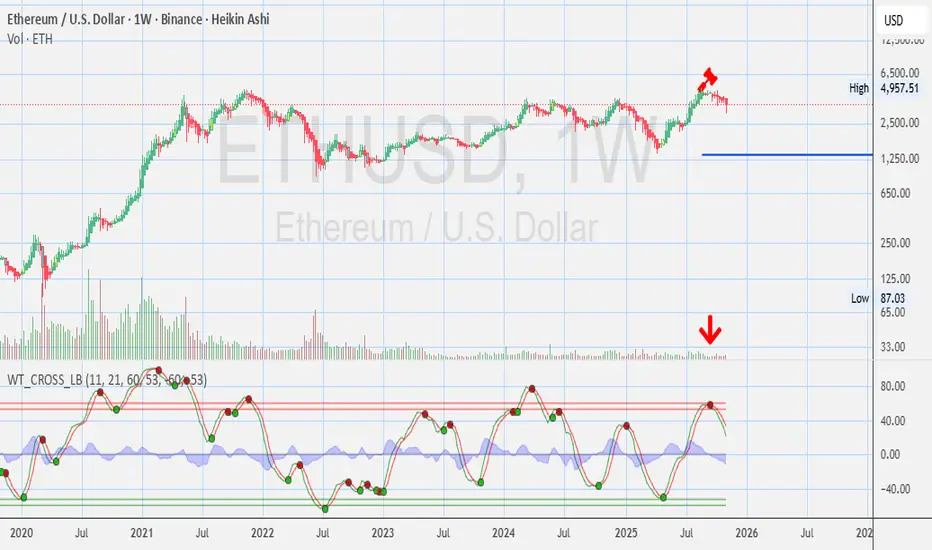
ETH - Ethereum Weekly Chart - Opinions? Disclosures : This analysis is for informational purposes only and is not financial advice. It does not constitute a recommendation to buy, sell, or trade any securities, cryptocurrencies, or stocks. Trading involves significant risk, and you should consult with a qualified financial advisor before making any investment decisions. Past performance is not indicative of future results. Always DYORShortby CryptoChartDaily3
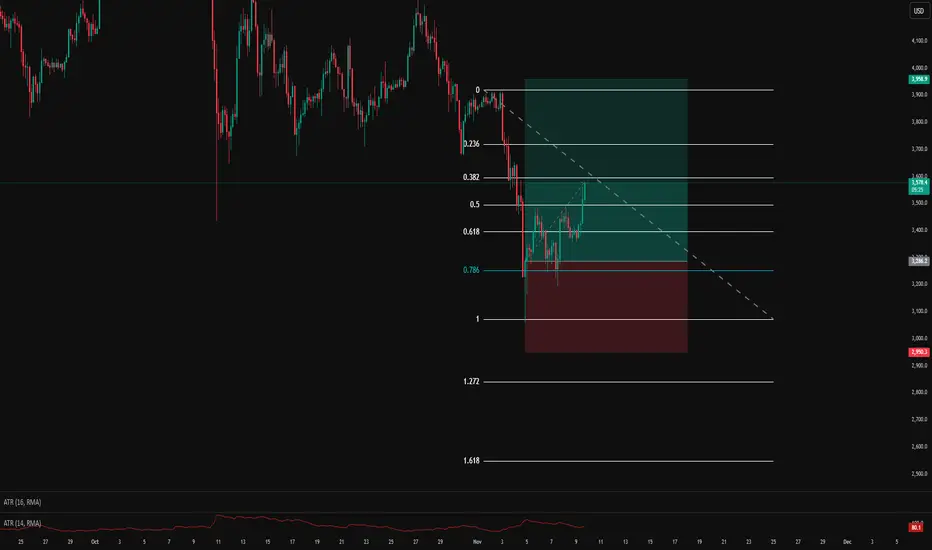
Coinciding with Bitcoin, it's time for an upsurge.We entered a buy order on Ethereum after observing oversold conditions on the Relative Strength Index (RSI), coinciding with oversold conditions on Bitcoin. A buy signal was formed between bars, and based on the volatility calculation using ATR, the take-profit and stop-loss levels were determined. Good luck to everyone.Longby fadibkmail0
$ETH Before the parabolic expansion.ETH is once again in a similar technical structure to that seen before its parabolic run in 2020. As was the case then, the falling trend breakout and subsequent retest phase are now complete. As seen previously, the RSI is still holding above the 50 level, clearly indicating that momentum continues in a positive direction. The structure is clear in both linear and stick bar charts. The trend has broken, the retest is happening, and Ethereum is on the verge of a major expansion movement.Longby EtherNasyonaLUpdated 20
ETHUSDMultiple options, same ledge. I'm thinking short term top is in and ETH to $1000 or less. Good luck.Shortby ovvnyou2
Ethereum at a CrossroadsThe chart shows ETH/USD on the daily timeframe, illustrating a clear Cup & Handle pattern formation. This structure typically signals a continuation of a long-term uptrend, but a short-term correction remains possible before any major breakout. Short-Term Outlook (next 2–3 months) Ethereum is currently trading around $3,500, having faced strong resistance near $4,800. The 50-day SMA around $4,000 is acting as a resistance level as well. Likely short-term scenario: Continued correction toward the $3,200–$2,800 support zone If $3,200 breaks: The next major support sits near $2,400 If $3,200 holds and ETH reclaims $4,000: A retest of $4,800 becomes likely Target (bullish): $4,500–$4,800 Stop-loss: Below $3,000 Long-Term Outlook (late 2025 to 2026) The broader cup pattern suggests that once ETH breaks above $4,800 and confirms it as support, a powerful long-term rally could begin. That level coincides with the previous all-time high from 2021, making it a critical breakout zone. If $4,800 is broken and held: Upside targets are $5,800 and $6,400 If $2,400 fails: The bullish structure breaks down, opening the way for a deeper decline toward $1,800–$1,600 Target (bullish): $5,800–$6,400 Stop-loss: Below $2,400 Summary Market is at a decision point: Break above $4,800 → strong bullish continuation to new highs Drop below $3,200 → deeper correction toward $2,400Longby isahebdadi11
ETH is at support and stay away from unscrupulous exchangesETH is currently at the support level and can consider buying if it stands at 3659. NOTE: Stay away from unscrupulous exchanges like bitfi**x . I was about 1.7x long and lost 130% at 10.11. The spot wallet was also frozen and taken over. The following doubts reported multiple times were ignored: - The closing price given by historical orders cannot calculate the actual loss. After asking customer service many times, a new price was given that was 70% lower than the closing price and much lower than the lowest price of the day . This behavior was simply shameless and completely a black box illegal operation! - The official documentation clearly states that if the price changes too fast resulting in negative equity, the losses will not all be borne by the trader, but it is actually a lie ! Summary: Exchanges are not trustworthy, do not use leverage on exchanges, margin trading is not gambling, it is fraud ! Take this as a warning!Longby falsechair778
ETH QuantSignals V3 Crypto 2025-11-09ETH QuantSignals V3 Crypto 2025-11-09 ETH Crypto Signal | 2025-11-09 • Direction: NEUTRAL | Confidence: 65% (Katy AI) • Timeframe: 15M • Volume vs Avg: 1.0× • Recent Move: +2.36% ⚖️ Compliance: Educational crypto commentary for QS Premium. Not financial advice. 🚀 QS V3 ELITE CRYPTO ANALYSIS Generated: 2025-11-09 07:58:31 UTC Instrument: ETH ($3519.337500) Trend: BULLISH Confidence: 50.0% Timeframe: 15M Model: QS + Katy AI Strictness: MEDIUM 🎯 TRADE RECOMMENDATION Direction: NO TRADE - WAIT FOR CLEARER DIRECTION Confidence: 50% Conviction Level: LOW Leverage: No leverage recommended 🧠 ANALYSIS SUMMARY Katy AI Signal: Sideways trend with 65% confidence, predicting minimal price movement over 120-minute horizon Technical Analysis: Current price $3519.34 shows +2.36% recent move but facing resistance at $3533 level. Multi-timeframe conflict between bullish recent move and neutral bias with -15% confidence score News Sentiment: Moderate impact from weekly reports with no clear directional catalysts. Historical weekly data shows consistent moderate impact without recent breaking news Options Flow: Limited unusual activity detected. Institutional positioning appears neutral with balanced P/C ratios Risk Level: HIGH due to conflicting signals and low AI confidence 💰 TRADE SETUP Entry Price: No entry recommended - wait for breakout above $3540 or below $3490 Take Profit 1: N/A Take Profit 2: N/A Stop Loss: N/A Position Size: 0% of capital - await clearer directional confirmation ⚡ COMPETITIVE EDGE Why This Trade: Superior risk avoidance by recognizing conflicting signals and low-confidence environment Timing Advantage: Avoiding entry during sideways consolidation prevents whipsaw losses Risk Mitigation: Strict adherence to confidence thresholds prevents low-probability trades Leverage Strategy: Zero leverage during uncertain market conditions # Image QS Analyst APP — 7:58 AM 🚨 IMPORTANT NOTES 🔴 HIGH RISK ENVIRONMENT - Multiple conflicting signals detected. Katy AI shows sideways prediction with only 65% confidence while technicals show bullish recent move but neutral bias. Recommended to wait for clear breakout direction with higher conviction. ⚠️ KATY CONFLICT EXPLANATION CONFLICT DETECTED: While Katy predicts sideways movement (neutral), the recent price action shows +2.36% bullish move creating directional ambiguity. Katy predicted sideways trend with 65% confidence and minimal price change Override rationale: Multiple timeframe conflict (-15% confidence score) suggests unreliable directional bias Justifying factors: Low composite score (+0.5), volume at average levels, and absence of strong catalysts Additional risk: Entering any position during this conflict carries elevated risk of false breakout RECOMMENDATION: Wait for Katy confidence above 70% or clear technical breakout before considering position entry. Current environment unsuitable for institutional-grade trading. --- QS V3 Crypto Strategy System - Professional cryptocurrency trading with Katy AI intelligence and 24/7 market analysis.Longby quantsignals1
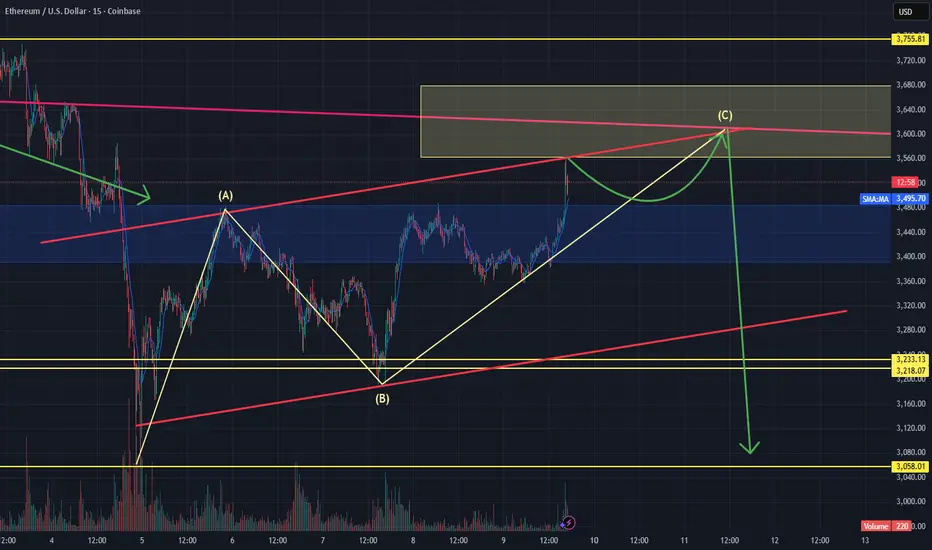
ETHUSD to complete ABC consolidationETHUSD seems to want complete the ABC consolidation in the down trend and should break south of the rising channel. Selling at C seems like a good idea to me!Shortby baherhosni2211
ETHUSDAs shown by my other posts, I've been anticipating a second black swan event, similar to 2020. I believe this will be the final one of its kind for our generation... I will not be shorting anything other than Ethereum. I think everyone that has a crypto as an investment, has ETH. Nobody knows why they have ETH, other than that it's good. I'm not saying ETH isn't good, it is, but almost nobody hold ETH actually knows why, other than they've heard that it's good. For this reason, I believe when the selling begins, Ethereum will be one of the hardest hit assets, but have the most smooth selloff (minimal wicks). I have concentrated my efforts here, for a continuous trigger-short strategy.Shortby ovvnyou2
$ETHUSD: a less bearish countCRYPTOCAP:ETH can be interpreted as having WXY complex correction. W and X are completed. Y is a flat abc with C currently in progress. C wave has 5-waves. 1, 2, 3 are completed and Wave 4 is shaping up to be a triangle. When this finishes, wave 5 should take us to a new local low, where the correction will finally end.by HeadsUp20210
ETH 11/8T.A explained - BackSide (BS) FrontSide (FS) Inverse BS (Inv.BS) Inverse FS (Inv.FS) BS & FS levels are expected support when dashed lines, tested when dotted and resistance when solid lines. The inverse is true for the Inv. BS Inv. FS levels, they are resistance as dashed lines, tested as dotted and support as solid lines. Monthly timeframe is color pink weekly grey daily is red 4hr is orange 1hr is yellow 15min is blue 5min is green if they are shown. strength favors the higher timeframe. 2x dotted levels are origin levels where trends have or will originate. When trends break, price will target the origin of the trend. its math, when the trend breaks, the vertex breaks too so the higher timeframe level/trend that breaks, the more volatility there could be as strength in the orders flow in to fuel the move.by StudyGuideTAUpdated 0