GBPJPY – Bearish Continuation After Structure Break GBPJPY has OANDA:GBPJPY has shown a decisive break below its short-term ascending structure, signaling a potential shift from bullish correction to bearish continuation. The pair recently broke beneath the trendline support and retested the previous supply area near 200.90, which aligns with a lower high formation.
As long as the price holds below this zone, bearish momentum is expected to extend toward the next demand region around 198.20. A clean rejection from the 200.90–201.00 area could confirm sellers’ control, while a sustained break above 201.50 would invalidate the bearish setup.
Key levels:
🔹 Resistance: 200.90 – 201.50
🔹 Support: 198.20
🔹 Bias: Bearish continuation
British Pound / Japanese Yen
No trades
Market insights
GBPJPY stays in correction before rising to 205.GBPJPY stays in correction before rising to 205.
The GBPJPY pair, chart on the 1-hour timeframe, appears to be preparing for another potential bullish movement.
From our previous analysis, the price is showing signs of correction. The chart suggests that GBPJPY may form a minor consolidation before resuming its upward trend.
A quick target can be seen around 203.20, where short-term resistance is located. If bullish momentum continues, the price could extend higher toward 204.00 and possibly 205.00, aligning with the broader resistance levels from previous market structures.
You may find more details in the chart!
Thank you and Good Luck!
❤️PS: Please support with a like or comment if you find this analysis useful for your trading day❤️
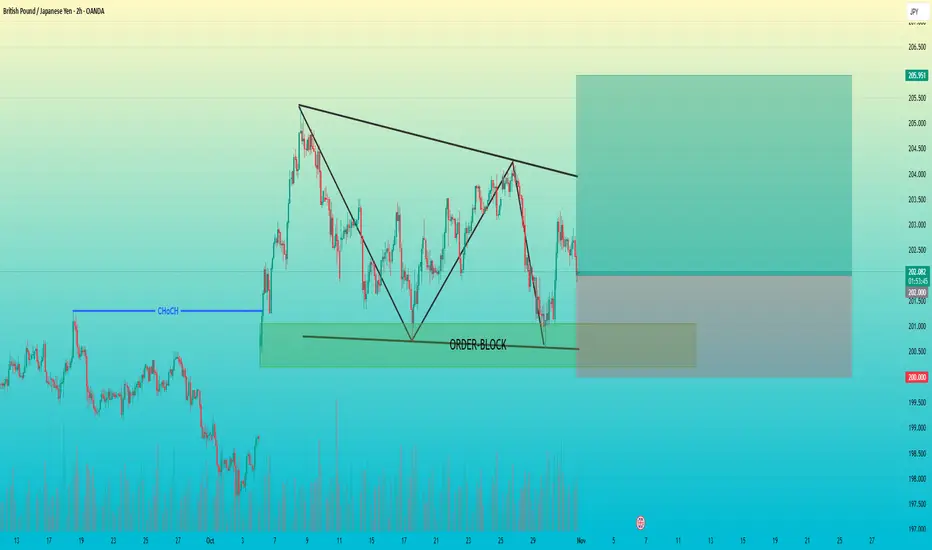
GBPJPY – Order Block + CHoCH+ Falling wedge = Reversal SetupTimeframe: 2H
Pair: GBPJPY
📊 Analysis:
The market recently showed a CHoCH (Change of Character), indicating a potential shift from bearish to bullish structure.
A clean bullish Order Block has formed near the previous demand zone, aligning with structure support.
Price is currently retracing toward the Order Block zone, offering a potential buy setup for continuation.
📈 Trade Plan:
Entry Zone: CMP or safe entry Inside Order Block area
Stop Loss: Below the OB low (around 200.00)
Target: 206.00
Risk to Reward: Approx. 1 : 2
⚠️ Notes:
Maintain proper risk management.
Setup remains valid until price breaks below the Order Block zone.
GBP/JPY) Bearish trend analysis Read The captionSMC Trading point update
Technical analysis of GBP/JPY 1H chart you shared
---
Overall Bias: Bearish
The market structure shows consistent lower highs and lower lows, respecting a descending channel. The price remains below the 50 EMA and 200 EMA, confirming bearish pressure.
---
Technical Breakdown:
1. Trendline Resistance & Supply Zone
Price is reacting from a descending trendline confluence area with a Fibonacci retracement (0.62–0.79 zone).
The rejection from this zone aligns with the prior bearish order block, acting as a supply region (marked in blue).
2. EMA Confluence
The 50 EMA (201.7) and 200 EMA (202.3) are both above current price — bearish alignment.
The 200 EMA coincides with the upper limit of the correction zone, reinforcing it as a strong resistance area.
3. Fibonacci Levels
Price likely to pull back into the 0.62–0.79 retracement area, where sellers may step back in.
The next bearish leg is expected to extend to the 0 Fibonacci level, or the projected target point around 198.726.
4. Market Structure Expectation
After completing the minor corrective move (B wave), structure suggests a C-wave drop or continuation leg downwards.
The internal liquidity sweep near 201.7–202.0 could be the last liquidity grab before the next bearish impulse.
---
Trade Plan Idea:
Entry Zone: 201.700 – 202.300
Confirmation: Bearish rejection candle or break of minor structure
Stop-Loss: Above 202.600 (beyond 0.79 retracement and EMA resistance)
Take-Profit:
TP1: 200.000 (psychological level)
TP2: 198.726 (target zone)
---
Notes:
Wait for price to tap into the supply zone and show rejection before entering.
Watch for fakeouts above the 0.79 level, as liquidity may be grabbed before the true drop.
Maintain proper risk management (1–2%).
Mr SMC Trading point
Summary:
GBP/JPY is likely to complete a small corrective rally into the 201.7–202.3 resistance zone, then continue its bearish trend toward 198.7. The structure, EMA alignment, and Fibonacci confluence all support this bearish scenario.
Please support boost 🚀 this analysis
GBPJPY – 15M Chart: Possible Reversal Setting UpGood morning,
We’ve got a hammer reversal pattern forming after a large impulsive move down — early signs that sellers may be losing strength.
Momentum is low and divergent, and structure looks like it’s rejecting this support area.
Now we wait for volume to rise above 75 (ideally 80+) to confirm the shift and bring full VMS alignment.
Patience pays — the setup is building, not ready yet.
#GBPJPY #ForexAcademy #VMS #ForexTrading #AlignedExecution #ReversalSetup
GBP/JPY looking bullish from key support area📊 GBP/JPY Bullish Forecast 🇬🇧💴
The pair is showing strong bullish momentum from the key support zone around 202.200 🔥
📈 Technical Outlook (4H Timeframe)
🎯 1st Target: 203.300
📍 Price holding above key support confirms potential upside continuation.
💡 Trade Idea:
Buy from dips near 202.200 zone with proper risk management in place ✅
⚠️ Risk Management is Key! Always use SL & manage your position wisely.
📅 Timeframe: 4H
#GBPJPY #ForexAnalysis #PriceAction #FXTrading
💬 Like 👍 | 💭 Comment 💡 | 🔁 Share to support the community!
GBPJPYExpecting overall bullish momentum to continue whilst taking short term sells for price to reach HTF demand zone before bullish momentum continues.
Overall GBPJPY bullish becuase:
- Interest rate differential. UK rates are higher than JPY. therefor higher yields being offered so more investor inflow in GBP. even though UK is on cutting cycle & JPY is on hiking cycle, there is still massive interest rate gap between them.
-Trade war optimism. Most of the deals have been finalised with optism coming in now from both sides. therefor less demand for JPY as a safe haven now.
GBPJPY: a racehorse ready to burst higher.GBPJPY: a racehorse ready to burst higher.
Fundamental Analysis
Among the negative factors affecting both currencies, the pound outperforms the yen due to three key angles.
1. Monetary Policy Influence
BoE: Likely to hold rates; policy stability plus firm wage/inflation backdrop is GBP-supportive.
BoJ: Stays dovish, maintaining low yield; wider yield gap favors GBP over JPY.
2. Fiscal Stability Signals
UK: The UK faces a challenging path to fiscal discipline, but a renewed commitment could lend modest support to the pound.
Japan: By contrast, Japan’s new PM’s tilt toward stimulus may pressure the yen and complicate the BoJ’s tightening cycle.
3. Economic Data Momentum
UK: Slightly positive labor, retail, and wage prints bolster GBP fundamentals.
Japan: Soft growth and accelerated inflation may keep JPY subdued unless global risk-off returns.
In summary, the combination of an expected BoE hold, Japan's ongoing pro-stimulus stance, improved UK data, and investor positioning should favor pound appreciation against yen.
Technical Analysis
4. GBPJPY dipped to retest the previous low and then rebounded, forming a pennant pattern (continuation pattern). Overall, the price is sideways within an ascending channel, with EMAs bullish stacked pointing to a short-term sideways within a larger uptrend. In other words, the price accumulates in a narrowing range awaiting a bullish breakout.
5. If GBPJPY breaks above the pattern’s upper boundary, it triggers a trend following signal, aiming at the ascending channel’s upper boundary. A surge beyond the upper bound may target the flag pattern target around 208.50
6. However, a plunge below the channel would signal a bearish reversal and require a reassessment of the whole view.
Analysis by: Krisada Yoonaisil, Financial Markets Strategist at Exness
GBPJPY November 2025 fundamental analysisBritish Pound (GBP): Stagflation Amid Rate Cuts and Fiscal Concerns
Monetary Policy Trajectory
The Bank of England faces mounting pressure to deliver another rate cut in November, with markets pricing in approximately 75% probability of a 25 basis point reduction. This follows September's inflation reading of 3.8% year-on-year (below the 4.0% consensus) and a surprise uptick in unemployment to 4.5%. Current projections suggest interest rates will decline to around 3.75% by the close of 2025, with two additional reductions anticipated in 2026, eventually bringing rates to approximately 3.25% over the medium term.
Economic Challenges
The UK confronts what economists describe as "the most stagflationary economy in the developed world"—a brutal combination of high inflation, weak growth, and rising unemployment. The upcoming Autumn Budget on November 26 represents a critical inflection point, with Finance Minister Rachel Reeves under pressure to balance fiscal responsibility against growth imperatives.
Services inflation remains elevated at 4.7%, while core CPI sits at 3.5%, both above the BoE's comfort zone. The labor market is softening, which could prompt the BoE to ease despite persistent inflation concerns. However, some MPC members have expressed caution about reducing rates too rapidly, creating policy uncertainty.
November Outlook: Bearish
The pound's trajectory is decidedly negative for November. The expected BoE rate cut, combined with fiscal tightening signals from the Autumn Budget, creates a challenging environment. GBP/USD forecasts suggest range-bound trading between 1.32-1.38, with downside risks predominating. Against the euro, the pound has already weakened to 0.8765, approaching key support levels. Analysts at RBC Brewin Dolphin note that much of the pound's recent upward movement is actually "more to do with underlying dollar weakness than faith in sterling itself".
Japanese Yen (JPY): Political Dovishness Delays Normalization
Bank of Japan: Divided Board, Delayed Tightening
The Bank of Japan kept its benchmark short-term rate unchanged at 0.5% at its October meeting, as widely expected, but the decision revealed significant internal division. The vote split 7-2, with board members Naoki Tamura and Hajime Takata advocating for a hike to 0.75%, repeating their stance from the September meeting. Takata argued that "now is the appropriate time to raise interest rates," noting that inflation has remained above the bank's target for three and a half years, while Tamura called for moving toward neutral rates.
Despite these hawkish voices, Governor Kazuo Ueda maintained a cautious approach, emphasizing that the BoJ would continue with policy normalization "once its economic projections are met" but warning that global trade policies could slow growth and hurt corporate profits. The central bank reiterated its inflation outlook, projecting core CPI at 2.7% in 2025, 1.8% in 2026, and 2.0% in 2027, while raising 2025 growth forecasts slightly to 0.7%.
Political Constraints: The Takaichi Factor
The election of Sanae Takaichi as Prime Minister in mid-October significantly altered the trajectory of BoJ policy expectations. Takaichi, known as a fiscal dove who favors expansionary fiscal measures and loose monetary policy, has complicated the path toward further tightening. Following her election, the yen depreciated more than 2% against the USD, and market expectations for an October rate hike evaporated.
The new government's support for accommodative policy creates a political constraint on the BoJ's normalization efforts, even as some policymakers argue for immediate rate hikes. US Treasury Secretary Scott Bessent has urged the BoJ to accelerate rate hikes to prevent excessive yen depreciation, adding external pressure to the central bank's considerations. Markets now assign only a 47% chance of a December rate hike, with consensus building around a delayed move to early 2026.
November Outlook: Persistent Weakness Despite Normalization Promise
The Japanese Yen carries a weak fundamental outlook for November, reflected in its trading near 154 per USD—nine-month lows and close to the 37-week low of 153.28. The currency has weakened more than 4% in October alone, making it one of the worst G10 performers. Despite some hawkish board members and the BoJ's stated intention to continue normalization, the dovish political environment and cautious central bank approach leave the yen vulnerable.
The 3.25% interest rate differential with the USD remains a key driver supporting USD/JPY carry trades, though this spread is expected to compress toward 2.5% as the Fed continues cutting while the BoJ only gradually raises rates. While this compression could eventually support the yen, the timeline remains uncertain—potentially extending into 2026 rather than materializing in November. Technical analysis suggests immediate support near 151.73 (21-day average) with the next level around 150.11 (50-day average), but resistance looms at 154.80 and potentially 155 if the BoJ remains dovish. For November, the yen is expected to remain under pressure against most major currencies, while showing marginal strength only versus the aggressively easing NZD.
Verdict
JPY has had a very hard time against any of the other major currencies this year. Even the ailing GBP finds itself in the better positions going into November. GBP/JPY is a BUY .
GBPJPY BEARISH BIASMarket Context:
Price is currently consolidating below a key supply zone (203.500–204.400) after multiple failed attempts to push higher. A bearish move is developing as liquidity builds above the most recent high. The market may be preparing for a deeper correction toward the unmitigated FVG (Fair Value Gap) around 200.200.
⸻
Key Zones
• Supply Zone: 203.500 – 204.400 (potential reversal area)
• Liquidity Zone: Above 204.000 (inducement for sellers)
• Target Area: 200.200 – 200.500 (FVG zone)
• Current Price: 202.226
⸻
Trade Scenarios
Scenario A (Inducement Play):
• Expect price to retest the 203.500–204.400 area to grab liquidity.
• Look for bearish rejection or change of character on lower timeframes.
• Target: 200.200 (FVG zone)
• Stop-loss: Above 204.500
Scenario B (Direct Continuation):
• If price fails to retrace, look for momentum break below 201.800.
• Enter on retest confirmation.
• Target: 200.200 zone
• Stop-loss: Above 202.900
⸻
Summary
📉 Bias: Bearish — expecting continuation toward the Fair Value Gap.
⚠️ Note: Wait for confirmation from 4H/1H timeframe before execution.
💡 Mindset: “Smart traders wait for liquidity; impulsive traders become it.”
GBPJPY | Accumulation in Demand Zone – Targeting Buy Side LiquidGBPJPY is holding strong above the demand zone (201.90–202.20), showing potential signs of smart money accumulation before a liquidity grab to the upside. Price is now approaching an intraday supply area where liquidity is stacked above equal highs.
Trade Outlook:
Demand Zone: 201.90–202.20
Short-term Target: 202.91 (Buy-side liquidity)
Extended Target: 203.16
Bias: Bullish while above 202.00
Setup: Wait for a BOS + retracement entry from discount zone
⚙️ Concepts: Smart Money | Liquidity Grab | Demand Zone Reaction | Market Structure Shift