RECAP TODAY. USING THE SIGNALS AND TOOLS Fellow traders - followers,
I have some today to recap on the day.
Now I will say this. Today went the way they said it would go UP! All the overnight new, the morning media and the tech headlines all made today a profitable day for the bulls! I will also say this: it is a scary situation, because we have no resistance levels up here, so where does all this up trend movement stop? What do we know or where to put our stop losses?
In building these indicators, I'm learning a few things. I'm learning more about myself and about what to look for exactly. There will be days where I will lose. Just like Friday: -$280! The price action was just not as consistent and friendly like it was today.
Let me break down today:
1. I attached the 5min chart to show you what the " Golden Pocket " of my indicator resembles.
A confirmation of price action and direction.
It reacted perfectly. 10:15am Bear candle - 10:20am Bull Doji inside pocket - 10:30am Engulfing Bull candle with a long signal! You couldn't ask for a better set up to the upside to make your money!
2. The 15min time frame was a little more of a bulky solid read. Bull candles with wicks.
The 10:15am candle carried the long signal with it. The wick within that candle was our 5min candles playing out.
Weather you waited for the 15min plays or you entered in the 5mins. You won.
3. So, with all this, there is another indicator I play. That is my 0dte Context bundle. How this works in our favor is that in this specific situation you want to make sure your trends are moving where they need to go. The EMA, SMA and VWAP lines all had same up direction. The Green EMA/SMA Cloud all indicated up is where it's going.
You have the tools to assist in decisions. If you need more help with reading these indicators. Let me know. I'm always down to help out.
Patient is still key. Confirmations are still key. Remember that when trading. Do not get antsy and enter in trades that are not strong or that will not check all your entry boxes.
Thank you again for the follows and the support. I hope these are helpful.
God Bless,
Trades with B!
Market insights
QQQ: Double Gap: Continuation or Exhaustion?QQQ has printed two consecutive upside gaps on the daily chart, signaling strong momentum but context matters. Back-to-back gaps this late in a trend often mark a climactic phase, especially when dollar liquidity is tightening.
Possible Interpretations
Runaway and Measuring Gap:
The first gap confirms a breakout. The second marks the midpoint of a continuing move. Price holds above both gaps and volume stays steady.
Runaway and Exhaustion Gap:
The first gap signals continuation. The second marks the final surge before reversal. Volume spikes, RSI overheats, and price slips back into the second gap within a few sessions.
Macro Backdrop
Widening SOFR–OIS spreads suggest a dollar funding shortage and tighter liquidity, a backdrop where exhaustion gaps are more likely. Similar setups in late 2018 and early 2020 preceded sharp pullbacks after euphoric double gaps.
Key Levels
Holding above 628 keeps the structure constructive. A close below 622 would confirm exhaustion and open a potential retrace toward the 600-level volume shelf.
Takeaway
Momentum remains strong, but two gaps in a row during liquidity stress often mark the final push, not the start of a new leg. Watch the gap lows closely; liquidity will decide whether this move runs or reverses.
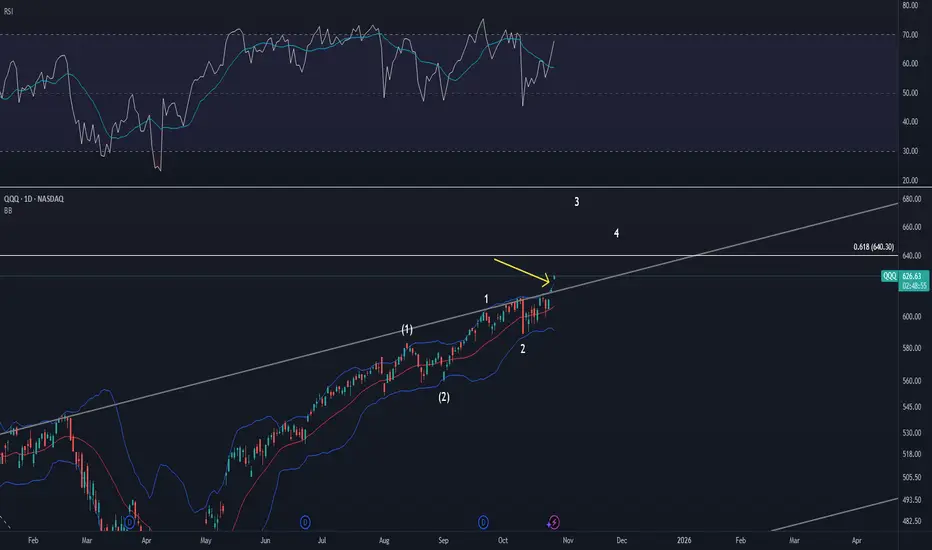
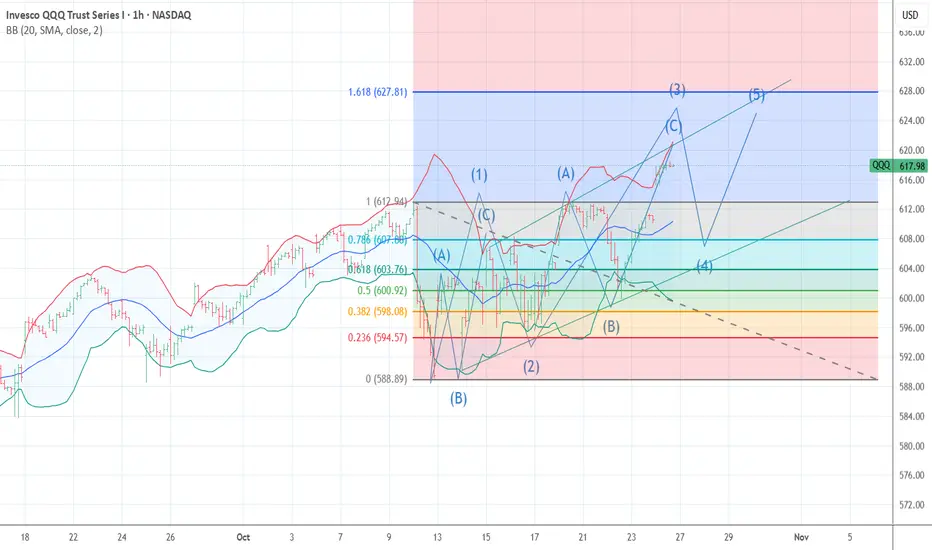
Lockout rally in wave 3 of (3)Oct 27's daily candle is significant because it's the first time that bursts out of the daily Bollinger Band and remains outside. This is typical action for wave 3 of (3). Full-on lockout rally mode. Any pull back will retest the outside of the band. I believe another gap up tomorrow.
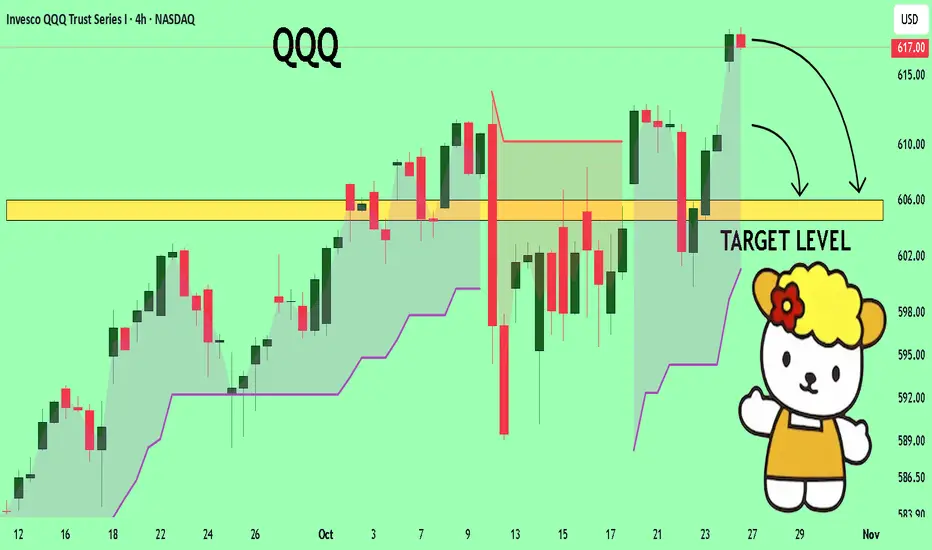
QQQ Will Collapse! SELL!
My dear followers,
I analysed this chart on QQQ and concluded the following:
The market is trading on 617.00 pivot level.
Bias - Bearish
Technical Indicators: Both Super Trend & Pivot HL indicate a highly probable Bearish continuation.
Target - 605.94
About Used Indicators:
A super-trend indicator is plotted on either above or below the closing price to signal a buy or sell. The indicator changes color, based on whether or not you should be buying. If the super-trend indicator moves below the closing price, the indicator turns green, and it signals an entry point or points to buy.
Disclosure: I am part of Trade Nation's Influencer program and receive a monthly fee for using their TradingView charts in my analysis.
———————————
WISH YOU ALL LUCK
QQQ: Runaway or Exhaustion Gap?QQQ just printed a strong bullish gap on the daily chart, but context suggests caution. With widening SOFR spreads signaling a dollar funding shortage, this move may represent an exhaustion gap rather than a continuation breakout.
Runaway Gap Characteristics
Mid-trend breakout with moderate volume
Price holds above the gap for several sessions
Liquidity and macro conditions remain supportive
Exhaustion Gap Characteristics
Occurs after an extended trend
Large gap accompanied by a volume spike
Fails to hold above the gap and quickly reverses
Macro Context
SOFR–OIS spreads are widening, pointing to tightening dollar liquidity.
Similar conditions in Q4 2018 and February 2020 preceded major reversals in QQQ as funding stress reduced leverage and weakened follow-through in risk assets.
Current Read
Estimated odds: 35 percent runaway, 65 percent exhaustion.
A close below the gap low or a rapid fill within a few sessions confirms exhaustion.
Sustained price strength on steady volume favors continuation.
What to Watch
SOFR–OIS spread trend next week
Dollar index strength and its correlation with QQQ
Volume and RSI behavior near the gap zone
Bottom line:
This gap looks bullish on the surface, but underlying liquidity stress could turn it into a final pop before a corrective phase. Monitor liquidity data before assuming a continuation.
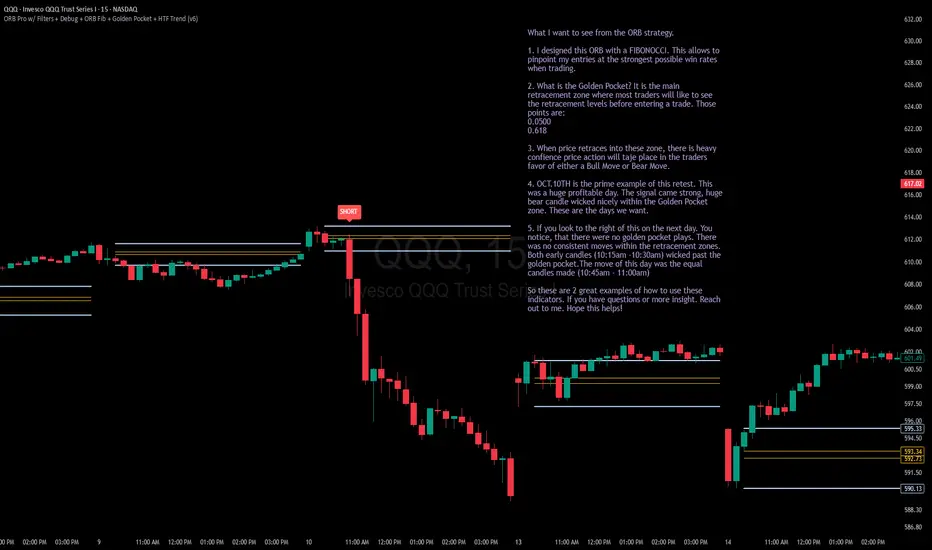
Some notes to reflect on. A little how to for the indicatorHey everyone,
Hope you guys & gals are doing well using these indicators. I'm publishing a chart that I wrote some notes for. Notes are offering some insight on what look for when using this indicator. If you have any questions, let me know. I am planning to get videos up soon when I get some extra free time.
Thank you again for the support!
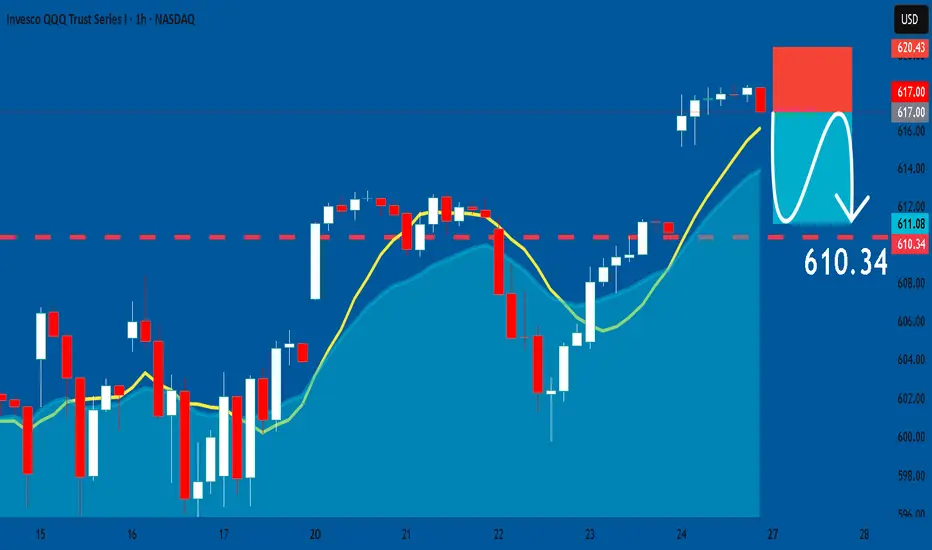
QQQ: Short Trading Opportunity
QQQ
- Classic bearish formation
- Our team expects fall
SUGGESTED TRADE:
Swing Trade
Sell QQQ
Entry Level - 617.00
Sl -620.43
Tp - 610.34
Our Risk - 1%
Start protection of your profits from lower levels
Disclosure: I am part of Trade Nation's Influencer program and receive a monthly fee for using their TradingView charts in my analysis.
❤️ Please, support our work with like & comment! ❤️
Developed Market and Emerging MarketIntroduction
The global economy is an interconnected network of nations at different stages of economic development. These stages are generally categorized into developed markets, emerging markets, and frontier markets. Among them, developed and emerging markets play the most significant roles in shaping international trade, investment flows, and financial stability. Understanding these two categories is essential for investors, policymakers, and economists who analyze global financial dynamics, risk profiles, and growth opportunities.
Developed markets represent mature, advanced economies with strong industrial bases, high income per capita, and stable political systems. Emerging markets, on the other hand, are countries in the process of industrialization and modernization, showing rapid growth but also facing economic volatility and structural challenges. This distinction helps investors gauge risk, return potential, and diversification strategies in global portfolios.
1. Definition and Concept
Developed Market
A developed market (also known as an advanced or mature market) refers to a country with a highly industrialized economy, well-established financial systems, and high living standards. These nations have robust infrastructure, sophisticated regulatory frameworks, and stable political environments that promote predictable business operations. Their economic activities are primarily driven by services and advanced manufacturing rather than agriculture or basic industries.
International organizations such as the International Monetary Fund (IMF), World Bank, and United Nations classify developed markets based on indicators like:
Gross Domestic Product (GDP) per capita
Human Development Index (HDI)
Financial market sophistication
Industrial diversification
Institutional strength and governance quality
Examples of developed markets include:
United States
Canada
United Kingdom
Germany
France
Japan
Australia
South Korea
Switzerland
These economies form the backbone of global financial systems and often host major stock exchanges such as the NYSE, NASDAQ, London Stock Exchange, and Tokyo Stock Exchange.
Emerging Market
An emerging market is a nation transitioning from a developing to a developed economy. These countries experience rapid industrialization, urbanization, and integration into the global economy, leading to substantial growth potential. However, they also face higher risks, including political instability, inflation volatility, and weaker institutional frameworks.
The term "emerging market" was popularized by economist Antoine van Agtmael in the 1980s to describe countries with growing capital markets that were becoming attractive to foreign investors.
Criteria defining emerging markets include:
Moderate to high GDP growth rates
Expanding middle class
Increasing foreign investment
Developing infrastructure and technology
Improving governance and market reforms
Prominent emerging markets include:
China
India
Brazil
Russia
Mexico
Indonesia
South Africa
Turkey
Thailand
These countries often form part of groupings such as BRICS (Brazil, Russia, India, China, South Africa) or MINT (Mexico, Indonesia, Nigeria, Turkey).
2. Key Characteristics
Developed Markets
High Income Levels:
Developed economies have high GDP per capita, reflecting widespread wealth and purchasing power. For example, countries like the U.S. and Switzerland boast per capita incomes exceeding $60,000 annually.
Mature Financial Systems:
Their banking systems, capital markets, and insurance sectors are well-established and transparent, governed by strong regulatory frameworks.
Low Political and Economic Risk:
Stable governments, rule of law, and consistent economic policies create confidence among investors.
Advanced Infrastructure:
Efficient transportation, communication, and energy networks support productivity and competitiveness.
Technological Leadership:
Developed nations are at the forefront of innovation in industries such as IT, biotechnology, and renewable energy.
Stable Currency and Inflation:
Their central banks, such as the U.S. Federal Reserve or the European Central Bank, maintain price stability and sound monetary policy.
Emerging Markets
High Growth Potential:
Emerging economies often record faster GDP growth, sometimes exceeding 5–8% annually, driven by industrialization and rising domestic consumption.
Expanding Middle Class:
Economic development leads to a growing middle-income population, which boosts demand for goods, housing, and financial services.
Reform-Driven Economies:
Structural reforms, such as privatization and liberalization, make these markets more attractive to foreign investors.
Developing Financial Systems:
Their capital markets are growing but may still lack depth, transparency, and liquidity compared to developed markets.
Currency and Political Volatility:
Exchange rates and government policies can fluctuate significantly, affecting investor confidence.
Urbanization and Industrialization:
Rapid city expansion and manufacturing growth drive job creation and export competitiveness.
3. Economic Indicators Comparison
Indicator Developed Markets Emerging Markets
GDP per capita High (> $40,000) Moderate ($5,000–$20,000)
Growth rate Moderate (1–3%) High (4–8%)
Inflation Low and stable Moderate to high
Infrastructure Advanced Developing
Political stability Strong Varies widely
Currency stability High Often volatile
Industrial base Services and high-tech Manufacturing and agriculture
Income inequality Relatively low Often high
Financial markets Deep and liquid Expanding but less liquid
4. Role in Global Economy
Developed Markets’ Role
Developed economies act as the anchors of global finance and trade. They host the largest multinational corporations, reserve currencies, and financial hubs. The U.S. dollar, euro, and yen serve as international mediums of exchange, influencing global monetary policy. Their advanced financial systems provide capital to the rest of the world through foreign direct investments (FDI) and institutional funds.
They also drive technological innovation and research & development, setting global standards in production and governance. Developed markets’ consumer demand fuels global exports from emerging and developing nations, linking their prosperity to world trade flows.
Emerging Markets’ Role
Emerging economies represent the engine of global growth in the 21st century. They contribute a significant share of global GDP expansion due to large populations, rapid industrialization, and consumption growth. For instance, China and India alone account for over one-third of global economic growth.
They are crucial suppliers of raw materials, manufactured goods, and increasingly digital services. Moreover, they offer investment diversification opportunities, as their growth cycles may differ from developed economies. Emerging markets also play an essential role in addressing global challenges such as energy demand, environmental sustainability, and digital transformation.
5. Investment Perspective
From an investment standpoint, both developed and emerging markets present distinct risk-reward profiles.
Developed Market Investments
Investing in developed economies offers stability, transparency, and lower risk. Their stock markets are highly liquid and regulated, making them ideal for long-term investors seeking steady returns. However, growth opportunities may be limited because of market maturity and slower GDP expansion.
Common investment vehicles include:
Blue-chip equities (e.g., Apple, Microsoft, Nestlé)
Government bonds (e.g., U.S. Treasuries)
Index funds tracking major benchmarks (e.g., S&P 500, FTSE 100)
Emerging Market Investments
Emerging markets provide higher growth potential but also higher volatility. Investors are attracted to the potential for strong returns from sectors like infrastructure, consumer goods, and technology. However, risks include political instability, currency depreciation, and weaker governance.
Investment opportunities include:
Local equities and bonds
Exchange-traded funds (ETFs) tracking emerging indices (e.g., MSCI Emerging Markets Index)
Direct investment in infrastructure or start-ups
Diversifying portfolios across both markets helps balance stability and growth potential.
6. Challenges Faced by Each Market Type
Challenges in Developed Markets
Slow Growth:
Mature economies experience limited GDP expansion due to market saturation and aging populations.
High Debt Levels:
Many developed nations carry large public debts, creating fiscal pressures.
Technological Disruption:
Automation and AI may lead to job displacement and inequality.
Geopolitical Risks:
Trade disputes and policy shifts (e.g., Brexit, U.S.–China tensions) can affect global stability.
Challenges in Emerging Markets
Political Instability:
Government changes and weak institutions can disrupt economic policy.
Inflation and Currency Risk:
Volatile exchange rates can deter foreign investment.
Dependence on Commodities:
Many emerging economies rely heavily on exports like oil or minerals, making them vulnerable to price swings.
Infrastructure Deficits:
Inadequate roads, power supply, and communication networks limit industrial efficiency.
Capital Flight:
When global interest rates rise, investors often withdraw funds from riskier emerging markets.
7. Interdependence Between Developed and Emerging Markets
Globalization has woven developed and emerging markets into a mutually dependent economic fabric. Developed nations invest heavily in emerging markets for higher returns and resource access, while emerging markets rely on developed economies for technology, capital, and demand.
For example:
U.S. and European companies outsource manufacturing to Asia to reduce costs.
China and India import advanced machinery and software from developed countries.
Financial crises or interest rate changes in the U.S. can ripple across emerging economies.
Thus, while they differ in structure and stability, both market types are interlinked in global trade, investment, and policy networks.
8. The Future Outlook
The future of global growth is expected to be driven increasingly by emerging markets. By 2050, countries like China, India, and Indonesia are projected to become the world’s largest economies in purchasing power parity (PPP) terms. Their rising consumer bases, technological adoption, and urbanization will reshape global demand patterns.
However, developed markets will continue to dominate in innovation, finance, and governance standards. They will serve as models of economic stability and sustainability, influencing the global economic architecture through institutions such as the IMF, World Bank, and G7.
The key to a balanced global economy lies in cooperation between developed and emerging markets, focusing on trade fairness, technology transfer, and sustainable development.
Conclusion
Developed and emerging markets represent two distinct yet complementary pillars of the global economic system. Developed markets embody stability, efficiency, and innovation, while emerging markets offer dynamism, growth, and transformation. Together, they shape the rhythm of global finance, trade, and investment.
For investors and policymakers alike, understanding the interplay between these markets is crucial. Developed economies provide safe, predictable environments for steady returns, whereas emerging markets offer the promise of high growth with commensurate risks. As globalization deepens and digital technologies blur traditional boundaries, the collaboration and balance between these two market categories will define the future of global prosperity.
QQQ : Stay heavy on positionsQQQ : Stay heavy on positions (QLD, TQQQ)
Entering a risk-on, high-volatility zone.
In stay light on positions zones, I hold QQQ and reduce exposure.
In stay heavy on positions zones, I increase allocation using a mix of QLD and TQQQ.
** This analysis is based solely on the quantification of crowd psychology.
It does not incorporate price action, trading volume, or macroeconomic indicators.
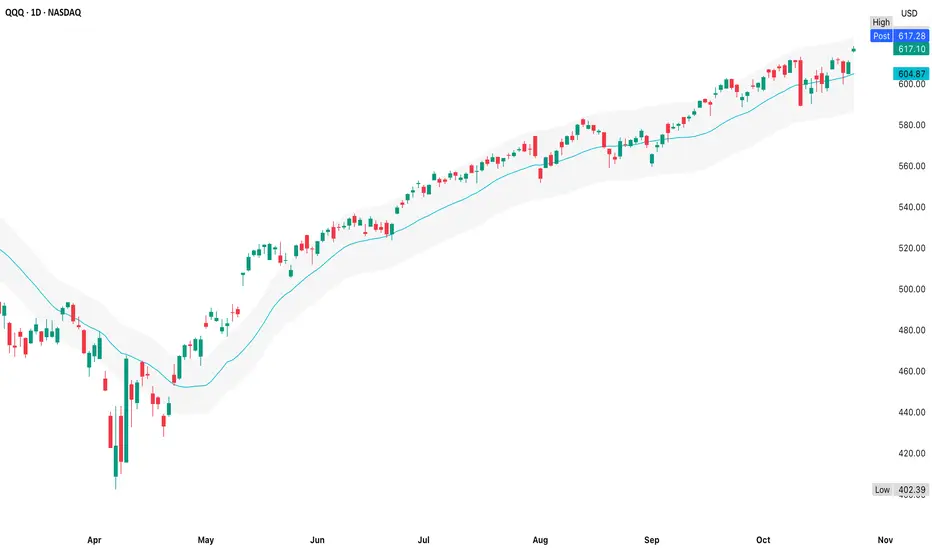
QQQ (24 October)QQQ is at the top of its 20d ±3 % envelope, a “momentum, but stretched” setup
Expect minor cooling or sideways action early next week, then potential continuation toward $625-$628 once the moving average catches up
20d MA ~$605 is upward-sloping which confirms a healthy intermediate uptrend
Envelope width is about 36 points (~6%), normal for a trending QQQ environment
Price hugging the upper envelope means momentum is strong, but stretched
In past rallies, when QQQ closed near or slightly above the +3 % band, it tended to consolidate or pull back toward the MA within 3-6 sessions, or trade sideways until the moving average "catches up"
Since May, you can see about 4-5 touches of the upper band
Each touch was followed by a 1-2 % fade lasting a few sessions
The moving average acted as dynamic support; deeper corrections only came after the slope flattened
That rhythm is still intact so this looks like another case where bulls may pause, but not reverse
$618-$620
Upper envelope resistance/overbought
55% chance of stall or mild fade
$610-$612
First support (mean reversion)
30 % chance of retest
$600-$605
20d MA & lower-band base
15 % chance unless news shock
Bias is still bullish; trend intact above the 20d MA, but short-term is slightly overbought so expect digestion rather than acceleration
Taking partial profits or tightening stops near +3% band often pays better than chasing new highs
Theta decay accelerates if price chops sideways here, so shorter-dated calls can flatten out quickly
Waiting for a dip toward $610-$612 offers a higher-reward entry aligned with the 20d MA
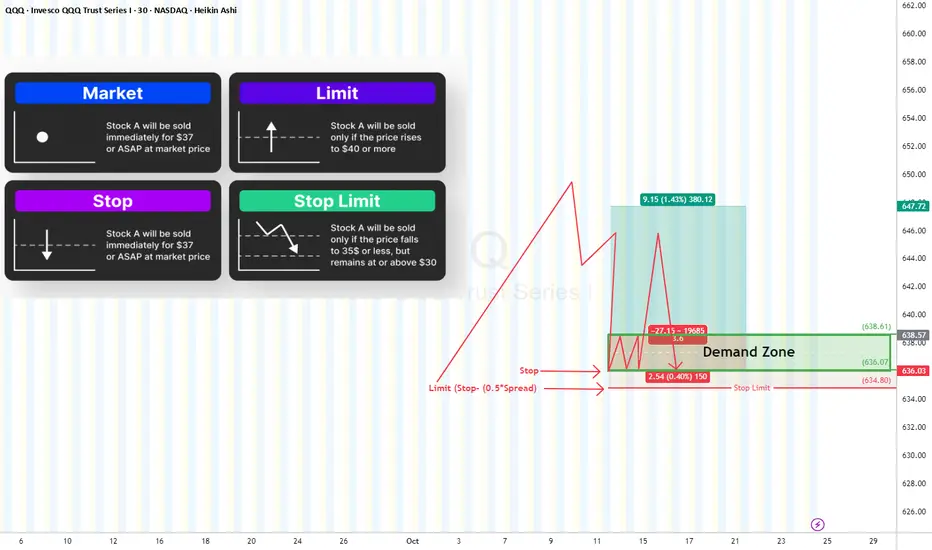
Why My Stop Loss Didn’t Trigger?”🛑 “Why My Stop Loss Didn’t Trigger?”
Let’s talk about Stop Orders, Stop Limits, Spreads, and the Outside-RTH trap.
Before we blame the broker, it’s crucial to understand how each order type actually works:
🔹 Market Order
Executes immediately at the best available price.
✅ Guarantees execution
⚠️ Doesn’t guarantee price (can slip during volatility).
🔹 Limit Order
Executes only at your specified price or better.
✅ Price control
⚠️ Might never fill if market doesn’t reach your limit or gap down.
🔹 Stop Order (Is a Stop “Market” Order)
Activates when price hits your stop level, then converts into a market order.
✅ Great for stop-loss protection
⚠️ May fill at much lower price than your stop due to slippage.
🔹 Stop Limit Order
Activates at the stop trigger, then becomes a limit order — meaning it only executes if the market trades at your limit price or better.
✅ Full control over fill price
⚠️ Risk of not executing at all if price moves away quickly.
Regular Trading Hours (RTH):
Market orders are supported → Stop Market
Outside RTH (Pre/Post-market):
Market orders are not supported therefore, only Stop Limit works.
Now, Why Your Stop Might Not Trigger?
1- You used a Stop-Limit (not Stop Market)
If the market gaps beyond your limit, there’s no fill (Buyer) at this price.
Price “touched” your stop — but never traded through your limit price.
2- You traded Outside RTH
During pre-market or after-hours, If you didn’t enable “Outside RTH” trading, your stop simply didn’t activate.
3- Thin Liquidity
Low volume = fewer buyers/sellers near your stop → delayed or partial fills.
This is especially true Outside RTH, where spreads widen and depth disappears. Or you are trading an equity or ETFs with slim volume (check the volume first before trading any asset)
✅ Recommendation:
Use Stop-Limit + “Allow Outside RTH+GTC” and make your limit “marketable” to ensure execution.
Offset guide for Stop-Limits (Δ):
• At least 0.5× spread
• Or ¼ to ½ ATR(5) for your timeframe
Example for a long position:
• You bought at $100, want to exit if it breaks $99.80.
• Pre-market spread = $0.12
• Set: Stop = 99.80, Limit = 99.68 (≈0.12 below stop)
→ Gives room for spread expansion and slippage so the stop fills quickly.
How to Set a Reliable Stop-Limit
Market Order Type Settings Notes
Equities & ETFS (RTH) Stop Market Standard stop Fastest execution
Equities & ETFS (Outside RTH) Stop Limit + GTC Limit offset = Spread Needed for after-hours fills
Futures / FX / Crypto Stop Market 24h trading Market fills OK
The Best Setup
✅ Inside RTH → Stop Market (guaranteed execution)
✅ Outside RTH → Stop Limit + GTC enabled with marketable offset
✅ Always give buffer beyond supply/demand levels (0.1–0.3%)
✅ Watch spread and volume before placing stops
Final Takeaway
Your stop loss isn’t just a line on the chart — it’s an engineered safety net.
Use the right order type for the session, give it breathing room, and understand how spread, liquidity, and RTH rules impact execution.
Because a stop loss that doesn’t trigger… isn’t a stop loss at all. 🛑
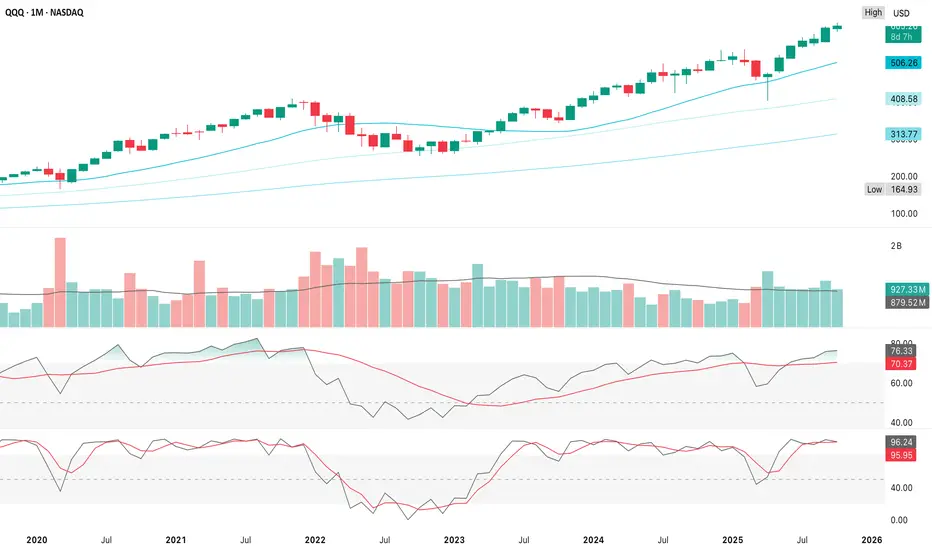
QQQ Cooling PhaseThe monthly candles show a secular uptrend
Price remains well above the 20, 50 & 100 month moving averages
Even with the short-term volatility we’ve seen around $603-$613, that’s just noise inside a steep upward channel
Big-picture momentum is still firmly bullish
Intraday price range are temporary mean-reversions inside an ongoing trend
The long-term “fuel” is still there, but risk-reward for new longer-term entries is thinning, so a multi-month consolidation or modest correction wouldn’t be unusual
RSI ≈ 76 is solidly overbought, but not diverging yet - typical of strong late-cycle trends
When RSI stays above 70 for months, it signals strength, not necessarily exhaustion
Stochastic ≈ 96 is extremely stretched which is often where monthly pullbacks (5–10%) - it can stay pinned for months before reversing
Volume has drifted lower since 2022, which hints that participation has narrowed to the mega-caps
That aligns with what we’re seeing day-to-day with QQQE (equal-weight) lagging, concentrated leadership from the largest names
1. Continued grind higher
If earnings/CPI stay supportive, QQQ could extend toward $630-$640 before serious resistance - hold above $600
2. Healthy correction
A 5-8% dip to $570-$580 would reset momentum without breaking trend
Support at 20 month MA (~$505) if deeper
3. Trend failure
Only a sustained break below $500-$505 would turn the monthly chart bearish
100 month MA near $314 = long-term floor
The monthly chart shows QQQ in a mature but intact bull trend with momentum hot, volume thinning, room for a 5-10% reset without real technical damage
For day-to-day trading, expect more mean-reversion around $600-$620 until volatility events pass
Long bias remains justified while price is above the 20 month MA
Intraday fades & pullbacks are tactical only - they’re counter-trend, not trend reversals
Watch IV + macro catalysts since spikes in implied volatility (earnings/CPI) often create those short-term pullbacks without changing the monthly structure
Feb-Mar 2020
RSI > 75
Stoch > 95
–12 %
1 month COVID crash (black-swan, outsized)
Nov 2021-Jan 2022
RSI ≈ 77
Stoch ≈ 96
–10 %
2 months
Rate-hike scare, peak valuation
Aug 2023-Oct 2023
RSI ≈ 74
Stoch ≈ 94
–7 %
2 months
Bond-yield spike/earnings reset
Apr 2024-May 2024
RSI ≈ 76
Stoch ≈ 97
–6 %
1 month
Macro pause, then continuation
-5% to -8% lasting 1-2 months while the long-term uptrend stays intact
Current price ≈ $604
–5 % ≈ $573
Minor swing-low support (Aug 2024 area)
–7 % ≈ $562
Volume-weighted support/10 month MA
–10 % ≈ $543
2024 high retest, deeper but still trend-safe
That $560-$575 area would relieve monthly overbought conditions without threatening the secular trend
1. RSI divergence on the weekly chart (lower high while price makes a higher high)
Weekly close below $600 confirms cooling momentum
VXN (Nasdaq Volatility Index) >20 shows volatility expansion accompanying the fade
Volume expansion on red candles after CPI/Fed events
2. RSI falls back toward 60-65 on the monthly
Price stabilizes near the 20 week or 50d MA (roughly $575-$585)
IV compresses again in a new accumulation phase/continuation toward prior highs
🧭 Summary
Historical overbought phases in QQQ resolve with a –5% to –8% dip over 1-2 months,
usually bottoming around $560-$575, then resuming the larger bull trend
Anything beyond –10 % would signal a regime change rather than a standard reset
QQQ Ready to CollapseReasons the stock market could fall today:
Government shutdown fears creating uncertainty and GDP drag
White House instability after East Wing destruction shaking political confidence
Rising China tensions and supply chain disruption fears
New or expanded tariffs increasing costs and squeezing margins
Inflation pressures staying elevated despite weak growth
Stagflation worries combining slow growth with high prices
Investor sentiment turning risk-off amid multiple uncertainties
Corporate earnings at risk from weaker demand and higher input costs
Global contagion from China or Europe worsening growth outlook
QQQ Failed PullbackOn a 15m chart, a bullish pennant is usually a 1-3 day setup, with the actual breakout move finishing within the same or next trading session
The breakout should occur before price drifts beyond two-thirds of the way to the apex of the pennant
If nothing happens after that, it’s likely morphing into sideways consolidation rather than a continuation thrust
1. The “failed pullback”
Sometimes what looks like the perfect setup for a fade gets front-run by buyers; especially, in strong index products like QQQ
When enough traders expect a dip, the first sign of weakness attracts dip buyers & short covering instead
That buying pressure prevents the retrace and squeezes price higher - exactly what forms a pennant breakout
2. Breadth & flows
If equal-weight tech (QQQE) & SPY are both firm, algorithmic inflows overwhelm local exhaustion signals
That’s what creates those shallow consolidations instead of proper retracements
It’s not that the overbought condition vanished - just that the market is digesting through time, not price
3. Where your pullback may still appear
The pennant breakout could run into $616-$620 (the measured-move zone)
Then a more meaningful pullback could occur back to $610-$608 to retest the breakout area
That’s often the second chance entry for traders who expected a dip earlier
4. How to adapt intraday
Price >VWAP & holding higher lows
Stay neutral-to-long; pullback unlikely yet
5m closes back under VWAP with volume
First confirmation of real selling
RSI divergence + volume spike at new highs - good cue that the delayed pullback is starting
Momentum is stretched
The difference is that strength absorbed the selling before it could cascade
Watch the VWAP ($604-$606) as the “true mean” since that’s where a genuine pullback would likely target once the breakout exhausts
Alphabet is one of the largest weights in QQQ (6-7 %)
When it reports after the bell, implied volatility in QQQ options & intraday price movement both spike, often producing head-fakes
Even if the pennant breakout looks clean intraday, the move can stall or reverse sharply after hours on the headline
A surprise beat could launch QQQ higher in one gap; a miss could invalidate the pattern instantly
If you’re trading intraday, tighten your exposure or take partial profits before the close
Don’t hold an unhedged position through the report unless it’s sized small enough to handle a gap
CPI is the next index-level volatility event
The market often “coils” ahead of CPI - exactly the kind of price compression a pennant shows
That means the real breakout may not sustain until after the CPI release confirms or challenges inflation trends
You can get false starts between now & Friday as traders reposition
Treat any breakout between now & Friday morning as range expansion, not confirmation, until post-CPI follow-through appears
Pattern still valid, but its resolution is dependent on catalysts
The “measured-move” projection ($622-$625) is realistic only if GOOGL’s report & CPI don’t introduce negative surprises
Until those hit, expect lower volume & tighter ranges with consolidation inside $609-$613 likely persists
QQQ’s bullish pennant is technically sound, but timing is hostage to this week’s catalysts
If you trade intraday, keep it mechanical - above $613 bullish, below $610 defensive & be flat or hedged going into tonight’s GOOGL print
Global Financial Markets and Their StructureIntroduction
The global financial market represents the interconnected network of institutions, systems, and instruments through which money and capital flow across borders. It forms the backbone of the world economy, enabling governments, corporations, and individuals to raise capital, invest, trade currencies, and manage risks. With globalization, technological innovation, and liberalization, financial markets have become increasingly integrated, influencing economic growth, monetary policy, and international relations. Understanding the structure of global financial markets is essential to grasp how capital is allocated worldwide and how financial stability is maintained.
1. Concept of Global Financial Markets
A financial market is a platform where buyers and sellers engage in the trade of financial assets such as equities, bonds, currencies, and derivatives. When these markets operate across countries and connect multiple economies, they form what is known as the global financial market.
In essence, the global financial market:
Facilitates the flow of funds from surplus units (savers) to deficit units (borrowers).
Provides a mechanism for price discovery and risk management.
Enhances liquidity, enabling participants to easily buy and sell assets.
Plays a crucial role in economic growth, investment, and stability.
The global market is not a single entity but a network of interconnected markets functioning through institutions such as banks, stock exchanges, hedge funds, insurance companies, and central banks. Modern communication technology, digital trading platforms, and financial integration have turned it into a real-time, 24-hour global system.
2. Structure of the Global Financial Market
The structure of the global financial market can be broadly categorized into several interrelated segments:
Money Market
Capital Market
Foreign Exchange Market
Derivative Market
Commodity Market
Insurance and Pension Market
Each segment serves a distinct purpose, yet all are interlinked and essential to the smooth functioning of the global economy.
3. The Money Market
The money market deals with short-term funds and financial instruments with high liquidity and short maturities, typically less than one year. It provides a means for governments, financial institutions, and corporations to manage short-term funding needs and liquidity.
Key Instruments
Treasury Bills (T-Bills)
Certificates of Deposit (CDs)
Commercial Papers (CPs)
Repurchase Agreements (Repos)
Bankers’ Acceptances
Major Participants
Central Banks (e.g., Federal Reserve, European Central Bank, Reserve Bank of India)
Commercial Banks
Financial Institutions
Corporations
Money Market Mutual Funds
Role in the Economy
The money market stabilizes short-term interest rates, supports monetary policy operations, and ensures liquidity in the financial system. It acts as the link between the banking system and capital markets, influencing credit flow and investment activity.
4. The Capital Market
The capital market is where long-term securities, such as stocks and bonds, are issued and traded. It enables corporations and governments to raise long-term funds for development and expansion.
Subdivisions
Primary Market: Where new securities are issued (Initial Public Offerings or IPOs).
Secondary Market: Where existing securities are traded (Stock Exchanges like NYSE, NASDAQ, LSE, BSE, NSE).
Key Instruments
Equity Shares
Corporate Bonds
Government Securities
Debentures
Mutual Funds
Exchange-Traded Funds (ETFs)
Major Participants
Institutional Investors (pension funds, insurance companies)
Retail Investors
Investment Banks
Stock Exchanges
Regulators (like SEC in the U.S. or SEBI in India)
Importance
The capital market promotes economic development by mobilizing long-term savings into productive investments. It ensures efficient capital allocation, wealth creation, and corporate governance through market discipline.
5. The Foreign Exchange (Forex) Market
The foreign exchange market is the largest financial market in the world, with daily transactions exceeding $7 trillion. It facilitates the exchange of one currency for another, supporting international trade, investment, and tourism.
Structure
Spot Market: Immediate currency transactions.
Forward Market: Agreements to exchange currencies at a future date.
Swap Market: Simultaneous purchase and sale of currencies for different maturities.
Major Participants
Central Banks
Commercial Banks
Multinational Corporations
Hedge Funds
Currency Traders and Brokers
Functions
Enables global trade and investment by providing currency convertibility.
Determines exchange rates through supply and demand.
Facilitates hedging against currency risk.
The forex market operates 24 hours a day due to overlapping time zones, making it a truly global and decentralized market.
6. The Derivative Market
The derivatives market deals with financial instruments whose value derives from underlying assets such as stocks, bonds, currencies, interest rates, or commodities.
Common Derivative Instruments
Futures
Options
Swaps
Forwards
Purpose
Derivatives allow investors and corporations to hedge against risks such as fluctuations in interest rates, exchange rates, and commodity prices. They also provide opportunities for speculative gains and portfolio diversification.
Examples
Interest Rate Swaps (used by banks)
Currency Options (used by exporters/importers)
Stock Index Futures (used by institutional investors)
The derivative market is an essential part of the global financial system, enhancing liquidity and risk management, though excessive speculation can contribute to systemic risk—as seen in the 2008 global financial crisis.
7. The Commodity Market
The commodity market facilitates trade in raw materials and primary products. It includes both physical trading and derivative contracts based on commodity prices.
Types of Commodities
Hard Commodities: Metals, oil, natural gas.
Soft Commodities: Agricultural products like wheat, coffee, and cotton.
Major Commodity Exchanges
Chicago Mercantile Exchange (CME)
London Metal Exchange (LME)
Multi Commodity Exchange (MCX, India)
New York Mercantile Exchange (NYMEX)
Role
Commodity markets allow producers and consumers to hedge against price fluctuations, promote transparency in pricing, and support global trade and industrial production.
8. Insurance and Pension Market
The insurance and pension market plays a stabilizing role in the global financial system by pooling and redistributing risks. Insurance companies and pension funds are major institutional investors in capital and bond markets.
Functions
Provide financial protection against unforeseen losses.
Accumulate long-term savings for retirement.
Channel funds into productive investments through capital markets.
Importance
These markets support long-term financial stability, complementing government welfare systems and reducing the economic impact of uncertainties.
9. Key Global Financial Institutions
The functioning and regulation of global financial markets rely heavily on international and national institutions.
Major Global Institutions
International Monetary Fund (IMF): Ensures global monetary stability, offers financial assistance to countries in crisis.
World Bank: Provides long-term loans and support for economic development.
Bank for International Settlements (BIS): Coordinates among central banks and promotes financial stability.
Financial Stability Board (FSB): Monitors and makes recommendations for global financial regulation.
Regional Development Banks: Such as the Asian Development Bank (ADB) and African Development Bank (AfDB).
National Regulators
U.S.: Securities and Exchange Commission (SEC)
U.K.: Financial Conduct Authority (FCA)
India: Securities and Exchange Board of India (SEBI)
Japan: Financial Services Agency (FSA)
These institutions promote transparency, protect investors, and maintain confidence in the financial system.
10. Global Financial Integration
Over the last few decades, financial globalization has deepened the interconnections between markets. Capital moves freely across borders, driven by liberalization policies, technology, and innovation.
Benefits of Integration
Greater access to capital for developing economies.
Efficient resource allocation.
Risk diversification for investors.
Lower cost of borrowing.
Risks
Contagion effect of financial crises.
Increased volatility and speculative capital flows.
Exposure to global shocks (e.g., 2008 crisis, COVID-19 market crash).
Therefore, effective global coordination and regulatory oversight are essential to balance the benefits of financial integration with the risks of instability.
11. Technological Transformation of Financial Markets
Technological innovation has revolutionized global financial markets:
Algorithmic Trading enables high-speed, automated trading.
Blockchain Technology enhances transparency and reduces transaction costs.
Fintech companies offer digital banking, peer-to-peer lending, and robo-advisory services.
Cryptocurrencies like Bitcoin have introduced decentralized finance (DeFi), challenging traditional systems.
These developments have made markets more accessible and efficient but also raised concerns about cybersecurity, regulatory gaps, and market manipulation.
12. Challenges in Global Financial Markets
Despite progress, the global financial system faces several challenges:
Systemic Risk: Interconnectedness can amplify crises.
Regulatory Arbitrage: Differences in national regulations create loopholes.
Market Volatility: Geopolitical tensions and policy shifts cause price instability.
Climate Finance: Need for green investments to support sustainable growth.
Digital Disruption: Balancing innovation with investor protection.
Addressing these challenges requires coordinated global governance and adaptive policy frameworks.
13. The Role of Emerging Markets
Emerging economies like India, China, Brazil, and Indonesia play a growing role in the global financial system. They attract foreign capital, develop strong financial institutions, and influence commodity and currency markets.
Their inclusion in global indices and financial reforms has diversified global portfolios and increased market depth. However, they remain vulnerable to capital flight, exchange rate shocks, and global interest rate changes.
Conclusion
The global financial market is a dynamic, complex system that channels capital across borders, drives economic growth, and fosters innovation. Its structure—comprising money, capital, forex, derivative, commodity, and insurance markets—forms a cohesive yet intricate network of interdependent segments. Financial institutions, both domestic and international, ensure the system’s stability and transparency.
While globalization and technology have enhanced efficiency and accessibility, they have also introduced new risks that demand vigilant regulation and international cooperation. In the 21st century, the resilience and adaptability of the global financial market will determine not only the prosperity of nations but also the stability of the global economy itself.
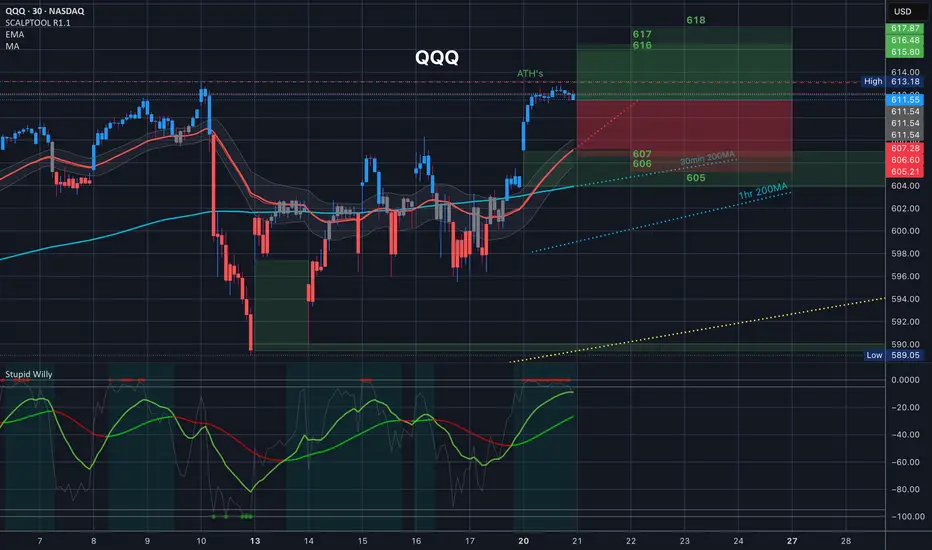
$QQQ Tomorrow’s Trading Range 10.21.25 NASDAQ:QQQ Tomorrow’s Trading Range 10.21.25
Alway’s know where your 35EMA is. It is underneath the implied move right now, which means tomorrow has a high probability of being flat or down. ATH’s are in tomorrow’s range above us, and 35EMA underneath us with that 30min 200 and also the bull gap from open as well… let’s go…
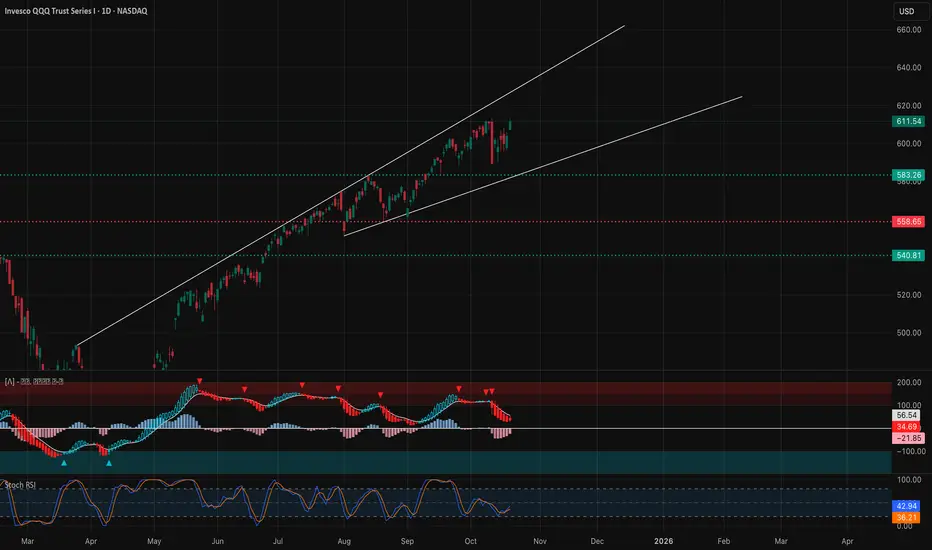
QQQ Weekly Outlook (Oct 21–25): Bulls Defend the Channel Testing the $616 Resistance Wall 🚀
📆 Daily Chart — Macro Structure and Market Context
Market Structure:
The NASDAQ ETF (QQQ) continues to ride a steady ascending channel since March, maintaining a higher-low structure. The recent CHoCH at $583 was followed by a rebound and BOS (Break of Structure) above $600, confirming that the pullback phase has likely completed.
Price is now pressing into the upper channel resistance near $611–$616, which coincides with heavy liquidity and prior supply zones. Despite the overhead resistance, the broader structure remains bullish, with price action consolidating in the upper half of the channel — a typical mid-trend continuation behavior.
Supply & Demand / Order Blocks:
* Demand Zone: $583–$590 (key defended base from last CHoCH).
* Mid-Demand Zone: $558–$560 (38% fib + historical OB).
* Supply Zone: $611–$616 (upper channel cap and recent BOS level).
Indicator Confluence:
* 9 EMA > 21 EMA: bullish alignment with widening slope.
* MACD: Momentum recovering from midline, histogram expanding positively.
* Stoch RSI: Mid-range reset around 43 — plenty of room to rise.
* Volume: Rising on breakout days, confirming accumulation.
The daily chart suggests a continuation setup with bullish pressure intact. As long as QQQ holds above $600, bulls control the trend toward $616–$620.
⏱️ 1-Hour Chart — Near-Term Trend and Swing Setup
Market Structure:
The 1-hour view highlights a strong recovery leg after multiple CHoCH → BOS sequences. Price broke out of a descending wedge and reclaimed the $608–$610 level, a crucial pivot area aligned with gamma resistance.
Currently, QQQ is consolidating beneath the $612–$616 resistance wall. A clean breakout with volume could trigger a test of the upper trendline near $620.
Supply & Demand / OB Zones:
* Demand Zone: $605–$608 (retest area for dip buyers).
* Supply Zone: $612–$616 (active resistance zone).
Indicator Confluence:
* 9 EMA > 21 EMA: bull control intact.
* MACD: still strong, histogram shows gradual expansion.
* Stoch RSI: hovering near overbought but showing no divergence yet.
Trade Scenarios:
* Bullish Setup: Buy dips near $606–$608 → Target $616 / $620 → Stop $601.
* Bearish Setup: Short rejection at $616 → Target $605 / $600 → Stop $618.
A close above $616 opens the door for momentum continuation toward $622–$625, while losing $605 would likely trigger a retest of $590 demand.
🕒 15-Minute Chart — Intraday Scalping Structure
Market Structure:
The 15-min chart reveals QQQ’s short-term compression after a morning rally. Price remains within a rising micro-channel but is stalling near resistance at $612–$614. Several BOS patterns confirm trend continuation, while the latest CHoCH at $611.3 marks minor cooling.
This looks like a controlled pullback rather than a reversal, with liquidity building around $610.
Supply & Demand / OB Levels:
* Demand Zone: $608–$610 (intraday support and EMA confluence).
* Supply Zone: $614–$616 (scalp resistance).
Indicator Confluence:
* 9 EMA vs 21 EMA: still trending upward but flattening slightly.
* MACD: weakening histogram — possible short-term cooldown.
* Stoch RSI: cycling down from overbought, indicating temporary pause.
Scalp Plan:
* Bullish Bias: Buy near $609–$610 → Target $614 → Stop $607.
* Bearish Bias: Short rejection from $614–$615 → Target $609 → Stop $616.
Expect small consolidation before breakout. Trend remains bullish until $608 breaks decisively.
📊 GEX (Gamma Exposure) & Options Sentiment
The GEX structure shows heavy call positioning at $612–$616, with a clear gamma ceiling near $616 — currently acting as resistance. Below $604 lies the highest liquidity void (HVL) where dealers might provide support.
Key GEX Levels:
* Highest Positive GEX / Call Wall: $616 (major gamma resistance).
* 2nd Call Wall: $613.
* Put Wall / Support: $604 and $593 (dealer hedging floors).
* IVR: 22.9 — low, suggesting compression and potential volatility pop.
* Put/Call Ratio: 48.5% puts — slightly bearish skew but stabilizing.
Dealers are in neutral gamma territory, meaning price may grind within $604–$616 until a breakout forces delta hedging momentum in either direction.
🎯 Closing Outlook
The broader QQQ structure remains bullish inside an uptrend channel, supported by strong demand zones and recovering momentum indicators. The short-term price action is coiling for a potential breakout above $616 — a key level to watch for momentum confirmation.
As long as QQQ holds above $605, the trend bias stays bullish toward $620–$625.
If $604 breaks, expect a deeper pullback to $590 before buyers re-engage.
Disclaimer:
This analysis is for educational purposes only and not financial advice. Always perform your own due diligence and manage your risk carefully.
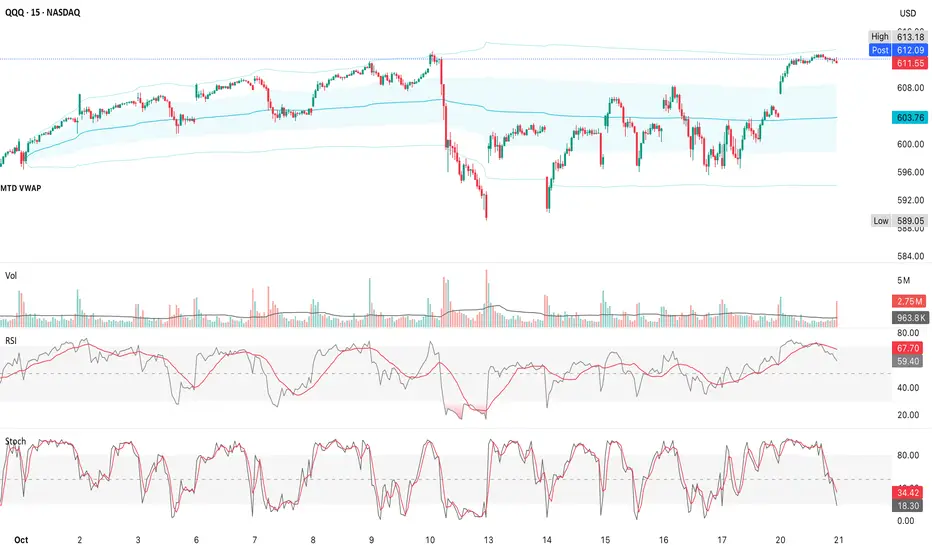
QQQ Early Topping BehaviorShort-term momentum is stretched so watch for a potential pullback to $608 then $603 if selling follows through
1. Price vs MTD VWAP
MTD VWAP ≈ $603.7, with +1σ ≈ $611 & +2σ ≈ $613
QQQ is pressing the upper (+2σ) edge of the VWAP envelope & that’s statistically extended
Historically, price rarely sustains above this zone without cooling off toward +1σ ($608-$609) or the VWAP itself ($603-$604)
Overbought short-term; risk of mean reversion if momentum fades
2. Volume Profile
Volume into the close rose sharply, but without broad range expansion
That kind of volume spike after an extended move often means distribution (profit-taking at highs) rather than fresh breakout energy
The closing volume spike without strong follow-through suggests distribution (smart money selling into strength)
That’s also characteristic of the transition from Wave 5 to wave a (meaning the first corrective down-leg may already be starting)
Likely aiming for $588-$590 first & potentially $532 over the next 4-6 weeks if the full correction unfolds
3. RSI (15m)
RSI ≈ 68 & curling lower from overbought
A bearish cross of RSI below its signal line after sitting near 70 is a classic short-term momentum-loss trigger
Supports the idea of a pullback or consolidation within 1-2 sessions
4. Stochastic Oscillator
Fast %K & %D have both rolled over sharply (≈ 34 & 18)
Coming off multiple overbought resets above 80, this steep drop signals short-term exhaustion with traders locking gains
5. Intraday Structure
You can see bearish divergence forming where price neared ATHs (~$613.18) while RSI & Stoch made lower highs
That divergence plus rejection at +2σ VWAP = early topping behavior on the 15m timeframe
Start of wave a
Post $613 tag
Pullback to $608–$609
+1σ VWAP support
Mid-wave a acceleration
Next 1-2 sessions
Sharp dip to $603-$604
MTD VWAP mean
End of wave a
Within ~3-5 days
$588-$590
Prior breakout base
Wave b "bounce"
Late this or next week
Rebound to $595-$600
Lower high under prior peak
Wave c
Following weeks
Down to $540-$532
61.8% daily retracement
October 20 - 24 2025
1. Macro
Due to the government shutdown inflation-indexed bond data is delayed, however what we are seeing based on data from Thursday (as shown on the white vertical line) suggests that forward inflation expectations $(US10Y+US03MY)/2-DFII10 may be reverting back to the mean, which is supported by TVC:US10Y rising slightly. The long term vs short term yield spread TVC:US10Y -US03MY has tightened and is very close to inverting, which was driven by long term yields plunging last week - a rush to safety. Another long-term bond rally could invert the yield curve, often a risk-off signal if it remains inverted and widens. The dollar is finding support near its average and gold is sitting at all time highs (more on gold later).
On the commodity side, Oil NYMEX:CL1! continues to slide, aided by fragile stability in the middle east. My ag/industrial gauge $(COPPER1!+ZC1!)/2/DXY is still elevated but lacks momentum. Nothing interesting to glean here other than the fact that higher commodity prices are not significantly affecting forward inflation expectations (for now). Oil’s continued downtrend is certainly playing a factor, however the pause in Fed data could also make any potential inflationary impact more delayed than usual.
When it comes to bonds, watch closely and proceed with caution.
2. FX
The dollar index is still well below other currency indices for the year but I have all of the charts on this layout indexed to 100 to show recent relative activity. The dollar TVC:DXY has recently seen stronger performance compared to other currencies, though the others have been on the uptick in recent days .
The important takeaway here can be seen on the 10Y yield comparison chart. Since the beginning of October, aside from Japan, buyers have pushed 10Y yields in the US, Eurozone and Britain down. This may suggest a rush to safety due to economic fears beyond just the US.
3. Risk
On the top left chart, you can see that the corporate bond option-adjusted spread average (high-yield & investment-grade) could have either peaked or is on the uptick. Since this data is only available at the end of the day, it’s best to proceed with caution.
Next, I want to highlight something I recently noticed when comparing the TVC:GOLD chart to its volatility index CBOE:GVZ . Last week while Gold was reaching all time highs, there was heavy buying of AMEX:GLD puts (GVZ was up over +20% on Thursday), which has pushed Gold down on the $GOLD/GVZ spread recently. I have included Gold on the bottom chart and marked the points where the ratio fell far below the standard deviation of (1) as shown via the Keltner Channel indicator on all of the charts. Looking at the previous three points where this extremity occurred, there seems to be some alignment with severe underperformance of S&P 500 Futures vs gold and stock market bottoms.
Since asset prices are currently seen as elevated and Gold is close to crossing above the CME_MINI:ES1! return since January 2020, the message this sends to me is that the gold rally is fear-driven rather than fundamentally-driven. Investors are aware that gold may be overstretched and are buying insurance. Fear without fundamentals can quickly become a buying opportunity for equities, especially when continued rate cuts (which in theory should help both Gold and Equities) are taken into consideration. If nothing fundamentally changes, and investors decide to start dumping gold, it would be expected to see equities catch a bid.
I’m also continuing to watch $SPY/RSP (SPY vs equal-weight ETF) and $NQ1!/YM1! to assess risk-on vs defensive bias. Right now the momentum towards risk is flat but the Russell TVC:RUT has slid more compared to the other indices recently, suggesting a rotation out of small caps, which supports the bias that both spreads could continue higher in favor of Risk, however that is just an assumption.
When looking at specific sectors, despite Consumer Staples ( AMEX:XLP ) finding support, I’m not yet seeing signs that the market is abandoning tech. All of this shows that recent volatility has not changed the market’s sector positioning in a significant way, however keeping an eye on XLP for now will be very important, as it could signal a risk-off day if $XLP/XLK rises strongly.
4. Bias ( CME_MINI:NQ1! )
I have changed my approach to trading to be more short-term, so I will not try to draw any weekly conclusions via this chart, however from Friday’s volatility action (lefthand side), it appears we may have seen a peak in near-term volatility last week. I would expect to se some volatility mean reversion on Monday ( TVC:VIX and CBOE:VVIX -VIX may open higher). If the volatility is absorbed by buyers (price is relatively flat or volatility is quickly absorbed by buyers), I think dealers will sell volatility (puts) and buy futures to raise the price of AMEX:SPY .
On the other hand, when more bearish factors (as described above) are considered, I can’t help but wonder when looking at the CME_MINI:ES1! chart if futures are forming a top. I would not have a problem playing the bull side if volatility activity suggests dealers are short puts, however if it shows indecision or short call positioning it may be best to sit out or wait for confirmation.
-+-+-+-+-+-+-+-+-+-+-+-+-+-+-+-+-+-+-
Conclusion:
Put simply - I am cautiously bullish on stocks.
I think the gold volatility is still mostly implied, so it will take a few more sessions before we find out if it will be realized or provide liquidity for more Gold buying. The extreme put buying has me fairly confident that the gold rally will stall out or pull back from around the 4,200 level.
Aside from news-related volatility, the only major threat I’m seeing to stocks is that institutions may start to rotate out of tech mega caps AMEX:XLK , communications AMEX:XLC , and consumer discretionary AMEX:XLY into safer sectors like consumer staples AMEX:XLP and healthcare AMEX:XLV . This can be tracked intraday so I will be watching it this week for early clues. $XLK/XLP will be an important gauge to watch, as well as $NQ1!/YM1! and $SPY/RSP for confirmation.
I’m not too worried about treasuries either. The lack of data will likely keep yields close to the average, and as I’ve said before, if the TVC:US10Y -US03MY curve inverts because 10Y declines while 3M is flat, it’s the less concerning way it could occur. Corporate bond spreads will be important to watch for a potential risk-off continuation, however that data will only be available once per day.
Most importantly, if volatility seems to have peaked (at least in the short term) it will solidify the bullish case. As I hope I’ve explained, I think the market is in a confused and defensive state, even if the situation doesn’t necessarily call for it. US economic data is still on hold so dealers are firmly in control of the narrative. Since dealers prefer to be short gamma on puts, that is the only reason why my bias is slightly bullish. On the contrary, if there is a sudden rush into puts that creates a significant Implied/Historical volatility imbalance, I will not hesitate to take the short side.
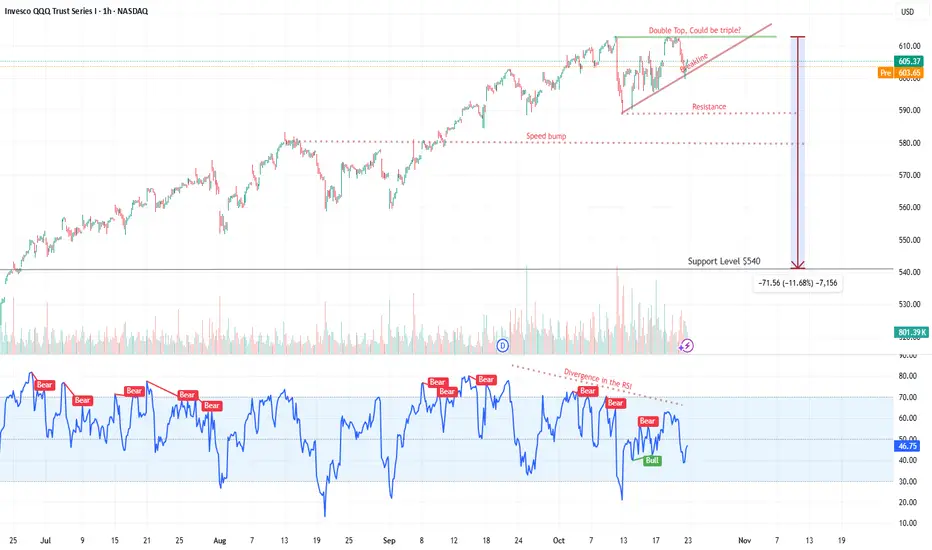
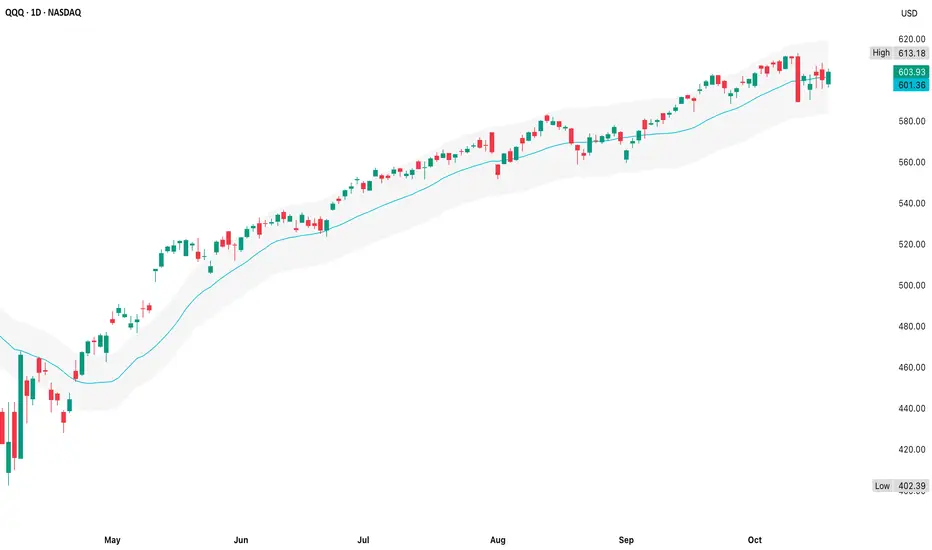
QQQ (17 October)The probability skew remains to the downside over the next 1-2 wks
±3% envelope = $622/$587
Expect mean reversion near $601
Technical confluence + implied vol suggest any break of $595 confirms a run toward the lower envelope (~$586-$590)
±3% Envelope from Current Price ($603.93)
1. +3% ≈ $622
Top edge of the prior uptrend channel; retests the failed breakout zone from early October ($613-$620)
Strong resistance cluster; unlikely to break unless mega-cap earnings crush expectations
2. -3% ≈ $586.80
Perfect alignment with the measured-move support from the head & shoulders (~$585-$590)
This is the “bear completion” area where shorts often take partial profits
The daily chart shows QQQ trapped around its mean, with weakening upside participation - ideal environment for short-term bearish option plays (1-3 week window), but not yet a crash setup
If you close below $600 on volume, this likely triggers momentum algos for a retest of $592
If you close above $607 with breadth confirmation, you’ll get a squeeze, but probably short-lived without macro support
The mean line around $601-$602 is acting as the pivot for now & price keeps oscillating right around it
You’ve got 2 failed highs in early & mid-October, that’s consistent with a rolling top
The candle bodies are hugging the lower half of the volatility band rather than the upper which is a subtle shift in momentum
RSI (4H view) is still under 55 with no true momentum reclaim
So despite the bounce Friday, it’s technically still corrective inside an uptrend, not fresh bullish
This kind of daily structure with a slow drift near the mean with room to test lower band usually plays out over 1½-2 weeks before a directional break
That again points to 10 to 21d options as the sweet spot since it's enough time for confirmation, short enough to keep theta manageable