Invest Globally for Great Growth1. Why Invest Globally?
1. Diversification Beyond Local Risks
Every country faces its own economic cycles, policy changes, political uncertainties, and currency fluctuations. By investing globally, you spread your capital across different markets, reducing the risk that any one economy’s downturn will harm your overall portfolio. For example, if India or the US slows down, growth in Europe, Southeast Asia, or Latin America may balance the impact.
2. Access to Innovation Worldwide
No single country leads in every industry.
The US dominates technology and biotech.
Europe is strong in automation, renewable energy, and luxury goods.
China excels in manufacturing, EVs, and AI hardware.
Emerging markets lead in digital payments, mobile users, and consumption-led growth.
Global investing allows you to “own the best of the world.”
3. Capture Growth in Emerging Markets
Fast-growing countries like India, Vietnam, Indonesia, Brazil, and the Philippines grow faster than many developed nations. Rising incomes, urbanization, young populations, and new industries create high-growth opportunities that are unavailable in slow-growing economies.
4. Protection Against Currency Risk
A global portfolio naturally hedges currency exposure. When one currency depreciates, another may strengthen, which stabilizes your investment value in your home currency.
2. Key Global Asset Classes for Great Growth
1. Global Equities
Stocks provide the highest long-term returns among major asset classes. Global equity investing includes:
Developed Markets (US, UK, Japan, Germany)
Emerging Markets (India, China, Brazil, South Africa)
Frontier Markets (Vietnam, Nigeria, Bangladesh)
You may invest through:
Global index funds
Country-specific ETFs
International mutual funds
ADRs (American Depository Receipts)
The biggest advantage: exposure to global giants like Apple, NVIDIA, Samsung, Toyota, Nestlé, LVMH, and more.
2. Global ETFs
Exchange-Traded Funds provide diversified exposure at low cost. Popular categories include:
MSCI World ETF
MSCI Emerging Markets ETF
S&P 500 ETF
Global Tech ETF
Global Healthcare & Pharma ETF
Clean Energy ETF
ETFs allow you to invest in hundreds of companies across nations in one trade.
3. International Bonds
Bonds provide stability and income. Investing globally gives access to:
US Treasuries (most stable globally)
Eurozone bonds
Asian government bonds
Global corporate bonds
These act as ballast in a volatile portfolio.
4. Real Assets and REITs
You can invest in:
Global REITs
Infrastructure funds
Global commodity ETFs (gold, oil, metals)
These assets protect against inflation and provide diversification.
5. Alternative Global Investments
Venture capital funds
Private equity
Global hedge funds
International startups (via crowdfunding platforms in some regions)
These offer high potential returns but also higher risk.
3. Global Investing Strategies for Great Growth
1. Core–Satellite Strategy
Your portfolio is built in two layers:
Core (70–80%): diversified global index funds or ETFs (MSCI World, S&P 500, Global Emerging Markets).
Satellite (20–30%): high-growth sectors like AI, EVs, biotech, clean energy, robotics, or country-specific themes.
This balances stability with aggressive growth.
2. Thematic Global Investing
The world is driven by megatrends. High-growth themes include:
Artificial Intelligence
Electric Vehicles & Battery Technology
Green Energy & Climate Tech
Robotics & Automation
Digital Health & Genomics
Cybersecurity
Space Technology
Semiconductors
Investing in global thematic funds lets you catch long-term exponential trends.
3. Country Rotation Strategy
Different countries outperform at different times.
Examples:
US leads in technology
India leads in consumption & digital payments
China leads in EVs
Japan leads in robotics
Europe leads in luxury & renewable energy
Rotating positions across countries can capture high phases of growth.
4. Dollar-Cost Averaging (DCA) Globally
Investing fixed amounts regularly (monthly/quarterly) reduces timing risk and steadily builds global exposure.
5. Risk-Parity Global Allocation
Allocate based on risk, not just geography:
Stocks (global): 60%
Bonds (global): 20%
REITs: 10%
Commodities: 10%
This provides long-term balance across cycles.
4. Risks in Global Investing and How to Manage Them
1. Currency Risk
Foreign currencies fluctuate compared to your home currency.
Solution: Use hedged funds or diversify across many currencies.
2. Political & Regulatory Risk
Geopolitical tensions, sanctions, trade wars, and domestic policy changes impact returns.
Solution: Invest through diversified ETFs instead of concentrating in one high-risk nation.
3. Market Liquidity Risk
Some emerging markets have lower liquidity.
Solution: Prefer large, reputable ETFs and funds.
4. Overexposure to One Country
Many investors buy too many US tech stocks, ignoring Europe or Asia.
Solution: Maintain a balanced global mix.
5. Example of a Balanced Global Growth Portfolio
Aggressive Growth Portfolio Example:
40% US Equities (S&P 500 / Nasdaq)
20% India & Emerging Markets
20% Global Tech / AI / Semiconductor ETFs
10% Europe & Japan Equities
5% Global REITs
5% Gold or global commodities ETF
This mix taps into worldwide growth engines.
6. Benefits of Long-Term Global Investing
1. Higher Compounding Potential
When you own the fastest-growing companies globally, your wealth compounds at a higher pace.
2. Reduced Volatility
A global portfolio is more stable because downturns in one region are offset by growth in another.
3. Access to Worldwide Innovation
You can own stocks driving future revolutions—AI, space, clean tech, biotech.
4. Inflation Protection
Global assets usually hedge long-term inflation.
7. How to Start Investing Globally
Open an international brokerage account (e.g., Interactive Brokers, Webull, Vested, or your region’s global access broker).
Start with broad global ETFs.
Add specific regions (US, Europe, Japan, emerging markets).
Gradually include thematic funds.
Rebalance yearly.
Invest consistently.
Conclusion
Investing globally is one of the smartest ways to achieve great long-term growth. It lets you diversify across continents, participate in worldwide innovation, and capture opportunities unavailable in your home market. A well-structured global portfolio combines stability, growth, and resilience, ensuring your wealth compounds over decades.
Whether you are a beginner or an experienced investor, the world is now open to you. Start small, remain consistent, stay diversified, and allow global compounding to work in your favor.
Amazon.com, Inc.
No trades
Market insights
Understanding the Global Stock MarketStructure of Global Stock Markets
The global stock market is not a single entity but a network of exchanges operating in different countries. Some of the most prominent exchanges include the New York Stock Exchange (NYSE) and Nasdaq in the United States, London Stock Exchange (LSE) in the United Kingdom, Tokyo Stock Exchange (TSE) in Japan, Shanghai Stock Exchange (SSE) in China, and Bombay Stock Exchange (BSE) and National Stock Exchange (NSE) in India. These exchanges provide the infrastructure for buying and selling shares, listing companies, and ensuring market transparency.
Each stock exchange has its own regulatory framework, trading hours, and listing requirements. However, they are interconnected through global capital flows. Investors increasingly have access to foreign markets through exchange-traded funds (ETFs), American Depositary Receipts (ADRs), and international brokerage accounts, making the stock market a global arena rather than a purely domestic one.
Market Participants
The global stock market comprises various participants, each with unique objectives and strategies:
Retail Investors: Individual investors who buy and sell stocks for personal investment purposes. They often follow market trends, financial news, and analysts’ recommendations.
Institutional Investors: Entities such as mutual funds, pension funds, hedge funds, and insurance companies that manage large pools of capital. Their decisions often have a significant impact on market movements due to the size of their trades.
Market Makers and Brokers: Professionals who facilitate the buying and selling of shares, ensuring liquidity and smooth functioning of the markets.
Speculators: Traders who seek to profit from short-term price fluctuations, often using leverage, derivatives, and technical analysis to make decisions.
Regulatory Bodies: Organizations such as the Securities and Exchange Commission (SEC) in the US or the Financial Conduct Authority (FCA) in the UK oversee market operations to ensure fairness, transparency, and investor protection.
Functions of the Global Stock Market
The global stock market serves multiple essential functions:
Capital Formation: Companies raise funds by issuing shares to the public. This capital is used for expansion, research, development, and operational improvements.
Liquidity: Stock markets provide liquidity, allowing investors to quickly buy or sell shares at prevailing market prices. This enhances investor confidence and encourages participation.
Price Discovery: Stock prices reflect the collective assessment of a company’s value based on supply and demand, economic conditions, industry trends, and investor sentiment.
Wealth Creation: Long-term investment in equities has historically provided higher returns compared to other asset classes such as bonds or savings accounts.
Economic Indicator: Stock market trends often serve as leading indicators of economic health. Rising markets can signal economic optimism, while declining markets may indicate economic challenges.
Factors Influencing the Global Stock Market
Several factors drive the performance and volatility of global stock markets:
Economic Data: GDP growth, unemployment rates, inflation, and consumer spending influence investor expectations. Strong economic indicators often boost market confidence.
Corporate Earnings: Companies’ profitability and growth prospects directly affect their stock prices. Positive earnings reports can drive stock prices up, while disappointing results can trigger declines.
Monetary Policy: Central banks’ interest rate decisions and quantitative easing programs impact stock markets. Low-interest rates often encourage investment in equities, while rate hikes can reduce market liquidity.
Geopolitical Events: Wars, conflicts, trade disputes, and political instability create uncertainty, leading to market volatility. For instance, the US-China trade tensions in recent years impacted global markets significantly.
Technological Advancements: Technology has transformed trading through algorithmic trading, high-frequency trading, and online platforms, making markets more efficient but also more volatile.
Global Capital Flows: Investment trends in one region can influence markets elsewhere. For example, large inflows of capital into US equities can impact emerging markets by changing currency values and liquidity conditions.
Market Indices
Stock indices serve as barometers for the overall market or specific sectors. Some key global indices include:
S&P 500 (US): Represents the 500 largest US companies and is widely used as a benchmark for the US market.
Dow Jones Industrial Average (US): Tracks 30 major industrial companies and is often cited in financial news.
NASDAQ Composite (US): Heavy on technology and growth stocks.
FTSE 100 (UK): Comprises the 100 largest companies listed on the London Stock Exchange.
Nikkei 225 (Japan): Reflects the performance of major Japanese companies.
Sensex and Nifty 50 (India): Represent the performance of leading Indian companies on BSE and NSE.
These indices help investors track market trends, compare performance, and make informed investment decisions.
Global Interconnectivity
Global stock markets are highly interconnected due to globalization, trade, and technology. Economic developments in one country can ripple across the world. For example, a slowdown in China’s economy can impact commodity-exporting countries and influence stock markets globally. Similarly, changes in US monetary policy can affect capital flows and stock valuations in emerging markets. This interconnectivity enhances investment opportunities but also increases systemic risk.
Risks in Global Stock Markets
Investing in global equities carries several risks:
Market Risk: Prices can fluctuate due to economic, political, or social factors.
Currency Risk: Investments in foreign stocks are exposed to exchange rate fluctuations.
Liquidity Risk: Some markets or stocks may have low trading volumes, making it harder to buy or sell.
Regulatory Risk: Changes in laws, taxes, or market rules can affect returns.
Geopolitical Risk: Political instability, wars, and sanctions can disrupt markets.
Emerging Trends
The global stock market continues to evolve with trends such as:
Sustainable Investing: ESG (Environmental, Social, Governance) factors are increasingly shaping investment decisions.
Digital Assets: Cryptocurrencies and blockchain technology are creating new investment opportunities and challenges.
Automation and AI: Algorithmic trading and artificial intelligence are transforming market analysis and execution.
Global Diversification: Investors are increasingly seeking exposure to multiple markets to spread risk.
Conclusion
The global stock market is a dynamic ecosystem that connects investors, companies, and economies worldwide. It serves as a vital engine for capital allocation, economic growth, and wealth creation. While offering substantial opportunities, it is also subject to volatility and risk driven by economic cycles, geopolitical events, and investor sentiment. Understanding its structure, functions, and influencing factors is essential for anyone looking to participate effectively in global finance. As globalization deepens and technology evolves, the stock market will continue to expand, offering both challenges and opportunities for investors across the world.
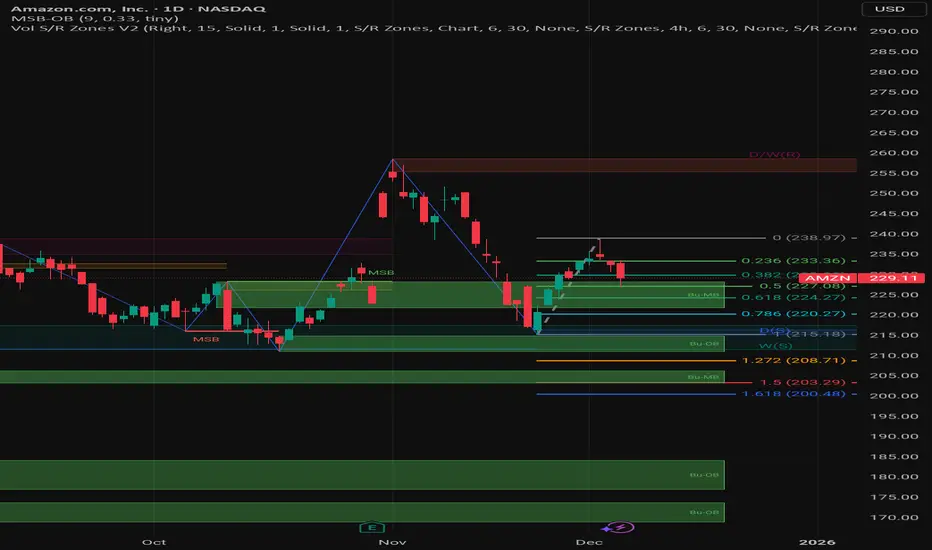
AB=CD pattern formationCurrent Price: 229.11 (Down -1.41% for the day).
Trend: Short-term bearish. The stock recently peaked at Point C (~239.00) and is currently rejecting that level, moving downwards to test immediate support zones.
Key Technical Elements
1. The ABC Structure
Leg A to B:** A significant drop from the high of ~255 down to ~215.
Leg B to C:** A corrective rally (retracement) that pushed price back up to ~239. This failed to make a higher high, creating a "Lower High" at Point C, which is a bearish signal.
Current Leg (C to D): The price is now dropping from C. The chart annotations suggest a target (PRZ) significantly lower, anticipating that this leg will extend downward.
2. Fibonacci Retracement Levels
The chart displays Fibonacci levels drawn from the low (Point B) to the high (Point C) to measure support during this pullback:
0.382 Level (229.90): The price is currently battling this level. A close below here opens the door to lower supports.
0.5 Level (227.08): The mid-point of the previous rally.
0.618 "Golden Pocket" (224.27): This is the most critical immediate support. It aligns perfectly with the green Bullish Order Block (Bu-OB).
3. Order Blocks (Support Zones)
Upper Green Zone (220.00 - 227.00): This is a strong demand zone ("Bu-OB"). This area previously acted as a base for the rally to Point C. If price enters this box, technical traders often look for a bounce.
Lower Green Zones:** There are deeper support blocks around 180.00 and 170.00, but these are far away from current price action.
Projected Scenarios
Bearish Scenario (The Chart's Primary Bias)
The chart labels a "PRZ: AB=CD 3" (Potential Reversal Zone) much lower, around the 195.00 - 200.00 area.
For this to happen, price must break the 0.618 Fib support (224.27) and the previous low at Point B (215.18).
If Point B breaks, the pattern implies a 1:1 extension (where the C-D leg equals the length of the A-B leg), targeting that ~200 zone.
Bullish Scenario
* The bulls need to defend the **0.5 (227.08) or the **0.618 (224.27) Fibonacci levels.
* A bounce from the green box (220-227) would form a "Higher Low" compared to Point B, potentially setting up a trend reversal to the upside.
AMZN 1M Outlook: Low Conviction, Potential Put OpportunityAMZN QuantSignals Katy 1M Prediction 2025-12-03
QuantSignals Katy AI Stock Analysis
Analyzed 1 stock(s): AMZN
AMZN Analysis
Current Price: $232.36
Final Prediction: $233.43 (+0.46%)
30min Target: $235.30 (+1.26%)
Trend: NEUTRAL
Confidence: 40.0%
Volatility: 71.4%
Summary: Generated 0 trade signals from 1 successful analyses out of 1 symbols.
Amazon - Big Tech Pullback Strategy Into $232 SupportAmazon Multi-Month Position Build: $232-234 Entry Zone Targeting $320
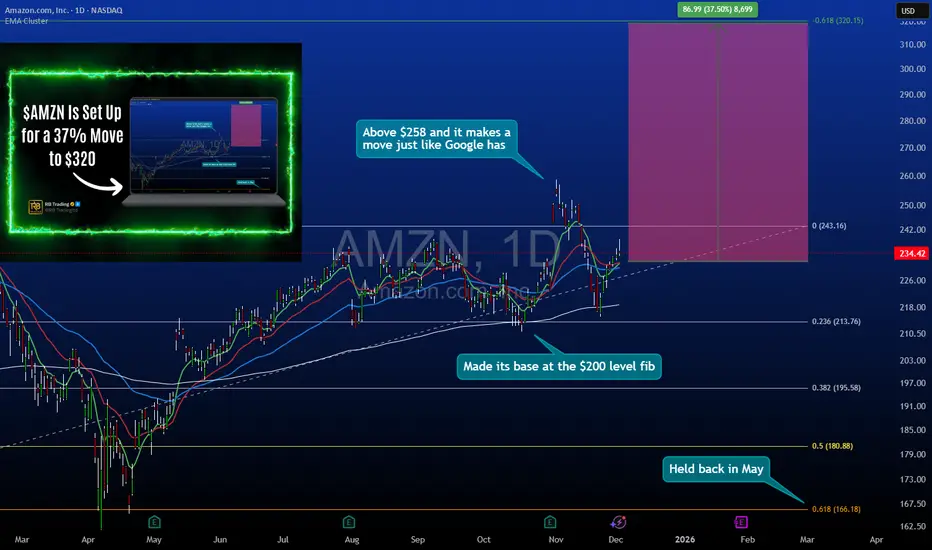
Amazon has pulled back into a critical support zone at $232-234, presenting the same geometric retracement setup that recently validated on GOOGL. This analysis breaks down why this level offers favorable risk/reward asymmetry for a multi-month position targeting $320.
🎯 Setup Overview:
Entry Zone: $232-234 (current pullback area)
Primary Target: $320 (37% upside potential)
Timeframe: Multi-month position (Q1-Q2 2025)
Pattern: Structured retracement in established uptrend
📊 Technical Structure:
Support Confluence at $232-234:
0.618 Fibonacci retracement from recent swing low to high
Previous consolidation zone that acted as resistance, now support
Volume profile shows significant accumulation at this level historically
Aligns with rising trendline from 2023 lows
Price Action Context:
Amazon rallied from $140 lows to $260+ highs before this pullback. The current retracement brings price back into a zone where buyers have historically stepped in with conviction.
Why $320 Target:
Represents the next major resistance zone from prior price structure
Aligns with measured move extensions from current base
37% upside provides asymmetric reward relative to defined risk
🔍 The GOOGL Parallel (Why This Pattern Works):
What Just Happened with GOOGL:
Google recently pulled back into a similar geometric retracement zone (0.618 level) and reversed sharply, validating the strategy of buying quality big tech names during structured pullbacks rather than chasing momentum.
Why The Pattern Repeats:
Institutional Behavior: Large funds rebalance and take profits at resistance, creating predictable pullback zones
Liquidity Zones: Support levels represent areas where prior buyers have conviction and add to positions
Mean Reversion: Extended moves in trending assets typically retrace to specific mathematical levels before continuation
Key Lesson from GOOGL:
The most uncomfortable entry (during the pullback) provided the best risk/reward. Waiting for "confirmation" meant entering 15-20% higher with expanded risk.
📈 Why This Setup Makes Sense:
Risk Is Defined:
Stop loss placement below $225 (structure breakdown) limits downside to ~$7-9 per share from mid-range entry at $233. If price breaks $225, the bullish thesis is invalidated.
Reward Is Probable:
The $320 target isn't arbitrary it's based on:
Previous resistance turned future resistance
Fibonacci extension levels from the pullback
Historical price behavior at major psychological levels
From $233 entry:
Risk: ~$8 to stop at $225
Reward: $87 to target at $320
Ratio: ~10.8:1
Even a conservative partial target at $280 (first resistance) still offers 6:1 reward/risk.
🛡️ Risk Management Framework:
Entry Strategy (Scaling In):
First position: $234 (initial test of support zone)
Second position: $232 (if support retests cleanly)
Final position: $228-230 (if maximum pain occurs but structure holds)
This averaging approach improves entry price while maintaining discipline.
Stop Loss Placement:
Below $225 - a decisive break of this level invalidates the support thesis and requires exit regardless of unrealized loss.
Target Management:
First reduction (1/3): $270 (previous resistance, books profit)
Second reduction (1/3): $295 (psychological level, locks gains)
Final exit (1/3): $320 (primary target, complete position close)
Progressive profit-taking removes emotion from exits.
🧠 Trader Psychology: Why Most Will Miss This:
The Discomfort Factor:
At $234, Amazon "feels" weak because it's down from $260. At $270, it will "feel" strong because it's rising. But the best risk/reward exists now, not later.
Recency Bias:
Recent selling pressure makes traders assume more downside. Historical structure suggests this is where buyers return.
Waiting for Confirmation:
Many will wait for price to break above $250 to "confirm" strength. By then, risk to $225 expands dramatically and reward compresses.
The GOOGL Proof:
Those who waited for Google to "prove itself" entered 18% higher with worse risk parameters. The same pattern is setting up here.
📊 Tools Supporting This Analysis:
Fibonacci Retracement:
0.618 level at $232 marks the zone where pullbacks in strong trends typically find buyers.
Volume Profile:
High volume node around $230-235 indicates this area has been contested heavily—now it must hold as support.
Trendline Analysis:
Rising support from 2023 lows intersects with current price, adding confluence to the $232 zone.
Market Structure:
Higher lows and higher highs remain intact. This pullback is a correction within an uptrend, not a reversal.
🎯 Why Big Tech Pullbacks Work:
Quality + Liquidity:
FAANG stocks have deep liquidity and institutional ownership. When they pull back to structure, buyers appear because the underlying businesses remain strong.
Rotation, Not Rejection:
Selloffs in mega-cap tech are often profit-taking and sector rotation, not fundamental deterioration. This creates buy-the-dip opportunities.
Historical Precedent:
Amazon has repeatedly rewarded buyers who entered during 15-20% pullbacks to support in multi-year uptrends.
📅 Timeframe Expectations:
Not a Day Trade:
This is a multi-month position (potentially 3-6 months to target). Intraday volatility should be ignored.
Quarterly Catalysts:
Amazon's next earnings report and holiday season results could act as catalysts for the move toward $320.
Patience Required:
The $232 level may retest multiple times before resolving higher. Position sizing should accommodate short-term volatility.
⚠️ What Could Go Wrong:
Macro Headwinds:
Broader market selloff could pressure all equities regardless of individual structure. The $225 stop exists for this reason.
Sector Rotation:
If money flows out of tech entirely, support may not hold. This invalidates the thesis and requires disciplined exit.
Earnings Risk:
If holding through earnings, position sizing should account for potential volatility. Consider reducing exposure before the event.
Breaking Support:
If price closes below $225, the setup is broken. No hoping, no averaging down further—just exit and reassess.
🏆 The Professional Approach:
They Buy Structure, Not Stories:
The $232 level isn't interesting because of news or narratives. It's interesting because risk is small and reward is large based on geometry.
They Scale Positions:
Rather than going all-in at $234, they build the position across $234, $232, and potentially $228. This reduces timing pressure.
They Accept Being Wrong:
If $225 breaks, they exit with a small, controlled loss. Pride doesn't enter the equation.
They Journal the Setup:
Entry rationale, risk parameters, and targets documented before the trade. Emotions don't dictate exits.
📌 Key Takeaways:
✅ GOOGL validated the pattern: The same pullback-to-support strategy that worked on Google is setting up on Amazon at $232-234.
✅ 10:1 risk/reward exists now: Entry at $233 with $225 stop and $320 target offers exceptional asymmetry this compresses as price rises.
✅ Multi-month timeframe: This isn't a quick flip. Targets may take 3-6 months. Position sizing and patience are critical.
✅ Structure over emotion: When $234 feels scary, that's the signal. When $280 feels safe, that's the warning.
✅ Scale in, scale out: Build the position across the zone, exit progressively at targets. This removes timing pressure and locks gains.
⚠️ Important Disclaimers:
This analysis is for educational purposes and reflects a technical view based on price structure, historical patterns, and risk/reward calculations. It is not financial advice or a recommendation to buy or sell AMZN or any security.
The $232-234 support zone could fail. The $225 stop loss exists because no support level is guaranteed. Proper risk management requires accepting potential loss if structure breaks.
Targets are based on historical resistance levels and do not guarantee future performance. Market conditions, company-specific events, and macroeconomic factors can prevent targets from being reached.
The GOOGL comparison is for educational pattern recognition, not a guarantee that Amazon will follow the same path. Each setup has unique risks.
Always conduct independent analysis, size positions according to your risk tolerance, and consider consulting a financial professional. All investing involves risk of loss.
✨ Join the Discussion:
Are you watching Amazon at these levels? Have you used similar pullback strategies on big tech names? Share your thoughts or questions in the comments below.
📜 Buy structure. Define risk. Trade with discipline.
AMZN long-term TAAmazon is consolidating, the indicators do not support recent short-term runs which resulted in pullbacks but the trend is neither bearish, more neutral-bullish and also it supports SMA50 along the way, yes there were news about new AI chip from Amazon to rival Nvidia and so on and it has a chance to rally yet following the AI hype trend ride, but the volumes didn't react that much either, we just have to give it a little bit more time to finish the consolidation and project the approximate outcome.
AMZN Weekly Outlook — Contrarian Put Opportunity📊 AMZN Trading Information
AMZN | QuantSignals V3 Weekly | 2025-12-01
🔹 Primary Direction (Weekly): BUY CALLS
Confidence: 58%
Risk Level: High (low confidence + mixed signals)
🔹 Katy AI Direction: BUY PUTS
Predicted Move: -1.38%
Katy Confidence: 50%
⚠️ Directional Conflict Detected
📈 Price + Targets
Current Price: $234.96
Recommended Strike: $230P
Entry: $0.21
Target 1: $0.42
Stop Loss: $0.11
Expiry: 2025-12-05 (4 days)
📉 Market Signals
Weekly Momentum: NEUTRAL (+0.38%)
PCR (Flow Intel): 0.98 (Neutral)
RSI: 70.7 (Overbought — supports downside move)
Resistance: $235.80
VWAP Support: $231.30
🧠 Why Bearish? (Summary)
Katy AI shows 168 prediction points trending downward.
Price near weekly high + overbought RSI → pullback likely.
Put premiums are cheap, giving strong risk/reward.
⚖️ Risk Rating: MODERATE–HIGH
Use small position size due to LLM vs Katy conflict
The Role of the Bond Market in the Global Market1. Foundation for Government Financing
One of the primary roles of the bond market is enabling governments to finance their operations, budget deficits, infrastructure development, and long-term national projects. Every country—whether a developed economy like the United States or an emerging market like India—issues bonds to fund expenditures beyond tax revenues.
Government bonds, often considered “risk-free” in stable countries, act as the backbone of global capital markets. Investors such as pension funds, mutual funds, and central banks rely on government securities to preserve capital and earn predictable income.
The yield on government bonds also reflects investor confidence in a country’s fiscal health. Lower yields indicate strong trust and stability, while higher yields signal economic stress or higher default risk. Thus, government bond markets are constantly monitored to understand a country’s financial condition and borrowing costs.
2. Benchmark for Global Interest Rates
Bond markets serve as the benchmark for interest rates worldwide. The yield on government securities, especially U.S. Treasury bonds, influences borrowing costs for corporations, banks, and even consumers.
Central banks use bond yields as a key indicator when designing monetary policy. For example:
Falling yields usually signal a slowdown, prompting rate cuts or stimulus.
Rising yields indicate inflationary pressure, leading to tighter policy.
Interest rates on mortgages, car loans, business loans, and credit lines are often priced relative to government bond yields. This makes the bond market essential for determining the cost of money in the global economy.
3. Safe Haven During Uncertainty
During economic crises, geopolitical tensions, or stock-market volatility, investors often shift funds from riskier assets to safer ones—primarily government bonds of stable nations. This phenomenon, known as the “flight to safety,” underscores the role of bonds as a secure investment.
For example, U.S. Treasuries, German Bunds, and Japanese Government Bonds are considered safe-haven assets. When global uncertainty rises, prices of these bonds increase, and yields fall. This behaviour stabilizes global capital flows and reduces panic across markets.
4. Financing Corporate Expansion
The corporate bond market allows companies to raise large amounts of money without relying solely on bank loans. Corporations issue bonds to:
Expand manufacturing capacity
Finance mergers and acquisitions
Invest in technology
Refinance old debt
Support working capital
Compared to banks, the bond market offers companies access to a broader pool of capital at potentially lower interest rates. This helps drive global growth, innovation, and job creation.
Corporate bonds also come in different categories such as investment-grade and high-yield (junk bonds). Investment-grade bonds are safer and purchased mainly by institutional investors, while high-yield bonds offer higher returns in exchange for greater risk. The diversity of the bond market supports businesses of all sizes and risk profiles.
5. Critical for Global Asset Allocation
The bond market provides diversification for investors worldwide. Pension funds, insurance companies, and sovereign wealth funds rely heavily on bonds because they deliver steady income and reduce portfolio volatility.
A well-balanced portfolio often includes:
Government bonds for safety
Corporate bonds for higher returns
Municipal bonds for tax benefits
Emerging-market bonds for growth exposure
This mix stabilizes the global financial system and ensures long-term wealth preservation for millions of individuals whose retirement funds are invested in bond portfolios.
6. Influencing Currency Movements
Bond yields are closely linked to currency valuations. Countries with higher interest rates often attract foreign capital, strengthening their currency. Conversely, falling yields may weaken a currency as investors move funds elsewhere.
For example:
Rising U.S. Treasury yields usually strengthen the U.S. dollar.
Falling yields can result in dollar depreciation and capital outflows.
Currency traders therefore watch bond markets closely. Global trade balances, import/export competitiveness, and cross-border investments depend heavily on currency movements influenced by bond yields.
7. Indicator of Economic Health and Expectations
Bond markets are deeply sensitive to inflation expectations, growth trends, and central-bank actions. The shape of the yield curve—the relationship between short- and long-term bond yields—serves as a powerful predictor of economic conditions.
Normal yield curve: Indicates stable growth.
Flattened yield curve: Signals uncertainty or slowing expansion.
Inverted yield curve: Occurs when short-term yields exceed long-term yields; historically, a strong recession indicator.
Investors, policymakers, and economists use yield-curve patterns to forecast economic cycles. Hence, the bond market provides valuable information long before official economic data is released.
8. Supports Financial Stability and Liquidity
The bond market offers deep liquidity, allowing governments and institutions to borrow and invest efficiently. Bond markets run smoothly even during economic disruptions, ensuring continuous capital flow.
Moreover, bonds are widely used as collateral in financial transactions, including repo markets and derivatives. This makes them essential for maintaining liquidity in the banking system.
Central banks also use bonds in open-market operations to regulate money supply—buying bonds injects liquidity, while selling bonds absorbs excess liquidity. Without a functioning bond market, monetary policy would be ineffective.
9. Facilitating Global Trade and Investment
International investors often purchase sovereign and corporate bonds across borders to earn better returns or diversify geographically. Emerging markets, in particular, rely heavily on foreign investment in bonds to fund infrastructure and development.
Bond market integration also enables:
Cross-border investment flows
International trade financing
Global capital mobility
For instance, multinational corporations issue bonds in foreign currencies to access cheaper funding or hedge currency risks. This connects global markets and supports international commerce.
10. Stabilizing Retirement and Insurance Systems
Pension funds and insurance companies depend on predictable cash flows to meet future obligations. Bonds provide fixed income that aligns with long-term liabilities such as pensions, annuities, and insurance claims.
Stable bond markets therefore support public welfare systems, retirement planning, and financial security for millions of households.
Conclusion
The bond market plays an irreplaceable role in the global economic structure. It finances governments and corporations, influences interest rates and currency movements, acts as a safe haven during crises, guides monetary policy, and promotes financial stability. Its deep integration with global trade, investment flows, and retirement systems makes it one of the most vital components of modern finance. While often overshadowed by the stock market, the bond market silently powers the global economy, ensuring liquidity, stability, and long-term economic growth.
AMZN : Mid-Term Bullish Continuation OutlookAmazon is shaping a constructive bullish sequence on the 4-hour timeframe, with recent price action reinforcing renewed upside momentum. The unfolding structure suggests buyers may remain in control as the market progresses into December, keeping the continuation scenario active while the current rhythm holds.
Disclosure: We are part of Trade Nation's Influencer program and receive a monthly fee for using their TradingView charts in our analysis.
AMZN: Bullish Outlook Post-Black Friday Surge
Title:
AMZN: Bullish Outlook Post-Black Friday Surge
Greetings, Traders!
🌟 Hello everyone,
As we analyze Amazon (AMZN) following the recent Black Friday and Thanksgiving sales, we notice a strong bullish sentiment emerging. The online sales surge of **3.1%** provides a solid foundation for potential upward movement.
NASDAQ:AMZN
Key Observations:
- A strong support level is identified at ** 161 ** and ** 167 **, though it is unlikely to be tested in the near future.
- Currently, AMZN is trading around ** 233 **, with a potential upward trajectory towards ** 250 ** in the coming days.
- The price is moving within a well-defined channel, with clear resistance and support lines, as well as internal channel trends.
Technical Analysis:
The channel analysis indicates that AMZN is likely to continue its upward move towards ** 250 **. Traders should consider setting a strict stop-loss at ** 225 ** to manage risk effectively, ensuring that potential downside is minimized.
Fundamental Factors:
The recent increase in online sales by **3.1%** during Black Friday and Thanksgiving suggests strong consumer demand, which is likely to benefit AMZN in the short and medium term. This positive momentum supports a bullish outlook for the stock.
Trading Strategies:
Traders may consider taking long positions with a target around ** 250 ** while maintaining a strict stop-loss at ** 225 **. The strong sales figures enhance the probability of achieving the target, making this a promising opportunity.
In Conclusion:
With AMZN showing strong momentum post-Black Friday, traders can expect further gains. The combination of technical patterns and positive sales data provides a compelling case for a bullish stance. Stay vigilant and manage risk appropriately for optimal results.
Engage with Us:
🟢 If you find this analysis insightful, please give it a LIKE.
🟡 Don’t forget to FOLLOW for more updates.
🔵 SHARE with fellow traders who might benefit from this information.
🔴 Feel free to COMMENT with your thoughts and insights!
Your active participation enriches our trading community, fostering knowledge exchange and collective growth. Share your feedback and ideas in the comments below or by boosting this post.
Looking forward to connecting with you in the next post.
Happy trading!
Amazon.com Inc.( $AMZN) and OpenAI Deal Reignites AI Momentum Amazon.com Inc. (NASDAQ: NASDAQ:AMZN ) gained 1.77% to close at $233.22 as investors reacted to its landmark $38 billion cloud deal with OpenAI. The agreement gives AWS a pivotal role in powering OpenAI’s future models, marking one of Amazon’s most significant AI infrastructure wins to date. The deal spans seven years and includes access to large-scale Nvidia GPU clusters—an essential component for training and deploying advanced generative AI models.
The partnership comes as Amazon accelerates its push to re-establish AWS leadership in the competitive AI cloud segment. For years, OpenAI relied almost exclusively on Microsoft Azure. The shift signals a broadening of OpenAI’s compute strategy and reinforces Amazon’s long-term commitment to expanding its high-performance AI capabilities. AWS leadership noted that its infrastructure is specifically optimized to support demanding AI workloads at global scale, while OpenAI called the partnership a meaningful addition to the broader compute ecosystem.
Strong fundamentals support the bullish outlook. Amazon’s Q3 results highlighted renewed AWS momentum, with cloud growth once again becoming a focal point of investor confidence. AWS remains Amazon's most profitable segment, and securing OpenAI positions it more competitively against Microsoft, Google Cloud, and rising GPU-focused providers.
Long-term performance metrics also reinforce Amazon’s resilience. While the stock is up just 6.30% year-to-date, its three-year return of 148% significantly outpaces the S&P 500. Amazon continues to invest aggressively in logistics automation, advertising, robotics, and AI-driven cloud capabilities—areas expected to drive sustained revenue expansion.
Technical Analysis
AMZN remains bullish, currently trading at $233.22. The chart shows price respecting an ascending trendline, offering structural support near $190–200. A key resistance zone sits near $258, the previous swing high. A breakout above this level could open the path toward $260+. Support remains at $200, with deeper support around $185 if retracement occurs.
Currency Wars and Forex TradingIntroduction
The global financial system is interconnected in complex ways, and one of the most crucial aspects of this system is the movement of currencies. Currency values are not just numbers on a screen; they represent national economic strength, political stability, and global competitiveness. Two concepts that are closely tied to this reality are currency wars and forex trading. Understanding them is essential for policymakers, investors, and traders who navigate the volatile world of international finance.
What are Currency Wars?
Currency wars, sometimes referred to as “competitive devaluations,” occur when countries deliberately devalue their own currencies to gain an advantage in international trade. The primary goal is to make exports cheaper and imports more expensive, stimulating domestic economic growth. For example, if Country A devalues its currency against the US dollar, its goods become cheaper for foreign buyers, potentially boosting exports. Conversely, imports from other countries become more expensive for domestic consumers, which can encourage consumption of locally produced goods.
Historically, currency wars are often associated with periods of global economic stress. The Great Depression of the 1930s and the financial crisis of 2008 both saw nations engaging in strategies to weaken their currencies to protect domestic industries. Currency wars can also arise from competitive monetary policies, where central banks use tools like interest rate cuts or quantitative easing to influence their currency’s value.
Causes of Currency Wars
Trade Imbalances: Countries with persistent trade deficits may attempt to devalue their currency to make exports more competitive and reduce the deficit.
Economic Stimulus Needs: During recessions, weaker currencies can boost domestic growth by encouraging exports.
Monetary Policy Differences: Central banks may adopt divergent policies—like lowering interest rates or engaging in quantitative easing—to influence their currency’s strength.
Global Political Tensions: Geopolitical rivalries can prompt countries to manipulate their currencies to protect economic interests.
While currency devaluation can stimulate exports, it also has risks. It can trigger inflation, erode consumer purchasing power, and provoke retaliatory measures from trading partners. If multiple nations engage in competitive devaluation simultaneously, a currency war emerges, potentially destabilizing the global economy.
Forex Trading: The Global Currency Market
Forex trading, or foreign exchange trading, is the act of buying and selling currencies in a decentralized global market. The forex market is the largest financial market in the world, with daily trading volumes exceeding $7 trillion as of 2023. Traders, investors, corporations, and governments participate to hedge risks, speculate on currency movements, or conduct international transactions.
The forex market operates 24 hours a day across different time zones, spanning financial centers in London, New York, Tokyo, and Sydney. Trading occurs in currency pairs, such as EUR/USD, USD/JPY, and GBP/USD. The value of a currency pair represents how much of the quote currency (the second currency) is needed to purchase one unit of the base currency (the first currency).
How Currency Wars Impact Forex Trading
Currency wars have a profound influence on forex markets. Since forex trading revolves around the relative value of currencies, any deliberate move by a government or central bank to weaken its currency creates volatility and trading opportunities.
Volatility and Speculation: Traders often capitalize on expected devaluations by short-selling the currency of a country engaging in competitive devaluation. Increased volatility can lead to both higher profits and greater risks.
Interest Rate Differentials: Central banks may cut interest rates to weaken their currency, affecting forex markets. Investors seek higher yields, leading to capital flows that influence currency values.
Safe-Haven Currencies: During currency wars, investors often flock to stable currencies like the US dollar, Swiss franc, or Japanese yen, affecting global liquidity and forex pricing.
Market Sentiment: Perceptions of a country’s economic health and political stability, influenced by currency policies, directly affect trading decisions in forex markets.
For instance, during the 2010s, when Japan aggressively pursued monetary easing to combat deflation, the Japanese yen experienced periods of significant depreciation. Forex traders who anticipated these moves were able to profit from yen carry trades and other strategies.
Trading Strategies in a Currency War
Currency wars create unique opportunities and risks for forex traders. Common strategies include:
Carry Trades: Traders borrow a low-interest-rate currency and invest in a high-interest-rate currency. In times of currency wars, the low-interest-rate currency may weaken, amplifying gains.
Technical Analysis: Traders analyze historical price movements, support/resistance levels, and technical indicators to predict currency movements in volatile markets.
Fundamental Analysis: Economic indicators such as GDP growth, trade balances, inflation, and central bank policies are closely monitored to anticipate currency devaluations.
Hedging: Corporations and investors may hedge their exposure to currency fluctuations using options, forwards, and futures contracts to manage risk during competitive devaluations.
However, currency war-induced volatility also carries risks of sudden market reversals. Traders must balance potential gains with the risk of unexpected policy changes or geopolitical developments.
Examples of Currency Wars in History
The 1930s Great Depression: Many countries devalued their currencies to boost exports, leading to trade tensions and global economic instability.
2008 Financial Crisis: Central banks in the US, Japan, and Europe implemented aggressive monetary easing, prompting fears of competitive devaluations.
US-China Trade Tensions (2010s–2020s): Both nations took measures affecting their currency values, impacting global trade flows and forex markets.
These examples show that currency wars are not only about short-term profit but also involve broader geopolitical and economic consequences.
Implications of Currency Wars
Global Trade Disruption: Competitive devaluations can distort trade balances and create uncertainty for exporters and importers.
Inflation Risks: Weaker currencies can increase import costs, driving domestic inflation.
Capital Flow Volatility: Investors may rapidly shift funds to perceived safe-haven currencies, affecting emerging markets.
Policy Retaliation: Countries may impose tariffs, quotas, or other trade barriers, exacerbating tensions.
Thus, currency wars have a dual impact: they influence both macroeconomic stability and micro-level trading opportunities.
Conclusion
Currency wars and forex trading are deeply intertwined. While currency wars involve deliberate attempts by nations to manipulate exchange rates for competitive advantage, forex trading represents the arena where these policies manifest in tangible price movements. Traders who understand the dynamics of currency wars can profit from volatility, but they must also navigate the risks of sudden policy shifts, global economic pressures, and geopolitical events.
In today’s interconnected world, the study of currency wars and forex trading is more relevant than ever. Central banks’ policies, global trade imbalances, and political developments can all cause rapid fluctuations in currency markets, influencing everything from international trade to individual investment portfolios. For policymakers, understanding the consequences of currency devaluation is critical to maintaining economic stability. For traders, monitoring these developments is essential for navigating the high-stakes, fast-moving world of forex markets.
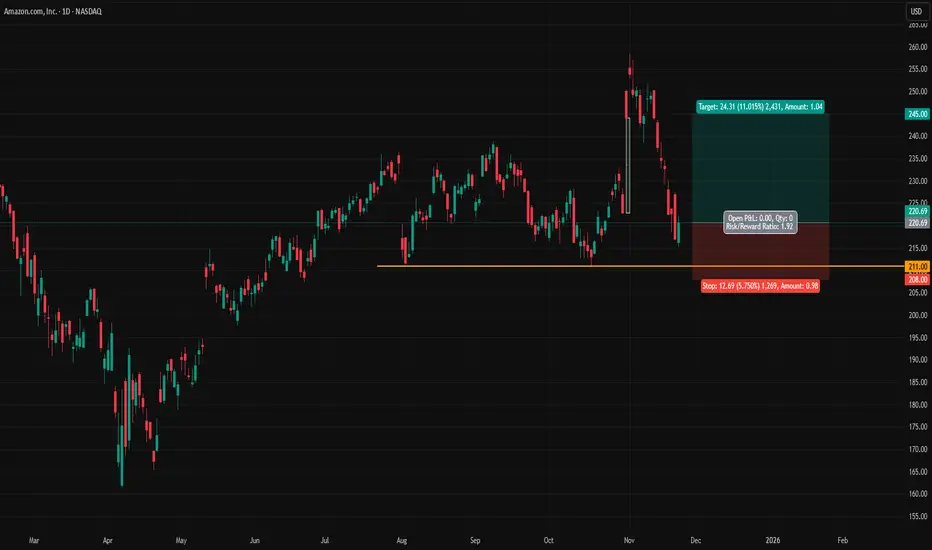
Amazon 🎯 Key Levels & Risk Management
Critical Support: $215 or the Year-To-Date (YTD) Anchored VWAP. These levels must hold to maintain the bullish structure.
Stop Loss: A close below $215 invalidates the long thesis.
Bullish Target/Flow: Huge institutional interest observed with $250 Calls (May '26)—over $10M in premiums hit the tape this week.
📉 Technical Analysis & Price Action
Trendline Defense: The stock hit a "crossroads" of trendlines but ultimately managed a bullish close above the rising trendline.
Gap Fill: The daily chart successfully closed the previous Earnings Run (ER) bull gap last week.
Moving Averages: Significant overhead supply exists. Bulls have heavy lifting to do to reclaim key Moving Averages (KMAs) on multiple timeframes following last week's sell volume.
📊 Market Context
Relative Performance: It is shocking to see NASDAQ:AMZN still net negative YTD, suggesting it is lagging significantly behind the broader market/Magnificent 7.
Risk/Reward: Given the defined stop at $215 and the upside lag, the R/R ratio is highly favorable for a long position.
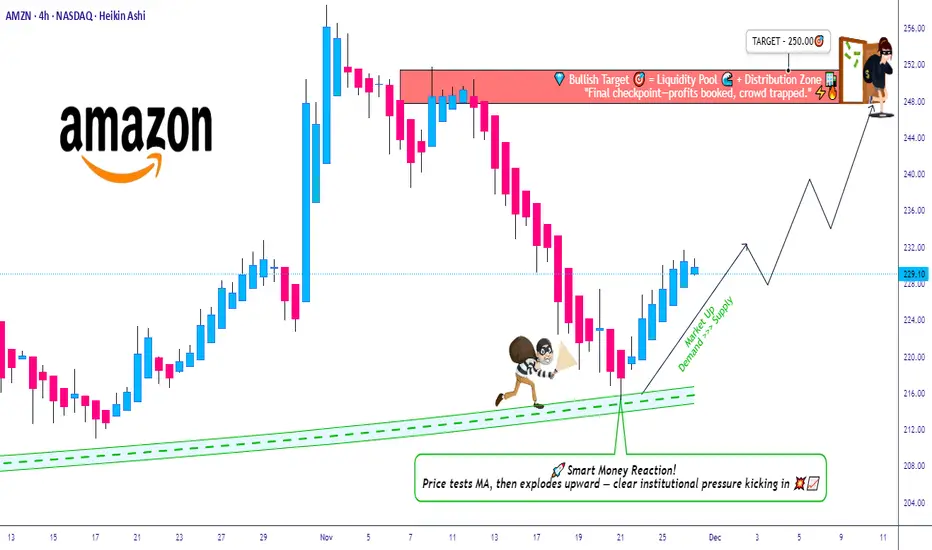
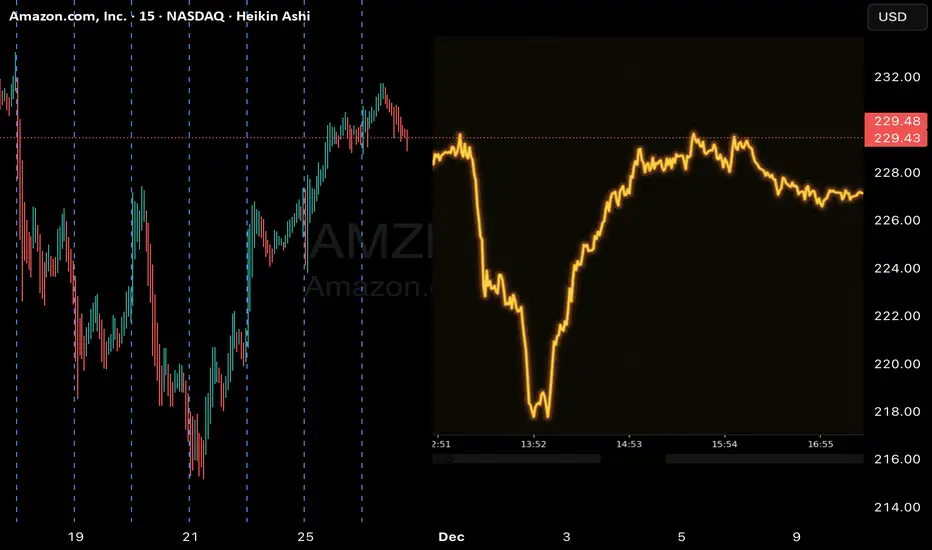
AMZN Breakout Reload? TMA Pullback Shows Buyer Strength🔥 AMZN Swing Trade Profit Playbook | Bullish Pullback + Thief Layering Strategy 🟢📦
Welcome back, Ladies & Gentlemen — the Thief OG’s 😎🕵️♂️
Here’s a polished, rule-friendly breakdown of the bullish setup developing on AMZN (Amazon.com Inc.) – NASDAQ.
📌 Market Context
AMZN is showing a clean bullish pullback into the Triangular Moving Average (TMA) zone, supported by a Heikin Ashi Doji Reversal, signaling that buyers are gaining strength and attempting to dominate momentum again. 📈🔥
🧠 Trade Plan (Swing Trade)
Plan:
A bullish pullback strategy confirmed by:
🔺 Triangular Moving Average pullback reaction
🟩 Heikin Ashi reversal-doji indicating potential trend continuation
📊 Buyers stepping in with momentum recovery
🎯 Entry Plan – Thief Style Layering (Multiple Limit Orders)
This is the famous Thief Strategy — using layered limit orders to scale into the move like a master of stealth 😎🕵️♂️💼
(TradingView-safe version: purely educational, optional, trade at your own risk.)
Layered Buy Limits:
🟢 215.00
🟢 220.00
🟢 225.00
🟢 230.00
(You may increase or adjust layers based on your own style and risk tolerance.)
🛑 Stop-Loss (Thief Style Educational Version)
SL Zone (Optional):
❌ 210.00
⚠️ Note: Dear Ladies & Gentlemen (Thief OG’s), this level is NOT a recommendation — it’s just part of the thief-style educational breakdown.
Choose your own risk plan, trade your own analysis.
🎯 Target Zone
The “Police Force” 🚓 — aka strong resistance, potential overbought zone, and liquidity trap area — sits around:
🟡 Target @ 250.00
⚠️ Note: Dear Ladies & Gentlemen (Thief OG’s), this is NOT a fixed TP recommendation.
Manage your profits as per your own risk appetite and strategy.
📡 Related Pairs to Watch (Correlation & Market Behavior)
Watching correlated tickers helps understand broader tech-sector sentiment and liquidity rotation.
Here are the key names to keep an eye on:
📌 NASDAQ:AAPL (Apple Inc.)
Strong correlation with AMZN in tech-momentum cycles.
When AAPL shows bullish continuation, AMZN often follows with similar pressure.
📌 NASDAQ:META (Meta Platforms Inc.)
Tracks consumer-tech spending sentiment.
Strong META moves can hint at acceleration across NASDAQ growth stocks.
📌 NASDAQ:MSFT (Microsoft Corp.)
A heavyweight pillar in NASDAQ.
MSFT strength boosts overall tech-index bullish bias.
📌 NASDAQ:QQQ (Invesco NASDAQ-100 ETF)
The main sentiment gauge.
If QQQ remains above its trend structure, AMZN's bullish continuation gets stronger confirmation.
📌 NASDAQ:TSLA (Tesla Inc.)
Not directly correlated, but impacts NASDAQ volatility dynamics.
High volatility in TSLA often ripples into liquidity behavior across the index.
💬 Final Thoughts
This AMZN setup blends structure, momentum, and multi-layer entries, crafted in a fun Thief-style teaching format while keeping everything compliant and research-focused 📚✨
Trade smart, manage risk, escape with profits when the “police” show up 🚓😆📈
✨ “If you find value in my analysis, a 👍 and 🚀 boost is much appreciated — it helps me share more setups with the community!”
⚠️ Disclaimer
This is a Thief-style trading strategy presented just for fun & educational purposes only.
Not financial advice. Do your own analysis and manage risk responsibly.
#AMZN #Amazon #SwingTrade #NASDAQ #BullishSetup #PullbackStrategy #HeikinAshi #TriangularMovingAverage #ThiefStrategy #LayeringEntries #TradingEducation #StockMarket #MarketAnalysis #TradingViewCommunity #EditorPickReady 🚀
Global Finance and Central Control1. The Architecture of Global Finance
The modern global financial system is built on several interconnected layers:
a) International Financial Markets
These include:
Foreign exchange (Forex) markets where currencies are traded.
Global bond markets where governments and corporations borrow.
Equity markets where companies raise capital.
Derivatives markets where risk is traded through futures, options, and swaps.
These markets operate almost 24/7 and link every financial center—New York, London, Tokyo, Singapore, Dubai, Frankfurt.
b) Cross-Border Capital Flows
Capital moves across borders in the form of:
Foreign direct investment (FDI)
Portfolio investments in stocks and bonds
Bank lending
Remittances
Trade financing
These flows allow nations to grow, but they also expose countries to global shocks.
c) Financial Institutions
The key pillars include:
Global banks (JPMorgan, HSBC, Citi, Standard Chartered)
Multinational corporations
Pension funds and sovereign wealth funds
Hedge funds and private equity
Central banks and regulatory bodies
Together, these institutions shape how money circulates globally.
2. The Rise of Central Control in Global Finance
Although global finance appears “free-flowing,” it is not without central oversight. Control is exerted in three broad ways:
A. Central Banks: The Nerve Centers of Financial Power
Central banks are the most powerful financial institutions within countries, but their influence spills into global markets.
Key Functions
Set interest rates that influence global borrowing.
Control money supply and liquidity.
Stabilize inflation and currency value.
Act as lenders of last resort during crises.
Global Impact
When the Federal Reserve (US) raises or cuts rates, the effects cascade worldwide:
Global investors shift capital.
Emerging-market currencies rise or fall.
Commodity prices fluctuate.
Debt burdens in dollar-dependent nations increase or ease.
Similarly, the European Central Bank (ECB), Bank of England, and Bank of Japan impact global liquidity and yield curves.
In this sense, global finance is not only shaped by markets but by centralized monetary decisions from a handful of powerful institutions.
B. International Financial Institutions (IFIs)
These include:
International Monetary Fund (IMF)
World Bank
Bank for International Settlements (BIS)
Financial Stability Board (FSB)
Their Role in Central Control
1. The IMF
Provides emergency loans, sets macroeconomic rules, and monitors global financial stability. Countries receiving IMF support must often adopt conditions such as:
Fiscal tightening
Structural reforms
Currency adjustments
This creates a form of policy influence over sovereign nations.
2. The World Bank
Finances development projects and shapes the economic policies of emerging markets through program design and conditional funding.
3. The BIS
Known as the “central bank of central banks,” the BIS sets global banking norms through the Basel accords:
Basel I: Capital requirements
Basel II: Risk management
Basel III: Liquidity and leverage rules
These rules unify how banks operate across the world.
4. Financial Stability Board (FSB)
Coordinates global regulators and sets standards for the world’s largest banks and financial institutions.
C. Regulatory and Political Control
Global finance is also influenced by:
Government fiscal policies
Trade agreements
Sanctions and geopolitical decisions
Financial regulations (AML, KYC, FATF rules)
The Power of Sanctions
The U.S., EU, and UN often use financial sanctions to control, punish, or pressure countries.
Sanctions affect:
Banking access (SWIFT restrictions)
Global payments
Trade receipts
Ability to borrow internationally
This highlights how finance becomes a tool of geopolitical influence.
3. The USD-Centric Financial Order
The U.S. dollar is the anchor of global finance:
60% of global reserves
88% of all FX transactions
50%+ of global trade invoicing
This dominance gives the U.S. unparalleled financial power:
It influences global liquidity via Fed policy.
It controls access to dollar clearing.
It sets global borrowing costs.
It can impose financial sanctions with global impact.
In short, the dollar system is a centralized backbone of global finance.
4. Technology and the Future Centralization of Finance
Digital innovation is transforming financial control.
A. Central Bank Digital Currencies (CBDCs)
Many countries—including China, India, the EU, and the U.S.—are researching or piloting CBDCs.
Implications
Real-time monetary policy tools
Greater surveillance of transactions
More control over taxation and fiscal distribution
Potential reduction in cash usage
Cross-border settlement improvements
CBDCs strengthen central authority and expand the scope of financial oversight.
B. Digital Payments & Fintech Networks
Platforms like:
UPI (India)
PayPal
SWIFT gpi
Visa/Mastercard
RippleNet
Crypto exchanges
These networks process billions of transactions daily. While they make finance efficient, they also consolidate control within digital ecosystems.
C. Cryptocurrencies and Decentralized Finance (DeFi)
Crypto represents the opposite of central control:
No central intermediary
Blockchain-based transparency
Peer-to-peer value transfer
However, regulators are increasing oversight on:
Exchanges
Stablecoins
DeFi protocols
On- and off-ramps
This means even decentralized systems are gradually being integrated back into the centrally regulated financial order.
5. The Tension Between Free Markets and Central Control
Global finance operates under constant tension:
Free Market Forces
Capital flows to high-return markets.
Traders respond to price signals.
Currency values fluctuate.
Central Controls
Interest rate decisions
Capital controls
Sanctions
Regulatory requirements
Monetary interventions
The global system depends on maintaining a balance between these forces.
Too much freedom leads to speculative bubbles and crises.
Too much central control restricts innovation and creates financial rigidity.
6. Crises and the Need for Central Coordination
Major financial crises have shown why central coordination is essential:
1997 Asian Financial Crisis
Massive capital flight destabilized multiple economies.
2008 Global Financial Crisis
The collapse of U.S. mortgage markets triggered global recession.
2020 Pandemic Shock
Central banks injected unprecedented liquidity to prevent collapse.
During crises, free markets alone cannot stabilize the system—central intervention becomes indispensable.
7. The Direction of Global Finance Going Forward
The future will be shaped by three trends:
1. Increasing Centralization
CBDCs
Stronger regulatory norms
Coordinated global oversight
Tighter cross-border monitoring
2. Multipolar Financial Power
Rise of China’s yuan
India’s rapid economic growth
Regional currency arrangements
Asian, Middle Eastern, and African financial alliances
3. Hybrid Financial Models
Mix of centralized control (CBDCs, regulations) and decentralized innovation (blockchain, tokenized assets).
Conclusion
Global finance is a vast, interconnected system shaped by markets, institutions, and powerful central actors. Central banks, the IMF, World Bank, BIS, and regulatory bodies exercise significant control over capital movement, banking standards, and financial stability. At the same time, digital transformation—from CBDCs to fintech—will increase central oversight while creating new tensions with decentralized technologies like crypto.
In essence, global finance is both free-flowing and centrally influenced, a system where market dynamics meet institutional power. Understanding this balance is essential to understanding how the world’s economic engine truly works.
AMZN Sideways Action — Quant Model Predicts Minimal MoveAMZN QuantSignals Katy 1M Prediction 2025-11-26
Ticker: AMZN
Signal Type: QuantSignals Katy 1M
Date: 2025-11-26
🔍 Analysis Summary
Current Price: $230.84
Final Prediction: $230.55 (-0.13%)
30min Target: $230.91 (+0.03%)
Trend: NEUTRAL
Confidence: 46.2% (Below trade threshold)
Volatility: 8.8%
⚠️ Trade Signal
No trade signal generated
Reason: Insufficient confidence and insufficient move size
Market conditions show flat momentum and tight range.
📌 Summary
0 trade signals generated from 1 analysis.
Model suggests waiting for clearer trend or higher confidence before entering.
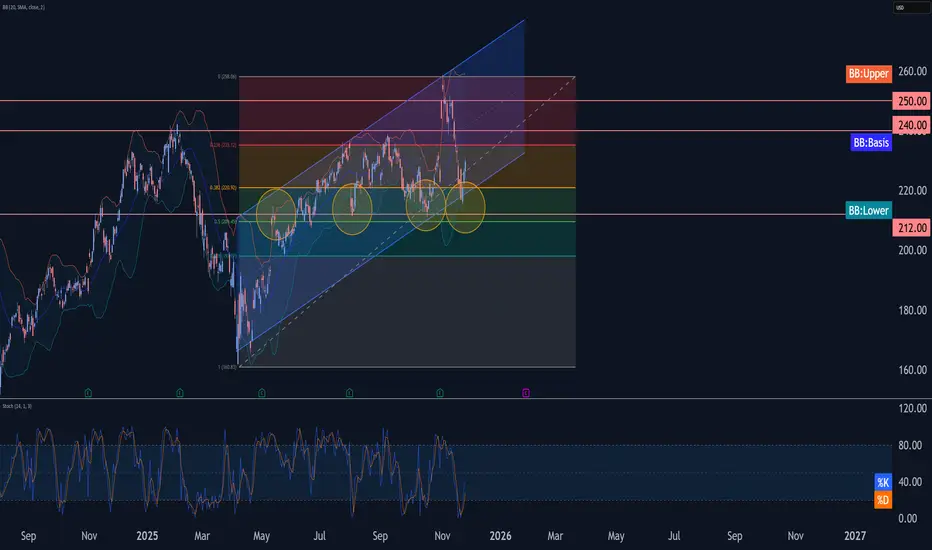
Amazon Wave Analysis – 25 November 2025- Amazon reversed from support area
- Likely to rise to resistance level 240.00
Amazon recently reversed from support area between the pivotal support level 212.00 (which has been reversing the price from May), lower daily Bollinger Band and the 50% Fibonacci correction of the upward impulse 1 from April.
The upward reversal from this support area stopped the previous sharp downward correction 2.
Given the clear daily uptrend, Amazon can be expected to rise further to the next resistance level 240.00.
RSI Bearish DivergenceAs we can see, there is a hidden RSI Divergence.
A HIDDEN RSI Divergence occur when we see lower highs for the price, and higher highs for the RSI.
The reason it is considered hidden is because the indicator refers to a momentum continuation, while the price is actually achieving lower highs.
This is confirmed by the last bearish candle we see.
...Please note, this is a 2 Hours Chart...
If the price breaks above and RSI continued to make higher higher along with the price, it might not divert.
On another note:
-We can notice a STRONG RSI Divergence, starting from the last candle in 30 October.
The reason it is strong is because the we see a strong price hike, and the momentum is decreased.
Why os Amazon $AMZN rallying?Why os Amazon NASDAQ:AMZN rallying? Amazon st. The strong weekly demand level at $231 per share is still in control. Rallying as expected. Long positions should be managed.
Hopefully, Amazon stock will continue to rally. These imbalances are great for stock swing trading, bullish stock option strategies and intraday stock trading once the imbalance gains control.
Amazon (NASDAQ: $AMZN) Expands AI Power With $50B GovCloud PushAmazon (NASDAQ: NASDAQ:AMZN ) is strengthening its position in the AI and cloud infrastructure race with a massive pledge of up to $50 billion to expand supercomputing capacity for U.S. government agencies. The investment focuses on building advanced AWS data centers across Top Secret, Secret, and GovCloud regions starting in 2026, adding nearly 1.3 gigawatts of AI and high-performance computing power. With more than 11,000 government customers, AWS aims to widen its lead as AI competition intensifies across cloud providers.
Industry analysts note that Amazon has lost some ground in AI-specific cloud growth to rivals like Google and Oracle. As companies such as Microsoft, OpenAI, and Alphabet pour billions into AI infrastructure, Amazon’s scale-driven investment is a strategic move to ensure AWS remains the backbone of government AI systems.
The new capacity will support federal agencies with a full stack of AI tools—including Amazon SageMaker, Amazon Bedrock, and foundation models like Amazon Nova and Anthropic Claude—allowing them to build customized AI solutions at scale. Analysts expect the U.S. government to accelerate AI adoption as part of its race to maintain technological leadership over China.
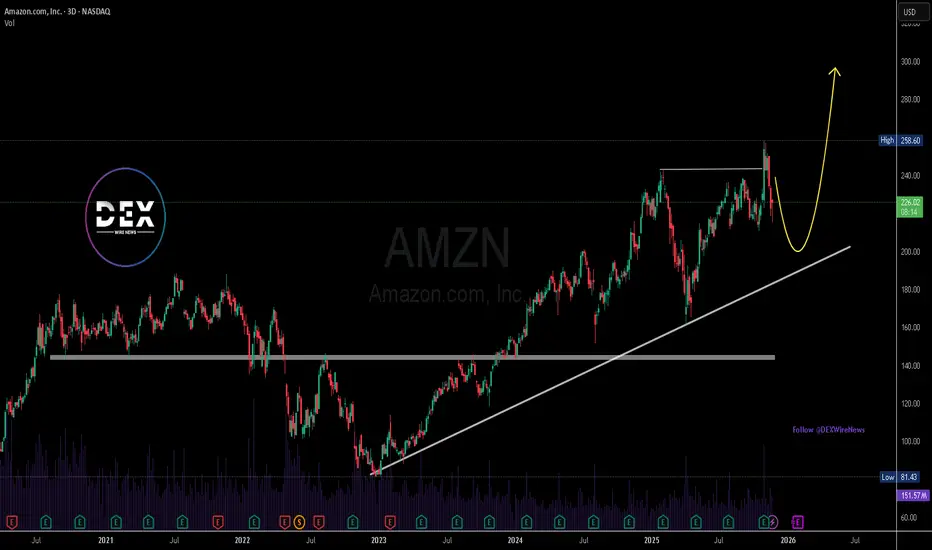
Technical Outlook
AMZN is currently pulling back from the $258 resistance, forming a healthy correction toward the $232 support zone, which aligns with a weekly demand level. Bulls will look for a strong reaction here to retest the $258 high and potentially break above it.
A failure at $232 exposes the ascending trendline support that has guided Amazon’s uptrend since early 2023. The RSI cooling off suggests this is a normal correction rather than a trend reversal. If support holds, upside targets between $280–$300 remain valid, matching long-term Fibonacci projections.