Europe’s Risk Map Has Flipped — France Replaces GreeceA decade ago, Greece symbolized the eurozone’s sovereign crisis — junk-rated, under bailout supervision, and trading with spreads above 3,000 bps vs the German Bund.
France, meanwhile, was near AAA, considered the cornerstone of European credit stability.
Today, that map has flipped.
🔹 Greece now sits in the middle of the pack — its spread has collapsed to ~70 bps, after years of fiscal reform and ECB backstops.
🔹 France, once a core safe haven, is now the worst-rated among the major euro economies.
All three major agencies — S&P, Moody’s, and Fitch — have progressively cut its rating, pushing it down from AA to the lower A range, only six notches above junk.
🔹 Italy remains the barometer of European risk, but France’s fiscal slippage and high deficit (≈5% of GDP) are now drawing the spotlight.
The combination of these two charts tells a clear story:
The “peripheral” risk has converged, while “core” credibility has eroded.
Europe’s sovereign hierarchy is no longer what it used to be.
France Government Bonds 10 YR Yield
No trades
Market insights
Credit Risk FRANCE: 2 Decisive BarometersSince the announcement of the confidence vote on September 8, 2025, the French political situation has been plunged into deep uncertainty. Prime Minister François Bayrou, who leads a minority government, faces a determined opposition that has already announced it will vote against him, making his continuation at Matignon very unlikely. This political fragility immediately weighed on market confidence: risk premia and borrowing costs are rising for the government and French companies.
In the event of the government’s fall, the possibility of early elections and the prospect of new social tensions, with mobilizations planned as early as September 10, heighten concerns. In this context, the authorities are attempting to reassure by insisting that France remains economically sound and that a 2026 budget will be adopted on time, with perhaps the establishment of a so-called “technical” government rather than another dissolution of the National Assembly.
This uncertainty may put pressure on French sovereign interest rates and thus destabilize French banks and companies, with a contagion effect across the Eurozone.
Will the situation worsen or, on the contrary, improve this September for France and the Eurozone?
Here are two market barometers to monitor very closely, which will be highly relevant in measuring the positive or negative evolution of this “France” risk.
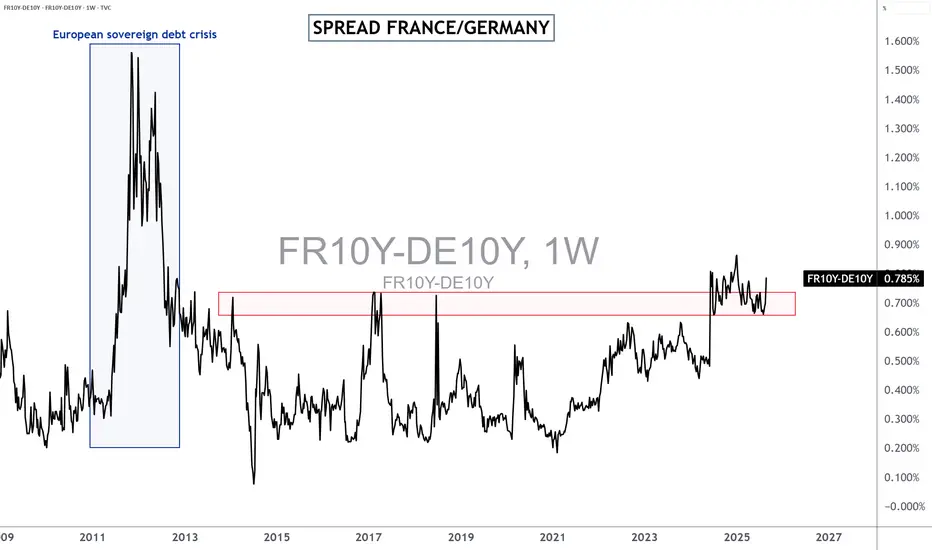
1. Primary barometer of “France” risk: the 10-year interest rate spread between France and Germany
The long-term bond yield spread between France and Germany represents the ultimate risk barometer for French public debt. The wider this spread, the more the market anticipates difficulties for French public finances.
I am currently placing this market proxy under close surveillance, as its upward trajectory could become worrying beyond a certain threshold. Conversely, if French political uncertainty eases, this spread will decline, which would be a positive signal for European financial assets.
The chart below shows, on a closing basis, the 10-year yield spread between France and Germany:
2. Secondary barometer to watch: the value of the French 10-year bond yield compared with the Italian 10-year bond yield
A second interesting barometer is the absolute gap between the French 10-year sovereign yield and the Italian yield. The French rate has never been higher than the Italian one, and if this were to occur, it would send a very negative market signal for France, its banks, and its companies. At present, the French yield remains lower than the Italian one.
The chart below shows the French and Italian 10-year bond yields in the form of daily candlesticks:
DISCLAIMER:
This content is intended for individuals who are familiar with financial markets and instruments and is for information purposes only. The presented idea (including market commentary, market data and observations) is not a work product of any research department of Swissquote or its affiliates. This material is intended to highlight market action and does not constitute investment, legal or tax advice. If you are a retail investor or lack experience in trading complex financial products, it is advisable to seek professional advice from licensed advisor before making any financial decisions.
This content is not intended to manipulate the market or encourage any specific financial behavior.
Swissquote makes no representation or warranty as to the quality, completeness, accuracy, comprehensiveness or non-infringement of such content. The views expressed are those of the consultant and are provided for educational purposes only. Any information provided relating to a product or market should not be construed as recommending an investment strategy or transaction. Past performance is not a guarantee of future results.
Swissquote and its employees and representatives shall in no event be held liable for any damages or losses arising directly or indirectly from decisions made on the basis of this content.
The use of any third-party brands or trademarks is for information only and does not imply endorsement by Swissquote, or that the trademark owner has authorised Swissquote to promote its products or services.
Swissquote is the marketing brand for the activities of Swissquote Bank Ltd (Switzerland) regulated by FINMA, Swissquote Capital Markets Limited regulated by CySEC (Cyprus), Swissquote Bank Europe SA (Luxembourg) regulated by the CSSF, Swissquote Ltd (UK) regulated by the FCA, Swissquote Financial Services (Malta) Ltd regulated by the Malta Financial Services Authority, Swissquote MEA Ltd. (UAE) regulated by the Dubai Financial Services Authority, Swissquote Pte Ltd (Singapore) regulated by the Monetary Authority of Singapore, Swissquote Asia Limited (Hong Kong) licensed by the Hong Kong Securities and Futures Commission (SFC) and Swissquote South Africa (Pty) Ltd supervised by the FSCA.
Products and services of Swissquote are only intended for those permitted to receive them under local law.
All investments carry a degree of risk. The risk of loss in trading or holding financial instruments can be substantial. The value of financial instruments, including but not limited to stocks, bonds, cryptocurrencies, and other assets, can fluctuate both upwards and downwards. There is a significant risk of financial loss when buying, selling, holding, staking, or investing in these instruments. SQBE makes no recommendations regarding any specific investment, transaction, or the use of any particular investment strategy.
CFDs are complex instruments and come with a high risk of losing money rapidly due to leverage. The vast majority of retail client accounts suffer capital losses when trading in CFDs. You should consider whether you understand how CFDs work and whether you can afford to take the high risk of losing your money.
Digital Assets are unregulated in most countries and consumer protection rules may not apply. As highly volatile speculative investments, Digital Assets are not suitable for investors without a high-risk tolerance. Make sure you understand each Digital Asset before you trade.
Cryptocurrencies are not considered legal tender in some jurisdictions and are subject to regulatory uncertainties.
The use of Internet-based systems can involve high risks, including, but not limited to, fraud, cyber-attacks, network and communication failures, as well as identity theft and phishing attacks related to crypto-assets.
Spread OAT/BUND Over seven in ten French people (72%) hope that Francois Bayrou's government does not obtain a majority of votes in the National Assembly on 8 September. The Rassemblement National (RN), La France insoumise (LFI) and the Ecologists, as well as the socialists have already said that they will not give their confidence to the government
France 10 Year bond Sun Storm Investment Trading Desk & NexGen Wealth Management Service Present's: SSITD & NexGen Portfolio of the Week Series
Focus: Worldwide
By Sun Storm Investment Research & NexGen Wealth Management Service
A Profit & Solutions Strategy & Research
Trading | Investment | Stocks | ETF | Mutual Funds | Crypto | Bonds | Options | Dividend | Futures |
USA | Canada | UK | Germany | France | Italy | Rest of Europe | Mexico | India
Disclaimer: Sun Storm Investment and NexGen are not registered financial advisors, so please do your own research before trading & investing anything. This is information is for only research purposes not for actual trading & investing decision.
#debadipb #profitsolutions
FR10Y at major resistanceI do not see 10 Yr French gov. bond yield break the resistance of this bearish canal. Paris CBD offices trade at c.2.7% yield which implies an already compressed spread. Further compression would likely cause a RE crash and a recession. This is true for RE and probably for other sectors too.
Declining yields could result from a variety of factors though i do not beleive in the rosy ones
France 10 Years Bond Europe Sun Storm Investment Trading Desk & NexGen Wealth Management Service Present's: SSITD & NexGen Portfolio of the Week Series
Focus: Worldwide
By Sun Storm Investment Research & NexGen Wealth Management Service
A Profit & Solutions Strategy & Research
Trading | Investment | Stocks | ETF | Mutual Funds | Crypto | Bonds | Options | Dividend | Futures |
USA | Canada | UK | Germany | France | Italy | Rest of Europe | Mexico | India
Disclaimer: Sun Storm Investment and NexGen are not registered financial advisors, so please do your own research before trading & investing anything. This is information is for only research purposes not for actual trading & investing decision.
#debadipb #profitsolutions
Bond Yield : From Negative to Positive and Negative AgainJapan and German Bond Yield just recently enter a positive area.
These Bond Yields previously have moved in a negative area since Investors keep buying those assets. But since the outbreak, Investor seems to ignore safe heaven and hoard cash. They sold Japan and German Bond so those bond yields are increasing since the prices are decreasing.
France Bond Yield is in a negative area which means Investor is still keeping that bond. US Treasury Yield is still positive but Investors believe that the yield soon touches zero-line and enters a negative territory.
I monitor these Yields to measure how investor reacts to the outbreak and possible global recession.