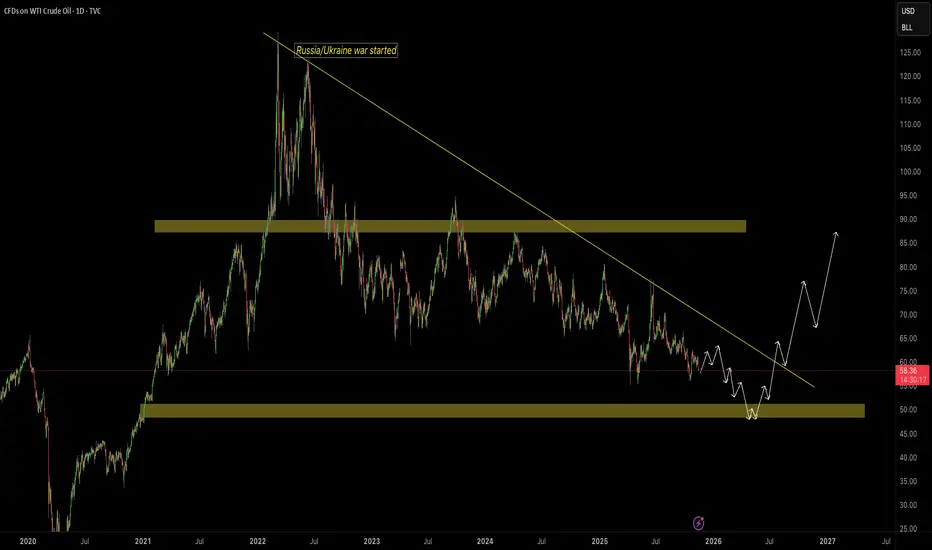
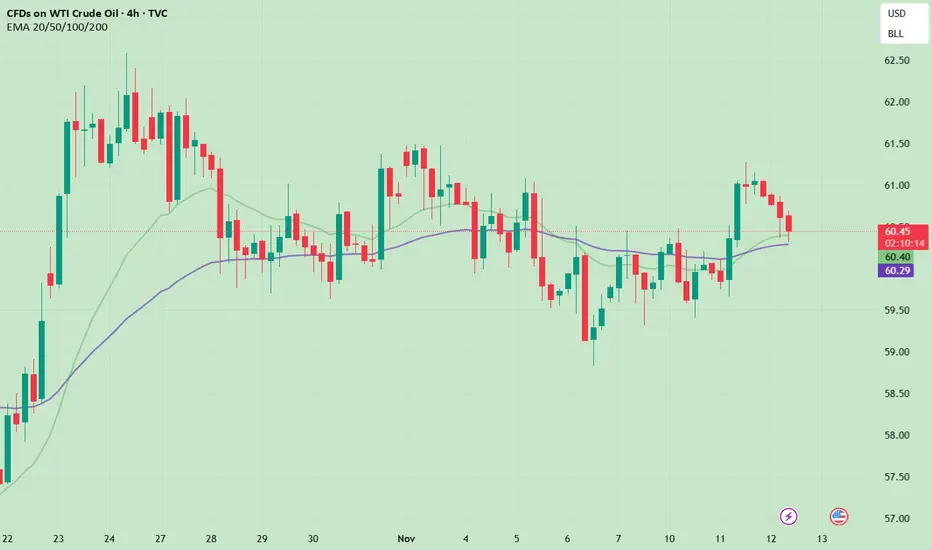
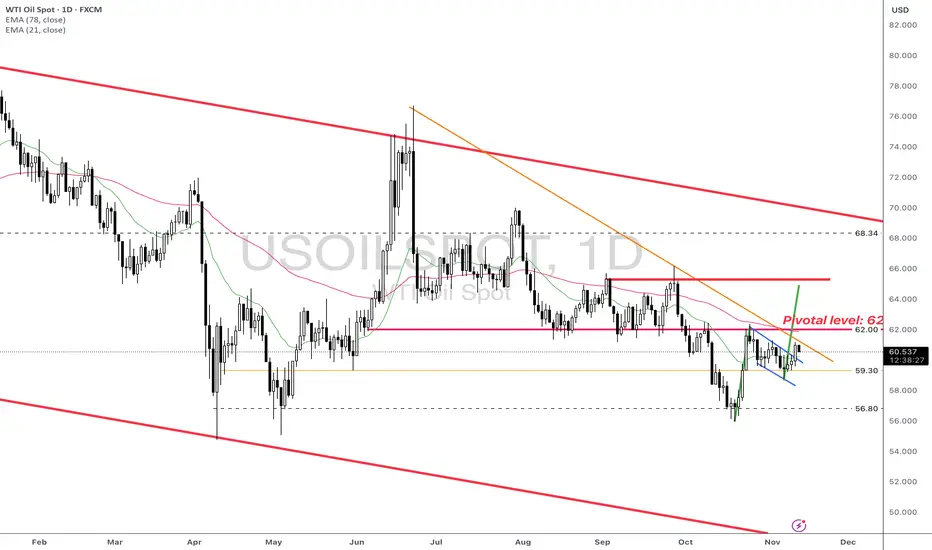
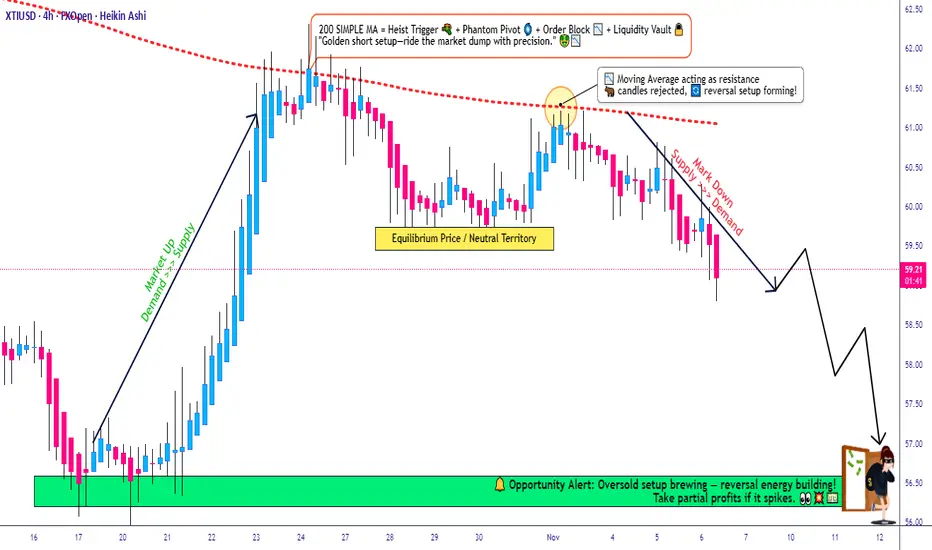
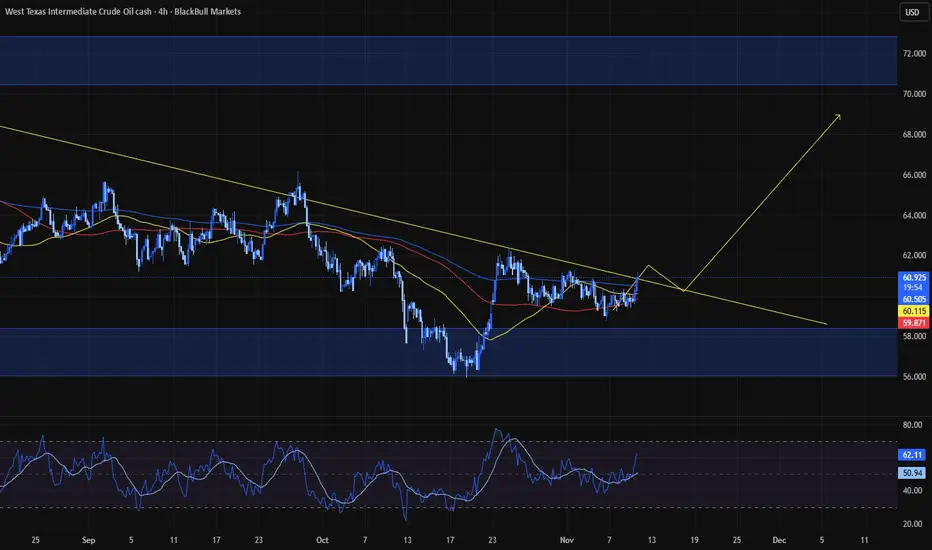
HTF - Crude Oil AnalysisOn the HTF, we can see Crude oil has overall been bearish since 2022 because :
- Geopolitical tensions priced in and faded out.
- Decreased oil consumption of oil. Demand reduced
- Oversupply concerns - OPEC maintained higher levels of oil product. Too much supply & less supply hence lower oil Prices.
· Historically, The markets keep an equilibrium on the price of oil which healthy prices being around $40 - $80 per barrel. This is where oil spends most of its time.
They wouldn’t let oil price drop too low since it would cost producers too much & if its too high, then the consumers will suffer so price always remain a balance.
Future Analysis/forecasts:
· Now we are seeing that Major central banks around the world adopting loose monetary policies and cutting interest rates following suits with the Federal Reserve.
-This would result in more economic activity, more manufacturers using oil etc therefor the demand for Oil will pick up again and we can see price start to rise.
Trade ideas
The Contango Conundrum: Why Crude’s Price Power WanesThe global crude oil market is signaling sustained weakness. A clear sign is the Contango in the West Texas Intermediate (WTI) futures curve for most of 2026. This structure prices future oil deliveries higher than immediate ones, strongly indicating a global supply glut. Major forecasting bodies like the International Energy Agency (IEA) and the Organization of the Petroleum Exporting Countries (OPEC) now confirm a record surplus looms in 2026, reversing previous tight market expectations. Understanding this decline requires a multidisciplinary lens, examining supply resilience against sluggish demand across several domains.
Geostrategy and Geopolitics: Production Over Protocol
Geopolitical decisions, paradoxically, contribute to oversupply. OPEC+ members are gradually unwinding previous voluntary production cuts, adding millions of barrels back to the market. This production boost, formalized in their latest agreements, increases supply visibility and dampens price spikes. Simultaneously, sustained geopolitical tensions between major powers often lead key consumers like China to ramp up Strategic Petroleum Reserves (SPR) , effectively soaking up immediate surplus but reducing future demand visibility. This policy-driven stockpiling mitigates immediate price falls, but structural oversupply persists.
Macroeconomics and Economics: Slowdown Meets Resilience
A deceleration in global oil demand growth meets unexpectedly resilient supply . Macroeconomic headwinds, including trade tensions and a sluggish global economic outlook, suppress consumption growth below historical trends. This tepid demand environment is exacerbated by expanding production from non-OPEC+ nations. Crucially, the United States, Brazil, Canada, and Guyana lead this non-OPEC+ supply expansion, challenging the cartel’s market dominance. The resulting imbalance, production exceeding demand, creates the chronic oversupply driving WTI into contango.
Technology and High-Tech: Efficiency Enhances Supply
Advancements in extraction technology dramatically boosted supply, particularly within the US shale sector. Continuous innovations in horizontal drilling and hydraulic fracturing sustain high US output, even as prices soften. Furthermore, the rapid expansion of Electric Vehicle (EV) sales and increasing vehicle fuel efficiencies represent a major technological headwind for transportation fuel demand. This shift, supported by global patent activity in battery and wave energy technology, structurally limits long-term oil consumption growth.
Patent and Science Analysis: The Energy Transition
Patent activity confirms the directional shift away from fossil fuels. While patents related to downhole completion systems and drilling fluid prediction remain, increased patenting in Carbon Capture and Sequestration (CCS) [/b and Green Hydrogen signals the industry's necessary pivot. The science of energy transition, focusing on low-carbon solutions, suggests a future where oil remains a critical input but faces mounting competition from technological substitutes. This long-term displacement risk pressures oil prices, even if demand remains firm in the short run.
Cyber and Strategic Risk: Supply Chain Security
The increasing reliance on complex digital infrastructure across the oil value chain introduces cyber risk . Successful attacks on pipeline operators or refineries can cause temporary supply disruptions and price spikes. However, the market currently views such disruptions as temporary events rather than long-term structural issues affecting the overall supply-demand balance. The oversupply acts as a buffer, with floating storage and ample inventory mitigating the impact of short-term, localized outages.
Investment Outlook: Watching Spreads
The market signals clearly indicate supply strength and demand vulnerability. The widening WTI contango structure provides a clear arbitrage opportunity for traders willing to finance storage. Investors should closely monitor the Brent-Dubai Exchange of Futures for Swaps (EFS), which is turning negative, underscoring specific weakening in the Atlantic Basin. Barring a sharp, coordinated OPEC+ cut or an unexpected large-scale geopolitical conflict, pricing pressure should persist into 2026. Traders must prioritize futures spread analysis over simple outright price forecasting.
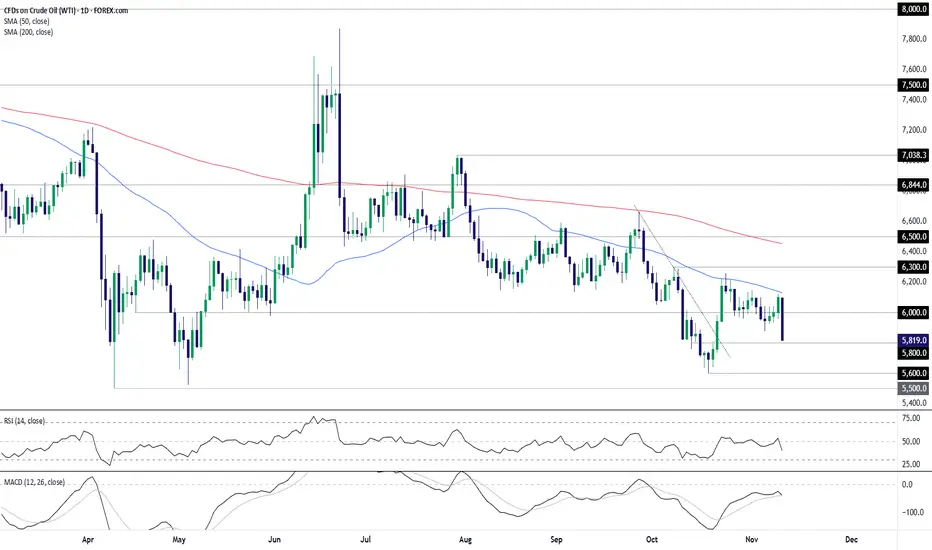
Bearish bar signals risk of deeper crude slideUnable to climb above the 50-day moving average and having just delivered an almighty bearish bar, is WTI crude about to revisit the October lows—an outcome that could put a retest of the YTD lows on the cards? With momentum indicators like RSI (14) and MACD swinging sharply lower, signaling building downside strength, the risk of such a move is growing.
$58.00 is a minor level to watch near term, having acted as support and resistance at times last month. Should price trade beneath this level, shorts could be established on the break with a stop above for protection, targeting a run toward the October swing low of $56.00. The preference would be to see a back-test and rejection of the level before entry.
While short setups are favored given recent price and momentum signals, should WTI manage to hold above $58.00 during Thursday’s session, the option would be there to flip the setup, allowing for longs with a stop beneath for protection. $60.00 screens as an appropriate initial target, even with the messy price action around it recently.
Plenty of fundamental catalysts were bandied around to explain Wednesday’s abrupt drop, most linked to an EIA report warning of market oversupply. It undoubtedly contributed to the bearish move, but the seeds were sown well before the event given how poorly WTI traded at the 50DMA in recent weeks.
Good luck!
DS
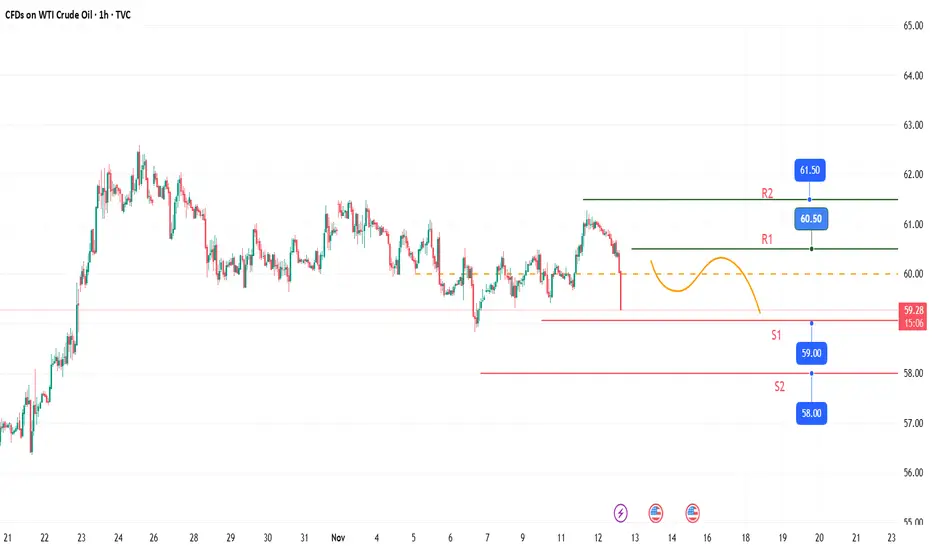
USOIL: Fluctuating declineCrude oil showed a trend of fluctuating decline today, breaking through key support levels, with a clear bearish dominance.
Key support below: In the short term, attention should be paid to the $59.00 integer mark. If this level is breached, oil prices may further drop to $58.00.
Resistance levels for rebound: If there is a technical rebound in oil prices, the first resistance level is at $60.50, and the second resistance level is at $61.50, with limited rebound space.
Trading Strategy:
Buy 59 - 59.5
SL 58.5
TP 60 - 60.5 - 61
Sell 60.5 - 61
SL 61.5
TP 59.1 - 58.5
A buying opportunity for oil — although it’s risky. Oil analysisAfter a strong rejection at the $61 resistance, oil is now approaching the $56–$57 support zone.
This is a time when it’s worth placing a stop in exchange for the potential of a good profit.
The yellow circle area marks the range where it’s worth entering a position.
Of course, the stop for any buy entry should be set below $55.700.
WTI Crude Oil – Update
I’ve entered a short position around this zone.
I don’t predict the market — I just follow opportunities.
It doesn’t matter what happens after entry; I simply follow my plan.
Those who’ve been following me know my system:
At a 1:1 reward, I close half of my position — that means zero risk.
If the market reverses and hits my stop, I lose nothing.
If it keeps moving, I use a trailing stop to catch as much of the move as possible.
That’s what real position management looks like.
And if my level breaks, I don’t just sit and watch — I’ll go long with the market.
I don’t predict or guess the future;
I trade with discipline, patience, and respect for the market.
I’m a trader, not a fortune teller.
USOIL | Breakout or Bull Trap? The Broader Case for Oil StrengthCrude oil appears to have broken above its short-term flag pattern — but is this the start of a continuation move, or just a false breakout? Several intermarket charts suggest the broader structure may still favour strength rather than exhaustion.
Technical Lens:
On the main USOIL chart, price has breached the upper bound of its descending flag after a steady base-building phase. The next few sessions will confirm whether this is a retest of the breakout or a failed move back inside the flag.
Chart-by-Chart Context:
1. Energy Sector ETF vs USOIL
The energy equity space has been outperforming crude itself. When energy stocks lead the underlying commodity, it often implies optimism about future earnings and renewed capital expenditure — a supportive sign for oil continuity.
2. Oil Volatility Index (OVX)
OVX has been steadily falling even as crude prices rise. This dynamic — higher prices with lower implied volatility — signals a healthy, stable uptrend driven by real demand rather than fear or short covering.
3. USOIL vs OVX Spread
The spread between crude and OVX continues to climb, indicating increasing price stability in the up-move. A rising spread historically accompanies sustained bullish phases.
4. USOIL vs Brent Oil
The spread between WTI and Brent remains in a descending structure, but with a potential breakout pending. If this breaks higher, it would suggest strengthening internal US demand — often a catalyst for follow-through in global crude benchmarks.
Scenarios:
Scenario A: If USOIL holds above the breakout zone → confirmation of a valid retest and potential continuation toward the upper resistance band.
Scenario B: If it slips back below the flag → false breakout risk, likely a short-term correction before broader trend direction resumes.
Takeaway:
Oil’s technical picture looks cautious but constructive. With energy equities leading, volatility compressing, and spreads hinting at underlying demand, the broader setup tilts toward stability — provided USOIL can sustain above its breakout zone.
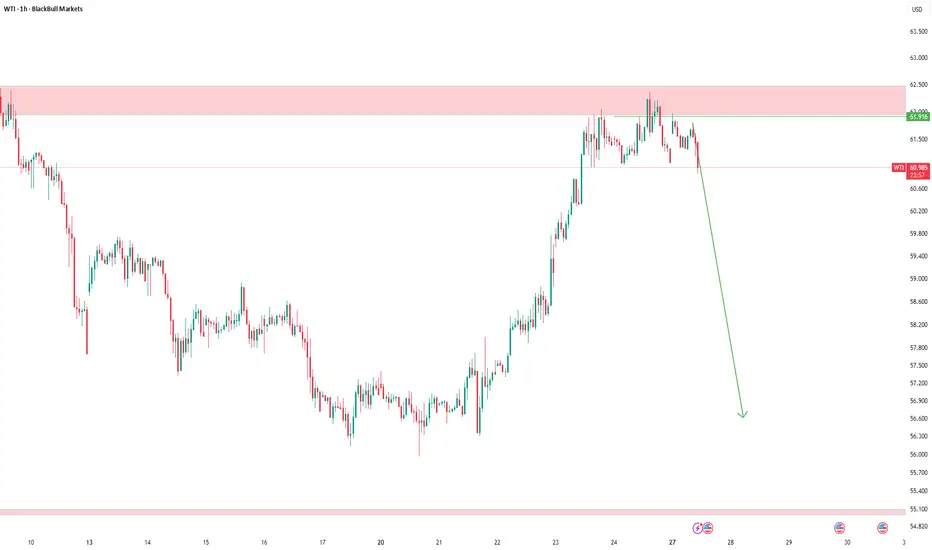
WTI OIL Successive 1D MA50 rejections. Sell Signal.WTI Oil (USOIL) has been trading within a 3-month Channel Down with the price experiencing successive rejection on the 1D MA50 (blue trend-line) since the October 24 Lower High.
Given that the 0.5 Fibonacci retracement level was also filled (as on the previous Lower High), we expect this inability to break above, to kickstart the new Bearish Leg.
As previously, the Target is the Support at $56.00.
---
** Please LIKE 👍, FOLLOW ✅, SHARE 🙌 and COMMENT ✍ if you enjoy this idea! Also share your ideas and charts in the comments section below! This is best way to keep it relevant, support us, keep the content here free and allow the idea to reach as many people as possible. **
---
💸💸💸💸💸💸
👇 👇 👇 👇 👇 👇
Crude Oil Bullish at 60, US Session Strategy Update
After two days of gains, crude oil has regained the 60 mark, finally establishing a clear upward trend. Maintaining our previous view, crude oil is likely to continue its upward trend with fluctuations. We need to observe the strength and effectiveness of the rebound this week. Based on the current fluctuations, crude oil should continue to rise this week. In the short term, focus on the 60-60.3 buying level and patiently wait for the bullish upward space. Resistance remains around 62-62.5.5.
This advice is time-sensitive. I update my trading ideas and strategies daily. If you don't yet have a crude oil trading plan or idea and are seeking consistent and stable returns, please stay tuned.
Oil - Expecting Bullish Continuation In The Short TermH1 - Downtrend line breakout.
Higher highs.
No opposite signs.
Until the two strong support zones hold I expect the price to move higher further.
If you enjoy this idea, don’t forget to LIKE 👍, FOLLOW ✅, SHARE 🙌, and COMMENT ✍! Drop your thoughts and charts below to keep the discussion going. Your support helps keep this content free and reach more people! 🚀
--------------------------------------------------------------------------------------------------------------------
USOIL Will Grow! Long!
Please, check our technical outlook for USOIL.
Time Frame: 1D
Current Trend: Bullish
Sentiment: Oversold (based on 7-period RSI)
Forecast: Bullish
The market is approaching a significant support area 60.422.
The underlined horizontal cluster clearly indicates a highly probable bullish movement with target 65.013 level.
P.S
We determine oversold/overbought condition with RSI indicator.
When it drops below 30 - the market is considered to be oversold.
When it bounces above 70 - the market is considered to be overbought.
Like and subscribe and comment my ideas if you enjoy them!
US CRUDE OIL (WTI): Classic Trend-Following Setup I spotted a very classic bullish model on 📈USOIL.
Following a strong bullish wave, the market started to correct within a bullish flag pattern.
The resistance breakout of this pattern consistently provides a reliable confirmation to consider a buy.
I anticipate a rise to 62.50 at this time.
USOIL: Q4/2025 Q1 2026 Action PlansSentiment:
- The broader market is cautious in a risk-off environment, which typically translates to concerns about demand and the strength of the US dollar. However, the market is not in a state of panic as the Fear Index is at around 30, opening room for either direction.
- Social Media (X/Twitter): The current tone is positive, as participants expect USOil to rise within the range of 57.50-65.00 in the near term, anticipating an upcoming upward breakout.
- The COT report shows extremely bearish sentiment regarding the latest data from 26/9 (following the US government shutdown), so we can only have a snapshot of more than a month ago. Although the current sentiment may or may not be as extreme (we need to wait for the latest data), it still reflects the state of market positioning.
- I think that Retail is unaware of positioning extremes and is more focused on technical breakout. It may lead to a sentiment shift as a result of a technical breakout and changes in the fundamental narrative.
Fundamental:
A. OPEC+ Production Shift:
- Narrative: OPEC+ has pivoted to MORE cautious supply management. After nine consecutive monthly increases, the group is now implementing only a modest 137k bpd increase for Dec 2025, followed by a production pause for the entire first quarter of 2026.
- Rationale: Healthy market fundamentals, low inventory levels, seasonal demand
- It means more supportive than what we observed earlier in 2025. Q1 2026 pause suggests OPEC+ acknowledges oversupply risks and is being disciplined. One more thing to note is that the current price is also not entirely factored into this narrative.
B. Geopolitical Risk Premium Returning:
- Narrative: Recent US/EU sanctions on Russian energy companies and escalating tension in oil-producing regions are providing price support.
- Market impact: This narrative provides a fundamental floor for price at least till the end of this year.
C. Bearish Fundamentals - Oversupply into 2026:
- Narrative: Despite the OPEC+ pause, global oil inventories are expected to rise through 2026 on weak demand growth and non-OPEC supply increases (such as the US production)
- Factors: global inventories forecast to rise through 2026, weak demand from China, tariff uncertainties and US production at record levels.
- Market impact: Bearish medium-term outlook for Q1-Q2 2026.
Technical:
- USOIL broke the small blue channel and is expected to reach the measured level at around 65, confluence with the Sep resistances.
- If USOIL can hold above 60 (retest the broken channel), it may resume its momentum to retest the key resistance at 62 first, then 65, as measured by the move upon breaking.
- Conversely, closing below the support at 59.30 may invalidate the short-term upward view and open the door for further decline, potentially retesting the swing low at 56.80.
Conclusion:
- Despite a short-term upward momentum until year-end, the prospect for USOIL in 2026 is not as promising.
- Therefore, a range of 65-70 is possible for the short term upward plan; however, any surge bejond that may open another opportunity for counter-trade setups in Q1-Q2 2026.
Analysis by: Dat Tong, Senior Financial Markets Strategist at Exness
How to Trade Crude Oil with Smart Money Concepts SMC Explained
Smart Money Concepts is one of the most reliable techniques for trading WTI Crude Oil.
In this article, I will teach you a profitable SMC strategy for analysing and trading USOIL futures and CFD.
This simple strategy is based on an important event every SMC trader should know - a break of structure BoS.
In a bullish trend, the best break of structure will be based on a violation and a candle close above a current higher high.
It will signify a highly probable bullish continuation and provides a great opportunity to buy
Though you can spot a bullish break of structure on any time frame, the most reliable one is a daily.
After a formation of a new high, I suggest waiting for a short term intraday correctional movement.
With a high probability, the market will retest a recently broken structure and smart money will manipulate the market, pushing the price below that, making buyers close their positions.
Once the market starts retracing, analyze an hourly time frame. The price will need to establish an i ntraday minor bearish trend.
In this bearish trend, 2 trend lines should connect lower highs and lower lows composing an expanding, parallel or contracting channel - a bullish flag pattern.
Your best signal will be a breakout of a resistance line of the flag and a violation of the level of the last lower high - a bullish change of character of a liquidity grab.
It will confirm a completion of a correction.
Buy the market on a retest of the level of the last higher low, it will be your best entry.
Set your stop loss at least below a trend line and aim at the next strong daily resistance.
That will be a perfect model for trading break of structure on WTI Crude Oil.
We spotted such a setup in my trading academy on one of the live streams with my students.
WTI Crude Oil was trading in an uptrend on a daily time frame.
A bullish violation of the last Higher High and a candle close above that confirmed a Break of Structure BoS.
The price started a correctional movement then, and we spotted a bullish flag pattern on an hourly time frame.
The market completed a correction after grabbing a liquidity below a broken structure.
A bullish movement started then, and the price violated a resistance line of the flag and the level of the last lower high.
These 2 breakouts confirmed a completion of a correction and a resumption of a bullish trend.
We opened a buy position immediately on a retest of a broken level of the last lower high.
Stop loss was below a trend line, take profit was based on the closest key daily resistance.
And the price went straight to the target.
Break of Structure BoS will be useful for analysis, forecasting and trading WTI Crude Oil.
Combining that with top-down analysis and lower time frames confirmations will provide accurate signals and profitable trading setups.
Integrate a price model that I shared in your strategy, and good luck to you trading USOIL!
❤️Please, support my work with like, thank you!❤️
I am part of Trade Nation's Influencer program and receive a monthly fee for using their TradingView charts in my analysis.
Factors favoring the price of crude oil1.Short-term bullish support: Excess inventory was unexpectedly depleted
The latest API data shows that U.S. crude oil inventory dropped by 6.5 million barrels, far exceeding the market expectation of 1.3 million barrels. This represents the largest single-week decline in recent history, reflecting that refineries have entered the seasonal expansion phase, with accelerated crude oil processing and consumption, and the export demand remains resilient. This data directly alleviated market concerns about short-term oversupply, providing immediate support at the $60.90 level. From a structural perspective, gasoline inventory also showed a depleting trend, suggesting a marginal improvement in terminal consumption, and the short-term supply-demand balance leans towards a tight equilibrium.
2. Potential bullish factor: The overlooked black swan risk
The attack by Ukraine on Russian oil facilities is still ongoing. The Lukoil Volgograd refinery (accounting for 5% of Russia's total refining output) has been out of operation and the recovery progress is slow. Moreover, the United States has included all four major Russian oil giants in sanctions, and there is still potential supply disruption. Additionally, the latent conflict between Israel and Iran has not been fully resolved. The Strait of Hormuz, which is a transportation channel for 20% of the world's oil, always has safety hazards as an "invisible support" for oil prices. If the situation changes again, the geopolitical risk premium will quickly flow back.
Crude oil trading strategy
buy:60.5-60.8
tp:61.5-62
sl:59.5
Is XTI/USD Setting Up for a Sharp Bearish Correction?🚨 WTI/USD CRUDE OIL: THE BEARISH HEIST AWAITS 🎯
═══════════════════════════════════════════════════════════
THE SETUP: Breaking Down The Crime Scene 🕵️♂️
We're executing a bearish pullback strategy on WTI/USD spot crude oil, leveraging the 200-period Simple Moving Average (SMA) as our primary technical confirmation. The energy sector is flashing opportunity signals, and it's time to work the levels like a seasoned professional.
📊 STRATEGY FRAMEWORK
Market Direction: Bearish Pullback from 200 SMA Resistance
Timeframe: Suitable for Swing & Day Trading Operations
Asset Class: Energies | WTI Crude Oil Spot
💰 THE LAYERED ENTRY STRATEGY (Multi-Level Approach)
This is where the Thief Method shines—stacking limit orders at key price levels to accumulate positions as the market comes to you:
Suggested Entry Layer Points:
Layer 1: 60.50 💧
Layer 2: 60.00 💧
Layer 3: 59.50 💧
Layer 4: 59.00 💧
⚠️ Pro Tip: Feel free to add or adjust layers based on your risk tolerance and position size. The beauty of this method is scalability—customize to YOUR account size and risk parameters.
🛑 STOP LOSS PLACEMENT
Primary SL Level: 61.00
Positioned at the nearest swing high/candle wick resistance above our entry cluster. This respects natural market structure and gives us a defined, measurable risk point.
⚡ DISCLAIMER ON RISK MANAGEMENT:
This is NOT financial advice. Risk management is YOUR responsibility. The suggested SL is based on technical structure, but YOU control your account. Set stops that align with YOUR risk tolerance. Trade only what you can afford to lose.
🎯 PROFIT TARGET STRUCTURE
Primary Target: 56.50
Secondary Support Level: 56.00 — A police barricade of strength where multiple factors converge:
Strong historical support confluence 📍
Oversold zone recognition ⚖️
Potential reversal trap (exit strategy alert) ⚠️
Exit Strategy: Consider banking profits at 56.50 before support intensifies at 56.00. Lock in gains as the technical structure suggests potential friction.
⚡ DISCLAIMER ON PROFIT TARGETS:
Again, these are TECHNICAL levels only. YOU decide your exit strategy. Whether you take full profits at 56.50, trail stops, or use partial exits—this is YOUR trading plan. No setup is guaranteed.
🔗 RELATED PAIRS TO WATCH (Correlation Check)
Understanding energy market interrelations helps you spot confirmation signals:
US Dollar Index ( TVC:DXY ) → Inverse correlation to crude oil. Strengthen USD = Bearish pressure on oil. Watch DXY for confirmation of our bearish bias.
CSEMA:S&P 500 ( AMEX:SPY / CME_MINI:ES1! ) → Risk sentiment indicator. If equities weaken, crude often follows bearish patterns. Check equity trends for macro confirmation.
Energy Select Sector ETF ( AMEX:XLE ) → Direct correlation. Tracks large-cap energy stocks. Oil weakness often precedes XLE drops.
FX:EURUSD → Global risk sentiment. Weak euro = risk-off environment = potential crude weakness. Monitor for macro context.
AMEX:USO (Crude Oil ETF) → Direct oil tracking instrument. Moves in lockstep with WTI. Use for backup confirmation.
📋 THE THIEF STRATEGY CHECKLIST
✅ Confirm 200 SMA as resistance/bearish context
✅ Stack limit orders—don't chase price
✅ Define your personal stop loss (around 61.00 structure)
✅ Target scale-outs near 56.50-56.00
✅ Use correlation pairs for macro confirmation
✅ Manage position size ruthlessly
✅ Accept losses—they're tuition in the market
💬 ENGAGEMENT BOOST
✨ If you find value in my analysis, a 👍 and 🚀 boost is much appreciated — it helps me share more setups with the community!
#WTI #CrudeOil #EnergyTrading #TechnicalAnalysis #ThiefStrategy #SwingTrading #DayTrading #Trading101 #ForexEnergy #MultiLayerEntry #RiskManagement #TradingSetup #FinancialMarkets #Energies #TradingCommunity
Short-term rebound opportunities are emergingThe policy divergence of the Federal Reserve has emerged, and the expectation of a rate cut has not been completely reversed.
Although some Fed officials (Schmid, Logan) oppose a rate cut in December, Powell emphasized that "policies need to balance the risks of employment and inflation", and member Milan advocated for a significant rate cut, while Baumann expected another rate cut twice before the end of the year. There is a significant divergence between the dovish and hawkish factions within the Fed. The probability of a rate cut in December remains at around 50% in the market, and the few hawkish remarks have not completely negated the trend of easing. Coupled with the narrow range fluctuation of the US dollar index near 99.66 today, it has not broken through the key resistance of 99.75, and the strengthening momentum of the US dollar has weakened marginally. The valuation pressure of crude oil priced in US dollars has eased, creating conditions for a rebound.
Crude oil trading strategy
buy:59.3-59.6
tp:60-60.5
sl:59
USOIL: Accumulate bullish momentumFrom the daily chart perspective of crude oil, on a partial level, the current oscillating rhythm is a secondary consolidation. Judging from the primary and secondary rhythms, there is still room for a rebound and upward move in the trend. The MACD indicator remains below the zero axis, indicating that bullish momentum still needs to accumulate further. It is expected that after the medium-term trend of crude oil tests the low point and finds support, a rebound and upward movement is likely to form.
Buy 59 - 59.5
SL 58.5
TP 60 - 60.5 - 61
Sell 60.5 - 61
SL 61.5
TP 59.1 - 58.5
USOIL BEST PLACE TO SELL FROM|SHORT
USOIL SIGNAL
Trade Direction: short
Entry Level: 60.33
Target Level: 59.05
Stop Loss: 61.18
RISK PROFILE
Risk level: medium
Suggested risk: 1%
Timeframe: 5h
Disclosure: I am part of Trade Nation's Influencer program and receive a monthly fee for using their TradingView charts in my analysis.
✅LIKE AND COMMENT MY IDEAS✅
Learn How to Trade WTI in 1 MinuteWTI in the 4H timeframe has formed a solid range for us that could lead to a strong trend after breaking out of it.
Setup and Entry: A: Our long trigger is breaking the ceiling, meaning 60.329 , and B: Our short trigger is breaking the floor at 59.375 .
Exit Plan: For scenario A, we can take profits at levels 61.203 and 61.891 —also, if you spot any kind of reject candle or reversal pattern on these levels, you can close the position.
For scenario B, 57.360 could serve as a sort of final target; depending on the risk-to-reward you get, you can close or hold out for 56.321 . Short targets are more extensive because HWC and MWC also carry bearish momentum, which aids further drops—so the bearish bias here is stronger.
Goal: For A, simply capturing the daily corrective wave; for B, continuing the MWC with partial profits to aim for higher R/R ratios.
Thanks for your attention.