Bitcoin - Channel no one talks about! (new Year's crash!)Bitcoin's price and development (code) are completely controlled by banks and government. They already have a roadmap on Bitcoin price, so they know what the price will be in 2030. Bitcoin technology is great for total control because all transactions are public. How to profit from that? First of all, you have to identify the big players on the chart and trade with them. They want to make as much money as possible on the way up, so that's why they cannot push the price to the upside in a straight line - they create a lot of traps and patterns on the chart.
When too many people are bullish, it's not worth it to them to send the price up, rather they push the price down in the short term and take all stop losses (your money is a stop loss). You are forced to sell, and guess who buys your order? Most likely the banks, because they love Bitcoin.
What we see on the chart is a blue descending parallel channel. This channel is the current pattern that we play on Bitcoin in this timeframe. Because the price is inside the channel and near the trendline resistance, we cannot be bullish at this point. What traders must understand is that we sell a resistance and buy a support, not the opposite. Currently the price is in a sell zone around 90k - 91k at the top of the channel. There is still an unfilled FVG at 91k - 92k that acts as a strong resistance. January is ticking on the door, and we know that statistically January is one of the most bearish months for Bitcoin. Currently I do not see any reason to be bullish, so I have to stay bearish at this point.
Write a comment with your altcoin + hit the like button, and I will make an analysis for you in response. Trading is not hard if you have a good coach! This is not a trade setup, as there is no stop-loss or profit target. I share my trades privately. Thank you, and I wish you successful trades!
Market insights
Bull Market 2023–2025: Final Results (27.12.25)Public history, responsibility, and the environment without which you don’t belong in the market
First of all, I want to thank @TradingView
In 2025, I received the WIZARD badge.
This is not just a label — it is recognition of my contribution as an active member of the TradingView Community.
For me, this matters not because of status, but because of responsibility.
This badge means I have the ability to propose changes and improvements to the platform, and some of these proposals have already been implemented.
I’m genuinely glad to be one of those community members who helps make TradingView better for everyone.
Why TradingView is about responsibility, not social media
I have been an active member of the TradingView Community for a long time, and I strongly believe this platform is fundamentally different from any other financial media space.
First — the chart as the core tool of analytical thinking.
Second — publications and the Play button, which lock ideas in time.
Third — and most important — the impossibility of deleting published ideas.
Fourth - indicators
You cannot rewrite history here.
You cannot erase mistakes.
You cannot hide behind “the context has changed.”
That is why I approach every single publication on TradingView with full responsibility.
Why there is no noise or random content here
I do not use TradingView the way many people use Twitter or Telegram.
There are no:
emotional reactions
random thoughts
posts made for reach or hype
As of December 2025, my audience consists of 132,000 followers, and I fully understand the responsibility that comes with that.
Yes, every publication is not financial advice.
But for myself, I set a clear internal rule:
every idea must be logical, verifiable, and honest.
Why the timeline starts in 2023
I intentionally start this review from 2023 because that is when the bottom of the previous cycle was forming.
At the time, it was not obvious to the majority of the market:
- fear was at its peak
- trust was minimal
- negative narratives dominated
I’ve been in the market for a long time and have lived through multiple full cycles.
This Bitcoin cycle was my third, and I consider it the most professionally executed one so far.
Each cycle is different:
- different narratives
- different audiences
- different speed
But market logic and crowd psychology repeat.
Publications that cannot be adjusted after the fact
Back in late 2022, an idea was published:
Bitcoin cycles + logistic curve = New bull run 2023–2025.
This was done before the move, not after.
Every marker you see on this chart represents a public idea published in real time on TradingView.
It’s important to highlight:
- all key ideas were LONG
- there were no public SHORT ideas during the bull phase
Why?
Because in a true bull market, speculating against the trend makes no sense.
The upside potential always outweighs the logic of catching small pullbacks.
Timing and the end of the cycle
If you open each publication, you’ll see:
- market phases
- time-based expectations
- structural projections
On most higher-timeframe ideas, the end of the bull market was publicly marked in red.
My key time reference was stated in advance — September 2025.
September 2025: when most still believed in continuation
Starting in September 2025, while market euphoria was still present,
I began publishing ideas stating that:
- the bull market was over
- positions were closed
- Bitcoin was forming a reversal
- the market was entering a bull trap phase
- you were warned in advance
These ideas were based not on emotions, but on market structure, cycles, and psychology.
Experience, no FOMO, and a mature position
After years in the market, I have zero FOMO.
I don’t worry about:
- missing a coin
- missing a narrative
- not participating in every move
The market is:
- fast
- volatile
- heavily manipulated
You cannot be everywhere.
The core task of the market is simple:
buy low — sell high.
That’s exactly what I’ve been doing for over 12 years, with more than 10,000 hours spent in the market.
The reality of the modern market
Today’s market consists of:
- funds
- corporations
- algorithms
- quantitative strategies
On lower timeframes and chaotic moves, retail traders are simply outmatched.
The gap between emotional decision-makers
and those who operate with structure, data, and discipline
will only continue to widen.
If you are in the market — you must be in the environment
Here I’ll be as direct as possible.
If you are in financial markets,
if you plan to continue trading,
if you want to survive and adapt —
you must be part of a strong community.
A lone trader in today’s market is easy prey.
Over the years, a community of like-minded traders has formed around me — people who:
approach the market systematically
- discuss scenarios
- analyze entries and exits
- stay connected during difficult periods
I share my public ideas for free, and that remains a core principle.
But if you truly intend to stay in this market,
you need an environment, feedback, and shared logic.
What you do next is your decision.
Trading is a marathon
Trading is not a sprint.
It’s a marathon.
Sometimes the best position is no position.
Sometimes the best trade is the one you didn’t take.
Patience, waiting, and discipline are skills —
without them, you don’t belong in this market.
The current moment and what’s ahead
At the moment, crypto is in a phase where I take very few trades.
Some positions are already open — at predefined levels, within a structured risk framework.
I’m not leaving financial markets:
- crypto
- Forex
- equities
- tokenized assets
- gold
- oil
Instruments change. Principles don’t.
In conclusion
If this chart receives 300 likes,
I will publish a separate post outlining:
- goals
- scenarios
- positioning
for 2026.
Wishing everyone clarity, discipline, and a cold mind.
May 2026 be better than 2025.
And may there be peace on our planet.
Yours, EXCAVO
Why Holding Bitcoin Beats Trading It for Most PeopleI don’t want to be offensive, but I can speak from experience.
Most people would make more money simply by holding Bitcoin than by trying to leverage trade it.
The data is clear. More than 95% of people lose money in crypto, mainly because of leverage and greed. I do trade Bitcoin as well, with a portion of my capital, and I’m doing fine. In 2025, I had 20 Bitcoin trades with a quite good win ratio:
Trading can work, but only for a small minority, and usually after years of experience.
🧪 Let’s compare it with my HODL portfolio (the bigger part).
I bought Bitcoin back in 2018. Here: The price today is more than 30× above my initial entry. That alone has produced far more gains than active trading over the same period.
🧪 Let’s put this into perspective.
To achieve a 30× return through trading over six years, you would need to generate more than 76% per year, every year. In simple terms, that means turning $10,000 into $300,000 purely through trading. That level of performance would require exceptional skill, discipline, and time, while increasing position size after every trade to compound and avoiding major mistakes.
🧪 And here is the problem — avoiding major mistakes.
Everyone makes mistakes in trading or in predicting the price. I was wrong with my target for this cycle: and I was not alone. In this post from Excavo, we can see how big players and institutions were wrong as well and completely missed the predictions No one can predict the market with 100% accuracy.
⁉️ So why people think they can outsmart the market on lower timeframes?
Because they chase quick gains in altcoins or believe they can make money in the market with leverage. Most can’t. Most lose.
📌 Let’s compare it:
1️⃣ Being wrong as a trader — stress, time wasted on screens, and you are losing money.
2️⃣ Being wrong as a long-term holder — no stress, you have more time to accumulate more BTC into your cold wallet and do almost nothing.
Don’t get me wrong, being a hodler is also not easy. I faced a drop from 69K to 15K. If you don’t understand Bitcoin and don’t have conviction, the FUD news, which often appears near the lows, can destroy you and force you to sell.
If you don’t know much about BTC, I suggest you study it. I’ll give you just three points here, but there is much more.
✅Central banks will not stop printing money; your purchasing power will continuously go down.
✅Bitcoin has a fixed supply of 21 million coins.
Not approximately. Not subject to change. Exactly 21 million.
✅By 2030, 99% of all Bitcoins will be mined. The rest will be mined over the next 100 years.
So what to do?
Of course, we are traders — we are going to trade. But I suggest you separate capital for trading and trade only with that. Never trade your long-term investment.
If you don’t have any physical BTC in your cold wallet, your ultimate goal should be to get to 1 Bitcoin and hold it long term, untouched.
🛡️ Here is how to behave.
On the chart below, I have spotted that BTC is flipping bearish and we could potentially go to 70K, and if a strong bear market hits, I believe it could dip below 50K:
1️⃣ As a trader - I flipped my bias to the bearish side and took a few shorts recently on a crypto exchange.
2️⃣ As an investor - I do nothing. I will be DCAing and building my long-term position. Remember, by 2030, 99% of BTC will be mined. M2 money supply will expand. Block rewards will be halved. The price will most likely be much higher.
I promised myself I’d become the person I once needed the most as a beginner. Below are links to a powerful lessons I shared on Tradingview. Hope it can help you avoid years of trial and error I went thru.
📊 Sharpen your trading Strategy
⚙️ 100% Mechanical System - Complete Strategy
🔁 Daily Bias – Continuation
🔄 Daily Bias – Reversal
🧱 Key Level – Order Block
📉 How to Buy Lows and Sell Highs
🎯 Dealing Range – Enter on pullbacks
💧 Liquidity – Basics to understand
🕒 Timeframe Alignments
🚫 Market Narratives – Avoid traps
🐢 Turtle Soup Master – High reward method
🧘 How to stop overcomplicating trading
🕰️ Day Trading Cheat Code – Sessions
🇬🇧 London Session Trading
🔍 SMT Divergence – Secret Smart Money signal
📐 Standard Deviations – Predict future targets
🎣 Stop Hunt Trading
💧 Liquidity Sweep Mastery
🔪 Asia Session Setups
🧠 Level Up your Mindset
🛕 Monk Mode – Transition from 9–5 to full-time trading
⚠️ Trading Enemies – Habits that destroy success
🔄 Trader’s Routine – Build discipline daily
💪 Get Funded - $20 000 Monthly Plan
🧪 Winning Trading Plan
🛡️ Risk Management
🏦 Risk Management for Prop Trading
📏 Risk in % or Fixed Position Size
🔐 Risk Per Trade – Keep consistency
Adapt useful, Reject useless and add what is specifically yours.
David Perk
The Boredom Stage of Trading - Why Most Traders Quit HereGood morning, all, thank you all for coming today.
Today we will be looking into the “ Boredom ” Phase of trading, and why most new traders quit because of it. Lets begin.
What Is the Boredom stage during Trading?
Boredom in trading is the stage where the excitement goes away, but the results have not arrived yet.
You are no longer a beginner filled with hype, joy and excitement.
You are aware of, and understand the basics, you have a strategy, and you know what you should be doing.
Yet progress feels slow , repetitive , and unrewarding .
There are less trades, fewer emotional highs, and long stages of patiently waiting.
This is where trading begins to feel boring , and for many traders, boredom feels like failure, it feels like they are failing since they are not “ doing anything. ”
This phase is not a sign you are doing something wrong it is a sign you are doing something right .
How the Boredom stage Affects Traders
Boredom secretly ruins traders because it does not feel dangerous.
During this period, traders will often:
• Start forcing trades just to feel active or “ alive ” like they are doing something.
• Break rules out of impatience ( breaking their own system )
• Abandon strategies that are working ( same as above )
• Chase excitement instead of probability ( they seek the 100x return )
• Confuse “ no trades ” with “ no progress ” ( If you follow your system and wait, you are making progress )
The market rewards patience, but boredom pushes traders toward action.
This creates losses, frustration, and eventually self-doubt. ( Which no one wants )
Many traders do not fail because they lack knowledge or skill. They fail because they cannot tolerate stillness. ( They psychology weakens when they face boredom. )
Why the stage Phase Occurs
The boredom phase takes place when trading becomes process-driven instead of emotion-driven. ( It becomes mechanical )
Early trading is exciting because:
• Everything feels new
• Wins feel euphoric
• Losses feel catastrophic
• The market feels fast and you feel uncertain
• You are eager to learn more
As you improve, your trading becomes:
• More selective and tight
• More rule-based and systematic like
• Slower and quieter ( calm )
• Less emotionally stimulating
This shift removes chaos, but it also removes excitement.
The market hasn’t changed.
You have.
And most people mistake this emotional flatline as a sign that something is missing.
( This is where “ The market rewards patience ” comes in. The market rewards those who wait. )
How to Overcome the Boredom stage
The key to overcoming boredom is understanding that trading is not meant to entertain you. ( It is just like a 9-5, you must follow rules, a system. Just in your own routine. )
Practical ways to handle this phase:
• Reduce screen time once your plan is complete. ( Do not over trade )
• Focus on execution quality, not trade quantity. ( Quality over quantity )
• Track rule-following instead of PnL. ( Did you follow your system? )
• Journal boredom-triggered decisions. ( Losses from impatience? )
• Accept that waiting is part of the job. ( Strengthen your mind by waiting. )
Professionals do not trade more and when they are bored, they trade less.
The goal is not to feel engaged and hyped up.
The goal is to remain consistent and disciplined.
Why the Boredom stage Is a Filter, not a Problem
The boredom stage exists to separate traders who want excitement from traders who want results. ( Splits Gamblers from Real Traders )
Most people quit and give up here because:
• There is no longer any dopamine .
• Progress feels slow, painful or invisible.
• Social media makes others look “ active ” when it is actually not.
• Patience feels unproductive since the mind is sitting “ idle .”
But this stage is where real traders are built.
If you can:
• Follow rules without excitement. ( Follow your system )
• Sit through days with no trades. ( Accept the process of waiting )
• Trust your edge without constant validation. ( Ensure to backtest to prove this. )
• Stay disciplined when nothing happens. ( Do not give in to FOMO. )
You have already passed a major psychological barrier.
The boredom phase is not a dead end it is a gateway that sits at the end of a long run.
Those who quit here were never meant to last.
Those who stay quietly move closer to consistency and mental freedom.
Final Thoughts
Every profitable trader has survived the boredom phase.
Most failed traders quit during it because of weak psychology.
If trading feels boring, repetitive, and uneventful, that is good.
That means emotions are leaving and structure is taking its place.
The market does not reward excitement.
It rewards endurance, patience, discipline, consistency and proper risk management.
Bitcoin Christmas Rally? $90K/More in SightBitcoin ( BINANCE:BTCUSDT ), as I previously expected , has risen to its initial target and has broken above the important level of $88,200, which is a positive sign for continued bullish momentum.
At the moment, Bitcoin is striving to break through the resistance zone($89,230-$87,720).
From an Elliott Wave perspective, it seems that Bitcoin is completing microwave B of the main wave Y.
I expect that after breaking the resistance zone($89,230-$87,720), Bitcoin could rise at least up to the significant level of $90,300, approaching the Cumulative Short Liquidation Leverage and the 50_SMA(Daily). If BTC breaks above the 50_SMA(Daily), we can anticipate even further gains for Bitcoin.
The question is: do you think Bitcoin will hold above $90,000, or will it begin to decline again?
And finally, a little note about Christmas: I hope you enjoy a wonderful holiday season with your loved ones, and let’s see how Bitcoin performs as we head into the new year!
Cumulative Long Liquidation Leverage: $86,690-$85,990
First Target: $90,161
Second Target: $90,721
Third Target: 50_SMA(Daily)
Stop Loss(SL): $86,850
Points may shift as the market evolves
💡 Please respect each other's opinions and express agreement or disagreement politely.
📌Bitcoin Analysis (BTCUSDT), 1-hour time frame.
🛑 Always set a Stop Loss(SL) for every position you open.
✅ This is just my idea; I’d love to see your thoughts too!
🔥 If you find it helpful, please BOOST this post and share it with your friends.
BTC/USDT: Compression Phase Inside a Broad StructureHi!
Market Structure:
Bitcoin is currently trading inside a well-defined symmetrical triangle, characterized by a series of lower highs and higher lows. This structure reflects price compression and balance, not trend continuation.
Key Boundaries:
Price continues to respect both the descending upper boundary and the ascending lower boundary, confirming the validity of the pattern. No directional breakout has occurred yet.
Price Behavior:
Recent moves remain corrective, with repeated rejections from the upper boundary near 88.3k–88.5k, while buyers defend the rising support around 87k–86.8k.
Scenarios:
Bullish: A confirmed breakout and acceptance above the upper boundary would favor upside expansion.
Bearish: Rejection and loss of the lower boundary would shift momentum to the downside.
BTC/USD- H1 - Rejection at Supply (23.12.2025)📝 Description 🔍 Setup (Market Structure) WHITEBIT:BTCUSDT
Bitcoin faced multiple rejections from a strong resistance / supply zone, clearly marked by repeated wick rejections. After the latest rejection, price broke below the rising trendline, signaling trend weakness on the H1 timeframe.
Key observations:
Multiple supply rejections (seller dominance)
Trendline breakdown confirmed
Price below short-term support → bearish pressure increasing
📍 Support & Resistance Levels
🟢 Resistance Zone: 89,800 – 90,400
🔴 1st Support: 85,200
🔴 2nd Support: 83,600
#Bitcoin #BTCUSDT #CryptoTrading #PriceAction #SupportResistance #TrendlineBreak #TradingView #Kabhi_TA_Trading
⚠️ Disclaimer
This analysis is for educational purposes only.
Crypto markets are highly volatile — always manage risk and use proper stop-loss.
💬 Support the Analysis 👍 Like if you’re tracking BTC closely
💬 Comment: Bounce or Breakdown? 🔁 Share with traders watching Bitcoin moves
Bitcoin - Can we hit the target at $91.000 This BTC technical analysis shows that Bitcoin is currently in a waiting phase. Price is trading around $87,500 and continues to move within a clearly defined range. Although a recent bounce has occurred, there is still a lack of a convincing impulse to define the next larger move. As a result, liquidity and fair value gaps remain the primary guiding factors.
4h bullish FVG
Within the bullish 4-hour FVG, a significant amount of liquidity is still present. This makes the zone around $86,000 to $86,500 an interesting area for a potential retest. As long as this liquidity has not been fully collected, there remains a strong possibility that BTC revisits this region. A deeper test of this FVG could actually provide a stronger foundation for a subsequent upward move.
4h bearish FVG
On the upside, the 4-hour bearish FVG forms a clear and strong resistance. This zone around $91,000 to $92,000 serves as the first logical target for a bounce originating from the lower range. There is substantial supply and prior rejection in this area, making a reaction highly likely. Only a convincing breakout would allow Bitcoin to shift focus toward higher price levels.
FInal thoughts
In summary, Bitcoin remains technically neutral to slightly bullish as long as the bullish 4-hour FVG continues to hold. The market appears to be gathering liquidity before committing to a direction. This BTC technical analysis emphasizes that patience is essential, as it first needs to become clear whether BTC will collect liquidity on the downside or move directly toward the bearish FVG for another test.
Bitcoin: Leaning Towards BullishWe're sitting at equilibrium ($89,619) with a clean higher low formation intact above both EMAs. The structure favors continuation, but the 64.9% rejection wick at $90,599 created a supply zone we need to respect. Volume is 68% below average—this is consolidation, not distribution.
1. THE TECHNICAL REALITY 📉
• Higher low formation holding above EMA20 ($88,584) and EMA50 ($88,436)
• Bearish order block at $89,429-$90,617 acting as supply after aggressive rejection
• Bullish order block at $86,795-$88,888 aligned with ascending trendline (4 touches, 127 bars validated)
• Structure remains unbroken despite the upper wick—support at $89,200 held
2. THE INDICATORS ⚖️
Bullish Signals:
• MACD crossover confirmed (476 vs 308) showing momentum build
• MFI at 75.5 indicates strong money flow
• ADX at 30.2 shows moderate directional conviction
Bearish Signals:
• RSI at 67.7 approaching overbought territory
• Volume 68% below average suggests caution on immediate breakout
The Conflict:
Low volume typically signals accumulation at these levels, not distribution. The question is whether we get one more shakeout to the demand zone before the next leg.
3. THE TRADE SETUP 🎯
🟢 Scenario A: Pullback Entry (Higher Probability)
• Trigger: Pullback to $89,200 or sweep to $86,795-$88,888 bullish OB
• Entry: $86,795-$88,888 demand zone (confluence with ascending trendline at $84,546)
• Target 1: $90,363 (immediate resistance)
• Target 2: $91,066 (premium zone entry)
• Target 3: $94,555 (weak high sweep)
• Stop: Below $86,700
🟢 Scenario B: Breakout Acceleration
• Trigger: Clean 4H close above $91,066 with volume confirmation
• Entry: Flip of $91,066 to support (CHoCH bullish)
• Target: $94,555
• Invalidation: 4H close below $86,795 (breaks bullish OB and trendline)
MY VERDICT
This is a 7/10 setup that favors patience. The structure is intact, indicators are aligned, but volume concerns and the overhead supply zone keep it from being perfect. If you're positioned, stop below $86,700. If you're waiting, the pullback to demand is your entry.
BTCUSDT: Holding 87,300 Support Ahead of a 89,000 RetestHello everyone, here is my breakdown of the current BTCUSDT setup.
Market Analysis
BTCUSDT is trading within a well-defined ascending channel, reflecting a sustained bullish structure after breaking out of the prior consolidation range. Earlier in the chart, price spent significant time moving sideways inside a broad range, capped by a resistance zone near 89,000 and supported by demand below. A decisive breakout from the range confirmed a shift toward bullish market conditions.
Recently, BTC pushed back into the 89,000 Resistance Zone, where selling pressure appeared again. The current reaction from resistance looks corrective, not impulsive, suggesting temporary rejection rather than a trend reversal. Price is consolidating just above support, indicating compression between support and resistance within the bullish channel.
My Scenario & Strategy
My primary scenario remains bullish as long as BTCUSDT holds above the 87,300 Support Zone. Continued defense of this area could lead to another attempt to test the 89,000 Resistance Zone. A clean breakout and acceptance above resistance would confirm continuation within the channel and open the door for further upside.
However, on the flip side, a decisive breakdown below the support zone and channel structure would weaken the bullish bias and signal a deeper corrective move toward lower levels. For now, price remains constructive, with buyers defending structure while BTC consolidates below resistance.
That's the setup I'm tracking. Thank you for your attention, and always manage your risk.
Bitcoin – The Big Liquidity Hunt is Coming!Bitcoin's price is controlled by banks and governments. They won't allow the price to move until they have acquired the liquidity they need.
Before trading, you should always think about where most retail traders have placed their stop losses. They don't care if you lose; they're after liquidity.
But if you can identify these liquidity pools, you can ride along with the big banks and institutions and profit.
If technical analysis accounts for 20%, psychology is 80% of the story.
The timeframe for this analysis is 4 hours
On the chart, we've marked liquidity pools places where most traders have set their stops with $$$ signs.
The price has been ranging in this zone for 36 days. What happens each time? Liquidity pools form, these pools get swept, and then the price moves.
Now, the liquidity pools we've marked at the lows in red have not yet been swept, and most traders in long positions have their stops just below these two lows. The range from 83,764 to 82,412 is exactly where long traders’ stop losses will be hit, short positions will increase in size, and it is the best zone for a trend reversal.
There are many traders with a bearish view on Bitcoin but guess what happens if these two lows are hit? Longs get stopped out, traders in short positions either add to their size or new shorts join in—and that is exactly where the price will bounce back upwards.
Trading is not hard or complicated if you have a professional coach.
If you have a coin or altcoin you want analyzed, first hit the like button and then comment its name so I can review it for you.
This is not a trade setup, as it has no precise stop-loss, stop, or target. I do not publish my trade setups here.
The Christmas Effect: Why Markets Slow Down Before They MoveEvery December, traders ask the same question:
Will we get a Christmas rally?
But the real lesson Christmas teaches the market isn’t about rallies.
It’s about behavior.
1️⃣ Christmas Is a Liquidity Event 🎄
As the year comes to an end:
- institutions reduce exposure
- desks thin out
- volume drops
- participation becomes selective
This doesn’t make markets weak.
It makes them quiet .
And quiet markets are where structure forms.
2️⃣ Low Activity Doesn’t Mean No Opportunity
During Christmas weeks, price often:
- compresses
- ranges tightly
- respects key levels
- moves slowly
Many traders mistake this for boredom.
Professionals see it differently.
Low-volatility environments often act like wrapping paper...
they hide the move that comes after the holidays.
3️⃣ Why Breakouts After Christmas Matter More
When markets return to full participation in January, two things happen:
- liquidity comes back
- intent becomes clear
That’s why post-Christmas breakouts tend to be:
- cleaner
- more directional
- better sustained
The move doesn’t start with fireworks.
It starts with patience.
4️⃣ Christmas Rewards the Prepared Trader
While most traders look for action, experienced ones:
- mark levels
- define scenarios
- reduce overtrading
- protect capital
Christmas is not about forcing trades.
It’s about preparing for the next chapter.
Final Thought 🎄
The market doesn’t move because it’s Christmas.
It moves because participants return.
And the traders who respect the quiet season
are usually the ones best positioned when the noise comes back.
So here’s the question:
Are you trying to trade Christmas… or preparing for what comes after it?
⚠️ Disclaimer: This is not financial advice. Always do your own research and manage risk properly.
📚 Stick to your trading plan regarding entries, risk, and management.
Good luck! 🍀
All Strategies Are Good; If Managed Properly!
~Richard Nasr
BTCUSDT Bulls Defend Range Support, Eyes on $90,500Hello traders! Here’s my technical outlook on BTCUSDT (4H) based on the current chart structure. BTCUSDT previously broke down from a descending triangle structure, confirming bearish control and leading to a strong impulsive move lower. After this decline, price found a base and transitioned into a broad range, where buyers and sellers have been in relative balance. Multiple internal breakouts within the range highlight volatility but no clear trend dominance during this phase. Recently, price bounced from the lower boundary of the range and the rising Support Line, showing clear buyer reaction and a short-term shift in momentum. BTC is now trading above the key 87,300 Support Zone, which aligns with previous range support and a recent breakout level. The latest move higher looks constructive, with price attempting to challenge the upper part of the range. My scenario: as long as BTCUSDT holds above the 87,300 support area, the bias remains mildly bullish. A sustained move higher could lead to a retest of the 90,500 Resistance and TP1 near the range highs. Acceptance above resistance would open the door for further upside expansion. However, failure to hold support and a breakdown back into the lower range would invalidate the bullish scenario and favor renewed consolidation or downside. For now, the focus remains on support holding and reaction near resistance. Please share this idea with your friends and click Boost 🚀
BTCUSDT Holds Support - Retest of 88,900 Resistance LikelyHello traders! Here’s my technical outlook on BTCUSDT (2H) based on the current chart structure. Bitcoin is trading within a broader recovery phase after a prolonged corrective move. Earlier, price formed a base and broke out of a consolidation range, signaling that selling pressure was weakening and buyers were regaining control. Following the breakout, BTC pushed higher but faced resistance near 88,900, where selling pressure emerged and caused a pullback. Price then retraced toward the 87,300 Support Zone, which aligns with the previous breakout area and acts as a key demand level. The reaction from this zone remains constructive, suggesting the pullback is corrective rather than impulsive. Structurally, price continues to respect a rising support line, while attempts to break above resistance are ongoing. My scenario: as long as BTC holds above the 87,300 Support Zone, the bullish recovery remains intact. A strong reaction from support could lead to another push toward the 88,900 Resistance (TP1). A confirmed breakout above this level would open the door for further upside. A breakdown below support would signal a deeper correction. For now, the focus remains on the 87,300 support. Please share this idea with your friends and click Boost 🚀
BTCUSDT Long: Compression Signals Big Move AheadHello traders! Here’s a clear technical breakdown of BTCUSDT (2H) based on the current chart structure. Bitcoin is trading within a broad consolidation after a strong bearish impulse earlier in the chart. Following the sell-off, price formed a key pivot low, from which a rising demand trend line has been established, indicating that buyers are gradually stepping back into the market. Since that pivot, BTC has been oscillating between a clearly defined Supply zone near 89,000 and a Demand zone around 86,800, creating a compression structure.
Currently, BTC is holding above the demand zone and reacting constructively from the lower boundary of the structure. The latest pullback into demand appears corrective rather than impulsive, signaling that sellers are losing momentum at these levels.
My scenario: as long as BTCUSDT holds above the 86,800 demand zone, the structure remains neutral-to-bullish. A strong reaction from demand could lead to another attempt toward the 89,000 supply, and a confirmed breakout above this level would open the door for upside continuation. A decisive breakdown below demand would invalidate the bullish bias and shift focus to lower levels. For now, price remains compressed between supply and demand, with buyers gradually defending structure. Manage your risk!
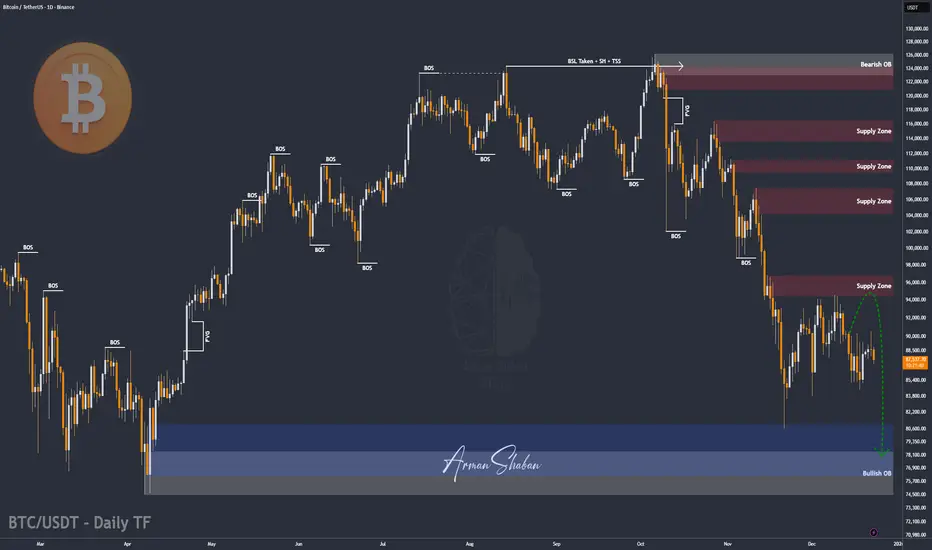
BTC/USDT | More Downside Ahead? Let's Discuss in the Comments!Bitcoin climbed back to $90,500, tapped resistance, and is now trading around $87,800. This bounce looks more like a classic liquidity grab than a trend reversal. I’m still leaning bearish. As long as $90,000 doesn’t flip into solid support, we’re likely heading lower. My next downside targets: $85,000 → $82,700 → $80,500
Nothing’s changed, structure is still weak, and the pressure’s on the bulls.
Please support me with your likes and comments to motivate me to share more analysis with you and share your opinion about the possible trend of this chart with me !
Best Regards , Arman Shaban
BTCUSDT Long: Buyers Defend Channel Support, Upside in FocusHello traders! Here’s a clear technical breakdown of BTCUSDT (4H) based on the current chart structure. After a prolonged consolidation phase defined by a broad range, BTC established multiple internal breakouts, highlighting volatility but no clear directional dominance. This range acted as an accumulation zone, with price repeatedly reacting around key horizontal levels. From the lower boundary of the range, BTC formed a clear pivot low, which marked the start of a bullish recovery and shift in short-term market structure.
Currently, BTC is holding above the Demand Zone around 86,800, which aligns with prior range support and the lower boundary of the ascending channel. This area has already shown buyer reaction, reinforcing it as a key level for continuation. Price is now attempting to push higher toward the upper boundary of the channel.
My scenario: as long as BTCUSDT holds above the Demand Zone and respects the ascending channel support, the bias remains bullish. I expect buyers to defend this area and attempt a move back toward the 89,000 Supply/Resistance Zone as the first target. A clean breakout and acceptance above this level would confirm bullish continuation and open the path toward higher targets within the channel. A breakdown below demand would invalidate the long scenario. Manage your risk!
Unlock MACD Mastery: Catch Trends Before They ExplodeThe Moving Average Convergence Divergence (MACD) is a trend-following momentum indicator that shows the relationship between two moving averages of a security’s price.
It consists of:
MACD Line: 12-period EMA minus 26-period EMA
Signal Line: 9-period EMA of the MACD Line
Histogram: MACD Line minus Signal Line
MACD helps spot buy/sell signals, trend strength, and reversals – essential for Forex, Crypto, and Stocks.
How MACD Works (Quick Setup)
Add MACD(12,26,9) on TradingView. Positive histogram = bullish momentum 📊. Negative = bearish 📉.
Key Strategies
1-Line Crossovers
Bullish: MACD crosses above Signal → Buy signal.
Bearish: MACD crosses below Signal → Sell signal.
2-Divergences
Bullish: Price lower lows, MACD higher lows → Potential reversal up.
Bearish: Price higher highs, MACD lower highs → Potential reversal down.
3-Zero Line Crossovers
Above zero = Bullish trend strength.
Below zero = Bearish trend strength.
Real Examples Right Now (Dec 27, 2025)
Bitcoin ( BINANCE:BTCUSDT )
*** In the chart which you see, I I have highlighted key points including MACD Line, Signal line, Crossover, Divergence and Histograms. ***
⚠️As you can see in the chart, MACD send the bearish signal in BTC'S ATH (All Time High) on around 6th October.
Pro Tips
Combine with RSI or support/resistance for confirmation.
In trending markets like Stocks, focus on crossovers; in ranging markets like Forex, use divergences.
Adjust periods for volatility (e.g., MACD(5,35,5) for Crypto).
Always backtest – don't trade blind!
Level up your charts with MACD today and ride the trends!
What's your go-to MACD setup? Share below! 👇
Bitcoin Price Update – Clean & Clear ExplanationBitcoin is currently showing weak price behavior after failing to hold above key resistance levels. Earlier, the market was in an uptrend, supported by a rising trendline. However, price has now broken below this trendline, which is an early sign that bullish momentum is fading.
The price faced strong rejection near the 88,800 – 89,300 zone, which is a major resistance area after rejection, Bitcoin started making lower highs and lower lows, indicating bearish pressure the previous support zone around 88,000 has now turned into resistance, confirming a trend shift price is currently trading around 87,000, struggling to move higher.
If Bitcoin fails to reclaim 88,000, sellers may push the price lower the next important support zone lies near 86,300 if selling pressure increases, price could extend the drop toward the 84,000 support area.
A short-term pullback or consolidation may happen first, but the overall bias remains bearish unless price moves back above resistance.
If you find it please like and comments for this post and share thanks.
Algorithmic Trading vs Manual TradingWhy the Edge Is Shifting And Why 2026 May Be a Turning Point
As this year comes to an end, it’s the perfect moment to slow down, zoom out, and ask an uncomfortable but necessary question:
Are we trading the markets — or are the markets trading us?
Whether you are in your first year of trading or have spent a decade studying charts, there comes a moment of clarity where you ask yourself:
“If I know what to do… why don’t I always do it?”
Beginners ask this after their first emotional mistake.
Experienced traders ask it after their hundredth.
The market does not punish ignorance as harshly as it punishes inconsistency.
Most traders don’t fail because they lack knowledge.
They fail because they are human.
We all know this pattern:
The entry is clear but hesitation creeps in
The stop is defined but gets adjusted “just a little”
The trend is obvious yet profits are taken too early
The system says don’t trade but emotions say this time is different
At the end of the day, trading is not a battle against the market.
It’s a battle against ourselves.
And that’s exactly where algorithmic (systematic) trading enters the game. Not as a shortcut, not as a holy grail, but as an evolution of execution.
Now, with AI evolving rapidly and tools becoming accessible to retail traders, something big is happening:
The same systematic edge institutions used for years is now available to individuals.
That raises a powerful question:
Can a system (without emotion, instinct, or fear) trade better than a human?
After spending the last 6–8 months deeply immersed in algorithmic trading, intense backtesting, rule-building, and system refinement, I came to a conclusion:
Algorithmic trading is not just the future, it’s the logical evolution of trading itself.
And I strongly believe 2026 will be a major turning point.
Let’s break this down properly.
Manual Trading (Human Trading) → The Strengths & The Silent Killers
Manual trading is where almost everyone starts and for good reason.
What humans do exceptionally well
Pattern recognition
Context awareness and regime interpretation
Macro, narrative, and sentiment understanding
Adaptation during abnormal market conditions
For experienced traders, discretion often becomes earned intuition.
But here’s the uncomfortable truth:
The better you get, the more painful your mistakes become.
Why?
Because you know better yet still break your own rules.
Humans are great at ideas.
But trading success doesn’t come from ideas.
It comes from execution → repeated thousands of times.
And this is where humans struggle most.
The Complete List of Human Trading Failures (The Real Reason Most Traders Lose)
Regardless of experience, humans share the same failure modes.
Here’s the part most people avoid talking about.
Emotional failures
Fear when price approaches entry
Greed when price runs in profit
Panic after one losing trade
Overconfidence after a winning streak
Revenge trading to “get it back”
Execution & discipline failures
Moving stop losses too early
Widening stops to avoid realizing a loss
Taking profit early because “it’s green now”
Ignoring your system once emotions kick in
Changing rules mid-trade
Cognitive biases (even in professionals)
Confirmation bias (seeing only what supports your bias)
Recency bias (overweighting the last trade)
Anchoring to entry price
Counter-trading the trend because price “feels extended”
Lifestyle & state-based issues
Trading tired
Trading stressed
Trading distracted
Trading emotionally impacted by life events
The classic question every trader has asked:
“Why did I take profit so early when the trend was obvious?”
Or:
“Why did I counter-trade when the moving averages clearly showed downside momentum?”
These aren’t skill problems.
They are human problems.
The Hard Truth: Trading Is an Execution Game
Markets reward:
Consistency
Repetition
Risk control
Statistical edge
They do not reward:
Creativity during execution
Emotional intelligence in drawdowns
Smart excuses
Execution quality determines outcomes and execution is precisely where humans are weakest.
Algorithmic Trading → What Changes When Rules Take Control
Algorithmic trading removes the weakest link in trading:
The trader.
A system:
Doesn’t feel fear, stress, fatigue, or boredom
Doesn’t reinterpret rules mid-trade
Doesn’t revenge trade
Doesn’t move stops
Doesn’t second-guess
Doesn’t hesitate
It follows rules.
Every single time.
Key advantages of algorithmic trading
Processes multiple data points simultaneously
Executes instantly during fast price action
Trades 24/7 without fatigue
Applies identical risk rules every trade
Can be objectively tested and measured
There is no emotional deviation.
And that alone is a massive edge.
“But Humans Have Instinct” — The Big Myth
Instinct is just pattern recognition shaped by experience.
And patterns can be quantified.
If a trader can explain why they take a trade
that logic can be turned into rules.
And rules can be executed better by machines.
Win Rate Reality — How High Can It Really Go?
When I began researching existing algo traders:
Some had ~60% win rates with solid returns
Some reached 70–80%
That sparked a question I wrote down and circled:
“Is a 90% win rate even possible?”
So I tested.
Started with swing trading systems
Moved to intraday
Then scalping
Simplified rules instead of complexity
Tested only what truly mattered
After months of backtesting and refinement:
Achieving high-precision win rates of 80–90% across various asset classes, with drawdowns kept to an absolute minimum.
It proved something deeper:
Precision trading is possible when emotion is removed.
Important Reality Check (Especially for Experienced Traders)
High win rate does not automatically mean profitability.
What truly matters:
Risk-to-reward
Drawdowns
Expectancy
Consistency
Longevity over multiple market regimes
A system must survive:
Trending markets
Ranging markets
High volatility
Low volatility
Durability beats elegance.
Always.
The Real Future of Trading (2025–2030)
Here’s how I see it:
More traders will become system builders, not button clickers
Manual trading will shift toward monitoring & strategy design
AI will assist in:
Data filtering
Pattern discovery
Optimization
Hybrid approaches will dominate:
Machines execute
Humans supervise
Manual trading won’t disappear
but manual execution will.
My Personal Conclusion
Manual trading becomes validation
Algorithmic trading becomes execution
Humans decide what to trade
Systems decide how to trade
That’s evolution.
Final Thoughts — End of Year Message 🎄
As the year comes to an end, take time to reflect:
What worked
What didn’t
Where emotions interfered
Where rules could replace decisions
Trading is a long-term game.
The goal isn’t to trade more
it’s to trade better.
Merry Christmas to everyone!
May the next year bring clarity, discipline and growth — both in trading and in life.
The edge is shifting.
And those who adapt early will lead.
Would love to hear your thoughts:
Are you trading fully manual?
Hybrid approach?
Or already building systems?
_________________________________
💬 If you found this helpful, drop a like and comment!
BTCUSDT: Buyers Defend 86K Support, Upside in FocusHello everyone, here is my breakdown of the current BTCUSDT setup.
Market Analysis
BTCUSDT has shifted its structure after breaking out of a prolonged Downward Channel, signaling a loss of bearish control and the start of a stabilization phase. Following the breakout, price entered a broad range, bounded by a clear Resistance Zone around 90,300 and a Support Zone near 86,000. This range reflects market indecision after the strong sell-off.
Currently, price has formed a triangle structure, with descending resistance and ascending support lines, indicating compression and preparation for a directional move. Recently, BTCUSDT tested the lower boundary of the range and successfully defended the Support Zone, followed by a breakout from the short-term structure, suggesting renewed buyer interest. Current price action shows consolidation above support, favoring a bullish continuation scenario.
My Scenario & Strategy
My primary scenario is bullish as long as BTCUSDT holds above the 86,000 support zone. The recent pullback appears corrective within the broader recovery structure. I expect price to continue higher toward the range high and resistance zone around 90,300.
Therefore, a clean breakout and acceptance above this resistance would confirm bullish continuation and open the path for further upside expansion. However, a sustained breakdown below the support zone would invalidate the bullish setup and increase the risk of a deeper move lower. For now, structure and price behavior favor buyers while support remains intact.
That's the setup I'm tracking. Thank you for your attention, and always manage your risk.
Bitcoin at Key Liquidity Zone — Bullish Reversal Loading?Bitcoin ( BINANCE:BTCUSDT ), as I mentioned in my previous idea , has successfully reached its first target($90,217).
Bitcoin is currently trading near Cumulative Long Liquidation Leverage($86,6330-$86,170) and is moving within a small descending channel.
Additionally, from an Elliott Wave perspective, it appears that Bitcoin is completing its Wave C in an expanding flat corrective pattern(ABC/3-3-5).
We’re also observing a positive Regular Divergence (RD+) within this small descending channel, indicating potential strength.
I expect that once Bitcoin breaks above the upper line of this small descending channel, it will aim to retest and potentially surpass the resistance zone($89,230-$87,720), which it previously failed to break.
Do you believe Bitcoin can sustain its momentum and confirm a breakout above $90,000? Let me know your thoughts!
Cumulative Short Liquidation Leverage: $91,300-$90,660
First Target: $89,321
Second Target: $90,250
Third Target: 50_SMA(Daily)
Stop Loss(SL): $85,377Worst)
Points may shift as the market evolves
💡 Please respect each other's opinions and express agreement or disagreement politely.
📌Bitcoin Analysis (BTCUSDT), 1-hour time frame.
🛑 Always set a Stop Loss(SL) for every position you open.
✅ This is just my idea; I’d love to see your thoughts too!
🔥 If you find it helpful, please BOOST this post and share it with your friends.
BTC/USDT (15m) – Cup Formation, Pullback Into Trend SupportHi!
BTC is developing a well-proportioned Cup formation on the 15-minute timeframe, signaling a constructive recovery after the recent decline. The rounded base reflects gradual absorption of supply rather than panic selling, which is a healthy characteristic of continuation structures.
Following the impulsive breakout from the right side of the cup, the price entered a short-term consolidation below resistance, forming a mild pullback. This retracement is technically logical and currently aligns with the rising trendline, which acts as dynamic support. Such pullbacks often serve as momentum resets rather than reversals, provided structure remains intact.
The highlighted supply zone above the price explains the temporary hesitation. Acceptance above this zone would confirm strength and open the path toward the 90,200–90,600 area, matching the projected continuation from the cup structure.
Overall, this is a technically logical setup favoring continuation, with well-defined risk and invalidation.