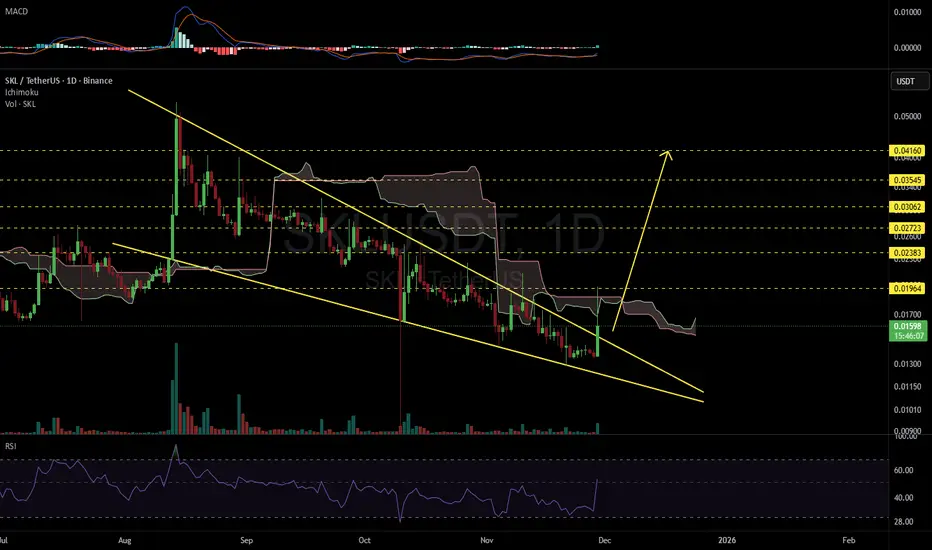
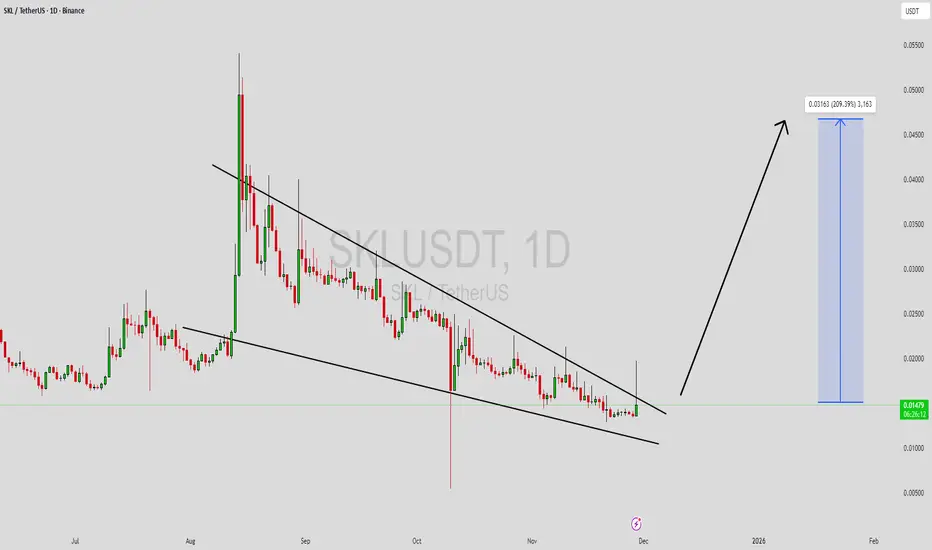
SKLUSDT Forming Falling WedgeSKLUSDT is forming a basic falling wedge reversal signal that often indicates an upcoming breakout. The price has been consolidating within a narrowing range, suggesting that selling pressure is weakening while buyers are beginning to regain control. With consistent volume confirming accumulation at lower levels, the setup hints at a potential bullish breakout soon. The projected move could lead to an impressive gain of around 190% to 200% once the price breaks above the wedge resistance.
This falling wedge pattern is typically seen at the end of downtrends or corrective phases, and it represents a potential shift in market sentiment from bearish to bullish. Traders closely watching SKLUSDT are noting the strengthening momentum as it nears a breakout zone. The good trading volume adds confidence to this pattern, showing that market participants are positioning early in anticipation of a reversal.
Investors’ growing interest in SKLUSDT reflects rising confidence in the project’s long-term fundamentals and current technical strength. If the breakout confirms with sustained volume, this could mark the start of a fresh bullish leg. Traders might find this a valuable setup for medium-term gains, especially as the wedge pattern completes and buying momentum accelerates.
✅ Show your support by hitting the like button and
✅ Leaving a comment below! (What is your opinion about this Coin?)
Your feedback and engagement keep me inspired to share more insightful market analysis with you!
Market insights
SKLUSDT Forming Falling WedgeSKLUSDT is forming a falling wedge patter, a classic bullish reversal setup that signals potential trend change after a sustained downtrend. The pattern is tightening, showing that selling pressure is weakening while buyers are gradually stepping in. The good trading volume further supports the likelihood of a strong breakout ahead. Based on current technical structure and investor sentiment, SKLUSDT holds an expected gain potential of 90% to 100%+, making it an attractive opportunity for traders looking for momentum-based setups.
This falling wedge formation indicates that the market is approaching a breakout zone where bulls are likely to regain control. The price compression within the wedge pattern suggests accumulation by stronger hands, while short-term traders may be waiting for confirmation before entering. A decisive breakout above the upper trendline could trigger a sharp upward move, potentially aligning with broader market recovery trends across the altcoin sector.
Investors’ growing interest in SKLUSDT adds further confidence to the technical outlook. With volume confirming accumulation and sentiment leaning bullish, the coin could soon see increased volatility to the upside. Traders are watching closely for a breakout confirmation, as the next leg up could deliver substantial gains once momentum shifts decisively.
✅ Show your support by hitting the like button and
✅ Leaving a comment below! (What is You opinion about this Coin)
Your feedback and engagement keep me inspired to share more insightful market analysis with you!
The Journey of the World EconomyIntroduction: The Pulse of Civilization
The story of the world economy is, in many ways, the story of human progress itself — a journey from barter to blockchain, from localized trade to globalized finance. Every era of history — from the ancient Silk Road to the digital highways of the 21st century — has shaped how nations produce, distribute, and consume wealth. The evolution of the global economy is not merely an economic tale; it is a social, political, and cultural transformation that reflects the very essence of humanity’s pursuit of growth and stability.
This comprehensive narrative explores the journey of the world economy, tracing its transformation through centuries — highlighting its major milestones, challenges, and the forces that continue to redefine it in the modern era.
1. The Dawn of Trade: Barter Systems and Early Economies
In the earliest human societies, there was no formal concept of money or global trade. People survived through barter systems, exchanging goods and services based on need. A farmer might trade grain for tools made by a blacksmith, or wool for pottery. This system worked in small, self-sufficient communities but faced limitations as societies expanded — differences in value, perishability, and coincidence of wants made trade cumbersome.
The first real economic revolution began with the invention of money — shells, metal coins, and later, paper notes — which enabled standardized exchange. Ancient civilizations like Mesopotamia, Egypt, and the Indus Valley established structured economies where trade routes linked distant lands. The Silk Road connected Asia to Europe, allowing not just the flow of goods like silk, spices, and gold, but also the spread of knowledge, religion, and technology.
This early phase laid the foundation of what would eventually become the global economy — an interconnected web of production and exchange that transcended borders.
2. The Age of Empires: Expansion, Colonization, and Mercantilism
From the 15th to 18th centuries, global trade was dominated by European powers seeking wealth through colonization and mercantilism. Nations like Britain, Spain, Portugal, France, and the Netherlands established colonies across Asia, Africa, and the Americas.
The mercantilist theory of this era believed that a nation’s wealth was measured by its stockpile of gold and silver. This drove colonial expansion as European powers exploited resources and labor from their colonies to fuel their own industrial and military growth.
The triangular trade system between Europe, Africa, and the Americas epitomized this global economic structure — with raw materials flowing from colonies, manufactured goods from Europe, and enslaved labor from Africa. This period brought immense wealth to Europe but at a devastating human cost.
Yet, mercantilism also laid the groundwork for capitalism, as trade, finance, and innovation flourished. The establishment of joint-stock companies like the British East India Company and Dutch VOC introduced the concept of corporate capitalism, where investments and profits were shared among shareholders — a precursor to the modern stock market.
3. The Industrial Revolution: The Birth of Modern Economics
The late 18th and 19th centuries marked the Industrial Revolution, a turning point that transformed the economic fabric of the world. Britain led this transformation, powered by technological innovations such as the steam engine, textile machinery, and railways.
Factories replaced workshops, and production shifted from manual labor to machine-driven efficiency. Urbanization surged as people moved to cities for work. Productivity soared, and with it, global trade expanded exponentially.
The revolution also birthed the modern capitalist system theorized by economists like Adam Smith, whose 1776 work “The Wealth of Nations” introduced the idea of free markets and the “invisible hand.” Capitalism emphasized private property, competition, and profit — principles that shaped economic policy for centuries to come.
However, industrialization also deepened class divides, giving rise to socialist ideologies and labor movements. Thinkers like Karl Marx criticized capitalism for exploiting workers and creating inequality — debates that still resonate in modern policy discussions.
4. The Age of Global Conflict and Recovery (1914–1945)
The early 20th century tested the global economy with unprecedented crises. The First World War (1914–1918) devastated Europe, draining resources and collapsing trade networks. The interwar years saw unstable financial systems, culminating in the Great Depression of 1929, one of the darkest economic periods in history.
Unemployment, deflation, and bankruptcies spread worldwide. The U.S. stock market crash exposed the fragility of the global financial system, leading to the rise of protectionism — countries imposed tariffs, restricting trade in a desperate attempt to save domestic industries.
As if that weren’t enough, the world plunged again into World War II (1939–1945). Economies were redirected toward military production, and destruction swept across continents. Yet, out of this devastation emerged the seeds of modern economic cooperation.
The Bretton Woods Conference (1944) laid the foundation for a new global economic order. Institutions like the International Monetary Fund (IMF) and World Bank were created to promote stability, reconstruction, and development — ushering in the post-war economic era.
5. The Post-War Boom: The Golden Age of Capitalism (1945–1973)
The period following World War II was one of unprecedented economic growth. The United States emerged as the global economic leader, while Europe and Japan rebuilt through programs like the Marshall Plan.
This era witnessed the rise of consumer economies, with booming industries, suburbanization, and technological innovation. The Bretton Woods system pegged currencies to the U.S. dollar, establishing global financial stability.
Trade liberalization under organizations like the General Agreement on Tariffs and Trade (GATT) encouraged global commerce. Living standards rose dramatically, and the middle class expanded.
However, the system began to strain by the early 1970s as inflation, oil shocks, and currency imbalances emerged. The collapse of the Bretton Woods system in 1971, when the U.S. abandoned the gold standard, marked the beginning of floating exchange rates and a more volatile financial environment.
6. The Era of Globalization: Technology, Trade, and Transformation (1980–2008)
From the 1980s onward, the world entered an era of hyper-globalization. Technological revolutions in computing, telecommunications, and the internet transformed production, communication, and finance.
Policies of economic liberalization, led by figures like Ronald Reagan and Margaret Thatcher, encouraged privatization, deregulation, and free-market capitalism. Global institutions such as the World Trade Organization (WTO) promoted open trade and reduced barriers between nations.
Emerging economies — particularly China and India — became key players. China’s market reforms under Deng Xiaoping and India’s 1991 liberalization opened new frontiers for global investment and manufacturing.
The European Union (EU) and the rise of multinational corporations deepened global integration. Outsourcing, global supply chains, and financial markets connected the world more tightly than ever before.
Yet, this period also created inequality and financial bubbles, culminating in the Global Financial Crisis of 2008, which exposed the vulnerabilities of unregulated markets and excessive debt.
7. The Post-Crisis Rebalancing: A New Global Reality (2008–2020)
After 2008, the world economy underwent significant restructuring. Governments and central banks implemented massive stimulus programs, including quantitative easing, to revive growth.
The crisis led to introspection — the need for sustainable, inclusive, and resilient economies became central to global policy. Emerging markets continued to rise, shifting the economic balance toward Asia.
Meanwhile, technological disruption accelerated. The rise of digital economies, fintech, and artificial intelligence transformed how people work, invest, and consume. Platforms like Amazon, Google, and Alibaba redefined commerce and competition.
At the same time, new challenges — climate change, automation, and inequality — demanded global cooperation. The United Nations’ Sustainable Development Goals (SDGs) emerged as a blueprint for balanced economic progress.
However, by 2020, the world faced another major disruption — the COVID-19 pandemic, which shook the foundations of global trade, travel, and supply chains.
8. The Pandemic Era and the Road Ahead (2020–Present)
The COVID-19 pandemic triggered one of the largest economic contractions since World War II. Lockdowns, factory closures, and disrupted logistics paralyzed industries. Global GDP fell sharply in 2020, and unemployment soared.
Yet, the crisis also accelerated digital transformation and remote work, while governments launched unprecedented fiscal and monetary interventions. Stock markets rebounded quickly, fueled by liquidity and innovation in sectors like technology, healthcare, and renewable energy.
The pandemic revealed the fragility of global supply chains, prompting countries to rethink economic self-reliance and strategic manufacturing. It also intensified discussions around de-globalization, climate finance, and digital currencies.
As nations recovered, attention shifted toward green economies, AI-driven productivity, and de-dollarization — as countries sought alternatives to U.S. financial dominance. The rise of BRICS nations, especially with China and India at the forefront, marked a multipolar shift in global power dynamics.
9. The Future of the World Economy: Innovation, Sustainability, and Inclusion
Looking ahead, the global economy is entering a transformational phase. Several key trends are shaping its trajectory:
Technological Revolution – AI, blockchain, and quantum computing are redefining industries, from finance to manufacturing.
Green Transition – Renewable energy, carbon markets, and sustainable finance are becoming economic cornerstones.
Geopolitical Realignment – The U.S.-China rivalry, de-dollarization, and regional trade blocs (like RCEP) are reshaping global alliances.
Digital Currencies & Fintech – Central Bank Digital Currencies (CBDCs) and decentralized finance (DeFi) are revolutionizing monetary systems.
Inclusive Growth – Nations are emphasizing equity, social welfare, and education as pillars of future prosperity.
The new world economy will be digital, decentralized, and data-driven — but its success will depend on how humanity balances innovation with inclusion and sustainability.
Conclusion: A Journey Without an End
The journey of the world economy is far from over. From primitive bartering to algorithmic trading, from local markets to the metaverse, each phase of economic evolution has mirrored humanity’s endless quest for growth, efficiency, and fairness.
Today, as we stand at the crossroads of technology, climate change, and geopolitics, the world economy is being rewritten once again — not by conquest or colonization, but by collaboration, innovation, and consciousness.
The next chapter will not just measure wealth in GDP, but in sustainability, resilience, and shared prosperity. The global economy’s true strength will lie not in how fast it grows, but in how well it uplifts humanity as a whole.
#SKL/USDT - shorters will get rekt!#SKL
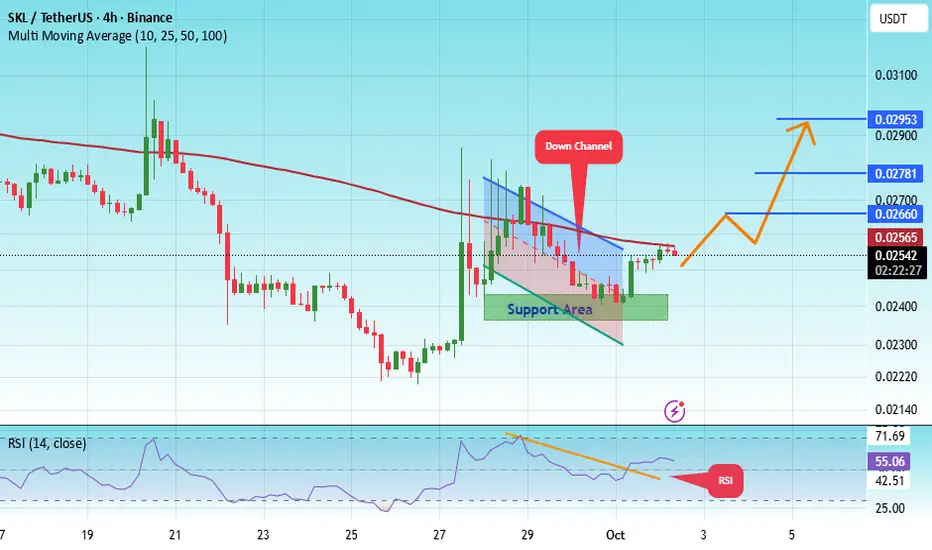
The price is moving within a descending channel on the 1-hour frame, adhering well to it, and is heading for a strong breakout and retest.
We have a bearish trend on the RSI indicator that is about to be broken and retested, which supports the upward move.
There is a major support area in green at 0.02412, representing a strong support point.
We are heading for consolidation above the 100 moving average.
Entry price: 0.02545
First target: 0.02660
Second target: 0.02781
Third target: 0.02950
Don't forget a simple matter: capital management.
When you reach the first target, save some money and then change your stop-loss order to an entry order.
For inquiries, please leave a comment.
Thank you.
#SKL/USDT#SKL
The price is moving within a descending channel on the 1-hour frame, adhering well to it, and is heading for a strong breakout and retest.
We have a bearish trend on the RSI indicator that is about to be broken and retested, which supports the upward breakout.
There is a major support area in green at 0.02800, representing a strong support point.
For inquiries, please leave a comment.
We are in a consolidation trend above the 100 Moving Average.
Entry price: 0.02970
First target: 0.03050
Second target: 0.03117
Third target: 0.03200
Don't forget a simple matter: capital management.
When you reach the first target, save some money and then change your stop-loss order to an entry order.
For inquiries, please leave a comment.
Thank you.
Currency Convertibility Issues in Global Markets1. Introduction to Currency Convertibility
Currency convertibility is critical for the functioning of international markets. A convertible currency allows:
Trade Facilitation: Businesses can pay and receive foreign currencies without restrictions.
Investment Flexibility: Investors can freely move capital across borders.
Economic Integration: Countries with convertible currencies can participate fully in the global economy.
Key terms:
Fully Convertible Currency: Freely exchangeable for any other currency without restrictions (e.g., US Dollar, Euro).
Partially Convertible Currency: Exchange is allowed for some transactions (like trade), but restricted for others (like capital account transactions).
Non-Convertible Currency: Cannot be freely exchanged; transactions require government approval or are prohibited (e.g., North Korean Won, Cuban Peso).
2. Historical Background
Historically, currency convertibility has evolved with global trade and economic integration:
Bretton Woods Era (1944-1971): Fixed exchange rates linked major currencies to the US Dollar, which was convertible to gold. Developing countries often had non-convertible currencies to protect domestic economies.
Post-Bretton Woods (1970s onwards): Shift to floating exchange rates increased currency convertibility, but capital controls remained in many emerging markets.
Modern Era: Globalization has pushed most developed nations toward full convertibility, while many emerging and frontier economies maintain partial restrictions to manage volatility and capital flight.
3. Types of Currency Convertibility Issues
Currency convertibility issues arise when restrictions impede the free exchange of a currency. They can be classified as follows:
3.1. Trade Convertibility Issues
Restrictions on import/export payments.
Limits on foreign exchange availability for international trade.
Common in countries with balance-of-payments crises.
Example: In India during the 1970s, foreign exchange allocation for imports was tightly controlled to manage reserves.
3.2. Capital Account Convertibility Issues
Restrictions on investment flows: foreign direct investment (FDI), portfolio investment, and lending.
Countries impose these to prevent sudden capital flight and speculative attacks.
Impact: While protective, it limits access to global finance.
Example: China maintains controlled capital account convertibility despite having a largely trade-convertible currency.
3.3. Dual Exchange Rate Systems
Countries maintain official vs. market exchange rates.
Official rate often underestimates currency value, creating incentives for black markets.
These systems arise due to currency overvaluation or limited reserves.
Example: Venezuela’s dual exchange rates in the 2010s caused widespread distortions in trade and imports.
3.4. Black Market and Parallel Market Issues
When official convertibility is restricted, a parallel market emerges.
Leads to currency speculation, inflation, and reduced confidence in the domestic currency.
Example: Zimbabwe’s hyperinflation in the 2000s led to a thriving black market for US Dollars.
4. Causes of Currency Convertibility Issues
Several factors can restrict currency convertibility:
4.1. Economic Instability
High inflation or fiscal deficits reduce investor confidence.
Governments may restrict convertibility to protect reserves.
4.2. Limited Foreign Exchange Reserves
Countries with small reserves cannot risk free capital outflows.
Convertibility restrictions are a tool to preserve reserves.
4.3. Speculative Attacks and Capital Flight
Free convertibility can trigger rapid outflows during crises.
Example: Asian Financial Crisis (1997) saw several currencies collapse due to speculative attacks.
4.4. Policy and Strategic Objectives
Some nations deliberately restrict convertibility to:
Protect infant industries.
Maintain control over foreign debt.
Shield the domestic economy from global shocks.
5. Implications of Currency Convertibility Issues
Currency convertibility issues have wide-ranging economic, financial, and social effects:
5.1. On International Trade
Restrictive policies increase transaction costs and delays.
Firms face uncertainty in pricing, payments, and hedging.
5.2. On Foreign Investment
Limited convertibility reduces investor confidence.
FDI inflows may decline, limiting economic growth.
5.3. On Domestic Economy
Encourages a shadow economy for foreign exchange.
Can lead to inflation and currency depreciation.
5.4. On Financial Markets
Currency volatility rises when markets anticipate policy shifts.
Hedging instruments are limited or costly.
6. Case Studies
6.1. India Pre-1991
India had strict foreign exchange controls and limited convertibility.
Imports and FDI required government approval.
The 1991 balance-of-payments crisis forced liberalization, leading to gradual convertibility.
6.2. China
China has a partially convertible Renminbi (RMB).
Trade account is largely convertible; capital account is tightly controlled.
This strategy stabilizes domestic financial markets while encouraging trade growth.
6.3. Venezuela
Overvalued Bolivar and dual exchange rates led to black markets.
Currency controls exacerbated inflation and scarcity of goods.
6.4. Eurozone
Euro is fully convertible across participating nations.
This has facilitated trade, investment, and capital mobility, highlighting the benefits of full convertibility.
7. Strategies to Address Convertibility Issues
Countries can adopt various measures to mitigate currency convertibility problems:
7.1. Gradual Liberalization
Phased approach from trade convertibility → capital convertibility.
Reduces risk of sudden outflows.
7.2. Strengthening Reserves
Adequate foreign exchange reserves improve confidence.
Enables smoother convertibility.
7.3. Exchange Rate Policy Adjustments
Managed float or crawling peg can balance stability with convertibility.
Avoids shocks from volatile global markets.
7.4. Capital Controls
Temporary measures during crises to prevent speculative attacks.
Should be transparent and predictable.
7.5. Encouraging Foreign Investment
FDI inflows bring foreign currency, supporting convertibility.
Incentives for long-term, stable investment help reduce risk.
8. Global Implications
Currency convertibility affects global finance in multiple ways:
Trade Expansion: Fully convertible currencies facilitate seamless trade and lower transaction costs.
Capital Flow Efficiency: Investors prefer economies with predictable currency exchange rules.
Financial Market Development: Convertibility encourages hedging instruments, derivatives, and risk management strategies.
Crisis Containment: Countries with restricted convertibility can insulate themselves temporarily from global shocks, but may also lose investor confidence.
9. Future Outlook
With globalization and digital finance, currency convertibility issues are evolving:
Digital Currencies and CBDCs: Central bank digital currencies may improve cross-border payments and reduce convertibility barriers.
Regional Currency Blocks: Initiatives like the African Continental Free Trade Area (AfCFTA) and the ASEAN Economic Community may enhance regional convertibility.
Emerging Market Reforms: Many emerging economies are gradually liberalizing currency accounts while balancing macroeconomic stability.
10. Conclusion
Currency convertibility is a vital aspect of economic integration and global financial stability. While fully convertible currencies offer benefits in trade, investment, and market efficiency, partial or non-convertible currencies provide temporary protection against volatility, capital flight, and external shocks. Understanding the nuances of convertibility issues helps policymakers, investors, and businesses navigate the complex global financial landscape. Future trends, including digital currencies and regional financial cooperation, are likely to shape how convertibility evolves in the next decades.
SKLUSDT Forming Bullish WaveSKLUSDT is showing signs of forming a strong bullish wave pattern, which could be a major signal for an upcoming explosive move. The structure indicates that price action is gradually building momentum and preparing for a breakout. With solid trading volume supporting this setup, SKLUSDT has the potential to deliver massive upside gains in the near term, with expectations ranging from 190% to 200%+.
This bullish wave pattern suggests accumulation and growing investor confidence. Historically, similar setups have triggered sharp rallies once resistance levels are broken, and SKLUSDT appears to be following a comparable path. The presence of higher lows and steady market activity strengthens the outlook, pointing towards a sustained upward push once a breakout occurs.
Investor sentiment is also favoring SKLUSDT as interest in this project continues to rise. A clean breakout above the resistance zone could unleash strong bullish momentum, driving prices to new levels and attracting even more buyers into the market. With these factors in play, SKLUSDT is positioned as one of the crypto pairs to watch closely for substantial growth potential.
✅ Show your support by hitting the like button and
✅ Leaving a comment below! (What is You opinion about this Coin)
Your feedback and engagement keep me inspired to share more insightful market analysis with you!
SKLUSDThi friends...
sorry about my low activity nowadays!!!
i try to open less positions with higher quality!!!
here we have the chat of Skale
We can see the high level of demand, and the chart is showing everything we want...
we can see the good rejection from low at 0.02 and high level of demand there
ichimuko is showing some growth signals in feature, and the price is in good position with low risk...
so we will open it for next year!!!
good lock!
Globalization and De-GlobalizationPart I: Understanding Globalization
1. The Concept of Globalization
Globalization is the process through which countries and societies become more connected through trade, technology, investment, culture, and politics. It is not a new phenomenon. Historically, trade routes like the Silk Road or colonial expansions already linked distant societies. However, modern globalization is faster, broader, and more complex because of digital technologies, modern transportation, and global institutions.
2. Historical Phases of Globalization
Pre-modern globalization (before 1500): Exchange of goods, ideas, and culture through ancient trade routes.
Colonial globalization (1500–1800): European expansion, global maritime trade, and the integration of colonies into global markets.
Industrial globalization (1800–1945): Industrial revolution, rise of capitalism, mass migration, and colonial empires.
Post-WWII globalization (1945–1990): Bretton Woods system, establishment of IMF, World Bank, GATT (later WTO), rapid growth of multinational corporations.
Contemporary globalization (1990–present): Driven by digital revolution, liberalization of markets, China’s rise, and global value chains.
3. Drivers of Globalization
Economic factors: Free trade agreements, foreign direct investment, outsourcing, and global supply chains.
Technological factors: Internet, smartphones, containerization in shipping, aviation, artificial intelligence.
Political factors: Collapse of the Soviet Union, liberalization of China and India, neoliberal policies.
Cultural factors: Spread of movies, music, cuisine, tourism, and global media.
Institutional factors: Role of WTO, UN, World Bank, IMF in shaping global rules.
4. Key Features of Globalization
Free movement of goods and services through trade liberalization.
Capital mobility via foreign investments, stock markets, and financial flows.
Labor mobility, including migration and outsourcing.
Knowledge and cultural diffusion through digital platforms and global communication.
Global governance, where international rules and treaties influence domestic policies.
Part II: Benefits and Criticisms of Globalization
1. Benefits of Globalization
Economic growth: Countries like China, South Korea, and India grew rapidly by integrating into global trade.
Poverty reduction: Hundreds of millions lifted out of poverty, particularly in Asia.
Access to technology and knowledge: Rapid spread of innovations like smartphones, vaccines, and renewable energy.
Cultural exchange: Increased exposure to different cuisines, languages, films, and lifestyles.
Global cooperation: Joint efforts in areas like climate change, health, and peacekeeping.
2. Criticisms of Globalization
Economic inequality: Benefits concentrated in urban elites, while rural and working-class populations often feel left behind.
Exploitation of labor: Sweatshops, poor working conditions, and child labor in developing countries.
Cultural homogenization: Local traditions sometimes overshadowed by dominant Western culture.
Environmental damage: Global supply chains contribute to carbon emissions and resource depletion.
Sovereignty concerns: National governments constrained by global corporations and institutions.
Part III: The Rise of De-Globalization
1. Defining De-Globalization
De-globalization refers to a process where countries reduce their interdependence and focus more on domestic or regional economies. It is not necessarily a complete reversal of globalization but a slowing down or selective disengagement.
2. Historical Precedents
The Great Depression (1930s): Countries adopted protectionism and trade barriers.
World Wars: Global connections broke down, leading to regional blocs.
Oil crises (1970s): Triggered energy nationalism and protectionist policies.
3. Contemporary Drivers of De-Globalization
Economic nationalism: Trade wars, tariffs, and policies favoring domestic industries (e.g., U.S.–China tensions).
Pandemics: COVID-19 exposed vulnerabilities in global supply chains, leading to “reshoring” or “nearshoring.”
Geopolitical tensions: Russia-Ukraine war, Taiwan conflict, Middle East instability.
Technological sovereignty: Push for domestic control over critical technologies like semiconductors and AI.
Environmental concerns: Shift toward local production and sustainable supply chains.
4. Examples of De-Globalization
Brexit: UK’s withdrawal from the European Union.
U.S.–China trade war: Tariffs, sanctions, and decoupling in technology.
Supply chain reshoring: Companies like Apple diversifying away from China.
Regionalization: Growth of regional trade agreements like RCEP (Asia) and USMCA (North America).
Part IV: Future of Globalization and De-Globalization
1. Hybrid Future
Most experts argue that globalization will not disappear entirely. Instead, we are entering a hybrid era where:
Supply chains become regional rather than fully global.
Countries balance global trade with domestic resilience.
Digital globalization (data, AI, e-commerce) grows even if physical trade slows.
2. Scenarios for the Future
Re-globalization: If countries overcome geopolitical rivalries and focus on cooperation in climate, health, and technology.
Fragmented globalization: World splits into competing blocs (U.S.-led, China-led, EU-led).
Selective de-globalization: Nations globalize in technology and finance but de-globalize in food, energy, and security.
3. Role of Key Actors
Governments: Balance between economic openness and protecting domestic interests.
Corporations: Redesign supply chains for resilience.
International institutions: Need reforms to stay relevant.
Civil society: Push for fairer, greener globalization.
Part V: Case Studies
1. China – From Globalization to Selective De-Globalization
China was the biggest winner of globalization, lifting millions out of poverty. But now, facing U.S. pressure, it is pursuing “dual circulation” – focusing on both domestic and global markets.
2. United States – Global Leader to Economic Nationalist
Once the champion of free trade, the U.S. has shifted toward reshoring, tariffs, and tech protectionism, especially under Trump and Biden administrations.
3. European Union – Between Integration and Fragmentation
The EU promotes internal integration but faces pressures like Brexit, energy crises, and immigration debates.
4. India – Strategic Balancing
India embraces globalization in IT and services but protects key sectors like agriculture. It seeks to position itself as an alternative manufacturing hub to China.
Part VI: Globalization vs. De-Globalization in Society
In economics: De-globalization raises costs but increases resilience.
In politics: Globalization fosters cooperation, while de-globalization strengthens sovereignty.
In culture: Globalization spreads diversity, but de-globalization protects heritage.
In environment: Globalization increases carbon footprints, but de-globalization can encourage local sustainability.
Conclusion
Globalization has been one of the most transformative forces in human history, reshaping economies, societies, and cultures. It has brought prosperity, connectivity, and innovation, but also inequality, environmental damage, and political tensions. De-globalization is not simply a rejection of globalization but a recalibration. The world is moving toward a more balanced model that emphasizes resilience, regional cooperation, and sustainability.
In the end, neither globalization nor de-globalization is inherently good or bad. Both are responses to changing realities. The challenge for policymakers, businesses, and societies is to shape globalization in a way that is more inclusive, equitable, and sustainable—while learning from the lessons of de-globalization.
SKLUSDT 1D#SKL has bounced off the support zone. We expect a pump only if it can hold the price above the support zone and the daily EMA200. If that happens, the potential targets are:
🎯 $0.03565
🎯 $0.04178
🎯 $0.04791
🎯 $0.05665
🎯 $0.06777
⚠️ Always remember to use a tight stop-loss and follow proper risk management.
Global Market InsightsGlobal Market Insights
Introduction
The world economy has never been as connected as it is today. A single headline in New York can influence stock prices in Mumbai, a factory shutdown in China can disrupt supply chains in Europe, and a currency decision in Tokyo can ripple across the global financial system. This interconnectedness is what we call the global market—a dynamic web of trade, finance, investment, and technology that links countries, businesses, and consumers.
Understanding global market insights means going beyond numbers and charts. It is about recognizing patterns, decoding the interplay between economies, and anticipating the opportunities and risks that shape the world’s financial and trade environment. For businesses, it means better decision-making; for investors, it provides a roadmap; and for policymakers, it is the foundation of economic strategy.
Historical Evolution of Global Markets
Early Trade Routes
Global markets are not new—they have been evolving for centuries. Ancient trade routes like the Silk Road connected China, India, and Europe, enabling the exchange of goods, culture, and ideas. Spices, silk, and gold moved across continents, laying the foundation of international trade.
Colonial Trade
During the colonial era, European powers expanded overseas trade. Colonies became sources of raw materials, while Europe turned into the hub of global commerce. The triangular trade routes connected Africa, the Americas, and Europe, setting the stage for structured global markets.
Industrial Revolution
The 18th and 19th centuries brought industrialization, mass production, and mechanization. This created demand for global raw materials and expanded markets for finished goods. Railways, shipping, and telegraph systems made trade faster and more reliable.
Post-WWII Institutions
After the devastation of World War II, new financial institutions like the IMF, World Bank, and GATT (later WTO) were established. Their goal was to stabilize currencies, promote trade, and rebuild economies. The Bretton Woods system anchored the US dollar as the world’s reserve currency.
The Digital Era
The late 20th and early 21st centuries saw globalization accelerate. The internet, digital platforms, and financial technologies made cross-border trading seamless. E-commerce, digital payments, and global capital flows now define how markets operate.
Key Drivers of Global Markets
Economic Growth & GDP Trends
Growth in GDP reflects an economy’s strength. For example, India’s rapid GDP expansion makes it attractive for foreign investment, while slowdowns in Europe raise global concerns.
Central Banks & Interest Rates
Monetary policy is a powerful driver. A rate hike by the US Federal Reserve often strengthens the US dollar, affects emerging market currencies, and shifts capital flows worldwide.
Geopolitics
Conflicts, trade wars, and diplomatic relations heavily impact markets. For instance, the Russia-Ukraine war disrupted energy markets, while US-China tensions reshaped technology supply chains.
Technology & Innovation
Advancements like artificial intelligence, fintech, blockchain, and automation are creating new asset classes and transforming trade. Digital finance is reducing barriers for investors across borders.
Global Supply Chains
Modern economies depend on complex supply chains. A disruption in semiconductor production in Taiwan can stall automobile factories in Germany or the US, highlighting interdependence.
Global Market Segments
Equity Markets
Stock exchanges like NYSE, Nasdaq, London Stock Exchange, and NSE India are central to global finance. The US remains dominant, but Asia is rising fast, with China’s Shanghai and Shenzhen exchanges gaining global importance.
Bond Markets
The global bond market is even larger than equities. Sovereign bonds, like US Treasuries, are considered safe havens, while corporate bonds fund business expansion worldwide.
Currency (Forex) Markets
The foreign exchange market is the largest in the world, with daily transactions exceeding $7 trillion. The US dollar remains the dominant reserve currency, but the Euro, Yen, and increasingly the Chinese Yuan are challenging its supremacy.
Commodities
Oil, gold, copper, and agricultural goods form the backbone of commodity markets. Oil prices influence inflation, while gold is a traditional safe haven during uncertainty. Industrial metals like copper are seen as indicators of global economic health.
Alternative Assets
Cryptocurrencies, private equity, hedge funds, and real estate investments are becoming major parts of global portfolios. Bitcoin, in particular, has sparked debates about the future of decentralized money.
Regional Market Insights
United States
The US remains the world’s largest economy and financial hub. The S&P 500 and Nasdaq set global benchmarks. US Federal Reserve decisions on interest rates influence global capital flows.
Europe
The Eurozone represents a unified market but faces challenges like debt crises, energy dependency, and post-Brexit trade disruptions. Germany’s manufacturing and France’s luxury goods industries play central roles.
Asia
China, the world’s second-largest economy, has slowed down recently but still drives global trade. India is emerging as a fast-growing market, fueled by demographics, technology, and reforms. Japan continues its ultra-loose monetary policy, affecting global yen carry trades.
Emerging Markets
Countries like Brazil, South Africa, and Indonesia are resource-rich and attract investment. However, they are vulnerable to capital outflows during global crises. ASEAN nations are gaining strength through regional cooperation.
Major Trends Shaping Global Markets
Shift from West to East
Economic power is gradually shifting toward Asia, particularly China and India.
Digital Finance & Blockchain
Cryptocurrencies, central bank digital currencies (CBDCs), and decentralized finance (DeFi) are reshaping financial systems.
ESG & Green Investing
Investors now focus on sustainability. Companies that prioritize environmental, social, and governance (ESG) standards attract global capital.
Supply Chain Diversification
The pandemic exposed supply chain weaknesses. Companies are diversifying away from single-country dependence, moving toward "China+1" strategies.
De-dollarization
Several nations are exploring alternatives to the US dollar for trade settlements. The BRICS bloc is discussing new currency frameworks.
Challenges & Risks
Inflation & Stagflation: Rising global inflation threatens purchasing power and investment returns.
Geopolitical Conflicts: Wars and trade disputes disrupt supply chains and energy flows.
Climate Change: Extreme weather impacts agriculture, energy, and insurance markets.
Financial Contagion: A crisis in one country can trigger a domino effect, as seen in 2008.
Global Market Opportunities
Emerging Technologies: AI, electric vehicles, renewable energy, and biotech present trillion-dollar opportunities.
India & Southeast Asia: With growing populations and strong digital adoption, these regions attract global investors.
Africa: Resource wealth and demographic growth position Africa as the "next frontier."
Digital Trade & Fintech: Cross-border e-commerce, digital payments, and fintech innovations expand global financial access.
Future of Global Markets
The next decade is likely to witness:
A multipolar financial world where the US, China, India, and Europe share influence.
The rise of digital currencies—both private and government-issued.
Green transformation, with renewable energy and sustainability as key investment drivers.
Increased regional alliances, as countries secure supply chains and reduce dependency on single markets.
Conclusion
Global markets are the heartbeat of the interconnected world. They reflect the hopes, fears, and ambitions of billions of people, from Wall Street traders to farmers in rural Africa. Insights into these markets allow investors, businesses, and policymakers to anticipate changes, mitigate risks, and seize opportunities.
As the global economy becomes more multipolar, digitalized, and sustainability-driven, the importance of staying updated with global market insights will only grow. For anyone involved in trade, investment, or governance, understanding these dynamics is no longer optional—it is essential.
SKL/USDT — Consolidation at a Critical Demand Zone, Big Move?Currently, SKL/USDT is trading around 0.0296 USDT, sitting right inside the historical demand zone (0.026 – 0.030) that has acted multiple times as a strong pivot. This area is a decision point: whether the bulls defend it or the bears break it will define the next major trend.
---
🔎 Structure & Price Pattern
1. Key Demand Zone (yellow box)
Price is consolidating after a sharp rejection from the August spike. This zone reflects accumulation, where buyers are absorbing supply to prevent a deeper breakdown.
2. Sideways Consolidation
Daily candles show small bodies with multiple wicks, signaling indecision. Such phases often precede a strong breakout move.
3. Layered Resistances (yellow dashed lines)
Several resistances stand above the current level: 0.0373 – 0.0495 – 0.0617 – 0.0696 – 0.0798 – 0.0859. Each can serve as a profit-taking zone or temporary rejection point.
4. Liquidity Grab (August spike)
The sharp August rally that quickly reversed looks like a liquidity sweep — stop orders above were taken before the retracement. Now, the retest of demand may set the base for a larger move.
---
🚀 Bullish Scenario
Main trigger: Daily close above 0.03730 USDT → signals strength and opens the way higher.
Targets:
0.0373 (+26%) → first breakout level.
0.0495 (+67%) → mid target.
0.0617 (+108%) → extended target.
0.0859 (+190%) → retest of previous swing high.
Risk/Reward setup: Example — Entry at 0.0296, stop at 0.025 (−15.5%), target 0.0495 (+67%) → RR ~ 4.3 : 1.
📌 This scenario holds if demand remains intact and bullish candles form with strong volume.
---
⚠️ Bearish Scenario
Main trigger: Daily close below the demand zone (0.026 – 0.030).
Downside targets:
0.0190 (−36% from current price).
0.01579 (−46% from current price, previous major low).
Breakdown would likely resume the bearish trend with deeper correction risk.
📌 This scenario becomes valid if buyers fail to defend the zone and strong selling pressure emerges.
---
🧠 Market Psychology
Bulls are building a base at demand, trying to defend this key zone.
Bears are still pressing, evident from repeated rejections at resistance.
This is the “battlefield zone” — whichever side wins will dominate the coming weeks.
---
🎯 Conclusion
0.026 – 0.030 is the make-or-break zone.
Breakout above 0.0373 → potential rally with >100% upside.
Breakdown below demand → risk of decline to 0.019 – 0.01579.
Best strategy: wait for a daily close confirmation before committing to a trade.
---
#SKLUSDT #SKL #CryptoAnalysis #Altcoin #CryptoTrading #PriceAction #SupportResistance #TechnicalAnalysis
Global Market Foundations1. Historical Evolution of Global Markets
Early Trade Systems
The roots of global markets can be traced back thousands of years to barter-based exchanges and regional trade. Ancient civilizations like Mesopotamia, Egypt, China, and the Indus Valley engaged in trade using goods such as grain, spices, textiles, and metals. Over time, currencies in the form of coins and later paper money simplified transactions.
Silk Road and Maritime Trade
Between the 2nd century BCE and the 15th century CE, the Silk Road connected Asia, the Middle East, and Europe. This network facilitated not just goods but also culture, ideas, and technologies. Maritime trade routes across the Indian Ocean and Mediterranean further accelerated cross-border exchange.
Colonial Era and Mercantilism
The Age of Exploration (15th–18th centuries) brought about European colonization, global trade in spices, cotton, and precious metals, and unfortunately, also the slave trade. The mercantilist philosophy—where nations aimed to accumulate wealth through exports and restricted imports—dominated global markets.
Industrial Revolution
The Industrial Revolution in the 18th and 19th centuries transformed global markets with mass production, mechanization, and steam-powered transport. This era witnessed the rise of global corporations, banking systems, and stock exchanges.
20th Century and Globalization
The 20th century saw the establishment of critical global institutions like the International Monetary Fund (IMF), World Bank, and later the World Trade Organization (WTO). The Bretton Woods system established a framework for currency exchange and stability. Post-1990s, globalization intensified with liberalized trade policies, financial deregulation, and technological innovation.
2. Core Components of Global Markets
Goods and Services Trade
The most visible aspect of global markets is the exchange of goods and services. Countries specialize in what they produce efficiently and trade for what they lack. For example, Saudi Arabia exports oil, while South Korea exports electronics.
Financial Markets
Financial markets provide the infrastructure for raising capital, trading securities, and managing risk. They include:
Equity markets (stock exchanges like NYSE, NSE, LSE)
Bond markets (government and corporate debt instruments)
Derivatives markets (futures, options, swaps)
Foreign exchange (Forex) markets (largest by volume globally)
Capital Flows
Investment across borders, including Foreign Direct Investment (FDI) and portfolio investment, forms a crucial foundation of global markets. Companies establish subsidiaries abroad while investors allocate funds to international assets.
Labor Mobility
Though limited compared to capital, the migration of skilled and unskilled labor plays a role in global markets. For instance, remittances from migrant workers significantly support economies like the Philippines, Mexico, and India.
Digital and Technology-Driven Markets
Today, e-commerce platforms, fintech solutions, and digital currencies like Bitcoin represent new dimensions of global markets. Technology has reduced transaction costs and barriers to entry.
3. Institutions Supporting Global Markets
International Monetary Fund (IMF)
Provides short-term financial assistance to countries facing balance-of-payment crises and advises on economic reforms.
World Bank
Focuses on long-term development projects, poverty alleviation, and infrastructure funding.
World Trade Organization (WTO)
Regulates international trade by providing dispute resolution and enforcing agreements to ensure free and fair trade.
Central Banks
Institutions like the U.S. Federal Reserve, European Central Bank, and Reserve Bank of India influence monetary policy, interest rates, and liquidity that impact global capital flows.
Multinational Corporations (MNCs)
Companies like Apple, Toyota, and Nestlé drive cross-border trade, investment, and cultural integration. They represent both opportunities and challenges in terms of competition and regulation.
4. Principles and Theories Underpinning Global Markets
Comparative Advantage
Proposed by David Ricardo, this principle states that nations benefit by specializing in goods they can produce relatively efficiently and trading for others.
Supply and Demand
The universal law of supply and demand governs price discovery in all global markets—whether for oil, wheat, or currencies.
Market Efficiency
Efficient Market Hypothesis (EMH) suggests that asset prices reflect all available information, though real-world evidence shows markets can be irrational at times.
Risk and Return
Investors allocate capital globally based on risk-return trade-offs, diversification benefits, and hedging strategies.
5. Drivers of Global Markets
Globalization
Integration of economies through trade, investment, and culture increases interdependence.
Technology
From telegraph and container shipping to blockchain and AI, technology has always shaped the speed and efficiency of global markets.
Policy and Regulation
Trade agreements (NAFTA, EU, ASEAN), tariffs, and sanctions influence the flow of goods and capital.
Energy and Natural Resources
Oil, gas, and minerals remain critical drivers of global trade and geopolitics.
Geopolitics
Wars, sanctions, and alliances impact supply chains, commodity prices, and investor confidence.
6. Risks in Global Markets
Economic Risks
Recessions, inflation, unemployment.
Currency volatility and capital flight.
Political Risks
Instability, protectionism, and trade wars.
Financial Risks
Market bubbles, banking crises, and debt defaults.
Environmental Risks
Climate change, natural disasters, and sustainability challenges.
Technological Risks
Cybersecurity threats, digital fraud, and over-dependence on AI.
The Future of Global Markets
Sustainability and ESG Investing
Environmental, Social, and Governance (ESG) principles are increasingly shaping investment decisions.
Digital Transformation
Fintech, blockchain, AI-driven trading, and Central Bank Digital Currencies (CBDCs) will redefine financial markets.
Regionalization vs. Globalization
While globalization remains strong, supply chain disruptions are pushing nations toward regional alliances.
Inclusive Growth
The future of global markets will depend on addressing inequality, ensuring fair trade, and supporting developing economies.
Conclusion
The foundations of the global market are built on centuries of trade, innovation, and institutional development. They rest upon principles like comparative advantage, risk management, and technological adoption, but they also face challenges from geopolitics, economic volatility, and environmental concerns.
For businesses, investors, and nations, understanding these foundations is not just academic—it is practical. Decisions about trade policy, investment strategy, and resource allocation depend on recognizing the forces that shape global markets.
As the world enters an era defined by digital transformation, sustainability, and geopolitical shifts, the global market will continue to evolve. Its foundations, however, remain rooted in human interdependence—the shared desire to exchange value, ideas, and opportunities across borders.
Scalping in World Markets1. What is Scalping?
Scalping is a short-term trading style where traders aim to profit from small price fluctuations, typically a few pips in forex, a few cents in stocks, or a few ticks in futures. The average trade duration is extremely short – from a few seconds to a few minutes.
Key characteristics of scalping:
High trade frequency – dozens or even hundreds of trades per day.
Small profit targets – usually 0.1% to 0.5% of price movement.
Tight stop-losses – risk is controlled aggressively.
High leverage usage – to magnify small gains.
Dependence on liquidity and volatility – scalpers thrive in active markets.
2. Scalping in Different World Markets
2.1 Forex Market
The forex market is the most popular for scalping because of its 24/5 availability, tight spreads, and deep liquidity.
Major currency pairs (EUR/USD, GBP/USD, USD/JPY) are preferred for scalping due to minimal spreads.
Forex scalpers often use 1-minute and 5-minute charts to identify quick opportunities.
2.2 Stock Market
Scalping in equities focuses on high-volume stocks like Apple, Tesla, or Amazon.
Traders benefit from intraday volatility and liquidity during opening and closing market hours.
Access to Level 2 order book and Direct Market Access (DMA) is crucial for equity scalpers.
2.3 Futures and Commodities
Futures contracts like S&P 500 E-mini, crude oil, and gold are attractive for scalpers.
Commodity scalping requires understanding of economic reports (EIA crude oil inventory, OPEC meetings).
2.4 Cryptocurrencies
Crypto markets are 24/7, offering endless scalping opportunities.
High volatility and liquidity in coins like Bitcoin and Ethereum make them ideal.
However, high transaction fees and slippage can erode profits.
2.5 Global Indices
Scalpers often trade indices like Dow Jones, FTSE 100, DAX, and Nikkei 225.
Indices react quickly to macroeconomic data, providing fast scalping opportunities.
3. Scalping Strategies in World Markets
3.1 Market Making
Involves placing simultaneous buy and sell orders to profit from the bid-ask spread.
Works best in highly liquid instruments.
3.2 Momentum Scalping
Traders ride micro-trends by entering when momentum surges (e.g., after a breakout).
Useful in fast-moving markets like NASDAQ or forex majors.
3.3 Range Scalping
Scalpers trade within tight support and resistance zones.
Buy near support and sell near resistance repeatedly.
3.4 News-Based Scalping
Focuses on volatility caused by economic releases (CPI, NFP, Fed announcements).
High risk but high reward.
3.5 Algorithmic Scalping
Uses bots to execute trades automatically within milliseconds.
Common in institutional trading with access to co-location servers.
4. Tools and Techniques for Scalping
Trading Platforms – MT4/MT5, NinjaTrader, Thinkorswim, Interactive Brokers.
Charts & Timeframes – 1-minute, 5-minute, tick charts, and order flow charts.
Indicators:
Moving Averages (EMA 9, EMA 21)
Bollinger Bands
RSI (1 or 5 period)
VWAP (Volume Weighted Average Price)
Order Book & Level 2 Data – Helps scalpers see liquidity depth.
Hotkeys & Fast Execution – Essential for entering/exiting trades within seconds.
5. Risk Management in Scalping
Scalping is high-risk due to the large number of trades and leverage. Key risk controls include:
Stop-loss orders – Protect from large losses when price moves unexpectedly.
Position sizing – Never risk more than 1% of account per trade.
Spread & commissions – Monitor closely, as these eat into small profits.
Discipline – Avoid overtrading and revenge trading.
6. Advantages of Scalping
Quick Profits – Immediate feedback from trades.
Less exposure to overnight risk – No swing or position holding.
Works in all market conditions – Volatile, range-bound, or trending.
Compounding effect – Small profits add up across multiple trades.
Psychological satisfaction – For traders who like constant engagement.
7. Challenges of Scalping
High Stress – Requires constant focus and fast decision-making.
Costs – Commissions, spreads, and slippage reduce profitability.
Execution speed – Any delay can wipe out gains.
Broker restrictions – Some brokers prohibit or limit scalping.
Psychological fatigue – Scalping can be mentally exhausting.
8. Psychology of a Scalper
Scalping is not just about technical skills; it demands the right mindset:
Patience and discipline – Avoid chasing trades.
Emotional control – Handle stress and avoid panic decisions.
Consistency – Stick to predefined strategies.
Focus – Ability to concentrate for hours without distraction.
9. Regulations and Global Differences
US Markets: FINRA requires $25,000 minimum for pattern day trading in equities.
European Markets: MiFID II rules on leverage (max 1:30 for retail).
Asian Markets: Japan and Singapore allow high-frequency scalping, but require licensing for institutional scalpers.
Forex Brokers: Some brokers discourage scalping due to server load.
Best Practices for Successful Scalping
Focus on liquid assets.
Keep a trading journal.
Test strategies on demo accounts.
Control emotions and avoid overtrading.
Use technology for execution speed.
Conclusion
Scalping in world markets is one of the most challenging yet rewarding trading approaches. It requires discipline, speed, and precision to consistently extract profits from tiny market movements. While technology and globalization have made scalping more accessible, only traders with the right psychology, tools, and risk management can succeed.
As markets evolve with AI, crypto, and faster infrastructures, scalping will continue to be a dominant force in global trading. For traders who thrive under pressure and enjoy high-frequency engagement, scalping offers unparalleled opportunities – but it demands mastery of both strategy and self-control.
Difference Between Domestic & Global Markets1. Defining Domestic and Global Markets
1.1 Domestic Market
A domestic market refers to the economic system where buying and selling of goods, services, and securities occur within a single country’s boundaries. Participants—consumers, businesses, and regulators—are all subject to the nation’s laws, taxation system, and currency.
Example: A retail chain like DMart in India primarily serves domestic customers, operating under Indian laws, pricing in rupees, and sourcing largely within the country.
1.2 Global Market
A global market refers to economic interactions that take place across national boundaries. Businesses operate internationally, customers are spread worldwide, and transactions involve multiple currencies, legal frameworks, and regulatory bodies.
Example: Apple Inc. operates in a global market by selling iPhones manufactured in China, designed in the U.S., and sold across Europe, Asia, and Africa.
2. Scope and Reach
2.1 Domestic Markets
Geographically limited to a nation’s borders.
Customer base is homogeneous to some extent, shaped by shared culture, language, and local preferences.
Easier for businesses to predict demand since consumer behavior follows national patterns.
2.2 Global Markets
Not restricted by geography.
Customer base is heterogeneous, shaped by multiple cultures, income levels, and lifestyles.
Businesses must adapt products, marketing, and pricing strategies to diverse markets.
Key Difference: Domestic markets are narrower and more predictable, whereas global markets are vast but require adaptation and flexibility.
3. Currency and Transactions
Domestic
Transactions occur in local currency (e.g., INR in India, USD in the U.S.).
Businesses are not exposed to foreign exchange risks.
Pricing is stable and predictable.
Global
Transactions involve multiple currencies.
Businesses face foreign exchange risks due to fluctuating exchange rates.
Hedging tools like forwards, futures, and options are often used to mitigate risks.
Example: An Indian exporter selling textiles to the U.S. earns in USD but pays expenses in INR, creating exposure to rupee-dollar fluctuations.
4. Regulatory Environment
Domestic
Governed by one set of laws—taxation, labor, trade, and consumer protection.
Relatively simple compliance requirements.
Global
Must comply with multiple regulatory frameworks, such as WTO guidelines, bilateral trade agreements, and local country laws.
Businesses face complex challenges like tariffs, customs duties, and import-export restrictions.
Example: Pharmaceutical companies must meet FDA regulations in the U.S., EMA rules in Europe, and CDSCO standards in India—all for the same drug.
5. Participants and Players
Domestic
Participants: Local consumers, domestic businesses, national government, and domestic financial institutions.
Competition is mostly between local companies.
Global
Participants: Multinational corporations (MNCs), foreign investors, international banks, governments, and supranational organizations (like IMF, WTO, World Bank).
Competition is global, with both domestic and foreign firms vying for market share.
6. Cultural and Social Factors
Domestic
Shared culture, traditions, and language make it easier to design marketing campaigns and business strategies.
Customer behavior is more predictable.
Global
Requires cultural sensitivity and adaptation.
Marketing campaigns must be tailored to different countries.
Misunderstandings can lead to failures.
Example: McDonald’s offers vegetarian menus in India but focuses on beef products in the U.S.—an adaptation to cultural norms.
7. Technology and Infrastructure
Domestic
Businesses depend on the nation’s infrastructure—roads, telecom, electricity, banking system.
Technological standards are uniform across the country.
Global
Requires adaptation to varying levels of infrastructure across countries.
Digital platforms and e-commerce allow businesses to reach global customers more easily.
Example: Amazon must adapt its delivery logistics differently in developed markets like the U.S. versus emerging markets like India.
8. Risks and Uncertainties
Domestic
Risks are limited to local economic cycles, political changes, or regulatory shifts.
Easier to forecast.
Global
Exposed to a wide range of risks:
Exchange rate volatility
Geopolitical tensions
Trade wars and sanctions
Global recessions
Higher uncertainty, requiring strong risk management.
9. Opportunities for Businesses
Domestic
Easier entry for startups and small businesses.
Lower operational complexity.
Opportunity to build brand loyalty in a focused market.
Global
Access to larger customer base.
Diversification across countries reduces dependency on one economy.
Economies of scale in production and sourcing.
Example: Samsung’s global operations allow it to spread risks—if demand slows in one region, it can rely on others.
10. Trade and Capital Flows
Domestic
Trade and capital flows remain within the country.
Investments are in local stocks, bonds, and banks.
Global
Involves international trade and capital flows.
Access to foreign direct investment (FDI), global venture capital, and international stock markets.
Cross-border mergers and acquisitions are common.
Advantages and Disadvantages
Domestic Markets
Advantages:
Lower risk and complexity.
Familiar consumer base.
Easier regulations.
Disadvantages:
Limited growth potential.
Vulnerable to domestic economic downturns.
Global Markets
Advantages:
Huge growth opportunities.
Risk diversification.
Access to global talent, technology, and capital.
Disadvantages:
Complex regulations and higher costs.
Cultural and operational challenges.
Exposure to global uncertainties.
Conclusion
The domestic market provides a secure foundation for businesses, enabling them to establish brand value and gain local expertise. The global market, on the other hand, offers expansion opportunities, diversification, and exposure to larger customer bases—but at the cost of higher complexity and risk.
For businesses and investors, the choice between domestic and global markets is not always an either-or scenario. In fact, the most successful strategies involve building a strong domestic base and then gradually expanding globally.
Ultimately, understanding the differences between domestic and global markets allows companies, policymakers, and investors to make informed decisions in an increasingly interconnected economic world.
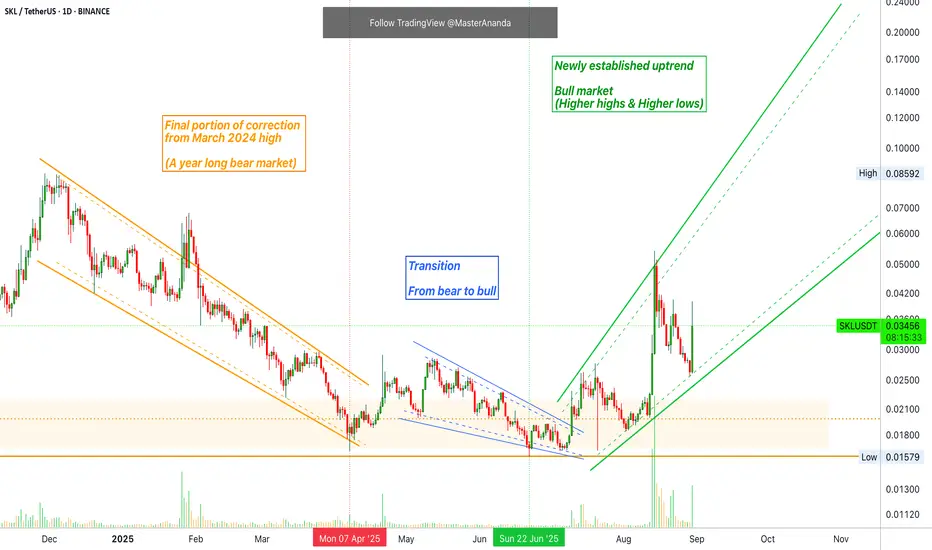
A Newly Established Uptrend Means Higher Highs · Skale NetworkThis is another perfect example of a trading pair "not dropping with Bitcoin." This is the theme today as I am trying to share some strength for those who need most, those who need to wait.
This market proof will show you, without a shadow of doubt, that the Cryptocurrency market is actually rising and will continue to do so. Which means that the best option is to hold or buy, not to sell because prices are going up and are doing so strong.
Bitcoin peaked 14-Aug and has been dropping until this day, producing the lowest price in almost two months. Since early June.
Skale Network (SKLUSDT) produced a peak 14-August followed by a fast retrace. This peak comes from a bullish breakout that is supported by the highest buy volume ever.
See this: Yesterday as SKLUSDT ended its retrace, a higher low, we have today a massive green candle with high buy volume again. As prices were moving lower, no volume basically. As soon as support is found, volume goes up.
You can see the same with Bitcoin. It was retracing, the retrace ends, now it starts (will) to grow.
Notice how SKLUSDT is moving within a newly formed uptrend. Not an old one, brand new. Notice the left side of the chart, the downtrend. The end of the downtrend. The initial bullish breakout and retrace (blue) and finally the new uptrend, higher highs and higher lows.
If Bitcoin were to start a bear market now, this pair wouldn't be starting a bull market now, it would crash.
The only reason why Skale Network can continue to grow, is because Bitcoin is simply retracing, not crashing, and soon will resume with its growth. Since the smaller projects know, they just keep on going... Many are going up. Buy and hold.
Namaste.
SKL Market Update📊 LSE:SKL Market Update
LSE:SKL has formed a key red resistance zone 🔴 where sellers are still active.
If buyers manage a confirmed breakout, it could signal the continuation of the bullish trend ✅
👉 The first target on breakout is the green line level 🎯
👉 Breaking this zone would show strong buyer momentum and open the door for further upside.
⚠️ Reminder: Always wait for confirmation — resistance zones often bring heavy selling pressure before a clear move.
SKL/USDT Current market structure looks bullish, with buyers aggressively stepping in and driving price higher. Momentum is clearly shifting in favor of the bulls, suggesting continuation toward the next resistance levels. If the structure holds, SKL has strong potential to extend gains in the upcoming sessions.
SKL - shorters will get rekt!Hi, this is very very interesting. First 1W candle closed above 0.03$ which is a breakout. If we will close second handle again high it means this can really skyrocket to test 1W high which is 0.13$. I belive something big happened in the backgroud because the volume input at 0.02$ was crazy high. Somebody invested a lot of money into this project and bought the dip. If there is really something behind, technology this will mean in alt coin season it will probably discover new price. BTC.D is falling so we might have major alt coin season in September. Fingers crossed because something is not right will all charts that Im watching. Regards.
SKLUSDT – Possible Reversal in PlaySKL shows a change of character (ChoCH) after long consolidation and now trying to push upward. Price already retested the zone, giving a chance for continuation if momentum holds.
Entry: 0.0310 - 0.0307
Stoploss: 0.0297
Targets:
0.0326
0.0339
0.0360
Let’s see if SKL can maintain strength and push into higher targets.