Trade Shapes Global CurrencyIntroduction
Trade is the lifeblood of the global economy. Every country engages in the exchange of goods and services, and this process deeply influences the strength, value, and demand for its currency. Global currencies—such as the U.S. dollar, euro, yen, yuan, and pound sterling—derive much of their power and stability from international trade activities. The balance of trade, capital flows, export competitiveness, and investor confidence all shape how currencies perform on the world stage. In essence, trade and currency are two sides of the same coin—each reinforcing and reacting to the other.
The Link Between Trade and Currency
At its core, trade involves buying and selling between nations. When a country exports more than it imports, foreign buyers must purchase the exporter’s currency to pay for goods. This increases demand for that currency, strengthening its value. Conversely, when a country imports more, it must sell its own currency to buy foreign currencies, leading to depreciation.
For example, if India exports software and receives payments in dollars, those dollars are exchanged for rupees in the domestic market, increasing the rupee’s value. On the other hand, heavy imports—such as crude oil—create demand for dollars, which can weaken the rupee. Thus, the balance of trade directly affects currency strength and exchange rates.
The Balance of Payments and Currency Value
The balance of payments (BOP) records all economic transactions between residents of a country and the rest of the world. It includes two main accounts: the current account (exports, imports, and services) and the capital account (investment flows and foreign reserves).
When a nation has a trade surplus—exporting more than it imports—foreigners must buy its currency, leading to appreciation. A trade deficit, however, creates more outflows of currency, resulting in depreciation. Persistent imbalances can influence long-term currency trends.
For instance, China’s massive trade surpluses have strengthened the yuan and increased its influence in global markets. Meanwhile, the U.S., despite trade deficits, maintains the dollar’s dominance because of its financial depth, stability, and global trust.
How Exchange Rates Affect Trade
Exchange rates influence how competitive a country’s goods are in the global market. A strong currency makes exports expensive and imports cheaper. A weaker currency, in contrast, makes exports more attractive to foreign buyers and discourages imports.
Countries often manage their exchange rates to maintain trade competitiveness. For example, Japan and China have historically intervened in currency markets to prevent excessive appreciation, keeping their exports competitive. Similarly, emerging economies often maintain a controlled currency value to boost exports and attract foreign investment.
Trade Deficits and Surpluses: The Currency Effect
Trade surpluses generally strengthen a nation’s currency, while trade deficits weaken it. However, the impact depends on how the country finances its deficit or surplus.
Trade Surplus Countries: Nations like Germany, Japan, and China export far more than they import. Their strong export sectors generate foreign currency inflows, increasing reserves and stabilizing their currencies.
Trade Deficit Countries: The U.S. and the U.K. often run trade deficits but maintain strong currencies due to global confidence, deep financial markets, and demand for their assets.
In contrast, developing countries with large trade deficits and low reserves often face currency devaluation or inflationary pressures.
Global Currencies and Trade Dominance
Trade flows have historically determined which currencies become global leaders. The British pound dominated the 19th century during Britain’s industrial and colonial expansion. The U.S. dollar took over after World War II, when the U.S. became the world’s largest exporter and economic power.
Today, the dollar remains the dominant reserve and trade currency, used in over 80% of international trade transactions. This is not only because of America’s trade volume but also due to its stable political system, strong financial markets, and the trust it commands globally.
However, the Chinese yuan (renminbi) is emerging as a challenger. As China has become the world’s manufacturing hub and a top trading partner for over 120 countries, the yuan’s use in trade settlements has expanded significantly. Through initiatives like the Belt and Road and the establishment of the Cross-Border Interbank Payment System (CIPS), China aims to internationalize its currency.
The Role of Trade Agreements in Currency Movement
Trade agreements, such as NAFTA (now USMCA), the European Union single market, and ASEAN Free Trade Area, influence currency flows by encouraging cross-border trade and investment. When countries form trade blocs, their currencies often stabilize relative to each other due to synchronized economic activity.
For example, within the Eurozone, countries adopted a single currency—the euro—to eliminate exchange rate fluctuations and boost trade efficiency. The euro’s value now reflects the collective trade performance of member nations rather than individual economies.
Similarly, India’s participation in regional and bilateral trade agreements affects rupee demand in neighboring and partner countries.
Currency Wars and Trade Manipulation
Sometimes, countries deliberately devalue their currencies to boost exports—a practice often called a “currency war.” By making exports cheaper, nations can gain a competitive edge. However, this can trigger retaliation from trading partners, leading to instability.
For instance, in the early 2010s, several countries accused China of undervaluing the yuan to maintain export competitiveness. The U.S. and other economies have also used monetary policy—such as quantitative easing—to weaken their currencies and stimulate exports.
While short-term devaluation may help trade, long-term manipulation can undermine trust and cause inflation.
Digital Currencies and the Future of Global Trade
In recent years, digitalization has started reshaping how trade influences global currency systems. The rise of central bank digital currencies (CBDCs)—such as China’s digital yuan and discussions around the digital euro and dollar—could transform cross-border payments.
Digital currencies can reduce transaction costs, enhance transparency, and speed up settlements, making trade more efficient. Moreover, they may reduce dependency on traditional reserve currencies like the U.S. dollar, particularly in bilateral trade agreements.
For example, China and Russia have started exploring digital currency settlements to bypass the dollar in international trade, signaling a shift toward a more diversified global currency system.
Trade, Inflation, and Currency Stability
Trade imbalances also affect inflation and purchasing power. When a nation imports heavily, especially essential goods like energy or food, currency depreciation makes these imports more expensive, fueling inflation. Conversely, a strong export economy generates income and reserves that can stabilize prices.
Central banks monitor trade data closely when deciding monetary policy. A widening trade deficit may prompt them to raise interest rates to support the currency, while a surplus might allow rate cuts to encourage investment.
Conclusion
Trade is one of the most powerful forces shaping global currencies. The demand and supply of money across borders, driven by exports, imports, and capital flows, determine exchange rates and international economic strength. A nation’s trade performance reflects its production capabilities, competitiveness, and global trust—all of which directly influence its currency’s value.
As globalization deepens and digital technology evolves, the link between trade and currency will become even more dynamic. While the U.S. dollar remains the world’s anchor today, the growing influence of emerging economies like China and India suggests a future where multiple currencies share global dominance.
In the end, trade doesn’t just move goods—it moves power, wealth, and currency values across the world, shaping the financial architecture of the global economy.
Community ideas
Globalization and Its Impact1. Understanding Globalization
Globalization can be described as the process by which national economies, societies, and cultures become integrated through a global network of trade, communication, immigration, and transportation. It is not a new phenomenon—it has existed in some form for centuries. The Silk Road, which connected Asia, the Middle East, and Europe, was an early form of globalization through trade and cultural exchange.
However, the modern phase of globalization began after World War II, especially with the establishment of international institutions such as the United Nations (UN), World Bank, and International Monetary Fund (IMF). The late 20th and early 21st centuries witnessed an explosion of globalization due to technological progress, digital communication, liberalized trade policies, and advancements in transportation.
2. Drivers of Globalization
Several factors have fueled globalization:
Technological Advancements: Innovations in communication (like the internet, mobile phones, and satellites) and transportation (like jet aircraft and container shipping) have made global interactions faster and cheaper.
Trade Liberalization: The removal of trade barriers, formation of free trade agreements (like WTO, NAFTA, and ASEAN), and economic reforms have opened markets across borders.
Foreign Direct Investment (FDI): Multinational corporations (MNCs) invest in foreign countries to expand production and reach new markets.
Global Financial Markets: Integration of global banking and stock markets allows capital to move freely across nations.
Migration: People move across countries for education, work, and better living standards, leading to cultural exchange and remittance flows.
3. Economic Impact of Globalization
The economic impact of globalization is profound and multifaceted.
a. Economic Growth and Development
Globalization has accelerated economic growth in many developing countries. Access to international markets has allowed nations like China, India, and Vietnam to industrialize rapidly, lifting millions out of poverty. Global competition has encouraged innovation and efficiency in production.
b. Job Creation and Opportunities
By opening new markets and expanding industries, globalization has created jobs in manufacturing, technology, and services. The outsourcing and offshoring industries, particularly in countries like India and the Philippines, have provided employment to millions.
c. Inequality and Job Displacement
While globalization benefits some, it disadvantages others. Low-skilled workers in developed countries often lose jobs to cheaper labor markets abroad, leading to income inequality. Similarly, not all regions in developing countries benefit equally, creating an urban-rural divide.
d. Rise of Multinational Corporations (MNCs)
MNCs have become powerful players in the global economy. They drive innovation, create employment, and bring investment. However, they can also exploit cheap labor, avoid taxes, and influence local policies to suit their interests.
4. Social and Cultural Impact
Globalization has reshaped social structures and cultural identities.
a. Cultural Exchange and Diversity
Global media, tourism, and the internet have made it possible for people to share music, movies, food, and traditions across borders. This cultural exchange fosters mutual understanding and tolerance.
b. Cultural Homogenization
On the other hand, globalization can lead to cultural homogenization, where local traditions and languages are overshadowed by dominant global cultures, particularly Western ones. For example, global brands like McDonald’s and Hollywood films influence lifestyles worldwide, sometimes at the expense of local customs.
c. Education and Knowledge Sharing
Globalization has expanded access to education. International universities, online learning platforms, and research collaborations promote knowledge exchange. Students can now study abroad, gaining global perspectives.
d. Migration and Social Integration
The movement of people across borders leads to multicultural societies. However, it also poses challenges such as identity conflicts, racism, and immigration tensions in some regions.
5. Political Impact of Globalization
Globalization affects the sovereignty and power of nation-states.
a. Interdependence Among Nations
Countries are now more interdependent for trade, energy, and technology. This interdependence encourages peace and cooperation, as conflicts disrupt economic stability.
b. Influence of International Institutions
Organizations like the United Nations, World Trade Organization (WTO), and World Health Organization (WHO) play major roles in shaping global policies on trade, security, and health. However, smaller countries sometimes find themselves at a disadvantage against powerful nations or corporations.
c. Spread of Democracy and Governance Standards
Globalization has encouraged democratic values, transparency, and human rights awareness. Information flow through social media helps citizens hold governments accountable. Yet, some authoritarian regimes use globalization’s tools for surveillance and propaganda.
6. Environmental Impact
The environmental consequences of globalization are increasingly visible.
a. Industrialization and Pollution
As production expands globally, energy consumption and industrial pollution have increased. Developing countries, in particular, face environmental degradation due to lax regulations and exploitation of natural resources.
b. Climate Change
Globalization-driven industrial activity contributes to carbon emissions, deforestation, and loss of biodiversity. Climate change has become a global challenge that requires collective action through international agreements like the Paris Accord.
c. Environmental Awareness and Cooperation
On a positive note, globalization has spread environmental awareness. NGOs and international organizations collaborate on issues like renewable energy, conservation, and sustainable development.
7. Technological Impact
Globalization and technology are mutually reinforcing.
Digital Transformation: The digital revolution has connected people and markets globally. E-commerce platforms, fintech, and social media enable even small businesses to operate internationally.
Innovation Sharing: Global collaboration accelerates research in medicine, science, and artificial intelligence.
Digital Divide: However, unequal access to technology between rich and poor nations creates a “digital divide,” limiting participation in the global economy.
8. Globalization and Health
The COVID-19 pandemic highlighted both the strengths and vulnerabilities of globalization.
Rapid Spread: Global travel accelerated the spread of the virus.
Global Cooperation: On the other hand, scientific collaboration enabled the rapid development of vaccines.
Health Inequality: Access to healthcare and vaccines remains unequal across nations, showing the need for global solidarity in health policy.
9. Challenges and Criticisms of Globalization
While globalization brings progress, it also faces criticism:
Economic Inequality: Wealth is concentrated in a few countries and corporations.
Cultural Erosion: Local traditions and languages may decline.
Environmental Damage: Industrial growth often comes at the cost of sustainability.
Loss of Sovereignty: National governments sometimes lose control over economic policies due to global institutions or MNCs.
Dependency: Developing countries can become overly dependent on foreign markets or investments.
10. The Future of Globalization
The future of globalization is evolving. The rise of protectionism, geopolitical conflicts, and technological changes are reshaping global dynamics. However, complete deglobalization is unlikely. Instead, a new form of “smart globalization”—one that balances economic growth with social equity and environmental sustainability—is emerging.
Global cooperation on issues like climate change, digital governance, and global health will define the next phase. Nations must work together to ensure that globalization benefits all, not just a privileged few.
Conclusion
Globalization has been a powerful driver of economic, social, and cultural transformation. It has connected the world like never before, enabling progress, innovation, and prosperity. Yet, it also presents serious challenges—inequality, cultural loss, and environmental threats. The key lies in managing globalization responsibly—by promoting inclusive growth, respecting cultural diversity, protecting the environment, and ensuring fair governance. Ultimately, globalization is not just an economic phenomenon; it is a human one that reflects our shared destiny in an interconnected world.
Technology and Innovation in Global Trade1. The Digital Transformation of Global Trade
The digitization of trade processes has drastically simplified international transactions. Earlier, global trade relied heavily on paper documentation, manual inspections, and lengthy approval systems. Today, electronic documentation, blockchain, and digital customs systems have replaced much of this inefficiency.
For instance, electronic bills of lading (eBL) and digital trade finance platforms now allow exporters and importers to complete transactions in hours instead of days. The use of smart contracts—automatically executed agreements coded on blockchain—ensures faster payments, reduces fraud, and enhances trust among international trading partners.
Moreover, e-commerce platforms like Amazon, Alibaba, and Shopify have empowered millions of small and medium-sized enterprises (SMEs) to reach global customers. These platforms integrate digital payment systems, AI-driven logistics, and marketing analytics, allowing businesses to compete globally without a physical presence.
2. Artificial Intelligence and Big Data in Trade
Artificial Intelligence (AI) and Big Data analytics are revolutionizing trade decision-making. With the massive volume of data generated through online transactions, AI systems can now analyze global supply chains, predict demand, and optimize pricing in real time.
AI in logistics enables route optimization, reducing delivery times and fuel consumption. Predictive analytics helps businesses anticipate market fluctuations, currency risks, and consumer trends, making trade more resilient and cost-efficient.
For example, ports like Singapore and Rotterdam use AI-based traffic management systems to coordinate ship arrivals, minimizing congestion and improving turnaround times. Similarly, AI-powered customs systems are now capable of identifying high-risk shipments using image recognition and machine learning, improving border security and efficiency.
Big Data also aids trade policy analysis. Governments and trade organizations use data analytics to monitor import-export trends, detect unfair trade practices, and assess the impact of tariffs. This data-driven approach has replaced traditional manual monitoring systems, enabling more adaptive and informed trade policies.
3. Blockchain: Ensuring Trust and Transparency
Blockchain technology is one of the most transformative innovations in international trade. It provides a secure, decentralized ledger system that records every transaction transparently and immutably.
In global trade, trust among multiple parties—exporters, importers, banks, shippers, and insurers—is essential. Blockchain eliminates intermediaries by creating a shared and tamper-proof record of trade documents, payments, and logistics.
For instance, TradeLens, a blockchain-based platform developed by IBM and Maersk, connects shippers, customs authorities, and logistics providers on a single network. It enhances visibility across the supply chain and reduces the risk of document fraud or manipulation.
Additionally, blockchain-based trade finance allows small exporters to access financing quickly since banks can verify transactions and documents instantly. This inclusion is critical for SMEs that traditionally struggled with high entry barriers in global markets.
4. Automation and Robotics in Logistics
Automation has significantly improved the speed, accuracy, and cost-efficiency of global trade operations. Robotics and automation are transforming warehousing, cargo handling, and transportation systems.
In modern ports and warehouses, automated guided vehicles (AGVs) and robotic arms handle container loading and unloading with minimal human intervention. Drones are increasingly used for inventory management and delivery in remote areas.
The Internet of Things (IoT) also plays a vital role by connecting devices and sensors across supply chains. IoT systems track shipments in real time, monitor temperature-sensitive goods, and detect disruptions instantly. This real-time visibility minimizes losses, enhances traceability, and ensures compliance with international trade regulations.
Furthermore, autonomous ships and trucks are being tested to reduce human error and improve delivery efficiency. As automation continues to evolve, it is expected to redefine labor markets and supply chain management globally.
5. Fintech and the Evolution of Cross-Border Payments
The financial infrastructure supporting international trade has been revolutionized by financial technology (fintech). Traditional cross-border payments often involved high fees, currency delays, and compliance hurdles.
Today, innovations like digital banking, cryptocurrencies, and blockchain-based remittance systems are making global payments faster, cheaper, and more secure. Platforms such as Ripple and SWIFT gpi enable near-instant international money transfers with transparent tracking.
Central Bank Digital Currencies (CBDCs) are also being explored by major economies as a way to simplify global trade payments while maintaining regulatory oversight. For example, China’s Digital Yuan and the European Union’s proposed Digital Euro aim to reduce dependency on the U.S. dollar and create more efficient cross-border trade settlements.
Moreover, decentralized finance (DeFi) is emerging as a new model for trade finance, providing blockchain-based lending and credit systems accessible to anyone globally. This democratization of finance could enable millions of smaller exporters and importers to access capital more easily.
6. 3D Printing and Decentralized Manufacturing
Another groundbreaking innovation influencing global trade is 3D printing (additive manufacturing). By enabling production closer to the point of consumption, it reduces dependency on global supply chains.
Instead of importing finished goods, companies can now trade digital design files and manufacture locally. This shift could drastically reduce shipping costs and carbon emissions while increasing customization and flexibility.
Industries such as automotive, aerospace, and healthcare are already using 3D printing to produce specialized components on demand. While it may reduce the volume of traditional goods traded, it creates a new category of digital trade — the trade of design, software, and intellectual property.
7. Sustainability and Green Innovation in Trade
As climate change concerns grow, sustainability has become central to global trade innovation. Green technologies such as renewable energy, electric transport, and carbon tracking tools are shaping how trade operates.
Companies are investing in carbon-neutral supply chains by adopting eco-friendly packaging, optimizing routes to reduce emissions, and using alternative fuels like hydrogen. Digital platforms now track the carbon footprint of each shipment, enabling environmentally conscious consumers and partners to make informed decisions.
The rise of Environmental, Social, and Governance (ESG) standards in trade finance further encourages sustainable practices, as banks increasingly offer better terms to companies meeting green criteria.
8. Cybersecurity and Digital Trade Governance
With digitalization comes the challenge of cybersecurity. As trade systems rely more on data and connected networks, protecting them from cyberattacks has become a priority.
Governments and corporations are investing in advanced encryption, AI-based threat detection, and cybersecurity frameworks to secure trade infrastructure. Simultaneously, international organizations like the World Trade Organization (WTO) and UNCTAD are working to develop digital trade rules, ensuring fairness, privacy, and interoperability across borders.
9. The Future: AI-Driven, Inclusive, and Sustainable Trade
Looking ahead, global trade is set to become more AI-driven, inclusive, and sustainable. Technologies like quantum computing, 5G connectivity, and digital twins will further enhance efficiency and simulation capabilities across global supply chains.
Moreover, digital trade agreements and virtual trade missions will enable more countries and individuals to participate in international commerce without physical limitations. The future of trade will depend not just on moving goods but on exchanging data, knowledge, and digital assets.
Conclusion
Technology and innovation have redefined the global trade landscape, transforming it into a fast, transparent, and data-driven ecosystem. From AI and blockchain to IoT and fintech, each advancement contributes to making trade more efficient, inclusive, and resilient.
However, this transformation also brings challenges—cybersecurity threats, unequal access to technology, and regulatory complexities. Balancing innovation with security and inclusivity will be crucial for the next phase of global trade development.
Ultimately, the synergy between technology and trade holds the power to create a more connected, sustainable, and prosperous world—where borders matter less, and opportunities are truly global.
The Formula to Make $10000 Daily👋 Hello traders!
If you’re looking for a real way to make $10000 every day from the markets, forget about the so-called magic strategies or secret expert tricks.
The truth is simple: there’s no overnight success formula. But there is a realistic path built on probability, discipline, and time — and that’s what I call The Formula to Make $10000 Daily .
⚙️ Step 1: Build a High-Probability Trading System
📊 This is your foundation.
A good trading system doesn’t have to be complex, but it must have clear rules and consistent logic .
You should always know:
✅ When to enter a trade
✅ When to stay out
✅ And most importantly — why you’re entering
Choose a strategy you can truly master and apply consistently — such as Break & Retest , Supply & Demand , or Market Structure Shift .
Every trade should have a Risk-to-Reward ratio (R:R) of at least 1:2 or higher.
💡 Example:
If you risk $2000 per trade and win just two out of three trades daily, you’ll make $4000.
Increase your lot size gradually and stay consistent — $10000 a day becomes a realistic outcome.
💼 Step 2: Capital Management – The Key to Survival
🧠 You can’t make $10000 daily if you lose $10000 in one bad trade.
Capital management isn’t just about protecting your balance — it’s about protecting your mindset and system.
Follow these golden rules:
💰 Risk only 1–2% per trade
🛑 Always use a stop loss
🎯 Set a clear take-profit target
With a $50,000 account, risking 1% equals $5000.
If your R:R ratio is 1:3, one winning trade a day earns $15000.
That’s not luck — that’s mathematics working in your favor .
🧘♂️ Step 3: Master the Trader’s Mindset
Once you have a solid system and money management plan, the final piece — and the most important — is your psychology .
Most traders don’t fail because their system is bad. They fail because they can’t control themselves .
Keep these principles close:
🚫 Don’t trade when emotions take control
🚫 Don’t revenge trade after losses
🚫 Don’t increase lot size out of greed
🚫 Don’t force yourself to take trades every day
A professional trader doesn’t aim to win every trade — they aim to lose less and lose smart .
🧩 The Real Formula
💎 (High-Probability System + Strict Risk Management + Strong Psychology) × Time = Sustainable Profit
There are no shortcuts.
No magic indicators.
Only you and your discipline .
📖 Real Story
One of my students, Ken, started with a $10,000 account.
He didn’t try to go big — instead, he aimed to earn 1% a day , or $1000.
After six months, by slowly increasing his trade size and staying disciplined, his average daily profit reached $10000 .
He told me:
“I didn’t need to change my system. I just needed to change myself.”
🎯 Final Thoughts
The formula to make $10000 daily doesn’t come from any special indicator, signal, or secret course.
It comes from understanding your system deeply, managing your capital wisely, and staying disciplined every single day .
💬 The market doesn’t reward the fastest traders. It rewards the most patient, consistent, and focused ones.
If you’re on your journey to becoming a professional trader, start today.
🔥 Build your own formula — and practice it every single day until it becomes second nature.
The Illusion of Control: Why You Can’t Force the Market“The moment you try to control the market,
the market reminds you who’s really in control.”
Every trader begins by trying to master the market,
to predict it, bend it, or time it perfectly.
But with every chart and every candle,
the lesson becomes clear: control is an illusion .
The Control Trap
You enter a trade and instantly want the next candle to move your way.
You adjust your stop loss to feel safer.
You exit early just to protect a small profit.
And without noticing, your process turns into emotional management.
The market doesn’t punish mistakes.
It punishes the need to be right .
Why Control Fails
The market isn’t a machine you operate.
It’s a reflection of millions of human decisions.
Your control ends the moment your order is placed.
Once you accept that, trading feels lighter.
You stop managing outcomes and start managing yourself .
Letting Go Isn’t Giving Up
Letting go means realizing your role is to identify structure, define risk, and stay calm inside uncertainty.
You no longer trade to be right; you trade to execute well.
The need to control fades, and discipline takes its place.
Practical Reminder
• Define risk before entry.
• Accept the loss before pressing buy or sell.
• Never move your stop just to feel better.
• Let probability do the work.
You control your plan, not the outcome.
The market owes you nothing.
And that is what keeps it honest.
📘 Shared by @ChartIsMirror
Do you still find yourself trying to control what happens after entry?
Share your reflection below — awareness begins where control ends.
RISK MANAGEMENT – How Pros Stay AliveIf you’ve traded long enough, you’ll realize this:
Nobody blows up their account because of a bad prediction — they blow it up because they don’t know when to stop.
1. The First Survival Rule: Set a FIXED RISK Per Trade
Choose a fixed risk percentage that you’re comfortable with — 1%, 2%, or a maximum of 3% per trade.
That means:
If you have a $1,000 account and risk 2%, you can only lose $20 per trade .
Even if you lose 5 trades in a row, you still have 90% of your account to keep fighting.
Never increase your lot size because of a “gut feeling.”
Traders don’t lose because they analyze wrong — they lose because they increase risk when they feel too confident.
2. Set STOP LOSS with Logic, Not Emotion
Don’t place your stop loss “just to have one.”
Your stop loss should be at the point where, if price hits it, your idea is truly invalidated — not because you’re afraid of getting stopped out early.
Example:
If you’re buying in an uptrend, your SL should be below the last higher low , not just below the last red candle.
If your SL is 30 pips and you want to risk 2%, then your position size = 2% of your account ÷ 30 pips.
This formula keeps your trades balanced and prevents those small, annoying blow-ups.
If you don’t know exactly how much you’re risking per trade — you’re not really trading. You’re gambling.
3. No Overloading, No Revenge Trading
One of the fastest ways to blow up an account is adding more trades while losing .
The market doesn’t care how much you’re down — it only cares how much you still have left to lose.
Pro traders do the opposite:
When the trade moves in their favor → they trail the stop and lock profits.
When the trade goes wrong → they cut it quickly, no questions asked.
That’s why they last longer — they trade small when uncertain and go big only when the odds are clearly on their side.
4. Emotional Control = The Extension of Risk Management
Risk management isn’t just about numbers — it’s about discipline.
If you just took a loss and still want to “jump back in to make it back” — stop immediately.
No analysis, no revenge trade.
Just close the chart, grab a drink, take a walk, or hit the gym.
Because once emotions take over, no system in the world can save you .
5. Turn Risk Management into a Strategic Weapon
When you have your risk under control, you trade with a cold mind.
That’s when you can actually take advantage of big opportunities .
Example:
You risk 2% per trade and find a setup with R:R = 1:4.
If it wins, you make +8%. If it loses, you only lose -2%.
Even if you’re right just 3 out of 10 times — you’re still profitable.
That’s how pro traders make a living.
They don’t need an 80% win rate — they just need consistency and control.
💬 A Simple Drill for You:
For every trade, write this down:
“How much % am I willing to lose if I’m wrong?”
If you can’t answer within 5 seconds → don’t take that trade.
If you’re still losing because of discipline issues → restart by focusing only on limiting risk before thinking about profit.
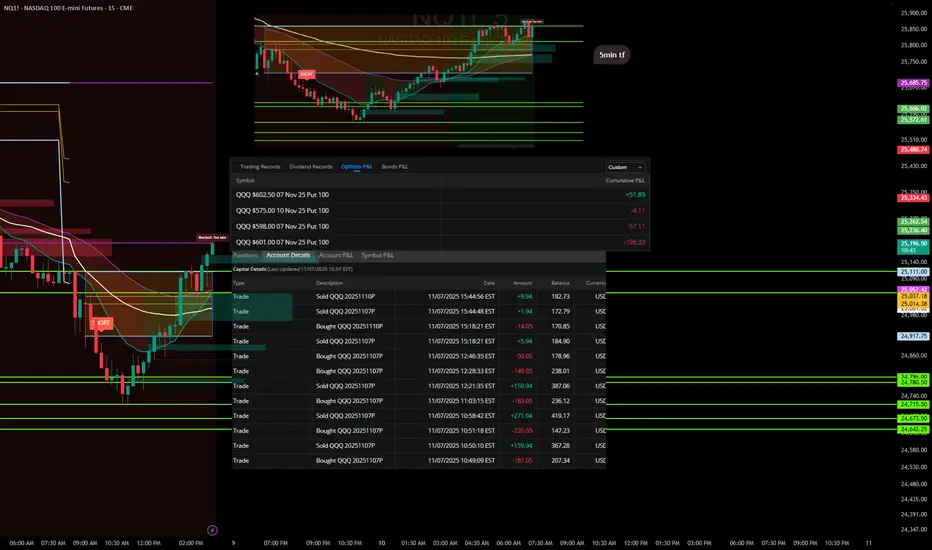
Trades with B – Daily Recap (Nov 7, 2025) "Lesson Learned"Ticker: QQQ / NQ1!
Strategy: ORB Pro + Fib Confluence + EMA Trend Filters
Result: Small red day – self-inflicted
🧭 Market Context
Today’s price action gave a clear short opportunity during the mid-morning fade, but momentum stalled mid-session. The first entries lined up beautifully with the ORB breakdown and EMA confluence, offering solid profits early on.
Where it fell apart was after the first wins — I overstayed, chasing secondary flushes that never came. The market started to base, and I kept expecting continuation instead of taking what the chart gave me.
📉 Trade Summary
Multiple put entries between $601–$602 levels
Early trades locked quick gains (+$271.94, +$159.94)
Gave back a chunk re-entering late into chop
Final P/L across contracts: -$205.66 total
Cumulative Options P/L breakdown:
QQQ $602.50 07 Nov 25 Put – +$51.89
QQQ $575 10 Nov 25 Put – -$4.11
QQQ $598 07 Nov 25 Put – -$57.11
QQQ $601 07 Nov 25 Put – -$196.33
💡 Lessons & Takeaways
The first clean move is often the best move. Don’t overcomplicate a confirmed win.
Late-day trades = low probability. Volume dries up, conviction fades.
Protect the capital, not the ego. There’s no “making up” missed points — only protecting what’s already earned.
🧘♂️ Reflection
“The setup worked, but I didn’t. I tried to extract more from a move that was already complete. Next time, once my target hits, I’m walking away.”
The Psychology Behind Winning Trades The Psychology Behind Winning Trades 🧠💹✨
Introduction – Hook:
📊 “Why do some traders consistently win 💰 while others struggle 💔?”
It’s rarely the strategy—it’s the mindset behind the trade! 🧠🌟
Your emotions, thoughts, and biases control your decisions, even with perfect technical skills. 🎯
1️⃣ What is Trading Psychology?
Trading psychology is the study of how emotions and mental habits affect trading decisions. 🌈🧘♂️
It’s about understanding:
How fear 😨, greed 😍, or impatience ⏳ impacts your trades
Why you sometimes ignore your rules 📝
How discipline 💪 can make the difference between profit 🏆 and loss 💸
💡 Tip: Even the best strategies fail if your mind isn’t in control. 🧠✨
2️⃣ Common Psychological Traps & How They Appear in Trades
Trap Emoji Effect Example in Trading
Fear 😨 Exiting too early Closing a winning trade because you’re scared of losing profits 💔
Greed 😍 Holding losing trades Waiting for a loss to “come back” and losing more money 💸
FOMO 🏃♂️💨 Jumping impulsively Entering trades last minute because everyone else is trading 🚀
Revenge Trading 😤🔥 Emotional loss-chasing Trying to recover losses by taking bigger, risky trades 💣
💡 Insight: Recognizing these emotions is the first step to controlling them. 🌟
3️⃣ How to Master Your Trading Mind
1️⃣ Pre-Trade Preparation 🧘♀️✅
Check your emotional state before trading 🕊️
Confirm your trade plan is clear 📋✨
2️⃣ During the Trade ✋🎯
Stick to your rules, don’t let emotions take over 💪🔥
Avoid impulsive exits or entries ⏱️❌
3️⃣ Post-Trade Reflection 📖🖊️
Keep a Trading Journal: note emotions, mistakes & wins ✨📓
Review trades to improve your mindset over time 📈🌟
4️⃣ Pro Tips for Winning Psychology
🔥 Mindset Checklist:
Am I trading calmly? 😌💭
Am I following my plan? 📋✅
Am I chasing losses or profits emotionally? ⚖️💡
💡 Daily Mindset Practice: Meditation 🧘♂️, journaling ✍️, or reviewing trades 📊 can help you stay disciplined under pressure 💎🌟
5️⃣ Why It Matters
Trading without psychology = strategy leaks money 💸💨
Emotional control = consistency, higher win rates, confidence 🏆💪
Professionals don’t just trade charts—they trade themselves 🧠✨
6️⃣ Engagement Section
👇 Question for your audience:
“What’s the biggest psychological trap YOU’ve faced in trading? Share your story below! 💬💭💖”
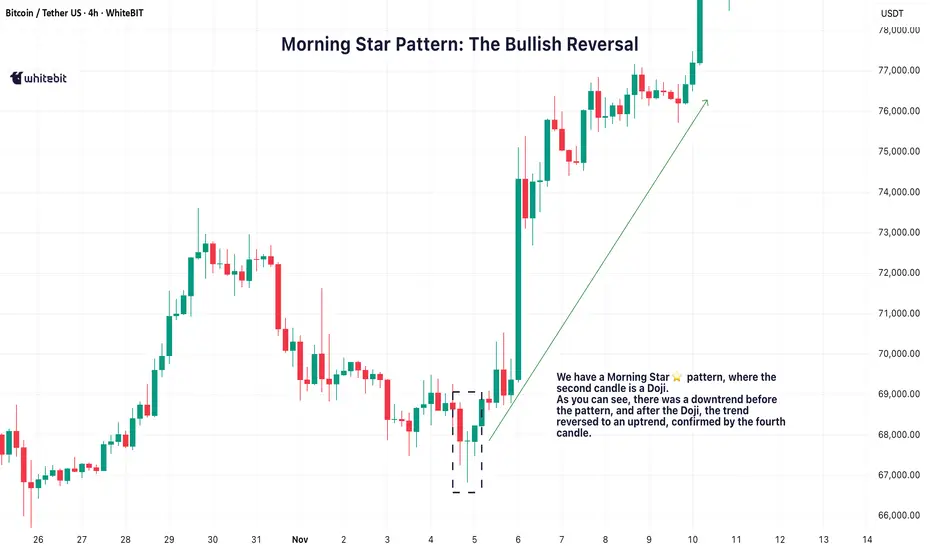
Mastering Trend Reversals: Morning & Evening Star PatternsSo, you're trying to nail those trend reversals? The Morning and Evening Star patterns are perfect for that. They show up right when the market’s about to shift, giving you a chance to get in before the move really takes off. Let’s break down how these setups work and why they’re such solid tools for traders like you.
🌅 Morning Star Pattern: The Bullish Reversal
The Morning Star pattern is one of the best ways to catch a trend reversal from bearish to bullish. It usually pops up after a downtrend, signaling that the market is about to make a move to the upside. It’s made up of three candles:
A long red candle that shows the market’s been selling off.
A small candle, often a Doji, that indicates indecision or a pause in the downtrend.
A big green candle that confirms the shift, showing buyers are taking control.
When you spot a Morning Star candlestick pattern, it’s a strong indication that the downtrend might be over and the bulls could be taking over. The third candle plays a crucial role here, confirming that the trend is likely reversing.
🌇 Evening Star Pattern: The Bearish Reversal
On the flip side, the Evening Star pattern is the bearish cousin of the Morning Star. It shows up after an uptrend and signals that the market is ready to start heading down. It also consists of three candles:
A long green candle that continues the uptrend.
A small candle, again often a Doji, that suggests the market’s losing momentum.
A big red candle that confirms the reversal, showing sellers are stepping in.
When you see the Evening Star candlestick pattern, it tells you that the market could be shifting from bullish to bearish. The third candle confirms that the reversal might be taking place.
💡 Trading the Star Patterns
Both the Morning Star trading pattern and Evening Star patterns are great for spotting potential trend reversals, but they shouldn't be relied on as the only signal. To increase the reliability of these patterns, consider confirming them with other indicators like RSI (Relative Strength Index) , MACD (Moving Average Convergence Divergence) , or volume analysis.
For example, if a Morning Star pattern candlestick appears and is followed by increasing volume, it adds strength to the reversal signal. Similarly, if the Evening Star shows up with an overbought RSI, it could provide further confirmation that the market is due for a pullback.
By using these additional tools, you can have more confidence in your analysis and make better-informed decisions.
📈 Why These Patterns Matter
The Morning Star and Evening Star patterns are powerful tools for identifying potential trend reversals. They give traders a visual cue that a market shift could be on the horizon, helping to spot potential turning points.
However, it’s crucial to make your trading decisions based on a combination of factors and not rely solely on these patterns. Always make sure to consider the broader market context and other technical indicators before acting on any pattern.
Trades with B – Daily Recap (Nov 6 2025)Ticker: QQQ / NQ1! (5 min & 15 min TF)
Strategy: ORB Pro + Golden Pocket Retest + Volume Filter
Focus: Confirmation Entry + HTF Trend Confluence
🧭 Market Context
The Nasdaq futures (NQ1!) opened with a sharp push into a key supply zone marked by the previous day’s Golden Pocket.
After an early fake push up, the market rolled over cleanly beneath the EMA cluster and the ORB box on both timeframes.
The first true confirmation signal came mid-morning — the 15 min and 5 min timeframes synced short, and the volume aligned perfectly with trend continuation.
🧠 Trade Review
Entry: 11:02 EST QQQ $613 Put (ORB Pro Short Trigger)
Exit: 11:35 EST — ORB extension target hit → secured profit into momentum flush
System Validation: Perfect alignment across EMA trend + HTF bias + retest rejection signal
P/L: +$199.78 net profit ( + $289.94 closed gain – $190.05 entry cost )
This trade was clean — confirmation entry, defined risk, and no over-trading.
📊 Performance Snapshot
Metric Value
Win Rate 100 % (today’s single trade)
Best Trade +$289.94
Largest Loss – $190.05
Net Result +$199.78 (Realized)
Setup Accuracy Excellent – Full confirmation alignment
📈 Chart Breakdown
The ORB Pro short triggered as price retested the upper Golden Pocket zone and failed to hold above the purple EMA band.
Both the 15 min and 5 min charts show a clean EMA curl-down with volume confirmation.
The short target zone was hit precisely before a small midday bounce, validating the system’s filter timing.
💡 Key Takeaways
Wait for alignment – when HTF and LTF agree, you get momentum moves.
Clean entry > early entry – confirmation beat anticipation again.
ORB Pro filter precision – blocked late entries, protecting the green.
🧘♂️ Reflection
“The setup was textbook — patience finally paid off. One trade, one signal, and one profit. The goal now is simple: keep filtering for these perfect alignments and size up responsibly as consistency builds.”
🧩 Next Steps
✅ Focus only on HTF + LTF confirmation signals
✅ Avoid re-entries once target zone is hit
✅ Document each setup screenshot for pattern library
Quantitative TradingThere are two main approaches to seeking consistent profits through the study of price history: the discretionary approach, based on experience and logical reasoning, and the quantitative approach, focused on identifying and exploiting behavioral patterns under specific market conditions.
Contrary to what’s usually thought, neither approach is exclusively intuitive or mechanical. Discretionary traders don’t operate solely on intuition, and quantitative ones don’t lack reasoning when building their systems. Both share fundamental elements: they rely on analyzing price history, spotting repetitive patterns, and applying statistical knowledge and risk management.
The main difference lies in flexibility. Discretionary traders enjoy greater freedom to make decisions, which can be harmful for inexperienced investors but a huge advantage for seasoned ones. Quantitative traders, on the other hand, follow strict rules, which reduces emotional influence and often allows automating processes to generate profits consistently.
This article is dedicated to exploring some vital concepts and ideas for developing solid and effective quantitative trading.
Key concepts about systems
• Quantitative systems require strict entry and exit rules
A quantitative system must be based on clear and objective rules for trade entries and exits. Though it seems obvious, many educational resources highlight metrics like win rates without considering the subjectivity in the systems they present, making reliable calculations impossible. Before evaluating a system’s stats, the investor must ensure all parameters are quantifiable and precisely defined.
• Trading systems are not universal
Each market has its own nature, which can be studied based on its historical record. For example:
• Trending markets , like SPY or Tesla, are driven by factors such as economic growth or market sentiment, making them ideal for systems that aim to capture directional moves.
• Range-bound markets , like Forex, are influenced by central banks promoting stability, limiting extreme moves and favoring ranges under normal conditions.
Applying a trending system to a pair like EUR/USD, which tends to consolidate, can lead to disappointing results. Similarly, using a mean-reversion system in a strongly directional market like the SPY ETF is illogical and usually ineffective. Plus, traditional markets have a structural bias favoring bulls over bears, which can significantly impact the performance of certain strategies.
On the other hand, timeframe is a critical factor when developing and evaluating quantitative systems. In lower timeframes, volatility from news, emotions, or high-frequency trading makes it hard to apply trending systems. Instead, higher timeframes (H4, D, W) offer more stability, improving the performance of many systems by reducing market noise.
• An effective quantitative trading system must be backed by a broad and detailed historical record
The larger the volume of data analyzed, the greater the confidence in the system’s ability to produce predictable results in the future.
A key aspect in developing quantitative trading systems is ensuring consistency in results. Consistency in a system’s performance across different timeframes (D, H4, H1) is an indicator of its robustness and adaptability. For example, a system that generates solid and stable returns across multiple timeframes shows greater reliability than one that only works well in a specific timeframe.
• We should avoid trading systems with unstable equity curves or large drawdowns
A quantitative trading system must be designed to generate consistent profits with controlled risk. That’s why it’s essential to avoid systems with unstable equity curves (erratic fluctuations in gains) or large drawdowns (maximum accumulated losses). These issues indicate a lack of robustness and can jeopardize the system’s long-term viability.
• A high win rate doesn’t guarantee consistent profitability
A common mistake among investors is assuming a high win rate ensures high and sustainable profitability. However, a quantitative trading system’s profitability depends on multiple factors beyond the win rate, such as the risk-reward ratio, market exposure, and operational costs.
For example, trending systems can generate larger profits but often have lower win rates due to greater market exposure, while systems with high win rates may offer limited returns because of shorter exposure and accumulated costs from high trade volume.
• Commissions and the number of trades must be factored into system testing
Failing to include these costs in the analysis can create a misleading perception of the system’s profitability, artificially inflating results.
Even a system with a stable and consistent equity curve doesn’t guarantee success if commissions aren’t considered, especially in strategies with low win rates or high trade volume.
• The risk-reward ratio must be adapted to the system
There’s no universal formula that guarantees profitability in all scenarios based solely on this parameter. However, using an inappropriate risk-reward ratio for the chosen system can lead to costly mistakes.
For example, applying a tight (low) risk-reward ratio in trending systems, or a high risk-reward ratio in mean-reversion systems or those exploiting small patterns, is an inconsistency that often results in significant losses for traders.
• About backtesting in TradingView
When a system is quantified on the TradingView platform, by default, profits and losses are calculated relative to the percentage of volatility. This means our margin per trade will generate losses or gains based on price movement.
For example, if our entry occurs on a bullish engulfing candle that closes above the EMA 20, and our SL is placed at the candle’s low, the losses from the entry point to the SL will be highly variable and depend on the volatility percentage, not on solid position management (like setting a 20% SL per entry, which would mean adjusting leverage). We could get three trades right in a row, and it’d only take the entry candle of the fourth trade to be huge for the losses to be disproportionate if the SL triggers.
This is especially important to keep in mind when backtesting systems on low timeframes, where volatility is extremely low. Without accounting for leverage and fixed loss percentages per trade, we might discard highly profitable systems, since the platform—calculating gains and losses based on volatility percentage—will always show poor profitability.
An inexperienced investor might face a system with a 60% win rate and a 1:1 risk-reward ratio, but if the backtesting is done on a 5-minute chart (where volatility is low), they’ll likely discard it due to the apparent poor profitability.
Conclusions
Developing effective quantitative systems requires an approach that integrates clear rules, rigorous testing, and a deep understanding of market dynamics. In upcoming articles, I’ll dive deeper into the topic, plus share my views and experience on other investment approaches.
Macroeconomics and Investor Psychology Driving Gold PricesFirstly, macroeconomic policies , particularly monetary policy moves by the U.S ., will continue to have a significant impact on gold prices. Specifically, the upcoming decisions by the Federal Reserve (Fed) regarding interest rate cuts are expected to create positive momentum for gold, as investors turn to gold as a safe-haven asset in a low-interest-rate environment.
Secondly, the independence of the Fed is a key factor, not only directly influencing confidence in the USD but also strongly affecting trust in U.S. institutions. The stability and transparency of the Fed's policy decisions will continue to create significant market volatility, directly impacting gold prices.
In addition, gold is becoming increasingly attractive to investors due to the combination of two key factors. First, the increasing national debt in many countries is becoming a major risk, as global fiscal sustainability is in question, making gold a more reliable safe-haven asset. Second, the erosion and weakening of international systems and standards have led to diminishing confidence in financial systems and international approaches. This has further strengthened gold's position as a safe asset in the eyes of investors.
Another important factor influencing gold prices is the psychology of seeking global risk hedging . In the context of concerns about "bubbles" in the AI technology sector , if AI technology proves to be a bubble and bursts, gold and other assets will become even more attractive as strategic safe-haven assets.
With all these factors in play, gold is not only an attractive investment choice but also a strategic asset during times of financial and global economic instability.
US Dollar's Abnormal BehaviorWhy am I saying it abnormal
- because typically DXY tends to weaken with a rate cuts
- In the last 2 month - there were 2 rate cuts,
- but since those "cuts", a declining dollar begins to show upward corrections (or started getting strong)
- Yesterday - ADP released a very strong labor statistics +42K from -29K in the previous month
- Now dollar must continue to strengthen & rise upon such positive data...........
- But today, DXY started with a gap-down and outlook looks further bearish today
Trading FX Spreads: Finding Fair Value & Spotting 'NO FLOW' DaysIn this video, I break down what's driving the flow with regards to FX Spreads. FX Spreads are my favorite synthetic instrument to trade because they say more than meets the eye. The spread is a pure measure of underlying relative value rather than being distorted by heavy directional momentum.
By combining the data with the Fair Value Price, it's easy to see if it's worth getting involved. In today's trade, you'll see the rare phenomenon I like to call a "NO FLOW" day. These are days where it's clear to see the majority of the market sitting on the sidelines.
GBP (Pound Move)
$OANDA:GBPNZD-FX:GBPUSD
FPMARKETS:GBPNZD OANDA:GBPCAD
CME:6B1!
Any move here is largely related to Chancellor Reeves telling the Budget watchdog that she plans to increase income tax as she seeks to repair the public finances.
Market analysis using bitcoin dominance & usdt dominance chartsWe aim to conduct an in-depth analysis of the correlations among four key indicators used to interpret the complex dynamics and investor sentiment in the cryptocurrency market — Bitcoin Dominance, USDT Dominance, TOTAL3, and the Coinbase Premium — and to share insights on how these can be effectively utilized in real trading strategies.
By analyzing these four indicators together, traders can identify the overall market trend, gauge the vitality of the altcoin market, and assess institutional participation, which provides a foundation for developing mid- to long-term trading strategies.
First, please click Boost (🚀) so that more people can see this post.
💡Understanding the Key Indicators
Bitcoin Dominance: CRYPTOCAP:BTC.D
The ratio of Bitcoin’s market capitalization to the total cryptocurrency market capitalization.
It represents Bitcoin’s market strength relative to altcoins.
USDT Dominance: CRYPTOCAP:USDT.D
The ratio of Tether (USDT) market capitalization to the total cryptocurrency market capitalization.
It helps identify risk-on/risk-off sentiment among investors and assess the level of market liquidity.
TOTAL3: CRYPTOCAP:TOTAL3
The total market capitalization of all altcoins excluding Bitcoin (BTC) and Ethereum (ETH).
It directly reflects the overall momentum of the altcoin market.
Coinbase Premium Index: TradingView Indicator
An indicator showing the price difference of BTC between Coinbase and other major exchanges (e.g., Binance).
It is used to indirectly gauge institutional buying pressure (positive premium) or selling pressure (negative premium) in the U.S. market.
⚙️Interaction of Indicators and Trading Strategies
These four indicators exhibit specific patterns under different market conditions.
By analyzing them comprehensively, traders can identify medium- and long-term trading opportunities.
Correlation between BTC price and indicators:
BTC price vs BTC.D: Complex correlation.
BTC price vs USDT.D: Mostly inverse correlation (USDT.D rising = market uncertainty and BTC decline)
BTC price vs TOTAL3: Mostly Positive correlation (BTC rise = TOTAL3 rise)
BTC price vs Coinbase Premium: Mostly Positive correlation (sustained positive premium = continued BTC uptrend)
✔️Scenario 1: Bullish Phase📈 (Bitcoin-led Rally)
BTC.D rises: Capital concentrates into Bitcoin
USDT.D falls: Increased risk appetite, cash inflows grow
TOTAL3 moves sideways or slightly upward: Altcoins remain weak or unresponsive
Coinbase Premium rises and stays positive: Institutional buying inflow
Interpretation:
Strong institutional buying of Bitcoin drives the market, with capital shifting from stablecoins into BTC.
Altcoins may lag behind this movement initially.
Strategy:
If the Coinbase Premium remains positive even during minor BTC corrections, it favors building long BTC positions.
When the positive premium persists and BTC breaks key resistance levels, it can be interpreted as a strong buy signal.
During early stages, focus primarily on Bitcoin rather than altcoins.
✔️Scenario 2: Strong Bull Market📈 (Altcoins Join the Rally)
BTC.D declines: Capital rotates from Bitcoin to altcoins
USDT.D declines: Ongoing risk appetite and continuous inflows
TOTAL3 rises: Peak momentum in the altcoin market
Coinbase Premium remains positive: Continuous liquidity inflow
Interpretation:
As Bitcoin stabilizes or trends upward, capital starts flowing aggressively into altcoins.
The rise in TOTAL3 reflects broad-based strength across the altcoin market.
Strategy:
Select fundamentally strong altcoins and build positions gradually.
During this phase, large-cap and small-cap thematic groups may experience rotational pumps — monitoring related narratives is crucial.
✔️Scenario 3: Bearish Market📉
BTC.D rises: Altcoins fall more sharply as BTC declines
USDT.D rises: Strengthened risk aversion and increased cash positions
TOTAL3 declines: Deepening weakness in the altcoin market
Coinbase Premium drops and stays negative: Institutional selling or halted buying
Interpretation:
Heightened market anxiety leads investors to liquidate risk assets and move into stable holdings such as USDT.
Institutional selling pressure pushes the Coinbase Premium negative or maintains it in a downward trend.
Altcoins are likely to experience the greatest losses in this phase.
Strategy:
Reduce crypto exposure or convert positions to stable assets (USDT) for risk management.
During technical rebounds, consider trimming positions or cautiously taking short opportunities (with higher risk).
✔️Scenario 4: Sideways or Correction Phase
BTC.D moves sideways: Range-bound consolidation
USDT.D moves sideways: Persistent risk aversion and lower market volume
TOTAL3 moves sideways: Altcoin market remains flat or slightly weak
Coinbase Premium stable: Fluctuates between positive and negative values
Interpretation:
The market enters a wait-and-see phase with sideways movement or mild correction.
The Coinbase Premium’s neutrality reflects uncertainty in institutional capital flows.
Strategy:
Monitor BTC and TOTAL3 reactions at major support levels before re-entering positions.
It may be prudent to stay on the sidelines until clear institutional accumulation or positive catalysts emerge to restore sentiment.
🎯TradingView Chart Setup and Usage Tips
Multi-Chart Layout: Use TradingView’s multi-chart feature to display BTCUSDT, BTC.D, USDT.D, and TOTAL3 simultaneously for comparative analysis. (Apply Coinbase Premium as an additional indicator.)
Timeframes: For short-term analysis, use 1H, 4H, or 1D; for medium- to long-term, use 1W or 1M charts. Confidence increases when multiple indicators align across the same timeframe.
Trendlines and Support/Resistance: Draw trendlines, support, and resistance on each indicator chart to identify key inflection points. Breakouts on USDT.D or BTC.D often signal major market shifts.
Supplementary Indicators: Combine RSI, MACD, or other technical indicators to detect divergences or overbought/oversold zones for added precision.
⚡Analytical Value and Considerations
Comprehensive Market Insight: Analyzing all four indicators together enhances overall market understanding.
Leading vs Lagging Indicators: Coinbase Premium can serve as a leading signal, while dominance and market cap metrics act as coincident indicators reflecting current conditions.
Probabilistic Nature: These indicators are not predictive tools but should be interpreted within a broader context of market variables.
Risk Management: Always apply stop-loss measures and manage exposure carefully. Be prepared for deviations from expected market behavior.
🌍Conclusion
Bitcoin Dominance, USDT Dominance, TOTAL3, and the Coinbase Premium Index are fundamental components in decoding the complex structure of the cryptocurrency market.
Analyzing them in conjunction enables a deeper understanding of market sentiment, anticipation of upcoming opportunities and risks, and the development of a more intelligent and stable trading strategy.
💬 If you found this analysis insightful, share your thoughts in the comments!
🚀 Don’t forget to hit Boost to support the post!
🔔 Follow to make sure you don’t miss the next market insight!
Global Trade: Role of WTO, IMF, and World Bank1. The World Trade Organization (WTO): Guardian of Global Trade Rules
The WTO, established in 1995 as the successor to the General Agreement on Tariffs and Trade (GATT), is the central body overseeing international trade rules. Its main purpose is to ensure that trade flows as smoothly, predictably, and freely as possible among member nations.
a. Promoting Free and Fair Trade
The WTO works to eliminate trade barriers such as tariffs, quotas, and subsidies that distort competition. It encourages member countries to open up their markets and engage in fair competition. By doing so, it promotes economic efficiency, consumer choice, and technological advancement.
b. Trade Negotiations
The organization provides a platform where member nations negotiate trade agreements. These negotiations cover a wide range of areas including goods, services, intellectual property, and agriculture. One of the most notable negotiation rounds was the Doha Development Round, which aimed to address trade imbalances between developed and developing countries.
c. Dispute Settlement Mechanism
A major strength of the WTO lies in its dispute settlement body (DSB). When countries violate trade rules or engage in unfair practices, affected members can file complaints. The DSB then provides a legal framework to resolve disputes through consultations, panels, and appeals, preventing trade conflicts from escalating into political tensions.
d. Monitoring and Transparency
The WTO also monitors trade policies of member nations to ensure transparency. Regular reviews under the Trade Policy Review Mechanism (TPRM) help identify potential violations and encourage best practices.
e. Support for Developing Nations
Recognizing the challenges faced by developing and least-developed countries (LDCs), the WTO offers technical assistance and capacity-building programs. These initiatives help such nations integrate better into the global trading system.
In essence, the WTO acts as the referee of global trade—setting rules, resolving conflicts, and ensuring that trade remains fair and transparent.
2. The International Monetary Fund (IMF): Stabilizing Global Economies
While the WTO focuses on trade rules, the IMF ensures that global financial systems remain stable enough to support trade. Created in 1944 during the Bretton Woods Conference, the IMF’s primary goal is to maintain international monetary cooperation and financial stability.
a. Promoting Exchange Rate Stability
Stable exchange rates are vital for smooth global trade. Fluctuations in currency values can create uncertainty for exporters and importers. The IMF monitors exchange rate policies of its members and offers advice to prevent competitive devaluations that can harm global trade flows.
b. Providing Financial Assistance
Countries sometimes face balance of payments crises—when they cannot pay for imports or service foreign debt. The IMF provides short- and medium-term loans to help stabilize their economies. These loans often come with reform conditions aimed at improving fiscal discipline, reducing inflation, and restoring investor confidence.
c. Policy Advice and Surveillance
Through its Article IV consultations, the IMF regularly reviews member countries’ economic policies. This surveillance helps detect potential risks early and guides countries toward sound economic management. For example, the IMF has played a crucial role in guiding nations through financial crises such as the Asian Financial Crisis (1997) and the Global Financial Crisis (2008).
d. Capacity Development
The IMF assists countries in building strong institutions for monetary policy, taxation, and financial regulation. Through technical training and policy advice, it strengthens countries’ ability to manage economic shocks and engage more effectively in global trade.
e. Supporting Global Financial Cooperation
The IMF serves as a forum for global monetary cooperation. It brings together 190+ member countries to discuss international financial stability, thereby preventing unilateral actions that could disrupt global markets.
In short, the IMF acts as the world’s financial watchdog—ensuring that countries maintain macroeconomic stability, which in turn supports smoother and more predictable global trade.
3. The World Bank: Financing Development for Trade Growth
The World Bank, also established in 1944, complements the IMF by focusing on long-term economic development and poverty reduction. It plays a key role in helping countries build the infrastructure and institutions needed for effective participation in global trade.
a. Financing Development Projects
The World Bank provides low-interest loans, grants, and credits to developing countries for projects in infrastructure, education, healthcare, energy, and agriculture. Infrastructure such as ports, roads, and telecommunications directly supports trade by improving connectivity and reducing logistics costs.
b. Encouraging Private Investment
Through its affiliate, the International Finance Corporation (IFC), the World Bank promotes private sector development by offering investment and advisory services. This helps attract foreign investment, create jobs, and strengthen export capabilities.
c. Policy Advice and Institutional Reform
The World Bank offers expertise in designing policies that promote trade competitiveness, good governance, and efficient resource allocation. It also encourages structural reforms—such as liberalizing trade policies and improving business environments—to help nations integrate into global markets.
d. Poverty Reduction and Inclusive Growth
Trade alone cannot guarantee equitable growth. The World Bank ensures that the benefits of globalization reach vulnerable populations by funding programs in education, healthcare, and social protection. These initiatives build human capital, making countries more resilient and competitive in international trade.
e. Global Partnerships and Knowledge Sharing
The World Bank also acts as a knowledge hub—sharing best practices and research on development and trade-related issues. Its global partnerships with regional banks, the WTO, and the IMF enhance coordination and ensure a holistic approach to economic development.
In essence, the World Bank provides the financial and developmental foundation upon which global trade can thrive.
4. Interconnected Roles: A Cooperative Framework
While the WTO, IMF, and World Bank have different mandates, they often work together to achieve common goals:
WTO sets and enforces trade rules.
IMF ensures monetary and financial stability.
World Bank promotes development and infrastructure for trade.
For example, during global crises—such as the 2008 financial collapse or the COVID-19 pandemic—these institutions coordinated efforts to support economies. The IMF provided liquidity and macroeconomic stability, the World Bank funded recovery and health initiatives, and the WTO advocated against protectionism to keep trade flowing.
5. Criticisms and Challenges
Despite their contributions, these institutions face criticism.
The WTO is often accused of favoring developed countries and being slow to reform trade rules that disadvantage poorer nations.
The IMF has been criticized for imposing strict austerity conditions on loans, which can harm social welfare.
The World Bank has faced backlash for funding projects with environmental or social consequences.
Moreover, rising protectionism, trade wars, and global inequality present new challenges that require these institutions to adapt and modernize their policies.
6. Conclusion
The WTO, IMF, and World Bank form the backbone of the global economic order. Together, they promote fair trade, financial stability, and sustainable development—key pillars of a prosperous global economy. While their roles differ—rule-making, stabilizing, and financing—they are interdependent and complementary.
As globalization continues to evolve, these institutions must work collectively to address new issues such as digital trade, climate change, and inequality. Their continued cooperation will determine not only the stability of international trade but also the economic well-being of nations across the world.
In summary, the WTO ensures fairness in trade, the IMF safeguards financial stability, and the World Bank empowers nations to grow—forming a triad that underpins global economic progress.
Understanding the Link Between War and Global Trade1. Historical Context: How War Shaped Trade Evolution
From the ancient Silk Road to modern-day global supply chains, trade has always been influenced by conflict. In medieval times, wars between empires often revolved around control of trade routes and access to resources such as spices, gold, or oil. The European colonial wars, for example, were largely driven by competition over global trade dominance.
In the 20th century, the two World Wars significantly reshaped global trade structures. After World War II, the devastation of Europe and Asia prompted the creation of new international trade institutions, such as the General Agreement on Tariffs and Trade (GATT) and later the World Trade Organization (WTO). These frameworks aimed to stabilize trade, rebuild economies, and prevent future conflicts through economic cooperation. Thus, while wars disrupt trade in the short term, they often lead to long-term structural changes in the global economic order.
2. Disruption of Supply Chains and Production
One of the most immediate impacts of war on trade is the disruption of global supply chains. Armed conflicts damage infrastructure—ports, roads, factories, and energy grids—making it difficult to produce and transport goods.
For instance, the ongoing Russia–Ukraine conflict has severely affected global trade in agricultural commodities like wheat, sunflower oil, and fertilizer. Both nations are major suppliers, and the conflict led to food price inflation worldwide. Similarly, wars in the Middle East often disrupt the oil supply, causing energy prices to surge globally and impacting industries dependent on stable fuel costs.
In addition to physical destruction, wars create logistical bottlenecks. Shipping routes may become unsafe due to blockades or military attacks, forcing traders to take longer, more expensive routes. Insurance premiums for shipping through conflict zones rise dramatically, adding further costs to international trade.
3. Trade Sanctions and Economic Warfare
In modern conflicts, nations increasingly use economic tools instead of direct military engagement. Trade sanctions, embargoes, and restrictions are often deployed as part of economic warfare.
For example, Western countries imposed extensive sanctions on Russia after its invasion of Ukraine in 2022. These sanctions targeted its energy exports, banking system, and access to international technology. While intended to pressure the Russian economy, such actions also disrupted global markets, particularly in Europe, which was heavily dependent on Russian gas.
Similarly, U.S.-China trade tensions illustrate how economic rivalry can take the form of trade wars rather than armed wars. Though not a traditional conflict, such economic confrontations can have similar destabilizing effects—reducing global trade efficiency, increasing tariffs, and forcing companies to diversify their supply chains.
4. Inflation, Commodity Prices, and Market Volatility
War creates economic uncertainty, which directly affects trade through market volatility and inflation. Investors tend to move away from risky markets during conflict, leading to currency fluctuations and reduced capital flow into affected regions.
Commodity prices—especially energy, metals, and agricultural products—often spike during wars. For instance, the Gulf Wars and the recent Russia–Ukraine war caused sharp increases in oil prices, which in turn raised the cost of transportation and manufacturing globally. These price shocks ripple through the entire global economy, reducing consumer spending power and slowing down international trade growth.
Inflation also becomes a significant challenge for importing countries, as the cost of raw materials and energy increases. Central banks may respond by tightening monetary policy, which can further slow global economic growth and trade expansion.
5. Shift in Trade Alliances and Global Power Dynamics
Wars often lead to the restructuring of global trade alliances. Countries may realign their economic partnerships based on political interests or security concerns.
For example, after the Cold War, the U.S. and Western Europe expanded trade with former Soviet bloc countries, integrating them into the global economy. In contrast, the Russia–Ukraine war has prompted Europe to seek energy independence from Russia, shifting its focus toward renewable energy and alternate suppliers like the Middle East, the U.S., and Africa.
China’s Belt and Road Initiative (BRI) can also be viewed as a strategic move to secure trade routes and minimize dependency on regions prone to conflict. Thus, wars accelerate geopolitical realignments that redefine global trade routes and dependencies for decades.
6. War-Induced Innovation and Industrial Transformation
Interestingly, wars have historically driven technological and industrial innovation, which later benefits global trade. Military research often leads to advancements in technology, logistics, and communication systems that are later adapted for civilian and commercial use.
For instance, World War II spurred innovations in aviation, shipping, and computing that laid the foundation for the modern global logistics industry. Similarly, the Cold War competition led to breakthroughs in electronics and space technology, which later revolutionized global communication and e-commerce.
In this sense, while wars initially disrupt trade, they can inadvertently stimulate industrial modernization and efficiency in the post-war period, enabling countries to rebuild stronger economic foundations.
7. Humanitarian and Labor Market Impacts
The human toll of war has a direct bearing on global trade through its effects on labor markets and migration patterns. Conflicts displace millions of people, leading to refugee crises and labor shortages in war-torn regions. At the same time, countries receiving refugees may experience labor surpluses or integration challenges.
For example, wars in Syria and Ukraine have caused large-scale migration toward Europe, affecting labor availability and domestic consumption patterns. Moreover, war reduces productivity as skilled workers flee conflict zones and industries struggle to operate under unstable conditions.
The resulting humanitarian crises also place financial burdens on neighboring countries, international aid organizations, and trade partners, altering the flow of goods, services, and capital in global markets.
8. Long-Term Economic Recovery and Reconstruction
Post-war periods often bring massive reconstruction efforts, which can revitalize trade. Rebuilding destroyed infrastructure creates demand for construction materials, machinery, and skilled labor, attracting global investment.
The Marshall Plan after World War II is a notable example—U.S. aid helped rebuild Western Europe, boosting transatlantic trade and fostering long-term economic growth. Similarly, post-war Japan and Germany transformed into industrial powerhouses due to international support and domestic reforms.
However, recovery depends on the scale of destruction, political stability, and international cooperation. Prolonged wars without resolution, such as those in parts of the Middle East and Africa, tend to keep trade volumes suppressed for extended periods.
9. Globalization, Interdependence, and the Future of Trade
In today’s interconnected world, the global economy is more interdependent than ever. This interdependence acts as both a deterrent to war and a source of vulnerability. On one hand, nations that are economically linked are less likely to engage in conflict due to the high mutual costs involved. On the other hand, when conflicts do occur, their ripple effects are felt globally—no economy remains isolated.
For instance, the Russia–Ukraine conflict affected everything from European gas prices to Asian fertilizer supplies and African grain imports. This has sparked debates about deglobalization, supply chain diversification, and strategic autonomy, as countries seek to reduce their exposure to geopolitical shocks.
Conclusion
The link between war and global trade is a complex web of disruption, adaptation, and transformation. While war undeniably brings destruction and economic instability, it also catalyzes long-term structural changes in trade systems, innovation, and geopolitical power dynamics. Modern conflicts, unlike historical ones, are fought as much with economic tools as with weapons, highlighting how trade itself has become a battleground for global influence.
As nations navigate the challenges of the 21st century—geopolitical tensions, resource competition, and economic sanctions—the future of global trade will depend on how effectively the world balances economic interdependence with security concerns. Ultimately, peace remains the most powerful driver of sustainable global trade, while war serves as a costly reminder of its fragility.
Global Currency Trends and Challenges1. The Dynamics of Global Currency Trends
Currencies fluctuate continuously due to multiple factors including interest rates, inflation, trade balances, and investor sentiment. In recent years, global currency trends have reflected the broader transitions in the world economy:
a. The Strength of the U.S. Dollar (USD):
The U.S. dollar continues to dominate as the world’s primary reserve currency, accounting for about 58% of global foreign reserves. Its dominance is supported by the stability of the U.S. economy and the depth of its financial markets. However, the dollar’s strength often creates challenges for emerging markets as it raises the cost of imports and foreign debt repayment.
b. The Rise of the Chinese Yuan (CNY):
China has made consistent efforts to internationalize the yuan (renminbi). Through trade settlements, central bank swap agreements, and inclusion in the IMF’s Special Drawing Rights (SDR) basket, the yuan has become an increasingly influential currency in Asia and beyond. The Belt and Road Initiative further enhances its role in regional trade.
c. The Euro’s Resilience (EUR):
Despite political fragmentation and energy crises, the euro remains the second most traded and held currency. The European Central Bank (ECB) has strengthened its credibility through unified monetary policies, although economic disparities among EU member states still pose challenges to its long-term stability.
d. Emerging Market Currencies:
Currencies like the Indian Rupee (INR), Brazilian Real (BRL), and Indonesian Rupiah (IDR) are gaining attention as their economies expand. Yet, these currencies often face volatility due to external factors such as oil prices, foreign investment flows, and geopolitical tensions.
2. Key Global Currency Trends Shaping the Future
a. Shift Toward De-Dollarization:
Many nations are reducing their dependence on the U.S. dollar for trade settlements and reserves. Countries such as Russia, China, and India are increasingly using local currencies for bilateral trade. The establishment of regional payment systems like the BRICS Pay initiative signals a long-term effort to diversify away from dollar dominance.
b. Digital and Central Bank Digital Currencies (CBDCs):
The introduction of digital currencies is transforming how money circulates globally. China’s digital yuan pilot, the European Central Bank’s digital euro project, and the U.S. discussions around a digital dollar show that CBDCs are becoming integral to future monetary systems. They promise faster transactions, greater transparency, and lower cross-border costs but also raise privacy and cybersecurity concerns.
c. Volatility Amid Global Uncertainty:
Geopolitical conflicts, such as the Russia–Ukraine war and Middle East tensions, continue to affect currency markets. These events drive investors toward “safe-haven” currencies like the U.S. dollar, Swiss franc (CHF), and Japanese yen (JPY), increasing volatility in emerging markets.
d. Inflation and Interest Rate Cycles:
Central banks across the globe are battling inflation through aggressive rate hikes. The U.S. Federal Reserve’s monetary tightening has strengthened the dollar, while other currencies have weakened comparatively. Such divergence in interest rate policies creates significant volatility in Forex markets and impacts global capital flows.
e. Technological Integration and Algorithmic Trading:
Advanced analytics and artificial intelligence have changed how currency trading operates. Algorithmic and high-frequency trading (HFT) dominate modern Forex markets, improving liquidity but sometimes amplifying short-term volatility.
3. Major Challenges Facing Global Currencies
a. Inflationary Pressures:
Post-pandemic recovery spending and geopolitical disruptions have triggered persistent inflation across major economies. Currency depreciation is often both a symptom and a cause of inflation, creating a feedback loop that destabilizes developing economies. For example, high inflation in Argentina and Turkey has severely eroded the value of their local currencies.
b. Sovereign Debt and Fiscal Imbalances:
Excessive government borrowing, especially in developing nations, can undermine currency stability. Investors demand higher returns to offset perceived risks, leading to capital flight and exchange rate depreciation. Countries with high external debt face added challenges when the dollar strengthens, as it raises the cost of servicing foreign liabilities.
c. Currency Wars and Competitive Devaluations:
Some nations deliberately devalue their currencies to make exports more competitive, leading to “currency wars.” While this may temporarily boost exports, it can trigger retaliatory devaluations by other nations and disrupt global trade equilibrium.
d. Geopolitical Fragmentation:
Trade conflicts, sanctions, and regional disputes have made currency management more complex. For instance, sanctions on Russia have accelerated the shift toward non-dollar settlements. Similarly, tensions between the U.S. and China have influenced exchange rate policies and investor confidence in Asian markets.
e. The Digital Currency Disruption:
While digital currencies offer efficiency, they also threaten the traditional banking system. Decentralized cryptocurrencies like Bitcoin and Ethereum challenge the authority of central banks, while CBDCs raise questions about data security, financial surveillance, and cross-border regulatory coordination.
4. Regional Perspectives on Currency Challenges
a. North America:
The U.S. dollar’s global dominance remains, but its high value has hurt American exporters. Canada and Mexico, heavily tied to U.S. trade, face indirect pressures from U.S. interest rate policies.
b. Europe:
The eurozone’s challenge lies in maintaining economic cohesion. Energy dependency, especially on imports, continues to pressure the euro. The U.K. pound has also faced volatility post-Brexit due to trade uncertainty.
c. Asia-Pacific:
Asian economies are at the center of global currency evolution. China’s controlled yuan regime, India’s managed float system, and Japan’s ultra-loose monetary stance make the region diverse and influential. However, regional currencies remain vulnerable to U.S. policy changes and commodity price shocks.
d. Latin America and Africa:
These regions experience chronic currency instability due to high inflation, low reserves, and political risks. However, some nations are exploring local currency trade and digital payment systems to stabilize transactions and reduce reliance on the dollar.
5. The Way Forward: Managing Currency Stability
To navigate the future of global currencies, coordinated strategies are essential:
a. Strengthening Monetary Cooperation:
International institutions like the IMF and World Bank must enhance collaboration among central banks to stabilize currency markets during crises.
b. Promoting Transparent Policies:
Countries should maintain credible fiscal and monetary policies to attract investor confidence and reduce speculative volatility.
c. Managing the Digital Transition:
As CBDCs become more common, global frameworks must ensure interoperability, privacy protection, and cyber resilience.
d. Diversification of Reserves:
Central banks are gradually increasing holdings in gold, the euro, and the yuan to balance their portfolios against dollar fluctuations.
Conclusion
Global currency trends reflect the dynamic balance of economic power, technological progress, and geopolitical change. While the U.S. dollar remains dominant, the rise of digital currencies and regional trade systems is reshaping the international monetary landscape. Challenges like inflation, debt, and political tension will continue to test the stability of global currencies. The future will likely see a more diversified, digital, and interconnected currency system — one that demands cooperation, innovation, and adaptability from all nations involved.
How MNCs Influence Global Trade Patterns1. Understanding Multinational Corporations (MNCs)
A multinational corporation is a company that owns or controls production, distribution, or service facilities in more than one country. Examples include Apple, Toyota, Unilever, and Tata Group. These corporations operate with a global strategy — sourcing materials where they are cheapest, producing goods where labor is most efficient, and selling in markets that offer the best demand.
Unlike domestic firms that focus solely on their home markets, MNCs operate with a worldwide perspective, blending international business practices with local adaptation. This gives them a competitive edge and allows them to significantly impact global trade dynamics.
2. MNCs as Drivers of International Trade
MNCs are the backbone of global trade. They account for a large portion of world exports and imports. According to global trade estimates, nearly two-thirds of international trade occurs within multinational networks — either between parent companies and their subsidiaries or among affiliates of the same corporate group.
By setting up production units across borders, MNCs effectively convert domestic production processes into international trade. For example, when Apple designs iPhones in the U.S., manufactures components in South Korea and China, and sells them worldwide, it creates multiple layers of trade transactions across countries. This production and supply chain integration magnifies global trade volumes and diversifies trade routes.
3. The Role of Foreign Direct Investment (FDI)
Foreign Direct Investment (FDI) is one of the primary ways MNCs influence trade patterns. Through FDI, MNCs invest in foreign markets to establish subsidiaries, acquire local firms, or build production facilities. These investments promote trade in two ways:
Export-Oriented Investment: MNCs set up production bases in developing countries to manufacture goods for export, thus increasing the host country’s export capacity.
Import-Substituting Investment: They also establish local operations to produce goods that were previously imported, reducing a country’s dependency on foreign goods.
For instance, automobile giants like Hyundai or Suzuki have established plants in India, not only to serve domestic markets but also to export vehicles to other regions. This has reshaped India’s position in the global automotive trade network.
4. Integration of Global Value Chains (GVCs)
One of the most significant contributions of MNCs to global trade is the creation of Global Value Chains (GVCs) — systems where production is fragmented across multiple countries. Each country participates in a specific stage of production based on its comparative advantage.
For example:
Raw materials are sourced from Africa.
Components are manufactured in China.
Assembly happens in Vietnam.
Products are marketed and sold in Europe and North America.
This interconnected production model has increased trade in intermediate goods (parts and components) and services (like logistics and IT support). The rise of GVCs means that the trade between countries today is not just about finished goods but also about value-added processes at each stage of production.
5. Technology Transfer and Innovation Diffusion
MNCs play a vital role in transferring technology and innovation across borders. When a multinational sets up a subsidiary in a developing country, it often brings with it advanced technologies, managerial expertise, and global best practices. This leads to productivity improvements in the host economy and helps integrate it into the global trade system.
For example, when semiconductor companies like Intel or TSMC establish units in emerging markets, they introduce sophisticated manufacturing methods. Over time, local firms adopt these innovations, raising the overall technological capacity and enhancing the country’s trade competitiveness.
6. Shaping Trade Policies and Economic Diplomacy
Due to their economic power, MNCs often influence trade and investment policies in both home and host countries. They lobby for favorable regulations, tariff reductions, and improved trade infrastructure. Their global reach gives them leverage in shaping bilateral and multilateral trade agreements.
For example, major technology firms like Google, Microsoft, and Amazon often advocate for data transfer and digital trade rules that benefit cross-border e-commerce and cloud services. Similarly, manufacturing giants push for lower tariffs and better intellectual property protections to facilitate smooth global operations.
7. Labor and Resource Allocation Across Borders
MNCs influence global labor and resource allocation by situating different functions in regions that offer maximum efficiency. They often:
Establish manufacturing in low-cost labor regions (like Southeast Asia).
Maintain R&D and management centers in high-skill economies (like the U.S. or Germany).
Source raw materials from resource-rich regions (like Africa or Latin America).
This distribution of work leads to economic specialization, where countries develop industries aligned with their strengths. While it fosters global interdependence, it can also create vulnerabilities — for example, over-reliance on certain regions for critical components (as seen during the COVID-19 supply chain crisis).
8. Impact on Emerging and Developing Economies
For developing nations, MNCs can be both a blessing and a challenge.
Positive impacts include:
Job creation and skill development.
Improved infrastructure and export potential.
Access to global markets and technologies.
However, challenges arise when MNCs dominate local markets, repatriate profits instead of reinvesting locally, or exploit labor and natural resources. Policymakers in developing countries must therefore balance attracting foreign investment with protecting domestic economic interests.
9. MNCs and Trade in Services
Traditionally, international trade was dominated by goods. Today, MNCs have expanded trade in services, including finance, telecommunications, logistics, and IT. For example, companies like Accenture, Infosys, and Amazon Web Services operate globally, exporting knowledge-based and digital services that are less constrained by geography.
This shift from goods to services trade has diversified global commerce and allowed developing economies with strong human capital to integrate into the global economy more effectively.
10. Environmental and Ethical Dimensions
Global trade expansion through MNCs has also raised environmental and ethical concerns. Large-scale production across multiple countries often leads to resource depletion, pollution, and carbon emissions. Additionally, differences in labor laws between nations can lead to exploitation.
In response, many MNCs have adopted sustainability frameworks and ESG (Environmental, Social, and Governance) principles. For example, companies like Unilever and Tesla have integrated eco-friendly practices into their global supply chains. Consumers and investors now reward corporations that demonstrate responsible global trade behavior.
11. The Future of MNCs in Global Trade
The next phase of MNC-driven trade will be shaped by digital transformation, geopolitical shifts, and supply chain resilience.
Digitalization will enable even small businesses to join global markets through e-commerce and AI-driven logistics.
Geopolitical tensions (like U.S.-China decoupling) may lead MNCs to diversify their supply chains to new regions such as India, Vietnam, or Mexico.
Sustainability pressures will push MNCs to adopt greener trade practices.
MNCs that adapt to these trends will continue to dominate international trade, while countries that align their policies with these shifts will benefit the most.
Conclusion
Multinational corporations are not just participants in global trade — they are architects of it. Their global operations integrate economies, influence policy, and determine the direction of international commerce. From creating global value chains to driving technological progress, MNCs have fundamentally reshaped how the world trades.
However, their influence also comes with responsibilities — to ensure fair competition, ethical labor practices, and sustainable development. As globalization evolves, MNCs will remain central to the world economy, continuously redefining global trade patterns in an increasingly interconnected world.
Role of the Stock Market in the Global Economy1. Capital Formation and Economic Growth
At the heart of every growing economy is capital — the financial resource required to fund new ventures, expand industries, and support infrastructure development. The stock market plays a fundamental role in capital formation by allowing companies to raise funds from the public through the issuance of shares. Instead of relying solely on banks or private investors, businesses can access large pools of capital by becoming publicly listed.
When investors buy shares, they effectively fund a company’s operations and expansion. This capital helps businesses invest in research and development, open new branches, or enter global markets. Over time, such investments lead to economic growth, job creation, and increased productivity. A thriving stock market, therefore, is both a cause and a consequence of strong economic performance.
2. Wealth Creation and Distribution
The stock market provides individuals and institutions the opportunity to invest in the success of corporations and, by extension, the economy itself. When stock prices rise, investors gain wealth through capital appreciation and dividends. This wealth creation boosts consumer confidence and spending, which fuels demand in the economy.
However, stock markets also play a role in wealth distribution. Institutional investors such as pension funds, mutual funds, and insurance companies invest heavily in equities, ensuring that ordinary individuals indirectly benefit through retirement plans and insurance policies. This allows wealth to spread across different layers of society, supporting long-term financial stability and social welfare.
3. Reflection of Economic Health
The stock market is often viewed as a barometer of economic performance. Rising stock indices generally signal optimism, investor confidence, and expectations of economic growth. Conversely, a falling market often reflects economic slowdowns, inflationary pressures, or geopolitical tensions.
Central banks, policymakers, and financial institutions closely monitor stock market movements to gauge the effectiveness of fiscal and monetary policies. For instance, a strong stock market may indicate that companies are performing well and consumers are confident, while a sharp decline could prompt governments to take corrective actions such as interest rate adjustments or stimulus packages.
In this way, the stock market doesn’t just mirror the economy—it influences it. Positive sentiment can attract foreign investment, boost domestic consumption, and encourage corporate expansion, creating a feedback loop that reinforces economic progress.
4. Global Capital Flow and Interconnected Markets
In the modern globalized economy, stock markets are deeply interconnected. Major exchanges like the New York Stock Exchange (NYSE), London Stock Exchange (LSE), Tokyo Stock Exchange (TSE), and National Stock Exchange (NSE) in India are linked through international trade, investment funds, and cross-border listings.
This interconnection facilitates global capital flows, where investors can diversify their portfolios across countries and sectors. For example, an investor in Europe can easily invest in Asian technology companies or U.S. pharmaceuticals. This global mobility of capital promotes financial integration, enhances liquidity, and helps balance growth across regions.
However, this interdependence also means that shocks in one market can ripple across the world. Events such as the 2008 financial crisis or the 2020 pandemic-induced sell-off demonstrated how global markets react collectively, affecting currencies, commodities, and economic stability worldwide.
5. Encouraging Corporate Governance and Transparency
Publicly listed companies are required to adhere to strict regulatory standards and disclose financial information periodically. This transparency builds investor trust and encourages good corporate governance. Shareholders have voting rights and can hold management accountable for their decisions.
Through these mechanisms, the stock market promotes ethical business practices, deters fraud, and supports long-term sustainability. The demand for transparency also leads companies to improve efficiency, maintain profitability, and focus on innovation—key drivers of global economic progress.
6. Facilitating Innovation and Entrepreneurship
Stock markets serve as engines of innovation by channeling funds into promising startups and expanding companies. Technology giants such as Apple, Amazon, and Tesla once relied on equity markets to raise funds for growth. Venture capitalists and private equity firms also use the stock market as an exit route—selling their stakes once companies go public.
By providing liquidity and valuation benchmarks, stock exchanges encourage entrepreneurial risk-taking. This continuous cycle of funding and innovation fosters competitiveness, drives technological advancement, and creates new industries that redefine the global economic landscape.
7. Risk Management and Portfolio Diversification
The stock market offers a range of financial instruments—equities, derivatives, exchange-traded funds (ETFs), and index funds—that help investors manage risk and diversify portfolios. Diversification across sectors, countries, and asset classes reduces exposure to localized downturns and ensures more stable returns.
Institutional investors, such as sovereign wealth funds and hedge funds, play a crucial role in stabilizing markets through sophisticated risk management strategies. In turn, this contributes to financial stability on a global scale, as markets with deeper and more liquid stock exchanges can absorb shocks more efficiently.
8. Impact on Employment and Business Expansion
The growth of the stock market directly influences employment and business opportunities. Companies that successfully raise funds through public offerings can expand their operations, hire more workers, and invest in innovation. This leads to job creation across multiple sectors, from manufacturing to technology and services.
Additionally, stock market activity generates employment within the financial ecosystem—brokers, analysts, fund managers, accountants, and regulatory bodies all contribute to economic productivity. The market thus becomes a catalyst for broader development, connecting individual prosperity with national growth.
9. Role in Monetary and Fiscal Policy Transmission
Governments and central banks use the stock market as an indicator and transmission channel for economic policy. For example, when central banks lower interest rates, borrowing becomes cheaper, boosting corporate profits and driving up stock prices. Similarly, expansionary fiscal policies like tax cuts can increase disposable income, which in turn enhances market performance.
Stock markets amplify the impact of these policies by influencing wealth effects—when investors feel wealthier due to rising portfolio values, they tend to spend more, stimulating the economy further. Thus, markets act as a bridge through which policy measures reach real economic outcomes.
10. Challenges and Risks
While stock markets bring immense benefits, they are not without risks. Speculative bubbles, market volatility, insider trading, and unequal access to information can distort the market’s role in supporting economic health. Excessive dependence on stock performance may also lead to short-termism, where companies prioritize quarterly profits over long-term sustainability.
Moreover, the globalization of markets means that crises can spread quickly across borders, as seen in the 2008 global financial crisis. Therefore, maintaining regulatory oversight, investor education, and market transparency is vital to ensure stability and fair growth.
Conclusion
The stock market is much more than a platform for trading shares—it is the lifeblood of the global economy. By enabling capital formation, encouraging innovation, reflecting economic trends, and promoting good governance, it supports long-term economic development.
At the same time, its interconnectedness means that nations must collaborate to ensure fair practices, transparency, and financial stability. When functioning efficiently, the stock market not only drives growth but also acts as a mirror of human progress and economic resilience—shaping the future of the global economy in every trade and transaction.
Sector-Wise Performance: Winners and Losers in a Recession1. Consumer Staples – The Recession-Resilient Winner
One of the most consistent winners during a recession is the consumer staples sector. This includes companies that produce essential goods such as food, beverages, cleaning products, and personal care items. No matter how bad the economy gets, people still need to eat, brush their teeth, and maintain basic hygiene.
Examples: Procter & Gamble, Nestlé, and Hindustan Unilever often maintain stable revenues even when luxury sectors collapse.
Why it survives:
Demand for basic necessities remains constant.
Consumers may switch from premium to affordable brands, but overall spending on essentials doesn’t fall drastically.
Predictable cash flows make these companies attractive to defensive investors.
Investor takeaway: During economic downturns, defensive sectors like consumer staples tend to outperform broader markets and serve as safe havens for portfolio stability.
2. Healthcare – A Pillar of Stability
The healthcare sector also tends to weather recessions well. People do not stop buying medicines or seeking medical attention due to economic hardship. Hospitals, pharmaceutical companies, and medical equipment manufacturers often continue to generate revenue even when consumer sentiment is weak.
Examples: Johnson & Johnson, Pfizer, and major hospital chains maintain steady performance during recessions.
Why it survives:
Healthcare demand is largely inelastic (not sensitive to economic changes).
Aging populations and chronic diseases ensure consistent demand.
In some cases, recessions can increase stress-related health issues, indirectly boosting demand for certain treatments.
Investor takeaway: Healthcare stocks often act as defensive assets. They provide consistent dividends and stable earnings, making them ideal for investors seeking protection from volatility.
3. Utilities – The Safe but Slow Sector
Utilities such as electricity, water, and gas providers are among the most stable industries during recessions. These services are essential for daily living, and their demand rarely fluctuates with economic cycles.
Why it survives:
Energy and water are indispensable, regardless of income levels.
Many utility companies have regulated pricing structures, ensuring steady revenue.
High dividend yields attract investors seeking safety.
Investor takeaway: Utilities offer reliability and income stability, though they may not deliver high growth. In a recession, they serve as a “safe harbor” for conservative investors.
4. Information Technology – Mixed Performance
The IT sector shows a mixed response during recessions. On one hand, technology is deeply embedded in modern life and business operations. On the other hand, corporations may delay software upgrades or IT spending to cut costs.
Winners within IT:
Cloud computing, cybersecurity, and digital communication firms often continue to grow as businesses seek efficiency and remote solutions.
Subscription-based services (like Microsoft 365, AWS, or Zoom) maintain steady cash flow.
Losers within IT:
Hardware manufacturers and consumer electronics companies may suffer due to reduced discretionary spending.
Startups dependent on venture capital may struggle as funding tightens.
Investor takeaway: Look for tech firms with recurring revenue models and strong balance sheets. They can outperform during recessions and rebound faster afterward.
5. Financial Services – Major Losers
The financial sector is often one of the hardest hit during recessions. Banks, insurance companies, and investment firms experience declines due to loan defaults, reduced credit demand, and falling asset prices.
Why it suffers:
Rising unemployment increases loan delinquencies.
Stock market volatility reduces investment income.
Central banks may lower interest rates, squeezing lending margins.
Examples: During the 2008 global financial crisis, banking giants like Lehman Brothers collapsed, and others like Citigroup required government bailouts.
Investor takeaway: Avoid heavily leveraged or high-risk financial institutions during recessions. Focus on well-capitalized banks with strong liquidity and diversified operations.
6. Real Estate & Construction – A Cyclical Victim
Real estate and construction are highly cyclical sectors that depend on credit availability and consumer confidence. During recessions, both commercial and residential property demand usually declines.
Why it suffers:
High-interest rates (if inflation-driven) make mortgages expensive.
Companies delay expansion plans, lowering commercial property demand.
Property prices may fall due to oversupply and weak investor sentiment.
Exceptions: Affordable housing and rental properties sometimes see steady demand as people downsize from luxury housing.
Investor takeaway: Real estate investment trusts (REITs) with strong cash flow from essential infrastructure (like warehouses or data centers) may perform better than those dependent on office or retail spaces.
7. Consumer Discretionary – The First to Fall
The consumer discretionary sector includes automobiles, luxury goods, entertainment, and travel — all of which are non-essential expenditures. When incomes fall and job insecurity rises, consumers cut back on these first.
Why it suffers:
Reduced household spending on luxury or leisure items.
High inventory levels can lead to heavy discounting and profit erosion.
Companies like automakers, apparel brands, and restaurants often report sharp sales drops.
Examples: The auto and tourism industries saw major declines during the 2020 COVID-19 recession.
Investor takeaway: Avoid heavily cyclical discretionary stocks during downturns. Focus instead on affordable or value-oriented brands that appeal to cost-conscious consumers.
8. Energy Sector – Highly Volatile
The energy sector is deeply tied to global economic activity. Recessions typically reduce industrial output, transportation, and consumption, leading to falling oil and gas demand.
Why it suffers:
Lower demand leads to falling commodity prices.
High fixed costs hurt profitability.
Energy companies may cut capital expenditures, slowing exploration and innovation.
Exceptions: Renewable energy firms and utilities linked to clean energy sometimes remain resilient as governments push green investment even in tough times.
Investor takeaway: Energy stocks can be risky in a recession but may offer opportunities when prices bottom out. Long-term investors can benefit from cyclical rebounds.
9. Industrials – Dependent on Economic Cycles
Industrial companies, including manufacturing, logistics, and heavy equipment firms, are directly affected by economic slowdowns. Orders decline, supply chains contract, and capital investment pauses.
Why it suffers:
Reduced demand for machinery and construction materials.
Dependence on global trade makes them vulnerable to international slowdowns.
Cost-cutting leads to layoffs and reduced capacity utilization.
Investor takeaway: Avoid capital-intensive industrials during recessions. Focus on companies with strong government contracts or exposure to defense and essential infrastructure projects.
10. Communication Services – The Modern Necessity
This sector includes telecom providers, digital media, and online entertainment platforms. In modern recessions, communication services have shown resilience because people still need connectivity for work, study, and entertainment.
Why it survives:
Internet and mobile connectivity are essential utilities today.
Streaming and online gaming often see usage spikes when people stay home.
Advertising revenue may dip, but subscription models offer balance.
Investor takeaway: Companies with recurring revenue, like telecoms or streaming platforms, often perform relatively well compared to traditional media firms reliant on ad income.
Conclusion
Recessions expose the real strength and adaptability of each sector. While consumer staples, healthcare, utilities, and telecom typically emerge as winners, sectors such as financials, real estate, energy, and discretionary goods often become losers due to their sensitivity to income and credit conditions.
For investors, the key lesson is sector rotation — shifting portfolio weight toward defensive and essential industries during downturns, and gradually moving back to cyclical and growth sectors as recovery begins. Understanding these dynamics not only helps preserve capital but also positions investors to capture gains when the economy eventually rebounds.
Understanding Different Types of Global Assets1. Equities (Global Stocks)
Equities represent ownership in a company and are one of the most popular asset classes worldwide. When investors buy shares of a company listed on a stock exchange, they become partial owners and are entitled to a share of profits through dividends and capital appreciation.
Global equity markets include major stock exchanges such as the New York Stock Exchange (NYSE), London Stock Exchange (LSE), Tokyo Stock Exchange (TSE), and National Stock Exchange of India (NSE). Each region offers exposure to different industries and economic cycles.
Developed Market Equities: These include companies from economically stable nations like the U.S., Japan, the U.K., and Germany. They are considered safer but often yield moderate returns.
Emerging Market Equities: Countries like India, Brazil, and China offer higher growth potential but with increased volatility and political risk.
Frontier Market Equities: These are smaller, less developed economies (such as Vietnam or Kenya) with higher risk but potential for exponential growth.
Equity investors often use exchange-traded funds (ETFs) or mutual funds to gain diversified exposure across multiple markets without the need to directly buy international stocks.
2. Fixed-Income Securities (Global Bonds)
Bonds are debt instruments issued by governments, corporations, or financial institutions to raise capital. In return, investors receive periodic interest payments and the principal upon maturity. Global bond markets are vast and serve as a backbone of the financial system, providing stability and predictable income.
There are several types of global bonds:
Sovereign Bonds: Issued by national governments (e.g., U.S. Treasury Bonds, German Bunds, Indian Government Bonds). They are often seen as low-risk investments.
Corporate Bonds: Issued by multinational companies to fund operations or expansion. These carry higher yields but greater default risk.
Municipal and Supranational Bonds: Issued by local governments or institutions like the World Bank or IMF for development projects.
Investors in global bonds must consider interest rate differentials, currency fluctuations, and credit risk. For instance, a bond issued in Japanese yen might perform differently when converted back to U.S. dollars depending on exchange rate movements.
3. Commodities
Commodities are physical goods such as metals, energy resources, and agricultural products that serve as essential inputs in global production. They are traded on exchanges like the London Metal Exchange (LME), Chicago Mercantile Exchange (CME), and Multi Commodity Exchange (MCX) in India.
The main commodity categories include:
Energy Commodities: Crude oil, natural gas, and coal dominate global trade. Oil prices, in particular, affect inflation, production costs, and currency values worldwide.
Precious Metals: Gold, silver, and platinum are seen as “safe-haven” assets that investors flock to during economic uncertainty.
Industrial Metals: Copper, aluminum, and zinc are key materials for manufacturing and construction.
Agricultural Commodities: Wheat, corn, coffee, and cotton play crucial roles in global food supply chains.
Commodity prices are highly sensitive to geopolitical tensions, supply-demand imbalances, and natural events like droughts or hurricanes. Investors can access commodities through futures contracts, ETFs, or commodity-focused mutual funds.
4. Currencies (Foreign Exchange or Forex Market)
The foreign exchange (forex) market is the largest financial market in the world, with daily trading volumes exceeding $7 trillion. Currencies are traded in pairs, such as EUR/USD or USD/JPY, reflecting the relative value of one currency against another.
Forex trading allows investors to speculate on currency movements or hedge international investments against exchange rate risk. For example, a U.S. investor with European assets may buy euros to protect against a weakening dollar.
Major currency pairs include:
Major Pairs: USD/EUR, USD/JPY, GBP/USD — most liquid and widely traded.
Minor Pairs: Non-USD combinations like EUR/GBP or AUD/JPY.
Exotic Pairs: Combine a major currency with one from an emerging economy, such as USD/INR or EUR/THB.
Forex markets are influenced by interest rates, inflation, trade balances, and political stability. Central banks also play a crucial role in currency valuation through monetary policies and interventions.
5. Real Estate (Global Property Markets)
Real estate is another essential global asset class that provides income through rent and appreciation in property value. Investors can access real estate directly (by buying physical property) or indirectly (through Real Estate Investment Trusts – REITs).
Global real estate markets vary greatly by region:
Developed Markets: Properties in cities like New York, London, or Singapore offer stability but are expensive.
Emerging Markets: Cities in India, Vietnam, or Brazil provide higher yields but with greater risk due to economic and legal uncertainties.
Real estate investments are influenced by interest rates, urbanization trends, and government policies. REITs make it easier for investors to diversify globally without the challenges of direct ownership.
6. Alternative Assets
Alternative investments include asset classes outside traditional stocks and bonds. These are often less liquid but can provide diversification and high returns.
Common types of alternatives include:
Private Equity: Investments in privately held companies before they go public.
Hedge Funds: Pooled funds using complex strategies like long/short positions or arbitrage.
Venture Capital: Early-stage investments in startups with high growth potential.
Infrastructure Assets: Investments in public utilities, transportation, and renewable energy projects.
Collectibles: Art, wine, or rare coins can also serve as alternative assets with niche market value.
Institutions and high-net-worth investors use alternatives to hedge market volatility and achieve uncorrelated returns.
7. Digital Assets (Cryptocurrencies and Tokenized Assets)
In the last decade, digital assets have revolutionized global investing. Cryptocurrencies like Bitcoin, Ethereum, and Solana are decentralized digital currencies that operate on blockchain technology. They allow peer-to-peer transactions without intermediaries like banks.
Beyond crypto, tokenization enables real-world assets such as real estate, art, or stocks to be represented digitally on blockchain networks. This enhances liquidity, transparency, and accessibility.
However, digital assets carry high volatility and regulatory uncertainty. Governments and financial institutions are gradually shaping frameworks to integrate them into mainstream finance through Central Bank Digital Currencies (CBDCs) and regulated exchanges.
8. Derivatives
Derivatives are financial instruments whose value derives from an underlying asset such as stocks, bonds, commodities, or currencies. Common derivatives include futures, options, swaps, and forwards.
They are used primarily for hedging (risk management) or speculation. For instance, a company importing oil may use futures contracts to lock in prices and protect against future price increases. Traders, on the other hand, may speculate on these price changes for profit.
Derivatives markets are essential for global financial stability, allowing participants to manage exposures effectively, though misuse can amplify systemic risk.
9. The Importance of Diversification Across Global Assets
Diversification is the cornerstone of smart investing. By spreading investments across multiple asset classes and geographies, investors reduce exposure to regional downturns or sector-specific risks. For example, when global equities face a correction, safe-haven assets like gold or U.S. Treasuries often rise, cushioning overall portfolio losses.
A balanced global portfolio might include:
40% equities (across regions),
30% bonds,
10% commodities,
10% real estate,
10% alternatives or digital assets.
This mix provides both growth and stability in an uncertain global environment.
Conclusion
Understanding the different types of global assets is fundamental for building a resilient and diversified portfolio. Each asset class — equities, bonds, commodities, currencies, real estate, alternatives, digital assets, and derivatives — behaves differently under various economic conditions.
The key to successful global investing lies in recognizing the interconnections among these assets, managing risks intelligently, and adapting to market shifts driven by globalization, technology, and geopolitics. As financial markets evolve, investors who understand the structure and behavior of global assets will be better positioned to capture opportunities and weather uncertainties with confidence.
How Global Markets Are Responding to Economic Shifts1. Price discovery and the immediate reaction
When new economic data or events arrive (jobs reports, CPI numbers, trade disruptions, or political shocks), markets move almost instantaneously to incorporate the information. High-frequency trading and algorithmic strategies often amplify initial moves — a surprise inflation print can trigger a sharp sell-off in bonds and a near-instant repricing of interest rate expectations. Equities typically show the widest variance by sector: interest-rate sensitive sectors (real estate, utilities) fall faster when rates spike, while commodity producers and cyclical industries may rally if the data imply stronger demand.
2. Interest rates and bond market mechanics
The bond market is the backbone of market response. Expectations about central bank policy — the path of short-term rates and the pace of balance-sheet actions — are priced into government yields globally. If inflation surprises on the upside or central banks signal tighter policy, yields rise and bond prices fall. This yields shock affects everything: higher yields increase the discount rate used to value equities, lower present values of future corporate earnings, and raise borrowing costs for companies and households. Conversely, signs of slowing growth or deflation risk push yields down, often boosting long-duration assets (growth stocks, long bonds).
3. Equity markets: winners, losers, and rotation
Stock markets reflect both macro outlooks and company-level fundamentals. In a growth-acceleration scenario, cyclicals, industrials, and small-cap stocks often outperform as investors rotate into riskier, higher-beta assets. In a growth-slowdown, defensive sectors (consumer staples, health care) and dividend-paying stocks usually offer relative safety. Market breadth and leadership shifts matter: when a handful of mega-cap tech companies are driving indices, the headline index may mask a narrower market. Active managers watch these leadership signals to rotate exposures.
4. Currency markets and capital flows
Currencies are real-time indicators of comparative economic strength and monetary policy. A central bank expected to raise rates will typically see its currency appreciate as yield-seeking capital flows in. Conversely, risk-off episodes trigger “flight-to-safety” flows toward reserve currencies (commonly the US dollar), pushing emerging-market and commodity-linked currencies lower. Persistent trade imbalances, capital controls, and sovereign risk perceptions also shape currency moves, which then feed back into inflation and corporate earnings through import costs and translation effects.
5. Commodities and real assets
Commodities react to both demand expectations and supply shocks. Energy prices surge with geopolitical tensions or supply disruptions, while industrial metals track global manufacturing health. Inflationary episodes often raise real asset prices — commodities and real estate can act as inflation hedges — but the relationship isn’t perfect and depends on real yields and growth expectations. Agricultural commodities can respond to weather and logistics as much as to macro demand.
6. Volatility, risk premia, and the cost of hedging
Economic shifts increase uncertainty, and volatility is the market’s “fear gauge.” Rising volatility raises the cost of hedging (options become more expensive), which alters trading strategies and risk management. Investors demand higher risk premia for holding volatile assets; this can push required returns up and valuations down. Institutional players often recalibrate portfolio risk — reducing leverage, increasing cash, or buying volatility protection — which can exacerbate short-term price moves.
7. Credit markets and corporate financing
Corporate bond spreads widen when growth fears or credit concerns rise, reflecting higher default risk or liquidity premiums. Tighter credit conditions hurt leveraged companies first, possibly slowing investment and hiring. Conversely, easier financial conditions (lower borrowing costs, ample liquidity) support refinancing, M&A activity, and risk-taking. The health of the banking system and non-bank lenders matters: stress in credit intermediation channels can transmit shocks to the broader economy quickly.
8. Policy responses and market feedback loops
Markets react not just to events but to the expected policy responses. Central banks and fiscal authorities monitor market signals closely. Sometimes markets move because investors anticipate policy easing or tightening; other times, central banks move because markets have moved (e.g., to restore stability). This two-way feedback can create virtuous cycles (confidence begets investment) or vicious ones (sell-offs trigger credit tightening). Transparency and forward guidance from policymakers help stabilize expectations, but surprises still cause sharp market adjustments.
9. Structural and technological influences
Market structure and technology have changed how responses unfold. Algorithmic trading, ETFs, and passive investment have altered liquidity patterns; large flows in and out of ETFs can amplify moves in underlying assets. Global interconnectedness means shocks travel faster — a manufacturing slowdown in one region quickly impacts supply chains and corporate earnings elsewhere. At the same time, data availability and analytics allow investors to react faster and to hedge with more precise instruments.
10. Longer-term asset allocation shifts
Sustained economic shifts—like a multi-year inflation regime change, deglobalization, or energy transition—reconfigure long-term allocations. Investors may favor real assets, shorten duration in fixed income, overweight certain regions, or increase allocations to alternatives (private equity, infrastructure) that offer different risk-return profiles. Pension funds and insurers, with long-dated liabilities, pay special attention to regime shifts because they directly affect funding ratios and required returns.
Conclusion — pragmatic lessons for investors
Markets are efficient at processing new information, but they are not always rational. Short-term reactions can be loud and disorderly; medium-term trends matter more for portfolios. Key practical takeaways: (1) watch interest-rate expectations and real yields — they shape valuations across assets; (2) track leadership and breadth in equity markets — it tells you if moves are broad-based or concentrated; (3) manage liquidity and hedging costs — volatility can spike unexpectedly; and (4) focus on scenario planning rather than prediction. A disciplined, diversified approach that explicitly considers how different assets respond to rate, growth, and inflation shocks will navigate economic shifts more successfully than one that chases yesterday’s winners.