Stop Guessing Risk — Start Measuring It Like a QuantStop deciding risk based on emotion or setup. Do what quants do. Measure volatility and let it define your risk.
Most traders size positions emotionally:
• "This setup looks strong, I’ll double size."
• "I’m not sure, so I’ll go small."
→ Both are inconsistent and lead to unstable performance.
Professionals and systematic traders use a simple principle:
Risk is not a feeling, it’s a function of volatility.
⚙️ The concept
Markets breathe in volatility cycles. When volatility expands, risk should contract.
When volatility contracts, risk can expand.
Your position size should adapt automatically to those cycles.
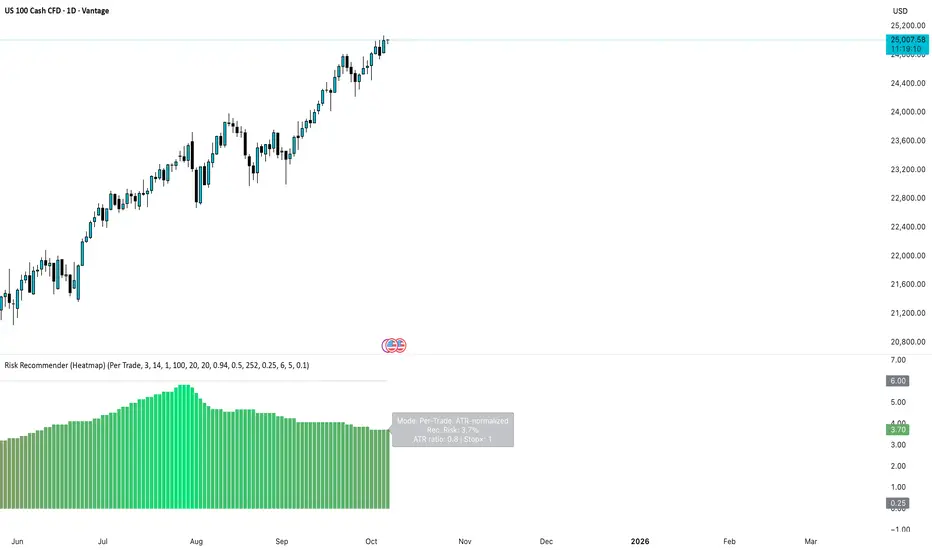
This Idea demonstrates the logic behind the new 📊 Risk Recommender — (Heatmap) indicator, a tool that quantifies how much of your equity to risk at any time.
🧮 How it works
The indicator offers two complementary modes:
1️⃣ Per-Trade (ATR-based)
• Compares current volatility (ATR) to a long-term baseline.
• When market noise increases, it suggests smaller risk per trade.
• When conditions are quiet, it recommends scaling up—within your own floor and ceiling limits.
2️⃣ Annualized (Volatility Targeting)
• Computes realized and forecast volatility (EWMA-style).
• Adjusts your base risk so your overall exposure stays near a target annualized volatility (e.g., 20%).
• The same math used in institutional risk models and CTA frameworks.
🎨 Visual interpretation
The heatmap column acts as a “risk thermometer”:
• 🟥 Red = High volatility → scale down
• 🟩 Green = Low volatility → scale up
• Smoothed and bounded between your chosen floor and ceiling risk levels.
• The label shows current mode, recommended risk %, and volatility context.
💡 Why this matters
Risk should *never* depend on how confident you feel about a trade.
It should depend on how loud or quiet the market is.
Volatility is the market’s volume knob and this indicator helps you tune your exposure to the same frequency.
📈 Example use case
• NASDAQ volatility spikes → recommended risk drops from 3.0% → 1.2%
• SPX volatility compresses → risk rises gradually → 4.5%
You stay consistent while others overreact.
🚀 Automating it
My invite-only strategy applies this logic automatically to manage exposure in real time.
Combine it with the Risk Recommender indicator for full transparency and adaptive position sizing.
🎯 Summary
✅ Stop guessing risk size.
✅ Let volatility guide you.
✅ Keep risk constant, results consistent.
That’s how quants survive. That’s how traders evolve.
#RiskManagement #Volatility #ATR #PositionSizing #Quant #TradingStrategy #AlgorithmicTrading #SystematicTrading #Portfolio #EWMA #RiskControl
Community ideas
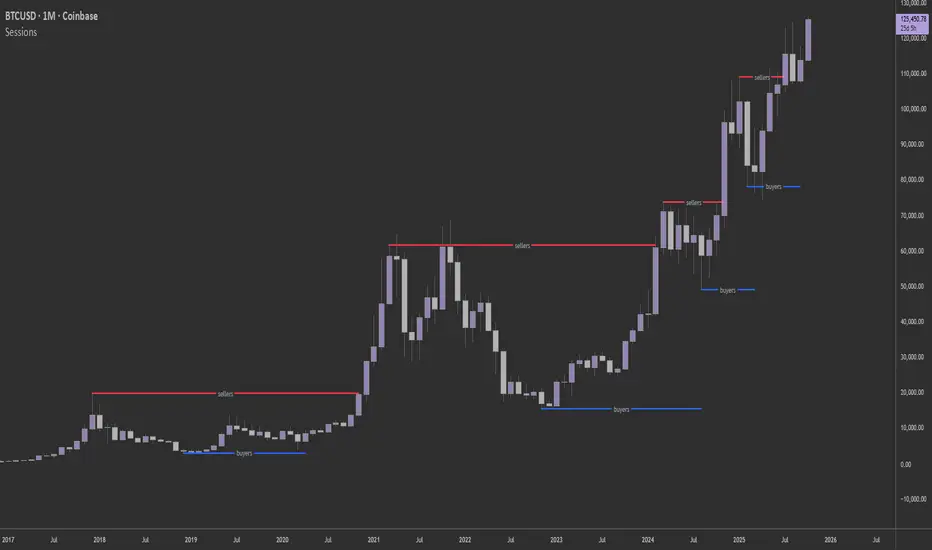
XAU(shows the world’s fear) - BTC(shows the world's hope) What’s Fueling Bitcoin and Gold to All-Time Highs
“Where macro meets momentum.”
Intro: The Tale of Two Safe Havens
Gold and Bitcoin — one ancient, one digital — are both rewriting history.
While their origins could not be more different, their current trajectory reveals something deeper about the state of global liquidity, trust, and capital flow.
Gold has pushed through multi-decade resistance to print new all-time highs. Bitcoin, often dubbed “digital gold”, isn’t far behind, revisiting historical peaks and attracting institutional capital again.
So, what’s fueling this synchronized surge?
1. Monetary Easing Expectations: The Silent Fuel
One of the strongest forces behind both rallies is expectation specifically, the market’s expectation that interest rates have peaked and liquidity will expand again.
When central banks signal easing, real yields fall.
That hurts cash and bonds, but benefits assets with no yield but high scarcity, like gold and Bitcoin.
US10Y Real Yield versus XAUUSD weekly — note how gold rallies as real yields decline.
You can overly Bitcoin which often lags slightly, then accelerates as liquidity broadens.
“When yield curves flatten and central banks pivot, gold rallies first, Bitcoin later joins the party.”
2. Liquidity & Global Balance Sheet Expansion
Both assets thrive on liquidity expansion.
Look at central bank balance sheets from the Fed, PBoC, and ECB, and you’ll see that total liquidity is creeping higher again, even amid rate-hike talk.
Gold reacts to real rates. Bitcoin reacts to real liquidity.
Both react to trust in the monetary system.
3. Inflation Hedge and the “Trust Crisis”
Gold has always been the metal of mistrust, when confidence in paper weakens, it shines.
Bitcoin inherited that narrative during the post-2008 era and strengthened it through decentralization and scarcity.
Now, both are beneficiaries of the same phenomenon:
The erosion of confidence in fiat systems.
Persistent inflation, record debt, and fiscal expansion across G7 nations are reviving the demand for hard assets.
4. Institutional Rotation and ETF Demand
For Bitcoin, 2024–2025 marked a structural change, the ETF era.
Institutional investors now have a compliant, liquid gateway to Bitcoin exposure, which has quietly unlocked billions in passive inflows.
Gold went through this same transformation in the early 2000s with the launch of SPDR Gold Shares (GLD).
The parallel is uncanny ETFs legitimize and absorb demand from new classes of investors.
Compare GLD inflows (2004–2008) vs. BTC Spot ETF inflows (2024–2025).
“The same story, told 20 years apart, first in metal, now in code.”
Institutions love narratives backed by liquidity.
Bitcoin is now walking the same path gold paved two decades ago.
5. Momentum and Market Memory
Markets remember levels — and they respond to them emotionally.
Gold’s prior high near $2,100 acted as psychological resistance for years. Once broken, momentum algos and portfolio reallocations accelerated the move, a textbook resistance-turned-support dynamic.
Bitcoin behaves similarly. Each breakout past an old high (20K in 2017, 69K in 2021) sets off a new wave of belief, often followed by an equal wave of disbelief (profit-taking, skepticism, corrections).
Markets are living memories.
They don’t forget where pain and profit once lived.
6. Correlation Cycles: From Divergence to Convergence
Historically, gold and Bitcoin don’t always move together, their correlation cycles alternate.
But during periods of global liquidity shifts or macro stress, they tend to align.
When fear and liquidity meet, gold and Bitcoin speak the same language — scarcity.
7. The Human Factor: Psychology & Narrative
Ultimately, charts move because people do.
Fear of missing out (FOMO), fear of loss, greed, disbelief, these emotional waves are as much a part of this rally as any macro variable.
Gold buyers think in decades. Bitcoin traders think in blocks.
But both respond to the same core emotion: the need for certainty in uncertain times.
8. What Could Derail the Rally
Every fuel has a flash point.
Delayed rate cuts → Higher real yields hurt both assets.
Liquidity drain → QT or fiscal tightening can pause flows.
Strong USD cycles → Historically inverse correlation to both BTC and XAU.
Regulatory tightening → Can impact Bitcoin specifically, as seen in 2021–2022.
Gold and Bitcoin thrive when dollars are cheap, trust is low, and liquidity is high.
Conclusion: Two Mirrors, One Message
Gold tells us where the world’s fear lies.
Bitcoin tells us where the world’s hope lies.
Both reaching all-time highs together is not coincidence, it’s signal.
A signal that liquidity, inflation, and trust are converging in ways unseen since the 1970s and early 2010s.
So whether you prefer the metal or the math, remember this:
“When scarcity assets rise together, the world is quietly pricing in the cost of confidence.”
my takeaway is :
Stay curious.
Study the cause, not just the price.
And remember, what’s fueling the rally is not hype.
It’s trust being re-priced.
put together by : Pako Phutietsile as @currencynerd
Gold Grid Trading Overview: Effective Strategy for 20% gains🪙 Gold Breakout-Stop Grid Strategy: Overview & Rationale
Grid trading is often built using limit orders above and below a base price, expecting the market to oscillate and capture many small profits. But in a strongly trending or volatile asset like gold, there is often breakout momentum that drives price through grid zones rather than bouncing.
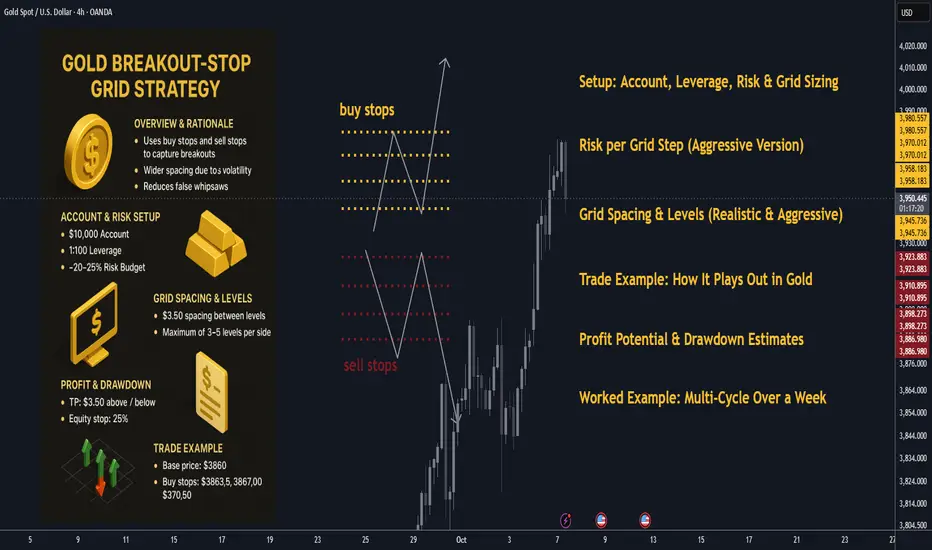
By instead using buy stops above and sell stops below (i.e. breakout triggers), you capture directional thrusts, while still retaining a grid structure (i.e. multiple layers). Think of it as a hybrid between a breakout strategy and a grid.
Key advantages in gold:
• ✨ Gold often exhibits strong trending phases, with momentum after breakouts of supply/demand zones.
• 📊 Volatility is higher than many forex pairs, so you can space your grid more widely, reducing overcrowding.
• 🎯 With breakout stops, you reduce “false bounce” whipsaws inside the range; only when momentum validates do you trigger entries.
Risks / caveats:
• ⚠️ If price doesn’t break strongly and whipsaws, you could trigger and then reverse, creating drawdown.
• 📉 In a sideways gold market, fewer breakouts may be triggered, lowering trade frequency.
• 🛡 You must carefully size exposure and use drawdown controls, especially with leverage.
I’ll now walk through how to set this up, with gold-tailored specifics and sample trades (with increased aggressiveness), using realistic current spot prices (≈ $3,862) Investing.com.
________________________________________
🧮 Setup: Account, Leverage, Risk & Grid Sizing
📋 Account & Leverage
• Account size: $10,000
• Leverage: 1:100
• This means your maximum notional exposure is huge but margin and maintenance rules will limit you.
• We’ll now risk ~20–25%+ of equity in an aggressive version of this system (in order to aim for 20-30% weekly), i.e. $2,000–$2,500 at most drawdown limit for a grid run.
Note: This is very aggressive and only for demonstration. Many traders would never risk this much per grid.
💰 Risk per Grid Step (Aggressive Version)
• Let’s target $50 risk per triggered order (instead of $10) so that each step is meaningful.
• That means if a triggered order goes adverse by its maximum “stop zone,” your loss is $50.
• If you trigger, say, 5 steps, that’s $250 worst case on that direction (if all hit adverse).
• You must still cap total drawdown (e.g. 25% or $2,500) and limit exposures.
📈 Gold Contract & Price Movements
• Spot gold (XAU/USD) currently trades about $3,862.74 Investing.com.
• Let’s assume a contract specification such that 1 standard lot gives $100 per $1 move (so $1.00 move = $100) — a common ballpark in retail gold CFDs.
• Then:
• A move of $0.01 = $1 (for 1 lot).
• Therefore, if you trade 0.50 lots, a $1 move = $50.
So with this, to get ~$50 risk per $1 adverse move, 0.50 lots is a candidate (because $1 adverse × 0.50 lots × $100/lot = $50).
You can scale lot sizes accordingly.
📏 Grid Spacing & Levels (Realistic & Aggressive)
Given gold’s volatility, use wider spacing. Let’s choose:
• Grid spacing = $3.50 between successive triggers (a robust distance).
• We’ll place buy stops and sell stops relative to a base zone around current spot.
Let’s pick base ~ $3,860 as our pivot.
So:
• Buy stops: $3,863.50, $3,867.00, $3,870.50, $3,874.00, $3,877.50
• Sell stops: $3,856.50, $3,853.00, $3,849.50, $3,846.00, $3,842.50
(Max 5 levels each side, but you may cap to 3–5.)
Take Profit / Exit Logic:
• Target profit per trade = $3.50 (same as spacing).
• Thus one successful step = $3.50 × lot_size × $100.
• If lot_size = 0.50 lots, $3.50 × 0.50 × $100 = $175 profit per triggered trade.
• If you get 3 successful triggers in a run: 3 × $175 = $525 gross.
• That’s 5.25% on $10,000 in one clean directional run (before commissions/slippage).
You see the scaling is now aggressive — you risk more per step, but also gain more per successful trade. Limit how many triggers you allow (e.g. max 3–4 per side) to cap exposure.
Define a hard equity stop: e.g. if floating drawdown > 25% ($2,500), close all and reset.
________________________________________
🧭 Trade Example: How It Plays Out in Gold (Realistic Prices & Aggression)
We’ll do two detailed scenarios. This time we target higher returns, with real price zones.
________________________________________
🎯 Scenario A: Bullish Breakout
Base price: ~$3,860 (spot)
Buy stops: $3,863.50, $3,867.00, $3,870.50
Sell stops: $3,856.50, $3,853.00, $3,849.50
Lot sizing: 0.50 lots per order (so $3.50 adverse = $175 risk).
TP per trade: +$3.50
Sequence:
1. Gold climbs and breaks $3,863.50 → triggers Buy #1 at 3,863.50
o TP at 3,867.00 → profit if reached = ($3.50 × 0.50 × $100) = $175
2. Momentum continues, price breaks 3,867.00 → triggers Buy #2 there
o TP at 3,870.50 → another $175
3. Price surges, breaks 3,870.50 → triggers Buy #3 → TP = 3,874.00 → +$175
If all three succeed: Gross = $525 (5.25% gain) in one directional move.
If you allow up to 4 or 5 levels, total can scale to ~$700–900 (7–9%) in a strong move — if all hits. If reversal? If price reverses after buy #2, or before buy #3, you can:
• Close open longs immediately when opposite side’s sell stop triggers.
• Or cancel further buy stops once a reversal signal appears.
• Or net positions (if your broker supports hedging) — but that adds complexity.
Better to disable opposite side (sell stops) after the first buy triggers, to avoid collision exposures.
________________________________________
🔻 Scenario B: Bearish Breakout
Same base zone. Now price breaks downward.
• Sell stops at: 3,856.50, 3,853.00, 3,849.50
• TP each = –$3.50 from entry.
Sequence:
1. Gold breaks 3,856.50 → Sell #1 → target 3,853.00 → profit $175
2. Continues down, breaks 3,853.00 → Sell #2 → target 3,849.50 → +$175
3. Breaks 3,849.50 → Sell #3 → target 3,846.00 → +$175
If all three succeed: $525 profit.
If you allowed 4 levels: e.g. break 3,846.00 next → target 3,842.50 → +$175 more → total $700. Again, reversal risk must be managed.
________________________________________
📊 Mixed / Whipsaw Scenario
Suppose price crosses above $3,863.50 → triggers Buy #1, moves a bit, then reverses and crosses down through 3,856.50, triggering Sell #1.
You now hold:
• Long from $3,863.50 (losing)
• Short from $3,856.50 (potential profit)
This is a collision. To avoid chaotic risk:
• Cancel all opposite-side stops when first side triggers.
• Or immediately close all on first collision signal.
• Or lock in partial profit/loss and pause grid until trend clarity returns.
That’s why many breakout-grid strategies disable the opposite direction after first breakout.
________________________________________
📈 Profit Potential & Drawdown Estimates (Aggressive Model)
Let’s simulate one clean grid run (bullish) where 3 steps succeed fully:
• Gross profit = $525
• If you risked 3 steps * $175 = $525, worst-case these same 3 steps lose you $525 (if all adverse)
• Net = +5.25% in one run
• If you manage 2–3 such runs per week (if market allows), theoretically 10–15%+ weekly is possible — but that is optimistic.
However, in real life, not all runs will hit all targets — sometimes partial, sometimes losses. A drawdown of 25% ($2,500) is your cap boundary.
With that, if you undergo 5 bad runs in a row, you’d hit your equity stop.
If average win per run is $400 and average loss per bad run is $500, you need a favorable win-loss ratio to hit ~20–30% weekly. This is extremely aggressive.
________________________________________
🔁 Adaptive Mechanics & Enhancements (for robustness)
To improve consistency and manage risk, add:
• 📐 ATR-based spacing: Use a 14-period ATR on H4 or D1 to set grid spacing. If ATR = $4, spacing = $4 or $5.
• 📈 Trend filter: Only open buy-side grids when price > 200-period MA (H4 or D1), or only open sell-side when price < MA. Prevent fighting trend.
• 🚫 Volatility filter / news blocks: Do not place or trigger near major gold-related news (Fed, CPI, central bank announcements).
• 🔄 Grid rebase / reset: After a winning cycle, re-center grid around new price and restart stop orders.
• 📈 Scaling rules:
– Aggressive scaling: after n consecutive wins, increase lot size (within risk caps).
– Defensive scaling: after a loss, reduce lot size or skip grid.
• 🛑 Equity-stop / margin cap: If floating drawdown > 25% or margin usage > 80%, close all and reset.
• 🧊 Cooldown periods: After a loss or big run, pause grid orders for some hours/days to let market settle.
________________________________________
🧮 Worked Example: Multi-Cycle Over a Week (Aggressive)
Say you run 3 grid cycles in a week under trending conditions:
Cycle Direction Steps hit Gross profit Net (after one partial loss)
1 Up 3 out of 4 levels hit fully +$525 +$490 (small drawdown on partial)
2 Down 2 of 3 hit, 1 reversed +$350 +$320
3 Up 4 levels hit fully +$700 +$700
Total gross = $525 + $350 + $700 = $1,575
Net after adjustments/slippage ~ $1,450–$1,500
That’s ~ 14.5% gain in one week.
If the market is more favorable, you may hit ~20–30%, but the risk is commensurate.
Over multiple weeks the compounding is powerful — but a few big losses can wipe gains.
________________________________________
✅ Summary & Implementation Tips
• Use breakout stops (buy stops above, sell stops below) instead of limits to catch directional thrusts in gold.
• Wider grid spacing (e.g. $3–$5) is essential to survive volatility.
• Lot sizing must match your desired risk per step (here $50).
• Limit max triggers per direction and enforce a hard equity stop (e.g. 25%) to avoid blow-ups.
• Employ trend / volatility filters to filter low-probability entries.
• After a net winning run, rebase grid to current price.
• Use scaling and cooldown mechanics to moderate aggression.
• On collision signals, cancel opp side stops or close everything to avoid contradictory exposures.
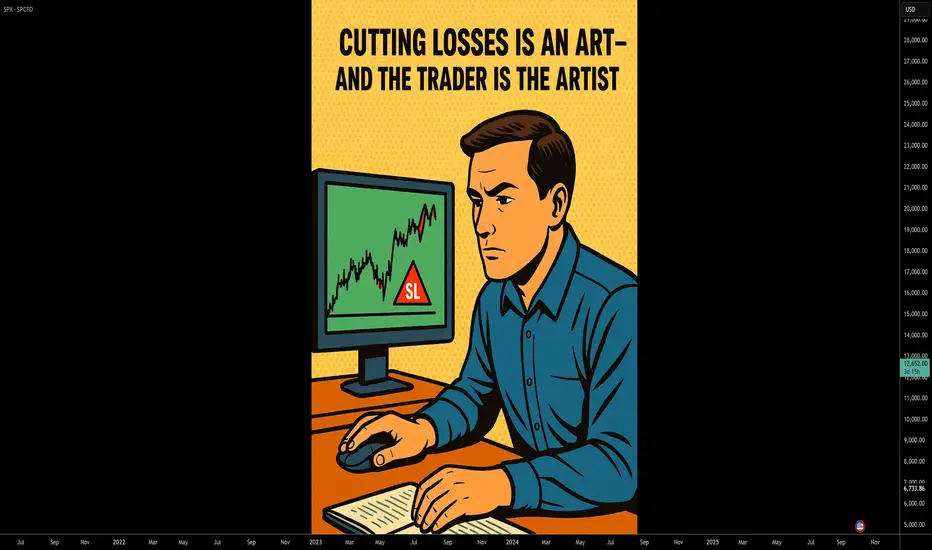
Cutting Losses is an Art – and the Trader is the Artist.🎨 Cutting Losses is an Art – and the Trader is the Artist.
Why Traders Struggle with Losses
In theory: cut your losses early, let your winners run.
In practice? It's an art – forged through discipline, experience, and the battle within.
Many enter the market quickly, full of hope, with no plan or risk awareness.
One wrong click – and they rely on luck instead of a system.
Anyone who trades without a setup or stop-loss isn't playing the game –
they're gambling.
Stop-Loss Isn’t Just Technical – It’s a Mirror of Your Discipline
It should be placed where your idea is objectively invalidated,
not where it just "feels okay."
Why is that so hard?
Because money is emotional
Because losses feel like personal failure
Because the market teaches you with pain if you don’t learn
🧠 “You should consider the money gone the moment you enter a trade.”
That’s not cynicism – it’s psychological armor.
If the trade fails, your self-worth and peace of mind remain intact.
That’s how you protect your mental capital and stay in the game – in trading and in life.
Technical Control + Psychological Honesty = Survival
Ask yourself:
Where is my personal pain threshold?
When do my hands start to sweat?
What is “a lot of money” – to me, objectively and emotionally?
Can I lose without falling apart emotionally?
Because the market will test you.
📉 It will test your ego.
💸 It will take without giving – if you're not prepared.
⏳ Patience is your sharpest weapon.
⚔️ And your greatest enemy? Greed, fear, hope.
A Pro Cuts Losses Mechanically – Not Emotionally
Every trade is just a try – with risk, with expectation, but no guarantee.
In the end, it’s not about how often you win –
it’s about how little you lose when you’re wrong.
📊 Chart Examples: Real-World Loss Management in Action
✅ Disciplined Exit
Clean stop-loss executed as planned. No hesitation, no hope.
“My setup was invalidated. The loss was expected, sized correctly, and accepted.”
❌ Emotional Hold
Ignored the stop-loss, hoping for a reversal.
“I hoped instead of acted. This was costly and unnecessary.”
⚖️ Clean Loss Despite Perfect Setup
All rules followed – but still hit the stop.
“Good trade, bad outcome. Still the right decision. Long-term edge remains.”
💬 How do YOU handle losses? Share your thoughts in the comments below.
🔔 Follow me for more on trading psychology, risk management & real chart breakdowns.
Multiple Correlated Currencies = Confluence to take the trade All the information you need to find a high probability trade are in front of you on the charts so build your trading decisions on 'the facts' of the chart NOT what you think or what you want to happen or even what you heard will happen. If you have enough facts telling you to trade in a certain direction and therefore enough confluence to take a trade, then this is how you will gain consistency in you trading and build confidence. Check out my trade idea!!
www.tradingview.com
Power of ReservesIntroduction: The Invisible Backbone of Global Trade
Behind every strong economy and stable currency lies an invisible force — national reserves. These reserves act as a financial cushion, ensuring stability during crises, boosting investor confidence, and influencing trade decisions worldwide. Whether it’s foreign exchange reserves, gold holdings, or sovereign wealth funds, each component plays a crucial role in determining a nation’s economic resilience and trading strength.
In the dynamic world of global trade, reserves aren’t just numbers sitting in a central bank’s vault. They dictate currency stability, trade competitiveness, and investment flows. Countries with robust reserves — like China, Japan, or Switzerland — often enjoy stronger bargaining power in global markets. On the other hand, nations with weak reserves face currency volatility, trade deficits, and limited import capacity.
This article explores in depth how reserves impact trading — both at the national and global levels, dissecting their role in monetary policy, currency valuation, investor sentiment, and international market behavior.
1. Understanding Reserves: The Foundation of Economic Strength
Reserves are assets held by a country’s central bank or monetary authority to support its currency and meet its international payment obligations. They usually include:
Foreign Currency Assets: USD, Euro, Yen, Pound, and other convertible currencies.
Gold Reserves: Stored as bullion or certificates to hedge against inflation and currency devaluation.
Special Drawing Rights (SDRs): Allocated by the IMF to provide liquidity.
Reserve Position in the IMF: Represents the country's claim on the IMF.
The primary purpose of maintaining reserves is to ensure financial stability, manage exchange rates, and support global trading obligations. For traders, investors, and policymakers, reserve data offers a mirror reflection of a nation’s economic strength and its ability to handle global trade shocks.
2. Reserves and Currency Stability: The Heartbeat of Trading
In global trading, currency stability is vital. A volatile currency disrupts exports, imports, and capital flows. Strong reserves enable central banks to intervene in the foreign exchange market — buying or selling currencies to stabilize exchange rates.
Example:
If a country’s currency is depreciating rapidly, its central bank can sell foreign reserves (like USD) to buy its domestic currency.
This reduces depreciation pressure, boosts confidence, and prevents inflation spikes.
Conversely, if the currency appreciates too much (hurting exports), the bank can buy foreign assets to weaken it. Thus, reserves act as the main defense mechanism against unpredictable market movements.
For traders, stable currencies mean lower hedging costs, predictable returns, and fewer risks. Therefore, countries with high reserves attract more trade deals, foreign investments, and cross-border contracts.
3. Impact on Trade Balance and Import-Export Dynamics
A country’s trade balance — the difference between exports and imports — is directly affected by its reserves.
High Reserves: Allow countries to import essential goods even during economic downturns or geopolitical tensions. It gives importers confidence that the country can pay for foreign goods and services.
Low Reserves: Limit import capacity, create shortages, and increase import costs due to weaker currency value.
Export Competitiveness:
Countries with healthy reserves can manage their currency strategically to maintain export competitiveness. For instance:
China often maintains large reserves to control yuan’s appreciation, keeping exports cheaper and more attractive in global markets.
India, with around $650 billion in reserves, uses them to manage the rupee’s volatility, ensuring exporters remain globally competitive.
Import Stability:
Nations with ample reserves can absorb shocks from rising oil prices, commodity fluctuations, or sanctions. This helps in keeping domestic inflation low, sustaining purchasing power, and ensuring smooth trading operations.
4. Reserves and Investor Confidence in Global Markets
Foreign investors closely monitor a country’s reserve position before committing capital. Strong reserves signal that:
The country can handle external debt payments.
There is low default risk.
The currency is stable, and the economy is resilient to shocks.
As a result, foreign direct investment (FDI) and portfolio inflows increase, strengthening both the capital market and trade.
For example:
Japan and Switzerland are considered safe havens because of their massive reserves and stable currencies.
Conversely, countries like Sri Lanka or Pakistan, with low reserves, face capital flight and currency depreciation, discouraging investors.
Thus, reserves serve as a trust factor — the larger they are, the higher the global confidence in that economy’s trade and investment potential.
5. The Role of Gold Reserves: The Traditional Guardian of Value
Even in today’s digital economy, gold remains a timeless store of value in national reserves. Central banks hold gold because it:
Retains value during inflation or currency crises.
Provides diversification away from fiat currencies.
Acts as a safe asset when geopolitical risks or trade wars escalate.
Gold reserves indirectly influence trading by backing currency credibility. For instance:
In times of global uncertainty, investors flock to gold-backed economies or currencies.
India and China — major gold holders — use gold reserves as insurance against sudden currency outflows.
Thus, while not directly traded in everyday commerce, gold plays a silent yet powerful role in ensuring trade stability and economic security.
6. Reserves and Global Monetary Policy Coordination
Large economies with massive reserves, such as China, the U.S., Japan, and the EU, influence global monetary policy and liquidity. When these nations adjust their reserve holdings, the ripple effects are felt across markets.
Example:
If China decides to diversify its reserves away from USD, it can weaken the dollar and affect global commodities priced in USD.
Similarly, when the U.S. Federal Reserve raises interest rates, countries with smaller reserves face capital outflows, forcing them to use their reserves to defend their currencies.
Reserves also help countries align with global financial standards, such as IMF guidelines, ensuring they can participate smoothly in global trade and monetary cooperation.
7. Crisis Management: Reserves as a Shield Against Shocks
Economic and geopolitical crises can paralyze trade. During such times, reserves become the first line of defense.
Key Functions During Crises:
Liquidity Support: Helps settle international debts and maintain import flows.
Currency Intervention: Prevents currency collapse during capital flight.
Market Confidence: Shows the world that the country can handle uncertainty.
Real-World Example:
During the Asian Financial Crisis (1997), countries like Thailand and Indonesia with low reserves faced severe devaluation.
In contrast, China maintained stability due to its massive reserves, strengthening its trade position in the region.
Similarly, during the COVID-19 pandemic, India’s high reserves enabled it to import medical equipment, oil, and essential goods without currency panic.
Hence, reserves are not just savings — they are insurance policies for trade continuity.
8. Strategic Use of Sovereign Wealth Funds (SWFs)
Some countries, especially oil-rich nations like Saudi Arabia, Norway, and UAE, channel their reserves into sovereign wealth funds. These funds invest globally in:
Infrastructure
Equity markets
Bonds
Real estate
This helps generate long-term returns, diversifies income sources, and supports national trade goals. For example:
Norway’s Government Pension Fund Global uses oil revenue reserves to invest worldwide, ensuring sustainable economic growth even beyond oil dependency.
UAE’s ADIA (Abu Dhabi Investment Authority) invests surplus reserves to stabilize domestic and external trade flows.
These funds not only protect reserves but also enhance global trading relationships through strategic investments.
9. Reserves and Exchange Rate Manipulation Debate
There’s an ongoing global debate about whether large reserves are used for exchange rate manipulation. Some nations allegedly maintain artificially undervalued currencies to boost exports.
For instance:
The U.S. has often accused China of holding vast reserves to control the yuan’s value and maintain trade dominance.
However, such control also helps countries avoid imported inflation and protect export-led growth.
This dual nature makes reserves both a tool of stability and a geopolitical instrument in global trade negotiations.
10. The Indian Perspective: Building a Fortress of Stability
India provides an excellent modern example of how reserves shape a nation’s trading destiny.
Foreign exchange reserves (as of 2025): Over $650 billion
Gold holdings: Over 800 tonnes
These reserves allow India to:
Manage rupee volatility effectively.
Finance essential imports like crude oil and electronics.
Maintain investor confidence despite global uncertainty.
Negotiate trade deals confidently with other nations.
The RBI (Reserve Bank of India) uses these reserves not only to stabilize the currency but also to signal financial strength — crucial for attracting global trade and investment partners.
11. Future Outlook: The Digital Era of Reserve Management
The future of reserves is transforming with the rise of digital currencies, blockchain technology, and tokenized assets. Central banks are exploring digital reserve diversification, such as:
Holding Bitcoin or CBDCs (Central Bank Digital Currencies).
Using blockchain for transparent cross-border settlements.
Diversifying away from the U.S. dollar dominance (a trend tied to de-dollarization).
In the next decade, reserves will evolve beyond traditional forms — becoming digitally liquid, globally diversified, and algorithmically managed, changing the very structure of international trade finance.
12. Challenges and Risks in Managing Reserves
Despite their benefits, reserve management carries significant risks:
Opportunity Cost: Excess reserves may yield low returns compared to productive investments.
Currency Risk: Holding assets in volatile currencies can cause valuation losses.
Geopolitical Sanctions: Reserves held abroad can be frozen during conflicts (as seen in Russia’s 2022 case).
Inflation Erosion: Holding low-yield assets may not offset inflation over time.
Thus, the challenge is maintaining a balance between liquidity, safety, and profitability, ensuring that reserves remain a source of strength, not stagnation.
Conclusion: Reserves – The Silent Engine of Global Trade
In the fast-paced world of international trade, national reserves serve as the hidden engine that keeps economies running smoothly. They stabilize currencies, build confidence, ensure import security, and empower countries to face global crises with resilience.
Whether through gold, forex, or sovereign wealth, reserves represent economic credibility and financial sovereignty. As nations move toward digital globalization, the art of managing reserves will define who leads and who follows in global trade.
In simple terms — reserves are not just savings; they are strategic power.
They determine who controls the currency, who leads trade negotiations, and who thrives during global uncertainty.
The next era of global trading will belong to countries that smartly manage, diversify, and digitalize their reserves — turning them into a true engine of economic growth and global influence.
Global Arbitrage Opportunities: Across World ExchangesIntroduction: The Art of Earning from Market Inefficiencies
In the world of finance and trading, arbitrage is often considered the holy grail of risk-free profit-making. It is the art of exploiting price differences of the same asset across different markets or exchanges. Though it sounds simple, global arbitrage requires deep market knowledge, speed, technology, and capital efficiency. As world exchanges become increasingly connected through technology and globalization, arbitrage has evolved from manual calculations to high-frequency trading algorithms that identify even millisecond differences.
In 2025, as global markets face volatility, digitalization, and decentralization, arbitrage remains a powerful strategy for both institutional and individual investors. This article explores how arbitrage works across world exchanges, the types of arbitrage that exist, key global examples, and how traders can spot opportunities amid market inefficiencies.
1. Understanding Arbitrage in Global Markets
Arbitrage occurs when an asset—such as a stock, commodity, currency, or cryptocurrency—is priced differently across two or more markets. Traders simultaneously buy the asset where it’s undervalued and sell it where it’s overvalued, profiting from the price difference.
For example, suppose Apple Inc. (AAPL) trades at $180 on the NASDAQ and $181 on the London Stock Exchange (LSE). A trader could buy Apple shares on NASDAQ and sell them simultaneously on LSE, pocketing the $1 difference per share, excluding transaction costs.
This principle applies across stocks, commodities, currencies, derivatives, and digital assets—making global arbitrage a multidimensional opportunity.
2. The Foundation of Arbitrage: Market Inefficiency
The core of arbitrage lies in the concept of market inefficiency. In an ideal, perfectly efficient market, asset prices should reflect all available information simultaneously. However, due to differences in time zones, regulations, liquidity, exchange rates, and information flow, inefficiencies persist even today.
These inefficiencies give rise to price gaps that can be exploited for profit. High-frequency traders, hedge funds, and institutional investors deploy advanced algorithms that scan global markets in microseconds to identify such discrepancies.
Even with today’s high level of automation, inefficiencies cannot be completely eliminated—creating continuous arbitrage potential worldwide.
3. Major Types of Global Arbitrage Opportunities
Let’s explore the most common and profitable forms of arbitrage that occur across world exchanges:
a. Spatial Arbitrage (Inter-Exchange Arbitrage)
This is the most classic form—buying an asset in one market and selling it in another where the price differs.
Example: Buying gold futures on the London Metal Exchange (LME) and selling them at a higher price on COMEX (New York).
b. Triangular Arbitrage
A strategy used in foreign exchange (forex) markets, where discrepancies between three currency pairs allow traders to profit.
Example: Using USD, EUR, and GBP pairs to exploit minor rate mismatches across exchanges.
c. Statistical Arbitrage
This involves using quantitative models to identify mispriced securities based on historical correlations.
Example: If two global steel companies usually move in tandem, but one lags temporarily, a trader can long one and short the other expecting reversion.
d. Cross-Border Index Arbitrage
Global index futures—like the S&P 500, Nikkei 225, or FTSE 100—often trade differently on international exchanges. Traders exploit these pricing gaps between index futures and their underlying baskets.
e. Commodity Arbitrage
Differences in oil, gold, copper, or agricultural commodity prices across world exchanges (MCX India, CME US, LME UK) often create arbitrage windows due to supply-chain disruptions or currency fluctuations.
f. Crypto Arbitrage
With 24/7 trading and hundreds of exchanges, cryptocurrencies offer one of the richest fields for arbitrage. For instance, Bitcoin might trade at $62,300 on Binance and $62,450 on Coinbase, allowing instant profit.
g. Interest Rate Arbitrage (Covered Interest Arbitrage)
This involves borrowing in a low-interest-rate currency and investing in a higher-yielding currency, hedging the exchange rate risk through forward contracts.
4. Global Markets Where Arbitrage Flourishes
1. United States (NYSE, NASDAQ, CME)
The U.S. markets are highly liquid, making arbitrage opportunities smaller but more frequent.
Example: Arbitrage between S&P 500 futures on CME and ETFs like SPY on NYSE.
2. United Kingdom (LSE)
London’s time zone overlap with both Asia and the U.S. makes it ideal for intercontinental arbitrage. Traders exploit pricing differences in dual-listed companies such as Unilever or HSBC.
3. India (NSE, BSE, MCX)
The Indian exchanges often see arbitrage between cash and futures markets, and also between NSE and BSE due to liquidity differences.
Example: Buying Reliance shares on NSE and selling on BSE if there’s a small price gap.
4. Japan (TSE) and Hong Kong (HKEX)
Arbitrage between Japanese ADRs (listed in the U.S.) and their domestic listings is common. Similarly, the Shanghai-Hong Kong Stock Connect allows price discrepancies between mainland and Hong Kong shares (A-shares and H-shares).
5. Europe (Euronext, Deutsche Börse)
European markets see cross-border arbitrage due to multiple exchanges trading the same blue-chip stocks. For example, Shell Plc trades across several European exchanges.
6. Crypto Exchanges (Binance, Kraken, Coinbase, OKX)
Crypto exchanges are globally fragmented and unregulated compared to traditional markets. This creates consistent arbitrage windows—especially between fiat-to-crypto pairs.
5. Tools and Technology Driving Modern Arbitrage
Global arbitrage today is a technology-driven discipline. Traditional traders are being replaced or assisted by algorithms, bots, and AI-powered systems. Here’s what drives modern arbitrage:
a. Algorithmic Trading
High-frequency algorithms detect and execute trades within microseconds. These algorithms continuously compare prices across exchanges.
b. Cross-Exchange APIs
APIs allow traders to fetch real-time prices and execute simultaneous buy/sell orders across global platforms.
c. Artificial Intelligence & Machine Learning
AI models analyze historical correlations, volatility patterns, and market inefficiencies to predict potential arbitrage zones.
d. Blockchain & Smart Contracts
In crypto markets, smart contracts automate arbitrage transactions—reducing latency and ensuring immediate execution.
e. Cloud-Based Trading Infrastructure
Cloud servers ensure that traders are geographically closer (co-located) to global exchanges, minimizing network delays.
6. Challenges and Risks in Global Arbitrage
While arbitrage is theoretically risk-free, in practice, execution, regulation, and timing risks can eat into profits. Key challenges include:
1. Transaction Costs
Brokerage, taxes, and exchange fees can eliminate small price differences, making trades unprofitable.
2. Execution Delays
Even a few milliseconds of lag between buying and selling can result in losses if prices move unfavorably.
3. Liquidity Risk
Low-volume assets may not allow traders to exit quickly, causing slippage.
4. Exchange Rate Fluctuations
In cross-border trades, currency volatility can erode arbitrage gains.
5. Regulatory Barriers
Some countries restrict cross-border trading or capital movement, making arbitrage legally complex.
6. Competition
Institutional traders and high-frequency funds dominate arbitrage, leaving minimal room for manual traders.
7. Technology Failures
Glitches, internet outages, or API failures can disrupt trades and cause heavy losses.
7. Case Studies: Real-World Arbitrage Scenarios
Case 1: Gold Arbitrage Between London and New York
When gold prices on the London Bullion Market Association (LBMA) were slightly lower than those on the COMEX, traders shipped gold physically or used futures contracts to arbitrage the difference—making steady profits before logistical costs reduced margins.
Case 2: A-Share and H-Share Arbitrage (China)
Companies listed both on the Shanghai Stock Exchange (A-shares) and the Hong Kong Stock Exchange (H-shares) often show price gaps due to investor access restrictions. Institutional traders exploit this through arbitrage using the Stock Connect link.
Case 3: Bitcoin Arbitrage in 2021-2022
During crypto bull markets, Bitcoin often traded at a “premium” in South Korea (the “Kimchi Premium”) compared to global averages. Arbitrageurs moved BTC from U.S. or Japanese exchanges to Korean exchanges for instant gains.
Case 4: ETF and Futures Arbitrage
During high volatility, index futures may deviate from their underlying ETF prices. Arbitrageurs buy the cheaper and sell the expensive instrument until prices converge.
8. The Future of Global Arbitrage: Trends for 2025 and Beyond
As the financial world moves deeper into digitalization, arbitrage is becoming more complex, global, and data-driven. Some emerging trends include:
1. AI-Enhanced Arbitrage
AI algorithms now learn from historical inefficiencies and predict arbitrage windows across correlated assets.
2. Tokenized Assets
With real-world assets being tokenized on blockchain, arbitrage between traditional and digital markets will rise.
3. Multi-Asset Arbitrage
Cross-market opportunities involving stocks, commodities, forex, and crypto will create new strategies.
4. Decentralized Exchanges (DEXs)
On-chain arbitrage between DEXs and centralized exchanges (CEXs) will continue to expand, especially in DeFi ecosystems.
5. Regulatory Harmonization
Efforts by global regulators to integrate financial systems (e.g., Basel norms, MiFID II) may reduce inefficiencies but also make legal cross-border arbitrage safer.
6. Quantum Computing
Quantum algorithms could soon revolutionize arbitrage by processing millions of correlations simultaneously—making inefficiencies vanish almost instantly.
9. How Individual Traders Can Find Arbitrage Opportunities
While institutional players dominate, retail traders can still benefit by focusing on specific niches:
Track price spreads between NSE and BSE for dual-listed stocks.
Monitor crypto exchanges for real-time differences using bots.
Use broker data APIs to automate alerts for arbitrage opportunities.
Combine forex and commodity arbitrage strategies using multi-asset platforms.
Participate in ETF arbitrage where price gaps persist during volatile periods.
With proper tools, discipline, and low transaction costs, individual traders can still find small but consistent profits.
10. Conclusion: Arbitrage—The Silent Engine of Global Market Efficiency
Arbitrage is not just about profit—it plays a vital role in maintaining market balance and price efficiency. By exploiting inefficiencies, arbitrageurs help ensure that identical assets trade at consistent prices worldwide.
In 2025, global arbitrage has evolved into a sophisticated, technology-powered discipline spanning traditional finance, commodities, and digital assets. Despite tighter spreads and fierce competition, opportunities persist for those who understand global linkages, act swiftly, and leverage automation.
In essence, arbitrage is where intelligence meets precision—a strategy that proves markets may be efficient, but never perfectly so.
Global Trading Trends 2025Introduction: The Pulse of Global Trading
The world of trading is not just about buying and selling financial instruments — it’s a dynamic ecosystem shaped by technology, policy shifts, geopolitical changes, and human psychology. In 2025, global markets are evolving faster than ever before. Traders, investors, and institutions are adapting to a new age where artificial intelligence, digital currencies, and sustainability are rewriting the rules of the game.
Understanding key trends in global market trading is essential for anyone who wishes to navigate these turbulent waters successfully. The forces influencing the markets today go far beyond traditional economic data; they encompass technological disruption, global integration, environmental priorities, and shifting monetary dynamics.
Let’s dive deep into the major trends shaping the global trading landscape in 2025 — and how they’re transforming investment decisions, strategies, and outcomes.
1. Rise of Artificial Intelligence and Algorithmic Trading
Artificial Intelligence (AI) has become the backbone of modern trading. From hedge funds to retail traders, AI-powered systems are now used to analyze data, detect patterns, and execute trades within milliseconds.
Key features driving this trend include:
Machine Learning Models: These systems learn from market behavior, identifying profitable entry and exit points more accurately than traditional models.
Natural Language Processing (NLP): AI now interprets financial news, social media sentiment, and earnings reports, turning unstructured data into actionable insights.
Algorithmic Execution: Automated bots handle high-frequency trading (HFT), reducing emotional bias and improving precision.
AI’s role in market prediction has expanded beyond equities — it now influences forex, commodities, and even crypto. By 2025, more than 70% of global trades are estimated to be executed through AI-driven algorithms, creating both efficiency and new ethical questions about fairness and transparency.
2. The Decentralization Revolution: Blockchain and Digital Assets
Blockchain technology is revolutionizing how financial assets are traded. Cryptocurrencies and tokenized assets are no longer fringe ideas — they are becoming integrated into mainstream portfolios.
Key global developments:
Central Bank Digital Currencies (CBDCs): Many nations, including China, India, and the European Union, are experimenting with or launching their own digital currencies.
Decentralized Finance (DeFi): This blockchain-based ecosystem allows users to lend, borrow, and trade assets without traditional intermediaries.
Tokenization of Assets: From real estate to art, tokenization enables fractional ownership, making investments more accessible to global investors.
Digital assets are reshaping cross-border payments, reducing transaction costs, and challenging the dominance of the U.S. dollar in international trade. As this shift continues, the decentralized economy is becoming a cornerstone of future trading systems.
3. Sustainability and ESG Investing
Environmental, Social, and Governance (ESG) factors have evolved from being “optional” to “essential.” Investors today evaluate companies not only by their profits but also by their ethical and environmental footprint.
Key reasons for this transformation:
Regulatory Push: Governments worldwide are mandating sustainability disclosures.
Investor Awareness: Millennial and Gen Z investors prefer sustainable portfolios.
Long-Term Stability: ESG-aligned companies are proving more resilient during economic downturns.
Global funds are now channeling trillions of dollars into green energy, carbon-neutral technologies, and socially responsible enterprises. Trading strategies increasingly incorporate ESG metrics, creating new market opportunities in clean energy, electric vehicles, and circular economy sectors.
4. Global Economic Realignment and De-dollarization
The global financial order is gradually shifting from a U.S. dollar-dominated system toward a multipolar currency environment. Emerging markets, particularly China and India, are exploring trade settlements in local currencies, challenging the dollar’s supremacy.
Drivers of this change:
Bilateral Trade Agreements: Countries are bypassing the dollar for local currency trade.
Gold and Yuan Reserves: Nations are diversifying their foreign exchange reserves.
Geopolitical Tensions: Sanctions and trade wars are pushing countries to seek independence from the U.S. financial system.
This de-dollarization trend could redefine forex markets, commodity pricing, and global trade balances in the next decade. For traders, currency volatility and macroeconomic shifts are becoming critical factors in strategy formulation.
5. Integration of Emerging Markets
Emerging markets (EMs) have become the new growth engines of the global economy. Countries like India, Brazil, Indonesia, and Vietnam are attracting substantial foreign investments due to demographic advantages, digital adoption, and robust domestic consumption.
What makes EMs attractive:
Rapid Economic Growth: GDP growth rates in EMs are outpacing developed economies.
Technological Adoption: Fintech and e-commerce sectors are expanding rapidly.
Infrastructure and Manufacturing Boom: Supply chain diversification is benefiting EMs post-COVID-19.
Global investors are increasing allocations to EM equities and bonds, though risks such as political instability and currency fluctuations remain. For traders, emerging markets offer high-risk, high-reward opportunities, especially in the technology and consumer sectors.
6. Volatility as the New Normal
Global markets have become more volatile due to rapid information flow, geopolitical tensions, and unpredictable policy moves. Events like wars, pandemics, and central bank decisions can trigger market-wide reactions within minutes.
Key sources of volatility include:
Interest Rate Cycles: The U.S. Federal Reserve and European Central Bank decisions directly impact global liquidity.
Energy Market Fluctuations: Oil and gas prices continue to influence inflation and global trade costs.
Geopolitical Uncertainty: Conflicts and political instability can quickly disrupt global supply chains.
While volatility poses challenges, it also creates opportunities for short-term traders. Sophisticated hedging instruments like options and futures are increasingly used to manage risks and capitalize on market swings.
7. Technological Integration and Real-Time Data Access
Technology has democratized access to financial markets. Platforms like Robinhood, Zerodha, and eToro have empowered millions of retail investors worldwide. Real-time analytics, advanced charting tools, and mobile trading apps have turned the average smartphone into a global trading terminal.
Major impacts include:
24/7 Global Trading: Crypto and forex markets operate continuously, aligning with global time zones.
Cloud and Edge Computing: Real-time trade execution and analytics are faster than ever.
Big Data Analytics: Traders can now analyze global economic data instantly and react to changes.
The fusion of technology and finance (FinTech) is driving inclusivity, transparency, and efficiency in trading. As a result, markets have become more liquid, though also more sensitive to digital information flows.
8. The Return of Commodities and Real Assets
After years of underperformance, commodities — such as gold, silver, oil, and agricultural products — are regaining prominence. Investors are turning to tangible assets to hedge against inflation and currency depreciation.
Why commodities are trending again:
Inflation Hedge: With global inflation staying elevated, commodities act as a store of value.
Supply Chain Disruptions: Ongoing shortages and conflicts affect commodity pricing.
Green Transition: Metals like lithium, cobalt, and copper are in demand due to the EV revolution.
Additionally, real assets like real estate and infrastructure are drawing institutional investments as they offer stability in uncertain times. For traders, this shift means renewed focus on commodity derivatives and ETFs.
9. Regulatory Evolution and Global Standardization
Financial regulations are evolving to catch up with the speed of innovation. Governments and regulators are introducing frameworks for cryptocurrency trading, AI-driven platforms, and ESG disclosures.
Recent developments include:
MiCA in Europe: The “Markets in Crypto-Assets” regulation sets standards for digital asset trading.
U.S. SEC Oversight: Stricter monitoring of high-frequency and social-media-driven trading.
Cross-border Collaboration: Countries are aligning standards to prevent money laundering and fraud.
This regulatory clarity boosts investor confidence but also demands compliance and transparency from traders and institutions. Understanding global regulatory trends is becoming as important as technical analysis itself.
10. The Rise of Retail Power and Social Trading
Retail investors are no longer passive spectators. The meme-stock phenomenon and the popularity of social trading platforms have proven that collective retail sentiment can move markets.
New dynamics include:
Social Media Influence: Tweets, Reddit posts, and YouTube channels can spark buying frenzies.
Copy Trading and Community Platforms: Traders can follow and replicate strategies of successful peers.
Gamification: Platforms use interactive tools to make trading more engaging.
This democratization of market access has increased participation but also created volatility spikes. It’s a reminder that in the digital era, market psychology is as powerful as financial fundamentals.
11. The Shift Toward Data-Driven and Quantitative Trading
Data has become the new gold in financial markets. Quantitative trading strategies use complex mathematical models and statistical analysis to forecast market behavior.
Core aspects include:
Alternative Data Sources: Satellite imagery, shipping data, and social sentiment are analyzed for market signals.
Quant Funds: Hedge funds now rely on data scientists as much as on economists.
Predictive Analytics: Combining big data with AI to anticipate price movements.
This trend reflects a broader truth — trading success increasingly depends on data literacy and access to real-time information rather than intuition alone.
12. Geopolitics and Global Supply Chain Reconfiguration
Global trade and market trends are now inseparable from geopolitics. The Russia-Ukraine war, U.S.-China trade tensions, and Middle East conflicts have underscored how political events directly impact global financial flows.
Emerging patterns:
Regional Trade Blocs: Nations are forming new alliances to reduce dependency.
Friend-shoring and Near-shoring: Companies are relocating manufacturing closer to home.
Defense and Energy Sectors: Both are seeing renewed investment amid global uncertainties.
Traders must now monitor geopolitical risk indicators as carefully as technical charts, since global politics can move markets overnight.
Conclusion: Adapting to the Future of Trading
The global trading landscape in 2025 is marked by innovation, integration, and unpredictability. Traders who adapt to these shifts — embracing AI tools, understanding macroeconomic dynamics, and practicing risk management — will thrive in this new era.
Tomorrow’s successful traders will be data-driven, globally aware, and technologically agile. As the lines between traditional finance and digital innovation blur, one thing remains constant: those who stay informed and adaptive will continue to find opportunity amid uncertainty.
The Role of Developed and Emerging Markets in the World Bank’s Introduction: A Tale of Two Worlds in One Financial Institution
The World Bank stands as one of the most influential international financial institutions in the modern era — a cornerstone of global economic stability and development. Since its establishment in 1944 at the Bretton Woods Conference, the World Bank has evolved from a post-war reconstruction lender to a powerhouse for global poverty reduction, infrastructure development, and economic reform.
At its heart, the World Bank is not merely a bank — it is a bridge between developed and emerging markets. Developed nations bring capital, expertise, and governance, while emerging economies bring growth, opportunities, and development challenges. Together, these two groups form the backbone of the institution’s structure, mission, and functioning.
This intricate partnership shapes the global economy, influences international policy, and determines the future of sustainable development. Understanding their respective roles within the World Bank reveals how global economic cooperation works — and sometimes, where it struggles.
1. The World Bank: Structure and Objectives
The World Bank Group (WBG) consists of five institutions:
International Bank for Reconstruction and Development (IBRD) – lends to middle-income and creditworthy low-income countries.
International Development Association (IDA) – provides concessional loans and grants to the poorest nations.
International Finance Corporation (IFC) – focuses on private sector development.
Multilateral Investment Guarantee Agency (MIGA) – offers political risk insurance and credit enhancement.
International Centre for Settlement of Investment Disputes (ICSID) – handles investment disputes between governments and foreign investors.
Together, they aim to reduce poverty, promote sustainable development, and enhance living standards across the world. But the direction of these goals and their implementation depend largely on the interplay between developed and emerging markets within the institution.
2. Developed Markets: The Pillars of Financial Strength
Developed economies — primarily the United States, Japan, Germany, France, and the United Kingdom — are the largest shareholders and financial contributors to the World Bank. Their roles are multifaceted and deeply rooted in both economic capacity and geopolitical influence.
A. Capital Contribution and Voting Power
The World Bank operates on a shareholding system where financial contributions determine voting power. Developed countries hold the majority of votes — for example, the U.S. alone has around 16–17% of voting rights, giving it significant influence over key decisions.
This capital infusion ensures the World Bank’s ability to provide loans at favorable rates to developing nations, maintain creditworthiness, and attract investors from international capital markets.
B. Policy Influence and Governance
Developed nations also shape the strategic priorities of the World Bank. They influence policy directions on:
Climate change initiatives
Good governance and anti-corruption frameworks
Debt sustainability
Gender equality and education programs
However, critics argue that this dominance can sometimes lead to policies that reflect the interests or economic ideologies of the developed world — particularly the neoliberal approach of privatization and deregulation.
C. Technical Expertise and Innovation
Developed economies contribute advanced research, technology, and institutional know-how to World Bank projects. For instance:
The U.S. contributes technological expertise in energy transition and innovation financing.
European countries drive climate adaptation, green infrastructure, and human rights frameworks.
Japan often supports disaster resilience and urban infrastructure development.
This infusion of expertise helps ensure that World Bank-funded projects are not only financially viable but also sustainable and modern in design.
3. Emerging Markets: The Engines of Growth and Development
Emerging economies — such as India, China, Brazil, Indonesia, and South Africa — play an equally vital yet distinct role within the World Bank. Once the primary recipients of development aid, many have now evolved into both borrowers and contributors.
A. Borrowers and Beneficiaries
Historically, emerging markets have been the primary recipients of World Bank loans and grants aimed at:
Building infrastructure (roads, dams, energy grids)
Expanding access to education and healthcare
Promoting agricultural and rural development
Strengthening governance and public institutions
For example:
India has been one of the largest recipients of World Bank loans, supporting rural electrification, sanitation, and digital finance initiatives.
China, before transitioning to an upper-middle-income economy, utilized World Bank funds to modernize infrastructure and improve poverty reduction programs.
These investments have had a profound multiplier effect — accelerating economic growth, improving living standards, and positioning these countries as regional powerhouses.
B. Emerging Donors and Shareholders
In recent years, several emerging economies have transitioned from aid recipients to development partners.
China has become a major shareholder and now contributes to World Bank financing pools.
India and Brazil participate in knowledge-sharing programs and South-South cooperation.
This evolution symbolizes a more balanced and inclusive global development model, where emerging economies not only receive aid but also help shape and fund development efforts in poorer nations.
C. Field Implementation and Local Innovation
Emerging markets also serve as testing grounds for innovative development models. Their on-ground experiences in poverty alleviation, microfinance, digital inclusion, and renewable energy provide blueprints for other developing nations.
For example:
India’s Aadhaar digital identity program inspired similar digital inclusion models across Africa.
Brazil’s Bolsa Família program influenced social welfare strategies in multiple countries.
Thus, emerging economies bring the voice of practicality, representing real-world development challenges and scalable solutions.
4. Collaboration Between Developed and Emerging Markets
The partnership between developed and emerging markets within the World Bank framework is both strategic and symbiotic.
A. Funding and Execution
Developed nations provide capital and governance, while emerging markets provide execution capacity and local insight.
This balance ensures that funds reach where they’re needed most and are used effectively for on-ground transformation.
B. Knowledge Transfer
The World Bank acts as a platform for knowledge exchange — developed countries share technical know-how, while emerging economies share policy lessons and innovations that work in resource-constrained environments.
C. Sustainable Development Goals (SDGs)
Both blocs are integral to achieving the United Nations’ 2030 SDGs. Developed nations finance and design global frameworks, while emerging markets implement and test these goals in diverse contexts — from renewable energy transitions to healthcare reforms.
5. Challenges in the Relationship
Despite mutual benefits, the relationship between developed and emerging markets in the World Bank is not without friction.
A. Governance Imbalance
Developing and emerging economies have long called for greater voting representation. Although reforms have been introduced, developed countries still dominate decision-making — limiting the voice of fast-growing economies like India or Brazil.
B. Policy Conditionalities
Many emerging nations criticize the World Bank’s loan conditions, which often require structural reforms like privatization or fiscal tightening. These can conflict with domestic socio-economic priorities and sometimes exacerbate inequality.
C. Geopolitical Tensions
The rise of China and the creation of the Asian Infrastructure Investment Bank (AIIB) has challenged the World Bank’s dominance, signaling emerging economies’ desire for alternative frameworks that better represent their interests.
D. Climate Finance Divide
Developed countries advocate for rapid green transitions, but emerging markets argue they need more time and support, as their economic growth still relies on energy-intensive sectors. Balancing development and decarbonization remains a key tension point.
6. The Evolving Role of Emerging Markets in the 21st Century
Emerging economies are no longer passive participants — they are increasingly shaping the World Bank’s agenda.
India champions digital public infrastructure and inclusive finance.
China promotes infrastructure-led growth and south-south cooperation.
Brazil emphasizes social protection and sustainable agriculture.
These nations push for a development model that blends economic growth with social inclusion, moving beyond the purely economic paradigms of the past.
Furthermore, as emerging markets contribute more financially and intellectually, the World Bank’s governance structure is slowly evolving toward greater inclusivity.
7. The Road Ahead: Toward a Balanced Global Partnership
For the World Bank to remain relevant in an increasingly multipolar world, it must strengthen the partnership between developed and emerging markets.
Key future directions include:
Reforming voting rights to reflect modern economic realities.
Enhancing transparency and accountability in project selection and implementation.
Promoting green finance and climate-resilient infrastructure, especially in the Global South.
Expanding digital transformation programs, leveraging emerging market innovation.
Encouraging co-financing and joint initiatives between developed and emerging nations.
The ideal future for the World Bank is not dominated by one group over another — but one where mutual respect, shared responsibility, and equitable participation drive global development.
8. Conclusion: A Shared Mission for Global Prosperity
The World Bank’s success depends on how effectively it balances the strengths of both developed and emerging markets. Developed countries provide stability, financial capacity, and institutional frameworks, while emerging economies bring energy, growth potential, and real-world experience.
Together, they represent the two engines of global progress — one supplying resources, the other driving innovation and execution.
As the 21st century unfolds, the collaboration between these two worlds within the World Bank will determine not only the institution’s future but also the fate of global development itself. The mission is clear: to bridge divides, foster inclusivity, and ensure that prosperity is not the privilege of a few nations — but the shared heritage of all.
The Journey of the World EconomyIntroduction: The Pulse of Civilization
The story of the world economy is, in many ways, the story of human progress itself — a journey from barter to blockchain, from localized trade to globalized finance. Every era of history — from the ancient Silk Road to the digital highways of the 21st century — has shaped how nations produce, distribute, and consume wealth. The evolution of the global economy is not merely an economic tale; it is a social, political, and cultural transformation that reflects the very essence of humanity’s pursuit of growth and stability.
This comprehensive narrative explores the journey of the world economy, tracing its transformation through centuries — highlighting its major milestones, challenges, and the forces that continue to redefine it in the modern era.
1. The Dawn of Trade: Barter Systems and Early Economies
In the earliest human societies, there was no formal concept of money or global trade. People survived through barter systems, exchanging goods and services based on need. A farmer might trade grain for tools made by a blacksmith, or wool for pottery. This system worked in small, self-sufficient communities but faced limitations as societies expanded — differences in value, perishability, and coincidence of wants made trade cumbersome.
The first real economic revolution began with the invention of money — shells, metal coins, and later, paper notes — which enabled standardized exchange. Ancient civilizations like Mesopotamia, Egypt, and the Indus Valley established structured economies where trade routes linked distant lands. The Silk Road connected Asia to Europe, allowing not just the flow of goods like silk, spices, and gold, but also the spread of knowledge, religion, and technology.
This early phase laid the foundation of what would eventually become the global economy — an interconnected web of production and exchange that transcended borders.
2. The Age of Empires: Expansion, Colonization, and Mercantilism
From the 15th to 18th centuries, global trade was dominated by European powers seeking wealth through colonization and mercantilism. Nations like Britain, Spain, Portugal, France, and the Netherlands established colonies across Asia, Africa, and the Americas.
The mercantilist theory of this era believed that a nation’s wealth was measured by its stockpile of gold and silver. This drove colonial expansion as European powers exploited resources and labor from their colonies to fuel their own industrial and military growth.
The triangular trade system between Europe, Africa, and the Americas epitomized this global economic structure — with raw materials flowing from colonies, manufactured goods from Europe, and enslaved labor from Africa. This period brought immense wealth to Europe but at a devastating human cost.
Yet, mercantilism also laid the groundwork for capitalism, as trade, finance, and innovation flourished. The establishment of joint-stock companies like the British East India Company and Dutch VOC introduced the concept of corporate capitalism, where investments and profits were shared among shareholders — a precursor to the modern stock market.
3. The Industrial Revolution: The Birth of Modern Economics
The late 18th and 19th centuries marked the Industrial Revolution, a turning point that transformed the economic fabric of the world. Britain led this transformation, powered by technological innovations such as the steam engine, textile machinery, and railways.
Factories replaced workshops, and production shifted from manual labor to machine-driven efficiency. Urbanization surged as people moved to cities for work. Productivity soared, and with it, global trade expanded exponentially.
The revolution also birthed the modern capitalist system theorized by economists like Adam Smith, whose 1776 work “The Wealth of Nations” introduced the idea of free markets and the “invisible hand.” Capitalism emphasized private property, competition, and profit — principles that shaped economic policy for centuries to come.
However, industrialization also deepened class divides, giving rise to socialist ideologies and labor movements. Thinkers like Karl Marx criticized capitalism for exploiting workers and creating inequality — debates that still resonate in modern policy discussions.
4. The Age of Global Conflict and Recovery (1914–1945)
The early 20th century tested the global economy with unprecedented crises. The First World War (1914–1918) devastated Europe, draining resources and collapsing trade networks. The interwar years saw unstable financial systems, culminating in the Great Depression of 1929, one of the darkest economic periods in history.
Unemployment, deflation, and bankruptcies spread worldwide. The U.S. stock market crash exposed the fragility of the global financial system, leading to the rise of protectionism — countries imposed tariffs, restricting trade in a desperate attempt to save domestic industries.
As if that weren’t enough, the world plunged again into World War II (1939–1945). Economies were redirected toward military production, and destruction swept across continents. Yet, out of this devastation emerged the seeds of modern economic cooperation.
The Bretton Woods Conference (1944) laid the foundation for a new global economic order. Institutions like the International Monetary Fund (IMF) and World Bank were created to promote stability, reconstruction, and development — ushering in the post-war economic era.
5. The Post-War Boom: The Golden Age of Capitalism (1945–1973)
The period following World War II was one of unprecedented economic growth. The United States emerged as the global economic leader, while Europe and Japan rebuilt through programs like the Marshall Plan.
This era witnessed the rise of consumer economies, with booming industries, suburbanization, and technological innovation. The Bretton Woods system pegged currencies to the U.S. dollar, establishing global financial stability.
Trade liberalization under organizations like the General Agreement on Tariffs and Trade (GATT) encouraged global commerce. Living standards rose dramatically, and the middle class expanded.
However, the system began to strain by the early 1970s as inflation, oil shocks, and currency imbalances emerged. The collapse of the Bretton Woods system in 1971, when the U.S. abandoned the gold standard, marked the beginning of floating exchange rates and a more volatile financial environment.
6. The Era of Globalization: Technology, Trade, and Transformation (1980–2008)
From the 1980s onward, the world entered an era of hyper-globalization. Technological revolutions in computing, telecommunications, and the internet transformed production, communication, and finance.
Policies of economic liberalization, led by figures like Ronald Reagan and Margaret Thatcher, encouraged privatization, deregulation, and free-market capitalism. Global institutions such as the World Trade Organization (WTO) promoted open trade and reduced barriers between nations.
Emerging economies — particularly China and India — became key players. China’s market reforms under Deng Xiaoping and India’s 1991 liberalization opened new frontiers for global investment and manufacturing.
The European Union (EU) and the rise of multinational corporations deepened global integration. Outsourcing, global supply chains, and financial markets connected the world more tightly than ever before.
Yet, this period also created inequality and financial bubbles, culminating in the Global Financial Crisis of 2008, which exposed the vulnerabilities of unregulated markets and excessive debt.
7. The Post-Crisis Rebalancing: A New Global Reality (2008–2020)
After 2008, the world economy underwent significant restructuring. Governments and central banks implemented massive stimulus programs, including quantitative easing, to revive growth.
The crisis led to introspection — the need for sustainable, inclusive, and resilient economies became central to global policy. Emerging markets continued to rise, shifting the economic balance toward Asia.
Meanwhile, technological disruption accelerated. The rise of digital economies, fintech, and artificial intelligence transformed how people work, invest, and consume. Platforms like Amazon, Google, and Alibaba redefined commerce and competition.
At the same time, new challenges — climate change, automation, and inequality — demanded global cooperation. The United Nations’ Sustainable Development Goals (SDGs) emerged as a blueprint for balanced economic progress.
However, by 2020, the world faced another major disruption — the COVID-19 pandemic, which shook the foundations of global trade, travel, and supply chains.
8. The Pandemic Era and the Road Ahead (2020–Present)
The COVID-19 pandemic triggered one of the largest economic contractions since World War II. Lockdowns, factory closures, and disrupted logistics paralyzed industries. Global GDP fell sharply in 2020, and unemployment soared.
Yet, the crisis also accelerated digital transformation and remote work, while governments launched unprecedented fiscal and monetary interventions. Stock markets rebounded quickly, fueled by liquidity and innovation in sectors like technology, healthcare, and renewable energy.
The pandemic revealed the fragility of global supply chains, prompting countries to rethink economic self-reliance and strategic manufacturing. It also intensified discussions around de-globalization, climate finance, and digital currencies.
As nations recovered, attention shifted toward green economies, AI-driven productivity, and de-dollarization — as countries sought alternatives to U.S. financial dominance. The rise of BRICS nations, especially with China and India at the forefront, marked a multipolar shift in global power dynamics.
9. The Future of the World Economy: Innovation, Sustainability, and Inclusion
Looking ahead, the global economy is entering a transformational phase. Several key trends are shaping its trajectory:
Technological Revolution – AI, blockchain, and quantum computing are redefining industries, from finance to manufacturing.
Green Transition – Renewable energy, carbon markets, and sustainable finance are becoming economic cornerstones.
Geopolitical Realignment – The U.S.-China rivalry, de-dollarization, and regional trade blocs (like RCEP) are reshaping global alliances.
Digital Currencies & Fintech – Central Bank Digital Currencies (CBDCs) and decentralized finance (DeFi) are revolutionizing monetary systems.
Inclusive Growth – Nations are emphasizing equity, social welfare, and education as pillars of future prosperity.
The new world economy will be digital, decentralized, and data-driven — but its success will depend on how humanity balances innovation with inclusion and sustainability.
Conclusion: A Journey Without an End
The journey of the world economy is far from over. From primitive bartering to algorithmic trading, from local markets to the metaverse, each phase of economic evolution has mirrored humanity’s endless quest for growth, efficiency, and fairness.
Today, as we stand at the crossroads of technology, climate change, and geopolitics, the world economy is being rewritten once again — not by conquest or colonization, but by collaboration, innovation, and consciousness.
The next chapter will not just measure wealth in GDP, but in sustainability, resilience, and shared prosperity. The global economy’s true strength will lie not in how fast it grows, but in how well it uplifts humanity as a whole.
De-Dollarization and the Global Currency WarIntroduction: The Shifting Sands of Global Finance
For decades, the United States dollar (USD) has reigned supreme as the world’s dominant reserve currency — the central pillar of global trade, finance, and economic stability. From oil transactions to international debt settlements, the dollar became more than just a currency; it was the bloodstream of globalization. But in recent years, a strong wave of economic nationalism, geopolitical rivalry, and strategic diversification has begun to challenge this hegemony — a process known as “de-dollarization.”
Simultaneously, we’re witnessing an intensifying “currency war” — a global competition among nations to protect their economic sovereignty, control exchange rates, and reduce dependency on U.S.-led monetary influence. Together, de-dollarization and currency warfare are reshaping the financial map of the 21st century, with implications that reach from the energy markets of the Middle East to the central banks of Asia and Latin America.
This 2000-word analysis dives deep into the rise of de-dollarization, explores its causes and strategies, examines the mechanics of currency wars, and forecasts the potential shape of the next global monetary order.
1. The Roots of Dollar Dominance
After World War II, the 1944 Bretton Woods Agreement established the U.S. dollar as the world’s reserve currency, pegged to gold at $35 per ounce. Other global currencies were tied to the dollar, making it the foundation of postwar economic stability. Even after President Richard Nixon ended the gold standard in 1971, the dollar retained its dominance because of its stability, liquidity, and the economic might of the United States.
By the late 20th century, the dollar had become:
The primary reserve currency, held by central banks worldwide.
The medium of international trade, particularly in oil (the “petrodollar” system).
The currency of global finance, underpinning stock markets, bonds, and derivatives.
In short, control of the dollar meant control of the global economic bloodstream — and this financial power translated into political leverage.
2. What Is De-Dollarization?
De-dollarization refers to the deliberate process of reducing reliance on the U.S. dollar in international trade, finance, and reserves. It’s not about completely abandoning the dollar, but about diversifying away from it to limit vulnerability to U.S. monetary policy and sanctions.
Countries and blocs leading this movement include:
China, promoting the yuan (renminbi) in global trade.
Russia, moving away from dollar-based settlements after sanctions.
BRICS nations (Brazil, Russia, India, China, South Africa, now joined by others) working toward a shared currency system.
Middle Eastern countries, exploring non-dollar oil transactions.
Latin America and Africa, forming regional trade agreements in local currencies.
The motivation? A mix of economic independence, geopolitical resilience, and strategic competition.
3. The Key Drivers Behind De-Dollarization
(a) U.S. Sanctions and Weaponization of Finance
The U.S. uses its control over global payment systems (like SWIFT and dollar-clearing banks) as a geopolitical tool. Nations such as Iran, Venezuela, and Russia have faced financial exclusion through U.S. sanctions.
This has sparked fear among emerging economies that dollar dependency exposes them to political risk — accelerating efforts to create alternative payment systems (e.g., China’s CIPS, Russia’s SPFS, and India’s RuPay/UPI cross-border systems).
(b) Rise of China and the Yuan
China’s economic growth and the Belt and Road Initiative (BRI) have given the yuan increasing global exposure. Beijing aims to internationalize its currency by encouraging trade in yuan and developing offshore yuan markets (especially in Hong Kong, Singapore, and London).
(c) The BRICS Challenge
The BRICS alliance has emerged as a collective front against Western economic dominance. The bloc’s discussions around a BRICS common currency or a gold-backed trade settlement system indicate a long-term ambition to challenge dollar supremacy.
(d) U.S. Debt and Inflation
The U.S. government’s rising national debt (over $34 trillion) and the repeated use of quantitative easing have weakened confidence in the dollar’s stability. Countries fear that excessive dollar printing could erode their reserves’ value, prompting diversification into gold, the yuan, and other currencies.
(e) Digital Currencies and Blockchain
Central Bank Digital Currencies (CBDCs) offer new pathways for global payments. China’s digital yuan is leading this race, aiming to bypass the traditional dollar-based banking infrastructure entirely.
4. The Mechanics of a Global Currency War
A currency war, also known as “competitive devaluation,” occurs when countries intentionally lower the value of their own currencies to boost exports, attract foreign investment, and reduce trade deficits.
How It Works:
By devaluing their currency, a country’s goods become cheaper abroad.
This can strengthen exports but also increases import costs and inflation.
When multiple countries engage in this simultaneously, global financial instability can follow — hence the term “war.”
Historical Examples:
1930s Great Depression: Nations devalued currencies to recover from economic collapse.
1980s U.S.-Japan tension: Japan’s yen appreciation reshaped global trade.
2010s “Currency War 2.0”: After the financial crisis, countries used ultra-loose monetary policy and quantitative easing to stay competitive.
Today, the modern currency war involves not just exchange rates but geopolitical influence, payment systems, and financial infrastructure.
5. De-Dollarization and Currency Wars: The Modern Battlefield
In the 2020s, de-dollarization and currency competition have become two sides of the same coin. The following arenas illustrate this growing conflict:
(a) Energy Markets
The traditional petrodollar system — oil sold in U.S. dollars — is under strain.
China and Russia have signed major energy contracts in yuan and rubles, while Saudi Arabia has hinted at accepting non-dollar payments for oil. The India-UAE rupee-dirham trade settlement is another example of regional diversification.
(b) Central Bank Reserves
According to IMF data, the dollar’s share of global reserves has declined from 70% in 2000 to around 58% in 2024, marking a slow but steady erosion. Central banks are increasing holdings in gold, yuan, and euro, signaling a rebalancing of trust.
(c) Cross-Border Settlements
Nations are exploring bilateral trade agreements in local currencies — for instance, India-Russia rupee-ruble trade, China-Brazil yuan settlement, and ASEAN nations’ local currency framework.
(d) Digital Currency Warfare
With the U.S. lagging in CBDC development, countries like China are pioneering digital payment systems that can function independently of SWIFT and U.S. banking oversight. This could redefine how international money moves in the next decade.
6. Winners and Losers in the De-Dollarization Era
Winners:
Emerging Economies – Greater autonomy over monetary policy and trade settlements.
China and BRICS Members – Enhanced global financial influence and regional cooperation.
Commodity Exporters – Ability to price goods in multiple currencies.
Gold and Digital Asset Markets – Investors view these as alternative stores of value amid dollar uncertainty.
Losers:
U.S. Financial System – Reduced demand for U.S. Treasury bonds and the dollar may weaken the U.S. fiscal position.
Dollar-Debt Dependent Nations – Countries heavily indebted in dollars could face volatility.
Global Investors – Increased currency risk and reduced liquidity in traditional markets.
7. Is a New Global Currency Order Emerging?
While de-dollarization is gaining traction, a complete end to dollar dominance is unlikely in the short term. The U.S. still has unmatched advantages:
The deepest financial markets in the world.
Global trust in its institutions and legal system.
Military and geopolitical clout backing the currency’s credibility.
However, the trend is unmistakable — the world is slowly transitioning toward a multipolar currency system, where the dollar, euro, yuan, and possibly regional digital currencies coexist in a competitive balance.
Future trade blocs might operate on multi-currency platforms, and international reserves could become more diversified.
8. The Future: Cooperation or Confrontation?
The next decade could unfold in one of two broad scenarios:
Scenario 1: Cooperative Multipolarity
Nations collaborate through institutions like the IMF, BRICS Bank, and AIIB, building systems that support currency diversity while maintaining global liquidity. In this world, de-dollarization doesn’t mean destruction — it means balance.
Scenario 2: Financial Fragmentation
Geopolitical rivalry intensifies, creating currency blocs (USD-based, yuan-based, euro-based). Trade becomes more regionalized, and financial flows become fragmented. This could lead to volatility, capital flight, and higher transaction costs worldwide.
In either case, technological innovation — from digital currencies to blockchain trade settlements — will play a defining role in shaping monetary competition.
Conclusion: The Dawn of a New Financial Era
De-dollarization and the currency war are not isolated economic trends; they are strategic transformations redefining how power is distributed across nations. What began as a defensive move by a few sanctioned countries has evolved into a systemic global recalibration of monetary order.
The dollar will likely remain powerful, but its monopoly is fading. The 21st-century global economy may no longer be built around a single currency but around a network of competing and cooperating monetary systems.
For traders, policymakers, and investors, this means one thing: the world of finance is entering a new era — more decentralized, more digital, and more dynamic than ever before.
CPI Data and Its Power in Global Trading MarketsIntroduction: The CPI—A Mirror of Inflation and Economic Health
In the fast-paced world of global finance, one number can send markets soaring or tumbling—the Consumer Price Index (CPI). Whether it’s a sudden rise in U.S. inflation or a dip in Japan’s consumer prices, traders across the world hold their breath when CPI data is released. CPI is more than just an economic statistic—it’s the heartbeat of inflation monitoring, influencing everything from interest rate decisions, currency movements, bond yields, and global stock performance to commodity prices.
The CPI reflects the average change over time in the prices paid by consumers for goods and services. When prices rise, purchasing power falls; when they decline, deflationary risks loom. For traders, investors, and policymakers, CPI acts as a compass, signaling where economies—and markets—are heading next.
In this comprehensive discussion, we’ll explore the importance, impact, and trading implications of CPI data in the global market, with detailed insights into how it shapes financial trends, investor sentiment, and global capital flows.
1. What is CPI and Why It Matters Globally
The Consumer Price Index (CPI) measures the change in prices of a "basket" of commonly purchased goods and services—such as food, housing, clothing, transportation, and healthcare—over a specific period. It’s typically released monthly by government statistical agencies (e.g., the U.S. Bureau of Labor Statistics, the UK Office for National Statistics, or India’s Ministry of Statistics).
The CPI serves as a key inflation indicator. Inflation, in turn, influences the monetary policies of central banks like the Federal Reserve (Fed), European Central Bank (ECB), and Reserve Bank of India (RBI).
For global traders, this means that CPI data releases are among the most market-moving events. A single surprise in CPI—say, inflation coming in higher than expected—can lead to sharp movements in currencies, bonds, equities, and commodities.
2. Components of CPI: The Building Blocks of Inflation
To understand how CPI affects global trading, it’s vital to know what it measures. CPI baskets vary by country, but they usually include:
Food and Beverages: Covers groceries, dining out, and beverages—one of the most volatile components due to weather and geopolitical issues.
Housing: Rent, utilities, and maintenance costs; the largest weight in most economies’ CPI.
Apparel: Clothing and footwear prices, reflecting consumer trends and supply chain conditions.
Transportation: Fuel, vehicle prices, and public transport—closely tied to crude oil prices.
Medical Care: Hospital, medicine, and health insurance costs.
Education and Communication: Tuition fees, phone bills, and internet costs.
Recreation and Other Goods: Entertainment, travel, and miscellaneous services.
Each sector’s performance contributes to the overall CPI value, revealing which parts of the economy are heating up or cooling down.
For example:
Rising housing and fuel costs often signal broad inflationary pressure.
Falling food and commodity prices may indicate deflationary trends or reduced demand.
3. CPI’s Role in the Global Financial Ecosystem
CPI doesn’t operate in isolation—it interacts deeply with global financial systems. Here’s how:
A. Influence on Central Bank Policy
Central banks use CPI to set monetary policy. If inflation exceeds target levels (e.g., the Fed’s 2%), they may raise interest rates to cool spending. Conversely, if inflation is too low, they might cut rates or use quantitative easing to stimulate demand.
Higher CPI → Rate hikes → Stronger currency, weaker stocks
Lower CPI → Rate cuts → Weaker currency, stronger stocks
For instance, when U.S. CPI data shows persistent inflation, the Fed signals rate hikes—strengthening the U.S. dollar (USD) but often causing global equity markets to fall.
B. Impact on Global Currencies
Currency traders react instantly to CPI data. Countries with higher inflation and higher interest rates usually see currency appreciation, as investors chase higher yields.
For example:
A hotter-than-expected U.S. CPI often boosts the USD/INR pair as the dollar gains.
A lower Eurozone CPI may weaken the Euro (EUR/USD), hinting at looser ECB policy.
C. Effect on Bond Markets
Bonds are extremely sensitive to inflation data. Rising CPI reduces the real return from fixed-income securities, prompting investors to sell bonds and push yields higher.
For traders, CPI data drives Treasury yield volatility, a crucial input for pricing everything from derivatives to mortgage rates.
D. Stock Market Reactions
Stock indices like the S&P 500, FTSE 100, and Nifty 50 often rally when CPI cools, as it signals lower inflation and potential rate cuts. Conversely, a spike in CPI dampens investor sentiment, especially in rate-sensitive sectors like banking, housing, and technology.
E. Commodity and Energy Markets
Commodities, particularly gold and oil, react sharply to inflation readings.
Gold acts as an inflation hedge—rising CPI often triggers gold rallies.
Crude oil prices influence and are influenced by CPI; rising energy costs feed inflation and vice versa.
4. CPI Data and Global Market Volatility
The release of CPI data often sparks immediate volatility. For professional traders, it’s a critical time for positioning. Algorithmic and institutional traders monitor CPI in real-time, executing trades within seconds of the release.
A. Pre-Announcement Positioning
Markets often price in expected inflation based on forecasts. If the actual CPI data deviates sharply from expectations, it triggers rapid market repricing.
For instance:
If U.S. CPI is forecast at 3.2% but comes at 3.8%, traders expect tighter Fed policy, selling equities and buying dollars.
If CPI underperforms, investors anticipate easing, leading to a risk-on rally in global stocks.
B. The Volatility Chain Reaction
CPI data doesn’t just move one asset—it triggers a chain reaction:
CPI → Interest rate expectations
Interest rate expectations → Currency and bond yields
Currency moves → Commodity and equity adjustments
This chain makes CPI the most-watched economic indicator globally, alongside GDP and employment data.
5. Global Examples: How CPI Data Drives Markets Worldwide
1. United States (US CPI)
The U.S. CPI release is arguably the most impactful in the world. As the dollar is the global reserve currency, U.S. inflation data shapes global risk appetite.
When the U.S. CPI surged above 9% in 2022—the highest in 40 years—it triggered aggressive Fed rate hikes, leading to:
A stronger dollar,
Global equity selloffs,
Declines in emerging market currencies,
Sharp corrections in tech stocks.
2. Eurozone (HICP – Harmonised Index of Consumer Prices)
The Eurozone uses the HICP for consistency across member states. When Eurozone CPI rises, the ECB faces pressure to tighten policy, affecting global bonds and EUR/USD levels.
3. India
In India, CPI is crucial for the RBI’s monetary policy. A rise in food or fuel inflation pushes the RBI toward rate hikes, influencing:
The Nifty and Sensex indices,
Bond yields,
The Rupee’s strength against the Dollar.
4. Japan
Japan’s CPI data has global attention because of its history with deflation. When Japan’s inflation rose above 2% in 2023, the Bank of Japan hinted at policy normalization, shaking up global carry trades and Yen-linked assets.
5. Emerging Markets
In developing economies like Brazil, Turkey, and South Africa, CPI spikes often lead to currency depreciation and investor flight, as markets fear policy instability and economic overheating.
6. How Traders Use CPI Data Strategically
CPI data isn’t just for economists—it’s a vital signal for trading opportunities. Let’s explore how professional traders integrate it into their strategies:
A. Forex Traders
They trade based on interest rate differentials caused by CPI surprises.
Example: If U.S. CPI beats expectations, traders go long USD/INR or short EUR/USD, anticipating a Fed rate hike.
B. Equity Traders
They focus on sector rotation:
High inflation → Banks and Energy outperform, Tech underperforms.
Low inflation → Growth sectors (Tech, Consumer discretionary) shine.
C. Commodity Traders
They monitor CPI as a proxy for demand. Rising CPI hints at economic expansion, lifting demand for industrial metals and energy.
D. Bond Traders
They hedge inflation risk using Treasury Inflation-Protected Securities (TIPS) or short-duration bonds when CPI is expected to rise.
E. Derivative Traders
CPI announcements often lead to volatility spikes, creating opportunities in options trading, especially in volatility-based instruments like VIX futures.
7. The Global CPI Chain: How Inflation Spreads Across Borders
In an interconnected economy, inflation in one region affects others through trade, energy prices, and currency flows.
Rising U.S. inflation leads to stronger USD → Weakens emerging market currencies → Raises import prices in India, Brazil, etc.
Europe’s energy-driven inflation spills into Asian import prices, raising CPI globally.
Global supply chain disruptions (like during COVID-19) create synchronized CPI surges across continents.
Thus, CPI is not just national data—it’s a global ripple effect determining trade competitiveness and monetary coordination.
8. The Future of CPI and Global Market Analysis
With the advent of AI, big data, and real-time analytics, CPI measurement and interpretation are evolving. Traders now use:
Alternative data (e.g., online retail prices, freight rates) to forecast CPI before official releases.
Machine learning models to detect inflation trends early.
Global CPI correlation models to assess cross-border inflation risks.
Moreover, energy transition, climate costs, and geopolitical risks are reshaping inflation dynamics. CPI in the future may include green energy indices and carbon costs, making it more reflective of modern consumption.
Conclusion: CPI—The Guiding Star of Global Traders
In global trading, CPI is more than just an economic indicator—it’s a market driver. It influences everything from central bank policy decisions to daily trading volumes on Wall Street, London, and Mumbai. Understanding CPI means understanding how money flows, assets reprice, and investor psychology shifts across borders.
For traders and investors, mastering CPI analysis provides an edge in forecasting macro trends, identifying trading opportunities, and managing risks. Whether you’re in forex, equities, bonds, or commodities, CPI remains the most powerful pulse point of global economic health.
In the era of inflation uncertainty and global interconnectedness, keeping an eye on CPI data isn’t optional—it’s essential. It tells the story of every nation’s economic heartbeat and shapes the rhythm of global markets.
Commodities: The Pulse of Global TradeIntroduction: The Lifeblood of Global Trade
Commodities are the foundation of global trade, the building blocks upon which the modern economy thrives. From crude oil powering industries to gold backing currencies, and agricultural goods feeding nations — commodities shape economic policies, influence geopolitics, and drive the rhythms of international commerce.
The global commodity market is a vast and dynamic ecosystem where raw materials are bought, sold, and traded across borders. It serves as a vital link between producers (countries rich in natural resources) and consumers (industrialized economies and emerging markets).
Understanding this market is crucial because fluctuations in commodity prices can make or break national economies, impact inflation, shape trade balances, and even alter political relationships.
1. What is the Commodity Market?
A commodity market is a place where raw materials or primary products are exchanged. These are typically divided into two main categories:
Hard Commodities: Natural resources that are mined or extracted — such as crude oil, natural gas, gold, silver, copper, and iron ore.
Soft Commodities: Agricultural or livestock products that are grown or raised — including wheat, corn, coffee, cotton, sugar, and soybeans.
The trading of these commodities happens both in physical form (actual goods being delivered) and financial form (through futures, options, and derivatives contracts).
Commodities are the first stage of production — they feed into industries like energy, manufacturing, construction, and consumer goods. As such, they reflect global economic health and industrial demand.
2. The Structure of Global Commodity Markets
Global commodity trading is facilitated through organized commodity exchanges, which act as platforms for price discovery and standardization. Some of the most influential commodity exchanges include:
New York Mercantile Exchange (NYMEX) – USA (for crude oil, natural gas, and metals)
Chicago Board of Trade (CBOT) – USA (for grains, soybeans, and other agricultural products)
London Metal Exchange (LME) – UK (for base metals like copper, zinc, and aluminum)
Intercontinental Exchange (ICE) – Global (for energy and soft commodities)
Multi Commodity Exchange (MCX) – India (for energy, metals, and agri commodities)
Shanghai Futures Exchange (SHFE) – China (for metals and energy)
These exchanges operate as transparent markets where prices are determined by supply and demand dynamics, speculation, hedging activities, and global economic indicators.
3. The Role of Commodities in Global Trade
Commodities are the building blocks of the world economy. Their importance in global trade can be understood in multiple ways:
a) Driving Economic Growth
Commodity exports are the primary source of revenue for many developing and resource-rich countries. For example:
Oil accounts for over 90% of export revenue in nations like Saudi Arabia and Nigeria.
Agricultural commodities dominate the exports of Brazil and Argentina.
Metals and minerals are key exports for Australia, Chile, and South Africa.
b) Enabling Industrialization
Industrial economies like China, the US, and Germany rely heavily on importing raw materials to fuel their manufacturing sectors. Without commodity imports, their industrial engines would stall.
c) Influencing Currency and Inflation
Commodity prices directly affect inflation rates and currency valuations. For instance:
A surge in oil prices increases transportation costs, leading to global inflation.
Commodity-exporting nations’ currencies (like the Canadian Dollar and Australian Dollar) often rise with higher global commodity prices.
d) Powering Global Supply Chains
Every major global supply chain — from food production to electronics — begins with commodities. For example:
Copper and lithium are crucial for electric vehicles and renewable energy infrastructure.
Wheat and corn are essential for global food security.
4. Factors Influencing Commodity Prices
Commodity markets are known for their volatility, driven by a complex web of factors:
a) Supply and Demand
This is the core driver. When demand exceeds supply (as seen in post-pandemic recoveries), prices surge. Conversely, when oversupply hits the market, prices fall sharply.
b) Geopolitical Tensions
Conflicts, trade sanctions, and political instability can disrupt supply chains. For example:
The Russia–Ukraine war affected wheat and crude oil supplies.
Sanctions on Iran influenced global oil markets.
c) Climate and Weather Conditions
Agricultural commodities are heavily influenced by climate. Droughts, floods, or hurricanes can devastate crop yields and spike prices for grains, coffee, or cotton.
d) Technological Developments
Innovation in extraction and farming methods can improve supply. For instance, the shale revolution in the US transformed it into a major oil exporter, altering global energy dynamics.
e) Speculation and Investment
Institutional investors and hedge funds actively trade commodities as an asset class. Large inflows of speculative money can amplify price movements.
f) Currency Fluctuations
Since most commodities are priced in US dollars, a strong dollar makes them more expensive for other countries, reducing demand and impacting prices globally.
5. The Global Commodity Supercycles
A commodity supercycle refers to a prolonged period of rising or falling prices driven by structural shifts in global demand and supply.
Historically, there have been several notable supercycles:
1950s–1970s: Post-war reconstruction in Europe and industrial expansion in Japan.
2000s: China’s rapid industrialization and infrastructure boom drove massive demand for metals and energy.
2020s (Emerging): The green energy transition is creating new demand for copper, lithium, and rare earth metals.
Each cycle has reshaped global trade flows and altered the balance of power between resource-rich and manufacturing nations.
6. The Role of Developing Nations in Commodity Trade
Developing countries are the main suppliers of global commodities, while developed nations are the primary consumers. This dynamic defines much of global trade.
a) Resource Dependency
Many developing nations rely heavily on commodity exports for government revenue and employment. However, this dependence can lead to vulnerability — known as the “resource curse” — where economic instability follows commodity price fluctuations.
b) Trade Imbalance
Commodity-rich nations often face trade imbalances due to their reliance on exporting raw materials while importing finished goods, trapping them in low-income cycles.
c) Diversification and Industrialization
To reduce this dependency, many emerging economies are now focusing on value addition, investing in refining, processing, and manufacturing to capture higher margins within the global supply chain.
7. Commodity Derivatives and Financialization
The evolution of commodity derivatives has transformed global trade by enabling participants to manage risk.
a) Futures Contracts
These allow buyers and sellers to lock in prices for future delivery, providing price certainty and stability in volatile markets.
b) Options and Swaps
These instruments allow traders to speculate on or hedge against price fluctuations without directly owning the physical commodity.
c) The Rise of Financial Investors
Banks, hedge funds, and ETFs have turned commodities into an investment asset class, linking them more closely to global financial markets. While this enhances liquidity, it also increases price volatility.
8. The Impact of Technology and Sustainability
The commodity market is undergoing a transformation driven by technological innovation and sustainability concerns.
a) Digitalization and Blockchain
Blockchain technology is enhancing transparency in commodity trading by creating secure, tamper-proof records of transactions. This reduces fraud and improves trust between buyers and sellers.
b) Automation and AI
AI and big data analytics are helping traders predict price trends, manage risks, and optimize logistics and supply chain operations.
c) Green Transition
The global shift toward renewable energy is reshaping demand for commodities:
Oil and coal demand may decline, while lithium, cobalt, and nickel demand surges for battery production.
Renewable infrastructure requires vast amounts of copper and aluminum.
Sustainability is now at the core of commodity trade, pushing producers to adopt eco-friendly practices.
9. Challenges in the Global Commodity Market
Despite its central role, the global commodity market faces numerous challenges:
Price Volatility: Unpredictable price swings disrupt planning for producers and consumers alike.
Supply Chain Disruptions: Wars, pandemics, and trade restrictions can halt the flow of goods.
Environmental Concerns: Mining and extraction often damage ecosystems, sparking global protests.
Economic Inequality: Resource wealth often benefits elites, not the broader population.
Policy and Regulatory Risks: Sudden government interventions, export bans, or taxation changes affect stability.
These challenges underline the need for resilient, transparent, and sustainable commodity trading systems.
10. Future Outlook of the Global Commodity Market
The future of commodities is intertwined with global megatrends — climate change, technological innovation, population growth, and geopolitical realignments.
a) Green Commodities Will Dominate
With the rise of electric vehicles, renewable energy, and decarbonization efforts, the demand for green metals like lithium, nickel, and copper will skyrocket.
b) Digital Commodity Exchanges
Digital platforms will make global trading more accessible, efficient, and transparent — benefiting small traders and emerging markets.
c) Strategic Resource Alliances
Nations will form alliances to secure access to critical minerals, leading to “resource diplomacy” becoming as vital as military or trade diplomacy.
d) Climate Risk Integration
Commodity prices will increasingly factor in climate risks, such as carbon footprints, water usage, and environmental impact.
e) Sustainable Investing
Institutional investors will favor ESG-compliant (Environmental, Social, and Governance) commodity producers, reshaping investment flows.
Conclusion: Commodities as the Pulse of the World Economy
The global commodity market is not just about trade—it’s about survival, growth, and balance. It powers industries, feeds populations, and fuels innovation. Every price movement in oil, gold, or grain ripples through the world economy, influencing policies, investments, and livelihoods.
In essence, commodities are the pulse of global trade, reflecting humanity’s evolving relationship with nature, technology, and economics. As the world transitions toward a green and digital future, the role of commodities will remain central — not just as resources, but as strategic instruments shaping the destiny of nations and the direction of global commerce.
World Economy Gets Affected by Shocks, Policies, and CrisesIntroduction: The Interconnected Web of Global Markets
The global market is no longer a collection of isolated economies—it’s an intricate web of trade, finance, technology, and politics. Every decision made in one corner of the world, whether it’s a central bank raising interest rates or a sudden geopolitical conflict, sends ripples across continents. A small policy tweak in Washington can impact commodity prices in Africa, stock indices in Europe, and currency markets in Asia within hours.
Understanding how the global market gets affected means looking deeply into the interconnections between macroeconomic policies, trade relations, technological innovations, geopolitical tensions, and investor sentiment. Over the past few decades, the world has witnessed several global market shocks—from the Dot-Com Crash (2000) to the Global Financial Crisis (2008), COVID-19 pandemic (2020), and the Russia-Ukraine War (2022)—each one teaching a new lesson about how fragile yet resilient the global economy truly is.
1. The Power of Monetary Policies: Central Banks as Global Market Movers
Central banks are the most influential entities in the financial world. Their decisions on interest rates, liquidity injections, and bond purchases have the power to strengthen or weaken economies.
For instance, when the U.S. Federal Reserve increases interest rates to control inflation, the effects are felt worldwide. Higher U.S. rates make the dollar stronger, attracting global capital into American assets. Emerging markets then see capital outflows, currency depreciation, and rising import costs.
A perfect example is the 2022–2023 tightening cycle, when the Fed raised rates aggressively. As a result:
The Indian rupee, Japanese yen, and Euro weakened.
Stock markets in emerging countries saw volatility.
Global investors moved funds to safer U.S. Treasury bonds.
On the other hand, when central banks lower rates or introduce quantitative easing (QE)—as seen during the 2008 financial crisis and the COVID-19 pandemic—markets experience liquidity boosts. Cheap money flows into equities, commodities, and even cryptocurrencies, inflating asset prices.
Thus, monetary policy isn’t just a domestic tool—it’s a global economic lever that affects trade balances, inflation, and investment trends across the world.
2. Trade Wars and Global Supply Chains: The Domino Effect
Trade is the lifeblood of the global economy, but it’s also one of the most vulnerable sectors. In recent decades, trade wars and protectionist policies have created ripple effects across industries and borders.
The U.S.–China trade war (2018–2019) showcased how tariff hikes between two major economies can disrupt global manufacturing chains. Companies dependent on Chinese components or American technology were forced to relocate, adapt, or shut down.
Supply chain disruptions not only raise production costs but also trigger inflationary pressures globally. During the COVID-19 pandemic, supply chain bottlenecks led to shortages in semiconductors, automobiles, and electronics, which in turn pushed up prices everywhere.
This domino effect demonstrates how interconnected and fragile the world’s production networks are. A single disruption in one country can cascade through the system, affecting manufacturing output, consumer prices, and employment in others.
3. Geopolitical Tensions and Conflicts: The Invisible Hand of Instability
Political instability, wars, and international sanctions play a major role in shaping global markets. They directly impact oil prices, commodity supplies, defense spending, and investor confidence.
For example:
The Russia–Ukraine War (2022) led to an immediate surge in crude oil and natural gas prices. European nations struggled with energy shortages, and inflation soared globally.
The Middle East conflicts often cause spikes in crude prices, influencing global inflation and currency movements.
Tensions in the South China Sea impact shipping routes, trade logistics, and manufacturing costs in Asia.
Investors hate uncertainty. When geopolitical risks rise, global markets experience volatility. Gold, the U.S. dollar, and government bonds often become safe havens, while equities and emerging market currencies decline.
In essence, the geopolitical environment acts as the emotional pulse of the global market—capable of triggering rapid swings based on fear, hope, or conflict resolution.
4. Technological Disruptions: Innovation, Automation, and the Digital Economy
Technology has reshaped global trade, investment, and consumer behavior. From automation and AI to blockchain and fintech, technological revolutions have created both opportunities and challenges for global markets.
The rise of the digital economy—driven by giants like Amazon, Apple, and Alibaba—has transformed how value is created and exchanged. At the same time, automation and AI-driven manufacturing have shifted the balance of labor-intensive industries, making some economies winners and others losers.
Moreover, the cryptocurrency boom in the 2010s and 2020s introduced a new digital asset class, disrupting traditional financial systems. Bitcoin, Ethereum, and blockchain technology sparked debates about monetary sovereignty, central bank digital currencies (CBDCs), and decentralized finance (DeFi).
Technological innovation also drives stock market trends. Sectors like semiconductors, green energy, and AI have outperformed traditional industries, influencing investor sentiment and portfolio allocations worldwide.
Thus, the tech wave is not only shaping economies—it’s redefining the future of global finance.
5. Global Crises: From Financial Meltdowns to Pandemics
Nothing affects global markets more severely than a full-blown crisis. History offers multiple lessons:
The 2000 Dot-Com Bubble: Overvaluation of tech stocks led to a crash, wiping out trillions in market value and marking the start of a recession.
The 2008 Global Financial Crisis: Triggered by the U.S. subprime mortgage collapse, it resulted in massive bank failures, job losses, and government bailouts.
The 2020 COVID-19 Pandemic: A global health crisis turned into an economic catastrophe. Markets crashed, unemployment soared, and governments unleashed record stimulus measures.
Each crisis led to profound market transformations. After 2008, the world saw the rise of low-interest-rate regimes and QE policies. After COVID-19, the focus shifted to digital acceleration, supply chain resilience, and remote work economies.
Crises also change investor psychology. They remind traders and governments alike that risk management, diversification, and regulation are essential to prevent future collapses.
6. Currency Fluctuations and Global Trade Imbalances
Currencies act as the bloodstream of global commerce. When exchange rates fluctuate significantly, the entire market structure feels the impact.
For instance, a stronger U.S. dollar makes American exports expensive but reduces import costs. On the other hand, a weaker yen or rupee benefits exporters but increases the cost of imports like crude oil.
Currency volatility also affects global investment flows. Hedge funds, multinational corporations, and even retail traders respond to exchange rate trends, often leading to speculative movements.
Global trade imbalances—like the persistent U.S. trade deficit with China—reflect deeper structural issues in competitiveness, consumption, and currency policies. Countries sometimes intervene in markets (through central banks or sovereign funds) to stabilize their currencies, which in turn affects global capital distribution.
7. Commodity Prices: The Pulse of Global Inflation
Oil, gold, copper, wheat, and other commodities form the backbone of the global economy. When their prices change sharply, it alters everything from inflation to interest rates.
For example:
Rising crude oil prices increase transportation and manufacturing costs, pushing inflation higher globally.
Falling metal prices hurt resource-dependent economies like Australia, Brazil, and Russia.
Gold prices often rise during uncertainty, reflecting investor flight from risky assets.
The 2022 energy crisis, triggered by the Russia-Ukraine conflict, is a recent example of how a regional issue can cause global inflation. Central banks worldwide had to raise rates aggressively to control prices, leading to slower growth and higher borrowing costs.
Thus, commodities act as global economic thermometers, signaling the health, fear, or optimism of the market ecosystem.
8. The Role of Global Institutions and Cooperation
Organizations like the IMF, World Bank, WTO, and G20 play crucial roles in maintaining financial stability and promoting international cooperation. They provide emergency loans, policy guidance, and platforms for dialogue during crises.
However, global coordination often faces challenges due to national interests, political rivalries, and economic disparities. The COVID-19 pandemic revealed deep inequalities between developed and developing nations in vaccine access and economic recovery speed.
Still, initiatives like climate finance, sustainable development goals (SDGs), and global debt relief show how multilateral cooperation can stabilize markets and promote long-term growth.
In the modern era, collaboration between countries is not optional—it’s a necessity to maintain global market equilibrium.
9. Investor Psychology: The Invisible Force Behind Market Movements
Markets are not just driven by data—they are powered by human emotions. Fear, greed, optimism, and panic collectively determine the direction of global indices.
During times of uncertainty, investors rush to safe-haven assets like gold, bonds, and the U.S. dollar. During bullish phases, risk appetite increases, pushing up equities, cryptocurrencies, and emerging market assets.
The rise of social media, algorithmic trading, and real-time news has amplified these emotional swings. A single tweet from a policymaker or a viral rumor can move billions of dollars in minutes.
Therefore, understanding market sentiment is as vital as understanding fundamentals. It explains why markets sometimes move irrationally—even against economic data.
10. The Future of Global Markets: Towards Sustainability and Digitalization
The next phase of global market evolution will be defined by two megatrends: sustainability and digital transformation.
Green Finance & ESG Investing: Investors are increasingly prioritizing environmental, social, and governance (ESG) factors. Countries are shifting towards renewable energy, electric mobility, and carbon-neutral strategies.
Digitalization: The integration of artificial intelligence, blockchain, and data analytics is transforming financial services, making transactions faster, cheaper, and more transparent.
Additionally, deglobalization trends—reshoring, local manufacturing, and regional trade agreements—are reshaping how countries interact economically.
While challenges like climate change, inequality, and cyber threats persist, the world is gradually moving toward a more digitally integrated yet locally resilient market ecosystem.
Conclusion: A Global Market in Constant Motion
The global market is a living organism—dynamic, interconnected, and highly sensitive. It reacts not only to economic data but also to politics, psychology, technology, and nature itself.
Every event—whether a war, a policy shift, or a tech breakthrough—sends signals through this global network, shaping prices, profits, and possibilities.
To thrive in this ecosystem, investors, policymakers, and citizens must understand that no economy stands alone anymore. The fate of the world market depends on collaboration, innovation, and adaptability.
As we step into the next decade, the key to success lies not in predicting every shock but in building systems resilient enough to withstand them.
The world may change, but one truth remains: global markets move together—sometimes in fear, sometimes in hope, but always forward.
Ascending channels trading applied to Gold current situation🔼 Ascending Channel – Explained Simply
An ascending channel is a bullish pattern — but not always a bullish ending.
It shows a market climbing step by step between two parallel rising lines:
the lower trendline (support) and the upper trendline (resistance).
🧠 Market Psychology
Buyers dominate, but sellers still show up at every swing high.
Each dip gets bought, keeping the trend alive —
until one side finally breaks the rhythm.
⚙️ How to Trade It
• Inside the channel:
Buy near the lower rail, take profit near the upper rail.
• Breakout play:
Go long on a confirmed close above resistance,
or short on a clean break below support.
• Stops:
Just outside the opposite rail — below support for longs, above resistance for shorts.
• Targets:
Use the channel height projected from the breakout point.
⚠️ What to Watch Out For
• False breakouts happen often.
• Too-steep channels usually fail faster.
• Volume must confirm — low volume = fake strength.
• Statistically, breakdowns occur slightly more often than breakouts.
________________________________________
Key takeaway:
An ascending channel isn’t a promise of a bull run —it’s a structured climb that eventually ends.
Trade the rhythm, not the hope. 🎯
Statistically, in 57% of cases, up channels are broken to the downside
Gold now situation: the recent 1k pips is way-way-way to steep
Confirmation came with a drop under 3950 zone
Usually, in the case of such a steep channel, all the move is negated, so a drop to the 3850 zone.
However 3900 zone is strong support now, so a break under 3950 zone could lead to "only" a drop to this support.
The Simple Logic of Trading: Understanding Market Structure
The logic of trading is simple, far simpler than many online educators make it seem. Forget about the so-called “algorithm” theories, smart money concepts, or any secret strategies promising institutional precision. At its core, every market moves for one reason: the constant battle between buyers and sellers.
1. The True Foundation of Market Movement
In an uptrend, buyers push the market higher until they encounter resistance, that’s where sellers begin to fight back. This resistance zone is not magical; it’s simply where supply exceeds demand for a moment in time.
When that happens, buyers pull back and look to buy again at a lower price. Why? Because they need opposing liquidity, the sellers’ orders, to pair with their buys. Once enough liquidity builds up, buyers regain strength and attempt to push price beyond the previous high.
This cycle repeats over and over in every financial market, on every timeframe.
2. The Three Pillars of Market Structure
If you look closely, each swing in the market reveals a simple pattern:
• A Low – the point where buyers start taking control
• A High – where sellers push back and slow the advance
• A Higher Low – where buyers reload for the next push
• A Potential Higher High – confirmation that buyers remain in charge
That’s the basic anatomy of an uptrend. The opposite applies in a downtrend, with sellers driving the pattern of lower highs and lower lows.
Understanding this simple sequence is more powerful than memorizing any indicator or so-called “institutional concept.”
3. Why Terminology Confuses Traders
Trading education often wraps simple ideas in complex language. Terms like bearish order block, supply zone, or resistance level all describe the same thing, an area where sellers overpower buyers.
Don’t get distracted by buzzwords. As traders, our real task is to identify who controls price at any given moment and position ourselves in that direction. Everything else, the fancy terms, the charts filled with boxes and lines, is just lipstick on the same monkey.
4. How to Apply This Logic in Your Trading
To apply this understanding effectively:
1. Study structure, not signals. Focus on the sequence of highs and lows.
2. Wait for confirmation. Don’t chase price, let the structure show who’s in control.
3. Keep it simple. Complexity doesn’t make you profitable; clarity does.
When you focus on market structure and liquidity, not labels or algorithms, trading becomes much clearer and more consistent.
Final Thoughts
The market isn’t random, and it isn’t mystical. It’s a visual representation of human behaviour, buying and selling, fear and greed, strength and weakness.
Your edge as a trader doesn’t come from knowing more terms; it comes from seeing the battle clearly and acting when the balance tips in favour of one side. Once you grasp that, the market’s “logic” becomes as straightforward as it’s always been.
How to Use The Relative Strength Index (RSI) in TradingViewMaster RSI using TradingView’s charting tools in this comprehensive tutorial from Optimus Futures.
The Relative Strength Index (RSI) is one of the most widely used momentum indicators in technical analysis. It helps traders identify potential overbought and oversold conditions, spot divergences, and confirm the strength of trends.
What You’ll Learn:
Understanding RSI: a momentum oscillator plotted from 0 to 100
Key thresholds: how readings above 70 suggest overbought conditions and below 30 suggest oversold conditions
Why RSI signals are not automatic buy/sell triggers, and how strong trends can keep RSI extended for long periods
Spotting bullish and bearish price divergences
Using RSI to confirm trends
How to add RSI on TradingView via the Indicators menu
Understanding the default inputs and how changing them affects the indicator
Example on the E-mini S&P 500 futures: how RSI dipping below 30 and crossing back above can highlight momentum shifts
Combining RSI with other analysis for better confirmation
Practical applications across multiple timeframes, from intraday trading to swing setups
This tutorial will benefit futures traders, swing traders, and technical analysts who want to incorporate RSI into their trading strategies.
The concepts covered may help you identify momentum shifts, potential reversal points, and confirmation of trend strength across different markets
Learn more about futures trading with TradingView:
optimusfutures.com
Disclaimer:
There is a substantial risk of loss in futures trading. Past performance is not indicative of future results. Please trade only with risk capital. We are not responsible for any third-party links, comments, or content shared on TradingView. Any opinions, links, or messages posted by users on TradingView do not represent our views or recommendations. Please exercise your own judgment and due diligence when engaging with any external content or user commentary.
This video represents the opinion of Optimus Futures and is intended for educational purposes only. Chart interpretations are presented solely to illustrate objective technical concepts and should not be viewed as predictive of future market behavior. In our opinion, charts are analytical tools—not forecasting.
Why is the Stock Market UP when the Government is shut down?The stock market has been trending upward via the indexes as representative of the overall stock market. The Government of the US has been shut down for over a week, but stocks, especially big blue chip stocks keep moving upward. WHY?
Is it Wall Street vs Main Street? No.
Is it because the "economy is unstoppable? No.
Is it because of tariffs? and all that money going to the government? No.
So what is driving big name companies upward when the market should be crashing because of the shut down as stock market has ALWAYS DONE in the past any time the ceiling budget increase fails in Congress?
Corporations, with the huge tax cuts this year, and with AI providing significant lower overhead costs, and payroll costs, are in a massive buyback program once again, as they were in 2018 and 2019.
Buybacks are intended to move price of a stock upward and or maintain a price that the corporation has targeted for their buybacks.
The Bank of Record for the corporation does the actual physical work of buying shares of a company back to return the ownership of those shares to the corporation. This boost dividends which keep the Buy Side Institutions, who hold the majority of shares of many corporations, from lowering inventory for that stock. Buy Side Institutions are the most important investors for every corporation. Keep the Buy Side Institutions content with how the company is being managed is a key element of maintaining a high Percentage of Shares held by Institutions which is the primary goal of every corporation. Corporations focus on keeping shareholders holding their stock is not about the average small lot investor. It is all about keeping the Buy Side Institutions pleased with the price of the stock during extreme stress to the market. This is very important information as it tells you WHO CONTROLS PRICE and that tells you when to enter a stock, how to trade that stock, what strategies will work best for your trading style, and when and how to exit to close the trade at the ideal profit taking price level.
Building a Trading Plan: The 2nd StepMy trading journey has been defined by a search for consistency. For years, I operated under the belief that a trading plan was a strict list of entry and exit rules. I would follow these rules, yet my results remained unpredictable. The turning point came when I began to understand what is a successful Forex trading plan is. Surely, it is not a rigid document, but a dynamic decision-making system.
The first component of this system is identifying the trading range. This foundational step seems simple, but I learned that its execution is critical. The range establishes the market's current context. It defines the battle between buyers and sellers, creating a clear framework for all subsequent analysis. Without accurately identifying this zone, every decision that follows is built on an unstable foundation. I spend a significant portion of my analysis time confirming these boundaries, knowing that everything else depends on it.
The second component, and the one that brought the entire process into focus for me, is the concept of inducement. In the methodology I am testing, inducement represents a key liquidity area. It is a level where the market is likely to see significant activity from larger participants. Learning to identify these zones clarifies both ends of the trading range. It was no longer just a box on a chart; it became a map with highlighted areas of strategic importance.
This understanding created a powerful filter. It helped me distinguish between a simple break of a level and a meaningful move targeting a specific liquidity pool. My plan specifically focuses on what is classified as a major inducement, which allows me to ignore the minor. This step directly addressed the inconsistency in my earlier trading, as it provided a logical reason for price action beyond basic support and resistance.
Perhaps the most important lesson has been the dynamic nature of a true trading plan. The market is not static, and neither can a Forex trading plan be. I recall a specific backtesting session analyzing the GBPUSD pair on the 15 Minute time frame where a clear change of character occurred. The price action broke a previously defined range. A clear rule shows the difference between a break of strucutre and change of character. Now, I just need to redefine the new trading range with the help of the inducement level. As simple as that.
This proves that a plan’s value is not in preventing change, but in providing a structured method to adapt to it. The plan I am building is a living system. It guides me not only on when to enter a trade but, just as crucially, on when to stand aside and reassess the market structure. This ongoing process of learning and adaptation is, for me, the true essence of what a Forex trading plan must be.
Let your trades run. Give them space.One of the most important lessons in trading:
Let your trades run. Give them space.
On small timeframes, price moves can look chaotic a few pips up or down can stress you out.
But zoom out… on the bigger picture, those small moves don’t even matter.
A single losing trade can distort your stats and your mindset if you focus too much on the short term. Personally, I hold trades for days, weeks, sometimes even longer using proper risk management and trade management.
That’s how you build consistency.!!!
1. Patience is key. Let your trades breathe.
2. Proper risk management keeps you in the game.
3. Discipline builds consistency over time
4. Stay calm, stay focused, and trust your process
How We Can Handle & Benefit From The Gaps ? When We Can Enter ?If we checked all JPY Pairs we will see that we have gaps in all JPY Pairs , this post will be on how we can benefit from this gaps , i have my own method , for example in this pair EUR/JPY , The price opened in gap to upside and 95% the price will cover this gap , but when we can do that , in my method , we should wait the price to close below last res with 4h candle and then we can enter a sell trade and targeting the gap . try it and tell me in the comments if it worked with you .
Research Shows That Trading Harmonic Pattern Could Improve IQ. Hey everyone, in this video, I broke down a fantastic trading setup on the EUR/USD pair using harmonic patterns. I love trading harmonics because it constantly challenges your IQ and makes you a smarter, more analytical trader.
I focused on my three-step framework that I apply to any pair:
Key Level: First, I identified a crucial order block on the higher time frame (weekly). This is our potential reversal zone.
Harmonic Pattern: Next, I moved to the 4-hour and daily charts to find a harmonic pattern aligned with that key level. I found a beautiful bearish Butterfly pattern. It's crucial to match the pattern with the trend—since the overall structure was bullish, we looked for an extension pattern (like the Butterfly) into the key level, not a retracement pattern.
Liquidity Sweep & Entry: The final step was confirming the setup. We waited for a liquidity sweep (a break of the Previous Daily High - PDH) and then a close below a key bullish candle. Entry is on the retest of that break, with a stop loss placed just above the key level.
I showed how the Fibonacci measurements (the 1.272 and 2.0 extensions) converged perfectly in the Potential Reversal Zone (PRZ), making it a high-probability trade. We also discussed profit targets and how to manage the trade by moving stop losses to maximize profits.
This exact same process is what I've used successfully on pairs like GBP/JPY, USD/JPY, and indices like the German 40. It's a structured, repeatable method that filters out market noise.
If you have any questions, drop them in the comments below! Don't forget to like, subscribe, and watch out for more videos like this.
Happy trading!
Options Blueprint Series [Advanced]: Gap Fill Time Spread Play1. The Market Context — Yen’s Weekend Gap and Mean Reversion Setup
The Japanese Yen futures (6J) reopened after the weekend with an aggressive downside gap, immediately catching the eye of volatility traders. Gaps of this nature are often emotional reactions to global macro news or overnight FX shifts — yet, when structural levels like the Bollinger Band lower boundary are involved, traders begin to anticipate a mean reversion rather than continued momentum.
This is exactly what we see on 6J:
Price plunged into the lower Bollinger Band, finding temporary balance near 0.0067+, while the middle band — representing the 20-period mean — sits around 0.0068+. The gap above remains open, and that area coincides with the Bollinger mean, creating a convergence between technical equilibrium and market memory.
Historically, the Yen tends to exhibit mean reversion behavior after outsized weekend gaps, as liquidity normalizes. That statistical tendency does not guarantee results, but it provides the foundation for a non-directional strategy applied with a slight directional bias — exactly where options on futures can shine.
2. Strategy Rationale — A Non-Directional Tool Used Directionally
Instead of a pure directional play (like buying calls), we opt for a Horizontal Call Spread — also known as a Calendar Spread or Time Spread — positioned around the 0.00680 strike. This structure allows us to express a view on time and volatility, rather than raw price movement.
Objective: capture a modest recovery or stabilization near 0.0068
Approach: profit from time decay and implied volatility behavior as the front option (short leg) loses value faster than the back month (long leg)
Outcome: defined risk, limited exposure to violent swings, and a smoother equity curve
In essence, we’re using a non-directional strategy (time-based) in a slightly directional context (mean reversion target) — a powerful way to let the clock, not the market, do most of the work.
3. Constructing the 6J Horizontal Call Spread
Let’s break it down with specific contracts:
Buy Nov 7 Call (0.00680 strike)
Sell Oct 24 Call (0.00680 strike)
This combination forms a calendar spread, where both options share the same strike but different expirations. The trade is initiated for a net debit, meaning we pay a small premium upfront for the position.
Mechanics
As time passes, the shorter-dated Oct 24 call decays faster.
If price drifts toward the 0.0068 area by the front expiry, the short leg expires near-the-money (or worthless), while the back-month call retains time value.
The spread expands — producing the ideal outcome.
The position benefits from stabilization, controlled volatility, and time decay alignment — instead of needing a directional surge.
Greeks behave in a nuanced way:
Theta: positive near the target zone
Vega: long volatility — the position gains if implied volatility rises in the back month
Delta: small positive exposure (mild bullish tilt)
That’s the “slightly directional” essence of this setup — time-sensitive, but gently leaning toward a gap-fill move.
4. Chart Perspective — The Technical Catalyst
The Bollinger Bands® tell the story clearly.
Lower band: 0.00672 → recent test zone
Mean (20-period average): 0.00681 → target
Upper band: 0.00690 → secondary resistance
The weekend gap remains unfilled, overlapping perfectly with the Bollinger mean.
Should price gravitate back toward equilibrium, the spread reaches its best reward zone as Oct 24 time decay accelerates.
5. Risk Management — Structuring Control, Not Hope
Every options trade begins with a cost — the net debit — which defines maximum risk. This makes the horizontal spread particularly appealing in uncertain environments.
Here’s the structured approach:
Entry zone: 0.0067+ area or below the lower Bollinger Band
Target zone: 0.0068+ (Bollinger mean & partial gap fill)
Stop: below 0.0066575 (recent intraday swing), or no stop at all since the options strategy provides a limited risk natively.
That defines a maximum reward-to-risk ratio of roughly 3:1 when measured against time decay and expected mean reversion distance.
It’s also crucial to track macro catalysts. The Yen can react sharply to U.S. yields or Bank of Japan policy headlines. Avoid holding this position through major FX events if volatility spikes uncontrollably — horizontal spreads work best in stable-to-moderate volatility environments.
Lastly, avoid scaling without liquidity awareness. 6J options are institutionally liquid, but ensure bid–ask stability during execution.
6. CME Context — Contract Specs
Understanding contract size and margin requirements is essential before structuring any options-on-futures strategy.
Contract size: 12,500,000 Japanese Yen
Minimum tick: 0.0000005 USD per JPY
Tick value: $6.25 per contract
Trading hours: Nearly 24-hour access Sunday–Friday
As of recent CME data, the initial margin for the standard 6J futures contract is around $2,800, though this varies with volatility. Traders using options on futures generally post the premium paid as margin (for debit spreads), which in this case is $237.5 (0.000019/0.0000005 x $6.25).
7. Risk, Reward & Realistic Expectations
The goal here is not to “predict” a direction — it’s to position intelligently around time.
A well-constructed calendar spread lets traders participate in short-term stabilization moves with predefined exposure.
If 6J consolidates and slowly lifts toward 0.0068:
The short Oct call decays,
The long Nov retains premium,
The spread widens — success.
If the Yen collapses further or volatility implodes across the curve, losses remain contained to the initial debit — no margin calls, no open-ended risk.
For advanced traders, layering such spreads across correlated expirations can create calendar ladders, offering continuous time exposure while recycling theta — but that’s a topic for another Blueprint.
8. Key Takeaways
Directional calendar spreads can be powerful after emotional gaps.
6J’s gap down plus Bollinger reversion potential creates an interesting time-based setup.
Using non-directional tools directionally provides precision control over risk and exposure.
Proper risk management defines the edge — not prediction accuracy.
This approach emphasizes professional-grade thinking: controlling variables (time, volatility, strike) rather than chasing price movement.
When charting futures, the data provided could be delayed. Traders working with the ticker symbols discussed in this idea may prefer to use CME Group real-time data plan on TradingView: www.tradingview.com - This consideration is particularly important for shorter-term traders, whereas it may be less critical for those focused on longer-term trading strategies.
General Disclaimer:
The trade ideas presented herein are solely for illustrative purposes forming a part of a case study intended to demonstrate key principles in risk management within the context of the specific market scenarios discussed. These ideas are not to be interpreted as investment recommendations or financial advice. They do not endorse or promote any specific trading strategies, financial products, or services. The information provided is based on data believed to be reliable; however, its accuracy or completeness cannot be guaranteed. Trading in financial markets involves risks, including the potential loss of principal. Each individual should conduct their own research and consult with professional financial advisors before making any investment decisions. The author or publisher of this content bears no responsibility for any actions taken based on the information provided or for any resultant financial or other losses.